31CrMoV9 (material number 1.8519) is a chromium–molybdenum–vanadium nitriding alloy steel standardised under EN 10083-3. It is quenched and tempered to form a tough, high-strength core, then gas or plasma nitrided to produce a hard surface of about 60–62 HRC — the combination that makes it ideal for high-load gears, shafts and rings.
Key takeaways
- What it is: a medium-carbon, low-alloy nitriding steel (EN 10083-3 / DIN 17200), material number 1.8519.
- Why it is special: Cr–Mo–V chemistry gives a harder, deeper nitrided case and better fatigue life than common grades like 42CrMo4.
- Hardness: ~60–62 HRC at the surface after nitriding, over a tough QT core of 850–1300 MPa tensile strength.
- Main uses: wind-turbine gear shafts, automotive crankshafts, oil & gas valve bodies, cement kiln pinions and mining crusher shafts.
- Equivalents: DIN 17200 31CrMoV9, France 30CDV12, Japan SNCM431, China 30CrMoV9; no exact AISI match.
This guide explains exactly what 31CrMoV9 is, how its alloy chemistry works, the mechanical properties you can expect, how it responds to heat treatment and nitriding, what other standards call it, and where it earns its keep in real industrial hardware. For readers specifying a component, the related 31CrMoV9 forging parts page shows how these properties translate into finished shafts, rings and flanges.
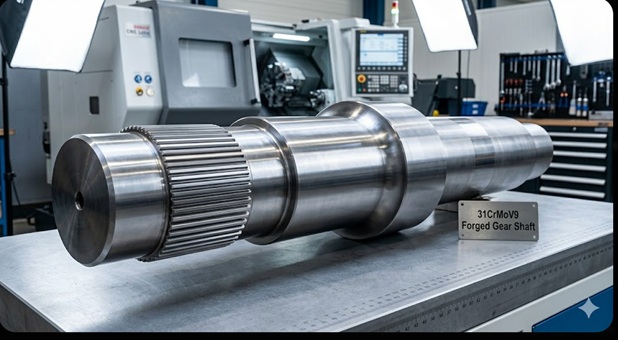
01 / DefinitionThe Short Answer: What 31CrMoV9 Actually Is
31CrMoV9 is a medium-carbon, low-alloy nitriding steel standardised across Europe under EN 10083-3 (and historically under the German standard DIN 17200). It is used in two combined conditions that give it its character.
First it is quenched and tempered (QT) to create a strong, tough, uniformly hardened core. Then, for most applications, its working surfaces are nitrided — a low-temperature process that diffuses nitrogen into the surface and forms ultra-hard nitride compounds. The result is a part that resists bending and impact in the bulk while resisting wear, scuffing and surface fatigue on the skin.
The name itself is a code. Reading it the EN way: 31 means roughly 0.31% carbon (×100), Cr Mo V lists the principal alloying elements in order of content, and the trailing 9 indicates the chromium level (the figure ÷4 gives about 2.3–2.7% Cr). That single string tells a metallurgist most of what they need before opening a datasheet.
02 / ChemistryChemical Composition & What Each Element Does
The performance of 31CrMoV9 is no accident; every element is dialled in for a reason. The table below shows the composition limits to EN 10083-3, followed by the metallurgical job each element performs.
| Element | Content (%) | Element | Content (%) |
|---|---|---|---|
| C Carbon | 0.27 – 0.34 | Cr Chromium | 2.30 – 2.70 |
| Si Silicon | max 0.40 | Mo Molybdenum | 0.15 – 0.25 |
| Mn Manganese | 0.40 – 0.70 | V Vanadium | 0.10 – 0.20 |
| P Phosphorus | max 0.025 | S Sulphur | max 0.035 |
Carbon (0.27–0.34%)
Enough to develop a strong martensitic core on quenching, but deliberately moderate. Keeping carbon down protects weldability, machinability and core toughness — the surface hardness comes from nitriding, not from carbon.
Chromium (2.3–2.7%)
The headline element. Chromium improves hardenability so that even large sections harden uniformly through their cross-section, and it forms stable, fine chromium nitrides during nitriding that build the hard, fatigue-resistant diffusion zone.
Molybdenum (0.15–0.25%)
Molybdenum suppresses temper embrittlement and stabilises the tempered structure, so the steel keeps its strength during the long nitriding cycle (typically 480–570 °C) instead of softening.
Vanadium (0.10–0.20%)
The detail that separates 31CrMoV9 from simpler grades. Vanadium forms very fine carbides and nitrides that refine grain size, raise temper resistance and contribute to a harder, more stable nitrided case.
03 / PropertiesMechanical Properties (Quenched & Tempered)
In the QT condition the mechanical properties depend on section size — thicker pieces cool more slowly and land at the lower end of the strength band. The values below follow EN 10083-3 and represent the core, before any nitrided surface is added.
| Section (mm) | Tensile Rm (MPa) | Yield Rp0.2 (MPa) | Elong. A (%) | Impact KV @ +20°C (J) |
|---|---|---|---|---|
| 16 – 40 | 1100 – 1300 | ≥ 900 | ≥ 9 | ≥ 25 |
| 40 – 100 | 1000 – 1200 | ≥ 800 | ≥ 10 | ≥ 25 |
| 100 – 160 | 900 – 1100 | ≥ 700 | ≥ 11 | ≥ 25 |
| 160 – 250 | 850 – 1050 | ≥ 650 | ≥ 12 | ≥ 25 |
Two things stand out. The steel holds a genuinely high yield strength even in heavy cross-sections — thanks to chromium-driven hardenability — and it retains useful impact toughness throughout, so it does not become brittle when made big. That combination of strength and toughness in large diameters is exactly what heavy rotating equipment demands.
04 / Heat TreatmentHow 31CrMoV9 Is Heat Treated
Getting the most out of 31CrMoV9 is a sequence, not a single step. A typical route through our heat-treatment shop looks like this:
1. Soft annealing
Hold around 680–720 °C and slow-cool in the furnace to bring hardness down to roughly ≤248 HB. This relieves forging stress and puts the steel in its most machinable state for roughing.
2. Quenching & hardening
Austenitise at about 840–880 °C, soak according to section thickness, then oil- or polymer-quench to transform to a fine, uniform martensite.
3. Tempering
Temper at roughly 570–680 °C and air-cool. The exact temperature tunes the strength–toughness balance; this is where the core properties in Table 2 are set.
4. Stress relief
After rough machining, a stress relief around 550–580 °C minimises residual stress and the risk of distortion during final machining and nitriding.
5. Nitriding
Finally, gas or plasma nitriding at low temperature diffuses nitrogen into the surface. Because the core was already tempered above the nitriding temperature, it stays stable while the skin becomes extremely hard.
05 / NitridingThe Nitriding Advantage — a Hard Skin on a Tough Core
Nitriding is the reason 31CrMoV9 exists. Unlike case hardening or induction hardening, nitriding runs at low temperature with no quench of the finished part, so distortion is minimal — a huge benefit for precision gears and long shafts that must stay straight and dimensionally stable.
On 31CrMoV9 the process produces a surface hardness of roughly 60–62 HRC with excellent wear, scuffing and contact-fatigue resistance, all sitting on a core that still bends rather than shatters. The chromium and vanadium content is what makes the case both hard and deep, which is why nitrided 31CrMoV9 typically outlasts a nitrided 42CrMo4 part under the same load.
06 / EquivalentsEquivalent Grades & International Standards
31CrMoV9 appears under several names around the world. The closest matches by chemistry and behaviour are listed below — but note that international “equivalents” rarely match exactly, so any substitution should be confirmed by an engineer against your drawing.
| Region | Standard | Designation |
|---|---|---|
| European Union | EN 10083-3 | 31CrMoV9 (1.8519) |
| Germany | DIN 17200 | 31CrMoV9 |
| France | NF A35-556 | 30CDV12 |
| Italy | UNI 3545 | 31CrMoV9 |
| United States | AISI / SAE | ~ 4130 mod. / 4340 (similar) |
| Japan | JIS G4053 | SNCM431 (similar) |
| China | GB/T 3077 | 30CrMoV9 |
07 / Why ForgedWhy 31CrMoV9 Is Forged, Not Cast or Cut from Bar
For critical, high-load components the manufacturing route matters as much as the grade. Open-die forging with a forging ratio of ≥ 3:1 breaks up the cast structure, closes internal porosity and aligns the grain flow with the shape of the part. The payoff is higher and more consistent toughness and fatigue strength than you get from a casting or from a part simply machined out of round bar.
That is why critical 31CrMoV9 components — from forged shafts to seamless rolled rings — are made as controlled forgings with full melt traceability and a mill test report for every batch.
08 / ApplicationsWhere 31CrMoV9 Is Used
Thanks to its combination of a tough core and a hard, fatigue-resistant nitrided surface, 31CrMoV9 turns up wherever parts spin fast, carry big loads and have to last. The most common industries:
Wind Power
Gearbox gear and pinion shafts, ring gears and rotor shafts for onshore and offshore turbines designed for a 20-year service life.
Automotive & Rail
Transmission gears, crankshafts and drive shafts for heavy trucks, performance vehicles and rail transit needing high surface hardness.
Oil & Gas
Drilling tool shafts, mud-pump parts, wellhead components and high-pressure valve bodies for demanding downhole environments.
Cement & Sugar Mills
Rotary-kiln pinion shafts, riding rings, mill roller shafts and crusher parts for continuous heavy-load duty.
Mining & Metallurgy
Crusher eccentric shafts, mill components and hoist parts that must shrug off impact and abrasion.
Power & Marine
Turbine and generator-rotor parts, plus marine gearboxes and drive shafts that face fatigue and corrosion offshore.
09 / Product FormsCommon Forms 31CrMoV9 Is Produced In
Because it forges and machines well, 31CrMoV9 is produced in a wide range of shapes — from small prototypes to very large pieces several metres in size. The main families are:
- Forged shafts — gear, pinion, main, rotor & crankshafts View →
- Seamless rolled rings — gear, bearing, riding & slewing View →
- Forged flanges — weld-neck, blind, plate & special View →
- Forged bars & blocks — round, square, flat & billets View →
- Precision-machined forgings — finished to ±0.02 mm View →
Specifying a 31CrMoV9 component?
For detailed specifications, available product forms, finishes and quality documentation, see the dedicated product page.
10 / FAQFrequently Asked Questions
What is 31CrMoV9 steel used for?
Is 31CrMoV9 a nitriding steel or a quenched & tempered steel?
How is 31CrMoV9 different from 42CrMo4?
What is the American (AISI) equivalent of 31CrMoV9?
What surface hardness can 31CrMoV9 reach?
What inspection documents do you provide with 31CrMoV9 parts?
Sources & Standards Referenced
- EN 10083-3 — Steels for quenching and tempering, Part 3: alloy steels (technical delivery conditions for 31CrMoV9 / 1.8519).
- DIN 17200 — historical German standard listing the 31CrMoV9 designation.
- NF A35-556 (30CDV12), UNI 3545, JIS G4053 (SNCM431), GB/T 3077 (30CrMoV9) — international equivalent designations.
- EN 10204 — standard defining types of material inspection documents (e.g. the 3.1 mill test report issued by the manufacturer).