What Is 1.8550 (34CrAlNi7-10) Nitriding Alloy Steel — And Why It Matters for Your Application
Jiangsu Liangyi Co.,Limited, founded in 1997 and headquartered in Jiangyin City, Jiangsu Province, China, is an ISO 9001:2015 certified specialist manufacturer of 1.8550 (34CrAlNi7-10) open die forging parts and seamless rolled rings. Our 80,000 m² integrated facility and 120,000-ton annual production capacity allow us to deliver precisely engineered forgings to heavy industry clients across more than 50 countries — from a single prototype piece to multi-ton serial production runs.
The designation 1.8550 is the EN material number defined under DIN EN 10085 (Nitriding Steels — Technical Delivery Conditions). The short name 34CrAlNi7-10 directly encodes its alloy architecture: approximately 0.34% Carbon for core strength, Chromium and Aluminum as the primary nitride-forming elements, and Nickel for toughness in large cross-sections. You may also encounter this material referenced as 34CrAlNi710, 34CrAlNi7.10, or by its closest international equivalents — BS 970 905M39 (United Kingdom), GOST 38KhN3MA (Russia), and the Japanese SACM645 — though chemical compositions differ slightly between standards and substitution always requires engineering sign-off.
What sets 1.8550 apart from simpler nitriding grades such as 31CrMoV9 (1.8519) or 34CrAlMo5-10 (1.8507) is its triple-alloying strategy. The 0.80–1.20% Aluminum content is the highest of any mainstream nitriding steel and directly controls the density and stability of the AlN (aluminum nitride) compound layer formed during gas nitriding. The Chromium additions (1.50–1.80%) create CrN precipitates that reinforce the diffusion zone beneath the compound layer, dramatically improving fatigue strength. Meanwhile, the 0.85–1.15% Nickel content — a feature absent from grades like 34CrAlMo5-10 — maintains core toughness and prevents brittle fracture in large-diameter forgings where through-hardening is challenging. Molybdenum (0.15–0.25%) further stabilizes the tempered martensite matrix and resists softening during the long nitriding cycles at 480–570 °C.
For procurement and design engineers evaluating nitriding steel options: after precision gas nitriding, 34CrAlNi7-10 achieves a compound layer surface hardness of HV 950–1100 — substantially harder than 31CrMoV9 (typically HV 700–850) — while retaining a tough, high-strength core at 900–1100 MPa tensile strength. This combination makes it the industry benchmark for gear shafts, pinion shafts, and transmission components that must simultaneously carry high bending and contact fatigue loads over multi-year service lives.
Critically, forging — not casting — is the correct manufacturing route for 1.8550 components. The deformation work imparted by open die forging refines the as-cast dendritic structure, eliminates internal porosity, closes shrinkage defects, and aligns grain flow to the component geometry. For large shafts and rings, this translates into measurably superior impact toughness and fatigue strength versus equivalent cast components, and it is why DIN EN 10085 forgings are specified in demanding applications such as wind turbine gearboxes, cement kiln drives, and offshore drilling equipment.
 View Our Full Forging Product Range
 1.8550 (34CrAlNi7-10) International Equivalent Grades & Grade Selection Guidance
When sourcing 34CrAlNi7-10 forgings from our Jiangsu factory for international projects, understanding equivalent grades across standards helps avoid specification mismatches. "Equivalent" does not mean "identical"; always check chemical composition against your project specification before confirming substitution.
International Equivalent Grade Comparison
| Standard | Grade Designation | Key Difference vs. 1.8550 |
|---|---|---|
| DIN EN 10085 (Germany / EU) | 34CrAlNi7-10 / 1.8550 | Reference standard; highest Al content for maximum nitriding hardness |
| BS 970 (United Kingdom) | 905M39 | Slightly different Ni range; older withdrawn standard, EN 10085 now preferred |
| GOST 4543 (Russia / CIS) | 38KhN3MA / 38ХН3МА | Higher Ni (2.75–3.25%), different Al spec; not a direct substitute |
| JIS G4202 (Japan) | SACM645 | Lower Cr (0.30–0.70%); Al range similar; reduced hardenability in large sections |
| ASTM / AISI (USA) | No direct equivalent; AMS 7140 nearest | AMS 6475 covers similar nitriding steels; composition must be verified case by case |
1.8550 vs. 31CrMoV9: Which Nitriding Steel Should You Choose?
31CrMoV9 (1.8519) contains no Aluminum. It relies on Chromium and Molybdenum nitrides for surface hardening, achieving typical nitrided hardness of HV 700–850. It is easier to machine before nitriding, has shorter nitriding cycles, and is generally the economical first choice for moderate surface hardness requirements — small gears, hydraulic cylinder rods, and precision spindles in light machinery.
34CrAlNi7-10 (1.8550) is the correct choice when the application demands: (a) nitrided surface hardness above HV 900; (b) a component cross-section larger than ~200 mm where core toughness must be maintained; (c) operating temperatures that briefly exceed 300 °C (the AlN compound layer is more thermally stable than CrN-only layers); or (d) applications subject to combined bending, torsion, and contact fatigue — the typical loading profile of a large gear shaft or pinion shaft. The trade-offs are longer gas nitriding cycles (40–100+ hours depending on layer depth), higher raw material cost, and more demanding machining of the harder pre-nitriding substrate.
Compare All Available Forging Material GradesCustom 1.8550 (34CrAlNi7-10) Forged Steel Products — Full Range & Dimensional Capabilities
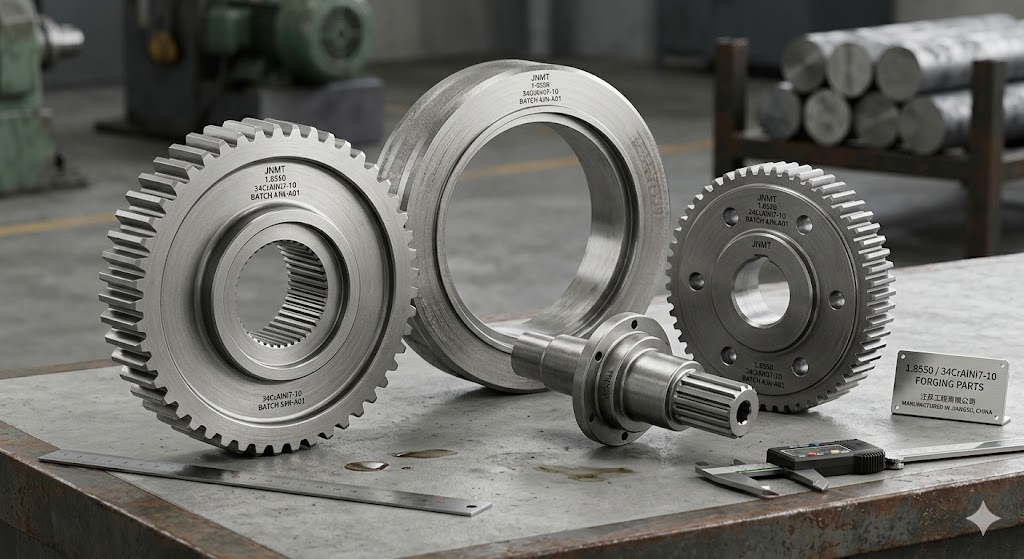
We manufacture the complete spectrum of 34CrAlNi7-10 forging products, from raw open die forgings rough-machined to drawing allowance through to fully finished, heat-treated, inspected, and certified components ready for assembly. Our integrated in-house capabilities — melting, forging, heat treatment, machining, and inspection — eliminate subcontractor dependencies and give you a single point of quality accountability. Single-piece weight range: 30 kg to 30,000 kg.
1.8550 Forged Bars & Rods
Open die forged bars in 34CrAlNi7-10 are produced from vacuum-degassed or ESR ingots, ensuring low hydrogen content and clean inclusion ratings. We supply round bars from Ø80 mm to Ø1,200 mm, square bars up to 800 × 800 mm, flat bars up to 1,000 mm width, and hollow (tube) forgings for thick-walled cylinder applications. Single-piece lengths up to 6,000 mm are routinely produced. Straightness tolerance is controlled to ≤ 3 mm/m before any machining, and surface condition can be supplied as-forged, shot-blasted, or rough-turned.
1.8550 Forged Shafts & Stepped Shafts
Forged shafts represent our highest-volume 1.8550 product category. We manufacture solid stepped shafts up to 12,000 mm in length, with individual step diameters from Ø80 mm to Ø1,500 mm. The open die forging process allows us to forge close to the final profile, reducing raw material waste versus bar stock machining by 15–30% on large shafts. All shafts are forged with controlled reductions to achieve a minimum forging ratio of 4:1 along the principal axis — a specification that ensures full elimination of as-cast dendritic structure and documented grain refinement. Products include: gear shafts, pinion shafts, step shafts, crankshafts, eccentric shafts, mill spindles, roller shafts, and transmission shafts. Finish machining to IT7–IT9 dimensional tolerance and Ra 1.6–3.2 µm surface finish is available in-house.
34CrAlNi7-10 Seamless Rolled Rings
Seamless rolled rings offer significant advantages for annular components: the unbroken circumferential grain flow eliminates stress concentration points inherent in welded or flame-cut rings, and material yield is far superior to machining a ring from a disc. Our ring rolling mills (1M and 5M radial-axial) produce 34CrAlNi7-10 seamless rings from Ø300 mm to Ø5,000 mm outer diameter, with heights from 50 mm up to 1,500 mm and wall thicknesses from 30 mm upward. Products include: gear rings, slewing bearing outer and inner races, riding rings for rotary kilns and dryers, coupling rings, and contoured (profiled) rings rolled to near-net shape to minimize finish machining. Ring roundness after rolling is controlled to ≤ 1.5 mm total indicator runout before heat treatment.
Custom Open Die Forged Components
Complex forged shapes — including hubs, flanges, housings, discs, sleeves, bushes, cylinders, and gear blanks — are produced against client drawings or 3D models. Our engineering team performs forgeability analysis and die design in-house, and we can produce prototype forgings within 15 working days of drawing approval. For components requiring precision bore finishing, external turning, keyway milling, or thread cutting, our integrated machining center provides one-stop processing. We also offer reverse engineering support for worn or discontinued components where only a physical sample is available.
Send Your Drawing for a Custom Forging SolutionIndustry Applications of 34CrAlNi7-10 Forgings — Verified Project Cases from Our Jiangsu Factory
The following industry applications and project cases are representative examples drawn from our production experience. Specific client names and project details are kept confidential per non-disclosure agreements. Full mill test certificates (EN 10204 3.1) are issued as standard for all orders; EN 10204 3.2 third-party inspection records are available where specified by the client at order placement.
Cement & Bulk Material Processing Industry
Cement plant drives are among the most demanding applications for nitriding steel forgings. Rotary kiln pinion shafts rotate continuously at 1–5 rpm under heavy radial and thrust loads, in an environment of airborne cement dust and fluctuating thermal input. The combination of abrasive surface conditions and cyclic bending fatigue makes a high-hardness nitrided surface on a tough forged core the industry-standard material choice. Sugar mill roller shafts face similar demands: high torque, shock loads during cane feeding, and humid, corrosive process environments where the nitrided AlN compound layer provides meaningful corrosion resistance advantage over uncoated alloy steels.
- 34CrAlNi7-10 forged pinion shafts and bull gear shafts for cement rotary kilns (2,000 t/d – 12,000 t/d capacity lines)
- 1.8550 forged roller shafts, coupling flanges, and pull torque rods for sugar mill three-roller sets
- 34CrAlNi7-10 forged riding rings (tyre rings) and riding gear rings for granulators, drum dryers, and rotary coolers
- 1.8550 forged trunnion shafts for ball mills and rod mills in cement grinding circuits
Solution: We supplied 1.8550 (34CrAlNi7-10) forged pinion shafts, quenched and tempered to 280–310 HB core hardness, followed by precision controlled-atmosphere gas nitriding at 520 °C for 72 hours — achieving compound layer depth of 18–22 µm (ε-phase controlled, white layer ≤ 15 µm), diffusion zone depth 0.55–0.65 mm, and surface hardness HV 980–1,040. All shafts 100% inspected by UT to EN 10228-3 quality class 3 before dispatch.
Wind Power & Renewable Energy Industry
Wind turbine gearboxes must transmit variable, unpredictable torque from the rotor through three or more gear stages, operating for 20+ years with limited access for maintenance on offshore installations. IEC 61400-4 specifies that gear shafts and planet carrier pins must maintain fatigue strength and dimensional integrity across the full load spectrum. The tooth root bending fatigue strength of a gas-nitrided 34CrAlNi7-10 gear (σ_Flim ≈ 450–500 MPa per ISO 6336 Method B) comfortably exceeds the capability of through-hardened 42CrMo4 (σ_Flim ≈ 280 MPa) in applications where case-hardened and ground gearing is not specified.
- 1.8550 forged planetary gear shafts, sun shafts, and planet carrier pins for multi-MW wind turbine gearboxes
- 34CrAlNi7-10 forged ring gears and internal gear rings for epicyclic gear stages
- 1.8550 forged high-speed shaft couplings and shrink disc flanges for turbine-to-generator connections
Solution: We supplied 1.8550 forged planetary gear shafts with controlled forging reduction ratio ≥ 5:1, quenched and tempered to 290–320 HB, followed by precision gas nitriding at 510 °C for 90 hours. Achieved: white layer ≤ 10 µm, diffusion zone 0.5–0.8 mm, surface hardness HV 1,020–1,080. ESR steel was used to guarantee inclusion rating A ≤ 1.5, B ≤ 1.0, C ≤ 0.5, D ≤ 1.5 per ASTM E45 Method A — required by the client's fatigue calculation methodology.
Mining & Mineral Processing Industry
Primary crushing equipment subjects eccentric shafts and main shafts to some of the highest impact energy levels encountered in any rotating machinery application. The shock load when oversized feed contacts the crushing surfaces can generate instantaneous contact forces many times the rated working load. The Nickel content in 34CrAlNi7-10 is specifically valuable here — it maintains core Charpy impact energy (≥ 30 J at 20 °C per EN 10085) that would be sacrificed in equivalent aluminum-only nitriding steels processed to similar core hardness.
- 1.8550 forged eccentric shafts and main shafts for gyratory crushers (1,100 mm to 1,525 mm head diameter range)
- 34CrAlNi7-10 forged spindles and pulley wheels for jaw crushers and impact crushers
- 1.8550 forged slewing bearing inner and outer races for mining excavators and surface miners
- 34CrAlNi7-10 forged head shafts, tail shafts, and drive pulleys for mine conveyor systems
- 1.8550 forged headframe sheave shafts and hoisting drum shafts for mine shaft hoisting systems
Solution: We redesigned the eccentric shaft in 34CrAlNi7-10 (EAF + LF + VD) with a minimum forging reduction ratio of ≥ 6:1 longitudinally to maximize Charpy impact values. After quench and temper to 300–330 HB, gas nitriding was applied to the journal bearing surfaces only (keyway areas masked to preserve ductility at stress concentrations). All shafts inspected by UT, MT, and PT before dispatch, with EN 10204 3.1 mill test certificates and third-party inspection available per client specification.
Oil & Gas Drilling & Production Equipment
Mud pump power end components — crankshafts, pinion shafts, and bull gear shafts — operate under demanding conditions: high cyclic loading from reciprocating piston action, drilling fluid contamination, and the need for dimensional stability across a wide temperature range. API 7K and API 11E govern material and inspection requirements. The ESR process, which we offer for oil and gas applications, eliminates segregation-related inclusions that act as fatigue crack initiation sites, and the resulting homogeneous mechanical properties are critical for large-diameter crankshafts where stress concentrations at fillet radii must be carefully managed.
- 34CrAlNi7-10 forged crankshafts and crosshead pins for triplex and quintuplex drilling mud pumps (API 7K)
- 1.8550 forged herringbone and helical gear shafts for mud pump power ends
- 34CrAlNi7-10 forged wellhead equipment components — valve bodies, stem guides, and actuator shafts
- 1.8550 forged components for subsea production equipment and anchor winch drive systems
Solution: We used our VIM + PESR (Vacuum Induction Melting + Protective Atmosphere Electroslag Remelting) process route. The large PESR ingot was forged on our 6300T press with minimum longitudinal reduction ratio 5:1 and a cross-reduction pass to eliminate residual radial segregation. Full UT to EN 10228-3, class 4, with zone-specific acceptance criteria. Mechanical test coupons taken from extension pieces integral with each shaft.
General Machinery, Power Transmission & Hydraulic Industry
Beyond the heavy primary industries, 34CrAlNi7-10 forgings are the material of choice wherever the engineer needs to combine a hard, wear-resistant surface with a fatigue-resistant core without the distortion risk of through-hardening. Gas compressor crankshafts, industrial gearbox pinion shafts, and hydraulic press eccentric shafts all benefit from the dimensional stability of the nitriding process — temperature below the tempering point means essentially zero distortion after nitriding, eliminating the costly straightening and final grinding operations that follow induction hardening or case carburizing.
- 34CrAlNi7-10 forged pinion shafts and ring gears for large industrial gearboxes and speed reducers (center distance up to 2,000 mm)
- 1.8550 forged crankshafts for large reciprocating gas compressors (API 618) and mechanical presses
- 34CrAlNi7-10 forged hydraulic cylinder barrels, tie rods, and piston rods for high-pressure hydraulic systems (up to 350 bar)
- 1.8550 forged components for flue gas desulfurization (FGD) absorber agitator shafts
- 34CrAlNi7-10 forged gear couplings, drum couplings, and flywheel hubs for large drive trains
Solution: We used EAF + LF + VD steel (vacuum-degassed to H ≤ 1.5 ppm) with a minimum forging reduction of 6:1 to break down all dendritic segregation. After forging, a stepped cooling procedure was applied before softening anneal to prevent hydrogen flaking. Quenching was performed in our 16 m deep agitated polymer quench tank, followed by tempering at 620–640 °C for 8 hours minimum, getting Rm range 960–1,050 MPa and hardness range 275–308 HB uniformly across the cross-section.
Why Source 1.8550 (34CrAlNi7-10) Forgings from Jiangsu Liangyi — Our Technical Differentiation
Many forging manufacturers in China can supply 34CrAlNi7-10 material in basic shapes. What distinguishes Jiangsu Liangyi is integrated process control from steelmaking through final inspection — under a single ISO 9001:2015 certified quality management system, with no subcontracting of critical processes.
1. Steelmaking Traceability: From Ladle to Forging
We operate our own melting facility on site: a 30t EAF, 30t LF, 30t VOD, and a 32t ESR/PESR plant. This means we control the full steel chemistry from charge calculation through to ladle analysis. For 1.8550, the Aluminum content specification (0.80–1.20%) is the most technically sensitive element to control — Aluminum is highly reactive and its burn-off rate during tapping and ladle treatment must be compensated precisely to hit the target. Our in-house melt chemistry control, verified by optical emission spectrometer (OES) immediately after tapping and before pouring, gives us the data to guarantee compliance rather than infer it from a supplier's certificate.
2. Forging Ratio Documentation and Grain Flow Verification
Every production order for 1.8550 forgings is accompanied by a forging log documenting the sequence of reductions, starting ingot dimensions, intermediate dimensions after each pass, and calculated forging ratios at every cross-section of the finished forging. This is not standard practice in the broader Chinese forging industry, but it is our standard for all nitriding steel orders. For clients whose specifications mandate minimum forging ratios (e.g., ≥ 4:1 per ASTM A668, or ≥ 5:1 per their proprietary procedure), we provide this documentation as part of the standard quality dossier.
3. In-House Heat Treatment with Full Atmosphere Control
Our semi-automatic heat treatment system includes furnaces up to 18 m in length for shaft-type components and a quench tank 16 m deep for full immersion of large-diameter parts. All heat treatment cycles are recorded by multi-point thermocouples with tamper-proof data logging, and the records are included in the shipment documentation package. For the gas nitriding step, we operate a controlled-atmosphere nitriding system with Kn (nitriding potential) monitoring throughout the cycle — not simply a time-temperature recipe — allowing us to tailor the compound layer composition (ratio of γ' to ε phase) to the client's specifications.
4. Comprehensive NDT: We Inspect What Others Skip
Our standard inspection scope for 1.8550 forgings includes: (a) ultrasonic testing (UT) per EN 10228-3 or ASTM A388, (b) magnetic particle testing (MT) per EN 10228-1 or ASTM A275, (c) dimensional inspection with calibrated instruments for machined components, and (d) hardness survey across multiple test positions on the cross-section — not just the test coupon. For ESR or VIM+PESR steel orders, we additionally perform inclusion rating per ASTM E45 on the test coupon. This full inspection scope is included in our standard pricing — because we believe clients should not have to pay extra to receive product that is verified to be what it claims to be.
5. Responsive Technical Support and On-Time Delivery
We maintain an English-speaking technical team capable of reviewing client drawings, providing material equivalence opinions, and issuing formal Inspection Test Plans (ITPs) within 3 working days of receiving complete inquiry documentation. Our 25+ years of production history for nitriding steel forgings means our production scheduling team understands the time constraints of every process step — including the long lead times inherent in ESR steel production and 60–100 hour nitriding cycles — and can provide realistic, committed delivery dates. Our historical on-time delivery performance for confirmed orders consistently exceeds 95%.
1.8550 (34CrAlNi7-10) Forging Production Process — Step by Step
Understanding our production process helps procurement engineers and quality engineers write better specifications and ask the right questions during supplier qualification. The following describes our standard process flow for a 1.8550 nitriding steel forging order.
Step 1: Steel Melting — Choosing the Right Route for Your Application
The steel melting route is the single most important decision affecting final forging cleanliness and homogeneity. We offer five routes, selected based on application criticality and budget:
- EAF (Electric Arc Furnace only) — Suitable only for non-critical general machinery applications with no fatigue or impact requirements. Not recommended for 1.8550 nitriding applications where surface fatigue performance matters.
- EAF + LF + VD (Ladle Refining + Vacuum Degassing) — Standard route for most 34CrAlNi7-10 forgings. Vacuum degassing removes dissolved hydrogen to ≤ 2 ppm (prevents hydrogen flaking in large sections) and reduces oxygen content. Sulfur is desulfurized to ≤ 0.005% in the ladle. Meets requirements of the vast majority of industrial applications including cement, mining, and general machinery.
- EAF + ESR (Electroslag Remelting) — The ESR process remelts the steel through a chemically active flux, reducing non-metallic inclusions by 60–80% compared to VD-only steel and producing a more homogeneous ingot. Recommended for wind power, oil & gas, and high-cycle fatigue applications.
- EAF + PESR (Protective Atmosphere ESR) — ESR conducted under a protective gas atmosphere (argon or nitrogen) to prevent Aluminum oxidation during remelting. Essential for 1.8550 because of its high Aluminum content — standard ESR without atmosphere protection causes Aluminum burn-off and loss of nitriding response. This is the correct specification for premium 34CrAlNi7-10 ESR steel.
- VIM + PESR (Vacuum Induction Melting + Protective Atmosphere ESR) — The highest cleanliness specification available. VIM melts the charge under vacuum, achieving extremely low oxygen, hydrogen, and nitrogen contents before the PESR step further refines inclusion content. Used for the most demanding applications including offshore oil & gas, heavy wind power, and any application where fatigue life calculations demand the cleanest possible steel.
Step 2: Ingot Casting and Homogenizing Soak
The refined steel is cast into ingots of the desired forging weight with adequate allowance for cropping of the riser and bottom-end segregation zones. The high content of aluminum for 1.8550 requires an inert atmosphere for pouring, to avoid surface oxidation and formation of alumina inclusions. After casting, all ingots are soaked in a homogenizing furnace at 1,200–1,250 °C for a minimum of 1 hour per 25 mm of ingot radius to eliminate chemical segregation before forging.
Step 3: Open Die Forging on 2000T / 4000T / 6300T Hydraulic Presses
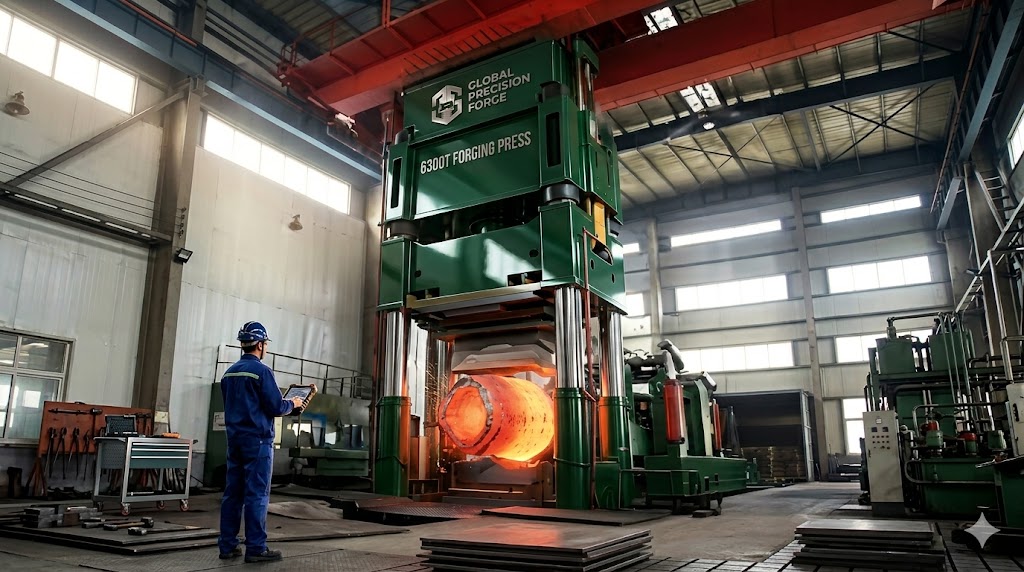
Our 6300T (62 MN) open die hydraulic press handles single ingots up to 30,000 kg and is capable of producing shaft forgings up to 12,000 mm in length in a single heat. The forging temperature of 34CrAlNi7-10 is usually 1,150 °C start / 850 °C finish. The forging schedule is designed to achieve the highest amount of work below the recrystallization temperature on the final passes to introduce sub-grain refinement in the surface layers. We have a 60t capacity manipulator on our press to handle large ingots safely and accurately. Seamless ring rolling is performed on our 1M (rings up to Ø2,000 mm) and 5M (rings up to Ø5,000 mm) radial-axial rolling mills after initial upset and punch on the press.
Step 4: Post-Forging Cooling, Hydrogen Diffusion Anneal, and Softening Anneal
Immediately after forging, 1.8550 components are placed into a pre-heated furnace for controlled slow cooling to prevent thermal shock cracking and to begin hydrogen degassing. For large cross-sections (Ø > 500 mm), a dedicated hydrogen diffusion anneal at 650–700 °C for a minimum of 24 hours is applied before the softening anneal, ensuring hydrogen content in the bulk material is reduced to below 1.5 ppm before the first machining passes — a critical step often overlooked by less experienced forging suppliers.
Step 5: Rough Machining and Pre-Heat-Treatment Ultrasonic Testing
After annealing and before final heat treatment, all forgings are rough machined to leave a minimum of 5 mm machining allowance per side on all critical surfaces. This removes any surface decarburization layer from forging and allows 100% volumetric UT inspection of the forging body in the annealed condition, where attenuation is lowest and defect detectability is highest. Any forging with UT indications exceeding the acceptance criteria is rejected before heat treatment — not after, which would waste all subsequent processing cost.
Step 6: Quench and Temper Heat Treatment
The final heat treatment consists of austenitizing at 870–930 °C (held for a minimum of 30 minutes after thermocouple confirmation of temperature uniformity throughout the cross-section), followed by quenching in oil or polymer solution and tempering at 580–700 °C for a minimum of 2 hours per 25 mm of effective cross-section thickness. Our 16 m deep quench tank allows full vertical immersion of the longest shafts, ensuring symmetrical quench severity and minimizing distortion from asymmetric cooling. Tempered hardness and mechanical properties are verified by Brinell hardness testing at a minimum of 3 positions on each forging, and by destructive testing on integral test coupons forged with each piece.
Step 7: Precision Gas Nitriding (Where Specified)
Gas nitriding of 34CrAlNi7-10 is performed in our controlled-atmosphere pit furnaces at a precisely maintained nitriding potential (Kn) of 0.3–1.0 atm, at 510–540 °C, for cycle durations of 40–120 hours depending on the specified layer depth. We use a two-stage process (high Kn stage to develop the compound layer, low Kn stage to deepen the diffusion zone while minimizing white layer brittleness) and monitor Kn by in-situ oxygen probe measurement — not simply by NH₃/H₂ gas flow ratio, which is less accurate. Surface hardness after nitriding is verified by Vickers hardness testing on a cross-section coupon to confirm compound layer thickness (≤ 15 µm white layer target for most gear applications) and diffusion zone profile (typically 0.4–0.8 mm depth).
Step 8: Final Inspection and Quality Documentation Package
Every shipment is accompanied by a complete quality documentation package including: EN 10204 3.1 mill test certificate (or 3.2 with third-party countersignature where specified), dimensional inspection report, UT/MT/PT inspection reports with qualified operator certifications, hardness survey results, heat treatment records with thermograph traces, nitriding process records with Kn monitoring logs (where applicable), and full packaging/shipping documentation. Third-party inspection by SGS, Bureau Veritas, TUV Rheinland, or Lloyd's Register can be arranged at the client's request.
 View Full Production Equipment List
 34CrAlNi7-10 (1.8550) Full Material Specifications — Chemistry, Heat Treatment & Mechanical Properties
All 1.8550 steel supplied by our Jiangsu factory is produced and tested in compliance with DIN EN 10085:2001 (Nitriding Steels — Technical Delivery Conditions). The chemical composition ranges below are the standard limits; tighter "restricted" composition windows can be specified on the purchase order for special applications.
Chemical Composition — Mass Fraction (%) per DIN EN 10085
| Element | Standard Range (%) | Role in the Alloy |
|---|---|---|
| Carbon (C) | 0.30 – 0.37% | Provides core strength after quench and temper; low enough to retain good toughness |
| Aluminum (Al) | 0.80 – 1.20% | Primary nitride former — creates extremely hard AlN precipitates; highest Al of any EN 10085 grade; controls maximum achievable surface hardness |
| Chromium (Cr) | 1.50 – 1.80% | Secondary nitride former (CrN); improves hardenability; enhances corrosion resistance of the nitrided surface; stabilizes carbides during tempering |
| Nickel (Ni) | 0.85 – 1.15% | Critical for toughness in large cross-sections; maintains Charpy impact energy in the core; distinguishes 34CrAlNi7-10 from the less tough 34CrAlMo5-10 |
| Molybdenum (Mo) | 0.15 – 0.25% | Resists temper embrittlement; improves hardenability; stabilizes the tempered martensite matrix against softening during long nitriding cycles at 500–540 °C |
| Manganese (Mn) | 0.40 – 0.70% | Contributes to hardenability and deoxidation during steelmaking; controlled to avoid Mn banding in large forgings |
| Silicon (Si) | ≤ 0.40% | Deoxidizer; contributes to solid solution strengthening; controlled to limit formation of hard silica inclusions |
| Phosphorus (P) | ≤ 0.025% | Residual impurity; controlled to minimum to prevent temper embrittlement and intergranular fracture at prior austenite grain boundaries |
| Sulfur (S) | ≤ 0.030% | Residual impurity; forms MnS inclusions that degrade transverse toughness and fatigue strength; controlled to ≤ 0.005% for ESR steel |
Standard Heat Treatment Procedure — Detailed Parameters
| Heat Treatment Step | Temperature Range | Holding Time / Condition | Cooling Medium |
|---|---|---|---|
| Softening Anneal (pre-machining) | 650 – 700 °C | Min. 1 hr per 25 mm section, max. 8 hr total | Furnace cooling to ≤ 300 °C, then air |
| Austenitizing (hardening) | 870 – 930 °C | Min. 30 min after full cross-section reaches temperature; 1–4 hrs depending on section size | Oil quench or polymer quench (PAG solution) |
| Tempering | 580 – 700 °C | Min. 2 hrs per 25 mm effective section thickness (typically 6–24 hrs for large forgings) | Air cooling from furnace |
| Stress Relief (pre-nitriding) | 550 – 600 °C (≤ tempering temp – 30 °C) | Min. 4 hrs after final machining, before masking and nitriding | Slow furnace cooling to ≤ 200 °C |
| Gas Nitriding | 480 – 570 °C (typically 510–540 °C) | 40–120 hrs depending on specified compound layer depth and diffusion zone requirement | Slow furnace cooling in NH₃/H₂ atmosphere to ≤ 150 °C |
Mechanical Properties After Quenching & Tempering — Standard vs. Typical Achieved
| Property | Symbol | DIN EN 10085 Standard | Typical Achieved (Our Production) |
|---|---|---|---|
| Tensile Strength | Rm | 900 – 1,100 MPa | 960 – 1,060 MPa |
| 0.2% Proof Strength (Yield) | Rp0.2 | ≥ 680 MPa | 750 – 900 MPa |
| Elongation at Fracture | A | ≥ 10% | 11 – 14% |
| Reduction of Area | Z | ≥ 40% | 45 – 58% |
| Charpy Impact Energy (20 °C) | KV | ≥ 30 J | 40 – 65 J |
| Brinell Hardness (Q&T) | HB | 270 – 330 HB | 278 – 318 HB |
| Surface Hardness (After Gas Nitriding) | HV0.3 | ≥ 900 HV (indicative) | 950 – 1,100 HV |
| Nitrided Case Depth (Diffusion Zone) | Nht | As specified | 0.45 – 0.75 mm |
Note on large-section size effects: DIN EN 10085 mechanical properties are measured on test bars of Ø ≤ 40 mm taken from the test coupon, which shows higher values than the bulk forging cross-section due to the faster quench rate of the small test bar. For large diameter forgings (Ø > 300 mm), expect core tensile strength in the range of 900–980 MPa and Charpy values of 35–55 J depending on tempering temperature, section size, and steel cleanliness. Our engineers can provide section-size correction estimates for specific component geometries on request.
View All Available Forging Material GradesFrequently Asked Questions About 1.8550 (34CrAlNi7-10) Forgings
For standard forged bars, our MOQ for 1.8550 (34CrAlNi7-10) forging parts is 30 kg. For custom machined parts, MOQ is 1 piece. We accept both one sample orders with one forging for engineering tests, as well as large volume mass production orders. There is no minimum order value. If you only need one trial part to verify a design, we can support your request. For single sample orders we recommend EAF + LF + VD steel which is economical and has reliable fatigue performance for design validation tests.
Lead time varies significantly depending on steel route, forging complexity, and whether nitriding is included. For EAF + LF + VD steel: raw forgings in as-forged condition can be ready in 15–20 working days. Fully machined and quench-and-tempered components are typically 25–30 working days. If gas nitriding is included, add 10–15 working days for the nitriding cycle, pre-nitriding stress relief, masking, nitriding, and post-nitriding inspection — typically 35–45 working days total. For ESR or PESR steel, add 5–10 working days for the remelting step. Expedited production (without nitriding) can be arranged in 10–15 working days for urgent requirements. Please share your required delivery date when inquiring — we will provide an honest assessment of what is achievable.
After precision gas nitriding at 510–540 °C for a typical 60–90 hour cycle, 34CrAlNi7-10 (1.8550) achieves a surface hardness of HV 950–1,100 (approximately 66–70 HRC), with a compound layer depth of 15–25 µm and total diffusion zone depth of 0.45–0.75 mm. This is substantially higher than 31CrMoV9 (1.8519), which typically reaches HV 700–850 (approximately 60–65 HRC) under the same nitriding conditions, because 31CrMoV9 contains no Aluminum and relies only on CrN and MoN precipitates. For heavily loaded gear tooth flanks, the higher surface hardness of 1.8550 provides meaningfully better resistance to pitting fatigue (contact fatigue) and scuffing under boundary lubrication conditions. If your application requires nitrided surface hardness below HV 800, 31CrMoV9 may be more economical; if you need HV 900+, only 34CrAlNi7-10 or equivalent high-Aluminum grades will achieve it.
Our company holds ISO 9001:2015 Quality Management System certification — this is our only company-level certification, and covers the full scope from raw material procurement through final inspection and shipping. In addition to our internal QMS, we provide the following documentation and inspection services: standard delivery documentation per EN 10204 3.1 (mill test certificate countersigned by our authorized quality representative) is included with every order at no additional cost. For clients requiring independent third-party verification, we can facilitate EN 10204 3.2 inspection by third-party inspection agencies including TUV Rheinland, Bureau Veritas, SGS, or Lloyd's Register — the cost of third-party inspection is billed to the client at the agency's standard rates. Chemical analysis is performed by OES traceable to NIST/PTB certified reference materials. UT inspection is performed per EN 10228-3 or ASTM A388 / A578. MT inspection per EN 10228-1 or ASTM A275. Mechanical testing per EN ISO 6892-1 (tensile) and EN ISO 148-1 (Charpy). We can also provide Inspection Test Plans (ITPs) for the client to review and approve before production. Note: We do not possess API monogram licensing or product specific certifications other than ISO 9001:2015. Products are manufactured and tested to client specified technical standards and project requirements.
Our 6300T (62 MN) open die hydraulic press supports single forgings up to 30,000 kg finished weight, with maximum shaft length of approximately 12,000 mm. For seamless rolled rings, our 5M ring rolling mill produces rings up to 5,000 mm outer diameter and 1,500 mm height. The limiting factor for very large forgings is typically the ingot weight — our ESR/PESR plant has a maximum electrode weight of 32 t, so for forgings requiring ESR steel above approximately 25 t finished weight, we discuss alternative steel routes with the client. For finished forgings above 15 t, we strongly recommend EAF + LF + VD as a minimum steel route to control hydrogen content and inclusion levels across the full cross-section.
34CrAlNi7-10 (1.8550) can be welded, but requires careful procedure qualification. The carbon equivalent (CE ≈ 0.65–0.70) indicates high hardenability and mandatory preheating. Minimum preheat temperature is typically 250–300 °C for material in the quenched and tempered condition, with interpass temperature maintained above 200 °C. Post-weld heat treatment (PWHT) at 550–580 °C for a minimum of 2 hours is required to temper the heat affected zone and restore toughness. Nitrided surfaces should never be welded — the compound layer must be removed to bare metal around the weld area before welding. In practice, most 34CrAlNi7-10 components are designed to avoid welding — the complexity of procedure qualification and PWHT typically makes redesign for a one-piece forging more economical than a welded assembly.
A complete purchase specification for 1.8550 forgings should clearly state: (1) Material standard — DIN EN 10085, grade 34CrAlNi7-10 / 1.8550. (2) Steel melting route — EAF+LF+VD, EAF+PESR, or VIM+PESR; this is the most common omission and the most consequential for fatigue-critical applications. (3) Forging standard — e.g., EN 10243-1 or ASTM A668. (4) Minimum forging ratio — typically ≥ 4:1 or ≥ 5:1 for fatigue applications. (5) Heat treatment condition — quenched and tempered, target hardness range in HB. (6) Nitriding specification (if required) — process type, temperature range, target compound layer depth, minimum surface hardness in HV, maximum white layer thickness, areas to be masked. (7) NDT requirements — UT class per EN 10228-3 or ASTM A388, MT class, surface condition for PT. (8) Certification — EN 10204 3.1 or 3.2, third-party inspection body if 3.2 required. Our technical team can review your draft specification before order placement and identify any gaps or conflicts, free of charge.
Request a Quotation for 1.8550 (34CrAlNi7-10) Forgings
To receive a competitive and technically accurate quotation for your 1.8550 (34CrAlNi7-10) forging requirements, please provide as much of the following as possible: component drawing or sketch (PDF or DXF format), material specification (DIN EN 10085 grade, steel melting route, EN 10204 certificate type), required heat treatment condition, nitriding specification if applicable, dimensional and weight data, required quantity and delivery schedule, and the application or operating environment if you would like our engineers to suggest the optimum material and process route.
We typically respond to new technical inquiries within 24 hours on business days, and can issue a formal quotation within 3 working days of receiving complete specification information. For urgent inquiries, WhatsApp is the fastest contact channel.
Jiangsu Liangyi Co.,Limited
Address: Chengchang Industry Park, Jiangyin City, Jiangsu Province 214400, China
Tel / Fax: +86-510-86107550
WhatsApp (24h): +86-135-8506-7993
Email: sales@jnmtforgedparts.com
Business Hours: Monday – Friday, 08:00 – 17:30 (China Standard Time, UTC+8)