ASTM A182 F55 vs F53 (2507): Super Duplex for Sour Service
Two grades, both rated PREN ≥ 40, both NACE-compliant — yet they are not interchangeable. Here is the practical engineering case for choosing UNS S32760 or UNS S32750 on your next forging package.
F55 · UNS S32760
Cr–Ni–Mo super duplex with deliberate Cu + W additions. The premium pick when the spec names it.
F53 · UNS S32750
The most widely stocked super duplex. Slightly higher minimum yield, broader availability, lower landed cost.
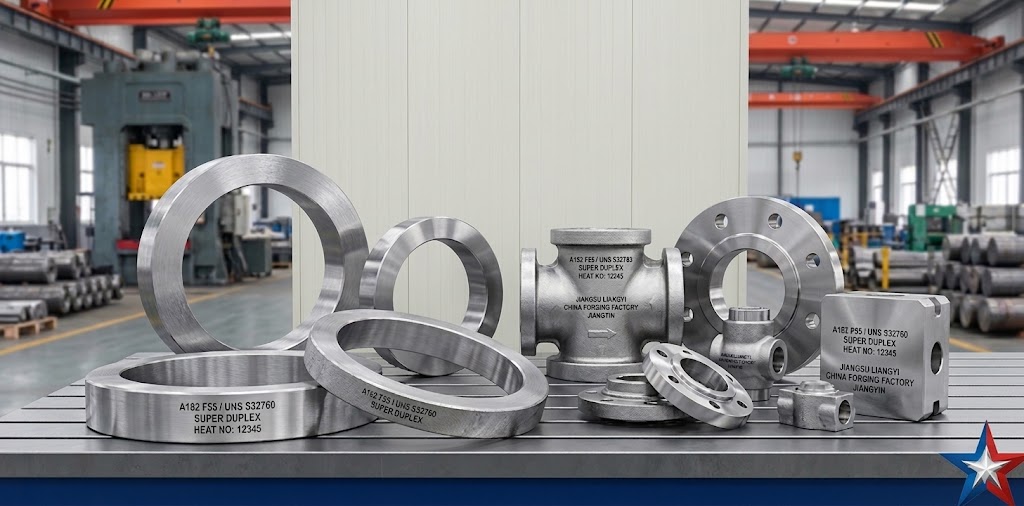
01 — SummaryThe short answer
- F55 (UNS S32760) contains 0.5–1.0% copper and 0.5–1.0% tungsten; F53 / 2507 (UNS S32750) contains neither — that is the core difference.
- Both are super duplex with PREN ≥ 40, a 50:50 austenite-ferrite structure, and full NACE MR0175 / ISO 15156 sour-service compliance.
- For most offshore, seawater and sour oil & gas duty, F53 / 2507 is the economical default — wider stock, shorter lead time, lower cost.
- Specify F55 / S32760 when the spec names it, or when reducing acids are present (where Cu + W add value).
- The two are never interchangeable without engineering approval — always order by the exact UNS number with a heat-specific MTR.
Super duplex stainless steels F55 and F53 sit at the top of the duplex family, and on a datasheet they look almost like twins: roughly 25% chromium, a 50:50 austenite-ferrite microstructure, a pitting resistance equivalent number (PREN) above 40, and full compliance with NACE MR0175 / ISO 15156 for sour service.
That similarity is exactly why they get confused on purchase orders — and why a wrong substitution can quietly void a material qualification.
For the majority of standard offshore, seawater and sour oil & gas duties, F53 / 2507 (UNS S32750) is the pragmatic default: it is more widely stocked, has the larger installed base, and usually carries a shorter lead time and lower price.
Reach for F55 (UNS S32760, the alloy commercially known as Zeron® 100) when the project specification or approved-vendor list names it, when the medium contains reducing acids where copper and tungsten earn their keep, or when a mixed chloride-plus-acid chemistry justifies the richer alloy. The two are never a free swap — always confirm the UNS number.
02 — DefinitionsWhat each grade actually is
Both materials are forged or rolled super duplex stainless steel covered by ASTM A182 / ASME SA-182, the specification for forged piping components, flanges, fittings and valve parts in high-temperature service. The grade suffix tells you the alloy:
- F55 = UNS S32760, the alloy most engineers know by the registered trade name Zeron® 100 — a trademark of its respective owner, used here only for identification (EN 1.4501). Its signature is a deliberate addition of 0.5–1.0% copper and 0.5–1.0% tungsten on top of the usual chromium-nickel-molybdenum-nitrogen recipe.
- F53 = UNS S32750, universally called 2507 (EN 1.4410). It carries a touch more molybdenum and nitrogen headroom but no intentional copper or tungsten.
That single chemistry difference — the Cu+W package — is the entire story behind why F55 exists alongside the more common 2507. Everything else flows from it. For full specifications, available sizes, certification and a quotation, see our main ASTM A182 F55 / UNS S32760 forged parts page — and, for the other grade, our F53 / 2507 forgings page.
03 — ChemistryChemistry head-to-head
The composition windows overlap heavily. The meaningful divergence is concentrated in copper, tungsten and the nitrogen ceiling. Typical specified ranges:
| Element | F55 · S32760 | F53 · S32750 |
|---|---|---|
| Carbon (C) | ≤ 0.030 | ≤ 0.030 |
| Chromium (Cr) | 24.0 – 26.0 | 24.0 – 26.0 |
| Nickel (Ni) | 6.0 – 8.0 | 6.0 – 8.0 |
| Molybdenum (Mo) | 3.0 – 4.0 | 3.0 – 5.0 |
| Nitrogen (N) | 0.20 – 0.30 | 0.24 – 0.32 |
| Copper (Cu) | 0.50 – 1.0 | ≤ 0.50 |
| Tungsten (W) | 0.50 – 1.0 | — none |
The tungsten in F55 is the reason it uses a modified PREN formula that credits W:
For 2507/F53 the classic formula applies (PREN = Cr + 3.3·Mo + 16·N). In service both land at PREN ≈ 40–43, so neither holds a decisive numerical edge on pitting resistance alone — the difference shows up in which environments each resists best.
04 — MechanicsMechanical properties
Strength is rarely the deciding factor between these two, because both comfortably exceed their minimums after a correct solution anneal and water quench. On paper, 2507/F53 carries a marginally higher specified yield.
| Property | F55 · S32760 | F53 · S32750 |
|---|---|---|
| 0.2% Yield Strength (min) | ≥ 530 MPa | ≥ 550 MPa |
| Tensile Strength | 730 – 930 MPa | ≥ 795 MPa |
| Elongation (min) | ≥ 25% | ≥ 15% |
| Hardness | ≤ 290 HBW | ≤ 310 HBW |
| Impact (Charpy, low temp) | Excellent | Excellent |
| Max continuous service | ~315 °C | ~300 °C |
Both grades deliver roughly twice the yield strength of 316L, which is the real reason designers pick super duplex: thinner walls, lighter assemblies and meaningful weight savings on subsea and topside hardware.
05 — CorrosionCorrosion behaviour: where they diverge
This is the section that actually decides the selection. Against chloride pitting, crevice corrosion and chloride stress corrosion cracking (Cl-SCC) in seawater and sour brines, the two grades are broadly equivalent — both are engineered for exactly those conditions and both pass the demanding ASTM G48 pitting and critical-pitting-temperature acceptance tests used to qualify super duplex forgings.
The separation appears in reducing-acid environments:
- Copper measurably improves resistance in dilute sulphuric and certain non-oxidising acids — a benefit when the process stream is more than just chloride brine.
- Tungsten raises the critical pitting temperature slightly and improves localized corrosion resistance and pitting initiation behaviour, which is why Zeron 100 built its reputation in aggressive mixed-chemistry seawater and acid service.
If the fluid is chloride brine, either grade will do. If reducing acids are in the mix, F55's copper-and-tungsten chemistry is the safer bet.
06 — SupplyCost & availability
Commercially, 2507/F53 wins on logistics for most buyers. It has been specified across offshore and seawater projects for decades, so mills, stockists and forge shops carry it in more sizes, and lead times for bar, ring and disc forgings are generally shorter. The richer alloying of F55 — plus its narrower supplier base — usually translates into a higher unit price and, on uncommon sections, a longer queue.
That does not make 2507 "better value" by default: when a client's approved-vendor list or an end-user specification calls out Zeron 100 / S32760 by name, substituting 2507 to save money is not your decision to make — it requires a formal engineering deviation.
07 — FabricationWelding & fabrication
Both grades weld well when the duplex rules are respected, and the procedures are nearly identical. The common over-alloyed filler choice is AWS A5.9 ER2594 (a 25.10.4L-type wire) for both, with Zeron 100 work sometimes using a matching proprietary filler. Key controls that apply equally to F55 and F53:
- Heat input held to a moderate window (roughly 0.5–1.5 kJ/mm) to keep the austenite-ferrite balance in the weld and heat-affected zone.
- Interpass temperature capped near 150 °C to avoid sigma-phase precipitation.
- Nitrogen-bearing shielding/backing gas (Ar + a few percent N₂) to offset nitrogen loss from the weld pool.
- No stress-relief tempering in the 300–980 °C window — if heat treatment is required, only a full solution anneal and rapid quench restores the microstructure.
In short: a fabricator already qualified on one super duplex grade transitions to the other with minimal procedure change, though a separate WPS/PQR is still required.
08 — DecisionHow to choose for your package
Strip away the datasheet noise and the decision usually comes down to specification language and chemistry of the medium:
Choose F53 / 2507
- Standard offshore, seawater and sour oil & gas service
- Cost and lead time are priorities
- You need the widest size and stock availability
- The spec lists 2507 / S32750 (or allows either)
- Pure chloride brine, no reducing acids
Choose F55 / S32760
- Specification or AVL names S32760 / Zeron 100
- Reducing acid environments (Cu + W add value)
- Mixed chloride + acid chemistry
- Client has standardized on F55 across a project
- Marginally higher service-temperature headroom needed
Whichever you land on, three procurement safeguards matter more than the grade debate itself: order by the exact UNS number, demand an EN 10204 3.1 (or 3.2) MTR tying chemistry, mechanicals, heat treatment and corrosion test results to the specific heat, and confirm the ferrite balance (40–60%) and absence of sigma phase, since a mis-heat-treated super duplex of either grade loses the corrosion resistance you paid for.
Need F55 or F53 forgings with full MTR traceability?
Jiangsu Liangyi forges both UNS S32760 (F55) and UNS S32750 (F53 / 2507) super duplex parts — bars, seamless rolled rings, discs and hollow sections from 30 kg to 30 tonnes — manufactured to meet NACE MR0175 / ISO 15156 requirements, supplied with an EN 10204 3.1 Material Test Report (MTR). Send your spec and we'll quote within 24 hours.
09 — FAQFrequently asked questions
Are F55 and F53 interchangeable in sour service?
No. Both meet NACE MR0175 / ISO 15156 and both exceed PREN 40, but F55 (S32760) contains intentional copper and tungsten that F53 / 2507 (S32750) does not. They are ordered by distinct UNS numbers and must never be swapped without a documented engineering deviation — even though they perform similarly in pure chloride brine.
Which is stronger, F53 or F55?
F53 / 2507 carries a slightly higher specified minimum yield (around 550 MPa versus about 530 MPa for F55). In practice both routinely deliver yield above 560 MPa after solution annealing, so strength is seldom the deciding factor between the two.
When does the extra copper and tungsten in F55 actually matter?
In reducing-acid and mixed acid-plus-chloride environments. Copper improves resistance in dilute sulphuric and similar non-oxidising acids, while tungsten nudges up the critical pitting temperature and localized corrosion resistance. In plain seawater or chloride brine the benefit is marginal, which is why 2507 remains the economical default there.
Do both grades use the same welding filler?
Yes, for most work both use an over-alloyed AWS A5.9 ER2594 (25.10.4L-type) filler, with the same heat-input, interpass and shielding-gas controls. Zeron 100 fabrication sometimes uses a matching proprietary filler. A grade-specific WPS/PQR is still required.
Is Zeron 100 the same as F55?
Effectively yes — Zeron 100 is the original commercial trade name for the UNS S32760 alloy that ASTM A182 designates as grade F55 (EN 1.4501). When a spec says "Zeron 100", S32760 / F55 is what is required.
10 — SourcesStandards & references
This comparison references the following published standards. Always consult the current edition for binding requirements:
- ASTM A182 / A182M — Standard Specification for Forged or Rolled Alloy and Stainless Steel Pipe Flanges, Forged Fittings, and Valves and Parts for High-Temperature Service.
- ANSI/NACE MR0175 / ISO 15156 — Materials for use in H₂S-containing environments in oil and gas production.
- NORSOK M-650 — Qualification of manufacturers of special materials.
- ISO 15510 — Stainless steels — Chemical composition.
- EN 10088-3 — Stainless steels — Technical delivery conditions for semi-finished products, bars, rods and sections.
- ASTM G48 — Standard Test Methods for Pitting and Crevice Corrosion Resistance of Stainless Steels and Related Alloys (Methods A & E).
- AWS A5.9 — Specification for Bare Stainless Steel Welding Electrodes and Rods (ER2594).
- EN 10204 — Metallic products — Types of inspection documents (3.1 / 3.2).