ASTM A182 Grade F55 / UNS S32760 Forged Forging Parts (A182-F55) | China Professional Super Duplex Stainless Steel Forgings Manufacturer
What is ASTM A182 Grade F55 / UNS S32760?
ASTM A182 Grade F55 (A182-F55, UNS S32760) is a premium super duplex stainless steel with a balanced 50:50 austenite-ferrite microstructure, minimum yield strength of 530 MPa, and a PREN value of ≥ 40. It follows NACE MR0175 / ISO 15156 for sour oil and gas service. Jiangsu Liangyi Co., Limited — ISO 9001:2015 certified — manufactures ASTM A182 Grade F55 / UNS S32760 open die forgings, seamless rolled rings, bars, discs, and custom components in Jiangyin, Jiangsu, China. We have rich experience of exporting to 50+ countries all over the world.
≥ 40 PREN Value
530 MPa Min. Yield Strength
30–30,000 kg Single-Piece Weight Range
50+ Countries Global Export
25+ Years Manufacturing Experience
120,000 t/yr Annual Capacity
✓ ISO 9001:2015 Certified ✓ 25+ Years Experience ✓ 50+ Countries Exported ✓ Material Test Reports Provided
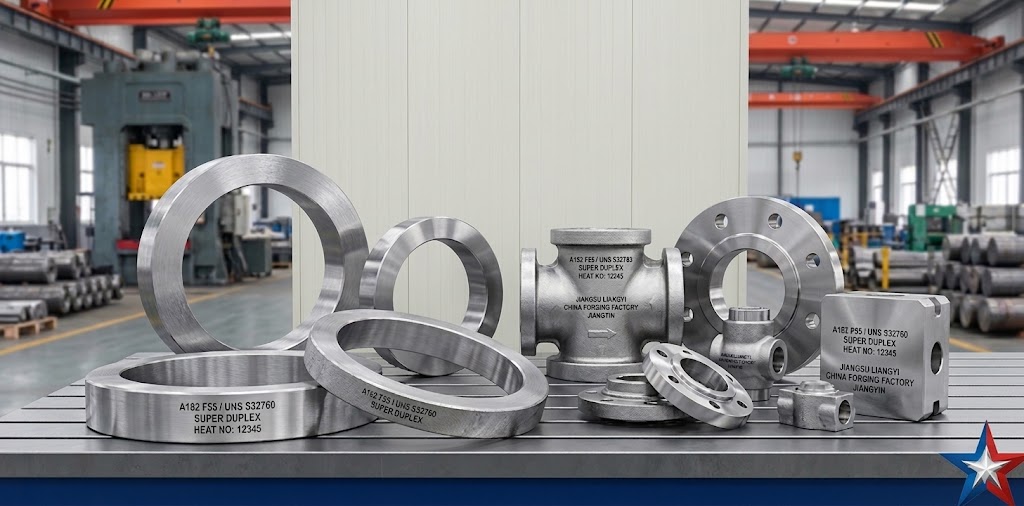
About ASTM A182 Grade F55 / UNS S32760 (A182-F55) Forged Parts
Jiangsu Liangyi Co., Limited is an ISO 9001:2015 certified professional manufacturer of ASTM A182 Grade F55, A182-F55, UNS S32760, F55 open die forging parts and seamless rolled steel forged rings. Our company located in Jiangyin, Jiangsu, China — the nationally recognized main industrial cluster of China's special steel forging industry, with over 25 years of specialized manufacturing experience in super duplex stainless steel forgings.
Our factory has an area of 80,000 m², with an annual manufacturing capacity of 120,000 tons, we can process the parts with single-piece weight from 30 kg to 30,000 kg. We provide high-performance F55 / S32760 super duplex stainless steel forged components to customers in more than 50 countries across Europe, the Middle East, North America, Southeast Asia and Oceania, 100% according to international standards and custom project requirements, with complete material test reports (MTR) and full material traceability from raw material to finished products.
ASTM A182-F55 (UNS S32760) is a high-quality duplex stainless steel (SDSS) with a perfectly balanced 50:50 austenite and ferrite dual-phase microstructure. This advanced material has a yield strength which can up to 600 MPa, great ductility and toughness, and great corrosion resistance in harsh marine environments, high-chloride media, and sour oil and gas production conditions with H2S content. All of our A182-F55 / S32760 forged materials come with a Pitting Resistance Equivalent Number (PREN) of at least 40.0. This means they will be more resistant to pitting corrosion, crevice corrosion, and stress corrosion cracking (SCC) in tough production conditions.
ASTM A182 Grade F55 / UNS S32760 International Standard Equivalents & Cross-Reference
ASTM A182 Grade F55 (UNS S32760) is known under multiple designations across international standards systems. Engineers, procurement teams, and fabricators all over the world may reference this material by its European, British, or proprietary trade names. All designations below refer to the same super duplex stainless steel alloy with nominally equivalent chemical composition and properties. Jiangsu Liangyi can supply material certified to any of the following equivalent standards upon request:
| Standard System | Designation / Grade | Standard Body | Notes |
|---|---|---|---|
| ASTM / ASME (USA) | A182 Grade F55 / UNS S32760 | ASTM International / ASME | Primary designation for forged parts |
| EN / DIN (Europe) | 1.4501 | European Committee for Standardization (CEN) | EN 10272, EN 10250, EN 10088 equivalent |
| EN Material Number | W.Nr. 1.4501 | DIN / German Standard | Werkstoff-Nummer used in EU engineering specs |
| EN Name | X2CrNiMoCuWN25-7-4 | EN 10088-3 | Full chemical formula designation |
| British Standard | BS 970 / BS EN 10088 | BSI Standards | Aligned with EN 1.4501 after harmonization |
| ISO | UNS S32760 (via ISO 15510) | ISO | ISO stainless steel chemical composition table |
| Trade Name (Rolled Alloys) | Zeron® 100 | Rolled Alloys / Meighs | Original commercial name for S32760 alloy |
| Trade Name (Outokumpu) | SAF 2507-type variant | Outokumpu / Sandvik | Note: S32760 ≠ S32750; confirm Cu+W content |
| NORSOK (Norway) | S32760 / Grade F55 | Standards Norway | Referenced in NORSOK M-650 for offshore |
| JIS (Japan) | SUS329J4L (similar) | Japanese Standards | Closest JIS grade; verify composition |
Important Note: UNS S32760 (F55) and UNS S32750 (F53 / 2507) are both super duplex stainless steels but are not interchangeable. S32760 contains copper (0.5–1.0%) and tungsten (0.5–1.0%), which S32750 does not. Always verify the UNS number and full chemical composition when sourcing. Jiangsu Liangyi provides complete material test reports (MTR) covering chemical composition and mechanical properties for every order.
Main Advantages of ASTM A182 F55 / UNS S32760 Super Duplex Steel vs Other Duplex & Austenitic Grades
As a high-performance super duplex stainless steel, A182 Grade F55 (UNS S32760) has significant performance advantages over standard duplex, super duplex 2507 (F53), and austenitic stainless steels like 316L. So it is the ideal material choice for critical industrial applications with harsh production conditions:
| Material Property | ASTM A182 F55 / UNS S32760 | 2507 (F53) Super Duplex | 2205 (F51) Standard Duplex | 316L Austenitic Stainless |
|---|---|---|---|---|
| PREN Value | ≥ 40 | ~38 | ~34 | ~23 |
| Minimum Yield Strength | 530 MPa | 550 MPa | 450 MPa | 170 MPa |
| NACE MR0175 Sour Service | Full Compliance | Full Compliance | Limited Compliance | Non-Compliant |
| Seawater Pitting Resistance | Superior | Excellent | Good | Basic |
| Cu + W Alloying (Reducing Acids) | Yes (F55 unique) | No | No | No |
| Max Continuous Service Temp. | 315°C | 300°C | 280°C | 343°C |
Main Performance Highlights of Our A182 F55 Forgings
-
Outstanding resistance to pitting corrosion, crevice corrosion, and stress corrosion cracking (SCC) in chloride-rich, sour H2S, and high-temperature acidic/alkaline environments
-
Nearly 3× higher yield strength than 316L stainless steel, enabling thinner wall designs, weight reduction, and cost savings in structural applications
-
Unique addition of copper (0.5–1.0%) and tungsten (0.5–1.0%) provides superior corrosion resistance in reducing acid environments — a main advantage over F53/2507
-
Great mechanical properties at both cryogenic temperatures (down to −40°C) and elevated temperatures (up to 315°C continuous service)
-
Suitable for NACE MR0175 / ISO 15156 sour service oil and gas applications; products can be manufactured to customer-specified standards including API 6A and API 6D upon request
-
Good weldability and machinability with our optimized proprietary heat treatment and machining processes
Full Range of ASTM A182 F55 / UNS S32760 Forged Products from China Jiangyin Factory
We manufacture custom ASTM A182 Grade F55 (A182-F55 / UNS S32760) forged parts in different kinds of shapes, sizes and specifications, 100% according to your engineering drawings, technical specifications, and project requirements. Our in-house production line supports complete processes from raw material melting, forging, heat treatment, precision machining, to final inspection, which can make sure whole control over product quality, delivery lead time, and custom requirements.
A182-F55 / UNS S32760 Forged Bars & Rods
ASTM A182 Grade F55 (UNS S32760) forged steel round bars, square bars, flat bars, rectangular bars, step shafts, gear shafts, crankshafts, and custom rods. All our F55 / S32760 forged bars have a minimum forging ratio of 3:1, with maximum diameter up to 2 meters, maximum length up to 15 meters, and single-piece weight up to 30 tons. They are Ideal for pump shafts, valve stems, drill collars, turbine shafts, and general machinery applications. View our full forged bars and shafts capabilities →
A182 F55 / S32760 Seamless Rolled Forged Rings
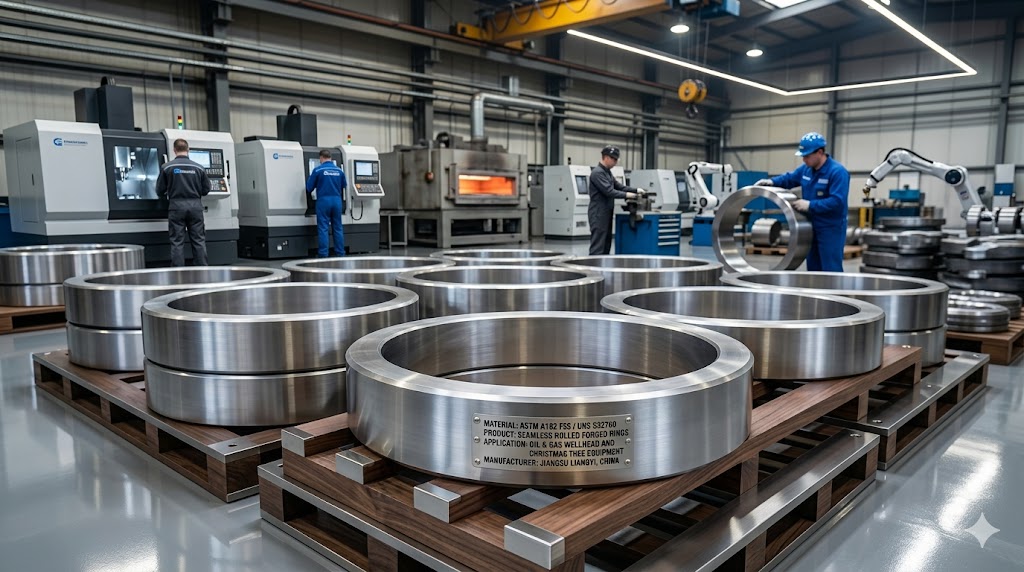
We make custom A182-F55 / UNS S32760 seamless rolled rings, contoured forged rings, gear rings, slewing bearing rings, flange blanks, and custom bearing rings on our 1-meter and 5-meter CNC seamless ring rolling machines. We can make rings with a maximum diameter of 6 meters and a single piece that weighs up to 30 tons. We can also do full heat treatment and precision machining.They are ideal for high-pressure valve bodies, wellhead equipment, Christmas tree components, turbine components, and rotating machinery applications. View our full seamless rolled forged rings capabilities →
A182 F55 / UNS S32760 Forged Hollow Components & Sleeves
ASTM A182 Grade F55 (S32760) forged hubs, housing shells, sleeves, bushes, casings, hollow bars, heavy-wall pipes, tubes, tubing shells, barrels, and custom hollow components, with outer diameter capacity up to 3,000 mm. Our seamless hollow forging process make sure uniform microstructure and mechanical properties, which can eliminate weld defects and improving corrosion resistance. They are suitable for high-pressure cylinders, subsea connectors, heat exchanger shells, downhole tool applications, and other heavy-wall hollow section forgings.
A182 F55 / S32760 Forged Discs, Plates & Blocks
High-precision A182-F55 / UNS S32760 forged discs, disks, blocks, plates, valve blanks, flange blanks, and custom forgings, complete heat treated and precision machined to meet your strict dimensional and performance requirements. Available in thickness up to 800 mm and maximum weight up to 30 tons, which is ideal for valve bonnets, blowout preventer (BOP) blocks, tube sheets, pressure vessel end caps, and general structural applications.
ASTM A182 F55 / UNS S32760 Forgings Industry Applications & Verified Global Project Cases
Our ASTM A182 Grade F55 (A182-F55 / UNS S32760) forged forging parts are commonly used in industrial sectors that demand high strength, superior corrosion resistance, long life cycle, and according to international safety and performance standards. Main applications and verified global project cases from our China Jiangyin forging factory include:
Oil & Gas Upstream & Downstream Industry
As the most commonly used and trusted material for sour production oil and gas applications, our A182 F55 (UNS S32760) forged components are commonly used in onshore and offshore oil and gas production, which including: forged drilling pipes, tubes, drill rods and drill collars; blowout preventer (BOP) bodies, RAM blocks and annular components; wellhead Christmas trees, spool bodies, casing heads, tubing heads, casing hangers and tubing hangers; drilling tools, risers, connectors, flexible joints, seals, flanges and gaskets; downhole drilling tool mud motor splined drive shafts, and electrical submersible pumps (ESP) motor splined shafts; oil measurement valve spools and ultrasonic flow meter bodies. The F55 / S32760 material is suitable for NACE MR0175 / ISO 15156 sour service environments per its alloy specification.
Verified Delivery Case #1 — Arabian Gulf Offshore Sour Gas Wellhead Project
Project Overview: An Arabian Gulf offshore platform operating at 87 meters water depth. A group of sour gas production wells requiring complete wellhead and Christmas tree assembly components in ASTM A182 Grade F55 / UNS S32760, certified to API 6A 21st Edition, PSL-3G, and PR2.
Production Conditions:
-
Wellhead working pressure (WP): 10,000 psi (690 bar)
-
Design temperature range: −29°C to +121°C (Temperature Class U, API 6A)
-
H₂S partial pressure: 0.083 MPa (830 mbar) — confirmed sour service per NACE MR0175
-
CO₂ partial pressure: 2.14 MPa; chloride content: 145,000 – 158,000 ppm
-
Material class: FF (full sour, both bore and annulus); Fluid category: sour hydrocarbon gas
Components Delivered (Total Order Qty: 6 sets / 312 pcs):
| Component | Qty | OD (mm) | ID (mm) | Length / Height (mm) | Unit Weight (kg) | Forging Type |
|---|---|---|---|---|---|---|
| 13-5/8" Casing Head Housing | 6 pcs | ϕ520 | ϕ346.1 | H=680 | 287 | Open die forging + rough machining |
| 13-5/8" × 10-3/4" Casing Head Spool | 6 pcs | ϕ495 | ϕ273.1 | H=540 | 198 | Open die hollow forging |
| 7-1/16" Tubing Head Spool | 12 pcs | ϕ380 | ϕ180 | H=460 | 142 | Open die hollow forging |
| 7-1/16" Tubing Hanger | 12 pcs | ϕ168.3 | ϕ88.9 | L=320 | 38 | Open die bar forging + machining |
| 13-3/8" Casing Hanger | 12 pcs | ϕ339.7 | ϕ177.8 | L=280 | 76 | Seamless rolled ring + machining |
| RTJ API 6BX Flange (10,000 psi) | 264 pcs | ϕ590 – ϕ280 | ϕ346.1 – ϕ180 | T=85–120 | 28–96 | Seamless rolled ring + machining |
Material Specification & Actual Heat Data (Heat No. JL-F55-2018H-14):
| Parameter | ASTM A182 F55 Requirement | Actual Value (Heat JL-F55-2018H-14) |
|---|---|---|
| C (%) | ≤ 0.03 | 0.019 |
| Cr (%) | 24.0 – 26.0 | 25.1 |
| Ni (%) | 6.0 – 8.0 | 7.0 |
| Mo (%) | 3.0 – 4.0 | 3.52 |
| Cu (%) | 0.50 – 1.0 | 0.72 |
| N (%) | 0.20 – 0.30 | 0.248 |
| W (%) | 0.50 – 1.0 | 0.74 |
| PREN (actual) | ≥ 40 | 42.3 |
| Tensile Strength | 730 – 930 MPa | 782 MPa |
| 0.2% Yield Strength | ≥ 530 MPa | 566 MPa |
| Elongation | ≥ 25% | 32% |
| Hardness | ≤ 290 HB | 241 HB |
| Charpy (−46°C) | ≥ 40 J (avg) | 68 / 71 / 74 J (avg 71 J) |
| Ferrite Content | 40 – 60% | 49% |
| ASTM G48 Method A (40°C, 24h) | No pitting; wt. loss ≤ 4.0 mg/cm² | No pitting; wt. loss 2.1 mg/cm² |
Heat Treatment Record: Production annealing at 1,120°C ± 8°C, hold time 3.5 minutes/mm (ruling section 95 mm → 333 min), water quenching to < 35°C within 60 seconds. Furnace temperature uniformity survey: ±6°C (SAT per AMS 2750E).
NDT & Inspection: 100% UT per ASTM A388; 100% MT per ASTM E709; 100% PT per ASTM E165; PMI (XRF); hardness testing (every piece); dimensional inspection per customer DWG. Material Test Report (MTR) with full chemical and mechanical test data provided.
Delivery: Contract signed October 2018; first delivery completed March 2019 (22 weeks). Final delivery June 2019. Total net weight: 18.7 tonnes.
Service Performance (as of 2025): All 6 wellhead sets have been in continuous service for 6+ years under confirmed sour conditions. Zero corrosion failures, zero NDT rejections in service, zero unplanned maintenance events related to material or forging quality. Client has since placed 3 repeat orders for the same material grade for additional platforms in the same block.
Valve Manufacturing Industry
We manufacture a complete range of A182-F55 / UNS S32760 forged valve components for critical production valves, which includes valve balls, valve bonnets, valve bodies, valve stems, valve closures, valve seat rings, valve cores, and valve discs, for ball valves, check valves, gate valves, butterfly valves, cryogenic valves, choke valves, and back pressure valves. Our F55 forged valve parts are suitable for high-pressure, high-temperature, corrosive medium production conditions in oil and gas, chemical, petrochemical, and marine industries, and can be manufactured to API 6D specifications upon request.
Verified Delivery Case #2 — Norwegian North Sea Subsea Choke Valve Forgings
Project Overview: Subsea choke valve bodies, bonnets, and stems for a Floating Production, Storage, and Offloading (FPSO) vessel working in the Norwegian North Sea, a North Sea offshore block. According to NORSOK M-650 Rev. 5 and NACE MR0175 / ISO 15156, you need ASTM A182 Grade F55 / UNS S32760. The end client is a big European EPCI contractor for systems that produce things underwater.
Production Conditions:
-
Design pressure: 345 bar (5,000 psi); design temperature: −29°C to +100°C
-
Medium: Sour crude oil / produced water; H₂S content: up to 1,200 ppm (mol); CO₂: 4.8 mol%
-
Subsea depth: 312 m; external seawater exposure with cathodic protection (CP) system at −1.05V vs Ag/AgCl
-
Applicable standards: API 6D 24th Edition, NORSOK M-650 Rev. 5, NACE MR0175 / ISO 15156, DNV-OS-F101
Components Delivered (Total Order Qty: 24 sets / 96 pcs):
| Component | Qty | OD (mm) | ID / Bore (mm) | Length (mm) | Unit Weight (kg) | Surface Finish |
|---|---|---|---|---|---|---|
| 6" Class 2500 Choke Valve Body | 24 pcs | ϕ580 (flange OD) | ϕ154.1 (bore) | L=820 | 312 | Ra ≤ 3.2 µm (bore); Ra ≤ 6.3 µm (ext) |
| 6" Valve Bonnet | 24 pcs | ϕ420 | ϕ95 (stem bore) | H=380 | 118 | Ra ≤ 3.2 µm (sealing face) |
| Valve Stem (Choke Stem) | 48 pcs | ϕ90 | Solid | L=680 | 28 | Ra ≤ 0.8 µm (sealing OD, ground finish) |
Material & NORSOK M-650 Qualification Data (Heat No. JL-F55-2021H-09):
| Parameter | Requirement | Actual Result (Heat JL-F55-2021H-09) |
|---|---|---|
| Cr / Ni / Mo / Cu / N / W (%) | Per ASTM A182 F55 | 25.3 / 6.9 / 3.61 / 0.78 / 0.252 / 0.76 |
| PREN (actual calculated) | ≥ 40 | 42.8 |
| Tensile Strength | 730 – 930 MPa | 794 MPa |
| 0.2% Yield Strength | ≥ 530 MPa | 572 MPa |
| Elongation (GL 50 mm) | ≥ 25% | 30% |
| Charpy V-Notch at −46°C | ≥ 40 J avg, ≥ 30 J min | 74 / 78 / 71 J (avg 74 J, min 71 J) |
| Hardness (valve body, 5-point grid) | ≤ 290 HB | 237 / 241 / 245 / 239 / 243 HB |
| Ferrite Content (Feritscope, 10 pts) | 40 – 60% | 47 – 53% (avg 50%) |
| ASTM G48 Method A (40°C, 24h) | No pitting; ≤ 4.0 mg/cm² | No pitting; 1.8 mg/cm² |
| ASTM G48 Method E (CPT) | ≥ 50°C | 57°C |
| ASTM A262 Practice E (IGC) | No intergranular cracking | Pass — no cracking |
| Sigma Phase (ASTM A923 Method C) | No detrimental phases | Pass — no sigma detected |
NDT & Inspection: 100% UT; 100% MT; 100% PT; PMI; complete CMM dimensional inspection per customer DWG. Material Test Report (MTR) with full chemical and mechanical test data provided.
Delivery: Contract awarded February 2021; all 96 pieces delivered in two shipments: April 2021 (48 pcs) and June 2021 (48 pcs). Total delivery lead time: 18 weeks from PO acceptance to final shipment. Total net weight: 13.9 tonnes. Sea freight: Jiangyin → Rotterdam port, FCL container, VCI packaging with desiccant and end caps.
Service Performance (as of 2025): All 24 choke valve assemblies have been put in place and tested on subsea production trees at a depth of 312 m.Verified 3.5+ years of continuous sour processing with no reported corrosion failures, no pitting, and no SCC events. Client (EPCI contractor) has qualified Jiangsu Liangyi as an approved F55 / S32760 forging supplier under their vendor qualification list (VQL) for all North Sea projects.
Power Generation & Marine Offshore Engineering Industry
Our ASTM A182 Grade F55 / UNS S32760 forged parts are commonly used in nuclear power, thermal power generation, and marine offshore engineering, which including: nuclear reactor coolant pump casings, shells and seal chambers; turbine and compressor labyrinth shaft seals; turbomachinery turbo centrifugal compressor impellers and shrouded impellers; marine propeller shafts; offshore drilling risers; subsea connectors; venturi cone meter bodies; subsea valve bodies; and other critical marine equipment parts. All products can meet international safety and performance standards which can be used for long-term operation in harsh environments.
Verified Delivery Case #3 — European PWR Nuclear Power Plant Reactor Coolant Pump Project
Project Overview: Reactor Coolant Pump (RCP) pressure boundary components for a 1,650 MWe EPR (European Pressurized Reactor) pressurized water reactor (PWR) nuclear power plant project in Western Europe. End client: a Tier-1 European nuclear island equipment manufacturer (nuclear pump OEM). Components were required to be manufactured to RCC-M 2007 + 2012 Addendum (French nuclear design code) and customer-specified nuclear quality standards.
Service Conditions:
-
Primary coolant circuit: borated demineralized water (2,200 – 2,600 ppm boric acid), pH 6.9 – 7.4 (cold leg) / 7.4 – 7.8 (hot leg)
-
Design pressure: 176 bar (2,552 psi); operating pressure: 155 bar (2,248 psi)
-
Design temperature: 343°C; operating temperature cold leg 293°C / hot leg 328°C
-
Environment: high neutron flux and gamma radiation field; strict RCC-M Class 2 (Safety class 2) requirements
-
Design lifetime: 60 years with zero unplanned maintenance on pressure boundary components
Components Delivered (Order Qty: 2 complete RCP sets / 16 pcs total):
| Component | Qty | Max OD (mm) | Min ID (mm) | Height / Length (mm) | Unit Weight (kg) | Forging Process |
|---|---|---|---|---|---|---|
| RCP Pump Casing (lower half) | 2 pcs | ϕ1,850 | ϕ780 (suction bore) | H=1,240 | 4,860 | VIM+ESR double-melt; open die forging; rough machined |
| RCP Pump Casing (upper half) | 2 pcs | ϕ1,850 | ϕ620 (discharge bore) | H=980 | 3,720 | VIM+ESR double-melt; open die forging; rough machined |
| RCP Main Shaft | 4 pcs | ϕ280 (journal) | Solid | L=2,380 | 876 | VIM+ESR; open die forging; rough turned; straightness ≤ 0.05 mm/m |
| RCP Wear Ring (stationary) | 4 pcs | ϕ720 | ϕ640 | H=180 | 148 | Seamless rolled ring; precision machined Ra ≤ 0.8 µm (bore) |
| Mechanical Seal Housing | 2 pcs | ϕ560 | ϕ290 (shaft bore) | H=420 | 312 | Open die hollow forging; precision machined |
| Impeller (closed type) | 2 pcs | ϕ940 | ϕ320 (eye) | H=380 | 524 | VIM+ESR; closed die + open die; 5-axis CNC finish machined |
Raw Material: VIM+ESR Double Melting Process
Due to the nuclear safety classification, all A182 F55 / UNS S32760 material was produced by Vacuum Induction Melting (VIM) followed by Electro Slag Remelting (ESR) to achieve ultra-low sulfur (≤ 0.005%), ultra-low phosphorus (≤ 0.018%), and total oxygen content ≤ 15 ppm. This double-melt process eliminates macro-segregation, reduces inclusion content, and ensures the highest level of compositional homogeneity across the large forging sections required for RCP casings.
Material Qualification Data (Heat No. JL-F55-2020H-VE-03, VIM+ESR):
| Parameter | RCC-M / ASTM A182 Requirement | Actual Result |
|---|---|---|
| C / Si / Mn / P / S (%) | ≤0.03 / ≤1.0 / ≤1.0 / ≤0.035 / ≤0.015 | 0.018 / 0.42 / 0.68 / 0.018 / 0.004 |
| Cr / Ni / Mo / Cu / N / W (%) | Per ASTM A182 F55 | 25.2 / 7.1 / 3.68 / 0.81 / 0.261 / 0.79 |
| PREN (actual) | ≥ 40 | 43.5 |
| Tensile Strength (at RT) | 730 – 930 MPa | 801 MPa |
| 0.2% Yield Strength (at RT) | ≥ 530 MPa | 581 MPa |
| Tensile Strength (at 300°C) | ≥ 590 MPa (RCC-M) | 638 MPa |
| Yield Strength (at 300°C) | ≥ 400 MPa (RCC-M) | 441 MPa |
| Elongation (GL 50 mm) | ≥ 25% | 31% |
| Reduction of Area | ≥ 45% | 62% |
| Charpy V-Notch at −46°C | ≥ 40 J avg (RCC-M Class 2) | 82 / 88 / 79 J (avg 83 J) |
| Grain Size (ASTM E112) | ≥ No. 5 (ASTM) | No. 6 – 7 (uniform) |
| Ferrite Content | 40 – 60% | 51% ± 3% (10-point Feritscope survey) |
| Sigma Phase (ASTM A923 C) | None permitted | None detected |
| ASTM G48 Method A (40°C, 24h) | No pitting; ≤ 4.0 mg/cm² | No pitting; 1.6 mg/cm² |
| Macro-examination (ASTM A604) | No macro-defects | Clean — Severity 1 max |
| Inclusion Rating (ASTM E45, Method A) | Thin series ≤ 1.5 each type | A1.0 / B0.5 / C0.5 / D1.0 |
Heat Treatment Record (Pump Casing, Ruling Section 320 mm): VIM+ESR ingot → forging at 1,150–1,200°C → air cool → solution anneal at 1,115°C ± 8°C → hold 800 min (2.5 min/mm × 320 mm) → water quench to <30°C in ≤ 90 seconds (full immersion, forced agitation) → PT / UT after quench. Furnace uniformity: ±5°C (SAT per AMS 2750E Class 2). Cooling rate at ruling section center confirmed by embedded thermocouple: 8.2°C/second through 900–700°C range.
NDT & Inspection: 100% UT; 100% MT; 100% PT; in-process and final CMM dimensional inspection per customer DWG. Material Test Report (MTR) with full chemical and mechanical test data provided.
Delivery: Contract signed July 2020; material qualification (PQTR) approved by AFCEN: November 2020; first RCP set delivered: September 2021; second RCP set delivered: February 2022. Total delivery: 19 months from contract to final acceptance. Total net weight: 21.6 tonnes. All components are shipped via ocean from Jiangyin → Le Havre in OOG (out-of-gauge) flat-rack containers with custom steel cradles and VCI film + wooden crating.
Service Performance (as of 2025): RCP Set No. 1 has been in operation since Q1 2023 (2.5+ years). Zero pressure boundary failures, zero unplanned outages attributable to material or forging quality. In-service inspection (ISI) at first outage confirmed zero indication growth in all UT and PT records. Jiangsu Liangyi has since been approved under the nuclear OEM's Approved Manufacturers List (AML) for future EPR and SMR reactor projects.
Chemical Composition of ASTM A182 Grade F55 / UNS S32760 Super Duplex Stainless Steel
All our A182-F55 / UNS S32760 forged materials according to ASTM A182 standard chemical composition requirements, We process the parts with full traceability from raw material melting to finished products. We provide complete Material Test Reports (MTR) covering full chemical composition and mechanical properties for every heat lot. The detailed chemical composition of ASTM A182 Grade F55 (UNS S32760) is as follows:
| Chemical Element | ASTM A182 F55 Standard Range | Our Typical Control Range |
|---|---|---|
| Carbon (C) | 0.03% Max | ≤ 0.025% |
| Silicon (Si) | 1.00% Max | ≤ 0.80% |
| Manganese (Mn) | 1.00% Max | ≤ 0.80% |
| Phosphorous (P) | 0.035% Max | ≤ 0.025% |
| Sulphur (S) | 0.015% Max | ≤ 0.010% |
| Chromium (Cr) | 24.0 – 26.0% | 24.5 – 25.5% |
| Nickel (Ni) | 6.0 – 8.0% | 6.5 – 7.5% |
| Molybdenum (Mo) | 3.0 – 4.0% | 3.2 – 3.8% |
| Copper (Cu) | 0.50 – 1.0% | 0.6 – 0.9% |
| Nitrogen (N) | 0.20 – 0.30% | 0.22 – 0.28% |
| Tungsten (W) | 0.50 – 1.0% | 0.6 – 0.9% |
| PREN Value | ≥ 40 | ≥ 41 |
PREN Calculation Formula: PREN = %Cr + 3.3 × (%Mo + 0.5 × %W) + 16 × %N
Heat Treatment & Mechanical Properties of A182-F55 / UNS S32760 Forged Parts
The mechanical properties and corrosion resistance of A182 F55 (UNS S32760), a high-alloy super duplex stainless steel, depend a lot on how well the heat treatment process is controlled. Our proprietary heat treatment process can make sure a perfectly balanced 50:50 austenite-ferrite dual-phase microstructure, which can eliminate harmful intermetallic phases such as sigma phase, chi phase, and Laves phase, and guaranteeing optimal material performance.
Standardized Optimized Heat Treatment Process
We put all of our ASTM A182 F55 forged parts through a strict solution annealing and quick water quenching process:
-
Uniform heating to 1,100 – 1,140°C, with precise temperature control within ±10°C using our computer-controlled heat treatment furnaces
-
Sufficient holding time to ensure the entire cross-section of the part reaches the target temperature, with holding time calculated based on part thickness (2.5 minutes per mm of ruling section)
-
Rapid water quenching to room temperature, ensuring a cooling rate fast enough to avoid the formation of harmful intermetallic precipitates, while preserving the balanced 50:50 austenite-ferrite dual-phase microstructure
Guaranteed Mechanical Properties (Solution Annealed & Quenched Delivery Condition)
All our A182 F55 forged parts meet and exceed ASTM A182 standard mechanical property requirements, we can make sure every heat lot are fully tested and documented. Below is the guaranteed mechanical properties:
| Mechanical Property | ASTM A182 Standard Requirement | Our Guaranteed Minimum Value |
|---|---|---|
| Tensile Strength | 730 – 930 MPa (105,877 – 134,885 psi) | 750 MPa Min |
| 0.2% Proof Strength (Yield Strength) | ≥ 530 MPa (76,870 psi) | 550 MPa Min |
| Modulus of Elasticity | 200 GPa (29,007 ksi) | 200 GPa |
| Elongation at Break (in 50 mm) | ≥ 25% | ≥ 28% |
| Hardness | ≤ 290 HB | 220 – 270 HB |
| Charpy V-Notch Impact Energy (Room Temperature) | ≥ 40 J | ≥ 60 J |
Microstructure & Grain Size Control
We control the microstructure of our A182-F55 forged parts so that it is uniform and does not have a lot of segregation, inclusions, or harmful intermetallic phases. Grain size determination is performed according to EN ISO 643 standards, with forged bars achieving a grain size of 5 or finer. We perform full microstructure inspection for every heat treatment lot, ensuring a stable 50:50 austenite-ferrite phase balance (±5%) for optimal corrosion resistance and mechanical performance.
Physical Properties of ASTM A182 F55 / UNS S32760 (at 20°C unless stated)
The following physical properties are essential for engineering design calculations involving F55 / S32760 components, which including thermal expansion allowances, heat transfer analysis, and electrical grounding design. All values are for solution annealed and water quenched condition at 20°C unless otherwise stated:
| Physical Property | Value | Unit | Notes |
|---|---|---|---|
| Density | 7.84 | g/cm³ (0.283 lb/in³) | At 20°C; slightly higher than austenitic due to ferrite content |
| Elastic Modulus (Young's Modulus) | 200 | GPa (29,000 ksi) | At 20°C; decreases to ~180 GPa at 300°C |
| Shear Modulus | ~78 | GPa | At 20°C |
| Poisson's Ratio | 0.30 | — | At 20°C |
| Thermal Expansion Coefficient | 13.0 | ×10⁻⁶ /°C (20–300°C) | Lower than austenitic (16–17×10⁻⁶); closer to carbon steel — advantage for dissimilar metal joints |
| Thermal Conductivity | 14.0 | W/(m·K) at 20°C | Higher than austenitic 316L (~14 vs ~13 W/m·K); 16.5 W/m·K at 200°C |
| Specific Heat Capacity | 480 | J/(kg·K) | At 20°C |
| Electrical Resistivity | 0.80 | µΩ·m (80 µΩ·cm) | At 20°C; increases with temperature |
| Magnetic Permeability | ~40–80 | µr (relative) | Weakly ferromagnetic due to ferrite phase; not suitable for non-magnetic applications |
| Melting Range | 1,350 – 1,410 | °C | Solidus–Liquidus range |
| Min. Service Temperature | −40 | °C | Below −40°C impact toughness may decrease; verify with Charpy test data |
| Max. Continuous Service Temperature | 315 | °C | Above 315°C risk of sigma phase precipitation increases; avoid prolonged exposure 300–980°C |
Corrosion Testing for ASTM A182 F55 / UNS S32760 Forged Parts
Super duplex stainless steel F55 (UNS S32760 / 1.4501) demands rigorous corrosion testing to verify that the correct microstructure has been achieved and that no harmful intermetallic phases are present after forging and heat treatment. Jiangsu Liangyi performs and/or supports the following corrosion tests as part of our standard quality assurance program, with third-party witness inspection available:
ASTM G48 Method A — Ferric Chloride Pitting Corrosion Test
The ASTM G48 Method A test is the standard acceptance test for verifying the pitting corrosion resistance of super duplex stainless steels.For 24 hours, specimens are put in a 6% ferric chloride (FeCl₃) solution at a high temperature. The test temperature for F55 / S32760 material is a minimum of 40°C (compared to 22°C for standard 316L and 35°C for 2205 duplex), reflecting its superior pitting resistance. Acceptance criterion: weight loss ≤ 4.0 mg/cm² per ASTM G48 standard; we guarantee ≤ 3.0 mg/cm² in our typical production. No pitting is permitted on the specimen surface when examined at 20× magnification.
ASTM G48 Method E — Critical Pitting Temperature (CPT) Test
The ASTM G48 Method E test determines the Critical Pitting Temperature (CPT) of the material in 6% FeCl₃ solution. For ASTM A182 F55 / UNS S32760, the minimum required CPT is ≥ 50°C; our typical production achieves CPT ≥ 55°C. A higher CPT means better phase balance and corrosion resistance, it is important for things like seawater desalination, offshore heat exchangers, and marine pump housings that work in high-temperature, high-chloride seawater.
ASTM A262 Practice E — Intergranular Corrosion (IGC) Test
The ASTM A262 Practice E (Strauss test) or Practice C (nitric acid test) is performed to confirm that the A182 F55 material is free from susceptibility to intergranular corrosion caused by sensitization (chromium carbide precipitation at grain boundaries). This is particularly important for super duplex forgings that have undergone complex forging and heat treatment cycles. Specimens are boiled in a copper sulfate-sulfuric acid solution for 15–72 hours; bent specimens must show no intergranular cracking when examined at 20× magnification. All our F55 forgings pass ASTM A262 Practice E as part of our standard production qualification.
Ferrite Content Measurement
The austenite-ferrite phase balance is measured by Fischer Feritscope (magnetic induction method) or image analysis of metallographic sections per ASTM E562 / ISO 8249. Our requirement and guarantee: ferrite content 40–60% (target: 50 ± 5%). Ferrite content outside this range indicates improper heat treatment or microstructure imbalance and is cause for rejection. Complete ferrite measurement records are included in our Material Test Report (MTR).
| Corrosion Test | Standard | Test Condition | ASTM A182 F55 Requirement | Our Guaranteed Result |
|---|---|---|---|---|
| Pitting Corrosion Test | ASTM G48 Method A | 6% FeCl₃, 40°C, 24 hrs | Weight loss ≤ 4.0 mg/cm²; no pitting | ≤ 3.0 mg/cm²; no pitting |
| Critical Pitting Temperature (CPT) | ASTM G48 Method E | 6% FeCl₃, incremental temp. | CPT ≥ 50°C (min.) | CPT ≥ 55°C typical |
| Intergranular Corrosion Test | ASTM A262 Practice E | CuSO₄-H₂SO₄ boiling, 72 hrs | No intergranular cracking | Pass (no cracking) |
| Ferrite Content Measurement | ASTM E562 / ISO 8249 | Feritscope / image analysis | 40–60% ferrite | 50 ± 5% (guaranteed) |
| Sigma Phase Check | ASTM A923 Method A/B/C | Microstructure + impact test | No detrimental phases | Pass (full microstructure inspection) |
Non-Destructive Testing (NDT) Procedures for A182 F55 / UNS S32760 Forgings
All ASTM A182 Grade F55 / UNS S32760 forged parts produced by Jiangsu Liangyi undergo a comprehensive multi-method non-destructive testing (NDT) program using calibrated equipment. Full NDT reports are included in the Material Test Report (MTR) provided with every order.
Ultrasonic Testing (UT) — ASTM A388 / EN 10228-3
We use ASTM A388/A388M or EN 10228-3 to do 100% volumetric ultrasonic testing on all of our A182 F55 forged bars, rings, hollow parts, and discs. Using calibrated UT equipment, we scan with both straight beams (compression waves) and angle beams (shear waves). For standard production, the acceptance criteria are Class 4 according to EN 10228-3 (no indications exceeding 50% DAC; no indications with equivalent flat-bottom hole diameter > 3 mm). For stricter Class 3 or Class 2 acceptance, the customer can specify. All forging cross-sections must be scanned 100% for safety-critical parts.
Magnetic Particle Testing (MT) — ASTM E709 / EN 10228-1
Magnetic particle testing (MT) is performed on all accessible surfaces of finished and semi-finished F55 / S32760 forged parts per ASTM E709 or EN 10228-1 using the wet fluorescent magnetic particle method. Since S32760 is weakly ferromagnetic (due to its ferrite phase), MT is effective for detecting surface and near-surface linear discontinuities, cracks, laps, and seams. Acceptance criteria: Class 3 per EN 10228-1 — no linear indications > 2 mm; no rounded indications > 4 mm; no more than 3 indications per 100 cm².
Liquid Penetrant Testing (PT) — ASTM E165 / EN ISO 3452
Liquid penetrant testing (PT) is performed on all machined surfaces and on the bore of hollow forged components per ASTM E165 or EN ISO 3452 using the fluorescent penetrant method (Type I, Method B, Sensitivity Level 2). PT can find any open-surface discontinuities, such as cracks, pores, cold shuts, and laps. Acceptance criteria: no relevant indications longer than 2 mm, no rounded indications longer than 2 mm, and no more than 3 relevant indications per 100 cm².
Positive Material Identification (PMI) — XRF Analysis
100% positive material identification (PMI) is performed on all finished A182 F55 / UNS S32760 forgings using handheld X-ray fluorescence (XRF) analyzers (Olympus Vanta / Thermo Scientific Niton or equivalent) to verify that the correct material grade has been forged and is traceable to the correct heat lot. PMI confirms main alloying elements Cr, Ni, Mo, Cu, W, Mn within ASTM A182 F55 standard limits. PMI records are included in the inspection dossier for every order.
Dimensional Inspection
Full dimensional inspection is performed on all finished machined components per customer drawing using calibrated measurement equipment which including CMM (Coordinate Measuring Machine), bore gauges, OD micrometers, height gauges, and surface roughness testers. All dimensions are confirmed to be within drawing tolerances before shipment. Dimensional inspection reports are provided with every order.
| NDT Method | Applicable Standard | Coverage | Acceptance Class / Criteria | Availability |
|---|---|---|---|---|
| Ultrasonic Testing (UT) | ASTM A388 / EN 10228-3 | 100% volumetric (all sections) | EN 10228-3 Class 4 standard; Class 3/2 on request | Standard (all orders) |
| Magnetic Particle Testing (MT) | ASTM E709 / EN 10228-1 | All accessible surfaces | EN 10228-1 Class 3 standard | Standard (all orders) |
| Liquid Penetrant Testing (PT) | ASTM E165 / EN ISO 3452 | All machined surfaces | No linear indications > 2 mm | Standard (finished components) |
| Positive Material Identification (PMI) | XRF — ASTM E1476 | 100% of finished parts | Within ASTM A182 F55 composition limits | Standard (all orders) |
| Radiographic Testing (RT) | ASTM E94 / EN ISO 17636 | Weld zones / critical sections | ASME Section V / Class B per EN ISO 17636 | On request |
| Hardness Testing (HT) | ASTM E10 / EN ISO 6506 | Each piece, multiple locations | ≤ 290 HB (ASTM A182 requirement) | Standard (all orders) |
| Ferrite Content (Feritscope) | ISO 8249 / ASTM E562 | Multiple locations per piece | 40–60% ferrite (50 ± 5% target) | Standard (all orders) |
| Dimensional Inspection (CMM) | Customer drawing / ISO 2768 | All critical dimensions | Per drawing tolerances | Standard (all orders) |
Welding Guidelines for ASTM A182 F55 / UNS S32760 Super Duplex Stainless Steel
ASTM A182 Grade F55 (UNS S32760 / EN 1.4501) has good weldability when correct procedures are strictly followed. The welding process is more sensitive than standard duplex grades since it has higher alloy content and the need to maintain the precise 50:50 austenite-ferrite phase balance across the weld metal and heat-affected zone (HAZ). The following guidelines are based on industry practices and are intended to assist fabricators welding our A182 F55 / S32760 forged components:
Recommended Filler Metals for F55 / UNS S32760 Welding
The standard recommended filler metal for welding UNS S32760 (F55) is AWS A5.9 ER2594 (UNS S32750-based, over-alloyed with Ni to compensate for dilution), which provides a weld microstructure with adequate ferrite content and corrosion resistance matching the base metal. Do not use ER2209 (standard duplex) or ER316L fillers — these will produce insufficient ferrite content and inadequate corrosion resistance in the weld.
| Welding Process | Recommended Filler / Electrode | AWS Classification | Notes |
|---|---|---|---|
| GTAW (TIG) | ER2594 wire | AWS A5.9 ER2594 | Primary process for precision, thin-section, and root pass welding of F55 / S32760 |
| GMAW (MIG) | ER2594 wire | AWS A5.9 ER2594 | Suitable for fill and cap passes; use Ar + 2–3% N₂ shielding gas |
| SMAW (Stick) | E2594 electrode | AWS A5.4 E2594 | Use for field repairs and limited access welding; lower dilution control vs TIG |
| SAW (Submerged Arc) | ER2594 wire + F9P0-EB2594 flux | AWS A5.9 / A5.23 | For large heavy-section welds; requires tight heat input control ≤ 1.5 kJ/mm |
| FCAW (Flux-Cored) | E2594T-1 flux-cored wire | AWS A5.22 | Suitable for structural welds; confirm ferrite content in weld procedure qualification |
Main Welding Parameters for UNS S32760 / F55
-
Preheat: If the base metal is less than 25 mm thick and the temperature is at least 10°C, you don't need to preheat it. If the base metal temperature is below 10°C, preheat it to at least 20°C to keep moisture from condensing and hydrogen from cracking.
-
Interpass Temperature: The maximum interpass temperature is strictly controlled at 150°C. Exceeding 150°C risks sigma phase precipitation and loss of corrosion resistance in the HAZ. Use pyrometer or contact thermometer to verify between passes.
-
Heat Input: The best range for heat input is between 0.5 and 1.5 kJ/mm (moderate heat input). Putting in too little heat (< 0.5 kJ/mm) can cause too much ferrite in the HAZ. Putting in too much heat (> 2.0 kJ/mm) can cause sigma phase to form and make the material less tough.
-
Shielding Gas (GTAW): Use Ar + 2–3% N₂ (not pure argon). Nitrogen addition prevents nitrogen loss from the weld pool, maintains austenite content, and improves corrosion resistance. For root passes, it is required to back purge with Ar + 2% N₂.
-
Post-Weld Heat Treatment (PWHT): Post-weld stress relief or tempering is NOT recommended for F55 / S32760 in the temperature range 300–980°C, as this promotes harmful sigma and chi phase precipitation. If PWHT is required (e.g., for dimensional stability), a full solution anneal at 1,100–1,140°C followed by rapid water quenching must be performed — the same process as the original heat treatment.
-
Post-Weld Cleaning: Remove all weld spatter, heat tint, and oxidation from weld zone by mechanical cleaning (stainless steel wire brushing, grinding with aluminum oxide wheels) followed by pickling (HNO₃ + HF acid paste or spray) and passivation to restore full corrosion resistance. Never use carbon steel tools on S32760 surfaces.
Weld Procedure Qualification (WPS/PQR)
All welding of A182 F55 / UNS S32760 forged components must be performed under a qualified Welding Procedure Specification (WPS) with a supporting Procedure Qualification Record (PQR) per ASME Section IX, AWS D1.6 (structural stainless), or EN ISO 15614-1 (as applicable). The PQR must include measuring the amount of ferrite in the weld metal and HAZ (the goal is 30–65% ferrite in the weld metal per EN ISO 17781), tensile testing, bend testing, Charpy impact testing at −20°C or lower, and ASTM G48 Method. A pitting corrosion test on weld cross-section specimens (no pitting at 40°C is acceptable).
Production & Inspection Standards for ASTM A182 F55 / UNS S32760 Forgings
All our A182-F55 / UNS S32760 forged parts are manufactured and inspected according to customer-specified international standards. We hold ISO 9001:2015 certification and provide complete Material Test Reports (MTR) for every order. Our production references the following industry standards:
-
ASTM A182 / ASME SA182: Standard Specification for Forged or Rolled Alloy and Stainless Steel Pipe Flanges, Forged Fittings, and Valves and Parts for High-Temperature Service
-
API 6A / ISO 10423: Specification for Wellhead and Christmas Tree Equipment
-
NACE MR0175 / ISO 15156: Petroleum and natural gas industries — Materials for use in H2S-containing Environments in oil and gas production
-
API 6D: Specification for Pipeline Valves
-
ASTM A370: Standard Test Methods and Definitions for Mechanical Testing of Steel Products
-
ASTM A388/A388M: Standard Practice for Ultrasonic Examination of Steel Forgings
-
ASTM A262: Standard Practices for Detecting Susceptibility to Intergranular Attack in Stainless Steels
-
ISO 148: Metallic materials — Charpy pendulum impact test
-
ASTM A484/A484M: Standard Specification for General Requirements for Stainless Steel Bars, Billets, and Forgings
-
EN 10204: Metallic products — Types of inspection documents (3.1 / 3.2 MTC)
-
-
DNV GL-OS-C401: Offshore Standard for Fabrication and Testing of Offshore Structures
Frequently Asked Questions (FAQ) About ASTM A182 F55 / UNS S32760 Forgings
Is ASTM A182 F55 (UNS S32760) according to NACE MR0175 for sour service oil and gas applications?
Yes. ASTM A182 F55 (UNS S32760) is an alloy designed to meet the requirements of NACE MR0175 / ISO 15156 for use in H₂S-containing sour oil and gas environments. Our F55 / S32760 forgings are manufactured and heat treated to meet all the material requirements — chemical composition, mechanical properties, and microstructure control — with full Material Test Reports provided for every order.
What is the maximum size and weight of A182 F55 / UNS S32760 forged parts you can produce?
We can produce A182 F55 / UNS S32760 forged parts with single-piece weight from 30 kg up to 30,000 kg. For forged bars and shafts, we support maximum diameter up to 2 meters and maximum length up to 15 meters. For seamless rolled forged rings, we support maximum diameter up to 6 meters. For custom hollow components, we support outer diameter up to 3,000 mm.
What is the recommended heat treatment temperature for ASTM A182 F55 / UNS S32760?
The standard annealing temperature for ASTM A182 F55 (UNS S32760) is 1,100°C to 1,140°C, which followed by rapid water quenching to room temperature. This temperature range guarantees the complete dissolution of alloying elements and prevents the formation of detrimental intermetallic phases, such as sigma phase. Meanwhile, the rapid quenching maintains the balanced 50:50 austenite-ferrite dual-phase microstructure, which is best for corrosion resistance and mechanical properties.
What inspection certificates for A182 F55 forgings can you provide?
We are ISO 9001:2015 certified and provide complete Material Test Reports (MTR) for every order, covering chemical composition analysis, mechanical property test results, and heat treatment records — with full traceability from raw material to finished products. Third-party inspection by SGS, BV, TUV, or DNV GL can be arranged by the customer upon request at their own cost.
What is the PREN (Pitting Resistance Equivalent Number)for ASTM A182 Grade F55, and how to calculate?
The minimum PREN (Pitting Resistance Equivalent Number) for ASTM A182 Grade F55 is more than 40. To find it, use this formula: PREN = %Cr + 3.3 × (%Mo + 0.5 × %W) + 16 × %N. Our control range can reach PREN ≥ 41, which gives better resistance to pitting and crevice corrosion. This PREN value shows that F55 is a real super duplex stainless steel (PREN ≥ 40), while standard duplex 2205 (PREN ~34) and 316L austenitic (PREN ~23) are not.
What is the difference between ASTM A182 F55 and F53 (2507) super duplex stainless steel?
Both F55 (UNS S32760) and F53/2507 (UNS S32750) are super duplex stainless steels with PREN ≥ 40. The main differences are F55 contains copper (0.5–1.0%) and tungsten (0.5–1.0%), which enhance corrosion resistance in reducing acid environments and increase overall PREN. F53/2507 has a slightly higher minimum yield strength (550 MPa vs 530 MPa for F55). Both are according to NACE MR0175.
F55 is better when copper and tungsten alloying makes it more resistant to reducing acids. F53/2507 is more common and cheaper for general super duplex uses.
Contact Us for a Custom ASTM A182 F55 / UNS S32760 Forging Quotation
Jiangsu Liangyi Co., Limited is your reliable and trusted China manufacturer and supplier of high-quality ASTM A182 Grade F55, A182-F55, UNS S32760 super duplex stainless steel forged forging parts. We are glad to provide the most competitive price and superior quality products for global clients. Welcome to send your custom engineering drawing, material requirement, quantity, and technical specifications for a detailed quotation within 24 hours!
Inquiry Email: sales@jnmtforgedparts.com
Phone / WhatsApp: +86-13585067993
Tel: +86-510-86107550 | Fax: +86-510-86107550
Website: https://www.jnmtforgedparts.com
Address: Chengchang Industry Park, Jiangyin City, Jiangsu Province, China