ASTM A182 Grade F60 (A182-F60) Duplex Stainless Steel Forgings | Jiangyin Jiangsu China Leading Manufacturer & Global Supplier
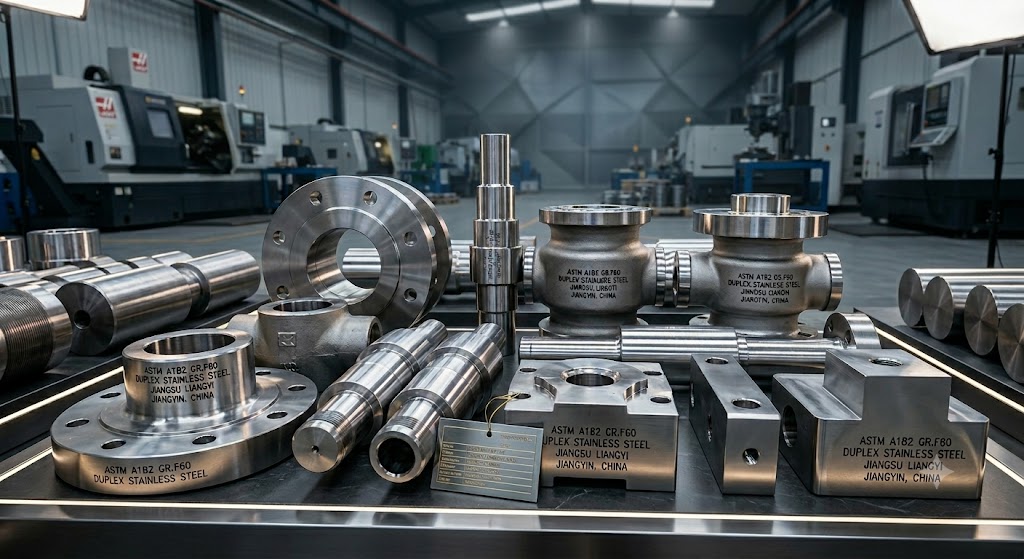
About ASTM A182 Grade F60 Material & Jiangsu Liangyi Manufacturer
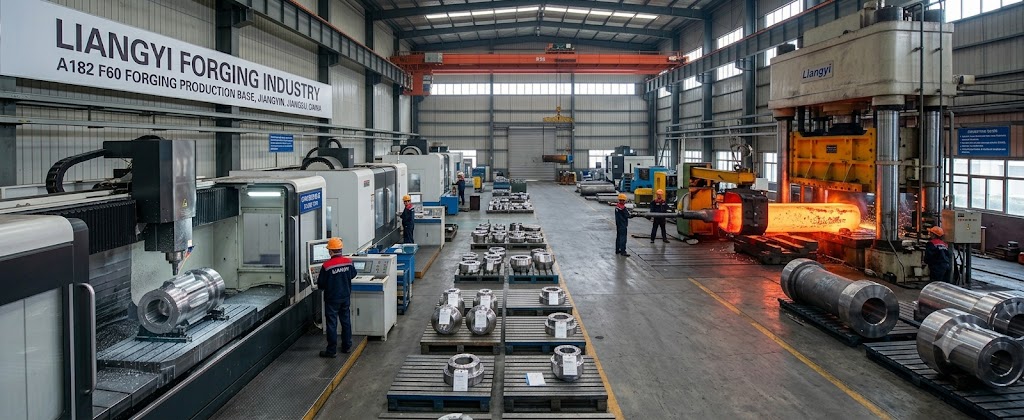
Jiangsu Liangyi Co., Limited, established in 1997, is a professional ISO 9001:2015 certified China manufacturer and global supplier of ASTM A182 Grade F60 (also referred to as A182-F60, F60, ASTM A 182 F 60) open die forging parts and seamless rolled steel forged rings. Strategically located in Chengchang Industry Park, Jiangyin City, Jiangsu Province, China, our factory covers an area of 80,000 ㎡ with original fixed assets up to 40 million USD. We provide full-process custom manufacturing from steel melting, open die forging, seamless ring rolling, heat treatment to precision CNC machining, strictly complying with international standards and client custom drawings.
Our ASTM A182 F60 forged products are exported to more than 50 countries and regions, covering core industrial markets including the European Union, North America, the Middle East, Southeast Asia, and Oceania, with successful project applications in oil & gas upstream and downstream, nuclear power generation, petrochemical, marine engineering, and industrial valve industries. As a leading Jiangsu forging factory, we are committed to delivering superior quality products and competitive pricing to global clients.
Why Global Engineers Choose Jiangsu Liangyi for A182-F60 Forgings
- Full vertical integration: EAF/AOD steel melting → open die forging (up to 30 t) → ring rolling (up to ⌀6 m) → heat treatment → CNC machining → in-house testing laboratory — all under one roof in Jiangyin, eliminating inter-supplier traceability gaps
- Duplex-specific process parameters: dedicated forging temperature windows (1050–1180°C working range), mandatory water quench protocol with 90-second transfer limit, and ASTM A923 Method B verification on every heavy heat — parameters developed specifically for S32205, not applied generically from carbon steel practice
- Zero-compromise quality documentation: In-house testing laboratory, 100% UT per ASTM A388, ferrite content measurement per ASTM E562/A923 on every heat, full furnace trace charts available
- Standards depth across industries: NORSOK M-122 (North Sea), ASME Section III (nuclear), PED 97/23/EC (EU pressure equipment), API 6A (wellhead), NACE MR0175/ISO 15156 (sour service) — experienced in producing forgings to these requirements, with documentation support available
Metallurgical Deep Dive: Why ASTM A182 Grade F60 Performs Where Others Fail
ASTM A182 Grade F60 is a premium UNS S32205 duplex stainless steel that achieves its exceptional performance by maintaining a carefully balanced two-phase microstructure of approximately equal volumes of austenite (γ) and ferrite (α). Unlike single-phase austenitic stainless steels (such as 316L), the duplex microstructure creates a natural barrier mechanism against corrosion propagation and crack growth. Understanding this metallurgy is essential for engineers specifying forgings for critical applications.
The PREN Formula and What It Actually Measures
The Pitting Resistance Equivalent Number (PREN) is the industry-standard single-number index for rating a steel's resistance to localized chloride pitting attack. For duplex stainless steels, the accepted formula is:
PREN = %Cr + 3.3 × %Mo + 16 × %N
For ASTM A182 Grade F60 at nominal mid-range composition (Cr 22.5%, Mo 3.25%, N 0.17%):
PREN = 22.5 + (3.3 × 3.25) + (16 × 0.17) = 22.5 + 10.7 + 2.7 = 35.9
Note: Nitrogen is the most cost-efficient alloying element for improving PREN. The jump from F51's minimum N of 0.08% to F60's guaranteed minimum of 0.14% adds approximately 1.0 PREN point from nitrogen alone — without any additional molybdenum or chromium cost. This is why F60 reliably achieves PREN ≥ 34 on every heat, while F51 cannot guarantee this threshold across all heats.
Ferrite Content: The Critical 35–55% Window and Its Practical Consequences
The target ferrite content for correctly processed A182-F60 forgings is 35–55% by volume, verified per ASTM E562 (metallographic point counting) or ASTM A923 Method A (sodium hydroxide etch). Deviating from this window has significant practical consequences that many suppliers fail to communicate upfront:
- Ferrite below 30%: The austenite-dominant microstructure loses the SCC resistance advantage of duplex steel. The alloy begins to behave more like a high-alloyed austenitic, losing the yield strength benefit and becoming susceptible to hydrogen embrittlement in sour service. This condition can result from insufficient solution annealing temperature (below 1040°C) or excessively slow cooling that promotes austenite re-formation.
- Ferrite above 65%: Excessive ferrite — caused by annealing temperatures above 1100°C or insufficient nickel — increases susceptibility to hydrogen-induced cracking (HIC), reduces Charpy impact toughness especially at sub-zero temperatures, and accelerates 475°C embrittlement during service at moderately elevated temperatures.
- 35–55% (the correct range): The balanced two-phase structure provides the optimal combination of SCC resistance, H₂S tolerance, impact toughness at −40°C, and mechanical strength — which is precisely why A182-F60 is universally specified for North Sea subsea equipment and sour gas processing projects.
At Jiangsu Liangyi, ferrite content is measured on every production heat using a calibrated Fischer Feritscope MP30E and cross-verified by ASTM E562 metallographic point counting for project-critical orders, with results documented on the final MTR.
Sigma Phase: The Hidden Danger in Duplex Forgings and How We Prevent It
Sigma (σ) phase is an iron-chromium-molybdenum intermetallic compound that precipitates in duplex stainless steels when the material spends time in the temperature range of approximately 600–1000°C (most rapidly at 700–900°C). Sigma phase formation depletes the surrounding matrix of chromium and molybdenum — the exact elements that provide corrosion resistance — dramatically reducing both pitting resistance and toughness. Even a small volume fraction of 1–2% sigma phase can reduce Charpy impact energy by 50% or more and lower the effective local PREN by 3–5 points.
⚠️ The Three Most Common Routes for Sigma Phase Contamination in Duplex Forgings
Based on our experience auditing material failures submitted by customers from previous suppliers, sigma phase contamination in duplex SS forgings typically originates from one of three production errors:
- (1) Insufficient annealing temperature (below 1040°C): leaves existing sigma phase undissolved. A furnace reading of 1035°C at one thermocouple location while the part is at 1020°C at its core is sufficient to prevent complete dissolution in thick sections.
- (2) Air or forced-air cooling after annealing: allows sigma phase re-precipitation during the slow passage through the sensitization range. Air cooling even 50 mm diameter bar can produce detectable sigma phase — the phase forms in minutes at 850°C.
- (3) Deformation below 900°C during forging: dynamic strain in the sensitization temperature range accelerates intermetallic formation by orders of magnitude compared to static annealing. A forging press operator who allows the billet to cool to 850°C before the final pressing blow can create localized sigma phase at the surface — even if the subsequent solution anneal is correct.
Jiangsu Liangyi's standard protocol for A182-F60 mandates: forging terminated at material temperature ≥ 950°C (verified by optical pyrometer), solution anneal at 1040–1080°C with quench tank transfer within 90 seconds, and mandatory ASTM A923 Method B Charpy impact test on all forgings exceeding 100 kg.
Core Performance Advantages Over Conventional Stainless Steel Grades
Superior Corrosion Resistance
- PREN ≥ 34, far exceeding 316L (PREN ≤ 24), with excellent resistance to chloride pitting in marine, offshore, and chemical environments
- Outstanding resistance to stress corrosion cracking (SCC) in high-temperature chloride environments — solving the most common failure mode of 304/316L stainless steel in offshore and chemical plant service
- Excellent resistance to H₂S corrosion, fully meeting NACE MR0175/ISO 15156 requirements for sour service oil and gas environments
High Mechanical Strength
The minimum yield strength of A182-F60 (450 MPa) is 2.6× that of 316L (170 MPa), enabling significant wall thickness and weight reductions for pressure-bearing components while maintaining higher safety margins. For deep-sea subsea equipment where every kilogram drives cost, this strength advantage directly reduces both material and installation costs.
Wide Service Temperature Range
Stable performance from −50°C to 300°C. At the lower end, the balanced duplex microstructure maintains adequate Charpy impact toughness at −50°C where ferritic stainless steels would undergo brittle fracture. At the upper end, 300°C represents the practical service limit before sigma phase formation rate becomes significant in long-term service.
ASTM A182 F60 vs 316L Stainless Steel — Core Performance Comparison
| Performance Index | ASTM A182 Grade F60 (UNS S32205) | 316L Austenitic SS (UNS S31603) |
|---|---|---|
| Microstructure | Duplex (α+γ), ~50/50 | Austenitic (γ single-phase) |
| Min. Yield Strength | 450 MPa (65 ksi) | 170 MPa (25 ksi) |
| Min. Tensile Strength | 655 MPa (95 ksi) | 485 MPa (70 ksi) |
| PREN | ≥ 34 | ≤ 24 |
| SCC Resistance (Cl⁻) | Excellent | Poor above 60°C / >1000 ppm Cl⁻ |
| Sour Service (H₂S) | NACE MR0175/ISO 15156 listed | Not NACE listed for H₂S service |
| Service Temp. Range | −50°C to +300°C | −196°C to +870°C (different SCC constraints) |
| Wall Thickness Saving | ~35% vs 316L at equal design pressure | Baseline |
Why Forging Outperforms Casting for Duplex Stainless Steel — A Technical Comparison
For duplex stainless steel grades like S32205, the choice between forging and casting is not merely a cost consideration — it is a fundamental material quality decision that affects PREN uniformity, impact toughness, fatigue life, and NDT reliability. Engineers specifying critical pressure-retaining components for sour service, offshore, or nuclear applications should understand the structural differences that the forging process creates at the microstructural level.
The As-Cast Segregation Problem in Duplex Stainless Steel
When duplex stainless steel solidifies from the melt, chromium and molybdenum — the two most important PREN-contributing elements — naturally segregate between the liquid and solid phases during solidification (a phenomenon called microsegregation). This creates dendritic structures where the core of each dendrite arm is depleted of Cr and Mo relative to the interdendritic regions. In a casting, these segregation bands are effectively frozen in place, regardless of subsequent heat treatment.
The practical result is significant local PREN variation across the microstructure of a cast duplex component. Even if the bulk composition tests as PREN ≥ 34 on the chemical certificate, individual dendrite core regions may locally exhibit effective PREN values of 28–30 — precisely the zones where chloride pitting initiates in aggressive environments. This is why cast duplex components frequently exhibit early pitting along segregation bands, even from heats that pass all standard chemical and mechanical acceptance criteria.
How Forging Physically Eliminates the Segregation Problem
Open die forging and seamless ring rolling impose mechanical work (plastic strain) on the heated billet, physically breaking up and dispersing the dendritic segregation bands. The mechanism operates on three levels simultaneously:
- Mechanical homogenization: Forging reduction ratios of 4:1 to 8:1 (standard at Jiangsu Liangyi for A182-F60) stretch and fragment segregated dendritic regions into thin, dispersed lamellae — small enough that thermal diffusion during the subsequent solution annealing cycle completely equalizes the composition, eliminating all local PREN variation
- Grain refinement: Dynamic and static recrystallization during hot working refines the grain size to ASTM 5 or finer (vs. typically ASTM 2–3 in castings), improving both Charpy impact toughness and fatigue crack initiation resistance
- Controlled grain flow orientation: Deliberate forging sequence orientation aligns the grain flow with the principal stress direction of the final component, maximizing fatigue life in the plane of maximum loading — a microstructural advantage that is architecturally impossible to replicate in castings
✅ Forged vs. Cast UNS S32205 — Quantified Performance Differences
| Property | Forged A182-F60 (Jiangsu Liangyi) | Cast CF-8M / A351 CD4MCu (Typical) |
|---|---|---|
| PREN Uniformity Through Section | Uniform ≥ 34 throughout | Variable 28–36 due to dendritic segregation |
| Charpy Impact (−20°C, transverse) | ≥ 60 J typical | 20–40 J typical |
| Fatigue Strength (10⁷ cycles) | ~40–45% of UTS | ~28–35% of UTS |
| Internal Porosity / Shrinkage | None — 100% UT verified to ASTM A388 | Possible without HIP post-treatment |
| Ferrite Content Consistency | 35–55% ± 3% within one heat | May vary ±8–12% across section |
| NORSOK M-122 Qualification | Products manufactured to NORSOK M-122 requirements upon request | Castings require separate M-123 pathway with additional testing |
For these reasons, NORSOK M-122, ASME Section III (nuclear), and API 6A (wellhead) all impose more stringent acceptance criteria on cast duplex components than on forgings — or require additional qualification testing. Specifying forged A182-F60 from the outset consistently reduces qualification risk, inspection cost, and in-service failure probability for critical applications.
Full A182-F60 Forging Manufacturing Process at Jiangsu Liangyi — Step by Step
Our manufacturing process for ASTM A182 Grade F60 forgings follows a rigorously controlled sequence developed and refined over 25+ years of duplex stainless steel forging experience. Every parameter — from forging temperature limits to quench transfer timing — is specifically calibrated for the metallurgical requirements of UNS S32205, not adapted from generic stainless steel procedures.
Raw Material Verification & Heat Traceability
We source S32205 steel from qualified EAF + AOD (Argon Oxygen Decarburization) steelmakers with established performance records in duplex grades, each supplied with a full heat analysis certificate. On arrival, our in-house laboratory performs incoming positive material identification (PMI) using OES (optical emission spectroscopy) to independently verify all nine required elements — with particular attention to nitrogen content, which is the element most prone to specification drift in duplex grades and the one most commonly absent from substandard suppliers' certificates. Any heat with N below 0.14% or calculated PREN below 34 is rejected before forging begins.
Ingot / Billet Soaking — Homogenization Before Deformation
The verified ingot or continuously cast billet is charged into our gas-fired soaking furnace and heated uniformly to 1150–1200°C. Minimum soak time is calculated based on cross-sectional diameter: 1 minute per millimeter of maximum section thickness, plus 30 minutes additional soak to ensure complete dissolution of any residual as-cast carbides or second-phase particles. Furnace temperature uniformity is calibrated to ±10°C per AMS 2750. Soaking records are retained as part of the traceability package.
Open Die Forging / Seamless Ring Rolling — Within the Correct Temperature Window
Forging is performed on our 31.5 MN hydraulic press (large heavy-duty components) or 16 MN press (medium components), maintaining the workpiece temperature between 1050°C and 1180°C throughout the entire forging sequence, verified by optical pyrometer at 5-minute intervals. The critical lower limit of 950°C is strictly enforced — we stop forging and return the piece to reheat before it reaches this boundary, because deforming S32205 in the 600–950°C range can mechanically assist sigma phase nucleation and create deformation-induced martensite in the austenite phase. For seamless rolled rings, our ring rolling mill achieves diameters up to 6,000 mm with a minimum wall reduction ratio of 4:1 from the preform to the final ring.
Inter-Stage Reheating (for Large Multi-Pass Forgings)
For heavy forgings requiring multiple forging passes, the workpiece is returned to the furnace for reheating to 1150°C between passes. Each reheating cycle is logged with timestamp, temperature, and cumulative pass count. Our internal process limit is a maximum of 5 reheat cycles for any single forging — beyond this, we assess grain size from a witness sample before proceeding, as excessive thermal cycling in the two-phase field can cause selective grain growth in the ferrite phase, leading to anisotropic mechanical properties.
Solution Annealing at 1040–1080°C — Precision Temperature Control
After forging is complete, all A182-F60 forgings undergo solution annealing in our calibrated furnace at 1040–1080°C. The minimum soak time is 30 minutes plus 1 minute per millimeter of maximum section thickness, ensuring complete dissolution of any sigma phase, chi phase, or secondary carbides formed during the forging sequence. For thick sections (over 150 mm), we anneal at the upper end of the range (1060–1080°C) where diffusion coefficients are higher, ensuring complete compositional homogenization across the full cross-section. Each furnace cycle generates a printed temperature-time trace chart, retained in the batch quality file.
Water Quench — Mandatory, Timed, Temperature-Controlled
Immediately upon exit from the solution annealing furnace, each forging is transferred to the quench tank within 90 seconds — a strict protocol enforced by procedural timer and operator log. The quench water temperature is maintained below 35°C by a closed-loop chiller system, with water temperature logged at transfer time. For forgings thicker than 75 mm in section, we use an agitated quench system to ensure the cooling rate through the 850–600°C sensitization range is fast enough to prevent sigma phase re-precipitation. Air cooling is explicitly prohibited for S32205 in any section exceeding 20 mm — Jiangsu Liangyi never offers air-cooled delivery for duplex grades, regardless of delivery condition wording in purchase orders.
Comprehensive Mechanical Testing, NDT & Ferrite Measurement
Following heat treatment: tensile test (ASTM E8/E8M, both longitudinal and transverse where required), Charpy V-notch impact test (EN ISO 148-1 or ASTM E23, standard at −20°C or customer-specified temperature), Brinell hardness survey (ASTM E10, minimum 3 locations per piece, additional locations for NACE orders), 100% ultrasonic testing (ASTM A388, Level 2 or 3 per customer PO), ferrite content measurement (Fischer Feritscope + ASTM E562 cross-check), surface liquid penetrant testing (ASTM E165), and ASTM A923 Method B impact test for all forgings over 100 kg. All results are recorded on the lot quality record.
CNC Precision Machining (Where Required)
Forgings requiring finished or semi-finished dimensions are machined on our CNC turning centers (maximum chuck diameter 3,500 mm), CNC boring mills, and 5-axis machining centers. Dimensional inspection is performed using Zeiss CMM (coordinate measuring machine) to 0.01 mm resolution. All machined surfaces undergo 100% liquid penetrant examination in the finished condition before shipping.
Marking, Documentation Package & Export Packaging
Each forging is permanently die-stamped or vibro-engraved with heat number, material grade (A182-F60 / S32205), and Jiangsu Liangyi's manufacturer identification code — fully traceable to the complete production and test record. The documentation package includes: EN 10204 3.1 MTR (or 3.2 for third-party witnessed orders), UT report, hardness survey with test point map, heat treatment trace chart, ferrite content result, and dimensional inspection report. Export packaging uses wooden crates with VCI (vapor corrosion inhibitor) paper lining and desiccant packs to prevent transit corrosion during ocean freight to all global destinations.
Grade Selection Guide: A182-F60, F51, F53, F55 — Which Duplex Grade is Right for Your Project?
ASTM A182 covers multiple duplex stainless steel forging grades that differ significantly in composition, corrosion resistance, cost, and processing difficulty. Choosing correctly at the specification stage prevents costly material upgrades, project delays, or in-service failures. The following guide is based on 25+ years of direct experience supplying duplex forgings to oil & gas, chemical, marine, and nuclear clients across 50+ countries.
A182 F60 — UNS S32205
"Standard Duplex / 22Cr Duplex"
PREN ≥ 34, guaranteed N ≥ 0.14%. The default choice for oil & gas sour service, offshore platforms, chemical process equipment, and valve bodies. Manufactured to meet NORSOK M-122, NACE MR0175, PED, and API 6A requirements upon project specification. Best all-round cost-to-corrosion-resistance ratio. Covers approximately 80% of all duplex forging applications worldwide.
A182 F51 — UNS S31803
"Original Duplex"
PREN typically 31–36, but N range 0.08–0.20% means individual heats can fall below PREN 34. Composition otherwise similar to F60. Only specify F51 when the procurement standard explicitly allows it and does not impose a PREN minimum. F60 is preferred for all critical applications — the price difference is negligible versus the assurance value of guaranteed PREN ≥ 34.
A182 F53 — UNS S32750
"Super Duplex 25Cr"
PREN ≥ 40. Higher Cr (24–26%), Mo (3.0–5.0%), and N than F60, providing superior pitting resistance for concentrated seawater injection, subsea umbilicals, and aggressive acid environments. Significantly more expensive, harder to weld, and more sensitive to sigma phase. Specify F53 when F60's PREN 34 is insufficient — typically seawater above 60°C or Cl⁻ exceeding 50,000 ppm.
A182 F55 — UNS S32760
"Zeron 100"
PREN ≥ 40, with additional tungsten (0.5–1.0%) and copper (0.5–1.0%) for improved crevice corrosion resistance vs F53 in stagnant seawater applications. Used for flowline connectors and downhole completion equipment in ultra-deepwater. Specify F55 for maximum crevice corrosion resistance in critical subsea crevice-prone geometries.
⚠️ Common Specification Mistake: "F51/F60" or "Duplex 2205" — These Terms Are Ambiguous
A significant portion of duplex forging purchase orders received industry-wide specify "A182 F51/F60" or merely "duplex 2205" — terms that reflect historical naming confusion between these grades. In practice: if your application requires PREN ≥ 34, always specify F60 (S32205) explicitly. If your project standard references NORSOK M-122 Grade 25Cr duplex, this maps to S32205 = F60. If your corrosion engineer specified "22Cr duplex, PREN ≥ 34," this is F60. Our technical team reviews your project standard free of charge at the inquiry stage to confirm the correct grade designation before production begins.
Full Range of Custom A182-F60 Forged Product Forms
We produce a complete line of ASTM A182 Grade F60 forged steel products with custom sizes from small precision forgings of 30 kg to large heavy-duty forgings of 30 tons, all parts fully meet the different requirements of global industrial projects. For more details, visit our Products page.
A182-F60 Forged Bars & Rods
Custom ASTM A182 F60 forged round bars, square bars, flat bars, rectangular bars, step shafts, gear shafts, and splined drive shafts, with a maximum forging diameter of up to 2,000 mm. Forged bars deliver superior properties compared to bars sawn from rolled plate: the grain flow in a correctly-forged bar follows the bar axis continuously, eliminating the cross-grain weakness that makes plate-derived bar stock susceptible to splitting under transverse tensile or impact loading. Suitable for transmission components, downhole tool mandrels, and structural members.
A182-F60 Seamless Rolled Forged Rings
Custom A182-F60 seamless rolled rings and open die forged rings, with a maximum diameter of up to 6,000 mm and a single-piece weight of up to 30 tons, including gear rings, valve seat rings, flange blanks, bearing rings, and custom contoured rolled rings. The seamless ring rolling process produces a 360° continuous circumferential grain flow — the ideal microstructural orientation for pressure-retaining rings, where hoop stress from internal pressure is the primary design driver. Seam-welded pipe or plate-rolled rings cannot replicate this grain flow advantage, which is why pressure vessel codes and NORSOK specifications mandate forgings (not weld seam assemblies) for critical ring-type components.
A182-F60 Hollow Forgings & Sleeves
ASTM A182 Grade F60 forged hubs, housing shells, sleeves, bushes, casings, heavy-wall hollow bars, and cylinders, with a maximum outer diameter of up to 3,000 mm and maximum length of 4,000 mm. Our hollow forgings are produced by piercing and mandrel drawing — a process that applies full forging reduction to the entire wall thickness, including the inner bore surface. This eliminates the dead-zone center material present in solid forgings that are subsequently drilled or bored, which typically has lower reduction ratio and poorer mechanical properties than the outer zone.
A182-F60 Forged Discs, Plates & Blocks
Custom A182-F60 forged discs, disks, blocks, plates, and blanks for valve balls, impeller blanks, tube sheets, and pressure vessel end caps, with full heat treatment and precision machining support. Maximum disc diameter: 3,500 mm. Maximum block dimensions: 2,000 × 2,000 × 500 mm. Tube sheets for duplex shell-and-tube heat exchangers represent a particularly demanding product — simultaneously sealing shell-side and tube-side at differential pressures up to 100 bar, requiring full UT examination and 100% PT of all tube hole bores after drilling.
A182-F60 Forged Pipes & Pressure Components
ASTM A182 Grade F60 forged steel pipes, tubes, tubings, piping shells, casings, barrels, and wellhead components, suitable for oil and gas gathering and transportation systems, high-pressure piping, and petrochemical process equipment. Forged pipe sections are particularly specified when seamless pipe in large wall thicknesses is unavailable in the required grade per ASTM A790, or when enhanced mechanical properties beyond the seamless pipe standard are required by the project specification.
Chemical Composition of ASTM A182 Grade F60 (UNS S32205)
The chemical composition of our ASTM A182 Grade F60 forgings strictly meets the ASTM A182 standard, with strict element control ensuring stable material performance and PREN ≥ 34 on every heat. All composition tests are performed in accordance with ASTM E 353 (spectrochemical methods) or equivalent analytical methods acceptable to the purchaser. For more material grades, visit our Materials page.
| Element | Symbol | Specification Limit (wt%) | Role in Alloy Performance |
|---|---|---|---|
| Carbon | C | 0.030 max | Low C prevents sensitization; carbide formation at grain boundaries must be avoided to protect corrosion resistance |
| Manganese | Mn | 2.00 max | Austenite stabilizer; limited to avoid adverse effect on corrosion resistance at higher levels |
| Phosphorus | P | 0.030 max | Impurity element; segregates to grain boundaries under thermal cycling, reducing low-temperature toughness |
| Sulfur | S | 0.020 max | Impurity element; forms MnS inclusions which act as preferential pitting initiation sites in chloride environments |
| Silicon | Si | 1.00 max | Deoxidant during melting; high Si content above 0.8% can accelerate sigma phase formation during service at 300–800°C |
| Nickel | Ni | 4.5 – 6.5 | Primary austenite stabilizer; controls the ferrite/austenite phase balance to the target 35–55% ferrite range |
| Chromium | Cr | 22.00 – 23.00 | Primary corrosion resistance element; largest single contributor to PREN (1:1 weight ratio in formula) |
| Molybdenum | Mo | 3.00 – 3.50 | Pitting and crevice corrosion resistance (3.3× weight ratio in PREN formula); critical for sour service performance |
| Nitrogen | N | 0.14 – 0.20 | Most efficient PREN contributor (16× weight ratio in formula); also stabilizes austenite and solid-solution strengthens. Min. 0.14% is the defining difference between F60 (S32205) and F51 (S31803). |
Mechanical Properties, Heat Treatment & Inspection Standards
All our A182-F60 forged parts are delivered in solution annealed and water quenched (SA + WQ) condition, with 100% performance testing ensuring full compliance with ASTM A182 standard requirements and client-specific additional requirements.
| Mechanical Property | ASTM A182 F60 Minimum Requirement | Jiangsu Liangyi Typical Achieved Values |
|---|---|---|
| Tensile Strength | 655 MPa (95 ksi) | 700–800 MPa |
| Yield Strength (0.2% offset) | 450 MPa (65 ksi) | 490–580 MPa |
| Elongation (GL = 4D or 50 mm) | 25% min | 28–35% |
| Reduction of Area | 45% min | 55–70% |
| Hardness | 290 HB max | 240–275 HB typical |
| Charpy Impact (−20°C, transverse) | Per customer specification / ≥ 41 J typical | 60–120 J (ASTM A923 Method B) |
| Ferrite Content | 35–55% (ASTM A923/E562) | 38–52% typical |
Strict Inspection & Test Standards Applied at Jiangsu Liangyi
- Chemical Composition: ASTM E 353 / OES — all 9 elements reported; nitrogen verified by carrier gas fusion technique for highest accuracy; full MTR provided
- Tensile Testing: EN ISO 6892-1 (room temperature) — longitudinal and transverse specimens available; high temperature tensile test support to 300°C
- Impact Testing: ASTM E23 / EN ISO 148-1 — Charpy V-notch; standard test temperature −20°C; −40°C and lower available on request
- Hardness Testing: ASTM E10 (Brinell) — minimum 3 test locations per piece; full circumferential survey on NACE-critical components
- Ferrite Content: Fischer Feritscope MP30E + ASTM E562 metallographic point counting — per piece for all NORSOK M-122 requirement orders and sour service orders
- Ultrasonic Testing (UT): ASTM A388 — 100% volumetric scan; acceptance level per customer PO (Level 2 standard; Level 3 available)
- Liquid Penetrant Testing (PT): ASTM E165 — 100% of all machined and as-forged surfaces per customer requirement
- ASTM A923 Method B (Charpy at −40°C): Detection of deleterious intermetallic phases — mandatory for all forgings over 100 kg at Jiangsu Liangyi
- Intergranular Corrosion Test: ASTM A262 Practice E (Strauss test) — available for orders requiring explicit sensitization freedom verification
- Grain Size: ASTM E112 — reported on MTR for critical orders and NORSOK applications
- Macroetch: ASTM A604 — available for large ring and disc forgings to verify macro-segregation freedom
Engineering Design & Specification Guidance for A182-F60 Forgings
Based on decades of experience supporting engineering teams across oil & gas, power, and chemical industries, Jiangsu Liangyi has compiled the following practical guidance. These points frequently create problems in the field when overlooked at the purchase order specification stage.
Writing a Complete A182-F60 Forging Purchase Order Specification
A poorly written purchase order leads to either over-testing (wasting cost and schedule) or under-specification (accepting non-conforming material). A complete A182-F60 forging specification should explicitly state:
- Material grade: "ASTM A182 Grade F60, UNS S32205" — not "F51/F60," not "duplex 2205" alone, as these are ambiguous
- Heat treatment: "Solution annealed at minimum 1040°C, water quenched" — state explicitly even though it is the standard condition, to prevent air-cooled deliveries from lower-quality suppliers
- PREN minimum: "Calculated PREN ≥ 34 using formula %Cr + 3.3×%Mo + 16×%N, computed from heat certificate composition and reported on MTR" — enforces N minimum compliance
- Ferrite content: "35–55% per ASTM E562 or Feritscope, measured and reported on MTR" — critical for sour service and NORSOK orders; without this, you cannot verify the heat treatment was correct
- NACE hardness: For sour service, add "Maximum hardness 28 HRC (approximately 270 HB) at all locations, measured per NACE MR0175 Annex A protocol"
- Impact testing: State temperature, acceptance energy, specimen orientation, and test standard: e.g., "Charpy V-notch ≥ 41 J at −20°C, transverse orientation, per ASTM E23"
- NDT: "100% UT per ASTM A388, Level 2 acceptance. 100% PT per ASTM E165, no linear indications acceptable" — or reference your company UT specification number
- Certification level: "EN 10204 3.1 MTR" (standard) or "EN 10204 3.2 with third-party witness by [DNV-GL / Bureau Veritas / TÜV]" for project orders
NACE MR0175/ISO 15156 Compliance — What It Actually Requires from the Forging
NACE MR0175/ISO 15156-3 Table A.3 lists UNS S32205 (the alloy for A182-F60 forgings) as acceptable for sour service with the following mandatory conditions — all of which must simultaneously be met:
- Maximum hardness: 28 HRC at all locations, per NACE MR0175 Annex A measurement protocol (specific indenter load 150 kgf, minimum 5 test locations per piece, including sub-surface locations on finished machined parts)
- Ferrite content: 35–65% — the standard allows up to 65%, but the more conservative 35–55% window is typically specified by major oil company operators for additional margin
- Heat treatment condition: solution annealed only — stress-relief heat treatments are not permitted as they may cause sensitization in the 300–600°C range
- Material must not have been cold-worked more than 5% after final heat treatment — cold straightening or light sizing operations above this level require re-annealing
Practical Service Temperature Limits: Beyond the "−50°C to 300°C" Simplification
The commonly cited service range for S32205 deserves more nuanced guidance for design engineers:
- Below −50°C: The ferrite phase of duplex SS undergoes ductile-to-brittle transition at cryogenic temperatures. For continuous service below −50°C, super austenitic or nickel alloy forgings are the appropriate material family.
- 250–300°C continuous service: This temperature range is generally acceptable, but long-term service (20+ years) at 250–300°C may accumulate low levels of spinodal decomposition in the ferrite phase. For critical components planned for 20+ year service at these temperatures, consider specifying lower test temperature (−40°C Charpy) at delivery to provide additional toughness margin and periodic in-service inspection intervals.
- Above 300°C: Sigma phase formation rate increases significantly above 300°C. For process equipment operating above this boundary, austenitic grades (310S, 904L) or nickel alloys are the correct material selection — not duplex grades.
MTR Procurement Verification Checklist — 12 Items to Check Before Accepting A182-F60 Forgings
A Mill Test Report (MTR) for ASTM A182 F60 forgings should contain substantially more information than a simple chemical and tensile result. Based on 25+ years of reviewing supplier MTRs for global engineering clients, the following are the items most frequently missing from substandard documentation packages — and why each matters for material performance assurance:
- Physical Heat Number Traceability: Every forging must carry a die-stamped or vibro-engraved heat number matching the MTR. Without stamped physical-to-document traceability, the certificate is legally and technically unverifiable. Always confirm the stamp on the physical piece matches the heat number on the certificate before releasing for fabrication.
- Complete Chemical Analysis — All 9 Required Elements: ASTM A182 F60 requires reporting of C, Mn, P, S, Si, Ni, Cr, Mo, and N. Many substandard MTRs omit nitrogen entirely, or list it as "<0.25%" without a minimum figure. A missing or vague N value makes PREN calculation impossible — this alone is grounds for MTR rejection for sour service or NORSOK applications.
- Calculated PREN Value (or Verification That You Calculate It): Reputable manufacturers include the calculated PREN on the MTR. If absent, calculate it yourself using %Cr + 3.3×%Mo + 16×%N from the reported composition. Any PREN below 34 is non-conforming for F60 (S32205) regardless of what the grade designation field states.
- Heat Treatment Record — Temperature, Soak Time, and Cooling Method: The MTR should indicate the actual solution annealing temperature range, minimum soak time, and cooling method.“Solution annealed per ASTM A182” alone is not sufficient – ask for the furnace trace chart for NORSOK or sour service critical orders. If the certificate mentions “annealed” and does not mention “water quenched”, then question it immediately.
- Complete Tensile Test Results: Tensile strength, 0.2% offset yield strength, elongation, and reduction of area must all be individually reported. Verify each value against F60 minimums separately — a part can pass tensile strength while failing yield strength if the cold work level is incorrect, for example.
- Hardness Results with Test Locations Specified: A single hardness value with no test location information is inadequate for NACE MR0175 compliance. The report should state number of test locations, their positions on the forging (e.g., OD mid-length, ID bore, face), and the hardness value at each location. Request a hardness location map for NACE-critical components.
- Ferrite Content Measurement Result: For NORSOK M-122 and NACE MR0175 applications, a ferrite content result (35–55% or 35–65% per NACE) measured per ASTM E562 or calibrated Feritscope is mandatory. This is the single most commonly missing item on duplex stainless steel MTRs from lower-tier suppliers — its absence indicates the supplier did not verify heat treatment adequacy beyond tensile and hardness testing.
- UT Report Reference Number with Coverage Statement: The MTR should include the UT report number. If the application is critical, ask for the UT report. Check to see that the report contains: 100% coverage, not partial. The frequency of the probe used (usually 2-4 MHz for duplex forgings). The acceptance level (Level 2 or Level 3 per ASTM A388 or customer specification).
- Dimensional Inspection Report or Reference Number: Dimensional inspection shall be documented by the final measured dimensions or reference to the dimensional inspection report number. For machined forgings, all main dimensions (OD, ID, length, concentricity of bore, key tolerances) are measured and recorded individually.
- Performing Laboratory Identification and Accreditation Status: For EN 10204 3.1, the test laboratory must be separate from the production department. For EN 10204 3.2, it must be independent from the manufacturer. Verify the laboratory name appears on the MTR, and for critical applications, confirm its ISO/IEC 17025 accreditation status for the relevant test methods.
- ASTM A923 Result for Heavy Sections: For forgings over 100 kg, confirm whether ASTM A923 Method B (Charpy impact at −40°C to detect intermetallic phases) has been performed. This is the only production-practical method to confirm freedom from sigma phase short of sending a cross-section for full metallographic examination. If absent for thick-section sour service components, request it — the additional cost is minor relative to the assurance value.
- Third-Party Inspector Stamp and Signature for EN 10204 3.2: A document labeled "EN 10204 3.2" is only legally valid if it bears both the manufacturer's quality authority signature AND the independent inspector's stamp and signature with their inspector ID number. A "3.2" certificate bearing only the manufacturer's signature — without an independent inspector's mark — is in fact only a 3.1 certificate regardless of the document label. Always verify the inspector's identity and confirm their affiliation with the named third-party inspection body.
Jiangsu Liangyi's standard MTR package covers all 12 items above as a minimum. For project orders requiring NORSOK M-122 documentation, we provide an additional documentation dossier including furnace calibration records, UT equipment calibration certificates, and inspector qualification records (ISO 9712 Level II or III).
Global Industrial Applications & Project Cases of A182-F60 Forgings
Our ASTM A182 Grade F60 forged parts are widely used in global critical industrial projects with demanding working conditions. For more project references, visit our Reference page.
Oil & Gas Upstream & Downstream Industry
A182-F60 is the core material for global oil and gas pressure-retaining equipment. Our forgings have been successfully applied in onshore sour gas projects in the Middle East (H₂S partial pressures up to 2 bar, Cl⁻ up to 150,000 ppm), deep-sea oil and gas projects in the North Sea (water depth up to 300 m, products manufactured to NORSOK M-122 requirements), and unconventional oil and gas projects in North America. Core applications include:
- Wellhead equipment: forged Christmas trees, wellhead spool bodies, casing heads, tubing heads, casing hangers, tubing hangers — manufactured to API 6A dimensional and material requirements
- Drilling equipment: drill collars, downhole mud motor splined drive shafts, downhole ESP components, risers, connectors
- Blowout prevention (BOP) equipment: BOP bodies, RAM and annular BOP blocks — manufactured to NORSOK M-122 material and inspection requirements upon project specification
- Valve components: forged valve balls, bonnets, bodies, stems, seat rings, and cores for ball valves, gate valves, check valves, and choke valves in oil gathering and transportation systems
Nuclear Power Generation Industry
Our A182-F60 forged parts are applied in nuclear power projects in Asia and Europe, meeting the strict safety and quality requirements of the nuclear power industry. Nuclear applications impose additional requirements beyond oil & gas practice: material pedigree must be traceable to original melt heat, all test laboratory equipment must be calibrated to national standards, and qualified welding procedure specifications per ASME Section IX are required for any joining operations. Core applications include nuclear reactor coolant pump casings, containment seal chambers, pressure vessel nozzles, and critical structural components — manufactured to ASME Section III nuclear power standard requirements upon project-specific documentation agreement.
Petrochemical & Pressure Vessel Industry
We supply A182-F60 forged components for petrochemical projects in Southeast Asia and the European Union, including tube sheets, baffle plates, nozzles, channel flanges, and transition cones for heat exchangers, pressure vessels, reactors, and heaters. Tube sheets in large diameter (up to 2,500 mm) forged from A182-F60 represent one of our highest-volume product lines — these components must simultaneously resist corrosion on both shell-side and tube-side surfaces in chemical process fluids, while maintaining dimensional flatness within 0.5 mm over their full face for reliable tube-to-tubesheet seal integrity. Documentation packages supporting PED 97/23/EC requirements available for EU projects upon request.
Turbomachinery & Power Generation Equipment
Our A182-F60 forgings are used in thermal power plants and renewable energy projects in Asia, including turbine and compressor labyrinth shaft seals, turbo centrifugal compressor impellers, and shrouded impellers. Impellers represent our most geometrically complex A182-F60 forgings — produced from a contoured ring-rolled preform followed by precision CNC profiling of the blade geometry, with blade root radii held to ±0.1 mm tolerance and 100% dye-penetrant inspection of all finished surfaces including internal flow passages.
Industrial Valve & Flow Control Industry
We provide A182-F60 forged parts for global valve manufacturers, including butterfly valve main shafts, cryogenic high-performance butterfly valve components, oil measurement valve spools, ultrasonic flow meter bodies, venturi cone meter bodies, double studded adapter flanges, and integral flanged outlets, suitable for high-pressure, cryogenic, and corrosive flow control applications. The valve bodies are normally manufactured from a forged billet in duplex stainless steel, machined to near-net shape, with the grain flow aligned perpendicular to the sealing face in order to optimize the fatigue life in the direction of the maximum stress.
Quality Assurance & International Certifications
Jiangsu Liangyi maintains a complete quality management system and holds full international certifications covering all major global industrial markets for A182-F60 duplex stainless steel forgings.
Our quality management system is certified to ISO 9001:2015, covering the full production scope from raw material procurement, open die forging, heat treatment, and CNC machining through to final inspection, packaging, and delivery. In addition, we operate to ISO 14001 (environmental management) and ISO 50001 (energy management) standards.
Standards Our Products Are Manufactured To
While the certifications listed above represent our independently audited management system credentials, our production team has extensive experience manufacturing forgings to meet the inspection, testing, and documentation requirements of the following international project standards. Documentation packages aligned to these standards are available upon request:
- NORSOK M-122 (Norwegian Continental Shelf / North Sea) — experienced in supplying forgings with the full NORSOK M-122 inspection and documentation package: chemical traceability, PREN calculation, ferrite content per ASTM E562, ASTM A923, and third-party witness inspection
- NACE MR0175 / ISO 15156 (sour service) — products can be manufactured and documented to meet all UNS S32205 requirements in NACE MR0175/ISO 15156-3 Table A.3, including hardness ≤ 28 HRC, ferrite 35–65%, solution annealed and water quenched condition
- ASME (North American market) — familiar with ASME material and documentation requirements; ASME Section IX welding procedure support available through qualified partners
- PED 97/23/EC (EU pressure equipment) — documentation packages supporting PED compliance available; CE marking requires engagement of an EU-based Notified Body, which we can facilitate at customer request
- API 6A (wellhead equipment) — products manufactured to API 6A dimensional and material requirements; note that API Monogram stamping requires a licensed API manufacturer
Third-Party Inspection Support
All A182-F60 forged steel parts are supplied with EN 10204 3.1 mill test certificate as standard. For project orders requiring independent witness inspection, we welcome and support access by third-party inspection bodies including DNV-GL, Bureau Veritas, Lloyd's Register, ABS, RINA, and TÜV. These are commercial inspection services that customers arrange directly — the EN 10204 3.2 certificate is then issued jointly by our quality authority and the inspector's representative.
Frequently Asked Questions (FAQ) for Global Buyers
Inquiry & Contact Information
Jiangsu Liangyi Co., Limited is a professional ISO 9001:2015 certified China manufacturer of custom ASTM A182 Grade F60, A182-F60, and F60 duplex stainless steel forged parts, with 25+ years of forging experience and full in-house production capacity from steel melting through precision CNC machining. Our products are manufactured to meet international project standards including NORSOK M-122, NACE MR0175, ASME, PED, and API requirements. Strategically located in Jiangyin, Jiangsu, China, we welcome global clients, engineering companies, EPC contractors, and distributors to contact us with your custom drawings, material specifications, quantity requirements, and project details for a detailed and competitive quotation.
Our technical sales team can assist — free of charge prior to purchase order — with: duplex grade selection (F51/F60/F53/F55), purchase order specification writing, documentation review for NORSOK M-122 / NACE / PED / ASME project requirements, dimensional feasibility assessment for large or complex forgings, and preliminary delivery schedule evaluation.
📧 Inquiry Email: sales@jnmtforgedparts.com
📞 Phone / WhatsApp: +86-13585067993
🌐 Official Website: www.jnmtforgedparts.com
📍 Factory Address: Chengchang Industry Park, Jiangyin City, Jiangsu Province 214400, China
⏰ Business Hours: Monday – Friday, 08:00 – 18:00 (UTC+8 / China Standard Time)