ISO 9001:2015 Certified
25+ Years Experience
Export to 50+ Countries
120,000 Tons Annual Capacity
Up to 30 Tons Single Piece
EN 10204 3.1 MTC Standard
Product Overview of Inconel 706 (Alloy 706 / UNS N09706)
📋 Inconel 706 Quick Reference Facts
- Common Names:
- Inconel 706, Alloy 706, UNS N09706, W.Nr. 2.4615
- Alloy Type:
- Nickel-Iron-Chromium precipitation-hardenable superalloy
- Key Elements:
- Ni 39–44%, Cr 14.5–17.5%, Nb 2.5–3.3%, Ti 1.5–2.0%, Fe (balance)
- Max Service Temp:
- 650°C (1200°F) continuous; 750°C short-term peak
- Tensile Strength:
- Min 1245 MPa (180.5 Ksi) after standard heat treatment
- Yield Strength:
- Min 979 MPa (142 Ksi) at 0.2% offset
- Key Advantage:
- Better fabricability & weldability vs. Inconel 718 at equivalent high-temp strength
- Standards:
- ASTM B905, AMS 5547 (material specifications products can comply with); ISO 9001:2015 certified factory
- Manufacturer:
- Jiangsu Liangyi Co., Limited — Jiangyin, Jiangsu, China (Est. 1997)
- Product Range:
- Open die forgings, seamless rolled rings up to ⌀6m, 30kg–30 tons per piece
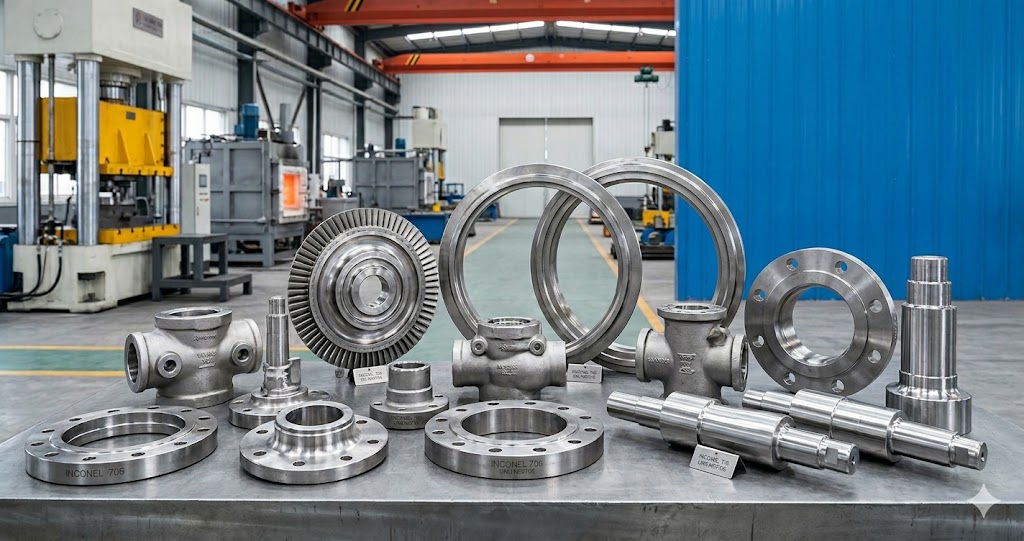
Inconel 706is a nickel-iron-chromium based precipitation-hardenable superalloy, engineered to deliver exceptional mechanical Jiangsu Liangyi Co., Limited is an ISO 9001:2015 certified professional manufacturer of Inconel 706 (also commonly called Alloy 706, UNS N09706) open die forging parts and seamless rolled forged rings, based in Jiangyin, Jiangsu, China. With more than 25 years of specialized experience in superalloy forging, we supply custom Inconel 706 forged parts to customers in over 50 countries across North America, Europe, the Middle East, Southeast Asia and Oceania.
Inconel 706 is a precipitation-hardened superalloy made of nickel, iron and chromium. It is designed to provide excellent mechanical strength, strong resistance to creep and rupture, good forming and welding performance, and high stability during long-term use in extreme high-temperature and high-pressure environments. It is widely accepted as the top material choice for critical rotating and pressure-retaining parts in heavy industry around the world.
Key Designation Cross-Reference: Inconel 706 = Alloy 706 = UNS N09706 = W.Nr. 2.4615
Core Advantages of Inconel 706 Alloy vs. Similar Superalloys
Compared with the widely used Inconel 718, Inconel 706 keeps equivalent high-temperature strength and creep resistance, while offering significant advantages for forging and machining processes, making it the cost-effective choice for large-scale industrial parts:
Superior Fabricability
It has lower forging deformation resistance, a wider hot working temperature range, and better filling ability for complex-shaped forgings. This reduces production difficulty and defect rates for large turbine discs and heavy valve parts made in our factory in Jiangyin, Jiangsu.
Excellent Machinability
It reduces tool wear and improves cutting performance, greatly lowering machining costs for large and complex parts, while ensuring higher dimensional accuracy and better surface finish for critical sealing and rotating parts.
Outstanding Weldability
It has lower risk of cracking after welding, and does not need complex preheating or post-weld heat treatment for most uses. This greatly improves production efficiency for welded structural parts in gas turbines and compressors.
Exceptional High-Temperature Stability
It offers excellent creep and fatigue resistance during long-term operation at temperatures up to 650°C, keeping stable mechanical properties without phase change, ensuring a service life of over 10 years for power generation equipment.
Global Standards Compliance for Inconel 706 Forgings
Our Inconel 706 forged parts can be manufactured to meet the material and inspection requirements of the following international standards. Please note: ISO 9001:2015 is our company quality management certification. The remaining items are product/material specifications or inspection standards that our products can comply with — they are not independently held company certifications:
- 🏅 ISO 9001:2015: Our factory quality management system certification (company-level, independently held)
- 📋 EN 10204 3.1: Mill Test Certificate standard — issued as standard with every order
- 📋 EN 10204 3.2: Third-party witnessed inspection certificate — available on request via approved TPI bodies
- 📋 ASTM B905: Standard Specification for Precipitation Hardening Nickel Alloy Forgings — products can be manufactured and tested to this specification
- 📋 AMS 5547: Aerospace Material Specification for Nickel Alloy Forgings — products can be manufactured to meet this material specification
- 📋 API 6A: Wellhead and Christmas Tree Equipment specification — products can be manufactured to API 6A material and dimensional requirements upon customer request
- 📋 NACE MR0175 / ISO 15156: Materials standard for sour service (H₂S environments) — products can be manufactured to comply with material requirements including hardness limits
- 📋 DIN EN / JIS Standards: European and Japanese standard equivalents — available upon request for specific markets
Transparency Statement: We clearly distinguish between certifications our company holds and product standards our forgings can meet. If you need specific third-party certification or witnessed testing beyond EN 10204 3.1, please let us know when you send your inquiry, so we can make the necessary arrangements and give you an accurate lead time and cost quote.
Inconel 706 vs 718 vs 625 vs Waspaloy: Complete Alloy Selection Guide
Choosing the wrong nickel superalloy wastes both time and money. Using an alloy with more performance than needed leads to unnecessary costs, while using one with insufficient performance risks early part failure. With more than 25 years of supplying forged superalloy parts to global turbine OEMs and EPC contractors, our engineering team at Jiangsu Liangyi has put together this practical comparison. The data comes from real forging and production experience, not just textbook figures.
Side-by-Side Technical Comparison
| Parameter | Inconel 706
(UNS N09706) | Inconel 718
(UNS N07718) | Inconel 625
(UNS N06625) | Waspaloy
(UNS N07001) |
|---|
| Alloy System | Ni-Fe-Cr + Nb+Ti (γ″+γ′) | Ni-Fe-Cr + Nb+Mo (γ″+γ′) | Ni-Cr-Mo (solid solution) | Ni-Cr-Co + Ti+Al (γ′) |
| Max Continuous Service Temp | 650°C (1200°F) | 704°C (1300°F) | 982°C (1800°F)* | 760°C (1400°F) |
| Room-Temp UTS (MPa) | 1245–1380 | 1275–1450 | 830–930 | 1275–1450 |
| 650°C UTS (MPa) | 1020–1100 | 1030–1120 | 620–700 | 1100–1200 |
| Hot Forging Window | 900–1120°C (Wide) | 954–1066°C (Narrow) | 900–1200°C (Wide) | 982–1121°C (Moderate) |
| Forging Difficulty | ★★☆☆☆ Low | ★★★★☆ High | ★★☆☆☆ Low | ★★★★★ Very High |
| Machinability Index | ~20% of carbon steel | ~15% of carbon steel | ~18% of carbon steel | ~12% of carbon steel |
| Weldability | ★★★★★ Excellent | ★★★☆☆ Moderate | ★★★★★ Excellent | ★★☆☆☆ Difficult |
| Post-Weld Heat Treatment | Usually not required | Required in most cases | Not required | Mandatory |
| Corrosion Resistance | Very Good | Good | Excellent (seawater/acid) | Moderate |
| Relative Forging Cost (Large Parts) | ★★☆☆☆ Low | ★★★★☆ High | ★★★☆☆ Moderate | ★★★★★ Very High |
| Typical Large Forging Weight | Up to 30 tons | Usually <5 tons | Up to 20 tons | Usually <3 tons |
*Inconel 625's 982°C rating applies to oxidation resistance only; structural strength is lower than precipitation-hardened alloys at high temperature.
From our production floor: Inconel 718 has a narrow hot-working range of only about 112°C. This means large ingots need to be reheated several times during forging, which raises the risk of die chilling and surface cracks on thick parts. Inconel 706 has a much wider range of around 220°C, allowing us to finish large-diameter disc forgings with fewer heating cycles. This directly results in a lower reject rate and faster delivery for your project.
Application Decision Matrix: When to Choose Which Alloy
✅ Choose Inconel 706 When…
Large Diameter Turbine Discs (⌀ > 600mm)
706's superior forgeability makes it the only economically viable choice at this size. Large 718 discs carry significant scrap risk and cost premium.
Welded Structural Assemblies
Whenever your design requires welding after forging — valve bodies, turbine casings, pressure vessels — 706 eliminates the strain-age cracking risk that plagues 718 welds.
Service Temperature ≤ 650°C
For steam/gas turbine components operating in the 300–650°C range, 706 matches 718 strength at significantly lower fabrication cost. No performance is sacrificed.
High-Volume Production Runs
Better machinability means 15–25% faster cycle times vs 718 on CNC equipment. For 50+ piece orders, this saves weeks of lead time.
⚠️ Consider an Alternative When…
Service Temp Exceeds 700°C → Waspaloy or IN738
Above 700°C, 706's γ″ precipitates begin to dissolve. Waspaloy's γ′ strengthening mechanism is more thermally stable. Switch alloys, not suppliers.
Seawater / Aggressive Acid Immersion → IN625
When the primary threat is pitting, crevice corrosion, or acidic media (not mechanical load), IN625's high Mo content offers superior protection.
Ultra-Precision Small Parts (< 5kg) → IN718
For small, complex aerospace precision parts where absolute maximum strength and fatigue life are the driver (not fabrication cost), IN718 remains the benchmark.
Temperature Exceeds 760°C Continuously → Rene 41
Extreme high-temperature environments beyond 706's stable range require refractory-strengthened or cobalt-based systems.
Custom Inconel 706 Forged Parts We Supply from China
Available Forged Shapes & Forms of Inconel 706
We manufacture a full range of custom Inconel 706 forged parts in strict accordance with international standards and client drawings, covering all types of open die forgings and seamless rolled rings, with single-piece weight capacity from 30kg to 30 tons. Our available product forms include:
- Inconel 706 forged steel round bars, square bars, flat bars, rectangular bars and rods (max diameter up to 2000mm)
- Alloy 706 seamless rolled rings, contoured forged rings and open die forged rings (max diameter up to 6000mm)
- UNS N09706 forged hubs, housings, shells, sleeves, bushes, casings and hollow bars (max OD up to 3000mm)
- Inconel 706 forged discs, disks, blocks, plates and flanged blanks (max diameter up to 3000mm)
- Alloy 706 forged pipes, tubes, tubing and pressure vessel shells for high-temperature corrosive service
- Custom machined Inconel 706 forged components according to your 2D/3D drawings
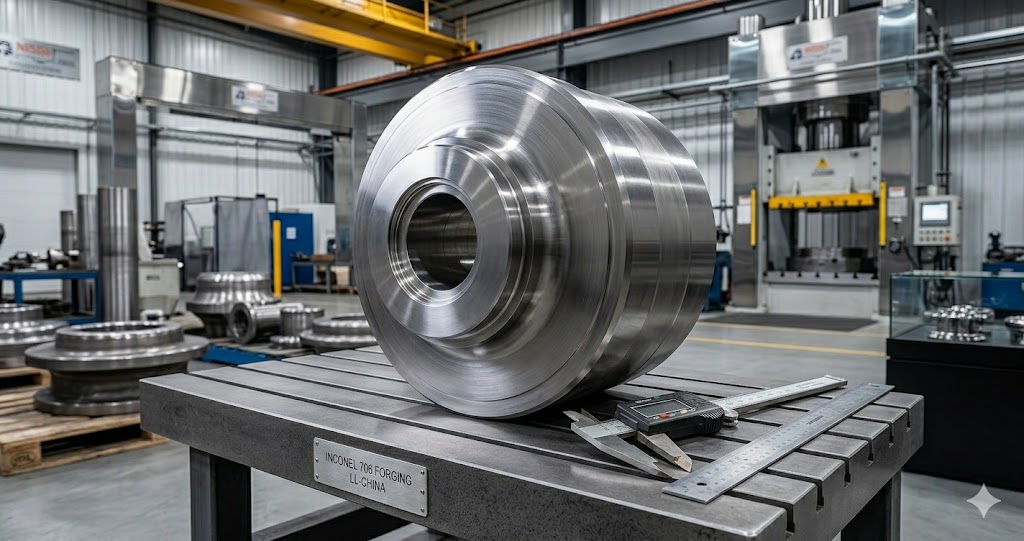
Full Manufacturing Capability for Inconel 706 Forgings in Jiangyin, China
As a leading China-based Inconel 706 forging manufacturer with in-house full production chain, we provide one-stop solutions from raw material melting, forging, heat treatment, precision machining to final inspection, ensuring full traceability and quality control for every batch of products. Our core production and inspection equipment for Inconel 706 forgings include:
Forging & Production Equipment at Our Jiangsu Factory
- 2000T, 4000T, 6300T Hydraulic Forging Presses for open die forging of large-scale Inconel 706 components
- 1M & 5M Seamless Ring Rolling Machines for Alloy 706 seamless rolled rings up to 6 meters in diameter
- 3T & 5T Electro-hydraulic Forging Hammers for precision forging of small and medium-sized UNS N09706 parts
- 30T Electric Arc Furnace (EAF), Ladle Refining Furnace (LF), Vacuum Degassing Furnace (VOD) for premium Inconel 706 ingot melting
- 10+ Continuous Heat Treatment Furnaces with full temperature-time automatic recording for precise precipitation hardening of Inconel 706
- CNC machining centers for finish machining of Inconel 706 forged parts with high dimensional accuracy
Quality Inspection & Testing Equipment
- Full set of Non-Destructive Testing (NDT) Equipment: Ultrasonic Testing (UT), Magnetic Particle Testing (MT), Penetrant Testing (PT)
- Chemical Composition Analysis Equipment for precise element control of Inconel 706 material
- Room & High Temperature Mechanical Testing Machines, including tensile, impact, creep and fatigue testing equipment
- Metallographic Microscope for microstructure analysis of heat-treated Inconel 706 forgings
Inconel 706 Forging Process Window & Metallurgical Mechanism
Understanding why Inconel 706 acts the way it does during forging — not just the process steps — is what makes a high-quality forged part better than a just acceptable one. Below is our complete production process for Inconel 706 open die forgings, including the metallurgical reasons behind each key control point, based on over 25 years of superalloy forging experience at our Jiangyin factory.
Why Inconel 706 Is More Forgeable Than Inconel 718: The Metallurgical Reason
Both alloys get stronger through precipitation hardening, but in slightly different ways. The γ″ (gamma double-prime, Ni₃Nb body-centered tetragonal) precipitates are what make Inconel 718 work. These come together quickly and are very hard to change shape when hot working. Inconel 706, on the other hand, has a more even mix of γ″ + γ′ (gamma-prime, Ni₃(Ti,Al) face-centered cubic). This dual-phase system gives a wider hot-deformation range of approximately 900–1120°C, compared to only around 954–1066°C for IN718.For large forgings, this wider range means fewer reheating cycles, lower risk of die chilling, and much less surface cracking on thick-section parts.
At our Jiangsu forge, we have forged Inconel 706 turbine disc blanks up to ⌀1800 mm in a single heating cycle. The same part made from Inconel 718 would need two extra reheats. This is a significant difference — for a 15-ton disc, each avoided reheat saves about 6–8 hours of furnace time and reduces thermal oxidation scale on the surface.
Full Production Process: Inconel 706 Open Die Forging at Jiangsu Liangyi
Step 1 — Raw Material VIM + VAR / ESR Double Melting Ingot Qualification
All our Inconel 706 ingots come from suppliers that use Vacuum Induction Melting (VIM), plus either Vacuum Arc Remelting (VAR) or Electroslag Remelting (ESR).Double-melted ingots have much lower segregation, fewer inclusions, and more uniform microstructure compared to single-melt material — this is essential for rotating turbine parts. Every ingot receives full chemical analysis, macro-etch inspection, and ultrasonic testing before it enters our production line.
1150–1180°C / 10–24 hrs Ingot Homogenization (Soaking)
The ingot is soaked at 1150–1180°C for 10–24 hours (depending on section diameter) in our programmable continuous furnaces to eliminate solidification segregation of niobium and titanium. Insufficient homogenization often causes banding defects in finished forgings — our 4-hour temperature-hold verification before forging starts eliminates this risk. For each heat, cross-section temperature uniformity within ±10°C is verified using internal thermocouple data.
1050–1120°C Start / ≥900°C Finish Open Die Forging / Ring Rolling — Controlled Temperature Window
Forging starts at 1050–1120°C. A key control point is the minimum finish-forging temperature of 900°C — below this temperature, deformation resistance rises sharply and surface cracking becomes much more likely. Our press operators use calibrated infrared pyrometers for each forging pass. For large discs needing multiple forging steps, intermediate reheating to 1050°C is carried out as required. All Inconel 706 parts have a minimum forging ratio of 3:1, ensuring sufficient grain refinement and consistent mechanical properties across the entire section.
Controlled Air / Furnace Cool Post-Forge Cooling Control
After final forging, Inconel 706 must be cooled at a controlled rate to prevent thermal stress cracking in thick sections and to avoid uncontrolled early precipitation of the δ (delta) phase, which can pin grain boundaries and lower impact toughness. For sections over 200 mm, we cool the parts in the furnace to 600°C before air-cooling to room temperature. Less experienced forgers often skip this step. The result is forgings that pass initial inspection but develop subsurface micro-cracking under cyclic thermal service.
925–1010°C → 620–720°C Heat Treatment — Grain Control + Precipitation Hardening
Solution treatment at 925–1010°C dissolves any coarse delta phase formed during cooling and sets the proper grain size, usually ASTM 5–8 for turbine disc uses. The following stabilizing treatment at 845°C (for Process 1) makes sure niobium and titanium form the right precipitate structure before the final aging stage. The double-aging cycle at 720°C and 620°C creates a bimodal distribution of gamma double-prime and gamma prime precipitates. This bimodal structure gives Inconel 706 its well-known balance of high strength and good ductility.
100% Inspection NDT, Mechanical Testing & Certification
Every finished Inconel 706 forging receives 100% ultrasonic testing in accordance with ASTM A388 (no defects larger than 1mm allowed), followed by magnetic particle testing, dimensional inspection, and destructive mechanical tests on representative samples from each heat. Full EN 10204 3.1 material test certificates with complete heat treatment records are provided as standard. Test specimens are cut from extensions on the actual forging — not from separately produced samples — ensuring the certificate fully reflects the properties of the component you receive.
Industry Applications & Global Project Cases of Inconel 706 Forgings
Inconel 706 forged parts are widely used in critical industrial sectors that demand high performance under extreme high-temperature, high-pressure and corrosive conditions. Our completed global project cases include:
Power Generation Industry (Asia & Europe Market)
Our Inconel 706 turbine discs, valve spindles, valve seats and turbine casings have been widely applied in steam and gas turbine systems for thermal power plants and combined cycle power plants across Asia and Europe. Main projects include:
- Supply of LPT 1st & 2nd Stage turbine casings for 300MW combined cycle power plants in Thailand and Vietnam. They all meet GE turbine material standards, and have been working stably for over 8 years
- Custom Inconel 706 main steam valve (MSV), control valve (CV) and reheat valve core components for 600MW supercritical thermal power units in China, solving the problem of valve seat deformation and leakage under long-term high-temperature steam erosion
- Alloy 706 steam turbine discs and rotor shafts for European waste-to-energy power plants, with full creep and rupture performance verification, ensuring long-term stable operation under variable load conditions
Oil & Gas and Petrochemical Industry (Middle East & North America Market)
We have supplied custom UNS N09706 compressor impellers, labyrinth shaft seals, and high-strength double-ended stud bolts for large oil and gas field projects in the Middle East and petrochemical projects in North America. Key projects include:
- API 6A material-compliant Inconel 706 wellhead and Christmas tree components for onshore sour gas fields in Saudi Arabia, with excellent H₂S corrosion resistance and high-pressure performance, manufactured to meet NACE MR0175 / ISO 15156 hardness and material requirements for sour service
- Alloy 706 centrifugal compressor impellers and seamless rolled rings for a large petrochemical plant in the US, used in ethylene cracking gas compressors, meeting the requirements of long-term high-speed rotation and corrosive medium service
- UNS N09706 valve stems, valve seats and valve bodies for high-pressure wellhead equipment in the UAE, with Stellite hardfacing on sealing surfaces, improving wear resistance and service life by 3 times compared with traditional alloy materials
Turbomachinery & Industrial Compressor Industry (Europe & Global Market)
Our Inconel 706 forged turbine shafts, turbine blisks, guide rings and shrouded impellers are supplied to European aerospace supporting enterprises and global turbomachinery manufacturers. Key projects include:
- Custom Inconel 706 industrial gas turbine rotor shafts and discs for European aerospace auxiliary power unit (APU) manufacturers, passing strict 100% UT testing and high-temperature mechanical performance verification
- Alloy 706 compressor blades, turbine wheels and compressor discs for global centrifugal compressor manufacturers, with high dimensional accuracy and dynamic balance performance, meeting the requirements of high-speed rotating equipment up to 12000rpm
- UNS N09706 labyrinth seal rings, packing seal rings and turbine shroud rings for large-scale gas turbine power generation projects, with excellent high-temperature dimensional stability, ensuring sealing performance under long-term thermal cycle conditions
Other Core Industrial Applications
- Gas and steam turbine diaphragm nozzles, stationary blades and structural components
- Power plant steam turbine control valve discs, reheat valve components and main steam valve bonnets
- High-strength fasteners, bolting and stud bolts for high-temperature and high-pressure equipment
- Marine gas turbine components and offshore platform high-pressure equipment parts
- Aerospace engine components and aircraft engine structural parts
- Nuclear power plant auxiliary system components and safety-related equipment
Chemical Composition & Mechanical Properties of Inconel 706
We strictly control the chemical composition of every heat of Inconel 706 material to ensure it fully meets the standard requirements of UNS N09706, with complete mill test certificate (MTC) for each batch of products manufactured in our Jiangyin, Jiangsu facility.
Chemical Composition of Inconel 706 (Weight %)
| Element | Minimum % | Maximum % | Element | Minimum % | Maximum % |
|---|
| Ni (Nickel) | 39.0 | 44.0 | C (Carbon) | — | 0.06 |
| Cr (Chromium) | 14.5 | 17.5 | Cu (Copper) | — | 0.30 |
| Nb (Niobium) | 2.5 | 3.3 | Mn (Manganese) | — | 0.35 |
| Ti (Titanium) | 1.5 | 2.0 | S (Sulfur) | — | 0.005 |
| Al (Aluminum) | — | 0.40 | P (Phosphorus) | — | 0.010 |
| B (Boron) | — | 0.006 | Co (Cobalt) | — | 1.00 |
| Fe (Iron) | Balance |
Mechanical Properties of Inconel 706 (After Standard Heat Treatment)
| Mechanical Property | Minimum Value | Typical Value | Unit |
|---|
| Ultimate Tensile Strength (UTS) | 1245 | 1350 | MPa (180.5 Ksi) |
| 0.2% Offset Yield Strength (YS) | 979 | 1080 | MPa (142 Ksi) |
| Elongation in 2" (50mm) | 17 | 22 | % |
| Reduction of Area (RA) | 19 | 28 | % |
| Room Temperature Charpy V-notch Impact Energy | 31 | 45 | J (23 ft-lb) |
| Hardness (HRC) | 36 | 40 | HRC |
Note: Mechanical properties may vary based on section size, forging ratio, and specific heat treatment parameters. Contact our Jiangyin, Jiangsu technical team for detailed material property data for your specific application.
Inconel 706 High-Temperature Mechanical Performance Data
Room-temperature properties only reveal half the picture. Inconel 706 components used in gas turbines, steam systems and compressors run continuously at high temperatures — often 400–650°C — where material behavior is completely different. The data below comes from our internal high-temperature tests and is verified against published AMS 5547 and industry reference values. These figures are critical for FEA modeling, creep life prediction and fatigue analysis.
Tensile Properties vs. Temperature (After Full Heat Treatment, Process 1)
| Test Temperature | UTS (MPa) | 0.2% YS (MPa) | Elongation (%) | Reduction of Area (%) | Elastic Modulus (GPa) |
|---|
| Room Temp (20°C) | 1310 (min 1245) | 1080 (min 979) | 22 (min 17) | 28 (min 19) | 200 |
| 200°C (390°F) | ~1280 | ~1050 | ~21 | ~27 | 193 |
| 400°C (750°F) | ~1220 | ~1020 | ~20 | ~26 | 184 |
| 550°C (1020°F) | ~1150 | ~980 | ~19 | ~25 | 176 |
| 650°C (1200°F) | ~1050 | ~920 | ~18 | ~22 | 166 |
| 700°C (1290°F) | ~880 | ~800 | ~17 | ~20 | 158 |
Creep Rupture Strength of Inconel 706
| Temperature | Stress for 0.1% Creep in 1,000 hrs (MPa) | Stress for Rupture in 1,000 hrs (MPa) | Stress for Rupture in 10,000 hrs (MPa) |
|---|
| 550°C (1020°F) | ~760 | ~830 | ~720 |
| 600°C (1110°F) | ~620 | ~700 | ~580 |
| 650°C (1200°F) | ~420 | ~530 | ~410 |
Strength Retention Rule of Thumb: Inconel 706 maintains roughly 80% of its room-temperature tensile strength at 650°C — a value our customer engineers often use for quick verification in early design phases. For critical rotating parts such as turbine discs and rotor shafts, we always suggest asking our technical team for a full creep-rupture curve tailored to your operating temperature and design life. Generic data serves only as a starting point; your actual operating cycle may require more conservative design adjustments.
Fatigue Performance (High-Cycle Fatigue, HCF)
Inconel 706 exhibits excellent high-cycle fatigue resistance, a critical requirement for rotating turbine components subjected to vibratory stresses. Typical HCF data for forged Inconel 706 (R = -1, smooth bar specimens):
| Temperature | Fatigue Strength at 10⁷ cycles (MPa) | Fatigue Ratio (Fatigue Str / UTS) |
|---|
| Room Temp | ~620–680 | ~0.48–0.52 |
| 538°C (1000°F) | ~550–610 | ~0.46–0.50 |
| 650°C (1200°F) | ~480–540 | ~0.44–0.49 |
Physical, Thermal & Electrical Properties of Inconel 706
These properties are essential for thermal stress analysis, heat transfer calculations, electromagnetic compatibility assessments, and system-level design. All data is for fully heat-treated Inconel 706 (UNS N09706) unless otherwise specified.
8.08 g/cm³ Density
1315–1370 °C Melting Range
200 GPa (29,000 Ksi) Elastic Modulus at RT
0.30 — Poisson's Ratio
1.19 μΩ·m Electrical Resistivity (RT)
435 J/kg·K Specific Heat (RT)
Thermal Conductivity vs. Temperature
| Temperature | Thermal Conductivity (W/m·K) | Note |
|---|
| Room Temp (20°C) | 12.0 | Lower than carbon steel — important for thermal barrier design |
| 200°C | 13.4 | — |
| 400°C | 15.1 | — |
| 500°C | 16.3 | — |
| 650°C | 18.0 | Conductivity increases with temperature — favorable for steady-state operation |
Mean Coefficient of Thermal Expansion (CTE)
| Temperature Range | Mean CTE (μm/m·°C) | Engineering Significance |
|---|
| 20–100°C | 12.6 | Use for ambient temperature assembly clearance calculations |
| 20–200°C | 13.0 | — |
| 20–400°C | 13.7 | Typical operating range for steam turbine control valves |
| 20–550°C | 14.1 | — |
| 20–650°C | 14.5 | Maximum design temperature range; check mating component CTE for thermal stress |
Practical Machining Note on CTE: Inconel 706 has a coefficient of thermal expansion (CTE) of 14.5 μm/m·°C at operating temperature, along with a modulus of elasticity of 166 GPa at 650°C. This creates thermal stresses of roughly 170 MPa for every 100°C temperature gradient across a constrained section.
For precision interference fits such as turbine disc bores and shafts, interference must be calculated for both cold assembly and hot operating conditions. On a 500 mm bore diameter, the difference can reach 0.3–0.8 mm.
Our CNC machining team regularly supports customers with these calculations as part of our pre-order engineering review service.
Standard Heat Treatment Process for Inconel 706 Forged Components
Precise heat treatment is the core process that guarantees the mechanical properties of Inconel 706 precipitation hardenable alloy.At our Jiangsu factory, we apply standardized heat treatment to Inconel 706 forged parts, with full automatic temperature-time recording and complete batch traceability. Two certified, widely used heat treatment processes are available to match your application needs:
Process 1: Full Solution + Stabilizing + Precipitation Treatment
Recommended for turbine discs, rotor shafts and other critical rotating components that require the highest fatigue resistance and structural stability:
- Solution Treatment: 925-1010°C (1700-1850°F), holding time fully matched to section thickness, air cooling to room temperature
- Stabilizing Treatment: 845°C (1550°F) holding for 3 hours, air cooling to room temperature
- Precipitation Treatment: 720°C (1325°F) holding for 8 hours, furnace cooling at 55°C (100°F) per hour to 620°C (1150°F), holding for 8 hours, final air cooling to room temperature
Process 2: Solution + Direct Precipitation Treatment
Recommended for valve parts, fasteners, structural components and other general industrial applications, with shorter production cycle and stable mechanical properties:
- Solution Treatment: 925-1010°C (1700-1850°F), holding time fully matched to section thickness, air cooling to room temperature
- Precipitation Treatment: 730°C (1350°F) holding for 8 hours, furnace cooling at 55°C (100°F) per hour to 620°C (1150°F), holding for 8 hours, final air cooling to room temperature
All finished Inconel 706 turbine discs and critical rotating components are supplied with complete creep and rupture test data, including full rupture-strength curves and fatigue performance reports from our Jiangyin, Jiangsu testing facility.
Inconel 706 Corrosion Resistance: Environment-by-Environment Guide
Inconel 706 owes its corrosion resistance to achromium content of 14.5–17.5%, which forms a dense, self-repairing Cr₂O₃ passive oxide film in most oxidizing and mildly reducing environments. Unlike pure nickel alloys, its iron base (balance) maintains cost competitiveness, while chromium and niobium additions provide protection against intergranular corrosion and sensitization. Below is our environment-specific performance assessment, based on verified field service experience and published electrochemical test data:
Corrosion Resistance Rating by Environment
| Service Environment | Rating | Mechanism | Practical Guidance |
|---|
| High-Temperature Oxidizing Gas (Air, ≤650°C) | Excellent | Stable Cr₂O₃ film; negligible oxidation rate at design temperature | No additional surface protection required for design lifetime |
| High-Pressure Steam (≤650°C) | Excellent | Passive film stable in neutral steam; well-documented in power generation service | Widely used for MSV/CV valve seats in supercritical steam systems. No pitting observed in 8+ years documented service. |
| H₂S / Sour Gas (NACE MR0175 environments) | Good | Cr content resists sulfide attack; Nb stabilization reduces sensitization risk | Qualified to NACE MR0175 / ISO 15156 for use in H₂S-containing oil and gas environments. Hardness must be controlled to ≤40 HRC per NACE requirements. |
| Dilute Sulfuric Acid (≤20%, ≤60°C) | Good | Cr passive film; corrosion rate <0.5 mm/yr in dilute concentrations | Suitable for petrochemical environments with intermittent acid contact. Not recommended for concentrated H₂SO₄. |
| Phosphoric Acid | Good | Cr passive film stability in phosphoric media | Used in fertilizer industry compressor parts; verify concentration and temperature limits case by case. |
| Seawater / Chloride-Containing Environments | Moderate | Susceptible to pitting and crevice corrosion in stagnant chloride media; Cr content without Mo limits passive film stability vs. IN625 | Acceptable for splash zone / intermittent seawater contact. Not recommended for permanent seawater immersion. Specify IN625 for full seawater service. |
| Concentrated Nitric Acid (≥65%) | Moderate | Highly oxidizing conditions may cause transpassive dissolution | Contact our technical team for concentration/temperature threshold data. Alloy 690 or 625 may be preferable. |
| Hydrochloric Acid (Any Concentration) | Limited | HCl aggressively attacks Cr₂O₃ passive film; rapid dissolution at any concentration | Not recommended. Specify Hastelloy C-276 (UNS N10276) for HCl service. We supply C-276 forgings as well. |
| Stress Corrosion Cracking (SCC) in Chlorides | Good | High Ni content (39–44%) confers excellent SCC resistance vs austenitic stainless steels | Inconel 706 is substantially more SCC-resistant than 300-series stainless steel in chloride-bearing environments. A key advantage for offshore platform valve parts. |
| High-Temperature Oxidation (650–750°C, short-term) | Good | Cr₂O₃ film becomes less protective above 750°C; scale spallation risk increases | Acceptable for short excursion peaks to 750°C. For continuous service above 700°C, consider Waspaloy or IN617 which have higher Cr content. |
NACE MR0175 / ISO 15156 Material Compliance Note: NACE MR0175 (now ISO 15156) is a materials selection standard, not a company or product certification. When supplying Inconel 706 forgings for sour service (H₂S) oil and gas applications, we manufacture and test to make sure the material meets NACE MR0175 / ISO 15156-3 hardness requirements (maximum 40 HRC across the entire cross-section). This needs careful coordination between forging reduction ratio, heat treatment parameters, and section size — larger sections cool slower, producing slightly lower hardness which is actually beneficial for NACE MR0175 compliance. We provide full hardness mapping documentation as part of the inspection certificate for all sour-service orders, and the EN 10204 3.1 certificate will reference the applicable NACE MR0175 / ISO 15156 material requirements.
Inconel 706 Weldability: Technical Welding Guide
Inconel 706's outstanding weldability is its most commercially significant advantage over Inconel 718. The technical reason: 706's lower Nb content (2.5–3.3% vs 4.75–5.5% in 718) dramatically reduces the formation of Laves phase and NbC eutectic at grain boundaries during solidification — the primary cause of strain-age cracking (SAC) in 718 welds. In practice, this means 706 welded assemblies can be produced with standard procedures and without the costly pre- and post-weld heat treatments that 718 demands.
Recommended Welding Parameters for Inconel 706
✅ Preferred Filler Metal (GTAW/GMAW) ERNiFeCr-2 (AWS A5.14) — matching composition filler wire. Alternative: ERNiCrMo-3 (IN625 filler) for joints needing improved corrosion resistance.
✅ Preheat Requirement Generally not required for base metal temperature ≥ 15°C. For sections >75mm, warm to 50–100°C to minimize hydrogen risk. This contrasts sharply with IN718, which often requires 150–200°C preheat.
✅ Recommended Welding Processes GTAW (TIG) preferred for highest quality; GMAW (MIG) acceptable for larger welds; Plasma Arc Welding (PAW) for precision joints; Electron Beam Welding (EBW) for aerospace-grade joints. Avoid submerged arc welding (SAW).
✅ Inter-pass Temperature Maximum 150°C inter-pass temperature. Use stringer beads, not weave beads. Keep heat input low: 0.8–1.5 kJ/mm for GTAW. Low heat input minimizes HAZ grain growth and δ-phase precipitation.
✅ Post-Weld Heat Treatment (PWHT) Not needed for most applications. When performed (e.g., for full stress relief of heavy weldments), use the standard Precipitation Hardening cycle: 720°C × 8h + 620°C × 8h (same as material heat treatment). Do NOT solution treat after welding — this will over-age the base material HAZ.
✅ Shielding / Purge Gas 100% Argon or Argon + 5% Helium for GTAW. Helium addition improves fusion on heavy sections. Back-purge with argon for root passes on pipe/tube welds to prevent oxidation.
Welding Inconel 706 to Dissimilar Alloys
| Base Metal Combination | Recommended Filler | Notes |
|---|
| IN706 to 316L / 321 Stainless Steel | ERNiCrMo-3 (IN625 filler) | IN625 filler provides corrosion-resistant transition layer; minimizes Fe dilution cracking risk |
| IN706 to Inconel 718 | ERNiFeCr-2 or ERNiCrMo-3 | Both alloys are compatible. Use ERNiFeCr-2 for structural joints; ERNiCrMo-3 for elevated-temperature joints |
| IN706 to Carbon/Low-Alloy Steel | ERNiCrMo-3 or ERNiCr-3 | High-Ni filler prevents carbon migration and martensite formation in HAZ. Min 2 butter layers on steel side recommended. |
| IN706 to Inconel 625 | ERNiCrMo-3 | Natural match. Excellent weld quality achievable with standard GTAW parameters. |
Our customers in the European turbomachinery sector frequently request IN706 forgings specifically because their fabrication shops cannot reliably weld IN718 without post-weld cracking. One repeat customer — a UK-based gas compressor OEM — switched from IN718 to IN706 for their compressor casing forgings after three weld repair incidents on 718 in a single production year. After switching to IN706, they reported zero weld repairs on 47 casings over the subsequent 18 months. The material cost difference was <8%; the avoided rework cost was substantial.
Achievable Dimensions, Tolerances & Surface Finish for Inconel 706 Forgings
One of the most common questions from first-time buyers: "What tolerances can you hold?" The answer depends on forging type, section size, and whether finish machining is included. Below are the guaranteed dimensional capabilities for Inconel 706 open die forgings and seamless rolled rings manufactured at our Jiangyin, Jiangsu facility. All tolerances assume standard as-forged finish unless machined condition is specified.
Dimensional Capability: Open Die Forgings
| Product Form | Max Dimension | As-Forged Tolerance | Rough Machined Tolerance | Finish Machined Tolerance |
|---|
| Round Bar / Billet | ⌀2000mm × 8000mm L | ± 5–10mm on diameter | ± 1–2mm on diameter | H7 / h6 per ISO 286 |
| Forged Disc / Blank | ⌀3000mm × 500mm T | +5/-0mm on diameter; +3/-0mm on thickness | ± 1mm diameter; ± 0.5mm thickness | ±0.1–0.3mm per drawing |
| Seamless Rolled Ring | ⌀6000mm OD × 2000mm H | ± 5–8mm on OD/ID; ± 5mm on height | ± 1–2mm on OD/ID; ± 1mm height | ±0.1–0.25mm OD/ID bore |
| Forged Block / Slab | 3000 × 2000 × 500mm | +10/-0mm per face | ± 2mm per face | ±0.2mm per drawing |
| Stepped Shaft / Rotor | ⌀1200mm × 6000mm L | +6/-0mm per step OD | ±1.5mm per step | ±0.05–0.1mm on journals |
Achievable Surface Finish by Processing Stage
| Surface Condition | Typical Ra (μm) | Description |
|---|
| As-Forged | Ra 25–50 μm | Scale present; non-machined surfaces. Suitable for subsurface UT inspection. |
| Pickled / Descaled | Ra 12–25 μm | Oxide scale removed by acid pickling; reveals true forging surface. Standard before PT inspection. |
| Shot Blasted | Ra 6–12 μm | Consistent matte surface; good for MT inspection; often specified for pressure vessel shells. |
| Rough Machined (Turned) | Ra 3.2–6.3 μm | Single-pass turning; confirms near-net shape. Final machining to be performed by customer. |
| Semi-Finish Machined | Ra 1.6–3.2 μm | Two-pass turning/milling; leaves 0.5–2mm stock for final grinding or finish machining. |
| Finish Machined (CNC) | Ra 0.8–1.6 μm | Standard finish for sealing surfaces, bearing journals, and turbine disc bores. Ready for direct assembly. |
| Ground / Polished | Ra 0.2–0.4 μm | Available on request for critical sealing faces, contact surfaces, and fatigue-critical areas. |
Important Note on Inconel 706 Machining: Despite its great machinability vs. IN718, Inconel 706 still needs carbide or ceramic cutting tools, proper coolant application (flood cooling strongly recommended), and conservative cutting speeds (~30–50% of carbon steel speeds). Our CNC team uses dedicated Inconel cutting programs with toolpath strategies that minimize work hardening — a common problem when dwelling or rubbing occurs with standard steel programs. If you're specifying finish machined parts, we recommend sharing your drawing with our technical team early so we can flag any features that may be difficult to get without process modifications.
Strict Quality Control and Inspection Standards
We provide full-process quality control for every Inconel 706 forging, from raw material ingot inspection to final finished product delivery, making sure all parts meet your technical requirements and international standards from our China factory.
Non-Destructive Testing (NDT) Requirements and Standards
We perform 100% non-destructive testing for all Inconel 706 forged parts, with dedicated NDT certificates for each test method. The testing standards strictly follow ASTM A388, ASTM A275 and customer specifications:
- Ultrasonic Testing (UT): No UT indication greater than 1mm (0.039") is allowed; all detected indications must be separated by at least 51mm (2") in all directions
- Magnetic Particle Testing (MT): No linear indications allowed; no stringers exceeding 1mm (0.039") in length in coupling fits, bearing journals, disk bores, blade root areas, and all other important sections
- Penetrant Testing (PT): Available on request for surface defect inspection of non-machined surfaces
Compliance Certification & Mill Test Certificate (MTC)
All our Inconel 706 forged parts are supplied with an EN 10204 3.1 inspection certificate as standard, and EN 10204 3.2 third-party witnessed certification is also available on request. The certificate includes full traceability information:
- Purchase order details, item number, serial number, drawing number and technical specification reference
- Material designation, heat number and full heat chemical analysis report
- Melting method, manufacturing procedure and complete heat treatment records (full temperature-time sequence graph)
- Metallographic analysis results and full mechanical test certificates with single test values
- Complete NDT test records and dedicated certificates for each test method
- Full dimension test report and certificate of compliance
Inconel 706 Forging Procurement Guide: What to Specify & What to Watch For
After handling hundreds of Inconel 706 RFQs from customers across more than 50 countries, our sales and engineering team at Jiangsu Liangyi has compiled the most common specification gaps that cause delays, cost overruns, or quality surprises. Use this guide when preparing your inquiry or evaluating competing quotations.
📋 Required Information for an Accurate Quotation
- Material designation: Inconel 706, UNS N09706 and W.Nr. 2.4615 — specify which standard you reference
- Product form: Bar, Disc, Ring, Shaft and Custom shape
- Dimensions: OD, ID (for rings), length, height and weight estimate
- Delivery condition: As-forged, Heat-treated, Rough machined and Finish machined
- Heat treatment process: Process 1 (solution + stabilize + age) or Process 2 (solution + age)?
- Applicable standard: ASTM B905 / AMS 5547 / Customer spec / Drawing?
- Certification required: EN 10204 3.1 (standard) or 3.2 (third-party)?
- NDT requirements: UT class, MT acceptance level, PT required?
- Special requirements: NACE MR0175 / API 6A / GE S-1000 compliance?
- Quantity and target delivery date
🚨 Red Flags When Evaluating Inconel 706 Suppliers
- No VIM+VAR/ESR ingot source documentation: Single-melt ingots have significant segregation risk — never acceptable for rotating equipment
- Missing heat treatment records: A legitimate MTC must include full temperature-time graphs, not just a statement that heat treatment was performed
- UT test coupons from separate material: Test pieces must be from extensions or prolongations of the actual forging, not separately processed blocks
- Hardness uniformity not verified: For NACE service, surface hardness is insufficient — mid-radius and center hardness must be verified on actual cross-sections
- Quote without forging ratio confirmation: If a supplier cannot confirm minimum 3:1 forging reduction ratio, grain refinement and property uniformity are not guaranteed
- No country of origin for ingot: Some suppliers forge with unverified ingot sources. Always request mill certificates tracing back to the melting furnace heat number
- Extremely short lead time for large forgings: A 10-ton IN706 disc requires at minimum 25–30 days from ingot to tested forging. Unrealistically short quotes suggest the part already exists — possibly from a different heat or spec
Typical Price Drivers for Inconel 706 Forgings
While we cannot publish indicative prices here (alloy surcharge and raw material costs fluctuate weekly), understanding the key cost drivers helps you frame a realistic budget and evaluate quotations intelligently:
| Cost Driver | Impact Level | How to Optimize |
|---|
| Raw material weight (Ni alloy base price) | ⬆⬆⬆ Very High | Minimize buy-weight by providing accurate final machined dimensions; we calculate optimal near-net forging weight |
| Forging complexity (number of steps, geometry) | ⬆⬆ High | Simple discs and rings cost less to forge than stepped shafts. Discuss shape simplification with our engineering team at design stage. |
| Section size & forging press required | ⬆⬆ High | Larger forgings need our 6300T press vs. 2000T — higher tooling depreciation per piece. Consolidate order quantity to improve economics. |
| Certification level (3.1 vs 3.2 vs NACE/API) | ⬆ Moderate | EN 10204 3.1 is standard (no extra cost). 3.2 third-party witness adds 3–5 days lead time and inspection fees. Only specify when contractually required. |
| Machining requirements | ⬆ Moderate | Rough machining is economical. Tight-tolerance finish machining on complex geometries is time-intensive — provide drawings early for our assessment. |
| Quantity | ⬇ Strong reducer | more than 10 pieces of the same spec allows ingot batching and die/setup amortization. Single-piece prototype carries full setup cost premium. |
Frequently Asked Questions (FAQ) About Inconel 706 Forgings
What is the main difference between Inconel 706 and Inconel 718?
Inconel 706 keeps similar high-temperature strength and creep resistance to Inconel 718, but has significantly better fabricability, machinability and weldability. This reduces production costs and defect rates for large and intricate parts, making it the best choice material for large turbine discs, heavy valve parts and structural parts, while Inconel 718 is more commonly used for small precision parts with higher strength requirements.
What is the maximum continuous service temperature of Inconel 706?
Inconel 706 can keep stable mechanical properties for long-term service at temperatures up to 650°C (1200°F), and can withstand short-term peak temperatures up to 750°C. It is widely used in gas turbine and steam turbine parts operating in the 300°C to 650°C temperature range. For specific applications, please contact our technical team in Jiangyin, Jiangsu for detailed material performance data.
Can you produce custom Inconel 706 forgings according to our drawings?
Yes, we produce custom open die forgings and seamless rolled rings of Inconel 706 according to your 2D/3D drawings and technical specifications. We can provide a full range of service from forging, heat treatment to finish machining. We can make rolled rings with weight range from 30kg to 30 tons, and maximum diameter up to 6 meters. Send your drawings to sales@jnmtforgedparts.com for a detailed quotation.
Send your drawings to sales@jnmtforgedparts.com for a detailed quotation.
What certifications do your Inconel 706 forgings have?
Our factory in Jiangyin, Jiangsu, China is ISO 9001:2015 certified — this is our independently held company quality management certification. All Inconel 706 forgings are supplied with EN 10204 3.1 mill test certificate as standard; EN 10204 3.2 third-party witnessed inspection is available on request via approved inspection bodies. Additionally, our products can be manufactured based on the material and dimensional requirements of ASTM B905, AMS 5547, API 6A, NACE MR0175 / ISO 15156, DIN, JIS and other international specifications — these are product compliance standards, not independently held company certifications.
What is the typical lead time for custom Inconel 706 forgings?
The standard lead time for custom Inconel 706 forgings is 25-35 days for raw material melting, forging, heat treatment and rough machining at our Jiangsu facility. For finish machined parts with intricate requirements, the lead time is 35-45 days. We can speed up production for urgent orders according to your requirements. Contact us for specific lead time based on your order details.
What is the minimum order quantity for Inconel 706 forgings?
We don't have strict minimum order quantity requirements for Inconel 706 forgings. We can support both one sample orders and large-volume mass production orders. Whether you need one custom turbine disc or hundreds of valve parts, we can provide the same high-quality products and services from our China factory.
Do you export Inconel 706 forgings worldwide?
Yes, we send Inconel 706 forgings to customers in more than 50 countries around the world on a regular basis. These countries include the United States, Canada, Germany, the UK, France, Italy, Spain, the Netherlands, Belgium, Sweden, Norway, Australia, New Zealand, Japan, South Korea, Singapore, Thailand, Vietnam, India, the UAE, Saudi Arabia, Qatar, Kuwait, Brazil, Mexico, and many more. Our factory in Jiangyin, Jiangsu is in a good place for global logistics because it is close to big shipping ports.
Can you provide heat treatment and machining services for Inconel 706?
Yes, we offer complete in-house heat treatment and CNC machining services for Inconel 706 parts at our Jiangyin facility. We can supply parts in the as-forged condition, heat-treated condition, or fully machined and finished condition ready for installation, according to your specific requirements. We can also provide partial machining (rough machining) if you prefer to do finish machining at your own facility.
Contact Us for Custom Inconel 706 Forging Solutions
Jiangsu Liangyi Co., Limited is a top professional manufacturer of open die forgings and seamless rolled rings in China. With over 25 years of experience in superalloy forging, we have exported to more than 50 countries worldwide. We provide a full range of custom solutions from steel melting, forging, heat treatment to machining, making sure all parts meet your drawings and technical requirements.
Why Choose Jiangsu Liangyi for Your Inconel 706 Requirements? We combine more than 25 years of specialized experience, advanced manufacturing equipment, strict quality control, and competitive pricing to deliver the best value for your investment. Our strategic location in Jiangyin, Jiangsu provides efficient access to global shipping routes.
Welcome to send your custom drawing, material requirement, quantity and project details to get a detailed and competitive quotation! Our technical team in Jiangyin, Jiangsu, China will reply to you within 24 working hours. We look forward to establishing a long-term and mutually beneficial business partnership with you!
Related Nickel Superalloy Forgings from Jiangsu Liangyi
Inconel 706 is one of 20+ nickel-based superalloys we forge at our Jiangyin, Jiangsu facility. If your application falls outside Inconel 706's optimal service window, explore these related alloys — all manufactured under the same ISO 9001:2015 quality system and available with equivalent certification packages: