What is 18CrMo4 (1.7243) steel?
18CrMo4 (material number 1.7243) is a low-alloy chromium–molybdenum case-hardening steel defined in EN 10084, used for carburized gears, pinion shafts and other power-transmission parts that need a hard, wear-resistant surface over a tough, shock-absorbing core.
Key facts at a glance
- Grade
- 18CrMo4
- Material No.
- 1.7243
- Standard
- EN 10084 (case-hardening steel)
- Type
- Carburizing / case-hardening alloy steel
- Key alloys
- ~1% Cr, ~0.2% Mo, ~0.18% C
- Case hardness
- ~58–62 HRC after carburizing
- Equivalents
- AISI 5120 · SCM420 · 20CrMo (approx.)
- Low carbon (~0.18%) keeps the core tough; carbon is added back at the surface by carburizing.
- Chromium and molybdenum give deep, reliable hardenability in larger forged sections.
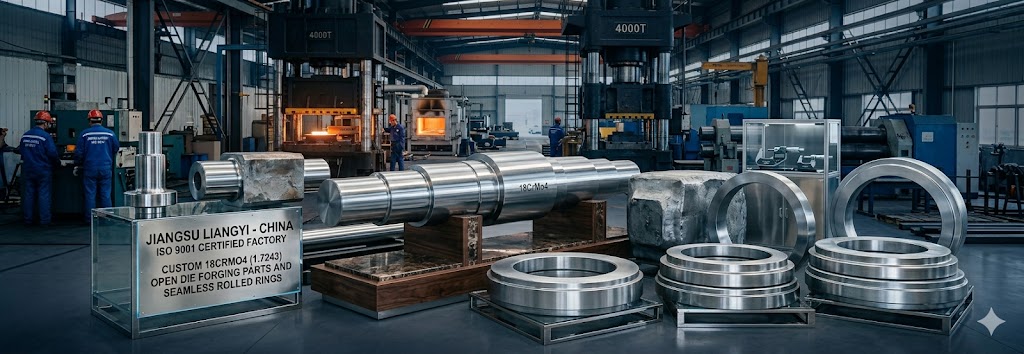
- Most common forged forms: gear shafts, pinion shafts and seamless rolled gear rings.
In plain terms, 18CrMo4 is engineered to do two things at once that most steels cannot: carry a glass-hard, wear-resistant outer skin while keeping a soft, shock-absorbing core underneath. That combination is exactly what a loaded gear tooth or a hard-driven shaft needs — a surface that resists pitting and abrasion sitting on a body that refuses to crack under impact.
It belongs to the same family of surface-hardening steels as 16MnCr5, 20MnCr5 and 21MnCr5, but the deliberate addition of molybdenum gives 18CrMo4 deeper, more reliable hardenability in larger sections — one reason it remains a default choice for medium-to-heavy power-transmission parts produced as custom 18CrMo4 forgings rather than bar stock.
How is 18CrMo4 named, and which standards apply?
The designation is not arbitrary; it encodes the chemistry. In the EN naming convention, “18” indicates roughly 0.18% carbon (mean carbon content × 100), “Cr” and “Mo” name the principal alloying elements chromium and molybdenum, and the trailing “4” reflects the chromium content scaled by a factor of four (about 1% Cr). The name alone tells an engineer: a low-carbon, chromium-molybdenum alloy meant to be carburized.
The material is governed primarily by EN 10084 (case-hardening steels — technical delivery conditions). Depending on product form it may also be cross-referenced to EN 10250-3 for open-die forgings and EN 10263-3 for cold-heading rod, while gear applications frequently invoke ISO 6336-5 and DIN 3990-5 for material quality classes. The exact specification set should always be confirmed against the part drawing.
What is the chemical composition of 18CrMo4?
Typical 18CrMo4 composition is carbon 0.15–0.21%, chromium 0.90–1.20%, manganese 0.60–0.90% and molybdenum 0.15–0.25%, with silicon up to 0.40% and phosphorus/sulphur each kept to a maximum of 0.035%. Each element has a job, summarised below.
| Element | Range (wt %) | Primary role |
|---|---|---|
| CCarbon | 0.15 – 0.21 | Keeps core tough; enriched at surface during carburizing |
| CrChromium | 0.90 – 1.20 | Hardenability & wear resistance |
| MnManganese | 0.60 – 0.90 | Deoxidiser; improves hardenability |
| MoMolybdenum | 0.15 – 0.25 | Deep-section hardenability; temper toughness |
| SiSilicon | 0 – 0.40 | Deoxidation; modest strengthening |
| PPhosphorus | ≤ 0.035 | Residual — kept low for toughness |
| SSulphur | ≤ 0.035 | Residual — controlled for cleanliness |
| CuCopper | 0 – 0.25 | Residual |
The defining tension in the chemistry is the low carbon level. A through-hardening shaft steel such as 42CrMo4 carries roughly 0.42% carbon so it can harden fully on quenching. 18CrMo4 deliberately stays near 0.18% so the core remains ductile — and the missing surface carbon is added back later, only where it is needed, during carburizing. Chromium and molybdenum then ensure that when the part is quenched, the hardness develops uniformly even well below the surface of a thick section.
Low carbon for a tough core, chromium and molybdenum for depth of hardness, carbon added back only at the surface — that is the whole strategy of 18CrMo4 in one sentence.
What are the mechanical properties of 18CrMo4?
Because 18CrMo4 is used in two distinct states — the bulk core and the carburized case — its mechanical properties are really two stories. The quenched-and-tempered core provides structural strength and impact resistance; the carburized and hardened case (about 58–62 HRC) provides surface hardness. Indicative core values for typical section sizes are shown below.
| Property | Section / condition | Typical value |
|---|---|---|
| Tensile strength Rm | thin section | up to ~1100 MPa |
| Tensile strength Rm | ≤ 160 mm | 485 – 660 MPa |
| Elongation A | ≤ 160 mm | ≥ 20 % |
| Impact energy KV | at +20°C | ~50 J |
| Surface hardness | carburized + hardened case | ~58 – 62 HRC |
How is 18CrMo4 heat treated?
The life of an 18CrMo4 part is defined as much by its heat-treatment route as by its chemistry. A representative cycle moves through the stages below, each tuned to the part geometry and the required case depth.
Typical processing windows
| Operation | Temperature | Cooling |
|---|---|---|
| Normalizing | 870 – 900°C | Air |
| Soft annealing | 680 – 700°C | Furnace |
| Carburizing | 880 – 980°C | — |
| Core hardening | 860 – 900°C | Oil / polymer / salt |
| Case hardening | 780 – 820°C | Oil / polymer / salt |
| Tempering | 150 – 200°C | Air |
Carbonitriding (around 860–950°C) is an alternative surface treatment where a shallower, very hard case is wanted. The low final tempering temperature is intentional: it relieves quench stresses without softening the freshly hardened surface.
Why does “case hardening” matter?
Imagine a single gear tooth. Its flank is hammered millions of times by the mating tooth — it needs to be hard enough to resist surface fatigue and pitting. But its root carries bending load on every rotation, and a hard, brittle root would simply snap. A uniformly hard steel forces a bad compromise; a uniformly soft one wears out.
Case hardening resolves the conflict by treating surface and core as separate problems. During carburizing, carbon diffuses into the outer layer, raising it to a high-carbon, hardenable composition. On quenching, that enriched skin transforms to hard martensite while the low-carbon core stays comparatively soft and tough. The result is a part that is hard where it is touched and tough where it is loaded — and, as a bonus, the surface ends up in residual compression, which strongly improves fatigue life.
What is 18CrMo4 commonly used for?
18CrMo4 concentrates in highly loaded, motion-transmitting components — anywhere a designer needs surface durability without sacrificing impact resistance. The most common forged forms include:
Gear & pinion shafts
The classic application — gearboxes, reducers and drivetrains where teeth must resist pitting on a shock-tolerant core.
Seamless rolled gear rings
Ring gears, slewing races and contoured rings produced as seamless rolled forgings for turbines and large machinery.
Wind turbine components
Carburized gear shafts and ring gears inside multi-megawatt gearbox stages running under variable load.
Mining & crusher parts
Eccentric shafts, slewing races and heavy transmission parts subject to abrasion and impact.
Bushings & sleeves
Wear surfaces, bushes and hubs where a hard skin extends service life under sliding contact.
Cement & kiln drives
Pinion shafts, riding-gear rings and trunnion components in heavy rotary equipment.
What is 18CrMo4 equivalent to?
Buyers working across standards frequently ask what 18CrMo4 maps to elsewhere. The closest commonly cited equivalents are AISI 5120 (USA), 20CrMo (China, GB) and SCM420 (Japan, JIS):
| Standard / Region | Comparable grade |
|---|---|
| EN (Europe) | 18CrMo4 · 1.7243 |
| AISI / SAE (USA) | ~ 5120 |
| GB (China) | ~ 20CrMo |
| JIS (Japan) | ~ SCM420 |
Why is 18CrMo4 usually forged rather than cut from bar?
For the heaviest power-transmission parts, mill bar is often the wrong starting point. Open-die forging and seamless ring rolling work the steel so that its internal grain flow follows the part’s contour, closing porosity and aligning the structure with the principal stresses. A forged gear shaft with grain flow running along its axis is markedly more resistant to fatigue than the same shape machined from a billet of rolled bar.
This is why 18CrMo4 in demanding service — wind, mining, cement, oil & gas — is specified as a forging with a controlled forging ratio, full ultrasonic inspection and EN 10204 documentation. You can see the full product scope, size range and documentation options on our 18CrMo4 forging parts page, and explore related grades such as 25CrMo4 and 21MnCr5 in our materials library.
Standards & references
The technical statements on this page are based on the following recognised material standards and the manufacturer’s own production practice:
- EN 10084 — Case-hardening steels: technical delivery conditions (defines 18CrMo4 / 1.7243).
- EN 10250-3 — Open steel die forgings for general engineering: alloy special steels.
- EN 10263-3 — Steel rod, bars and wire for cold heading and cold extrusion: case-hardening steels.
- ISO 6336-5 / DIN 3990-5 — Calculation of load capacity of spur and helical gears: gear material quality classes.
- EN 10204 — Metallic products: types of inspection documents (3.1 / 3.2 certificates).
- Jiangsu Liangyi Co.,Limited — In-house forging, heat-treatment and inspection practice for 18CrMo4 (ISO 9001:2015).
Frequently asked questions about 18CrMo4
What is 18CrMo4 (1.7243) steel?
18CrMo4 (material number 1.7243) is a low-alloy chromium-molybdenum case-hardening steel defined in EN 10084. It is carburized so a hard, wear-resistant surface forms over a tough low-carbon core, which makes it a standard choice for gears, pinion shafts and other power-transmission parts.
Is 18CrMo4 a case-hardening or a through-hardening steel?
It is a case-hardening (carburizing) steel under EN 10084. It is carburized so that a hard, wear-resistant surface forms over a tough low-carbon core — not hardened uniformly through the whole section like a through-hardening grade such as 42CrMo4.
What is 18CrMo4 equivalent to?
It is broadly comparable to AISI 5120 (USA), 20CrMo in the Chinese GB system and SCM420 (Japan). These are approximate equivalents; exact limits should be confirmed against the part drawing and standard.
What is the carbon content of 18CrMo4?
Typically 0.15–0.21% carbon. The low carbon level keeps the core ductile and is what allows carbon to be added back at the surface during carburizing.
What surface hardness can 18CrMo4 reach?
After carburizing and hardening the case typically reaches roughly 58–62 HRC, while the core stays much tougher and lower in hardness. Achievable case depth depends on the carburizing cycle and the part geometry.
What parts are made from 18CrMo4?
Most commonly gear shafts, pinion shafts, seamless rolled gear rings, sleeves, bushings and hubs — power-transmission parts used in gearboxes, wind turbines, mining equipment and cement plants.