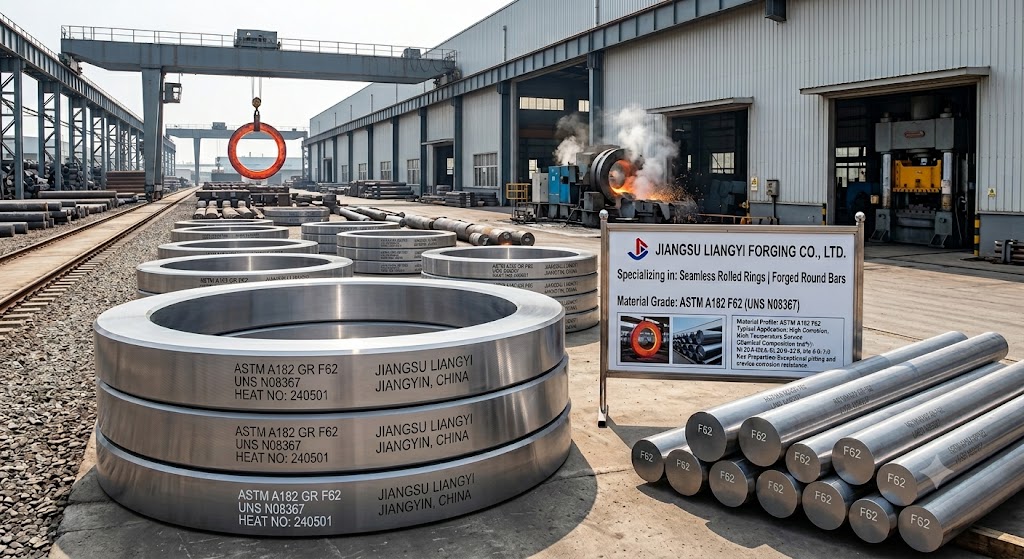
No — A182 F62 and 254 SMO are not the same alloy. F62 is UNS N08367 (trade name AL-6XN), with about 24–25% nickel. 254 SMO is UNS S31254, forged as ASTM A182 F44, with about 18% nickel. Both are 6Mo super austenitic stainless steels, but they are distinct grades and are not interchangeable on a material certificate.
Short answer: no. They are two different alloys that happen to share the "6Mo" nickname.
Same family, different members. Both are fully austenitic 6Mo alloys with PREN above 40 — but a mill certificate for one is not a valid substitute for the other.
Key takeaways
- Different UNS numbers. F62 is UNS N08367 (AL-6XN); 254 SMO is UNS S31254, forged as A182 F44 — not F62.
- Different nickel. F62 carries ~24–25% Ni; 254 SMO carries ~18% Ni. That gap changes phase stability and stress-corrosion behaviour.
- Similar performance class. Both resist seawater pitting (PREN >40), both are fully austenitic, both weld with nickel-base filler.
- Not certificate-interchangeable. If your drawing calls out F62, the cert must read N08367 — 254 SMO/F44 will fail incoming inspection.
If you have ever compared two supplier quotes for a "6Mo super austenitic" forging and found one offering "A182 F62" and the other offering "254 SMO," you have met one of the most persistent naming mix-ups in corrosion-resistant alloy procurement. The two names get treated as synonyms in purchase orders, RFQs and even some datasheets. Functionally they live in the same neighbourhood — but metallurgically, and on paper, they are distinct grades. Getting this wrong can mean a rejected forging, a delayed project, or a material certificate that will not pass third-party inspection.
Where the confusion startsWhy everyone calls them both "6Mo"
The nickname "6Mo" simply means a super austenitic stainless steel with roughly 6% molybdenum. Several alloys qualify: N08367, S31254, N08926 and a handful of others. Because molybdenum is the single biggest driver of chloride pitting resistance, the trade groups them together and buyers start using "6Mo" as if it named one specific product. It doesn't. It names a class.
The confusion deepens because 254 SMO was the first 6Mo grade to achieve wide market recognition, so its brand name became shorthand for the whole category — the way one brand name sometimes stands in for an entire product type. When someone writes "we need 254 SMO," they often mean "we need a 6Mo super austenitic," which may or may not be the specific S31254 chemistry their code actually requires.
The decisive testRead the UNS number, not the nickname
Every wrought corrosion-resistant alloy has a Unified Numbering System (UNS) designation that fixes its chemistry independently of any brand. This is the identity that appears on a mill test certificate, and it is the only identifier that matters when you are checking specification compliance.
A182 F62
- ASTM forging grade: A182 F62
- Bar: A479 · Plate/sheet: B688
- Higher nickel (23.5–25.5%) → borderline nickel-iron alloy
- PREN ≈ 45–46 at mid composition
254 SMO®
- ASTM forging grade: A182 F44
- Plate: A240 · Bar: A479
- Lower nickel (17.5–18.5%) + deliberate copper
- PREN ≈ 43–44 at mid composition
Notice the crossover that trips people up: 254 SMO's forging grade is F44, not F62. So "F62 versus 254 SMO" is really "N08367 versus S31254" — two different rows in the ASTM A182 table. Our dedicated A182 F62 forged parts page covers the N08367 side in depth; the AL-6XN (N08367) page lists the same alloy under its trade name.
The fastest way to settle any "are these the same?" argument on the shop floor is to ask for the two mill certificates and read the UNS field. N08367 and S31254 will never both appear on one certificate — because no single heat can satisfy both chemistries at once. The nickel windows alone (24–25% vs ~18%) do not overlap.
The numbersF62 vs 254SMO: full comparison
| Property | A182 F62 · N08367 (AL-6XN) | 254 SMO · F44 (S31254) |
|---|---|---|
| UNS number | N08367 | S31254 |
| ASTM forging grade | A182 F62 | A182 F44 |
| Common trade name | AL-6XN® (ATI) | 254 SMO® (Outokumpu) |
| EN designation | — (ASTM-origin) | 1.4547 |
| Chromium (Cr) | 20.0–22.0% | 19.5–20.5% |
| Nickel (Ni) | 23.5–25.5% | 17.5–18.5% |
| Molybdenum (Mo) | 6.0–7.0% | 6.0–6.5% |
| Nitrogen (N) | 0.18–0.25% | 0.18–0.22% |
| Copper (Cu) | 0.75% max | 0.50–1.00% (deliberate) |
| Carbon (C) max | 0.030% | 0.020% |
| PREN (mid comp.) | ≈ 45–46 | ≈ 43–44 |
| Microstructure | Fully austenitic | Fully austenitic |
| Min. tensile | 655 MPa (95 ksi) | ≈ 650 MPa (94 ksi) |
| Min. yield (0.2%) | 310 MPa (45 ksi) | ≈ 300 MPa (44 ksi) |
| Delivery condition | Solution annealed + water quench | Solution annealed + water quench |
PREN = %Cr + 3.3 × %Mo + 16 × %N. Values are typical of specification mid-ranges; always confirm against the actual heat chemistry on the mill certificate.
What the chemistry meansThe nickel gap is the real story
The headline difference is nickel: roughly 24–25% in F62 against ~18% in 254 SMO. Nickel is an austenite stabiliser and a major contributor to resistance against chloride stress-corrosion cracking (SCC). The higher nickel content of N08367 pushes it toward the boundary between "super austenitic stainless" and "nickel-iron alloy," and it gives F62 a modest edge in hot, chloride-rich environments where SCC is the failure mode of concern — think flue gas desulphurisation liquor or concentrated brines above 60 °C.
254 SMO answers back with a deliberate copper addition of 0.5–1.0%. Copper improves resistance in reducing acids such as dilute sulphuric acid, which is why S31254 is often favoured in certain chemical-process streams. F62 lists copper only as a maximum, not a target, so it does not claim the same reducing-acid advantage. The lower maximum carbon in 254 SMO (0.020% vs 0.030%) also gives it a slightly wider margin against sensitisation, though both grades are low enough that a correct solution anneal keeps carbides in solution.
In serviceDo they actually perform differently?
For the majority of chloride and seawater duties, both alloys land in the same performance class. Both clear the PREN > 40 threshold widely cited for reliable pitting resistance in natural seawater, both stay fully austenitic (so neither suffers the sub-zero embrittlement of duplex grades), and both are permitted for sour service under NACE MR0175 / ISO 15156 in the solution-annealed condition, subject to the standard's hardness limits. In practical terms, a design engineer comparing them for an offshore flange or a valve body will often accept either.
The nuances that separate them are situational: F62's higher nickel favours it where chloride SCC or low-temperature toughness dominates; 254 SMO's copper favours it in reducing-acid service. Neither is universally "better" — they were optimised by different mills for slightly different corrosion emphases.
Procurement realityCan you substitute one for the other?
Here is where the distinction stops being academic. Functional equivalence is not the same as specification compliance. If your engineering drawing, code case or datasheet calls out ASTM A182 F62 / UNS N08367, then the forging you receive must certify as N08367. A 254 SMO (S31254 / F44) piece — however capable — will not match, and a diligent inspector or third-party surveyor will reject it at incoming inspection.
The correct workflow is simple: confirm which UNS number your specification actually requires before issuing the purchase order. If the spec genuinely permits alternatives (some do, with an "or approved equal" clause), get that flexibility in writing so the mill certificate you accept is defensible during audit. When you request a quote for our A182 F62 (UNS N08367) forgings, telling us the exact UNS number and forging grade lets our engineering team quote the right heat and the right documentation the first time.
Write both identifiers on the RFQ — grade and UNS, e.g. "ASTM A182 F62 (UNS N08367)." It removes ambiguity for the mill, prevents an accidental F44 substitution, and gives your QA team a single line to verify on the certificate.
Quick guidanceWhich one should you specify?
Lean toward F62 / N08367 when…
- Chloride SCC at elevated temperature is the governing risk
- Maximum phase stability and toughness are priorities
- Your project's code or client standard names N08367 / AL-6XN
- You want the slightly higher PREN margin (≈ 45–46)
Lean toward 254 SMO / F44 when…
- Dilute sulphuric or other reducing acids are present
- Your spec explicitly calls out S31254 / 1.4547 / F44
- Existing plant materials are standardised on 254 SMO
- Copper-bearing chemistry is required by the process licensor
In most cases the choice is made for you by the specification, not by a marginal corrosion difference. The engineering task is to read the spec correctly and order to the exact UNS number — which is the whole point of understanding that F62 and 254 SMO are two grades, not one.
FAQCommon questions, answered
Is ASTM A182 F62 the same as 254 SMO?
What is the UNS number for A182 F62?
What ASTM A182 grade is 254 SMO?
Can I substitute F62 for 254 SMO on a project?
Which has the higher PREN?
Need 6Mo super austenitic forgings — N08367 (F62) or S31254 (F44)?
We forge both 6Mo super austenitic grades to their UNS / ASTM specifications — seamless rolled rings, round bars, discs and custom shapes up to 30 tons — with PREN-verified chemistry and EN 10204 3.1 material certificates as standard (type 3.2 with independent third-party inspection available on request), supplied to the exact UNS number and grade your specification requires.
References & standards
- ASTM A182/A182M — Standard Specification for Forged or Rolled Alloy and Stainless Steel Pipe Flanges, Forged Fittings, and Valves and Parts for High-Temperature Service. astm.org
- Pitting Resistance Equivalent Number (PREN) — definition and formula. Wikipedia
- UNS N08367 (AL-6XN) super austenitic alloy overview. Wikipedia
- ANSI/NACE MR0175 / ISO 15156 — Materials for use in H₂S-containing environments in oil and gas production.
- ASTM A240 (plate), ASTM A479 (bar), ASTM B688 (N08367 plate/sheet/strip).