ASTM A182 Grade F62 Forged Parts | China A182-F62 Super Austenitic Stainless Steel Forgings Manufacturer
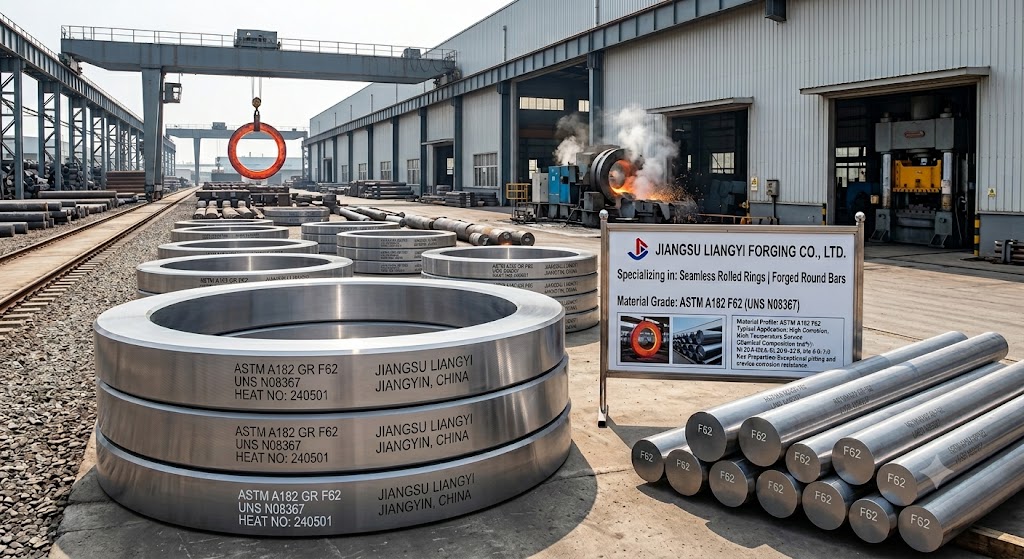
ASTM A182 Grade F62 super austenitic stainless steel forged parts produced by Jiangsu Liangyi Co., Limited in Jiangyin, Jiangsu Province, China — seamless rolled rings, round bars, and custom open die forgings for demanding global industrial applications
Jiangsu Liangyi Co., Limited is an ISO 9001:2015 certified manufacturer of ASTM A182 Grade F62 (A182-F62) open die forgings and seamless rolled rings, headquartered in Jiangyin City, Jiangsu Province, China. Since 1999, our engineers and metallurgists have worked exclusively with high-alloy forged materials — including 6Mo super austenitic grades — developing process knowledge that generic steel mills cannot replicate. We currently produce F62 forgings from 30 kg to 30 tons in a single piece, seamless rolled rings up to 6 meters in outer diameter, and serve clients across oil & gas, nuclear power, chemical processing, and marine industries in over 50 countries.
What sets our A182-F62 production apart is not just our equipment — it is our metallurgical process control. Every F62 order begins with PREN verification of incoming chemistry, proceeds through a strictly controlled forging temperature window, and concludes with a solution anneal and rapid water quench timed to the second. The result is consistently a fully austenitic microstructure with ASTM grain size 5–8 and mechanical properties that exceed ASTM A182 minimums in our routine production.
What Is ASTM A182 Grade F62? A Manufacturer's Explanation
ASTM A182 Grade F62 — also written A182-F62, F62, or colloquially as "6Mo" — is a nitrogen-enhanced, 6% molybdenum super-austenitic stainless steel covered under ASTM International standard A182/A182M, Standard Specification for Forged or Rolled Alloy and Stainless Steel Pipe Flanges, Forged Fittings, and Valves and Parts for High-Temperature Service. While the standard title suggests piping flanges, A182 is applied broadly to any forged pressure-containing component in that composition and heat-treated condition.
The "super" in super-austenitic refers to the alloy's elevated alloy content — particularly its molybdenum (6–7%) and nickel (23.5–25.5%) levels — compared to conventional austenitic grades like 316L (2.5% Mo, 12% Ni) or 317L (3.5% Mo, 13% Ni). These elevated levels elevate the alloy's performance well beyond what the standard austenitic family can achieve, particularly in chloride-containing environments. The nitrogen addition (0.18–0.25%) is equally important: it strengthens the austenite matrix by solid-solution hardening, raises the yield strength without reducing ductility, and further improves pitting resistance through its contribution to the PREN formula.
Common Specification Confusion: Buyers sometimes specify "F62" on a drawing without realizing that A182 covers the forged form only. The equivalent wrought plate/sheet/strip grade is covered by ASTM A240 (UNS S31254), and the equivalent cast grade falls under ASTM A351 Grade CN3MN. If your engineering team specifies A182-F62 for a component that will be machined from bar stock or cut from plate, ensure the fabricator understands that A182-F62 requires a forged starting stock — not a cast or wrought flat product — to comply with the specification letter.
From a forging manufacturer's standpoint, F62 behaves distinctly differently from 316L or 317L during hot working. Its higher alloy content raises the hot flow stress — meaning our hydraulic presses must exert approximately 15–20% greater force per unit area to achieve the same reduction ratio in F62 versus standard austenitic grades. The alloy also has a narrower "hot-workable" temperature window: below 950°C the material becomes increasingly resistant to deformation, and surface cracking can initiate; above 1200°C the alloy softens excessively and risks grain boundary oxidation. Maintaining metal temperature within this 250°C window throughout a complex forging sequence is one of the key technical challenges our production team manages on every F62 order.
PREN: The Number That Determines Whether F62 Is the Right Choice
The Pitting Resistance Equivalent Number (PREN) is the most widely used single-number ranking for comparing pitting corrosion resistance in stainless steels and nickel alloys. The formula accepted for nitrogen-containing austenitic grades is:
PREN = %Cr + 3.3 × %Mo + 16 × %N
For A182-F62 at mid-range composition: PREN = 21 + (3.3 × 6.5) + (16 × 0.215) = 21 + 21.45 + 3.44 ≈ 45.9
This calculation uses mid-range values. At the low end of the A182-F62 specification (20% Cr, 6% Mo, 0.18% N), PREN calculates to approximately 43.7. At the high end (22% Cr, 7% Mo, 0.25% N), PREN reaches approximately 49.6. In our manufacturing practice, we aim to verify the PREN from each heat's actual chemistry certificate before production begins — any heat with PREN below 43 from an incoming material supplier is rejected, regardless of whether individual elements technically pass specification minimums.
Why does PREN matter so much in practice? The generally accepted industry threshold is PREN > 40 for reliable resistance to pitting in natural seawater at ambient temperature. Below PREN 40, pitting initiation becomes statistically likely within 12–36 months in offshore environments. Standard 316L (PREN ~25) fails this threshold by a significant margin, which is why subsea and offshore topside specifications universally exclude 316L from chloride-wetted services and require super duplex (PREN ~42) or super austenitic (PREN >40) alternatives.
316L
Not suitable for seawater or aggressive chloride service
317L
Marginal. Better than 316L but still below seawater threshold
2205 Duplex
Good. Suitable for many chloride environments but watch low-temp toughness
254SMO / F44
Excellent. Borderline for aggressive seawater. Similar to F62 minimum
A182-F62 ★
Superior. Reliable in seawater, bleach, FGD, and most aggressive chloride environments
Super Duplex 2507
High strength, excellent PREN but brittle at low temp and after long thermal exposure
Alloy 625
Highest corrosion resistance but 3–5× higher cost than F62
Manufacturer Insight: One aspect of PREN rarely discussed in datasheets is its sensitivity to segregation in the final product. In a cast F62 component, local molybdenum segregation can create zones where local PREN drops to 38–40 even when the bulk heat chemistry passes specification. In a properly forged and solution-annealed F62 component, our metallographic examinations consistently show chemical homogeneity where the local PREN at any point in the cross-section stays within 2–3 points of the bulk chemistry-calculated value. This is a fundamental reason why critical corrosion-service specifications — including NACE MR0175 — require forged or wrought product for downhole and subsea sour service rather than accepting cast equivalents.
A182-F62 vs Alternative Materials: When to Specify Each
One of the most common engineering questions we receive from procurement and design teams is: "Our current spec calls for duplex 2205 — can we use F62, and is it worth the cost premium?" The answer depends on the specific service conditions, and the decision matrix is more nuanced than simply comparing PREN numbers.
| Property / Criterion | 316L (F316L) | 2205 Duplex (F51) | Super Duplex 2507 (F53) | 254SMO (F44) | A182-F62 ★ | Alloy 625 |
|---|---|---|---|---|---|---|
| PREN (approx.) | ~25 | ~35 | ~42 | ~43 | ~46 | ~52 |
| Microstructure | Austenitic | Duplex (50/50) | Duplex (50/50) | Austenitic | Fully Austenitic | Nickel Alloy |
| Min. Tensile Strength | 485 MPa | 620 MPa | 795 MPa | 650 MPa | 655 MPa | 827 MPa |
| Min. Yield Strength | 170 MPa | 450 MPa | 550 MPa | 310 MPa | 310 MPa | 517 MPa |
| Sub-zero Toughness (<−40°C) | Good | Limited | Poor | Good | Excellent | Excellent |
| Sigma Phase Risk (300–900°C exposure) | Low | Moderate | High | Low | Low | Low |
| Seawater Pitting Resistance | Poor | Moderate | Good | Good | Excellent | Excellent |
| SCC Resistance (Chloride) | Poor | Good | Good | Good | Excellent (high Ni) | Excellent |
| Weldability | Excellent | Good (preheat not req.) | Moderate | Good | Good | Good |
| Machinability (vs 316L = 100%) | 100% | 55% | 45% | 40% | 30–35% | 20–25% |
| Relative Material Cost vs 316L | 1× | 2–2.5× | 3–4× | 3.5–4.5× | 4–5× | 8–12× |
| NACE MR0175 Compliance | Restricted | Yes (with limits) | Yes | Yes | Yes | Yes |
When F62 outperforms super duplex 2507 (F53): Despite F53's similar PREN, the duplex microstructure becomes a liability in three scenarios: (1) cryogenic or sub-zero service, where the ferritic phase loses impact toughness dramatically below −40°C; (2) extended service at temperatures between 300–900°C where sigma phase can precipitate in the ferritic phase, causing catastrophic embrittlement; and (3) radiation environments (nuclear power) where the ferritic phase is more susceptible to radiation-induced hardening than the fully austenitic F62 matrix. In all three scenarios, F62's fully austenitic structure is the correct engineering choice.
When to choose Alloy 625 over F62: If your service environment involves reducing acids (hydrochloric, sulfuric above 10% concentration, phosphoric acid), or temperatures above 400°C in oxidizing service, Alloy 625 or other nickel alloys should be specified. F62's passive film, while excellent in chloride media, is not designed for the severe reducing acid environments where molybdenum-rich nickel alloys truly excel. The cost premium for 625 (approximately 2–2.5× over F62) is justified only when the environment genuinely exceeds F62's capability.
Our A182-F62 Forging Manufacturing Capabilities
Our manufacturing infrastructure in Jiangyin, Jiangsu Province was developed specifically for high-alloy forging. We do not produce carbon steel and then occasionally attempt super austenitic grades — our furnaces, tooling, press schedules, and quality protocols are built around the thermal and mechanical demands of materials like F62 where process discipline directly determines corrosion performance in the field.
Forging Weight Range
30 kg to 30,000 kg (30 metric tons) per piece. F62-specific tooling sets maintained for common ring, bar, and disc profiles to minimize setup time.
Annual Production Capacity
120,000 metric tons across all alloy grades. F62 represents approximately 15% of our high-alloy production volume, with dedicated furnace schedules maintained year-round.
Press Fleet
2000T, 4000T, and 6300T hydraulic presses for open die forging. 1T–9T electro-hydraulic hammers for smaller components and finishing operations. All presses calibrated for tonnage accuracy.
Ring Rolling
Radial-axial ring rolling mill capable of producing seamless rings up to 6,000 mm OD and 30,000 kg. Computer-controlled rolling schedule with real-time diameter and height measurement during rolling.
Heat Treatment
Gas-fired furnaces with 10-zone temperature control, capable of precise soak at 1100–1150°C. Water quench tanks with mechanical agitation to ensure adequate quench severity for thick F62 sections.
Machining
CNC turning centers up to 3,000 mm swing diameter. Carbide tooling with positive rake geometries selected specifically for nitrogen-hardened austenitic grades. Flood coolant on all F62 operations.
In-House Testing
OES chemical analysis (calibrated for Mo, N, Cu trace elements), universal tensile testing machine, Brinell hardness tester, impact test machine, metallographic preparation and microscopy suite, UT phased array system.
Certifications
ISO 9001:2015 QMS. EN10204 3.1 and 3.2 mill test certificates issued. Third-party inspection by DNV, BV, LR, ABS, TÜV, SGS arranged on request. Material documentation to support PED (Pressure Equipment Directive) compliance can be supplied for EU-bound shipments upon specific request — PED certification responsibility rests with the EU-based equipment manufacturer.
Available A182-F62 Forged Product Shapes & Dimensions
We produce A182-F62 forgings in every open die shape that the alloy's hot-working characteristics permit. Below are the most commonly ordered product forms with their dimensional limits as produced at our Jiangyin facility. Custom profiles outside these ranges can be discussed on a case-by-case basis — ring OD above 6 meters, for instance, may be feasible in a collaborative arrangement with partner mills for very large projects.
| Product Form | Key Dimension Range | Weight Range | Typical Tolerances | Common Applications |
|---|---|---|---|---|
| Seamless Rolled Rings | OD: 200 mm – 6,000 mm Height: 50 mm – 1,500 mm Wall: 20 mm min. | 5 kg – 30,000 kg | OD: +3/-0 mm (rough) OD: ±0.5 mm (machined) | Flanges, pressure vessel shells, pump casings, bearing rings, reactor nozzles |
| Round Bars & Billets | Diameter: 60 mm – 2,000 mm Length: up to 8,000 mm | 20 kg – 20,000 kg | Diameter: ±3 mm (rough) Diameter: ±0.2 mm (turned) | Shafts, valve stems, pump shafts, compressor impeller blanks, drill collars |
| Hollow Bars / Sleeves | OD: 80 mm – 3,000 mm ID: 40 mm – 2,000 mm Wall: min. 20 mm | 30 kg – 25,000 kg | Wall thickness: ±5 mm (rough) ±0.5 mm (machined) | Cylinder liners, bushings, bearing housings, valve body blanks, pressure vessel nozzles |
| Discs & Plates | Diameter: 100 mm – 3,000 mm Thickness: 20 mm – 600 mm | 10 kg – 15,000 kg | Thickness: +5/-0 mm (rough) Flatness: 2 mm/m (rough) | Tube sheets, baffle plates, flanged end caps, heat exchanger end plates |
| Piping Shells & Casings | OD: 150 mm – 1,200 mm Wall: 20 mm – 200 mm Length: up to 4,000 mm | 50 kg – 8,000 kg | OD: ±3 mm (rough) Wall eccentricity: <10% | Pressure vessel shells, compressor casings, pump bodies, offshore riser joints |
| Custom Open Die Shapes | Per customer drawing | 30 kg – 30,000 kg | Per drawing tolerances; DIN 7527 or equivalent | BOP components, wellhead bodies, Christmas tree components, custom valve bodies |
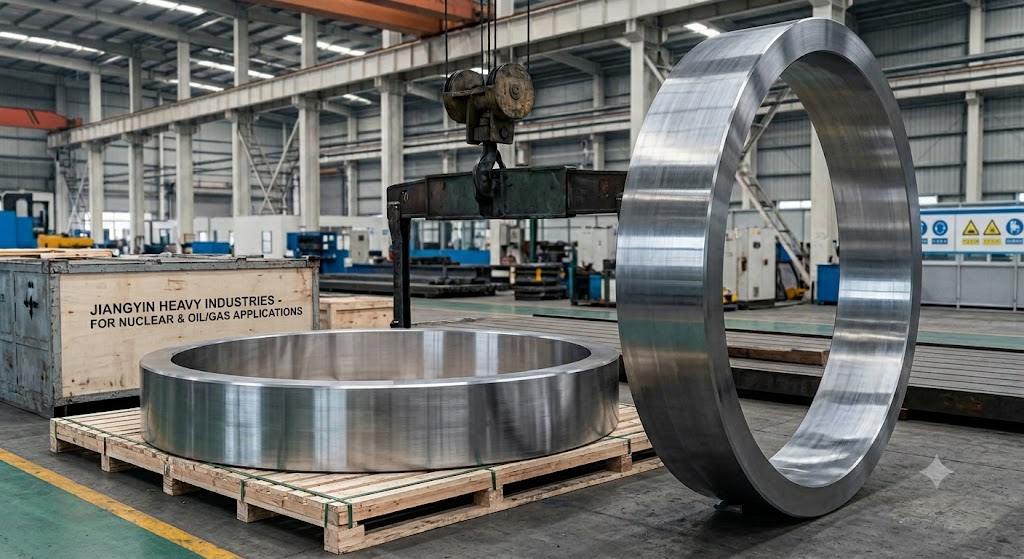
Large-diameter A182-F62 seamless rolled rings produced on our radial-axial ring rolling mill in Jiangyin, Jiangsu Province. Rings up to 6 m OD and 30 tons are within our standard capability range.
Chemical Composition of ASTM A182 Grade F62
The chemical composition specification for A182-F62 is defined in ASTM A182/A182M and cross-references the wrought alloy UNS S31254. Chemical analysis of forged material is performed on heat samples (ladle analysis) per ASTM E354 and ASTM E1473 for trace elements. Product (check) analysis of the forged piece is performed per ASTM B880 variation allowances, which are slightly wider than the ladle analysis limits to account for sampling heterogeneity.
| Element | Symbol | Min. (%) | Max. (%) | PREN Contribution | Metallurgical Role |
|---|---|---|---|---|---|
| Carbon | C | — | 0.030 | None | Must be kept low to prevent sensitization (Cr carbide precipitation at grain boundaries during cooling). At >0.030%, rapid quench becomes even more critical. |
| Manganese | Mn | — | 2.00 | None | Austenite stabilizer and deoxidizer. Also improves hot workability by increasing the hot-ductility range during forging. |
| Phosphorus | P | — | 0.040 | None | Impurity element controlled to prevent hot shortness (hot cracking) during forging. Critical in high-Ni alloys where P segregates to grain boundaries. |
| Sulfur | S | — | 0.030 | None | Impurity controlled to prevent sulfide inclusion formation. In F62, MnS inclusions are pitting initiation sites — lower S is always preferred even within specification. |
| Silicon | Si | — | 1.00 | None | Deoxidizer used during melting. Higher Si levels (approaching 1%) can promote sigma phase formation — specification limit set conservatively to minimize this risk. |
| Nickel | Ni | 23.5 | 25.5 | None (direct) | Critical for thermal stability, SCC resistance, and austenite phase stability. The high Ni content is what differentiates F62 from lower-Ni 6Mo alloys and contributes to sub-zero toughness retention. |
| Chromium | Cr | 20.00 | 22.00 | 21 (mid) × 1 = 21 | Primary passive film former. Minimum 20% Cr ensures robust passive film in oxidizing environments including dilute oxidizing acids and atmospheric exposure. |
| Molybdenum | Mo | 6.00 | 7.00 | 6.5 (mid) × 3.3 = 21.45 | The defining element of the "6Mo" alloy family. Mo dramatically stabilizes the passive film against chloride attack. The PREN contribution of Mo (3.3× coefficient) makes it the single most impactful element for pitting resistance in F62. |
| Copper | Cu | — | 0.75 | None | Beneficial in reducing acid environments (e.g., dilute H₂SO₄). Also improves corrosion resistance in certain chemical processing streams. Kept below 0.75% to avoid hot shortness concerns during forging. |
| Nitrogen | N | 0.18 | 0.25 | 0.215 (mid) × 16 = 3.44 | Solid-solution strengthener that raises yield strength by approximately 30–50 MPa without reducing ductility. Also contributes directly to PREN and improves pitting resistance in crevices. Achieved through AOD or VOD nitrogen injection during melting. |
From Our Metallurgists: Of all the elements in F62, nitrogen is the one most susceptible to variation between manufacturers. Achieving 0.18–0.25% N in a 25% Ni, 6% Mo melt requires precise control of nitrogen partial pressure during the VOD or AOD refining step. Heats that come in at the low end of N (0.18–0.19%) will still pass specification, but their PREN will be approximately 1.5–2 points lower than heats at the high end of N (0.24–0.25%). When we receive material certifications from steel mills, nitrogen is the element we scrutinize most carefully on F62 heats, and we encourage our clients to do the same when reviewing any supplier's material certificates.
Mechanical Properties of A182-F62 Forgings
ASTM A182 specifies minimum mechanical properties for F62 in the solution-annealed and quenched condition. These are the minimum acceptable values for a code-compliant forging. In our routine production, the actual values we achieve in mechanical testing typically exceed these minimums — the following table shows both the ASTM minimum requirements and our typical production performance based on our internal test data records.
| Property | ASTM A182 Minimum | Our Typical Production Range | Test Method | Specimen Orientation |
|---|---|---|---|---|
| Tensile Strength | 655 MPa (95 ksi) | 690–760 MPa | ASTM E8 / EN ISO 6892-1 | Longitudinal (parallel to grain flow) |
| Yield Strength (0.2% Offset) | 310 MPa (45 ksi) | 330–390 MPa | ASTM E8 / EN ISO 6892-1 | Longitudinal |
| Elongation (GL = 50 mm or 4D) | 30% min. | 38–50% | ASTM E8 / EN ISO 6892-1 | Longitudinal |
| Reduction of Area | 50% min. | 60–72% | ASTM E8 / EN ISO 6892-1 | Longitudinal |
| Brinell Hardness (Typical) | Not specified by A182 for F62 | HB 160–210 | ASTM E10 / EN ISO 6506-1 | Surface measurement |
| Charpy Impact Energy (−196°C) | Not required by A182 (available on request) | ≥ 80 J (typical) | ASTM E23 / EN ISO 148-1 | Transverse CVN specimen |
Note that the A182 standard does not specify a hardness limit for F62 — unlike some precipitation-hardened or heat-treated grades. However, if your application involves hydrogen service per NACE MR0175, note that NACE limits austenitic stainless steels to a maximum of HRC 22 (approximately HB 237) in sour service. F62 forgings in the solution-annealed condition routinely test below HB 220, so NACE compliance on hardness is not typically an issue, but it should be verified on the mill test certificate for each piece going into H₂S-containing service.
QTC (Qualification Test Coupon) Location: Per ASTM A182, mechanical properties must be tested from a Qualification Test Coupon (QTC) taken from the ¼T envelope location (one-quarter of the maximum thickness from the surface) of the thickest section, or from a sacrificial extension forged with the piece. This is critical for large F62 forgings above 200 mm section thickness, where the thermal gradient during quench means the surface and center see different cooling rates. Our test records show that for well-quenched F62 forgings, the ¼T mechanical properties are typically within 5% of the surface values — confirming adequate through-thickness quench severity in our process.
Heat Treatment of A182-F62: Why It Is Non-Negotiable
Of all the process steps in manufacturing an A182-F62 forging, heat treatment is the one where the consequences of deviation are most severe and least visible. A forging that is insufficiently solution-annealed — held at too low a temperature, or quenched too slowly — will have a microstructure containing sigma phase, chi phase, or carbide precipitates that dramatically reduce corrosion performance. The forging will pass dimensional inspection, it may even pass chemical analysis, but in chloride service it will fail prematurely through intergranular corrosion or pitting at the precipitate-matrix interfaces.
Our heat treatment protocol for A182-F62 is as follows:
Solution Annealing Temperature: 1100–1150°C
The solution annealing temperature must be high enough to completely dissolve any sigma phase, chi phase, or chromium carbides that formed during the elevated-temperature forging and slow intermediate cooling stages. For F62, we target 1120–1140°C as our standard range, confirmed by furnace thermocouple readings and a secondary pyrometer aimed at the load surface. The lower bound of 1100°C is a hard minimum — below this temperature, sigma phase dissolution in thick sections (above 100 mm) is incomplete even with extended hold times.
Hold Time: Minimum 30 Minutes + 1 Minute per Millimeter of Maximum Thickness
For a 200 mm thick ring with wall thickness of 150 mm, our minimum soak is 30 + 150 = 180 minutes at temperature. This ensures uniform temperature throughout the cross-section and complete dissolution of any second phases. For large rings above 1,000 mm OD with thick walls, soak times exceeding 6 hours are common. Rushed heat treatment to meet a delivery deadline is something we will never do on a super austenitic alloy — the metallurgical consequences are permanent and cannot be corrected without re-annealing the piece.
Water Quench: Within 60 Seconds of Furnace Exit
This is the most time-critical step in the entire manufacturing sequence. After the furnace door opens, the forging must reach the water quench tank within 60 seconds — before the surface temperature drops below 1050°C. At cooling rates below approximately 1–2°C per second through the sigma-formation range (600–900°C), sigma phase can re-precipitate in F62 within minutes. Our furnaces are positioned directly adjacent to our water quench tanks to minimize transfer time, and for large forgings above 5 tons we use overhead cranes pre-staged at the furnace door to ensure no delay.
Quench Water Temperature: ≤ 40°C Maximum
We monitor quench water temperature continuously during heat treatment operations. Water above 40°C significantly reduces quench severity, particularly at the surface-water interface where a vapor film (Leidenfrost effect) can form on very hot surfaces and insulate the metal from the cooling water. Our tanks are equipped with mechanical agitation (propeller agitators) and are cooled by heat exchangers to maintain temperature below 35°C even after multiple quench cycles in the same day.
How to Verify Heat Treatment Compliance: When reviewing a mill test certificate for A182-F62 forgings, look for the heat treatment record to include: (1) furnace temperature with calibration reference, (2) actual part temperature if measured by pyrometer or thermocouple, (3) total hold time at temperature, (4) quench medium (water) and temperature at quench, and (5) time from furnace exit to quench submersion. Any certificate that simply states "solution annealed" without these details should prompt a request for the furnace chart. A furnace chart — the continuous temperature recorder printout showing the actual time-temperature profile of the heat treatment — is the gold standard document for verifying proper solution annealing of super austenitic forgings.
The Metallurgy of Forging A182-F62: What Makes It Challenging
Most engineering buyers understand that "forged" generally means better mechanical properties than "cast." But few outside the forge shop understand the specific metallurgical challenges that 6Mo super austenitic alloys present during hot working, and why not every forging manufacturer can produce consistent F62 results despite having adequate press tonnage on paper.
Higher Flow Stress Than 316L
F62's flow stress at forging temperature (the force required to plastically deform the material) is approximately 15–20% higher than 316L at the same temperature. This stems from the solid-solution strengthening effect of high molybdenum and nitrogen content. In practical terms, a 4000-ton press that can forge a 2,000 kg 316L disc in four passes may require six passes on an equivalent F62 disc, with intermediate reheating between passes to maintain metal temperature above 1,000°C at the surface.
Narrower Forging Temperature Window
The workable temperature range for F62 — the range where the alloy is hot enough to deform without cracking but not so hot as to cause grain boundary oxidation or excessive grain growth — is approximately 950–1180°C. This 230°C window is narrower than the 300–400°C window available for carbon steel, meaning that temperature management during forging requires more careful monitoring. We use optical pyrometers and thermocouple-equipped test pieces during production qualification to map the actual surface temperature evolution during complex forging sequences.
Risk of Surface Cracking at Low Temperatures
If a large F62 forging is allowed to cool below 900°C at the surface during a long forging sequence — due to die contact time, radiation losses in cold air, or excessive handling time — surface tensile stresses can develop that initiate cracking along grain boundaries. These cracks are not always visible to the naked eye immediately; they may only be revealed by dye penetrant testing (PT) after forging completion. Our practice is to reheat any F62 piece between passes when surface temperature approaches 980°C, rather than waiting until it falls to the 950°C minimum.
Forging Ratio Requirement
ASTM A182 does not specify a minimum forging ratio (reduction ratio) for F62. However, our internal standards, derived from years of metallographic examination of forged pieces, require a minimum forging ratio of 3:1 (three-to-one cross-sectional area reduction) for round bars and discs, and equivalent deformation for rings. This minimum ratio is necessary to fully break down the as-cast ingot dendritic structure and close any internal porosity to a size below the UT detection threshold required by ASTM A388. Forgings made from pre-rolled billet (rather than cast ingot) may require lower minimum ratios, as the upstream rolling has already achieved partial breakdown.
Grain Refinement and Its Role in Corrosion Resistance
An often-overlooked benefit of forging over casting for F62 is grain size control. Solution-annealed F62 forgings from our facility consistently achieve ASTM grain size number 5–8 (grain diameter approximately 32–90 μm). Cast components — even after solution annealing — frequently retain a coarser grain structure (ASTM grain size 1–3) due to the absence of any mechanical deformation-induced recrystallization. Finer grain size improves resistance to stress corrosion cracking (SCC), reduces the severity of intergranular corrosion if sensitization occurs during welding, and improves fracture toughness — all critical for components in demanding chloride service.
Industrial Applications of A182-F62 Forged Parts
ASTM A182 Grade F62 forgings are specified wherever the combination of high strength, fully austenitic microstructure, and PREN above 40 is required. The following section provides engineering-level context for each major application area — not just a list of part names, but the technical reasons why F62 is selected over lower-alloyed alternatives in each case.
Offshore and Subsea Oil & Gas
Seawater is the most aggressive naturally occurring chloride environment: typically 18,000–35,000 ppm Cl⁻, variable temperature (2–30°C), dissolved oxygen, and in some locations microbiologically influenced corrosion (MIC). Standard 316L flanges and valves have been documented to pit within 6–18 months in seawater service. F62's PREN ~46 places it safely above the critical pitting temperature (CPT) threshold for natural seawater service. NACE MR0175 / ISO 15156 permits F62 for sour service (H₂S-containing environments) in the solution-annealed condition, subject to hardness not exceeding HRC 22. Components we commonly produce for offshore service include:
- Wellhead equipment: Christmas tree components, wellhead spool bodies, casing heads, tubing heads, casing hangers, tubing hangers, tubing spools, casing spools, and spacer spools — all requiring consistent geometry over complex internal features, where the machining allowance benefit of a near-net-shape forging reduces cost significantly versus bar stock machining
- Blowout Preventer (BOP) components: RAM bodies, annular bodies, dual BOP blocks — large, complex forgings where forging grain flow alignment with the primary stress directions during blowout events is a documented engineering preference
- Subsea connectors and risers: Where wall thickness and consistent mechanical properties through the section are verified by UT per ASTM A388 and section-specific mechanical testing
- Downhole tools: Mud motor drive shafts and ESP motor shafts in H₂S-containing well fluids, where NACE compliance and corrosion fatigue resistance under cyclic loading are both required
- Flanges and outlet fittings: Double-studded adapter flanges, integral mud flanges, studded crosses — where dimensional repeatability across large production batches is critical for interchangeability with mating API-rated equipment
Valve Manufacturing
Valves in chloride service — particularly gate valves, ball valves, and check valves in seawater injection systems, produced water handling, and FGD service — represent one of the highest-volume applications for F62 forgings globally. The valve body and trim are typically fabricated from separate forgings: the body as a hollow forging or bored round bar, the ball or disc as a near-net-shape open die forging, and the stem as a turned bar. F62 is preferred over super duplex in valve applications specifically for sub-zero and cryogenic service (LNG-adjacent applications) and for valves that undergo repeated thermal cycling, where the superior toughness and phase stability of the fully austenitic microstructure reduces the risk of brittle fracture during emergency shutdowns.
- Ball valve bodies, bonnets, balls, and seats
- Gate valve bodies, bonnets, gates, and stems
- Butterfly valve shafts and disc blanks
- Check valve bodies and disc blanks
- Oil measurement valve spools and ultrasonic flow meter bodies
- High-performance cryogenic butterfly valve (HPBV) shafts
Nuclear Power
The nuclear power industry presents unique material requirements that favor F62 over super duplex grades. Radiation embrittlement of the ferritic phase in duplex stainless steels has been studied and documented in multiple reactor programs — the ferritic phase accumulates radiation damage (vacancy clusters and precipitates) more rapidly than the austenitic phase, reducing fracture toughness over the reactor design life. A fully austenitic alloy like F62 does not contain a ferritic phase, eliminating this mechanism entirely. Additionally, the high nickel content of F62 contributes to resistance to radiolytic corrosion in reactor coolant water environments. Applications we have supplied to nuclear projects include:
- Nuclear reactor coolant pump (RCP) casings, shells, and seal housings — where the combination of pressure boundary integrity, corrosion resistance in borated PWR coolant, and radiation stability is required simultaneously
- Containment seal chambers and penetration flanges
- Reactor pressure vessel (RPV) nozzle forgings — supplied with full traceability and material certification to support ASME Section III code fabrication by the licensed vessel manufacturer
- Heat exchanger tube sheets for primary-to-secondary heat exchangers
Flue Gas Desulfurization (FGD)
FGD absorber systems — used to remove SO₂ from coal plant stack gases — operate in arguably the most corrosive environment that F62 routinely encounters in power generation: a wet slurry containing 10,000–80,000 ppm chlorides, pH 4–6, temperatures of 40–80°C, and abrasive limestone or gypsum particulates. Standard austenitic grades fail by pitting within 1–3 years in this environment. Super duplex grades have been used successfully, but their stress corrosion cracking susceptibility in the hot, chloride-rich liquor at FGD temperatures (above 60°C) is a documented concern. F62, with its high nickel content providing superior SCC resistance and PREN ~46 providing pitting resistance, is the material of choice for FGD pump components, agitator shafts, spray header supports, and absorber outlet ducts.
Chemical Processing
The chemical processing industry specifies F62 for processes involving:
- Bleach (sodium hypochlorite) systems: Chlorinated alkali environments at moderate temperatures where 316L and even 317L suffer pitting. F62's PREN provides a reliable safety margin against pitting initiation in hypochlorite concentrations up to approximately 15% at ambient temperature.
- Seawater cooling systems: Once-through or recirculating seawater coolers where the cooling medium is raw seawater. Tubes are often titanium, but the flanged headers, pump casings, and piping components specified in F62 or super duplex to prevent under-deposit corrosion.
- Phosphoric acid production: Wet-process phosphoric acid at intermediate concentrations (30–50% P₂O₅) contains fluorides that attack most stainless steels. F62 is one of the few non-nickel-alloy materials with acceptable corrosion rates in this service at temperatures below 70°C.
- Pump impellers and casings in corrosive chemical slurry service, where the combination of corrosion resistance, erosion resistance (benefiting from the higher hardness achievable in nitrogen-strengthened austenitic grades), and availability in forged form for superior soundness drives specification
Marine and Pulp & Paper
Marine propulsion systems operating in tropical seawater (higher temperatures, higher chloride attack rates than cold-water environments) have used F62 for shaft seals, bearing housings, and heat exchanger end caps where the combination of seawater exposure and mechanical stress makes lower-PREN alloys unreliable. In the pulp and paper industry, the bleach plant environment — particularly the chlorine dioxide and hypochlorite stages — creates conditions similar to FGD: highly oxidizing, chloride-rich, pH variable, and mechanically demanding. Digesters, blow tanks, and bleaching towers use F62 forgings for nozzles, flanges, agitator shaft sleeves, and pump components.
Material Selection Guide: Is A182-F62 the Right Choice for Your Application?
The decision to specify A182-F62 involves a balance of technical performance, cost, and availability. Use the following framework — developed from our 25 years of field feedback from customers in oil & gas, chemical, and power generation — to determine whether F62 is the optimal choice, or whether a lower-alloyed or higher-alloyed alternative would serve better.
Specify A182-F62 When:
- Chloride concentration ≥ 1,000 ppm and temperature ≥ 40°C (the combination of chloride concentration and temperature that takes PREN <40 alloys past their critical pitting temperature)
- Seawater service (any temperature) for structural components, flanges, valves, or piping where through-wall pitting would cause loss of containment
- Sour service per NACE MR0175 where 316L or duplex grades are restricted by local Cl⁻ content or temperature limits
- Sub-zero or cryogenic temperatures where duplex grades lose toughness (below −40°C for 2205, below −10°C for 2507)
- Radiation environments where ferritic phase radiation embrittlement is a design life concern
- FGD and bleach plant service with Cl⁻ above 20,000 ppm and temperature above 50°C
- Stress corrosion cracking concern in environments above 60°C with chlorides, where austenitic high-Ni grades outperform duplex grades despite similar PREN
Consider a Lower-Alloyed Alternative When:
- Chloride concentration is below 500 ppm and temperature is below 60°C — 316L or 317L may provide adequate service life at significantly lower cost
- Service is in freshwater or atmospheric — super duplex or 316L is typically more than adequate
- Component is a non-wetted structural member — material cost reduction available by using a lower corrosion grade
- Budget is severely constrained and service life of 5–10 years rather than 20–30 years is acceptable — scheduled replacement of 316L may be more economical than F62 in non-critical applications
Consider a Higher-Alloyed Alternative (Alloy 625, Alloy 276) When:
- Service involves concentrated hydrochloric acid (HCl above 5%) at any temperature
- Service involves concentrated sulfuric acid (H₂SO₄) in the reducing range (below 65% concentration at elevated temperature)
- Temperature exceeds 400°C in an oxidizing environment — F62's austenitic matrix provides good high-temperature oxidation resistance to approximately 700°C, but mechanical strength drops sharply above 400°C where solution-annealed austenitic grades lose their work hardening advantage
- Service involves wet HF (hydrofluoric acid) at any concentration — this environment requires nickel alloys specifically resistant to fluoride attack
A182-F62 Forging Manufacturing Process at Jiangsu Liangyi
The following describes our complete end-to-end manufacturing process for A182-F62 forgings, from raw material receipt to certified shipment. This level of process detail is not marketing language — it is what we actually do, and what differentiates a metallurgically sound F62 forging from one that merely passes dimensional and documentation checks.
Raw Material Qualification
Incoming F62 ingot or billet is verified by OES chemistry. PREN is calculated from actual chemistry. Any heat with PREN <43 is rejected. Ingot surface is inspected for cracks and seams before acceptance.
Ingot Homogenization
Ingots are soaked at 1180–1220°C for ≥1 hour per 100 mm thickness before first forging, dissolving dendritic segregation and putting all alloying elements into uniform solid solution.
Open Die Forging / Ring Rolling
Forging performed in the 950–1180°C window. Intermediate reheats applied when surface temperature approaches 980°C. Minimum 3:1 reduction ratio for bars and discs. Ring rolling to final OD with ±1% diameter control.
Solution Annealing
1100–1150°C soak for (30 min + 1 min/mm thickness). Furnace chart recorded throughout. Surface pyrometer confirms load temperature within ±15°C of furnace setpoint before hold time starts.
Rapid Water Quench
Transfer from furnace to agitated water quench in ≤60 seconds. Quench water temperature maintained ≤35°C by heat exchanger cooling. Quench duration minimum 30 minutes for sections above 100 mm.
Rough Machining
CNC turning and milling to rough dimensions (typically +5–10 mm stock on machined surfaces). Rough machining reveals any subsurface defects for detection by subsequent NDT before finish machining investment.
Non-Destructive Testing
Ultrasonic testing (UT) per ASTM A388 from all accessible surfaces. Magnetic particle (MT) on magnetic after-hardened surfaces is N/A for austenitic F62; liquid penetrant (PT) per ASTM E165 on all accessible surfaces instead.
Final Machining & Inspection
CNC finish machining to drawing tolerances. Carbide tooling, positive rake angles, flood coolant to prevent work hardening. CMM dimensional verification. Full documentation package compiled. Export packing and shipment.
Quality Assurance and Testing for A182-F62 Forgings
Quality assurance for super austenitic stainless steel forgings cannot be reduced to a final inspection event — it is a process-integrated discipline that begins with raw material selection and continues through every manufacturing step. Our quality management system is certified to ISO 9001:2015, and our A182-F62 specific quality plan includes controls not required by the standard but implemented because we have learned, over 25 years of production, that they are the difference between a component that performs for 30 years in the field and one that develops a pitting defect within three years.
Material Qualification Test Coupons (QTC)
Per ASTM A182, one QTC is required per heat per heat-treat lot. Our practice exceeds this: for forgings above 300 mm section thickness, we take QTCs from both the ¼T location and the mid-thickness location, comparing results to verify adequate through-thickness quench uniformity. If the mid-thickness tensile properties are more than 8% below the ¼T values, we re-evaluate our quench process before accepting the piece, even if both sets of values nominally pass the ASTM minimums.
PREN Verification on Every Heat
As described above, we calculate PREN from the actual OES chemistry of every F62 heat we process. This is recorded in our internal quality system and referenced in the material certification. Clients who want this information explicitly stated on the EN10204 3.1 certificate can request it at order entry, and we will include the PREN calculation alongside the chemistry data.
Comprehensive Inspection Reports
Every A182-F62 forging we ship is accompanied by documentation including:
- Piece identification, material specification, order reference, and drawing number with revision
- Ingot heat number and melting method (EAF + VOD, EAF + AOD, or ESR/VAR as applicable)
- Ladle (heat) chemical analysis and product chemical analysis, with PREN calculation
- Complete heat treatment record: furnace ID, setpoint, actual measured temperatures, hold start and end times, quench medium, and quench water temperature at start of quench
- All NDT reports (UT, PT) with inspector names, qualifications and certification references, equipment calibration records, and specific acceptance criteria applied
- Mechanical test report: all tensile data points (TS, YS, elongation, RA), hardness values per test location, and test specimen identification traceable to QTC location
- Dimensional and visual inspection report with CMM printout for critical dimensions
- Deviation log: any deviations from the quality plan, corrective actions taken, and disposition (accept, rework, or reject)
- EN10204 3.1 or 3.2 mill test certificate, signed by QA manager (3.1) or independent inspection body representative (3.2)
Third-Party Inspection
We facilitate third-party inspection by internationally recognized inspection bodies including DNV GL, Bureau Veritas (BV), Lloyd's Register (LR), American Bureau of Shipping (ABS), TÜV SÜD, SGS, and Intertek, subject to their availability and your project schedule. Third-party inspectors can witness heat treatment, mechanical testing, NDT, and final dimensional inspection at our Jiangyin facility. Inspection fees are passed through at actual cost with no markup. For EN10204 3.2 certificates, coordination with an independent inspection body is required by definition — we assist in arranging this upon request.
Why Choose Jiangsu Liangyi for Your A182-F62 Forging Needs?
25+ Years F62 Experience
Since 1999, exclusively producing high-alloy forgings. Our metallurgists have processed hundreds of F62 heats and built process knowledge not available in general-purpose steel mills.
PREN-Verified Incoming Material
Every F62 heat verified by OES chemistry with PREN calculation before forging. Heats below PREN 43 are rejected — not just chemically compliant heats, but metallurgically capable ones.
Controlled Quench Process
Solution anneal temperature, hold time, transfer time, and quench water temperature all measured and recorded on every piece. Furnace charts available as part of documentation package.
Grain Size Verification
For critical applications, we can provide metallographic reports including ASTM grain size number, microstructural cleanliness, and absence of sigma phase — available as an optional quality supplement.
Global Certifications
ISO 9001:2015 QMS. EN10204 3.1 and 3.2 certificates. Material documentation to support PED compliance (responsibility of EU equipment manufacturer). Third-party inspection by DNV, BV, LR, ABS, TÜV, SGS on request.
Export to 50+ Countries
Full export documentation, flexible Incoterms (EXW, FOB, CFR, CIF, DDP), and coordination with your preferred freight forwarders. Sea freight via Shanghai/Ningbo to anywhere in the world.
Welding and Fabrication Guidance for A182-F62 Forgings
Many of our clients receive A182-F62 forgings as components that will be welded into larger assemblies — valve bodies welded to piping, ring forgings welded to vessel shells, or nozzle forgings welded into pressure vessel walls. Understanding the weldability characteristics of F62 and specifying the correct consumables and procedures prevents the most common field failures we have seen in customer feedback over the years: weld heat-affected zone (HAZ) sensitization and insufficient filler metal corrosion resistance leading to preferential weld corrosion.
Weld Filler Metal Selection
F62 (UNS S31254) must never be welded with matching filler metal — that is, filler metal of the same nominal composition. The reason is solidification cracking: the fully austenitic weld metal solidifies without any delta ferrite, and in this condition, impurity segregation (particularly S and P) to the solidification grain boundaries causes hot cracking. The correct approach is to use an overalloyed filler metal with sufficient nickel and molybdenum to maintain a small amount of primary ferrite in the weld metal, which scavenges the harmful impurity elements.
| Filler Metal (AWS) | UNS | Key Composition | Process | Comments |
|---|---|---|---|---|
| ERNiCrMo-3 (Alloy 625) | N06625 | 21% Cr, 9% Mo, bal. Ni | GTAW, GMAW, SAW | Most commonly specified. No sensitization risk. Overalloyed — weld metal corrosion resistance exceeds base metal. No delta ferrite — relies on Ni-rich matrix to avoid hot cracking. |
| ERNiCrMo-4 (Alloy C-276) | N10276 | 15% Cr, 16% Mo, bal. Ni | GTAW, GMAW | Even higher corrosion resistance than 625. Used where HAZ corrosion resistance is highest priority. Higher cost than ERNiCrMo-3. |
| ER309LMo | — | 22% Cr, 2.5% Mo, 14% Ni | GTAW, GMAW | NOT recommended for corrosion service. Mo content is insufficient for pitting resistance matching the base metal. Use only for structural joins where corrosion exposure at the weld is not a concern. |
Preheat and Interpass Temperature
A182-F62 does not require preheating before welding (preheat is used for carbon and low-alloy steels to prevent hydrogen cracking — a mechanism not relevant to fully austenitic materials). Maximum interpass temperature should be limited to 150°C to prevent sensitization in the HAZ from slow cooling at elevated temperature. This interpass limit is particularly important for multi-pass welds in heavy sections where heat buildup can be significant.
Post-Weld Heat Treatment (PWHT)
Stress relief PWHT is generally not required or recommended for F62 welds — the temperatures required for effective stress relief (above 900°C) fall within the sigma phase precipitation range, and any time at these temperatures will degrade corrosion resistance unless followed by a full solution anneal and quench. If PWHT is required by a design code (e.g., ASME BPVC Section VIII), the only acceptable heat treatment for F62 weld assemblies is a full solution anneal at 1100–1150°C followed by rapid water quench. This is feasible for small assemblies but impractical for large fabrications, which is why the preferred design approach for large F62 weld assemblies is to use low-heat-input welding procedures that minimize HAZ sensitization rather than relying on post-weld heat treatment.
Frequently Asked Questions About A182-F62 Forgings
ASTM A182 Grade F62 is a 6% molybdenum super-austenitic stainless steel forging grade with a Pitting Resistance Equivalent Number (PREN) of approximately 46. The alloy contains 20–22% Cr, 23.5–25.5% Ni, 6–7% Mo, and 0.18–0.25% N, which together produce exceptional chloride pitting resistance, stress corrosion cracking (SCC) resistance, and fully austenitic microstructure stability from cryogenic temperatures to approximately 400°C. Minimum tensile strength is 655 MPa (95 ksi), minimum yield strength is 310 MPa (45 ksi), minimum elongation is 30%, delivered in the solution-annealed and water-quenched condition.
The PREN of A182-F62 is approximately 43–50 depending on actual heat chemistry, with a mid-specification value of approximately 46. PREN is calculated as %Cr + 3.3×%Mo + 16×%N. A PREN above 40 is generally required for resistance to pitting in natural seawater. F62's PREN significantly exceeds this threshold, making it reliable in seawater, concentrated chloride brines, bleach solutions, and FGD slurries where lower-PREN alloys (316L at ~25, 317L at ~30, duplex 2205 at ~35) fail by pitting. We verify PREN from actual OES chemistry on every incoming F62 heat and reject any heat with PREN below 43 regardless of individual element compliance.
A182-F62 has a fully austenitic microstructure, which provides three advantages over super duplex grades (F53, F55): (1) Superior sub-zero and cryogenic toughness — the ferritic phase in duplex grades loses toughness dramatically below −40°C, while F62 remains ductile to −196°C; (2) No sigma phase embrittlement risk — the duplex ferritic phase precipitates sigma phase rapidly between 300–900°C, causing brittle failure; F62 is much less susceptible; (3) Better radiation stability for nuclear applications — the ferritic phase accumulates radiation damage more rapidly. F62 also has significantly higher nickel content (23.5–25.5% vs 6–8% for super duplex), providing superior resistance to chloride SCC at temperatures above 60°C where duplex grades show some susceptibility.
The primary industries using A182-F62 forgings are: (1) Offshore and subsea oil & gas — wellhead equipment, BOPs, subsea connectors, valves in seawater and sour service; (2) Chemical processing — pumps and piping in chloride-containing process streams, bleach systems, FGD systems; (3) Nuclear power — reactor coolant pump casings, pressure vessel nozzles, seal housings, where fully austenitic structure is required for radiation stability; (4) Valve manufacturing — bodies, balls, bonnets, and stems for gate, ball, and butterfly valves in corrosive service; (5) Pulp and paper — bleach plant equipment, digester components; (6) Marine — seawater handling equipment, propulsion system components in tropical seawater.
Yes. We specialize in custom open die forgings to client drawings and specifications. Our engineering team reviews customer drawings before quotation to provide DFM (Design for Manufacturability) input — we will flag, for example, if a drawing calls for wall thickness changes that would create problematic thermal gradients during quench, or if machining allowances are insufficient for the rough forging tolerances. We can accommodate any cross-sectional profile achievable by open die forging, all standard tolerance classes (DIN 7527 and equivalents), any NDT scope (UT, PT, MT where applicable, RT), and any documentation level including EN10204 3.2 with third-party witnessing. Surface finishes from rough forged (Rz 200 μm) to precision turned and ground (Ra 0.8 μm) are available.
Our Jiangyin facility's standard capability for A182-F62: single piece weight from 30 kg to 30,000 kg (30 metric tons), seamless rolled ring OD up to 6,000 mm, round bar diameter up to 2,000 mm, hollow component OD up to 3,000 mm, disc diameter up to 3,000 mm, piping shell OD up to 1,200 mm. The practical upper limit for F62 specifically is influenced by the solution annealing furnace capacity (up to 30-ton batch per heat treatment cycle) and the water quench tank dimensions (ensuring adequate quench immersion for very large pieces). For projects requiring pieces above 30 tons or rings above 6 meters, please contact us to discuss feasibility — in some cases, collaboration with partner mills in our network can extend these limits.
Standard documentation package: EN10204 3.1 or 3.2 mill test certificate, full heat and product chemical analysis (OES), PREN calculation, complete mechanical test report (TS, YS, elongation, RA, hardness), heat treatment record with furnace chart, NDT reports (UT per ASTM A388, PT per ASTM E165), dimensional inspection report, and packing list. Optional supplements available on request: metallographic report with grain size number and sigma phase assessment, Charpy impact test results at sub-zero temperatures, corrosion test per ASTM G48 Method A or C, NACE MR0175 compliance statement, ASME Section III material documentation (for nuclear applications), PED declaration of conformity (for EU pressure equipment). Third-party inspection by DNV, BV, LR, ABS, TÜV, SGS, or Intertek coordinated on request.
Standard A182-F62 forgings (simple geometry, weight below 3,000 kg): 4–6 weeks from order confirmation. Complex custom forgings or large rings above 2,000 mm OD: 8–12 weeks. Very large one-off pieces above 15,000 kg: 12–16 weeks. Rush options for simple geometries below 500 kg may be available in 3 weeks when raw material is in stock — ask our sales team at inquiry. The primary lead time drivers are: (1) F62 ingot or billet procurement from the steel mill (3–5 weeks for non-stock heats); (2) Forging scheduling in our hydraulic press queue; (3) Heat treatment furnace scheduling; (4) Third-party inspection scheduling if EN10204 3.2 is specified. We recommend providing 12 weeks planning lead time for first-time orders to allow DFM review iteration before production commitment.
Forging improves A182-F62 compared to casting in four key ways: (1) Soundness — forging closes internal voids and porosity that are inherent in cast solidification; UT inspection per ASTM A388 can verify internal soundness to well-defined acceptance criteria that cast components cannot meet; (2) Microstructural uniformity — forging breaks down dendritic segregation, producing uniform distribution of Mo and Cr rather than the segregated dendritic structure of cast components where local PREN can vary by 5–8 points; (3) Grain refinement — forged F62 routinely achieves ASTM grain size 5–8, while cast material after annealing may remain at grain size 1–3; finer grain size improves SCC resistance and fracture toughness; (4) Grain flow alignment — open die forging can align the principal grain flow with the primary stress direction of the component, improving fatigue and impact performance in the critical load orientation.
Related Forging Products from Jiangsu Liangyi
Request a Quotation for A182-F62 Forgings
Jiangsu Liangyi Co., Limited is your trusted China-based manufacturer of ASTM A182 Grade F62 forged steel parts. To receive an accurate quotation, it is helpful to provide: (1) the product form (ring, bar, disc, hollow bar, custom shape); (2) key dimensions (OD, ID or wall thickness, length or height, weight estimate if known); (3) material specification (ASTM A182 Grade F62 or equivalent); (4) quantity (number of pieces); (5) required documentation level (EN10204 3.1 or 3.2); (6) any special testing requirements (grain size, ASTM G48 corrosion test, Charpy impact, NACE compliance); (7) delivery term preference (EXW, FOB, CIF); and (8) target delivery date.
Even without a complete drawing, our engineering team can provide a budgetary estimate based on dimensions and weight alone — often sufficient for early project budgeting. We respond to all inquiries within one business day, and to urgent requests within hours via WhatsApp (+86-13585067993).
Request A Custom A182-F62 Forging Quote →