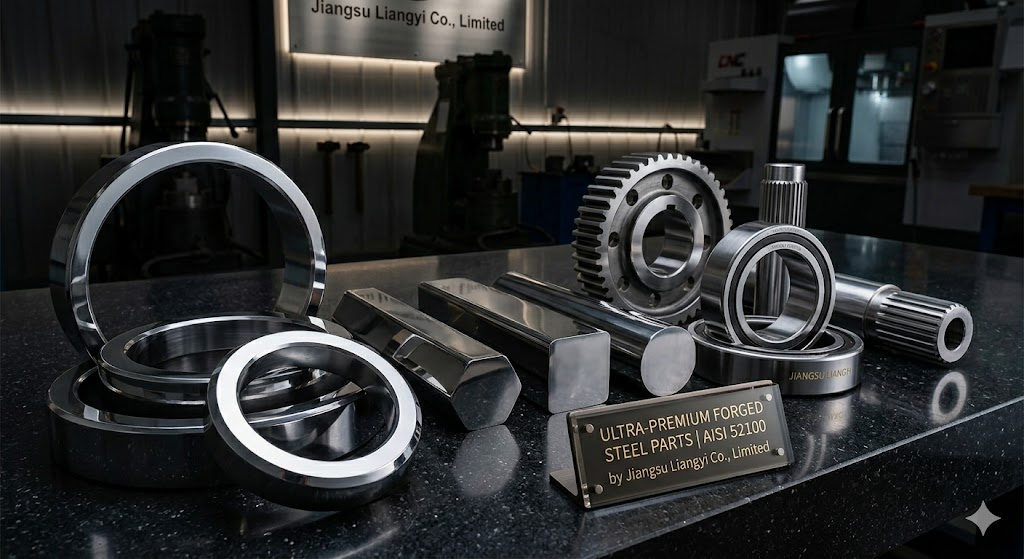
Yes — for almost every engineering purpose these are the same steel. AISI 52100, 100Cr6, SUJ2 and GCr15 are the American, European, Japanese and Chinese names for one high-carbon (~1% C) chromium (~1.5% Cr) bearing steel. They melt, forge and heat-treat identically and reach the same 60–64 HRC. The differences live in the small print: carbon and chromium band edges, how residual elements are capped, sulfur limits, and — most importantly — which cleanliness standard the steel is rated against.
If you buy or design forged bearing components, you have almost certainly seen the same part called four different things depending on where the drawing was drawn. A procurement engineer in Ohio writes AISI 52100; a bearing house in Schweinfurt writes 100Cr6; a Japanese OEM writes SUJ2; a Chinese mill certificate reads GCr15. The natural question follows: can I treat them as one material, or am I about to approve a substitution that bites me later?
This article answers that at the level a metallurgist and a QA reviewer both need. It is a comparison guide, not a product page — the base grade's full metallurgy, size range, delivery conditions and ordering details live on our AISI 52100 forging parts page. Here we focus purely on the cross-standard question.
- Same core steel: AISI 52100, 100Cr6, SUJ2 and GCr15 are one through-hardening high-carbon chromium bearing steel (~1.0% C, ~1.5% Cr).
- Same hardness: after quench and temper, all four reach 60–64 HRC — no national grade is metallurgically "harder" than another.
- Minor paper differences: SUJ2 allows carbon up to 1.10% and Mn only as a maximum; GCr15 sets chromium at 1.40–1.65%; JIS and GB explicitly cap nickel and copper.
- What really matters: steel cleanliness (inclusion rating) drives bearing fatigue life far more than the national grade name.
- Buyer action: request material dual- or multi-certified from a single heat so one certificate satisfies ASTM, EN, JIS and GB at once.
01Equivalents at a glance
The direct cross-reference most buyers are searching for — the four principal designations plus the older national codes in the same family:
| Designation | Region | Governing standard | Material No. / UNS |
|---|---|---|---|
| AISI / SAE 52100 | USA | ASTM A295 · SAE J404 | UNS G52986 |
| 100Cr6 | Europe / Germany | EN ISO 683-17 · DIN 17230 | 1.3505 |
| SUJ2 | Japan | JIS G4805 | — |
| GCr15 | China | GB/T 18254 | — |
| 100C6 | France | NF A35-565 | — |
| 535A99 | United Kingdom | BS 970 | — |
| ShKh15 | Russia | GOST 801 | — |
02Four standards, one metallurgical family
All four designations describe a through-hardening, high-carbon chromium bearing steel — hypereutectoid carbon near 1%, chromium near 1.5%, with the chromium forming stable M₃C and Cr₇C₃ carbides that give the steel its wear resistance and rolling-contact fatigue life. None of them is stainless; none is meaningfully alloyed with nickel or molybdenum. They are, genuinely, the same idea of a steel expressed by four national standards bodies working from the same physical metallurgy.
What differs first is paperwork identity — the governing document, the material number, and the product forms each standard was written to cover:
- AISI/SAE 52100 (USA) — chemistry per SAE J404; bearing-quality bar per ASTM A295; UNS number G52986. The "E" in AISI E52100 is a historical electric-furnace marker and today carries no compositional meaning.
- 100Cr6 (Europe/Germany) — EN ISO 683-17 (through-hardening bearing steels), material number 1.3505, historically DIN 17230. The name encodes the chemistry: ~1.00% C ("100"), chromium present ("Cr"), near 1.5% ("6" ÷ 4).
- SUJ2 (Japan) — JIS G4805 high-carbon chromium bearing steel. SUJ2 is the workhorse grade of the five SUJ types and the direct counterpart to 52100/100Cr6.
- GCr15 (China) — GB/T 18254. "G" marks bearing steel, "Cr15" indicates ~1.5% chromium. Premium variants add vacuum-degassing quality classes.
03Composition, side by side
This is where "the same steel" earns its footnotes. The four standards overlap heavily, but not perfectly. The highlighted cells are where a grade's specified limit steps outside the tightest common window — small on paper, and almost always invisible after processing, but real if your contract polices chemistry to the decimal.
| Element | AISI 52100 ASTM A295 |
100Cr6 EN ISO 683-17 |
SUJ2 JIS G4805 |
GCr15 GB/T 18254 |
|---|---|---|---|---|
| Carbon (C) | 0.93–1.05 | 0.93–1.05 | 0.95–1.10 | 0.95–1.05 |
| Chromium (Cr) | 1.35–1.60 | 1.35–1.60 | 1.30–1.60 | 1.40–1.65 |
| Silicon (Si) | 0.15–0.35 | 0.15–0.35 | 0.15–0.35 | 0.15–0.35 |
| Manganese (Mn) | 0.25–0.45 | 0.25–0.45 | ≤ 0.50 | 0.25–0.45 |
| Phosphorus (P) max | 0.025 | 0.025 | 0.025 | 0.025 |
| Sulfur (S) max | 0.015 | 0.025* | 0.025 | 0.025 |
| Molybdenum (Mo) max | 0.10 | 0.10 | 0.08 | 0.10 |
| Nickel (Ni) max | 0.25† | — | 0.25 | 0.30 |
| Copper (Cu) max | 0.30† | — | 0.25 | 0.25 |
* EN ISO 683-17 also defines lower-sulfur quality classes; premium bearing-quality 100Cr6 is routinely supplied well below the standard maximum. † ASTM A295 residual limits depend on edition and quality clause. Treat this table as an orientation map, not a substitute for the current standard text.
Read across the rows and three honest differences emerge: SUJ2 permits a slightly higher carbon ceiling (up to 1.10%) and specifies manganese only as a maximum; GCr15 sits its chromium band a touch higher (1.40–1.65%); and the Japanese and Chinese standards explicitly cap nickel and copper as residuals, which the older Western documents historically handled differently. Everything else is effectively common ground.
04Where they actually differ
Composition tables tell only part of the story. The differences a good buyer cares about are as much about how the steel is qualified as about the numbers themselves.
Carbon & chromium band edges
SUJ2's carbon can run marginally higher and GCr15's chromium band is nudged up. In practice a mill aims for the centre of the overlap (~1.00% C, ~1.45% Cr), so a single heat can satisfy all four at once — the edge cases only matter if a spec polices the extremes.
Residual element caps
JIS and GB name explicit Ni and Cu ceilings; EN and older ASTM text lean on general steelmaking practice. For clean scrap-fed EAF + LF + VOD melting these residuals sit far below every limit, so this rarely constrains supply.
Sulfur & inclusion cleanliness
This is the difference that actually drives bearing fatigue life — and it lives outside the base grade. Sulfur maxima differ slightly, but the bigger lever is the cleanliness rating method each standard invokes.
Governing standard & certification
ASTM A295, EN ISO 683-17, JIS G4805 and GB/T 18254 each carry their own testing, product-form and documentation expectations. When a contract cites one by name, the certificate must reference that document — even if the steel is physically identical.
Two heats can both be "52100" and behave completely differently in a bearing if one is dirty and one is clean. Non-metallic inclusions — oxides and sulfides — are the primary initiation sites for sub-surface rolling-contact fatigue. Cleanliness is rated by different methods across regions: ASTM E45 (US), ISO 4967 / DIN 50602 (EU), JIS G0555 (JP) and GB/T 10561 (CN). Aligning the grade is easy; aligning the cleanliness class is the real engineering work.
05Properties after heat treatment — effectively identical
Here the four grades converge completely. Because the base chemistry is shared, the response to heat treatment is shared: austenitize near 830–860 °C, oil quench, temper at 150–170 °C for bearing hardness. Whichever national name is on the certificate, a correctly processed part lands in the same envelope.
| Property | Typical value (quench + temper 150–170 °C) |
|---|---|
| Hardness | 60–64 HRC |
| Tensile strength | 1,150–1,400 MPa |
| Annealed hardness | HB 179–207 (for machining) |
| Through-hardening depth (oil) | effective to ~25 mm section |
| Density | 7.81 g/cm³ |
| Elastic modulus | 210 GPa |
In other words: if a supplier hands you a hardness or fatigue argument for choosing SUJ2 "over" 52100, be sceptical. At equal cleanliness and equal processing, the mechanical case for one national grade over another is essentially zero.
06So are they interchangeable?
For the vast majority of forged bearing rings, rolling elements, wear sleeves, valve seats and cold-forming dies — yes, freely interchangeable, provided cleanliness and heat-treatment condition are matched. The cases where you should slow down and specify precisely:
- Contractual standard compliance. If a purchase order or safety case cites ASTM A295 (or EN, JIS, GB) by name, the material certificate must reference that exact standard. The metal can be identical; the paperwork still has to match.
- Premium and aerospace applications. High-duty bearings often invoke tighter cleanliness classes or vacuum-remelt (VAR / VIM-VAR) routes and premium material specifications. There the base grade name is only the starting point — the melt route and inclusion class carry the real requirement.
- Tight residual or sulfur limits. If your design caps sulfur below 0.010% or restricts residuals for a specific reason, verify against the actual heat analysis, not the grade name.
Ask for material dual- or multi-certified from a single heat. When the melt chemistry is held inside the overlapping window of all four standards and the cleanliness class is agreed up front, one heat and one certificate can legitimately read "AISI 52100 / 100Cr6 / SUJ2 / GCr15." That is exactly how we serve buyers across US, EU, Japanese and Chinese specifications from one forging program.
07How to specify across all four on one drawing
A clean, dispute-proof callout has four parts, and the grade name is only the first:
- Grade + governing standard — e.g. "AISI 52100 per ASTM A295" — and list the accepted equivalents you'll take: 100Cr6 (EN ISO 683-17), SUJ2 (JIS G4805), GCr15 (GB/T 18254).
- Cleanliness requirement — name the rating method and acceptance class (e.g. ASTM E45 Method A, with your maximum D-type). This does more for fatigue life than any grade choice.
- Delivery condition + hardness — spheroidize-annealed for machining, or quenched-and-tempered to a stated HRC range.
- Certification level — EN 10204 3.1 as standard, or 3.2 with a named third-party body if the application demands independent witness.
Specify those four and the national name becomes a formality — any of the four grades, correctly clean and correctly processed, will satisfy the part.
08Myths vs facts
"SUJ2 is a harder, higher-carbon steel than 52100."
The carbon ceiling is marginally higher, but final hardness is set by heat treatment. Both reach 60–64 HRC.
"GCr15 is a cheaper, lower-grade Chinese imitation."
GCr15 is the same standardized bearing steel; premium bearing-quality GCr15 is vacuum-degassed and tightly inclusion-controlled.
"You can't substitute 100Cr6 for 52100 without re-qualifying the whole part."
Metallurgically they're equivalent; a single heat is routinely certified to both. Re-qualification is a paperwork and cleanliness question, not a metallurgy one.
"The E in E52100 means a better, cleaner steel."
"E" was a historical electric-furnace marker. Today it carries no compositional or cleanliness meaning and is used interchangeably.
AISI 52100, 100Cr6, SUJ2 and GCr15 are four national passports for one bearing steel. Match the cleanliness class and heat-treatment condition, and ask for a single-heat mill test certificate that lists all the standards you need — then the national name on the drawing becomes a formality rather than a risk.
09Frequently asked questions
What is AISI 52100 equivalent to?
AISI 52100 (UNS G52986) is equivalent to 100Cr6 / 1.3505 (EN ISO 683-17, Europe), SUJ2 (JIS G4805, Japan), GCr15 (GB/T 18254, China), 100C6 (France), 535A99 (UK) and ShKh15 (Russia). All are the same high-carbon chromium bearing steel with about 1.0% carbon and 1.5% chromium.
Is 100Cr6 the same as AISI 52100?
Yes, for practically all engineering purposes. 100Cr6 (material number 1.3505) and AISI 52100 share a nominally identical carbon and chromium composition and behave the same through heat treatment. A single heat is routinely certified to both ASTM A295 and EN ISO 683-17.
Can I use 100Cr6 where a drawing specifies AISI 52100?
For the large majority of forged bearing and wear components, yes. The safe path is to require material dual-certified to both ASTM A295 and EN ISO 683-17 from a single heat, so one certificate satisfies both callouts, and to match the cleanliness class and heat-treatment condition.
Is SUJ2 harder than 52100 because JIS allows more carbon?
No. JIS G4805 permits carbon up to about 1.10% versus roughly 1.05% for AISI 52100, but final hardness is governed by austenitizing temperature and tempering, not by that small ceiling difference. In practice both reach the same 60–64 HRC.
What is the difference between GCr15 and 52100?
GCr15 (GB/T 18254) and AISI 52100 are the same bearing steel. The only paper differences are that GCr15 places its chromium band slightly higher (1.40–1.65%) and explicitly caps nickel and copper residuals. Metallurgical behaviour and hardness are the same.
Is GCr15 lower quality than 52100 or 100Cr6?
No. GCr15 is the same standardized high-carbon chromium bearing steel, and premium bearing-quality GCr15 is vacuum-degassed and tightly inclusion-controlled. Quality is decided by steelmaking cleanliness, forging reduction and heat-treatment control, not by which national code appears on the certificate.
What does the 6 in 100Cr6 mean?
In the European name 100Cr6, "100" indicates about 1.00% carbon, "Cr" marks chromium as the main alloying element, and "6" is the chromium content multiplied by four — so 6 ÷ 4 ≈ 1.5% chromium. The name is a compact description of the chemistry.
Can one heat be certified to all four standards at once?
Yes, when the melt chemistry sits inside the overlapping window of all four standards and the required residual, sulfur and cleanliness limits are met. Multi-standard certification from a single heat is routine and is the most reliable way to serve buyers across the US, Europe, Japan and China from one forging program.
Need 52100 / 100Cr6 / SUJ2 / GCr15 forgings for global specifications?
We forge high-carbon chromium bearing steel and can certify a single heat to AISI 52100, 100Cr6, SUJ2 and GCr15 on one EN 10204 3.1 mill test certificate that we issue with every shipment. Jiangsu Liangyi is ISO 9001:2015 certified; independent EN 10204 3.2 inspection can be arranged through a recognised third-party body at your request. Open-die forgings and seamless rolled rings, 30 kg to 30 t.
See our custom AISI 52100 forgings → or request a 24-hour quote10Standards referenced
This comparison is based on the publicly published national and international bearing-steel standards below. Always work from the current edition and the material certificate for your specific order.
- ASTM A295 — Standard Specification for High-Carbon Anti-Friction Bearing Steel (AISI 52100).
- SAE J404 — Chemical Compositions of SAE Alloy Steels (grade 52100).
- EN ISO 683-17 — Heat-treatable steels, alloy steels and free-cutting steels; ball and roller bearing steels (100Cr6, 1.3505).
- DIN 17230 — Ball and roller bearing steels (historical, superseded by EN ISO 683-17).
- JIS G4805 — High carbon chromium bearing steels (SUJ2).
- GB/T 18254 — High-carbon chromium bearing steel (GCr15).
- ASTM E45 / ISO 4967 / JIS G0555 / GB/T 10561 — Methods for rating the non-metallic inclusion content (steel cleanliness).
- EN 10204 — Types of inspection documents (3.1 and 3.2 material certificates).