AISI 52100 (Alloy 52100 / AISI E52100 / UNS G52986) Forging Parts | ISO 9001 Certified China Manufacturer
AISI 52100 Forged Steel — Expert Quick Reference
- Material Class: High-carbon chromium alloy bearing steel — ASTM A295 / AMS 6440 / DIN 17230
- Global Equivalents: 100Cr6 (EU/Germany) · SUJ2 (Japan) · 100C6 (France) · 535A99 (UK) · ШХ15 (Russia) · GCr15 (China)
- Composition Key: C 0.93–1.05% · Cr 1.35–1.60% · Si 0.15–0.35% · Mn 0.25–0.45%
- Hardness Range: 60–64 HRC (Q+T) / HB 179–207 (annealed) / up to 65 HRC (cryo-treated)
- Tensile Strength: 1150–1400 MPa · Yield: ≥880 MPa · Elongation: ≥10%
- Physical Properties: Density 7.81 g/cm³ · Elastic Modulus 210 GPa · Thermal Expansion 11.9 µm/m·°C
- Forging Capacity: 30 kg – 30 t · Max ring Ø 6 m · Max shaft L 15 m · Max hollow OD 3000 mm
- Our Certification: ISO 9001:2015 · EN 10204 3.1 (standard with all shipments)
- Third-Party Inspection: EN 10204 3.2 via international inspection bodies available on customer request
- Lead Time: 15–45 days · Markets: 50+ countries · Experience: 25+ years
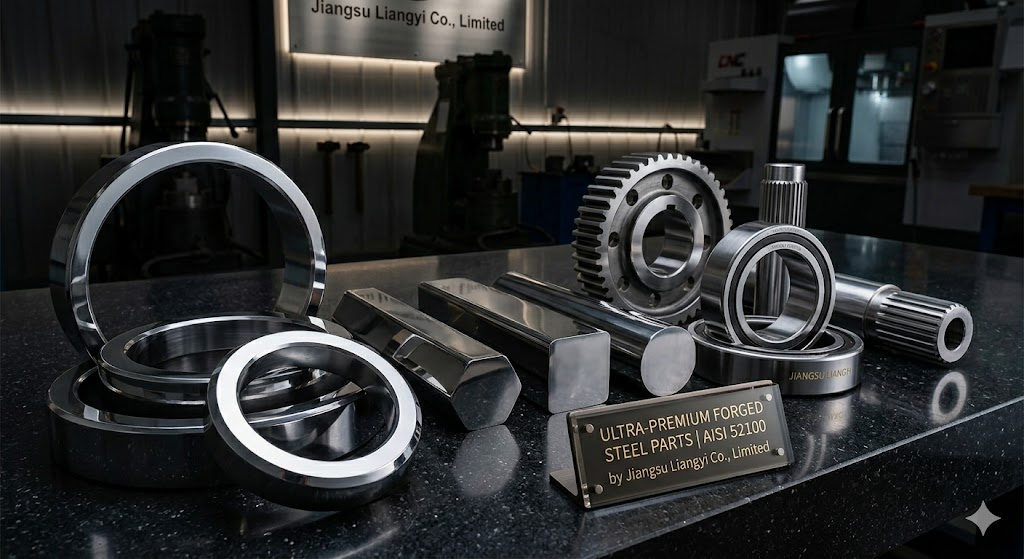
About AISI 52100 High Carbon Chromium Bearing Forging Steel
Jiangsu Liangyi Co., Limited is a professional ISO 9001:2015 certified manufacturer of AISI 52100 (also designated Alloy 52100, AISI E52100, and UNS G52986) open die forging parts and seamless rolled forged rings in China. With over 25 years of continuous forging experience and an installed press capacity ranging from 2,000 to 6,300 tonnes, we supply custom AISI 52100 forged components to engineering buyers in more than 50 countries across North America, Europe, the Middle East, Asia Pacific, and Australia.
AISI 52100 occupies a uniquely stable position in the global materials landscape: it was first standardized for bearing steel applications in the early 20th century and remains, over a century later, the world's single most widely produced bearing steel by volume. Its endurance as the industry benchmark is not coincidental — it derives from a precise balance of alloying elements that, when properly processed, creates a microstructure capable of sustaining Hertzian rolling contact stresses exceeding 3,000 MPa for hundreds of millions of load cycles without surface fatigue. No other steel of comparable alloying cost has replicated this combination of through-hardening depth, dimensional stability under cyclic load, and resistance to abrasive and adhesive wear.
Beyond its classical bearing role, AISI E52100 has earned a secondary reputation as an elite wear-resistant tool steel for cold-work applications. Its response to heat treatment is highly predictable and reproducible, allowing manufacturers to dial in hardness from a soft HB 179 (for machining) to a fully hardened 64 HRC within well-understood process windows. This versatility, combined with its broad international standardization under equivalent designations including 100Cr6, SUJ2, 100C6, 535A99, ШХ15, and GCr15, means that a single forging program from Jiangsu Liangyi can satisfy procurement teams across the European Union, United States, Japan, South Korea, Russia, and China simultaneously.
Metallurgical Fundamentals of AISI 52100 — Why This Steel Works
Understanding why AISI 52100 (100Cr6) performs the way it does requires a look at its microstructure — specifically the relationship between its high carbon content, chromium alloying, and the carbide phases that form during solidification and heat treatment.
The Role of Carbon: Hardness, Carbides, and Fatigue Life
The 0.93–1.05 wt% carbon content of AISI 52100 places it in the hypereutectoid composition range. This is deliberate. During solidification and hot working, the excess carbon above the eutectoid point (~0.77%) combines preferentially with chromium to form hard, thermodynamically stable chromium carbides — primarily of the Cr₇C₃ and M₃C (cementite) type. After a properly executed spheroidizing anneal, these carbides exist as fine, uniformly dispersed globular particles approximately 0.3–1.5 µm in diameter embedded in a ferritic matrix. This morphology is critical: spherical carbides are far less damaging to fatigue resistance than plate-shaped carbides, because they present no sharp stress-concentrating geometry to initiate sub-surface cracks under rolling contact.
Upon quenching from the austenitizing temperature, approximately 6–12% of the dissolved carbon and chromium remain in solution in the martensite, contributing directly to hardness and the creation of compressive residual stresses at the surface — a key contributor to rolling contact fatigue resistance. The remaining carbon is locked in undissolved carbides, which act as hard particles resisting abrasive scratching and adhesive seizure.
The Role of Chromium: Carbide Stability and Hardenability
Chromium is a double contributor in AISI 52100. First, it increases the thermodynamic stability of carbides and prevents them from dissolving into austenite when heated. Secondly, chromium greatly increases hardenability by slowing the diffusion-controlled transformation of austenite to pearlite and bainite on cooling, enabling through-hardening in sections up to about 25 mm diameter in oil quench. Special quench protocols are designed by our technical team to obtain acceptable hardness gradients in components up to 150 mm effective section thickness for larger forged sections.
The Critical Problem: Carbide Banding and Network Carbides
The primary metallurgical challenge with AISI 52100 is controlling the distribution of carbides throughout the forged section. In as-cast billets, carbides tend to segregate in bands parallel to the solidification direction and, in severe cases, form a continuous grain-boundary carbide network. Both conditions are damaging to fatigue life: carbide bands create preferred planes for sub-surface crack propagation, while network carbides act as ready-made crack paths around prior-austenite grain boundaries. This is precisely why forging — rather than bar rolling or casting — is the manufacturing method of choice for critical AISI 52100 components. Our minimum 3:1 forging reduction ratio physically breaks up these networks and redistributes carbide particles into a uniform, dispersed pattern. Post-forging spheroidizing annealing then shapes these particles into the ideal globular morphology.
Retained Austenite: The Hidden Variable
A less-discussed but practically important phenomenon in AISI 52100 heat treatment is retained austenite after quenching. Because the martensite finish temperature (Mf) of 52100 is below room temperature (approximately −60 to −80°C), standard room-temperature quenching always leaves some untransformed austenite in the microstructure — typically 8–20% by volume depending on austenitizing conditions. This retained austenite is dimensionally unstable: it will gradually transform to martensite over time under stress or at elevated temperatures, causing volume expansion and dimensional changes that can destroy the sub-micron tolerances required in precision bearings.
For standard industrial applications, low-temperature tempering at 150–170°C reduces retained austenite to approximately 5–8%, which is acceptable. For precision bearing components with very tight bore tolerances, we offer an optional cryogenic (sub-zero) treatment immediately after quenching: the forging is cooled to −80°C for 2 hours, which transforms retained austenite below 2% before tempering. This additional step adds stability and pushes final hardness toward 63–65 HRC.
AISI 52100 Chemical Composition (ASTM A295 Standard)
The chemical composition of our AISI 52100 forged steel is strictly controlled within the ASTM A295 standard limits. At Jiangsu Liangyi, our internal chemistry window is deliberately narrower than the standard range — tighter carbon and chromium control reduces heat-to-heat variation in hardness response, a meaningful improvement for customers producing tightly toleranced bearing components.
| Element | ASTM A295 Standard (%) | Our Controlled Range (%) | Metallurgical Role |
|---|---|---|---|
| Carbon (C) | 0.93 – 1.05 | 0.98 – 1.03 | Primary hardness former; carbide volume fraction control; hypereutectoid composition ensures wear-resistant carbide dispersoids |
| Chromium (Cr) | 1.35 – 1.60 | 1.40 – 1.55 | Carbide stabilizer (Cr₇C₃); hardenability improver; retards pearlite formation enabling oil-quench through-hardening to ~25 mm section |
| Silicon (Si) | 0.15 – 0.35 | 0.20 – 0.30 | Deoxidizer in steelmaking; strengthens ferrite matrix; reduces decarburization during heat treatment |
| Manganese (Mn) | 0.25 – 0.45 | 0.30 – 0.40 | Hardenability supplement; combines with sulfur to form MnS; increases austenite stability during quenching |
| Phosphorus (P) | ≤ 0.025 | ≤ 0.020 | Harmful impurity — segregates to grain boundaries and embrittles; tighter limit reduces temper embrittlement risk |
| Sulfur (S) | ≤ 0.015 | ≤ 0.010 | Harmful impurity — forms MnS inclusions acting as crack initiation sites in rolling contact fatigue; low S is critical for bearing quality |
Physical & Thermal Properties of AISI 52100 Forged Steel
Physical properties govern the engineering behavior of AISI 52100 forged components in service — particularly in applications involving thermal cycling, precision fits, or dynamic loading. The values below are representative of the spheroidize-annealed condition and are consistent with published data from ASTM, DIN, and JIS reference standards.
| Property | Value | Condition / Notes |
|---|---|---|
| Density | 7.81 g/cm³ | Room temperature, annealed |
| Elastic (Young's) Modulus | 210 GPa (30.5 × 10⁶ psi) | Room temperature; decreases ~20% at 300°C |
| Shear Modulus | 81 GPa | Calculated from E and ν |
| Poisson's Ratio | 0.295 | Room temperature |
| Coefficient of Thermal Expansion (CTE) | 11.9 µm/m·°C | 20–100°C; 12.5 µm/m·°C at 20–300°C |
| Thermal Conductivity | 46.6 W/m·K | Annealed, 20°C; ~35 W/m·K at 200°C |
| Specific Heat Capacity | 475 J/kg·K | 20°C; increases to ~600 J/kg·K at 500°C |
| Electrical Resistivity | 0.22 µΩ·m | Annealed condition, 20°C |
| Magnetic Properties | Ferromagnetic | Fully magnetisable in annealed and hardened states |
| Melting Range | 1430–1460°C | Solidus–liquidus range |
| Austenitizing Temperature | 830–870°C | For quench hardening (standard) |
| Martensite Start (Ms) | ~190–210°C | Varies with dissolved carbon content |
| Martensite Finish (Mf) | ~−60 to −80°C | Below room temperature → retained austenite is always present after standard quench |
The CTE of 11.9 µm/m·°C has practical implications for precision bearing assemblies. A 500 mm diameter bearing outer ring will expand approximately 0.60 mm per 100°C temperature rise — a change that must be accommodated in housing designs where the ring is retained by interference fit. Our engineering team can provide CTE-based dimensional guidance for press-fit assemblies in high-temperature environments.
Full Range of Custom AISI 52100 Forged Steel Products
All AISI 52100 forged steel products are produced strictly in accordance with international standards and customer provided drawings.Our vertically integrated production encompasses the entire value chain — from steel melting and vacuum degassing through forging, heat treatment, CNC rough machining, dimensional inspection, and NDT — with single-piece weight capacity from 30 kg to 30 tons.
AISI 52100 Forged Bars & Rods
We supply AISI 52100 forged round bars, square bars, flat bars, rectangular bars, and step-profile rods with maximum diameter up to 2,000 mm. Unlike rolled bar products, our forged bars are produced with a minimum reduction ratio of 3:1 from the original billet cross-section, ensuring that the as-cast dendritic structure and carbide segregation bands are thoroughly broken down. This translates into consistently superior transverse mechanical properties compared to rolled products — a critical advantage for bar stock machined into bearing rings or dies where loading direction may be perpendicular to the rolling axis. All bars are available with full EN 10204 3.1 mill test certification and optional UT per ASTM A388.
AISI 52100 Seamless Rolled Forged Rings
Our custom AISI 52100 seamless rolled rings are produced on 1M–5M CNC ring rolling mills, with finished outer diameters from 200 mm to 6,000 mm and weights up to 30 tons. The seamless rolling process imparts a favorable circumferential grain flow that aligns mechanical properties with the hoop stresses predominant in ring-shaped components — consistently outperforming machined-from-plate or welded rings in rotating applications. We produce flat rings, profile rings, and bearing outer ring blanks with wall thickness tolerances of ±2 mm on standard orders, tightened to ±0.5 mm on precision orders with additional machining. Application markets include European offshore wind turbine bearing rings, North American automotive differential ring gear blanks, and Middle East valve seat rings.
AISI 52100 Forged Hollow Parts, Sleeves & Bushes
We produce AISI E52100 forged hubs, cylindrical housings, thick-wall sleeves, bushes, and heavy-wall hollow bars. Outer diameter capacity: up to 3,000 mm; bore diameter from 100 mm; wall thickness from 30 mm. These near-net-shape hollow forgings reduce material waste and machining time compared to solid bar alternatives. Products can be manufactured to meet customer-specified API 6A material and dimensional requirements for oil and gas valve body applications in the Middle East and United States.
AISI 52100 Forged Discs, Blocks & Plates
Tooling die blanks, rolling mill backup roll collars, and structural machinery wear pads are produced to precise dimensional specifications from custom forged AISI 52100 forged discs, square and rectangular blocks, and thick plate forgings.Maximum disc diameter: 2,500 mm. Maximum block dimensions: 2,000 × 1,500 × 500 mm. All plate and block forgings are inspected with full-volume UT to confirm internal soundness to ASTM A578 acceptance Level C or better as standard.
AISI 52100 Forged Shafts, Spindles & Gear Blanks
Our AISI 52100 forged transmission shafts, step shafts, spindles, pinion shafts, and gear blanks are manufactured with a maximum finished length of 15 meters and maximum weight of 30 tons per piece. Shaft straightness is controlled to ≤1 mm/m during rough machining, with final straightness achievable to ≤0.3 mm/m on additional precision processing. Every shaft forging receives 100% longitudinal and radial UT scanning per ASTM A388 before dispatch.
AISI 52100 Forged Pipes, Casings & Pump Components
Our UNS G52986 forged steel pipes, tubes, pump casings, impellers, shaft sleeves and wear rings are suitable for high pressure industrial fluid systems with continuous abrasive wear conditions. Max pipe OD: 600 mm; max casing diameter: 1,800 mm. These components are supplied to pump manufacturers in the US, Germany, and China for use in chemical processing, water injection and industrial transfer.
AISI 52100 Forging Process — Step-by-Step at Jiangsu Liangyi
Steel Melting & Vacuum Degassing (EAF + LF + VOD)
Our steelmaking begins in a 30-tonne electric arc furnace (EAF). The molten steel is then transferred to a 30-tonne ladle refining furnace (LF) for precise temperature control and final chemistry trimming, with calcium-silicide injection for sulfide shape control. Final vacuum oxygen degassing (VOD) reduces dissolved oxygen and hydrogen to target levels. Every heat is sampled by optical emission spectrometry (OES) before tapping to verify chemistry compliance with ASTM A295.
Ingot Casting & Homogenization
Steel is cast into bottom-poured ingots under inert atmosphere. Ingots are soaked at 1180–1220°C for a minimum of 8 hours in a walking beam furnace to homogenize macro-segregation from solidification — particularly important for 52100 where chromium and carbon co-segregate to final-solidifying dendritic regions. This homogenization step is the foundation for achieving uniform mechanical properties across the full cross-section of large forgings.
Billet Preparation & Pre-Forging Heating
Ingots are cut to billet with ends cropped to remove primary pipe shrinkage (minimum 15% of ingot height). Billets are heated in a controlled-atmosphere car-bottom furnace at a rate not exceeding 80°C/h above 600°C to a uniform soak temperature of 1,050–1,100°C. Surface decarburization depth is monitored: for bearing ring blanks, decarburization must be contained within the machining stock allowance, verified by metallographic examination on process coupons from each heat lot.
Open Die Forging — Carbide Network Breakdown
Forging is performed on our 2,000T–6,300T hydraulic presses and 3T–5T electro-hydraulic hammers. The forging sequence is designed to achieve a minimum total reduction ratio of 3:1 (4:1 for precision bearing applications) while maintaining forging temperature above the 850°C lower limit. Working below 850°C in AISI 52100 accelerates carbide precipitation at prior-austenite grain boundaries, forming a brittle network that cannot be eliminated by subsequent heat treatment. Our press operators monitor forging temperature with optical pyrometers and return pieces to the reheat furnace if temperature drops to 900°C during long forging sequences.
Seamless Ring Rolling (for Ring Forgings)
Pre-formed ring blanks are transferred to our 1M–5M CNC ring rolling mills while still hot. The rolling mill simultaneously reduces wall thickness and increases ring diameter, imparting continuous circumferential deformation that produces favorable tangential grain flow and a uniformly fine grain structure throughout the ring cross-section. Dimensional parameters — outer diameter, bore, height, and ovality — are monitored in real time by the CNC control system.
Controlled Post-Forging Cooling
Cooling rate after forging is one of the most critical variables in AISI 52100 processing. Our protocol for sections above 100 mm: cooling in an insulated sand pit or furnace at a controlled rate of ≤30°C/h from forging temperature to below 200°C, after which air cooling is safe. Smaller sections (under 50 mm) are transferred to a warm sand box at 400°C and allowed to equalize for a minimum of 4 hours. This controlled approach eliminates the hydrogen-assisted delayed cracking that can occur in large 52100 forgings when cooled too rapidly.
Rough Machining, NDT & Final Certification
After heat treatment, forgings are rough-machined to leave 3–8 mm of machining stock on critical surfaces. Surfaces are then subjected to: (a) 100% ultrasonic testing per ASTM A388; (b) magnetic particle testing per ASTM E709 on all accessible surfaces; and (c) hardness survey at agreed locations. Dimensional report, hardness certificate, UT scan records, chemical analysis, and mechanical test results are compiled into an EN 10204 3.1 mill test certificate reviewed by our QC manager and issued with every shipment.
AISI 52100 Heat Treatment Protocols — Full Technical Specification
We operate three fully automated continuous furnace lines with PID temperature control to ±3°C and independent quench medium temperature control.
Protocol 1 — Spheroidizing Annealing for Optimal Machinability
Application: Standard delivery condition for forgings requiring subsequent CNC machining by the customer.
Cycle: Heat to 780–810°C at ≤80°C/h → hold 2–4 hours → furnace cool at 10–20°C/h to 680–720°C → isothermal hold 3–6 hours → furnace cool to ≤200°C → air cool.
Result: Fully spheroidized carbide microstructure, hardness HB 179–207. Cutting parameters: surface speed 90–120 m/min with coated carbide inserts, depth of cut 2–4 mm, feed 0.2–0.4 mm/rev.
Protocol 2 — Quench and Low-Temperature Temper for Bearing Applications
Application: Highest hardness and wear resistance condition for bearing rings, rolling elements, valve seat rings, and precision wear components.
Cycle: Preheat to 500–550°C → heat to 845°C ±10°C → soak 15–45 minutes (section-size dependent) → oil quench at 60–80°C → temper at 150–170°C for 2 hours minimum → air cool → (optional) cryogenic treatment at −80°C for 2 hours → re-temper at 150°C for 1 hour.
Result: Hardness 60–64 HRC (standard); 63–65 HRC (with cryogenic treatment). Retained austenite: 5–8% standard; <2% cryogenic.
Protocol 3 — Modified Temper for Tool & Die Applications
Application: Cold forming dies, stamping dies, shear blades and cutting tools where a balance of hardness and impact toughness is required.
Cycle: Austenitize at 845°C → oil quench → temper at 200–250°C for 2–3 hours → air cool.
Result: Hardness 58–62 HRC with approximately 20–30% higher impact toughness (Charpy energy) compared to the 150–170°C temper condition. This improvement in toughness reduces chipping at sharp cutting edges in interrupted-cut applications.
Protocol 4 — Stress Relief Anneal (Post-Machining)
Application: Large machined forgings where residual machining stresses could compromise dimensional stability.
Cycle: Heat slowly to 550–600°C → hold 2–4 hours → furnace cool to 150°C → air cool.
Result: Reduction of machining residual stresses without affecting mechanical properties. Recommended for complex profiles with section thickness changes >3:1 and thin-wall sections below 15 mm.
Mechanical Properties of AISI 52100 Forgings — All Delivery Conditions
Mechanical properties are verified on representative test coupons cut from each production forging lot and tested by our in-house quality laboratory. Results are reported in the EN 10204 3.1 mill test certificate accompanying every shipment.
| Property | Spheroidized Annealed | Q + Temper 150–170°C | Q + Temper 200–250°C | Cryo + Temper 150°C |
|---|---|---|---|---|
| Hardness | HB 179–207 | 60–64 HRC | 58–62 HRC | 63–65 HRC |
| Tensile Strength (Rm) | 620–760 MPa | 1,150–1,400 MPa | 1,050–1,300 MPa | 1,300–1,550 MPa |
| Yield Strength (Rp0.2) | 370–480 MPa | ≥ 880 MPa | ≥ 820 MPa | ≥ 960 MPa |
| Elongation (A5) | ≥ 18% | ≥ 10% | ≥ 11% | ≥ 9% |
| Reduction of Area (Z) | ≥ 45% | ≥ 35% | ≥ 38% | ≥ 30% |
| Impact Toughness (Charpy V) | ≥ 80 J | ≥ 18 J | ≥ 25 J | ≥ 14 J |
| Retained Austenite (vol.%) | n/a | 5–8% | 3–6% | < 2% |
| Fatigue Limit (σ₋₁) | ~320 MPa | ~580 MPa | ~560 MPa | ~610 MPa |
Machinability, Weldability & Cold Formability of AISI 52100
Machinability
In the spheroidized-annealed condition (HB 179–207), AISI 52100 machines with moderate difficulty — it rates approximately 55% of the AISI 1212 free-machining reference. The primary challenge is abrasion of cutting tools by hard chromium carbide particles. Use uncoated or TiAlN-coated carbide inserts (ISO P10–P20 grade) for turning; apply flood coolant; use cutting speeds of 80–120 m/min, feed rates of 0.15–0.35 mm/rev, and depths of cut of 1–4 mm. For hard turning of fully hardened 52100 components (above 55 HRC), use cubic boron nitride (CBN) inserts. Grinding of hardened 52100 requires close attention to wheel speed and coolant flow to prevent grinding burns that create harmful tensile residual stresses.
Weldability — Why AISI 52100 Is Not Recommended for Welding
With a carbon equivalent (CE) of approximately 1.65–1.85 (IIW formula), AISI 52100 has extremely poor weldability. Fusion welding causes rapid austenitization of the heat-affected zone (HAZ) followed by martensitic transformation on cooling, producing an intensely hard (65–67 HRC) brittle zone that typically cracks within hours of cooling. This is a fundamental thermodynamic consequence of the steel's composition, not a correctable procedure issue.
Preferred joining alternatives: interference fits (shrink/press fitting), bolted flanges, mechanical locking rings, adhesive bonding with structural epoxies, or brazing with silver-copper alloy filler metals at temperatures below 780°C. If emergency repair welding of a cracked component is unavoidable, preheat to 300°C minimum and use Inconel-type nickel alloy filler metals with very low heat input — but treat any such repair as temporary and replace the component at the earliest opportunity.
Cold Formability
In the fully annealed condition, AISI 52100 can be cold formed to a limited degree — bending radii of 2× material thickness are achievable without cracking, but severe cold forming such as deep drawing is not practical. Cold sizing (coining) of annealed forged discs to improve flatness is routinely performed in our facility. Any significant cold forming must be followed by a full spheroidizing anneal to restore the microstructure before subsequent machining or heat treatment.
Failure Mode Analysis of AISI 52100 Components — Common Causes & Prevention
Based on our manufacturing experience and collaborative engineering work with customers, we have identified the four most common failure modes in AISI 52100 forged components in service.
Failure Mode 1 — Sub-Surface Rolling Contact Fatigue (Spalling)
Appearance: Small, shallow pits on rolling or sliding contact surfaces, often showing a "oyster shell" fracture morphology under SEM examination.
Root Cause: Fatigue crack initiation at sub-surface stress concentrations — most commonly large (>10 µm) non-metallic inclusions (alumina clusters or globular oxides) that create a local triaxial stress field under Hertzian contact pressure.
Prevention: VOD degassed, steel cleanliness to ASTM A295; inclusion rating to ASTM E45, Method A, acceptable D <=1.0; minimum forging reduction ratio 3:1; optional cryogenic treatment to reduce retained austenite.
Failure Mode 2 — Grinding Burns & Residual Stress Cracking
Appearance: Shallow surface cracks following grinding tracks; detectable by Barkhausen noise analysis or acid etch.
Root Cause: Excessive heat in the grinding operation causes localized re-austenitizing and re-tempering which produces a softened "white layer" with tensile residual stresses.
Prevention: Maintain wheel surface speed ≤25 m/s; use open-structure aluminum oxide or CBN wheels; apply minimum 20 L/min flood coolant; limit depth of cut to ≤0.005 mm per pass for finish grinding; verify absence of burns with 3% nital etch on every finished bearing surface per ISO 15330.
Failure Mode 3 — Grain Boundary Carbide Cracking
Appearance: Intergranular fracture with a rock-candy appearance on the fracture face, typically triggered by impact loading or assembly press-fitting.
Root Cause: Continuous grain-boundary carbide film formed during forging below 850°C, or during slow cooling through the 700–500°C range.
Prevention: Strict enforcement of the 850°C forging finish temperature floor; controlled post-forging cooling at ≤30°C/h; full-volume UT inspection — grain boundary carbide networks produce elevated background noise in UT that experienced operators can identify.
Failure Mode 4 — Dimensional Instability from Retained Austenite Transformation
Appearance: Progressive dimensional changes over time; bore diameter growth in precision bearing applications; loss of interference fit.
Root Cause: Stress-induced or thermally induced transformation of retained austenite (causing ~4% volume expansion locally) causing dimensional drift in precision components.
Prevention: Cryogenic sub-zero treatment immediately after quenching; stabilization tempering at 130–150°C for extended duration for ultra-precision applications; perform final dimensional measurement 24 hours after heat treatment, not immediately, to capture short-term transformation before finish grinding.
AISI 52100 vs. Common Forging Steel Grades — Detailed Performance Comparison
| Steel Grade | Max Hardness (HRC) | Core Advantage | Limitation vs. AISI 52100 | Best Application |
|---|---|---|---|---|
| AISI 52100 | 60–65 | Ultra-high wear resistance, superior rolling contact fatigue life, excellent dimensional stability, predictable heat treatment, moderate cost | Reference grade — limited corrosion resistance; not weldable | Bearing components, rolling contact wear parts, valve seats, cold forming dies |
| AISI 4140 / 42CrMo4 | 50–54 | Excellent weldability, high impact toughness, wide availability, good machinability | Lower maximum hardness (~54 HRC), significantly lower wear resistance, not suitable for high-wear applications | General-purpose shafts, gears, structural components, flanges, hydraulic cylinder bodies |
| D2 Tool Steel / X155CrVMo12-1 | 60–64 | Higher chromium (12%) gives better corrosion resistance; superior edge retention in long-run stamping dies | Higher material cost (~2.5× AISI 52100), lower impact toughness, more complex heat treatment | Long-run blanking and stamping dies; slitter knives; corrosion-environment wear plates |
| 440C Stainless Steel | 58–62 | Excellent corrosion resistance (Cr ≈ 17%); suitable for food contact and wet environments | Lower rolling contact fatigue life; higher material and machining cost; lower hardness ceiling | Surgical instruments, food processing bearings, marine wear parts |
| AISI 4340 / 36CrNiMo4 | 52–58 | Outstanding fatigue resistance under bending and torsion; excellent toughness; excellent weldability with preheat | Much lower maximum hardness; poor surface wear resistance | High-stress structural forgings, aircraft landing gear, crankshafts, large turbine shafts |
| M2 High Speed Steel | 62–66 | Excellent hot hardness (retains hardness to 600°C); superior tool life in high-speed cutting | Much higher cost (4–6× AISI 52100); complex heat treatment; poor toughness under impact | Cutting tools, drills, end mills, taps; not for large structural forgings |
Global Industrial Applications of AISI 52100 Forged Steel Parts
Automotive & Industrial Bearing Manufacturing (EU, USA, Japan Market)
AISI 52100 (100Cr6 / SUJ2) has been the undisputed global standard for rolling element bearings since the early 20th century. Our Alloy 52100 forged bearing rings, rolling element blanks, and bearing housing forgings are supplied to automotive transmission manufacturers in Germany, wind turbine bearing suppliers in Denmark, and industrial motor producers in the United States and Japan. After precision heat treatment, AISI 52100 delivers uniform through-hardening and exceptional wear resistance in heavy-duty rotating applications. All products comply with DIN EN ISO 683-17 and ASTM A295 standards with full EN 10204 3.1 certification; EN 10204 3.2 with independent third-party inspection is available on request.
Oil & Gas Valve Industry (USA, Middle East Market)
We supply AISI E52100 forged valve balls, bonnets, bodies, stems, seat rings, and back-pressure valve components for oilfield wellhead projects in Saudi Arabia, the UAE, and the United States. In high-pressure wellhead services handling sand-laden crude oil, gas, or produced water, AISI 52100 in the fully hardened 60–64 HRC condition provides significantly higher abrasion resistance than standard 17-4PH stainless steel, extending valve service intervals between maintenance shutdowns. We manufacture valve components to customer specified material and dimensional requirements and 100% ultrasonic tested and magnetic particle tested prior to delivery. On request we can provide third party inspection and EN 10204 3.2 certification.
Steel Rolling Mill Equipment (Southeast Asia, India, Korea Market)
Our UNS G52986 forged work rolls, roll sleeves, and cold work rolls are widely used in rolling mills across India, South Korea, Turkey, and Vietnam. The high carbon chromium composition provides the best resistance to thermal fatigue and abrasive wear by oxide scale in continuous rolling conditions. We can optimize our heat treatment process to achieve a hardness gradient between the roll surface and core. This gives wear resistance to the surface and keeps the core tough against bending fatigue stresses. In these markets, customers typically report measurable reductions in roll change frequency compared to conventional roll materials.
Mining & Construction Machinery (Australia, Brazil, Chile Market)
We manufacture AISI 52100 forged crane wheels, sheave wheels, transmission shafts, and wear components for large mining machinery manufacturers in Australia, Brazil, and Chile. These components are used in harsh, high-abrasion mining environments where great impact resistance and wear performance are needed. In similar field conditions, AISI 52100 forged crane wheels in the hardened condition of 60–62 HRC show substantially lower tread wear rates than cast manganese steel alternatives, providing longer wheel replacement intervals and reduced total maintenance costs for mine operators.
Pump & Fluid Handling Equipment (North America, EU, China Market)
We produce AISI 52100 forged pump casings, impellers, shaft sleeves, wear rings, and high-pressure valve components for industrial pump manufacturers in the United States, Germany, and China. An AISI 52100 shaft sleeve hardened to 60 HRC provides substantially higher galling resistance compared to AISI 316 stainless steel in metal-to-metal contact scenarios, extending mechanical seal service life in high-shaft-speed applications. Customers in high-pressure descaling pump applications report sustained performance over extended operating periods with AISI 52100 sleeve components.
Tool & Die Manufacturing (USA, Germany, Italy Market)
Alloy 52100 forged cold forming die blanks, stamping die blocks, shear blade forgings, and precision gauge blocks are supplied to tool rooms and die manufacturing shops across the United States, Germany, and Italy. After heat treatment to 60–62 HRC, AISI 52100 tools are well-suited for medium-production-run stamping of low-to-medium carbon steel sheet, with the material cost advantage of approximately 30–40% versus D2 or A2 tool steel making it the economic choice for production runs where D2's additional wear resistance is not required. We also provide custom pre-machined die blanks with bore, shank, and locating features rough-machined to ±0.5 mm.
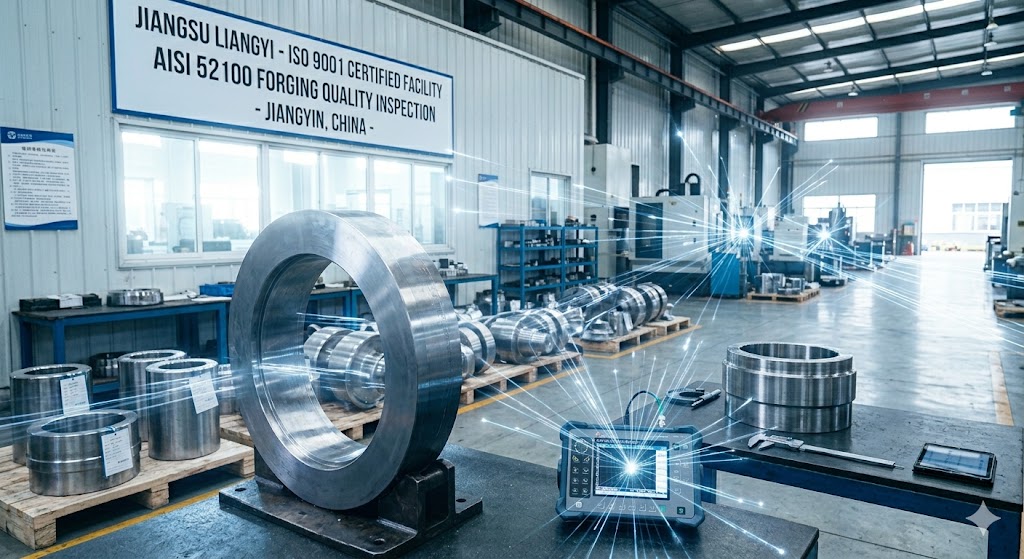
Quality Assurance, Inspection & Certification
We operate an ISO 9001:2015 certified quality management system, audited annually by an independent certification body. Our approach to quality for AISI 52100 forged components means designing the manufacturing process so that defect opportunities are eliminated upstream rather than detected downstream.
In-Process Quality Controls
- Steel Chemistry: OES analysis of every heat before tapping; retained sample archived for 5 years per EN 10204 traceability requirements
- Inclusion Rating: Per ASTM E45 Method A on every heat, reported on MTC; maximum acceptance D-type ≤1.0 for bearing quality
- Forging Temperature: Optical pyrometer monitoring at every press blow; mandatory reheat if temperature drops to 900°C
- Dimensional Control: CMM verification of critical dimensions after rough machining; ±0.5 mm standard, ±0.1 mm on precision machined deliveries
- Heat Treatment Control: Calibrated data-logging furnace controllers (±3°C accuracy); regular thermocouple calibration surveys; hardness testing at minimum 5 locations per piece
Final Inspection & NDT Services
- Ultrasonic Testing (UT): 100% volume scanning per ASTM A388 / EN 10228-3; acceptance: FBH ≤2 mm standard, FBH ≤1 mm for precision bearing grades; C-scan imaging available for critical components
- Magnetic Particle Testing (MPT): 100% accessible surfaces per ASTM E709 / EN 10228-1; acceptance per applicable standard or customer specification
- Dye Penetrant Testing (PT): Per ASTM E165 / EN ISO 3452 for non-magnetic or inaccessible areas
- Hardness Survey: Portable Rockwell / Brinell testing at agreed locations; full hardness depth profile by incremental Vickers testing on request
- Retained Austenite Measurement: X-ray diffraction (XRD) analysis available on request
- Dimensional Verification: Full dimensional report per customer drawing; surface roughness measurement where specified
Certification Scope — What We Hold vs. What Can Be Arranged
How to Order AISI 52100 Forgings — Buyer's Complete Procurement Guide
Information Required for a Complete RFQ
- Material Specification: ASTM A295 Gr. 52100, DIN 17230 100Cr6, JIS G4805 SUJ2, or equivalent. Include the full document if using a proprietary specification.
- Part Drawing / Dimensional Sketch: PDF or DWG format with all critical dimensions and tolerances. For budgetary quotes, a written description of the approximate dimensions (OD x ID x H for rings; L x Ø for bars) including tolerance requirements is enough.
- Delivery Condition: Spheroidized-annealed (for machining), quenched-and-tempered (specify hardness range), or normalized.
- Required Mechanical Properties: Tensile strength, yield strength, elongation, hardness range — specify which values are mandatory vs. informational.
- NDT Requirements: UT acceptance grade (ASTM A388, EN 10228-3, or other); MPT and PT requirements; visual acceptance standard.
- Certification Level: EN 10204 3.1 (standard) or EN 10204 3.2 (with third-party; specify inspection authority). Also indicate if ABS, DNV, BV or other society endorsement is required.
- Quantity and Required Delivery: Piece count per order and target delivery date. Typical lead time: 30–45 days from drawing approval for new orders; 20–30 days for repeat orders.
- Special Requirements: Surface roughness, machining stock allowance, marking (heat number, part number stamping), packaging (VCI wrapping, wooden case), or Incoterms (FOB, CIF, DDP).
Our Order Process
- RFQ Acknowledgement: Within 2 hours during business hours (GMT+8, Mon–Fri 08:00–18:00).
- Technical Review: Our engineering team reviews drawing and specification for manufacturability within 24 hours.
- Quotation Issue: Formal quotation including unit price, tooling cost, lead time, payment terms, and certification scope within 24 hours of receiving complete technical information.
- Order Confirmation: Upon PO receipt and drawing approval, production scheduling begins immediately. Production schedule issued within 3 business days.
- Production Updates: Progress reports at key milestones (forging complete, heat treatment complete, NDT complete) sent proactively.
- Shipment and Documentation: MTC, UT report, dimensional report, packing list, and commercial invoice issued 24 hours before shipment.
Frequently Asked Questions — 12 Expert Answers on AISI 52100 Forging Parts
AISI 52100 (UNS G52986) is globally equivalent to: 100Cr6 per DIN EN ISO 683-17 (Germany/EU); SUJ2 per JIS G4805 (Japan); 100C6 per NF A35-565 (France); 535A99 per BS 970 (UK); ШХ15 per GOST 801 (Russia); and GCr15 per GB/T 18254 (China). All share nominally identical carbon (0.95–1.05%) and chromium (1.35–1.60%) composition. The "E" prefix in AISI E52100 historically designated electric furnace melting — today it is used interchangeably with AISI 52100 and the compositions are identical.
AISI 52100's dominance as a bearing steel rests on a unique metallurgical combination: (1) The hypereutectoid carbon content (~1%) creates a dense dispersion of hard chromium carbide particles resisting abrasive wear; (2) 1.5% chromium stabilizes carbides against dissolution during heat treatment and improves hardenability; (3) The through-hardening response produces uniform hardness to 60–64 HRC across sections to ~25 mm; (4) The resulting tempered martensitic matrix with spherical carbides delivers substantially superior rolling contact fatigue life compared to plain carbon steels. The steel has been continuously optimized since the 1920s and its heat treatment behavior is the most thoroughly characterized of any engineering steel — reducing process risk for manufacturers worldwide.
AISI 52100 hardness by delivery condition: Spheroidized annealed: HB 179–207 (ideal for machining). Normalized: HB 220–255. Q + tempered at 150–170°C: 60–64 HRC (standard bearing condition). Q + tempered at 200–250°C: 58–62 HRC (die/tool condition with improved toughness). Cryogenic treated + tempered at 150°C: 63–65 HRC with retained austenite <2% (ultra-precision bearing condition). Note: the optimal austenitizing temperature for maximum hardness is 845°C ± 10°C — higher temperatures dissolve more carbon, lower the martensite start temperature, and can actually reduce final hardness by 1–2 HRC despite more carbon in solution.
Our production capacity: Weight range: 30 kg to 30 tons per piece. Forged bars: maximum diameter 2,000 mm, maximum length 8,000 mm. Seamless rolled rings: maximum outer diameter 6,000 mm, minimum bore 500 mm, maximum height 2,000 mm. Forged hollow parts: maximum OD 3,000 mm. Forged shafts: maximum length 15,000 mm. Forged discs/blocks: maximum diameter 2,500 mm. All custom sizes producible per customer drawings. Through-hardening in oil quench is effective to approximately 25 mm effective section — for larger through-hardened sections, we design specialized quench protocols on a case-by-case basis.
No — AISI 52100 is not stainless steel. Its chromium content of 1.35–1.60% is far below the 10.5% minimum required for passive film formation. Unprotected AISI 52100 will develop surface rust in humid air within days. For bearing applications in corrosive environments: (1) use protective coatings (hard chrome plate, phosphate + oil, or DLC coating); (2) specify grease with rust inhibitors; (3) upgrade to 440C stainless steel (Cr ≈ 17%) for wet environments; or (4) consider silicon nitride (Si₃N₄) ceramic rolling elements paired with 52100 rings for hybrid bearing applications in water-contaminated lubrication. Properly sealed and lubricated AISI 52100 bearings perform reliably in mild industrial atmospheres.
AISI 52100 is generally not weldable by conventional fusion welding. Its carbon equivalent (CE ≈ 1.65–1.85 per IIW formula) causes the heat-affected zone (HAZ) to harden to approximately 65–67 HRC during cooling after welding, producing a brittle, highly stressed zone that typically cracks within hours — even with extensive preheating. Preferred joining methods: interference fits, mechanical clamping, structural adhesive bonding, or silver-copper brazing below 780°C. If emergency repair welding is unavoidable, preheat to 300°C minimum and use Inconel-type nickel alloy filler metals with very low heat input — but treat any such repair as temporary.
The forging temperature window for AISI 52100 is 850–1,100°C. The upper limit of 1,100°C avoids grain boundary liquation and rapid grain growth. The critical lower limit of 850°C is where the steel enters a two-phase austenite + carbide region: working below this temperature causes chromium carbides to precipitate continuously at austenite grain boundaries, forming a brittle network that is permanent — it cannot be eliminated by subsequent heat treatment and causes intergranular brittle fracture in service. In our facility, every forging blow is monitored by optical pyrometer, and any piece that cools below 900°C is returned to the reheat furnace before continuing.
Our standard NDT scope: UT: ASTM A388 / EN 10228-3, acceptance FBH ≤2 mm (standard) or FBH ≤1 mm (bearing-quality grade). MPT: ASTM E709 / EN 10228-1, acceptance linear indications ≤2 mm, rounded indications ≤4 mm, or per customer specification. PT: ASTM E165 / EN ISO 3452. Visual: EN ISO 17637. Dimensional: ±0.5 mm standard, ±0.1 mm on precision machined deliveries. Hardness: minimum 5 surface locations per piece. All NDT performed by qualified NDT personnel per applicable international standards. Customer-specified NDT standards (ASME, API, DNV, etc.) implemented on request.
Retained austenite is the portion of the steel's microstructure that does not transform to martensite during quenching — because the martensite finish temperature (Mf) of AISI 52100 is approximately −60 to −80°C, below room temperature. After a standard oil quench to room temperature, 8–15% typically remains as metastable austenite. In service, this can transform to martensite under stress or elevated temperatures, causing a volume expansion of approximately 4% locally — enough to cause dimensional drift that destroys sub-micron tolerances in precision bearings. The solution is cryogenic treatment (cooling to −80°C immediately after quenching) to drive retained austenite below 2%. We measure retained austenite by X-ray diffraction (XRD) and report the result on the MTC for all cryogenic-treated forgings.
Yes. EN 10204 3.1 mill test certificates — issued by our own authorized quality representative — are included as standard with every shipment. For customers requiring EN 10204 3.2 independent third-party verification, inspection and certificate issuance can be arranged through internationally recognized bodies including TUV, Bureau Veritas (BV), DNV, Germanischer Lloyd (GL), American Bureau of Shipping (ABS), Lloyd's Register (LR), RMRS, and RINA. The customer specifies their preferred inspection authority; that body reviews our documentation and witnesses testing at our facility. Third-party witness inspection during production forging, heat treatment, and final inspection can be arranged with advance notice. Survey costs are passed through at actual cost without markup.
The chemical composition of AISI 52100 and AISI E52100 is identical. The "E" prefix historically designated steel melted in an electric arc furnace (EAF) rather than an open hearth furnace — a distinction relevant before the 1980s. Today, essentially all commercial steel is EAF-melted, making the "E" prefix redundant. The designations AISI 52100, AISI E52100, SAE 52100, and UNS G52986 all refer to the same steel and are used interchangeably in modern engineering documents. If a purchasing specification calls for AISI E52100, standard AISI 52100 per ASTM A295 is the correct supply material.
To receive a complete quotation within 24 hours, send to sales@jnmtforgedparts.com: (1) Material specification (ASTM A295 Gr. 52100 / DIN 100Cr6 / JIS SUJ2 / your proprietary spec); (2) Part drawing in PDF or DWG (a rough sketch with key dimensions is sufficient for budgetary quotes); (3) Delivery condition required (annealed / Q+T with hardness range / normalized); (4) Mechanical property requirements; (5) NDT scope and acceptance criteria; (6) Certificate type (EN 10204 3.1 or 3.2, specify issuing authority); (7) Quantity and target delivery date; (8) Any special requirements (surface finish, marking, packaging, Incoterms). Our sales engineers respond within 2 hours during business hours and can schedule a video call with our technical team for complex specifications.
Contact Us for Custom AISI 52100 Forgings Quotation
Jiangsu Liangyi Co., Limited is your trusted China-based manufacturer of high-quality AISI 52100 forged steel parts. With over 25 years of professional forging experience, advanced EAF + LF + VOD steelmaking, 2,000T–6,300T hydraulic press capacity, and a rigorous ISO 9001:2015 quality system, we deliver consistent, certified forgings to demanding customers across all global markets. Send us your drawing, material specification, and quantity requirement — our sales engineers will confirm receipt within 2 hours and return a complete technical and commercial offer within 24 hours.
Inquiry Email: sales@jnmtforgedparts.com
Phone / WhatsApp: +86-13585067993
Website: https://www.jnmtforgedparts.com
Factory Address: Chengchang Industry Park, Jiangyin City, Jiangsu Province, 214400, China
Business Hours: Monday – Friday 08:00–18:00 (GMT+8) | WhatsApp available outside business hours
Our Certification: ISO 9001:2015 | EN 10204 3.1 with all shipments
Third-Party Inspection: EN 10204 3.2 via TUV / BV / DNV / GL / ABS / LR available on customer request