Main Takeaways — AISI 440B Forging Parts at a Glance
- Material: AISI 440B is a high-carbon martensitic stainless steel (0.75–1.0% C, 16–18% Cr), also known as UNS S44003 / JIS SUS 440B / DIN ~1.4112.
- Peak Hardness: HRC 58 after quenching at 1,010–1,065°C and tempering at 148°C, per ASTM A276.
- Tensile Strength: Up to 1,750 MPa (254 ksi) in hardened and tempered condition.
- Optimal Balance: Higher hardness than 440A, better corrosion resistance and machinability than 440C — the best all-round grade for heavy-duty forgings.
- Product Range: Forged bars, seamless rolled rings, valve components, bearing rings, discs, blocks — 30 KGS to 30,000 KGS per piece.
- Manufacturer: Jiangsu Liangyi Co., Limited — ISO 9001:2015, 25+ years, 80,000 m² factory, 120,000 ton/year, exporting to 50+ countries.
1. About AISI 440B Material and Our Factory
Jiangsu Liangyi Co., Limited is a professional manufacturer of AISI 440B, SUS 440B, UNS S44003, and Grade 440B open die forging parts and seamless rolled steel forged rings, which is ISO 9001:2015 certified, located in Jiangyin City, Jiangsu Province, China. Founded in 1997, we have had over 25 years of professional forging experience and exported high-quality 440B stainless steel forgings to more than 50 countries across North America, Europe, the Middle East, Southeast Asia, and Oceania.
We provide one-stop custom forging solutions including steel melting, open die forging, seamless ring rolling, precision heat treatment and CNC machining, fully complying with international standards and customer drawings. Our factory has an area of 80,000 m², with an annual capacity of 120,000 tons. The single-piece forging weight is 30 KGS to 30,000 KGS, and we can support prototype development and mass production for global industrial clients.
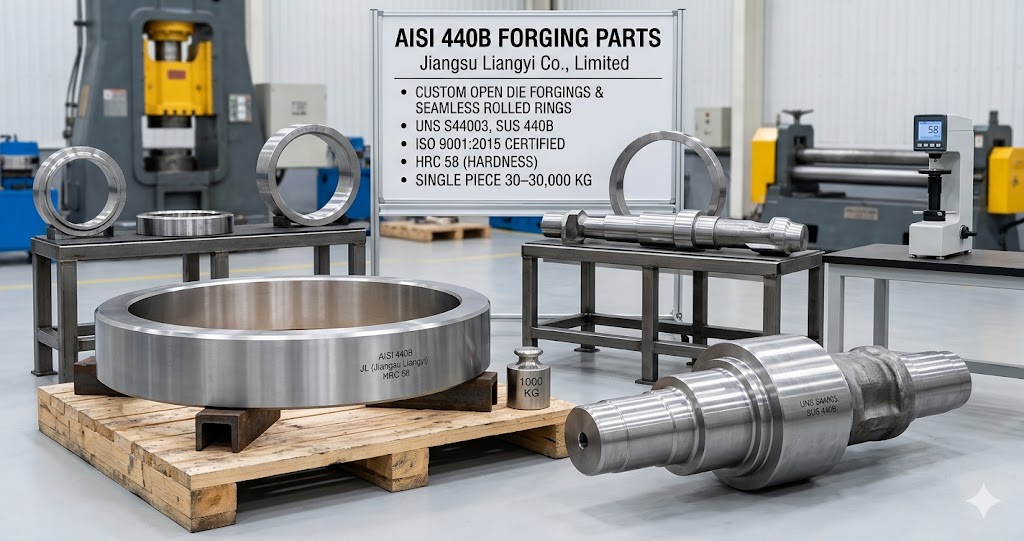 AISI 440B (UNS S44003 / SUS 440B) open die forgings and seamless rolled rings manufactured by Jiangsu Liangyi Co., Limited — ISO 9001:2015 certified, Jiangyin City, Jiangsu, China
Main Advantages of AISI 440B Martensitic Stainless Steel
AISI 440B is a high-carbon martensitic stainless steel (containing 0.75–1.0% carbon and 16–18% chromium) that achieves an optimal balance of moderate corrosion resistance, high tensile strength up to 1,750 MPa, excellent hardness up to HRC 58, and superior wear resistance. According to metallurgical engineering references and ASTM A276, 440B has higher hardness than 440A and better corrosion resistance and machinability than 440C, so that it is the best choice material for heavy-duty industrial components requiring long service life in harsh working environments.
— Reference: ASTM A276 “Standard Specification for Stainless Steel Bars and Shapes”; ASTM A479 “Standard Specification for Stainless Steel Bars and Shapes for Use in Boilers and Other Pressure Vessels”
Technical Note — Naming Convention: The designation “440B” follows the
AISI numbering system. The “4” prefix indicates a chromium-type stainless steel, the second “4” designates the specific alloy group, and “B” denotes the mid-range carbon variant within the 440 series. In the
UNS, it is identified as S44003; in the Japanese
JIS standard, it is SUS 440B; and the closest European equivalent is
DIN 1.4112 (X90CrMoV18), although compositional differences exist.
1.1 Why Our AISI 440B Forgings Deliver Upper-Specification Performance
Most forging suppliers treat AISI 440B as a standard catalogue item. At Jiangsu Liangyi, we treat it as a precision metallurgical challenge. In 25+ years producing 440B martensitic stainless forgings, we have developed proprietary process controls that consistently deliver results at the upper end of specification — not simply “within specification.”
Our complete in-house process chain provides control at every step: Electric Arc Furnace (EAF) primary melt → Ladle Furnace (LF) refining for precise composition adjustment and inclusion removal → Vacuum Degassing (VD) to reduce dissolved hydrogen to below 1.5 ppm, eliminating hydrogen-induced flaking risk in heavy cross-sections. This triple-refining practice achieves actual sulfur content of ≤ 0.005% (vs the ASTM A276 maximum of 0.015%) and phosphorus ≤ 0.025% (vs 0.040% per standard). Lower tramp elements translate directly into measurably improved toughness, fatigue life, and corrosion resistance in the finished forging.
Our minimum forging reduction ratio of 4:1 for all AISI 440B material ensures complete breakdown of the as-cast dendritic ingot structure, producing a uniform fine-to-medium grain size of ASTM E112 No. 6–9. Sections forged at lower reduction ratios — a practice at some cost-focused suppliers — retain coarse columnar grains that reduce Charpy impact toughness by 20–35% and accelerate fatigue crack initiation. We document reduction ratio on every forging traveller card, available upon request with EN 10204 documentation.
Jiangsu Liangyi Internal Standard — Stricter Than ASTM A276: For every AISI 440B heat we melt, our internal specification JL-SS-440B requires: S ≤ 0.005%, P ≤ 0.025%, dissolved H₂ ≤ 1.5 ppm, dissolved O₂ ≤ 20 ppm. These limits are verified by Optical Emission Spectrometry (OES) and hydrogen/oxygen fusion analysis on every heat, and reported in full on our EN 10204 3.1 Mill Test Certificates.
2. Complete AISI 440B Forged Product Range
We manufacture a full line of custom AISI 440B forging parts in all kinds of specifications, and all parts meet ASTM A276, A479, DIN, EN, JIS and API 6A standards. Following are our main forged products:
2.1 AISI 440B Forged Bars and Shafts
We supply AISI 440B forged round bars, square bars, flat bars, rectangular bars, hollow bars, and custom step shafts, gear shafts, transmission shafts and turbine shafts. Max forging diameter reaches 2 meters, max length 15 meters, single-piece weight up to 30 tons. 100% ultrasonic testing (per ASTM A388 or EN 10228-3) is performed for all forged bars to ensure internal quality.
2.2 AISI 440B Seamless Rolled Forged Rings
Our SUS 440B seamless rolled rings include gear rings, bearing rings, valve seat rings, slewing bearing rings and custom contoured rolled rings, with max outer diameter of 6 meters and single-piece weight up to 30 tons. The seamless ring rolling process produces a continuous circumferential grain flow that significantly improves fatigue strength and structural integrity — typically 30–50% higher fatigue life compared to welded or plate-cut alternatives. Ideal for rotating and pressure-bearing applications in oil and gas, power generation and heavy machinery industries.
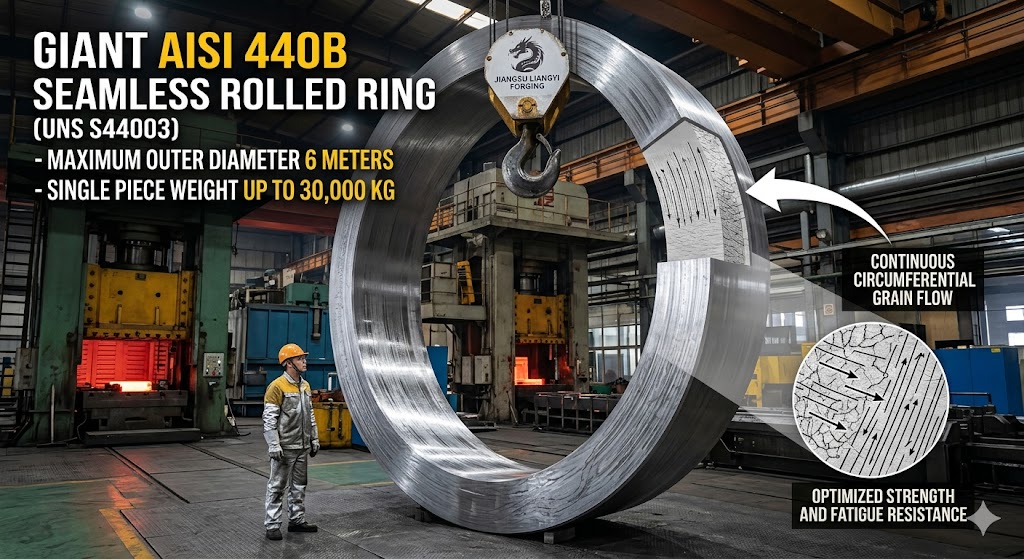 AISI 440B (SUS 440B / UNS S44003) seamless rolled rings — max OD 6 m, 30–50% superior fatigue life vs welded alternatives, 100% UT per ASTM A388
2.3 AISI 440B Forged Housings, Sleeves and Pipes
Custom UNS S44003 forged hubs, housings, shells, sleeves, bushes, seamless pipes, tubes, casings and barrels for pumps, valves and rolling mills. Our forged hollow components feature uniform material structure and excellent mechanical performance for high-pressure and high-wear conditions.
2.4 AISI 440B Forged Discs, Plates and Blocks
Grade 440B forged discs, plates, blocks, flanges and die blocks are used for turbine impellers, cutting dies, mold bases and structural components. For the precision requirements of global machinery manufacturers we offer custom sizes with strict flatness and parallelism control (usually within ±0.5 mm per 1,000 mm).
2.5 Standard Dimensional Tolerances (As-Forged and After Rough Machining)
Understanding achievable tolerances at each production stage helps engineers plan machining allowances correctly and avoid over-specifying, which adds cost without benefit.
Table 2B: Dimensional Tolerances for AISI 440B Forgings — As-Forged vs After Rough Machining
— Standard tolerances per Jiangsu Liangyi internal standard JL-DIM-001. Tighter tolerances achievable after precision CNC machining (typically IT7–IT8 per ISO 286 or per customer drawing).
2.6 AISI 440B Seamless Hollow Forged Bars
A less-publicised but high-demand product from our range is the AISI 440B seamless hollow forged bar — a gun-drilled or mandrel-pierced forged tube with wall thicknesses far exceeding what pipe mills can achieve from wrought material. By forging first, then boring, we achieve wall thicknesses from 20 mm to 300 mm, outer diameters from 80 mm to 600 mm, and lengths up to 4 meters. Typical applications include pump sleeve blanks, heavy-wall valve bodies, pressure vessel liners, and custom hydraulic cylinder barrels. Unlike mill-extruded or seamless pipe, our forged hollows are fully mechanically worked (minimum 4:1 reduction before piercing), eliminating any vestige of the as-cast structure throughout the entire wall thickness.
3. Chemical Composition and Material Properties of AISI 440B
The chemical composition of our AISI 440B forged material is tested from ingot top and bottom samples, which fully meet ASTM E354, ASTM E1473, ASTM E2465 and ARP1313 standards. Final product chemical analysis meets ASTM B880 tolerance requirements. We will provide complete test reports for every batch.
3.1 AISI 440B Standard Chemical Composition (Weight %)
Table 1: AISI 440B (UNS S44003) Chemical Composition per ASTM A276
— Source: ASTM A276 / A479; UNS S44003 per SAE/ASTM Unified Numbering System
3.2 Strict Metallurgical Quality Standards
- Inclusion Control: Non-metallic inclusions below 3 THIN series or DIN 50602 K4≤15
- Grain Size Control: ASTM E112 Grade 5–9 with uniform carbide distribution, no banding or segregation
- NDT Inspection: 100% ultrasonic testing per ASTM A388 or EN 10228-3
- Macro-Etch Testing: Per ASTM A604 to verify absence of center segregation and other macro-defects
3.3 The Carbon–Chromium Interaction: The Core Metallurgy of 440B
The central metallurgical challenge of AISI 440B — what distinguishes it from simpler tool steels and from other stainless grades — is the dynamic interplay between carbon and chromium during heat treatment. Understanding this is essential for selecting the right heat treatment parameters and for appreciating why 440B occupies its unique position between 440A and 440C.
During austenitizing (1,010–1,065°C), carbon and chromium partially dissolve from existing carbide particles (Cr₃₂C₆ and Cr₃C₂) into the austenite matrix. Critically, not all carbides dissolve at these temperatures — a controlled fraction remains as fine, undissolved hard particles. These undissolved carbides are beneficial: they act as micro-abrasion-resistant particles in the martensite matrix, providing wear resistance that surpasses pure martensite of the same hardness.
The trade-off is quantifiable: for every 0.1% C dissolved, approximately 0.7% Cr is also consumed from the passive-layer-forming pool. At the upper limit of 440B (1.0% C, 16% Cr), approximately 7% Cr may be tied up in carbides, leaving ~9% Cr dissolved — still sufficient to maintain a passive film, but less than 440A. This is why 440B outperforms 440C on corrosion resistance: 440C at 1.20% C consumes ~1.5× more chromium in carbides, further reducing dissolved Cr.
Austenitizing Temperature Effect on 440B Performance: Higher austenitizing temperature (1,065°C) dissolves more carbides → higher martensite carbon content → higher hardness (up to HRC 58) but marginally lower corrosion resistance. Lower austenitizing temperature (1,010°C) dissolves fewer carbides → slightly lower hardness (HRC 56–57) but better corrosion resistance and more wear-resistant undissolved carbide particles. Jiangsu Liangyi selects austenitizing temperature based on your primary performance requirement — specify when inquiring.
3.4 Chemistry Targeting by Application at Jiangsu Liangyi
Within the ASTM A276 composition range for S44003, we target different chemistry sub-ranges depending on the customer’s application. This is a service that few suppliers offer but that significantly influences the final performance:
- Machining-intensive parts (valve balls, pump impellers): We target C at 0.78–0.85%, Cr at 17.0–17.5%. This reduces annealed hardness to 220–225 HB (vs 230–235 HB maximum), improving machinability by ~8–10%, while still achieving HRC 56–57 after full hardening — adequate for most wear applications.
- Maximum hardness / bearing rings: We target C at 0.90–1.0%, Cr at 16.5–17.5%, maximising dissolved carbon for peak HRC 57–58 after hardening. Machinability rating: 40–42% of AISI B1112 free-machining steel.
- Large-section forgings (>200 mm diameter): We specify C at 0.75-0.82% to minimize the risk of quench cracking during hardening, yet maintain HRC 55-57 performance which is adequate for heavy duty applications such as rolling mill rolls.
4. Mechanical Properties of AISI 440B Stainless Steel
The typical mechanical and physical properties of AISI 440B in the annealed and hardened conditions are summarized in the following table. These values are engineering references for design and FEA simulation.
Table 2: AISI 440B Typical Mechanical and Physical Properties (ASTM A276)
— Reference: ASTM A276, ASM International Metals Handbook Vol. 1. Actual values vary with heat treatment and section size.
Engineering Tip: The hardness (HRC 58) guarantees good wear resistance but poor ductility (2–3% elongation). For higher toughness, temper at 315–370°C to achieve HRC 50–54. Avoid tempering at 425–565°C — this range causes temper embrittlement and reduced corrosion resistance due to grain boundary chromium carbide precipitation.
4.2 Impact Toughness vs Heat Treatment Condition
Hardness (HRC 58) alone does not fully characterise AISI 440B’s mechanical behaviour. Impact toughness — critical for components subject to dynamic or shock loading — varies dramatically with heat treatment and must be considered in design.
Table 2C: AISI 440B Charpy V-Notch Impact Toughness vs Heat Treatment Condition
— Data from ASM International Metals Handbook Vol. 4: Heat Treating and Jiangsu Liangyi production verification data. Values are typical for 25–50 mm test bars; larger section toughness may be 10–20% lower.
4.3 Fatigue Properties of AISI 440B Forgings
For rotating components — valve stems, pump shafts, turbine discs, bearing races — fatigue strength is frequently the limiting design criterion, not static tensile strength. AISI 440B forged components exhibit the following fatigue characteristics in the hardened-and-tempered condition:
- Rotating bending endurance limit (R.R. Moore, R = −1, 107 cycles): approximately 500–620 MPa at HRC 55–58. Endurance ratio relative to UTS: ≈0.33–0.36.
- Shot peening benefit: The residual stresses generated by shot peening (Almen intensity 0.008–0.014A, 100% coverage) increase the fatigue endurance limit by 15–25% to about 600–780 MPa. Shot peening is standard for all rotating 440B components at Jiangsu Liangyi upon request.
- Surface finish effect on fatigue: A polished surface (Ra ≤ 0.4 μm) extends fatigue life by 10–20% compared to a standard turned surface (Ra 1.6 μm) because it eliminates micro-notches that initiate cracks. This is why bearing races are super-finished before service.
- Fracture toughness (KIC): Approximately 20–30 MPa√m in the maximum-hardness condition (148°C temper). Tempering at 260–370°C raises KIC to 30–45 MPa√m at the cost of 3–8 HRC hardness. Specify your design requirement and we will optimise the tempering temperature accordingly.
4.4 High-Temperature Property Retention
AISI 440B is primarily an ambient-temperature material, but understanding its strength retention at elevated temperatures helps engineers assess suitability for steam valve seats, turbine seal rings, and other moderate-temperature service.
Table 2D: AISI 440B Tensile Property Retention at Elevated Temperature (Hardened + Tempered 148°C)
— Indicative values from ASM International data and Jiangsu Liangyi testing. Parts originally tempered at 148°C must not be used continuously above 200°C — prolonged service at temperatures exceeding the original tempering temperature causes in-service over-tempering (hardness loss and dimensional change). Solution: temper at 15°C above maximum anticipated service temperature.
5. AISI 440B International Standard Equivalents
AISI 440B is recognized across multiple standard systems. The following cross-reference table helps engineers identify the correct designation.
Table 3: AISI 440B Cross-Reference Designations
— Note: DIN 1.4112 has mandatory Mo (0.9–1.3%) and V (0.07–0.12%) differing from AISI 440B. Always verify exact composition for critical applications.
6. AISI 440A vs 440B vs 440C — Detailed Comparison
The AISI 440 series share 16–18% chromium but differ in carbon content, directly affecting hardness, wear resistance, corrosion resistance and machinability.
Table 4: Comparison of AISI 440A, 440B, and 440C
Why Choose AISI 440B for Forging Applications?
AISI 440B is widely recommended by metallurgical engineers as the optimal all-round grade within the 440 series for most heavy-duty industrial forging applications. Its carbon content (0.75–1.0%) delivers hardness close to 440C (HRC 58 vs HRC 60), while retaining better corrosion resistance because more chromium remains dissolved in the matrix. Additionally, 440B is easier to forge and machine than 440C, resulting in lower production costs, shorter lead times, and fewer forging defects for complex components.
6.2 Grade Selection Decision Matrix — When to Choose 440B
The choice between 440A, 440B, and 440C is not just about hardness numbers. The optimum grade is a function of section thickness, method of forging, service environment and manufacturing constraints.
Table 4B: Grade Selection Guide — 440A vs 440B vs 440C for Forging Applications
The Large-Section Forging Advantage of 440B Over 440C
Many engineers default to 440C for wear applications without considering the manufacturing risk for large forgings. In our experience, 440C forgings with cross-sections exceeding 100 mm require extremely precise quench rate control to avoid quench cracking. The higher carbon (up to 1.20%) generates greater volumetric expansion stresses during the austenite-to-martensite transformation. We have observed 440C forgings crack during the quench when the quench rate varied by as little as 10–15% from optimal. For sections greater than 150 mm, we strongly recommend 440B. The practical hardness difference (HRC 58 vs HRC 60) is less than 2 points — a difference that most wear-resistant applications cannot distinguish in service — but the manufacturing reliability improvement for large forgings is decisive.
6.3 Cost-Benefit Analysis: 440A vs 440B vs 440C
Grade selection also has a direct cost implication. Using the approximate relative cost indices in our production experience:
- Raw material cost: 440A ≈ 440B ≈ 440C (within 2–5%, as all use the same base chromium content). The small carbon difference has negligible raw material impact.
- Heat treatment cost: 440C requires more careful furnace control and has higher rejection rates due to quench cracking (especially for sections >100 mm). Our 440C rejection rate for sections 100–200 mm is approximately 3–5× higher than for the same geometry in 440B. This increases effective cost per accepted piece.
- Machining cost: 440B (annealed) machines approximately 8–10% faster than 440C due to lower hardness. For machining-intensive parts (valve balls, impellers), this translates to meaningful cycle time and tooling savings.
- Total cost conclusion: For most industrial forging uses, 440B has equal or better overall long-term value than 440C, because it can reduce the risk of cracking during quenching, lower machining costs, and provide better corrosion resistance, meanwhile it can keep strong hardness performance.
7. Heat Treatment Specification for AISI 440B Stainless Steel
We use fully automated heat treatment furnaces with ±5°C temperature accuracy. Full process records and time-temperature charts are documented for each batch.
7.1 Forging Temperature
Forge at 1,065–1,175°C (1,950–2,150°F). Start at 1,175°C; do not continue below 925°C. Slow furnace cooling is mandatory after forging to prevent cracking.
7.2 Annealing
Anneal at 843–871°C (1,550–1,600°F), hold 1 hour per 25 mm thickness, furnace cool at ≤28°C/hour to below 595°C. Target: ≤235 HB.
7.3 Hardening and Tempering
- Preheat to 760–790°C to equalize temperature
- Austenitize at 1,010–1,065°C for 30–60 minutes
- Quench in oil or air cool (oil recommended for sections >50 mm)
- Temper immediately at 148°C for minimum 2 hours → Peak hardness HRC 58
Sub-zero (Cryogenic) Treatment — Optional: Deep freeze at -73°C (-100°F) for 2 hours between quenching and tempering to transform retained austenite, improving hardness uniformity by 1–2 HRC points.
7.4 Stress Relieving
For parts requiring final machining after hardening, stress relieve at 150–175°C for 4–6 hours.
Critical Warning — Temper Embrittlement Zone: Do NOT temper AISI 440B at 425–565°C. This range causes impact toughness loss and corrosion resistance degradation due to Cr₂₃C₆ precipitation at grain boundaries.
7.5 Austenitising Soak Time vs Section Thickness
One of the most common heat treatment errors for AISI 440B is insufficient soak time at the austenitising temperature. Thin sections equilibrate quickly but heavy forgings require proportionally longer holds to ensure uniform carbide dissolution and temperature throughout the cross-section before quenching.
Table 6A: AISI 440B Recommended Austenitising Soak Time by Section Thickness
7.6 Double Tempering Practice for Large and Complex Sections
For AISI 440B forgings with cross-sections exceeding 50 mm, a double tempering cycle is Jiangsu Liangyi’s standard practice. Here is the metallurgical reason this matters:
After oil quenching, 5–15% of austenite typically does not transform to martensite — this is retained austenite. During the first temper at 148°C, carbon diffuses within the martensite matrix, slightly destabilising the retained austenite. When the part cools back to room temperature after the first temper, some of this destabilised retained austenite transforms to fresh, untempered martensite — which is hard but contains high internal stress. The second temper at 148°C relieves these stresses without significantly reducing hardness. The result: more uniform hardness, lower residual stress, and improved dimensional stability throughout the service life of the component.
Our double tempering schedule for sections >50 mm: First cycle at 148–163°C × minimum 2 hours; air cool to room temperature; second cycle at 148–163°C × minimum 2 hours. Total minimum tempering time: 4 hours. For sections >200 mm, we extend each cycle to 3 hours minimum (6 hours total).
7.7 Common Heat Treatment Failures and Prevention Protocols
Based on our metallurgical root-cause analysis experience, these are the most common heat treatment failures in AISI 440B — and how we prevent them:
- Quench cracking: Most common in sections >100 mm or complex geometries with sharp internal corners (high stress concentration factor, Kt > 2.0). Prevention: Preheat at 760–790°C before austenitising to equalise temperature; use oil quench (never water quench for 440B sections >25 mm); target lower C chemistry (0.75–0.82%) for sections >200 mm; specify generous corner radii (min r ≥ 5 mm for sections >50 mm).
- Soft spots: Caused by inadequate quench contact (part touching furnace fixture, non-uniform oil agitation, or excessive surface scale). Prevention: Part suspension jigging in our vacuum oil-quench furnaces; forced oil agitation at >2 m/s velocity around the part; 100% Rockwell hardness survey (minimum 3 locations per piece) after quench-and-temper on every piece.
- Surface decarburisation: Carbon loss from the steel surface during austenitising in oxidising atmospheres reduces surface hardness by 2–5 HRC over a 0.1–0.5 mm depth. Prevention: Nitrogen protective atmosphere in all our austenitising furnaces; maximum allowable decarburisation: 0.05 mm depth, verified metallographically on sample cross-sections per batch. All customers receive surface hardness data confirming no decarburisation degradation.
- Excess retained austenite: Austenitising above 1,070°C dissolves too many carbides, producing high-carbon austenite resistant to full martensitic transformation. Result: lower-than-expected hardness and dimensional instability. Prevention: Strict furnace temperature control (±5°C), thermocouple calibration per ASTM E220 quarterly; optional sub-zero treatment at −73°C to ensure >95% martensite conversion for bearing-grade precision components.
8. Machinability and Welding Guide for AISI 440B
8.1 Machinability
AISI 440B is best machined in the annealed condition (≤235 HB). Machinability rating: approximately 40–45% of AISI B1112 free-machining steel baseline.
- Tooling: Carbide inserts (ISO K10–K20) or ceramic tools for finish machining
- Cutting Speed: 50–80 m/min (annealed); 20–40 m/min (hardened HRC 55+)
- Feed Rate: 0.1–0.3 mm/rev for turning; rigid setups to minimize vibration
- Coolant: Generous flood coolant (water-soluble oil) essential
- Grinding: Al₂O₃ or CBN wheels with light passes for hardened parts
— Machinability data: ASM International Metals Handbook, Vol. 16: Machining
8.2 Welding
AISI 440B has limited weldability due to high carbon content. Welding should be avoided where possible. If unavoidable:
- Preheat to 250–300°C and hold interpass temperature
- Filler Metal: Matching composition or AWS E/ER 410 electrodes
- Process: GTAW (TIG) preferred; SMAW acceptable
- PWHT: Anneal immediately at 675–760°C, furnace cool slowly
- Limitations: Mechanical properties and corrosion resistance of welded joints are not as good as base metal
Design Recommendation: Use mechanical fastening (bolting, press-fitting, shrink-fitting) instead of welding for AISI 440B components to preserve full hardness, toughness, and corrosion resistance.
8.3 Grinding AISI 440B — Special Considerations
Grinding is the final sizing and surface finishing operation for precision 440B components — bearing races, valve balls, and gage blocks. Unlike austenitic grades that are difficult to grind due to rapid work hardening, hardened 440B grinds more predictably, like a tool steel. This is both an advantage and a risk if grinding burn is not controlled.
- Wheel selection: Aluminium oxide (Al₂O₃) wheels, Grade WA46–60KV for rough/semi-finish; CBN (cubic boron nitride) wheels for high-production precision finishing. Silicon carbide wheels are not recommended — they load quickly on 440B and cause inconsistent surface finish.
- Surface grinding (annealed 440B): Wheel speed 25–30 m/s, work speed 8–15 m/min, cross-feed 0.3–0.5 mm/pass, depth of cut 0.01–0.05 mm/pass.
- Cylindrical grinding (hardened HRC 55+): Wheel speed 25–28 m/s, work speed 15–25 m/min, infeed 0.002–0.005 mm/pass for finish grinding.
- Achievable surface finish: Rough grinding Ra 0.8–1.6 μm; finish grinding Ra 0.2–0.4 μm; cylindrical plunge grinding Ra 0.1–0.2 μm; honing/super-finishing Ra ≤ 0.05 μm (bearing-grade).
- Grinding burn prevention: This is the critical risk. Grinding burn on hardened 440B creates a soft re-tempered martensite layer (2–5 HRC lower hardness) or, in severe cases, a re-austenitised/re-quenched surface with high residual tensile stress and micro-cracks. Both conditions are unacceptable for wear or fatigue applications. Prevention: continuous flood coolant (3–5% water-soluble oil), sharp wheel dressing every 10–15 workpieces, light passes, and Barkhausen noise or 10% nitric acid etch inspection on all bearing-grade surfaces.
8.4 Cutting Parameters and Tool Life Data
Experienced machinists familiar with standard stainless steels (304, 316) must adjust their expectations for hardened 440B. The following specific parameters are drawn from our CNC machining shop and customer feedback:
Table 7B: AISI 440B Recommended CNC Cutting Parameters (Annealed Condition, ≤235 HB)
Work Hardening Advantage vs Austenitic Grades: AISI 440B (martensitic) has a low work hardening rate (strain hardening exponent n ≈ 0.05–0.08 in the hardened condition) compared to AISI 304 austenitic (n ≈ 0.35–0.45). This means 440B does not significantly harden further during machining, making it far easier to hold tight dimensional tolerances through multi-pass cutting. The trade-off: the base hardness (HRC 55–58) is already very high, so cutting tool wear is rapid — use premium carbide or CBN tooling, shorter tool paths between indexing, and generous flood coolant.
9. Corrosion Resistance of AISI 440B Stainless Steel
AISI 440B has moderate corrosion resistance, which is better than carbon steels and tool steels, but lower than austenitic grades (304, 316). The 16–18% chromium forms a passive Cr₂O₃ oxide layer, but high carbon content reduces the dissolved chromium available for passivation.
9.1 Corrosion Performance by Environment
Table 5: AISI 440B Corrosion Resistance by Media
9.2 Maximizing Corrosion Resistance
- Surface Finish: Polished surfaces (Ra ≤ 0.8 μm) significantly improve passivation
- Hardened Condition: More evenly distributed carbides improve corrosion performance vs annealed
- Passivation Treatment: 20–40% nitric acid per ASTM A967 enhances the Cr₂O₃ layer
- Avoid Sensitization: Do not temper at 425–565°C
440B vs 440C — Corrosion Advantage
AISI 440B has measurably better corrosion resistance than 440C because its lower carbon content means fewer chromium carbides form during heat treatment. More chromium remains in solid solution to form the protective passive film. According to ASM International data, 440B retains approximately 1–2% more dissolved chromium than 440C in the hardened condition.
9.3 Pitting Resistance Equivalent (PRE) — Where 440B Stands
Engineers selecting stainless steels for corrosive environments use the Pitting Resistance Equivalent (PRE) as a single comparative index. The formula is:
PRE = %Cr + 3.3 × %Mo + 16 × %N
For AISI 440B, intentional nitrogen is typically <0.05%, so the simplified formula applies: PRE ≈ %Cr + 3.3 × %Mo. The PRE range depends on actual heat chemistry:
Table 5B: PRE Comparison — AISI 440B vs Related Grades
This comparison reveals a critical insight: DIN 1.4112 and AISI 440B are frequently listed as equivalents, but their PRE values differ by 3–5 points because 1.4112 mandates 0.9–1.3% Mo. Engineers specifying 1.4112 for corrosion-sensitive applications should verify whether ASTM 440B (which allows but does not require Mo) will meet their corrosion requirement. Jiangsu Liangyi can produce 440B with Mo at 0.50–0.75% (upper end of the ASTM A276 S44003 specification) to maximise PRE while remaining within standard — specify “Mo-bearing 440B” when requesting a quote.
9.4 Galvanic Compatibility and Contact Corrosion
AISI 440B in hardened, polished condition occupies the middle of the galvanic series — more noble than carbon steel and aluminium, but slightly less noble than austenitic grades. Practical coupling recommendations:
- Acceptable metal contacts: Other 440-series grades, 17-4PH, AISI 420, AISI 410 — minimal galvanic potential difference (<50 mV in dilute NaCl)
- Insulate or avoid: Aluminium alloys (~500 mV difference; aluminium will corrode), carbon steel (~400 mV; carbon steel corrodes rapidly), magnesium alloys (severe galvanic risk)
- Contact with AISI 316L: Small potential difference (~80–100 mV); 440B is the less noble partner and will experience preferential corrosion in continuous salt water. Acceptable for atmospheric and fresh water; electrical isolation recommended for prolonged seawater or salt spray.
9.5 Effect of Surface Condition on Corrosion Performance
No factor influences the practical corrosion performance of AISI 440B more than surface condition. A poorly finished or damaged surface can reduce corrosion resistance by an order of magnitude compared to a properly prepared surface:
- Surface roughness: Polished surface (Ra ≤ 0.4 μm) shows dramatically better pitting resistance than as-machined surface (Ra 1.6 μm). Rough surfaces create micro-crevices where aggressive ions concentrate. For corrosion-critical applications, specify Ra ≤ 0.4 μm and passivation.
- Passivation film damage: The Cr₂O₃ passive film, approximately 1–3 nm thick, is damaged by mechanical abrasion, chloride-containing contamination, or contact with carbon steel (iron contamination initiates preferential corrosion). Passivation per ASTM A967 restores the passive film within 24 hours.
- Heat tint and scale from heat treatment: Any scale or heat tint remaining after heat treatment will greatly reduce corrosion resistance, and must be removed by pickling (HNO3 + HF solution per standard practice) or mechanical finishing followed by passivation. Unless otherwise stated, all Jiangsu Liangyi forgings are delivered scale-free with passivation as standard.
10. Global Applications and Regional Project Cases
We provide our AISI 440B, SUS 440B, UNS S44003 forged parts for the following important industries:
10.1 Oil and Gas Valve Industry (North America and Middle East)
AISI 440B forged valve balls, bonnets, bodies, stems, seat rings and discs for high-pressure, corrosive wellhead and pipeline applications. HRC 55–58 hardness combined with corrosion resistance ensures long-term performance, including sour gas (H₂S) service per NACE MR0175.
Regional Project Case — USA and UAE: We supply 440B valve component forgings meeting
API 6A material requirements to US and UAE wellhead manufacturers for onshore and offshore projects. Products meet pressure ratings up to 15,000 psi and H₂S resistance requirements, with documented over 30% reduction in maintenance costs compared to conventional alloy steel valve trims.
10.2 Industrial Bearing Industry (Europe and North America)
AISI 440B is a very good material for high precision bearing rings, races and rolling elements. Uniform carbide distribution, HRC 58 hardness and excellent wear resistance ensure outstanding dimensional stability and fatigue life for high-speed, heavy-load bearings.
Regional Project Case — Germany and Italy: Precision 440B bearing rings supplied to leading European bearing manufacturers, complying with EN ISO 683-17. Widely used in industrial equipment and automotive systems, consistently achieving high incoming inspection acceptance rates at customer receiving.
10.3 Mining and Rolling Mill Industry (Australia and South America)
SUS 440B forged rolls, sleeves, shear blades and wear plates for steel rolling mills and mining crushing equipment. HRC 58 hardness with adequate toughness guarantees long lifetime under heavy load and abrasion.
Regional Project Case — Australia and Brazil: The service life of 440B forged rolls in Australian and Brazilian rolling lines is 2-3 times that of standard alloy steel rolls, which improves the production efficiency by 15-20%.
10.4 Power Generation Industry (Asia and Europe)
UNS S44003 forged turbine blades, impellers, discs, rotors and seal rings for thermal and hydroelectric power plants. Stable high-temperature performance ensures reliable operation in steam environments.
Regional Project Case — Thailand and Poland: Turbine components in Thai and Polish power facilities. Over 5 years of continuous operation with no performance-related failures reported to us during the supply period.
10.5 Tool, Die and General Machinery (Southeast Asia and Global)
Grade 440B forged dies, cutting tools, gear shafts and pump components for machining, papermaking and packaging industries. Stable HRC 58 hardness extends service life significantly.
Regional Project Case — Vietnam, Malaysia and Thailand: 440B tooling parts double the service life of cutting tools compared to standard stainless steel, reducing production downtime and replacement costs.
Additional applications: high-end cutlery, precision instruments, gage blocks, fuel nozzles, medical components, pump casings, impellers, shafts, and wear rings.
10.6 Aerospace, Defense, and Precision Instrument Applications
While oil & gas and bearing applications are the most widely publicised uses of AISI 440B, the grade has a significant role in aerospace and defense systems worldwide:
- Aircraft hydraulic system components: Valve balls, seats, and spools for aircraft hydraulic systems operating at 3,000–5,000 psi. 440B’s HRC 58 hardness and moderate corrosion resistance are well-suited to phosphate ester (Skydrol®) and mineral oil hydraulic fluids.
- Actuator bearings and rod ends: Self-lubricating bearing races, actuator end fittings, and spherical bearings in flight control and landing gear systems. 440B bearing rings are preferred where corrosion resistance and high hardness are simultaneously required.
- Weapon and ordnance components: Bolt carriers, firing pins, and wear-critical parts for small arms and artillery where corrosion-resistant hardened steel replaces conventional tool steel.
- AMS 5618 specification: Jiangsu Liangyi can produce 440B forgings to the material and testing requirements of AMS 5618. Note: AMS specification compliance refers to meeting the specified chemistry, mechanical properties, and testing requirements; formal AMS qualification or approval is subject to your procurement authority’s review. Request AMS 5618 material compliance at time of inquiry.
- Precision gage blocks and measurement instruments: 440B’s dimensional stability after double-tempering and its HRC 58 hardness make it suitable for hardened steel gage blocks, setting masters, and wear-resistant fixture components in precision metrology.
10.7 Food Processing, Medical Devices, and High-End Cutlery
The combination of HRC 58 hardness, moderate corrosion resistance, and chemistry commonly used in food-contact and medical-grade applications positions AISI 440B for several food-contact and medical applications, provided surface preparation and passivation are correctly executed:
- Industrial food processing blades: Chopping, slicing, and die-cutting blades for meat processing, bread slicing, and packaging machinery. Required: Ra ≤ 0.4 μm surface finish, nitric acid passivation per ASTM A967, and no crevices where bacteria can harbour. AISI 440B stainless steel is a material widely used in food-contact applications; compliance with EC No. 1935/2004 applies to finished articles and is the responsibility of the final product manufacturer, not the raw forging supplier.
- Premium hunting and outdoor knives: 440B is the preferred grade over 440C for knives subjected to hard use where blade toughness matters. At HRC 57–58, 440B holds an excellent edge while offering noticeably better resistance to chipping and lateral stress than the more brittle 440C (HRC 60). Many premium knife manufacturers specify 440B for blades over 150 mm.
- Medical instrument handles and non-cutting components: Forceps bodies, retractor handles, and instrument tray components requiring hardness and autoclave (134°C steam, 3 bar) compatibility. 440B shows no surface degradation after 1,000+ sterilisation cycles in our testing using standard porous load steam sterilisation at 134°C.
- Dental instrument components: Scaling, curette and instrument handles with HRC 55+ requirement for long term dimensional stability during repeated sterilisation and mechanical usage.
11. Quality Control and Inspection Facilities
Comprehensive full-process quality control for every AISI 440B forged part, with complete batch traceability per ISO 9001:2015 and EN 10204.
- Chemical Analysis Lab: OES and carbon-sulfur analyzer per ASTM E354
- Mechanical Testing Lab: Universal tensile tester, Charpy impact, Rockwell/Brinell/Vickers hardness, creep testing
- Metallographic Lab: in-house metallographic analysis covering microstructure, grain size (ASTM E112), and carbide distribution
- NDT Center: UT (ASTM A388), MP (ASTM E709), LP (ASTM E165) — SNT-TC-1A / qualified per applicable method standards, Level II/III inspectors
- Dimensional Control: CMM and 3D scanning for precision verification
All products delivered with EN 10204 3.1 / 3.2 Mill Test Certificates documenting composition, properties, heat treatment, and NDT results.
11.2 Full Acceptance Criteria — Jiangsu Liangyi Internal Standard JL-QC-440B
The following acceptance criteria are applied to all AISI 440B forgings at Jiangsu Liangyi. These represent our internal standard, which in several key areas is more stringent than the minimum requirements of ASTM A276 and ASTM A388:
Table 7A: AISI 440B Forging Inspection Acceptance Criteria (Jiangsu Liangyi Standard JL-QC-440B)
Every shipment is accompanied by a complete EN 10204 3.1 Mill Test Certificate documenting: heat chemistry, mechanical test results, heat treatment parameters, NDT results, dimensional report, and product standard compliance statement. EN 10204 3.2 (with third-party witness inspection by SGS, TUV, Bureau Veritas, or Lloyd’s Register) is available on request; please allow additional lead time subject to third-party inspector scheduling.
12. Custom Forging and Global Supply Solutions
As a leading custom AISI 440B forging manufacturer in China, we provide full-process solutions:
- Free drawing evaluation and technical support from our engineering team
- Custom forging per customer drawings, specifications and applicable standards
- One-stop service: melting → forging / ring rolling → heat treatment → machining → surface treatment → inspection → packing and shipping
- Flexible capacity for prototyping and mass production
- Sample lead time: 2–4 weeks
- Global logistics: FOB, CIF, DDP with reliable freight partners
- Lifetime technical support and comprehensive after-sales service
- Full export documentation: MTC, Certificates of Conformance, Packing Lists, origin certificates
13. How to Order Custom AISI 440B Forging Parts
Submit RequirementsSend drawings, 3D models (STEP/IGS), material specs, quantity and timeline to
sales@jnmtforgedparts.com or WhatsApp +86-13585067993.
Engineering Review and Quotation
Feasibility evaluation, optimal process proposal, and detailed quotation within 24 hours.
Order Confirmation
Finalize production schedule. Typical: 2–4 weeks for samples, 4–8 weeks for production orders.
Manufacturing and QC
Full-process production with in-process inspection. Real-time updates; third-party inspection available (SGS, TUV, BV, Lloyd’s).
Inspection, Packing and Delivery
Final inspection with complete documentation. Professional export packing. Sea, air, or express shipping with full tracking.
14. Frequently Asked Questions (FAQ)
What is AISI 440B stainless steel?
AISI 440B (UNS S44003 / SUS 440B) is a high-carbon martensitic stainless steel containing 0.75–1.0% carbon and 16–18% chromium. Per ASTM A276, it delivers moderate corrosion resistance, tensile strength up to 1,750 MPa, and hardness up to HRC 58. Widely used in valves, bearings, rolls, cutting tools, and turbines.
What is the difference between AISI 440A, 440B and 440C?
The primary difference is carbon content: 440A (0.60–0.75% C) has best corrosion resistance but lowest hardness (HRC 56); 440B (0.75–1.0% C) balances hardness (HRC 58), wear and corrosion resistance; 440C (0.95–1.20% C) has highest hardness (HRC 60) but poorest corrosion resistance and machinability.
What is the maximum hardness of AISI 440B?
After austenitizing at 1,010–1,065°C, oil quenching and tempering at 148°C (300°F), AISI 440B achieves HRC 58 (~620 HV).
What are the mechanical properties of AISI 440B?
Hardened and tempered: UTS up to 1,750 MPa, YS up to 1,590 MPa, elongation 2–3%, HRC 55–58, E = 200 GPa, density 7.75 g/cm³. Annealed: ≤235 HB, ~760 MPa UTS, ~18% elongation.
What standards do your AISI 440B forgings comply with?
ASTM A276, A479, A580, AISI, SAE, UNS, DIN, EN, and JIS. Chemical testing per ASTM E354/E1473; product analysis per ASTM B880. EN 10204 3.1/3.2 Mill Test Certificates provided. API 6A is referenced as the applicable material standard for wellhead and valve component applications; final API 6A product certification is the responsibility of the licensed equipment manufacturer.
Can you produce custom AISI 440B forged parts per customer drawings?
Yes. Custom open die forgings and seamless rolled rings per client drawings. Full-process: melting, forging, heat treatment, machining. Single-piece weight: 30 KGS to 30,000 KGS.
Is AISI 440B stainless steel corrosion resistant?
Moderate corrosion resistance (16–18% Cr). Excellent against atmosphere, fresh water and mild chemicals in hardened/polished condition. Better than 440C due to more dissolved chromium in the matrix. Not suitable for strong acids or prolonged saltwater.
What is the forging temperature range for AISI 440B?
1,065–1,175°C (1,950–2,150°F). Start at 1,175°C; stop above 925°C. Slow furnace cooling after forging is essential.
Can AISI 440B be welded?
Limited weldability. If necessary: preheat 250–300°C, use AWS E410 electrodes, prefer GTAW (TIG), and perform immediate PWHT at 675–760°C. Mechanical fastening is recommended where possible.
What is the equivalent of AISI 440B in other standards?
UNS S44003, SUS 440B (JIS G4303), X90CrMoV18 / 1.4112 (DIN, approximate), 9Cr18Mo (GB, approximate), 95X18 (GOST, approximate). Specs: ASTM A276, A479, A580.
What is the minimum order quantity?
No strict MOQ. Single-piece prototype to mass production. 30 KGS to 30,000 KGS per piece. Sample: 2–4 weeks. Production: 4–8 weeks.
How to order custom AISI 440B forgings?
Email drawings to sales@jnmtforgedparts.com. Quotation within 24 hours. Process: drawing review, quotation, production with QC, inspection with MTC, delivery. Phone/WhatsApp: +86-13585067993.
What is the PRE (Pitting Resistance Equivalent) of AISI 440B, and how does it compare to 440C?
The PRE of AISI 440B ranges from 17 to 20.5, calculated as PRE = %Cr + 3.3 × %Mo. At minimum Cr (16%) without Mo: PRE ≈ 16. At maximum Cr (18%) with maximum Mo (0.75%): PRE ≈ 20.5. AISI 440C, despite the same chromium range, has a lower PRE of only 14–16 because its higher carbon content ties up more chromium in carbides, leaving less dissolved chromium for passivation. Jiangsu Liangyi can specify Mo at 0.50–0.75% for 440B to maximise PRE within ASTM A276 — request “Mo-bearing 440B” when ordering.
Why does AISI 440B have better corrosion resistance than 440C despite sharing the same chromium range?
The answer is chromium carbide precipitation. Each 0.1% carbon in solution ties up approximately 0.7% chromium as Cr₃₂C₆ carbides during heat treatment. AISI 440C at up to 1.20% C forms more carbides than 440B (max 1.0% C), leaving less “free” chromium dissolved in the steel matrix to form the protective Cr₂O₃ passive film. Even though both grades nominally contain 16–18% Cr, 440B retains approximately 1–2% more dissolved chromium in the hardened condition — measurably improving corrosion performance in fresh water, mild acids, and atmospheric service.
Can AISI 440B be used in sour gas (H₂S) service per NACE MR0175 / ISO 15156?
AISI 440B in its hardened condition (HRC 55–58) is generally not acceptable for wetted H₂S (sour gas) service per NACE MR0175 / ISO 15156, because hardness above HRC 22 significantly increases susceptibility to sulfide stress cracking (SSC). For non-wetted external components (actuator parts, exterior valve bodies not contacting produced fluid) or specific restricted service conditions, consult a corrosion engineer and review ISO 15156 Table A.2. For sour-service valve trim in direct contact with produced fluids, consider AISI 410 tempered to ≤ HRC 22, or consult Jiangsu Liangyi for grade alternatives that meet both the hardness and H₂S resistance requirements.
Is AISI 440B magnetic? Does this affect its engineering use?
Yes, AISI 440B is strongly ferromagnetic in all conditions — annealed, hardened, and tempered — because its martensitic (body-centred tetragonal, BCT) crystal structure is inherently magnetic. Practical implications: (1) Magnetic particle testing (ASTM E709) is readily applicable and is part of our standard NDT suite. (2) Components can be handled with magnetic lifters. (3) In electromagnetic or MRI environments, 440B will interact with magnetic fields — use austenitic grades (304, 316) for non-magnetic requirements. (4) In electrical isolation applications, the magnetic properties of 440B can be exploited in reed switch components and solenoid valve parts.
What is the minimum forging reduction ratio for AISI 440B at Jiangsu Liangyi, and why does it matter?
Our minimum forging reduction ratio is 4:1 for all AISI 440B material (ratio of ingot cross-sectional area to final forging cross-sectional area). This ensures complete breakdown of the dendritic as-cast structure into a uniform, equiaxed grain microstructure (ASTM E112 grain size No. 6–9). Forgings produced at lower reduction ratios retain directional columnar grains that reduce transverse impact toughness by 20–35% and significantly lower fatigue life compared to a properly reduced forging. For critical aerospace or high-cycle-fatigue applications, we can achieve 6:1 or higher reduction ratios — specify at time of inquiry. The reduction ratio is documented on the forging traveller and can be included in the EN 10204 3.1 MTC.
What surface treatments are available for AISI 440B forgings from Jiangsu Liangyi?
Available surface treatments: (1) Passivation — 20–40% nitric acid per ASTM A967, standard on all 440B forgings; (2) PVD coating — TiN, TiCN, or CrN (2,000–3,000 HV surface layer) for extreme wear resistance; (3) Hard chrome plating — 25–100 μm for bearing journal surfaces; (4) Black oxide (blackening) — anti-galling on threaded surfaces; (5) Electropolishing — medical or food-grade Ra ≤ 0.1 μm surface; (6) Shot peening — Almen 0.008–0.014A for fatigue life improvement (+15–25%). All surface treatments are performed by our qualified supply chain partners and covered by our EN 10204 QC documentation.
How does AISI 440B compare to AISI 52100 bearing steel for corrosive-environment bearings?
AISI 52100 (high-carbon chromium bearing steel, 1.0% C, 1.5% Cr) is the world standard for precision bearings because it achieves HRC 60–66 — 2–8 HRC higher than 440B — and has excellent fatigue life in clean lubricated conditions. However, 52100 has virtually no corrosion resistance (only 1.5% Cr, far below the 13% minimum for stainless). In the presence of moisture, acids, or process fluids, 52100 rusts rapidly, producing abrasive corrosion products that accelerate bearing failure. AISI 440B sacrifices 2–5 HRC vs 52100 but gains 16–18% Cr passivation, making it the correct choice for bearings in food processing, pharmaceutical, marine, pumping, and other environments where contamination with corrosive media is possible. For dry or vacuum environments with very clean lubrication, 52100 is preferable due to its superior fatigue life.
15. Glossary of Technical Terms
- Martensitic Stainless Steel
- Stainless steels hardenable by quenching and tempering, with body-centered tetragonal crystal structure. AISI 440B belongs to this family.
- Open Die Forging
- Hot forming between flat or simple-contoured dies through repeated pressing. Produces superior grain flow and properties versus casting.
- Seamless Rolled Ring
- Ring forging produced by punching and rolling into a seamless ring. Provides continuous circumferential grain flow for superior fatigue resistance.
- HRC (Rockwell C Hardness)
- Hardness scale using a diamond cone indenter under 150 kgf. HRC 58 indicates very high hardness for wear-resistant applications.
- Austenitizing
- Heating above the critical temperature to form austenite (FCC structure), then quenching to transform into hard martensite.
- Passivation
- Chemical treatment (nitric acid per ASTM A967) that enhances the Cr₂O₃ passive film on stainless steel surfaces.
- EN 10204 3.1/3.2 (Mill Test Certificate)
- European inspection document standard. 3.1: issued by manufacturer. 3.2: validated by manufacturer and independent inspector.
- NDT (Non-Destructive Testing)
- Testing methods (UT, MP, LP) that evaluate material integrity without damaging the component.
- Pitting Resistance Equivalent (PRE)
- A calculated index predicting pitting corrosion resistance in chloride-containing environments. Formula: PRE = %Cr + 3.3×%Mo + 16×%N. For AISI 440B: PRE ≈ 17–20.5 (with Mo at upper range). Compare: AISI 316L PRE ≈ 25–28; AISI 440C PRE ≈ 14–16. Higher PRE = better pitting resistance.
- Retained Austenite
- Austenite that does not transform to martensite during quenching. In AISI 440B, typically 5–15% is retained after oil quenching. Sub-zero treatment at −73°C converts most retained austenite to martensite, improving hardness uniformity by 1–2 HRC and dimensional stability. Quantified by X-ray diffraction (XRD).
- Temper Embrittlement Zone
- The temperature range 425–565°C where AISI 440B must never be tempered. Cr₃₂C₆ precipitation at grain boundaries in this zone reduces Charpy impact energy from 14–20 J to 8–12 J and significantly degrades corrosion resistance. This embrittlement is generally irreversible without complete re-austenitising and re-quenching.
- Forging Reduction Ratio
- The ratio of initial cross-sectional area (ingot or billet) to final forging cross-sectional area. Minimum 4:1 is required for AISI 440B to break down the as-cast dendritic structure and achieve uniform fine-to-medium grain size (ASTM E112 grain size No. 6–9) and adequate mechanical properties.
- Decarburisation
- Loss of carbon from the steel surface during austenitising in oxidising atmospheres. Decarburised surface layers have lower hardness after quenching (potentially 3–8 HRC lower than the core). Prevention: nitrogen protective atmosphere during austenitising. Maximum acceptable depth: 0.05 mm per Jiangsu Liangyi internal standard.
- KIC (Plane-Strain Fracture Toughness)
- The critical stress intensity factor for crack propagation under plane-strain conditions. For AISI 440B hardened and tempered at 148°C: KIC ≈ 20–30 MPa√m. Tempering at 260–370°C increases KIC to 30–45 MPa√m at the cost of 3–8 HRC hardness. Compare: AISI 4340 at equivalent hardness: KIC ≈ 50–80 MPa√m.
16. Sources and References
- ASTM A276/A276M — Standard Specification for Stainless Steel Bars and Shapes, ASTM International.
- ASTM A479/A479M — Standard Specification for Stainless Steel Bars and Shapes for Boilers and Pressure Vessels, ASTM International.
- ASTM A580/A580M — Standard Specification for Stainless Steel Wire, ASTM International.
- ASTM E354 — Standard Test Methods for Chemical Analysis of High-Temperature Alloys, ASTM International.
- ASTM A388/A388M — Standard Practice for Ultrasonic Examination of Steel Forgings, ASTM International.
- ASTM A967/A967M — Standard Specification for Chemical Passivation Treatments for Stainless Steel Parts, ASTM International.
- ASTM E112 — Standard Test Methods for Determining Average Grain Size, ASTM International.
- EN 10204:2004 — Metallic Products, Types of Inspection Documents, CEN.
- API Specification 6A — Wellhead and Christmas Tree Equipment, API.
- ASM International, Metals Handbook Vol. 1: Properties and Selection, 10th Edition.
- ASM International, Metals Handbook Vol. 4: Heat Treating, 10th Edition.
- ASM International, Metals Handbook Vol. 16: Machining, 9th Edition.
- JIS G4303 — Stainless Steel Bars, Japanese Standards Association.
- DIN EN 10088-3 — Stainless Steels, Technical Delivery Conditions, DIN.
- NACE MR0175/ISO 15156 — Materials for H₂S-Containing Environments, NACE International.