1.4418 vs 17-4PH (1.4542): Which Stainless Steel Forging Should You Choose?
Two of the most specified high-strength stainless steels for forged valve, pump and turbine parts — but they harden, weld and corrode very differently. Here is how to pick the right one for your drawing.
Quick answer
Choose 1.4418 (X4CrNiMo16-5-1) when toughness, weldability, chloride corrosion resistance and cost are the priority — it is the better all-round choice for most valves, pumps, turbines and downhole forgings. Choose 17-4PH (1.4542) when you need maximum strength (above 1,100 MPa), age-hardening after final machining, or aerospace compliance such as AMS 5643.
Key takeaways
- Strength: 17-4PH (H900) is stronger, up to ~1,310 MPa tensile vs ~1,100 MPa for 1.4418 (QT900).
- Toughness: 1.4418 wins decisively — 40–80 J Charpy vs 27–40 J for 17-4PH.
- Corrosion: 1.4418 has the higher PREN (~20 vs ~16) thanks to molybdenum.
- Welding: 1.4418 often needs no mandatory PWHT; 17-4PH usually requires re-ageing.
- Machining: 17-4PH can be age-hardened after final machining for tight tolerances.
- Cost: 1.4418 is typically the lower-cost option to buy and process.
Engineers reach for 1.4418 and 17-4PH for the same broad reason: both are high-strength stainless steels that can be forged into demanding shapes and heat-treated to carry serious loads. On a spec sheet they can even look interchangeable. In a real component they are not. The two alloys reach their strength by completely different metallurgical routes, and that single difference cascades into everything that matters on the shop floor — toughness, weldability, dimensional stability, corrosion behaviour and unit cost.
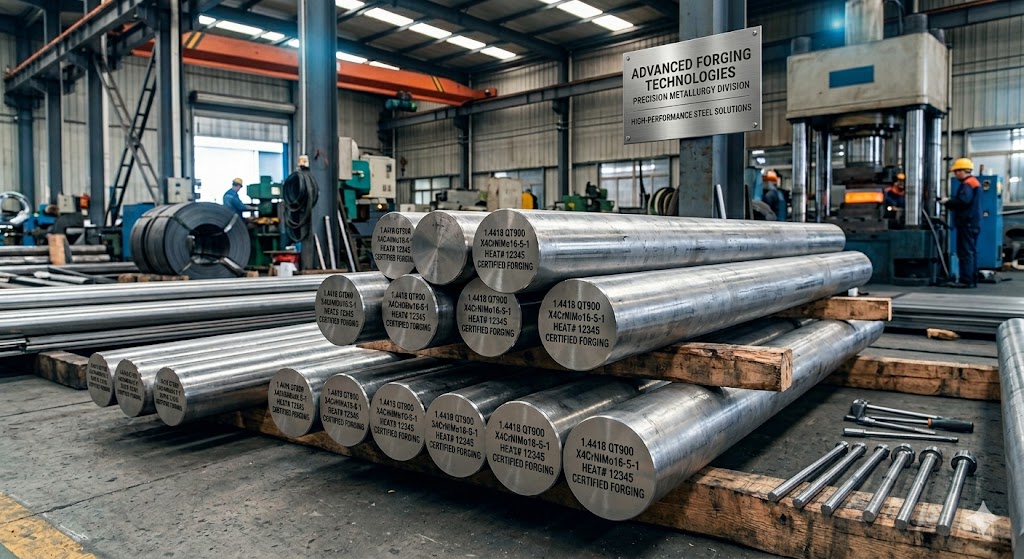
This guide breaks the comparison down property by property, then turns it into a plain decision rule. Wherever the data refers to forged product, it reflects what we routinely supply as 1.4418 (X4CrNiMo16-5-1) open-die forgings and seamless rolled rings from our Jiangyin works.
- What is 1.4418 (X4CrNiMo16-5-1)?
- A low-carbon "soft-martensitic" (supermartensitic) stainless steel with roughly 16% Cr, 5% Ni and 1% Mo. It is hardened by quenching and tempering, offers excellent toughness and weldability, and is also known as S165M. Typical standard: EN 10088-3.
- What is 17-4PH (1.4542)?
- A precipitation-hardening martensitic stainless steel with roughly 17% Cr, 4% Ni and 4% Cu, strengthened by ageing that forms a fine copper-rich phase. It reaches very high strength and is also known as UNS S17400. Typical standards: ASTM A564, AMS 5643.
How each steel gets strong
1.4418 develops strength the classic way — through quenching and tempering (Q+T). Its low carbon content is deliberate: it keeps the martensite tough and weldable rather than hard and brittle, which is why 1.4418 behaves so well in welded and cryogenic assemblies.
17-4PH is strengthened by precipitation hardening — ageing at a relatively low temperature precipitates a fine copper-rich phase through the matrix. That mechanism lets 17-4PH reach much higher strength, and it can be machined in the soft solution-annealed state and then aged afterwards with very little distortion.
One steel is hardened by transformation and tempering; the other by precipitation. Almost every practical trade-off between them flows from that one fact.
Strength, yield and toughness
17-4PH is the stronger alloy. In the popular H900 condition it delivers the highest tensile and yield figures of the two. But the figure most forging buyers underestimate is impact toughness, where 1.4418 has a clear and consistent advantage.
| Property | 1.4418 (QT900) | 17-4PH (H900) |
|---|---|---|
| Tensile strength Rm | 900–1,100 MPa | 930–1,310 MPa |
| 0.2% proof strength | ≥ 700 MPa | 724–1,170 MPa |
| Elongation A | ≥ 16% | 10–14% |
| Charpy V-notch (RT) | 40–80 J | 27–40 J |
| Hardness | 270–320 HB | 40–44 HRC |
The practical reading: 17-4PH gives headroom above 1,100 MPa that 1.4418 cannot reach. But for parts that see impact, shock or low-temperature service — valve stems in cold climates, cryogenic shafts, downhole tools — 1.4418's higher elongation and impact energy mean a far larger margin against brittle fracture.
Corrosion resistance (PREN)
Chloride pitting resistance is best summarised by the Pitting Resistance Equivalent Number (PREN = %Cr + 3.3 × %Mo + 16 × %N). Here 1.4418 holds the advantage, mainly because it contains roughly 1–1.5% molybdenum that 17-4PH lacks.
- 1.4418: PREN ≈ 20 — comfortable in seawater splash zones, brackish water and industrial cooling water.
- 17-4PH: PREN ≈ 16 — adequate in mild atmospheres, but more prone to chloride pitting and not a first choice for marine-adjacent service.
Neither alloy substitutes for a duplex grade in fully immersed seawater (2205 sits near PREN 34), but where the two compete head-to-head, 1.4418 is the more corrosion-tolerant option.
Weldability and fabrication
This is where the gap is widest, and where many projects are quietly decided. 1.4418's low carbon content lets it be welded with conventional methods while retaining its properties — often without mandatory post-weld heat treatment (PWHT) on thinner sections. That makes it a natural choice for fabricated assemblies, repair welding and clad components.
17-4PH can be welded, but to restore properties in the heat-affected zone it generally needs a controlled PWHT or re-ageing cycle. For a one-piece machined part that is fine; for a welded fabrication it adds cost, lead time and qualification effort.
Dimensional stability after heat treatment
17-4PH has one standout fabrication advantage: because final strength comes from a low-temperature ageing step, parts can be rough- and even finish-machined soft, then aged with minimal dimensional movement. For tight-tolerance precision parts that is a real benefit.
1.4418 reaches its properties through quench-and-temper, so most machining is done after heat treatment. It also carries a known process caution: tempering or slow-cooling through roughly 450–550 °C must be avoided to prevent temper embrittlement — something we control with rapid, instrumented cooling on every heat.
Service temperature and price
| Factor | 1.4418 | 17-4PH |
|---|---|---|
| Max continuous service | ≈ 350 °C | 316 °C (H900) / 480 °C (H1150) |
| Low-temp / cryogenic | Excellent with ESR | Limited |
| Hardening route | Quench & temper | Precipitation (age) |
| Relative cost | Medium | Medium–High |
| Typical standard | EN 10088-3 | ASTM A564 / AMS 5643 |
On budget, 1.4418 is usually cheaper to buy and to process, especially once you factor in its easier weldability. 17-4PH commands a premium that is justified when its strength or aerospace pedigree is genuinely required.
So which should you choose?
Strip away the tables and the choice comes down to what your component punishes hardest. Use the rule below.
Choose 1.4418
- Welded or repair-welded assemblies (no mandatory PWHT)
- Low-temperature / cryogenic service (LNG valve shafts at −196 °C)
- Chloride-exposed parts needing PREN ≈ 20
- High-toughness valves, pump shafts, turbine & downhole parts
- When 760–1,100 MPa is enough and cost matters
Choose 17-4PH
- Tensile strength above 1,100 MPa required
- Age-hardening after final machining for tight tolerances
- Aerospace / defense compliance (AMS 5643)
- One-piece machined parts in mild environments
- High-strength fasteners and fittings
Application snapshot
| Application | Better fit | Why |
|---|---|---|
| LNG / cryogenic valve shafts | 1.4418 | Superior low-temperature toughness |
| Reactor coolant pump parts | 1.4418 | Toughness + weldability + corrosion balance |
| Sour-service downhole tools | 1.4418 | Controllable hardness for NACE MR0175 |
| Aerospace structural fittings | 17-4PH | Strength + AMS qualification |
| Tight-tolerance precision parts | 17-4PH | Age-harden after machining |
| General pump / compressor shafts | 1.4418 | Balanced properties at lower cost |
Frequently asked questions
Is 17-4PH stronger than 1.4418?+
Which has better corrosion resistance, 1.4418 or 17-4PH?+
Can both 1.4418 and 17-4PH be welded?+
When should I choose 17-4PH over 1.4418?+
Are 1.4418 and 17-4PH direct drop-in replacements for each other?+
Sources & standards referenced
- EN 10088-3 — Stainless steels: technical delivery conditions for bars, rods and sections (mechanical data for 1.4418).
- EN 10204 — Inspection documents for metallic products (3.1 / 3.2 mill test certificates).
- ASTM A564 — Hot-rolled and cold-finished age-hardening stainless steel bars (17-4PH / S17400).
- AMS 5643 — Aerospace material specification for 17-4PH stainless steel.
- NACE MR0175 / ISO 15156 — Materials for use in H2S-containing (sour) oil & gas environments.
See the full 1.4418 data sheet, sizes & certifications
This guide is about choosing between the two grades. For the complete 1.4418 material specification, available shapes and sizes, applications and EN 10204 certification options — and to request a quote for your own drawing — head to our main product page.