1.4542 (X5CrNiCuNb16-4) Forging Parts | Custom Precipitation Hardening Stainless Steel Forgings
1.4542 (X5CrNiCuNb16-4) Forging Parts — Key Facts at a Glance
| Also Known As | 17-4PH (AISI/ASTM), X5CrNiCuNb16-4 (EN), X5CrNiCuNb164, X5CrNiCuNb16.4 |
| Material Type | Chromium-nickel-copper precipitation hardening (PH) martensitic stainless steel |
| EN Standard | EN 10088-3 / EN 10250-4 (Material No. 1.4542) |
| ASTM Equivalent | 17-4PH — ASTM A693 / ASTM A564 |
| Density | 7.78 g/cm³ |
| Strength Range | UTS 800–1300 N/mm² depending on aging condition |
| Available Forms | Open die forgings, seamless rolled rings, bars, shafts, discs, hollow bars, pipes, flanges, valves, machined components |
| Max Size | Single-piece up to 30 T; rings up to 6 m OD; shafts up to 15 m length; hollow bars OD up to 3000 mm |
| Key Industries | Aerospace, oil & gas, turbomachinery, valve manufacturing, pressure vessels, marine, nuclear power |
| Certifications | ISO 9001:2015; EN10204 3.1 MTC standard; 3.2 MTC (TÜV/SGS/BV) on request |
| Lead Time | 2–6 weeks (expedited available) |
| Manufacturer | Jiangsu Liangyi Co., Limited — Jiangyin, Jiangsu, China (est. 1997, 50+ countries) |
About 1.4542 (X5CrNiCuNb16-4) Forging Material & Jiangsu Liangyi
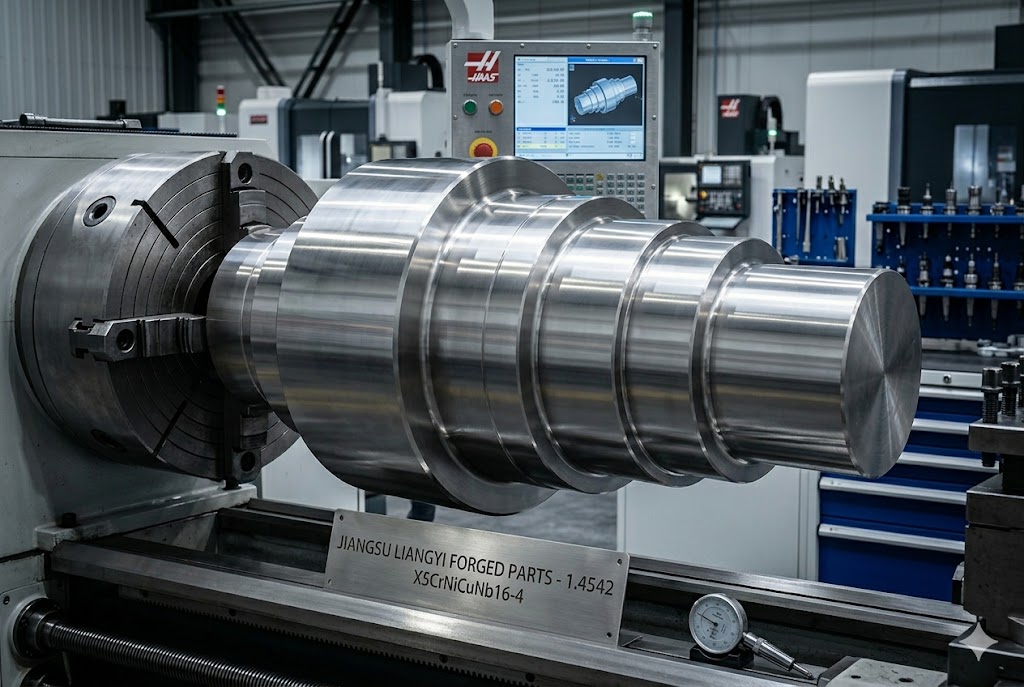
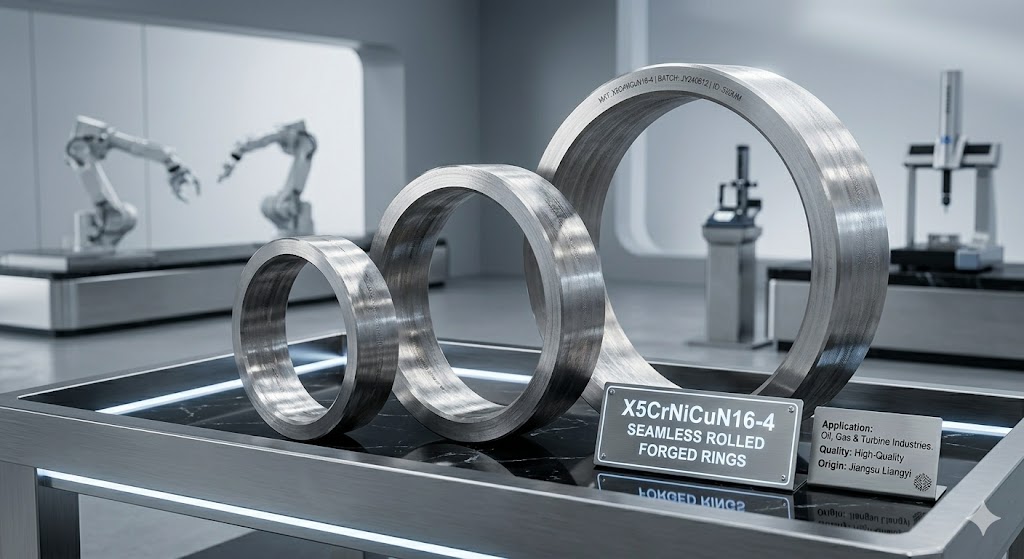
Jiangsu Liangyi Co., Limited is a professional ISO 9001:2015 certified manufacturer of 1.4542 (also known as X5CrNiCuNb16-4, X 5 CrNiCuNb 16-4, X5CrNiCuNb164, X5CrNiCuNb16.4, and 17-4PH precipitation hardening stainless steel) open die forging parts and seamless rolled steel forged rings, located in Jiangyin City, Jiangsu Province – the core forging industry cluster in China's Yangtze River Delta.
Established in 1997, our factory covers an area of 80,000 ㎡ with original fixed assets up to 40 million USD, and an annual manufacturing capacity of 120,000 tons. We provide end-to-end custom forging solutions from steel melting, forging, heat treatment to precision machining, fully according to clients' detailed drawings and technical requirements, and have supplied high-quality products to customers in more than 50 countries worldwide.
What is 1.4542 (X5CrNiCuNb16-4) steel? 1.4542 (X5CrNiCuNb16-4) is a chromium-nickel-copper precipitation hardening stainless steel, engineered to deliver exceptional high strength (max tensile strength up to 1300 N/mm² in the +P1300 condition), excellent toughness, superior wear resistance, and good corrosion resistance in mild atmospheric, freshwater, and mild chemical environments. Its industry-leading strength-to-weight ratio makes it the preferred material for critical high-load components in aerospace, oil & gas, power generation, and heavy industrial applications worldwide.
Core Advantages of 1.4542 (X5CrNiCuNb16-4) vs. Conventional Stainless Steels
- 2–3× higher yield strength than 304/316 austenitic stainless steel, reducing component weight without sacrificing load capacity
- Excellent machinability and weldability compared to other martensitic stainless steels, lowering fabrication costs
- Tunable mechanical properties via flexible heat treatment processes, adapting to diverse working conditions from cryogenic to 315 °C high-temperature environments
- Superior resistance to stress corrosion cracking and fatigue, extending service life in dynamic load applications
Full Range of Custom 1.4542 (X5CrNiCuNb16-4) Forged Products
We manufacture a complete portfolio of 1.4542 (X5CrNiCuNb16-4) forging products in custom shapes, dimensions, and heat treatment conditions.All parts fully meet EN, ASTM, API, AMS, and other international standards. Our production capacity covers single-piece weight from 30 kg to 30 tons, with full in-house CNC machining support and EN10204 3.1/3.2 Mill Test Certificates (MTC) available. Following are our main product ranges:
- 1.4542 forged steel round bars, square bars, flat bars, rectangular bars and precision ground rods
- X5CrNiCuNb16-4 forged seamless rolled rings, gear rings, seal rings, labyrinth rings and contoured custom rings (max diameter up to 6 meters)
- X5CrNiCuNb16-4 forged hubs, housings, shells, sleeves, bushes, cases and heavy-wall seamless hollow bars (max OD up to 3000 mm)
- 1.4542 forged discs, disks, blocks, plates, flanged blanks and tube sheets (max diameter up to 4 meters)
- X5CrNiCuNb16-4 forged steel pipes, tubes, tubings, piping shells, casings and barrels for pressure equipment
- Custom 1.4542 forged shafts, step shafts, gear shafts, turbine shafts, marine propeller shafts and splined drive shafts (max length up to 15 meters)
- 1.4542 forged valve parts, fasteners, studs, bolts, impellers and other custom machined forging parts
Explore our full production capabilities on our Equipment Page, complete product range on our Products Page, and all available material grades on our Materials Page.
Industry Applications & Global Project Cases of 1.4542 (X5CrNiCuNb16-4) Forgings
Our 1.4542 (X5CrNiCuNb16-4) forging parts are widely used in important industrial sectors across more than 50 countries. Following are real project cases tailored to regional standards and working conditions:
Aerospace & Turbomachinery Industry (EU & North America Market)
European Aerospace Structural Components
We supplied 1.4542 forged turbine blades, gear parts, structural bars and shaft forgings for leading European aerospace enterprises, and they all met EU EN standards and aviation-grade material traceability requirements.
Asian Thermal Power Turbine Parts
Our X5CrNiCuNb16-4 forging products are also widely used for gas and steam turbine disks, turbine impellers, turbine blisks, turbo centrifugal compressor impellers, and turbine rotor shafts for thermal power plants in Asia and Europe.All products worked stably for a long time under high-temperature and high-speed rotating conditions.
Oil & Gas and Subsea Engineering (Middle East & Southeast Asia Market)
Middle East Onshore/Offshore Wellhead Equipment
We provided X5CrNiCuNb16-4 wellhead Christmas trees, frac pump fluid end bodies, casing heads, tubing heads, casing hangers, tubing hangers and spool bodies for large-scale onshore and offshore oil and gas projects in the Middle East. All products met API 6A standards and were suitable for over 10,000 psi high-pressure sour service environments.
Southeast Asia Offshore Oilfield Components
Our 1.4542 forged parts also include subsea X-tree high-pressure elbows, double studded adapter flanges, downhole drilling tool parts, mud motor splined drive shafts, and electrical submersible pump (ESP) motor shafts for Southeast Asia offshore oilfield projects.
Valve Manufacturing Industry (Global Market)
We provide custom forgings in X5CrNiCuNb16‑4 for valve manufacturers across Europe, North America and Asia, including valve balls, bonnets, bodies, stems, closures, seat rings, cores and discs.These parts are suitable for 2‑way valves, check valves, ball valves, gate valves and high‑performance cryogenic butterfly valves. All parts can be precision machined to a surface finish of Ra 0.8 µm or finer.Stellite hardfacing is also available for applications needing extreme wear resistance.
Pressure Vessel & Heat Exchanger Industry (Petrochemical Market)
Our 1.4542 forged steel pipes, tubes, shells, tube sheets, nozzles, and channel flanges are widely used for boilers, heat exchangers, pressure vessels, reactors and heaters in petrochemical and energy industries. All products fully meet ASME Section VIII and EN pressure equipment standards. We also manufacture 1.4542 studding outlets and custom pressure vessel parts for global EPC contractors.
Hydraulic & High-Pressure Equipment Industry
We supply 1.4542 forged hydraulic cylinders, accumulators, attenuators, intensifier pump sealing heads, and piston rods for ultra-high pressure water jet cutting machines.Precision heat treatment is applied to guarantee stable hardness and excellent fatigue resistance.
Our products are also widely used for intake gate hoist cylinders, miter gate machinery hydraulic cylinders, as well as homogenizer pump pistons and plungers in food processing and other industrial equipment.
Marine, Nuclear Power & Other Heavy Industries
We manufacture X5CrNiCuNb16‑4 marine propeller shafts and subsea manifold parts for international shipyards, and they all have excellent corrosion resistance for harsh offshore environments.We also supply 1.4542 forgings including nuclear reactor coolant pump impellers, casings and seal chamber parts for nuclear power projects, meeting stringent nuclear‑grade safety and reliability requirements.
Our 1.4542 forgings are widely used in fasteners, gear timing adapter plates, pressure port sensor housings, load cells and ultrasonic flow meter bodies.
International Production Standards for 1.4542 (X5CrNiCuNb16-4) Forging Parts
All our 1.4542 (X5CrNiCuNb16-4) forging parts are made based on global mainstream international standards, they all fully meet the requirements of EU, North America, Middle East and Asia-Pacific markets:
- EN 10088-3: 2005 Stainless steels. Technical delivery conditions for semi-finished products, bars, rods, wire, sections and bright products of corrosion resisting steels for general purposes
- EN 10250-4: 2000 Open steel die forgings for general engineering purposes. Stainless steels
- EN 10088-1: 2005 Stainless steels. List of stainless steels
- EN 10088-5: 2009 Stainless steels. Technical delivery conditions for bars, rods, wire, sections and bright products of corrosion resisting steels for construction purposes
- EN 10088-4: 2009 Stainless steels. Technical delivery conditions for sheet/plate and strip of corrosion resisting steels for construction purposes
- ASTM A693, ASTM A564 for 17-4PH (1.4542) precipitation hardening stainless steel forgings
- API 6A for oil and gas wellhead equipment parts.
1.4542 vs. Alternative Stainless Steel Grades: Which Should You Choose?
Choosing the right stainless steel forging grade directly impacts service life, overall manufacturing cost, and compliance with project specifications.Drawing on over 25 years of experience supplying forged parts across diverse industries, following is a comparison between 1.4542 (X5CrNiCuNb16-4 / 17-4PH) and its most common alternative grades:
| Property | 1.4542 / 17-4PH (This Grade) | 316L / 1.4404 (Austenitic) | 2205 Duplex / 1.4462 (Duplex) | 17-7PH / 1.4568 (Semi-austenitic PH) |
|---|---|---|---|---|
| Steel Type | PH Martensitic | Austenitic | Duplex | PH Semi-austenitic |
| Yield Strength (typical aged / annealed) | 620–1170 N/mm² | 170–310 N/mm² | 450–550 N/mm² | 310–1380 N/mm² |
| Tensile Strength (typical) | 800–1300 N/mm² | 480–620 N/mm² | 620–800 N/mm² | 520–1550 N/mm² |
| Pitting Resistance Equiv. (PREN) | ~16 (mild chloride only) | ~24 | ~35 (excellent) | ~16 |
| Magnetic Behaviour | Ferromagnetic (aged) | Non-magnetic | Weakly magnetic | Transition: non-magnetic → magnetic |
| Age-hardening Possible? | Yes — wide range | No | No | Yes — extreme range |
| Weldability | Good (with procedure) | Excellent | Good | Moderate |
| CNC Machinability | Good (low work hardening) | Moderate (work hardens) | Moderate | Moderate |
| Max Continuous Service Temp. | 315 °C | 425 °C (oxidation) | 300 °C (to avoid embrittlement) | 315 °C |
| Typical Forging Applications | High-load structural, aerospace, oil & gas wellhead, turbines | Corrosion-critical, food/pharma, cryogenic | Offshore/subsea, high-chloride environments | Extreme-strength aerospace springs and bellows |
| Relative Material Cost | Medium | Low–Medium | Medium–High | Medium–High |
Our Engineering Recommendation
Choose 1.4542 when: If your component needs to bear high structural loads in mild to moderate corrosive environments, weight reduction is critical, or your design requires adjustable hardness through heat treatment — 1.4542 (17‑4PH) is an excellent choice.
It delivers higher specific strength than 316L, and better machinability and forgeability for complex shapes than 2205 duplex stainless steel.
Choose 316L when: the operating environment involves concentrated chloride solutions, crevice corrosion risk is high, or the part must remain non-magnetic throughout service (MRI, compass-sensitive systems).
Choose 2205 Duplex when: the primary challenge is aggressive chloride pitting or stress corrosion cracking in offshore seawater environments, and wall thickness can be controlled to exploit its higher PREN.
Chemical Composition of 1.4542 (X5CrNiCuNb16-4) Forged Steel
| Element | Content Range (Weight %) |
|---|---|
| Iron (Fe) | 69.6 to 79 |
| Chromium (Cr) | 15 to 17 |
| Nickel (Ni) | 3.0 to 5.0 |
| Copper (Cu) | 3.0 to 5.0 |
| Manganese (Mn) | 0 to 1.5 |
| Silicon (Si) | 0 to 0.7 |
| Molybdenum (Mo) | 0 to 0.6 |
| Niobium (Nb) + Tantalum (Ta) | 0.15 to 0.45 |
| Carbon (C) | 0 to 0.070 |
| Phosphorus (P) | 0 to 0.040 |
| Sulfur (S) | 0 to 0.015 |
The Niobium (Nb) addition is a main differentiator in 1.4542's design: Nb stabilizes the microstructure against sensitization during welding heat cycles and refines the austenite grain during hot forging, resulting in a finer, more homogeneous martensitic structure after solution treatment — which in turn produces more consistent mechanical properties across large cross-section forgings compared to plain 17-4 without Nb stabilisation.
Physical & Thermal Properties of 1.4542 (X5CrNiCuNb16-4) Forged Steel
The physical and thermal properties listed below are measured on forged specimens in the solution-annealed and aged condition. They are essential for stress analysis, FEA modeling, thermal fatigue design, and dimensional tolerance calculations. All values represent typical properties of forged billet material produced by Jiangsu Liangyi and are consistent with property data specified in EN 10088-3:
| Property | Value at 20 °C | Value at 100 °C | Value at 200 °C | Unit |
|---|---|---|---|---|
| Density | 7.78 | 7.75 | 7.70 | g/cm³ |
| Elastic Modulus (E) | 197 | 190 | 183 | GPa |
| Shear Modulus (G) | 77 | 74 | 71 | GPa |
| Thermal Conductivity (λ) | 18.3 | 19.0 | 19.8 | W/m·K |
| Specific Heat Capacity (cp) | 460 | 480 | 500 | J/kg·K |
| Mean Coeff. of Thermal Expansion (α) | 10.8 (20–100 °C) | 11.3 (20–200 °C) | ×10⁻⁶/K | |
| Electrical Resistivity (ρ) | 0.77 | 0.84 | 0.93 | ×10⁻⁶ Ω·m |
| Magnetic Behaviour (aged condition) | Ferromagnetic; µr varies with aging condition and field strength | — | ||
Melting range: 1404 – 1440 °C. Maximum continuous service temperature: 315 °C (593 °F) for sustained load-bearing applications; brief excursions to 370 °C are permissible for non-critical components. Above 315 °C, over-aging effects progressively reduce strength in precipitation-hardened condition.
Design Note: Thermal Expansion in Multi-Material Assemblies
The thermal expansion coefficient of 1.4542 (α ≈ 10.8 × 10⁻⁶/K at 20–100 °C) is lower than that of 304/316 austenitic stainless steels (α ≈ 16–17 × 10⁻⁶/K). When 1.4542 parts are assembled with austenitic fasteners or housings, the differential expansion at elevated temperature must be included in the joint design calculation to prevent loosening or stress build-up. We recommend specifying matching 1.4542 fasteners for critical flanged joints operating above 150 °C.
Mechanical Properties of 1.4542 (X5CrNiCuNb16-4) Forgings — All Heat Treatment Conditions
Unlike many types of steel where one heat treatment method is standard, 1.4542 (X5CrNiCuNb16-4) is specially designed to have a wide range of strength and toughness through controlled precipitation aging. Jiangsu Liangyi has 10 heat treatment furnaces in its own factory and has passed the qualification for all eight EN aging conditions listed in EN 10250-4. The table below shows the minimum guaranteed values from our production qualification records — not theoretical numbers from handbooks:
| Condition Code | Aging Treatment | UTS Rm min (N/mm²) | Yield Str. Rp0.2 min (N/mm²) | Elongation A min (%) | Impact KV min (J, RT) | Hardness (approx. HRC) |
|---|---|---|---|---|---|---|
| +P1300 | 470–490 °C / 1 h, air cool | 1300 | 1170 | 8 | 60 | 40–44 |
| +P1070 (≈ H900) | 550 °C / 4 h, air cool | 1070 | 1000 | 10 | 120 | 33–37 |
| +P960 | 590 °C / 4 h, air cool | 1000 | 865 | 12 | 120 | 31–35 |
| +P950 | 580–600 °C / 1 h, air cool | 980 | 830 | 13 | 120 | 30–34 |
| P930 (≈ H1150) | 620 °C / 4 h, air cool | 950 | 750 | 16 | 140 | 28–32 |
| +P900 | 590–610 °C / 1 h, air cool | 930 | 760 | 15 | 135 | 29–33 |
| P850 | 610–630 °C / 4 h, air cool | 900 | 720 | 16 | 145 | 27–31 |
| +P800 (Double-aged) | 760 °C / 2 h + 620 °C / 4 h, air cool | 800 | 620 | 18 | 175 | 24–28 |
Values represent minimum guaranteed properties from Jiangsu Liangyi production qualification data for forgings up to 250 mm cross-section. For larger cross-sections or special applications, contact us for section-specific qualification data. All test specimens are taken at ¼T depth per EN 10250-4.
How to Read This Table: Condition Selection Guide
+P1300 delivers the highest achievable strength in the 1.4542 / 17-4PH family — ideal for highly loaded fasteners, downhole drilling parts, and aerospace structural brackets where every gram matters. The trade-off is reduced toughness (KV ≥ 60 J) and slightly elevated sensitivity to notch stress concentrations.
+P1070 and +P960 represent the "engineering sweet spot" for most demanding applications — wellhead equipment, pump shafts, valve bodies — combining tensile strength above 1000 N/mm² with adequate impact toughness (≥ 120 J) for dynamic service.
P930 and +P800 are preferred where corrosion resistance and toughness take priority over maximum strength: nuclear pump casings, marine propeller shafts, and low-temperature subsea components where the higher Charpy value (≥ 140–175 J) directly reduces risk of brittle fracture.
Full Heat Treatment Process for 1.4542 (X5CrNiCuNb16-4) Forged Components
We have 10 in-house heat treatment furnaces to provide precise heat treatment services for 1.4542 (X5CrNiCuNb16-4) forgings, guaranteeing consistent material properties across the entire component:
- Hot Forging & Rolling Process: 1150–900 °C, followed by controlled air cooling
- Solution Annealing Process: 1020–1055 °C, followed by rapid oil or air quenching
- Ageing Hardening Process (Custom Conditions):
- +P800 Condition: 760 °C in air for 2 hours + 620 °C in air for 4 hours
- P850 Condition: 610–630 °C in air for 4 hours
- +P900 Condition: 590–610 °C in air for 1 hour
- P930 Condition: 620 °C in air for 4 hours
- +P950 Condition: 580–600 °C in air for 1 hour
- +P960 Condition: 590 °C in air for 4 hours
- +P1070 Condition: 550 °C in air for 4 hours
- +P1300 Condition: 470–490 °C in air for 1 hour
Fabrication Guide: Welding & CNC Machining of 1.4542 (X5CrNiCuNb16-4) Forgings
Based on our over 25 years of in-house production experience and direct technical feedback from customers in aerospace, oil & gas, and valve making industries, the following guide sums up practical best practices for welding and machining 1.4542 (X5CrNiCuNb16-4) forged parts:
Weldability Overview
1.4542 (X5CrNiCuNb16-4) is much easier to weld than standard 400‑series martensitic stainless steels. Its low carbon content (C ≤ 0.07%) and niobium stabilization greatly cut down carbon buildup at grain boundaries during welding, which reduces the risk of damage in the heat-affected zone (HAZ).This material welds best in the solution-annealed (SA) condition before final aging. This avoids uneven hardness across the weld joint and ensures the part responds consistently to later heat treatment.
Recommended Filler Metal & Process
Filler: Use AWS A5.9 ER630 (matching 17-4PH wire or rod) for TIG and MIG welding. If you cannot do heat treatment after welding, you can use AWS A5.9 ER309L austenitic filler instead, but this will create an uneven weld area with lower strength in the weld metal.
Process: GTAW (TIG) is the best choice for root passes and precise joints. GMAW (MIG) can be used for fillet welds and structural welds that need higher production speed. Do not use SMAW (stick) for structural joints unless there is no other option.
Post-Weld Heat Treatment Requirements
The post-weld treatment strategy depends on the criticality of the joint and the production schedule:
- Full property restoration (recommended for critical joints): Solution anneal at 1020–1055 °C followed by water or forced-air quench, then re-age to the specified condition (+P1070, P930, etc.). This fully homogenises the weld zone and HAZ microstructure, restoring base metal mechanical properties to within ±5% of unwelded values.
- Direct aging after welding (acceptable for non-critical joints): If the base metal was solution annealed before welding and the heat input was controlled, direct aging in the +P1070 or P930 condition after welding is acceptable. The weld HAZ will reach approximately 85–90% of base metal properties. This approach is commonly used for valve assemblies and structural brackets where full disassembly for re-annealing is impractical.
- Pre-weld condition: Welding in the fully aged (hardened) condition should be avoided wherever possible, as the elevated hardness in the HAZ increases susceptibility to hydrogen-assisted cracking (HAC) — particularly relevant in sour service (H₂S-containing) oil & gas environments.
CNC Machining Parameters & Best Practices
1.4542 (X5CrNiCuNb16-4) is one of the more machinable stainless steel grades in the high-strength category, primarily because its precipitation-hardened microstructure work-hardens significantly less than austenitic grades (304/316). Our in-house CNC machining centres have processed 1.4542 forgings across all eight aging conditions. Key guidance from our machining team:
- Best machining sequence: Do all rough cutting when the material is in the solution‑annealed (SA) state, then apply final aging, and finish machining last. This order reduces tool wear when removing large amounts of metal and keeps dimensions stable after aging. Finish machining after aging also fixes any small shape changes caused by the heat treatment process.
- Tooling: We strongly recommend using coated carbide inserts with TiAlN or AlCrN coating. Uncoated high-speed steel tools can only be used for light finish cuts in the P800 condition. Do not use cutting edges with a very large rake angle. A neutral or slightly negative rake angle works better to handle the uneven cutting forces common on forged surfaces.
- Turning parameters (fully aged, +P1070 condition): Cutting speed 80–110 m/min; feed rate 0.15–0.30 mm/rev; depth of cut 1.5–4.0 mm for roughing, 0.3–0.8 mm for finishing.
- Milling parameters: Cutting speed 60–90 m/min; feed per tooth 0.08–0.15 mm/z. Use climb (down) milling wherever possible to reduce built-up edge formation.
- Coolant: We recommend water-soluble cutting oil with an emulsion concentration of 8–10% for all machining steps. Dry cutting is not a good choice. 1.4542 does not conduct heat as well as austenitic stainless steels, so more heat stays in the cutting area and causes faster tool wear on the rake face.
- Achievable surface finish: Ra 0.8 µm or better is routinely achievable with finish turning or grinding. Ra 0.4 µm is achievable with fine grinding + polishing for sealing surfaces and valve seats. Our in-house CNC grinding centres can hold dimensional tolerances to IT6 (h6/k6) for shaft and bore fits.
Quality Inspection & Testing Standards
Every batch of our finished 1.4542 (X5CrNiCuNb16-4) forging parts goes through strict quality checks and tests following international standards. Full material traceability is available, and we include EN10204 3.1/3.2 Mill Test Certificates (MTC) with every shipment.
- ASTM E10-12: Standard Test Method for Brinell Hardness of Metallic Materials
- ASTM A370-12: Standard Test Methods and Definitions for Mechanical Testing of Steel Products
- ASTM E23-07a: Standard Test Methods for Notched Bar Impact Testing of Metallic Materials
- AMS 2315G: Determination of Delta Ferrite Content
- ASTM E45-05: Standard Test Methods for Determining the Inclusion Content of Steel
- ASTM E112-10: Standard Test Methods for Determining Average Grain Size
- ASTM E837: Standard Test Method for Determining Residual Stresses by the Hole-Drilling Strain-Gage Method
Mandatory Non-Destructive Testing (NDT) for All Deliveries
- 100% Visual inspection and PMI material verification test
- 100% Ultrasonic Testing (UT) according to EN 10228-3 (Table 3), with inspection types tailored to part geometry:
- Type 1 (or EN 10308 Type 1) for 1.4542 forging bar and shaft parts
- Type 2 for X5CrNiCuNb16-4 forged discs, plates and block parts
- Type 3b and Type 3 for X5CrNiCuNb16-4 forging rings, sleeves and bushing parts
- Optional Magnetic Particle Testing (MT), Penetrant Testing (PT) and Radiographic Testing (RT) available on request
Packaging, Export Documentation & Shipping of 1.4542 Forging Parts
Jiangsu Liangyi has supplied 1.4542 (X5CrNiCuNb16-4) forged parts to customers in more than 50 countries over 25+ years. Our export packaging and paperwork follow two main goals: keeping parts in perfect condition during shipping, and making customs clearance quick and smooth. Below is our standard export process:
Surface Protection & Packaging Standards
- Machined and ground surfaces: All finished machined surfaces are cleaned, degreased, and individually wrapped in VCI (Vapor Corrosion Inhibitor) polyethylene film to prevent transit corrosion for storage periods up to 24 months. Important bore and shaft surfaces are additionally protected with a thin film of rust-preventive oil conforming to MIL-PRF-16173 Grade 3 equivalent before VCI wrapping.
- As-forged and rough-machined surfaces: Coated with a water-based anti-corrosion compound (rust-preventive oil) and wrapped in moisture-proof kraft paper before final packaging.
- Small and medium components (≤ 500 kg total): Packed in ISPM-15 compliant fumigation-free wooden crates with foam padding or steel brackets to prevent movement during sea freight. Individual pieces are isolated from each other to prevent contact damage.
- Large and heavy components (> 500 kg, including large rings and shafts): Secured to steel pallets or flat-rack container frames with steel banding and custom-fabricated wooden cradles. Lifting lugs are welded to the pallet for safe crane handling at the receiving port.
- Container loading: We provide full FCL (Full Container Load) and LCL (Less-than-Container Load) services. For time-critical shipments, air freight packaging (ATA carnet compatible) is available for parts under 200 kg.
Export Documentation Provided with Every Shipment
- Commercial Invoice (CI) — in USD, with HS code pre-classified per importing country requirements
- Packing List — itemised by piece number, dimensions, net weight and gross weight
- Certificate of Origin (CoO) — Form A (GSP), general CoO, or RCEP CoO as needed by the destination country
- EN10204 3.1 Mill Test Certificate (MTC) — heat-traceable, with full chemical analysis and mechanical test results signed by our QC manager
- EN10204 3.2 MTC — available on request with accredited third-party inspector (TÜV / SGS / Bureau Veritas / Intertek)
- NDT Reports — UT, MT, PT, PMI reports issued per applicable standard
- Heat Treatment Records — furnace charts, calibration certificates for all thermal cycles applied
- Dimension Test Reports — with first-article inspection (FAI) report available upon request
Shipping Lead Time Reference
Production and packing lead time: 2–6 weeks from order confirmation, depending on product complexity and heat treatment requirements. Sea freight from Jiangyin/Shanghai takes about 25–35 days to European ports including Hamburg, Rotterdam and Antwerp; 20–28 days to Middle East ports such as Dubai and Dammam; 18–25 days to Southeast Asia including Singapore and Jakarta; and 28–38 days to US East and Gulf Coast ports.Air freight is available for small urgent orders, with a worldwide transit time of 5–7 business days. Our logistics team provides free shipping quotes together with product price quotes.
Frequently Asked Questions (FAQ) About 1.4542 (X5CrNiCuNb16-4) Forgings
Contact Us for Custom 1.4542 (X5CrNiCuNb16-4) Forging Solutions
Jiangsu Liangyi Co., Limited is a professional ISO 9001:2015 certified forging manufacturer with over 25 years of experience, supplying high-quality 1.4542 (X5CrNiCuNb16-4) forging parts to customers in more than 50 countries worldwide. We provide full custom forging solutions from steel melting, forging, heat treatment to precision machining, fully according to your drawings and technical requirements.
Inquiry Email: sales@jnmtforgedparts.com (Send Email)
Phone/WhatsApp: +86-13585067993
Website: https://www.jnmtforgedparts.com
Address: Chengchang Industry Park, Jiangyin City, Jiangsu Province, 214400, China
Welcome to send your custom drawings, material requirements, heat treatment specifications and quantity for a detailed quotation within 24 hours! You can also view our global project references on our Reference Page.