2.4652 (2.4631, NiCr20TiAl) Forged Parts | China Superalloy Forging Manufacturer
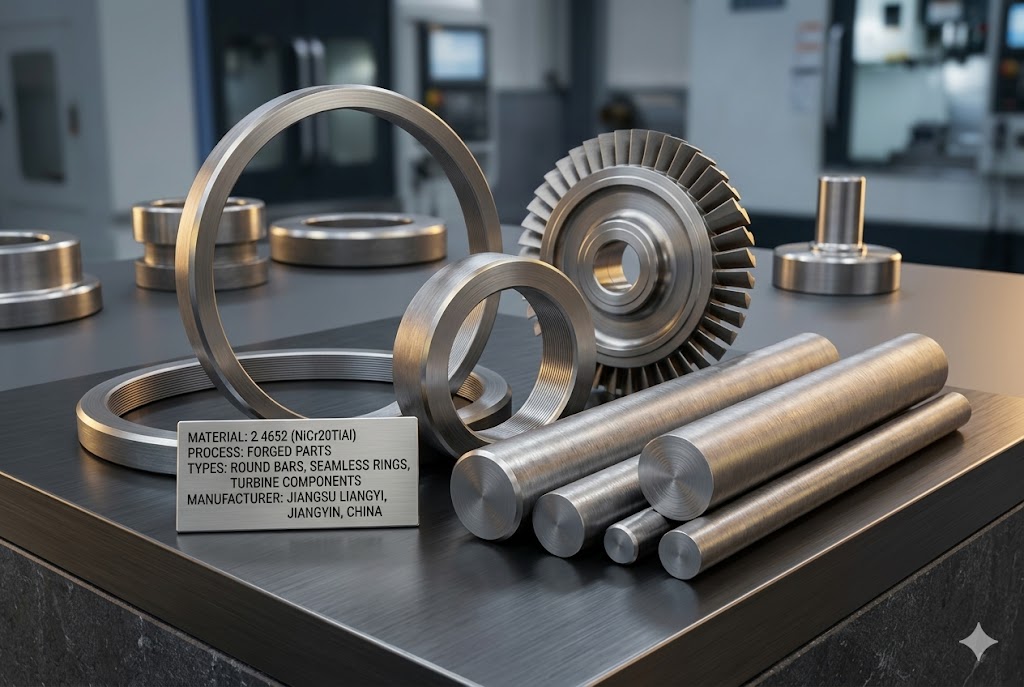
Quick Reference: 2.4652 (NiCr20TiAl) Forged Parts
- Alloy Designations
- 2.4652 · 2.4631 · NiCr20TiAl · W.Nr. 2.4952 · UNS N07080
- Alloy Type
- Precipitation-hardening nickel-based superalloy
- Max Continuous Service Temp.
- 815 °C (1,500 °F)
- Density
- 8.19 g/cm³ (0.296 lb/in³)
- Tensile Strength (RT, +AT)
- 1,100–1,400 MPa
- 0.2% Proof Strength (RT, +AT)
- Min 725 MPa
- Hardness (HB, +AT)
- 320–400 HB
- Elastic Modulus
- 214 GPa (20 °C)
- Max Bar Diameter
- 2,000 mm
- Max Ring Diameter
- 6,000 mm
- Max Single-Piece Weight
- 30,000 kg (30 metric tons)
- Key Standards
- EN 10269 · EN 10090 · EN 10302 · ASTM B637 · AMS 5667
- Lead Time (Raw Forging)
- 4–6 weeks standard; expedited available
- Manufacturer
- Jiangsu Liangyi Co., Limited — ISO 9001:2015, Jiangyin, China
Jiangsu Liangyi, a leading ISO 9001:2015 certified manufacturer based in Jiangyin, Jiangsu Province, China, specializes in producing high-quality 2.4652 (2.4631, NiCr20TiAl) open die forging parts and seamless rolled rings. With over 25 years of experience in the superalloy forging industry, we have supplied custom NiCr20TiAl components to customers in more than 50 countries worldwide.
Our 2.4652 (also known as W.Nr. 2.4952, UNS N07080) forgings are manufactured to the highest international standards, ensuring exceptional performance in high-temperature, high-pressure, and corrosive environments. We provide complete in-house services from steel melting and forging to heat treatment and precision machining according to your exact drawings and specifications.
Get Your Custom 2.4652 Forging Quotation NowISO 9001:2015
Certified Quality System
25+ Years
Forging Experience
50+ Countries
Global Export
120,000 Tons
Annual Capacity
About 2.4652 (2.4631, NiCr20TiAl) Nickel-Based Superalloy
2.4652 (NiCr20TiAl) is a precipitation-hardening nickel-chromium superalloy engineered for long-term service in environments where conventional stainless steels and heat-resistant steels cannot perform reliably. The alloy achieves its exceptional strength through a dual mechanism: the solid-solution hardening provided by chromium (18–21%) in the face-centred cubic nickel matrix, combined with the precipitation of coherent γ′ (Ni₃(Ti,Al)) intermetallic particles during the ageing treatment. These nanometre-scale precipitates pin dislocation movement at high temperature, which is the fundamental reason the alloy resists creep and fatigue degradation far more effectively than iron-based alloys at temperatures above 600°C.
Unlike many high-performance superalloys developed specifically for aerospace, 2.4652 was deliberately designed for the broader industrial market — offering an outstanding balance of strength, oxidation resistance, weldability, and machinability at a cost point accessible for large forgings used in power generation, heavy industry, and automotive manufacturing. This combination is exactly why it remains one of the most specified nickel alloys in European and Asian turbine standards after more than six decades of continuous use.
Understanding the Designation Differences: 2.4652 vs 2.4631 vs 2.4952
Buyers frequently encounter three material numbers for what is fundamentally the same alloy. Here is a clear explanation based on our manufacturing experience:
- 2.4631 — The designation used in EN 10302:2008 (creep-resisting steels, nickel and cobalt alloys). This is the primary reference for turbine discs, valve bodies, and structural components that operate under sustained load at elevated temperature.
- 2.4652 — The designation used in EN 10269:1999 (fasteners with elevated-temperature properties). When engineers specify high-temperature bolts, studs, and nuts, this number appears in the drawing call-out.
- W.Nr. 2.4952 — An older Werkstoffnummer cross-reference that appears in German engineering archives and legacy component drawings. Chemically identical.
- UNS N07080 — The Unified Numbering System identifier used primarily in North America and in ASTM B637 procurement documents.
At Jiangsu Liangyi we regularly certify against whichever designation a customer's drawing requires. The raw material, forging sequence, and heat treatment are identical regardless of the number printed on the mill certificate.
Key Material Advantages of 2.4652 (NiCr20TiAl)
- Exceptional high-temperature strength retention up to 815°C
- Superior creep resistance at operating temperatures where ferritic and austenitic steels lose dimensional stability
- Good oxidation resistance owing to a protective Cr₂O₃ surface scale
- Precipitation hardenable — mechanical properties can be tailored by adjusting ageing time and temperature
- Acceptable weldability using matching filler (AWS ERNiCr-3) with pre-weld and post-weld heat treatment
- Machinability is moderate; carbide tooling with slow speeds and positive rake angles gives the best surface finish
- Long, documented service history spanning 60+ years in European and North American power plants
Melting & Refining Processes at Jiangsu Liangyi
The quality of a finished 2.4652 forging is inseparable from the cleanliness of the starting material. Our Jiangyin facility controls every step from raw metal charge to final bar:
- High-Frequency Induction Melting (HFIM): Primary melt in a controlled-atmosphere furnace ensures precise charge composition. Optical emission spectrometry (OES) confirms chemistry before tapping.
- Electroslag Remelting (ESR): A second refining pass through ESR removes non-metallic inclusions, tightens segregation bands, and produces a columnar solidification structure ideal for subsequent forging. ESR is standard for all 2.4652 orders.
- Vacuum Arc Remelting (VAR): Available on request for aerospace and nuclear applications demanding the absolute lowest inclusion content and tightest chemistry tolerances.
Chemical Composition of 2.4652 (NiCr20TiAl)
The following composition limits define the alloy per EN 10302:2008 and EN 10269:1999. Note that the intentional absence of molybdenum (which Inconel 718 contains) keeps material cost lower while titanium and aluminium provide the precipitation-hardening response.
| Element | Symbol | Min % | Max % | Role in Alloy |
|---|---|---|---|---|
| Nickel | Ni | Balance (~72–76%) | Austenitic matrix, base for γ′ precipitation | |
| Chromium | Cr | 18.0 | 21.0 | Oxidation/corrosion resistance; solid-solution hardener |
| Titanium | Ti | 1.8 | 2.7 | Primary γ′ (Ni₃Ti) former; controls ageing response |
| Aluminium | Al | 1.0 | 1.8 | γ′ (Ni₃Al) former; oxidation resistance |
| Carbon | C | 0.04 | 0.10 | Carbide formation at grain boundaries; creep resistance |
| Silicon | Si | — | 1.0 | Deoxidiser; mild solid-solution hardener |
| Manganese | Mn | — | 1.0 | Deoxidiser; sulphide former |
| Iron | Fe | — | 1.5 | Residual; kept low to preserve γ′ stability |
| Copper | Cu | — | 0.2 | Residual; controlled to prevent hot-shortness |
| Boron | B | — | 0.008 | Grain-boundary strengthener; improves creep ductility |
| Sulfur | S | — | 0.015 | Impurity; controlled to prevent hot tearing during forging |
Mechanical Properties of 2.4652 (NiCr20TiAl) Forgings
Room-Temperature Mechanical Properties
The following values are guaranteed minimum properties for forged bars per EN 10302:2008 and EN 10269:1999. Sample orientation follows the standard unless otherwise specified on the order.
| Property | Symbol | Condition: +AT | Condition: +P | Test Standard |
|---|---|---|---|---|
| Tensile Strength | Rm | 1100–1400 MPa | Min 1000 MPa | ISO 6892-1 |
| 0.2% Proof Strength | Rp0.2 | Min 725 MPa | Min 600 MPa | ISO 6892-1 |
| Elongation at Fracture | A | Min 15 % | Min 18 % | ISO 6892-1 |
| Reduction in Area | Z | Min 18 % | Min 20 % | ISO 6892-1 |
| Impact Energy (Longitudinal) | KV (+20°C) | Min 20 J | Min 25 J | ISO 148-1 |
| Hardness | HB | 320–400 | 280–360 | ISO 6506-1 |
+AT = Solution Annealed + Aged Treatment; +P = Precipitation Hardened only
Elevated-Temperature Mechanical Properties
The following short-term tensile data at elevated temperatures are characteristic values measured on +AT condition forged bars from Jiangsu Liangyi's production. Actual values vary with exact chemistry within specification limits and section size. These data are intended to guide engineering design; final values for critical applications should be verified on production material with documented heat treatment records.
| Test Temperature | Tensile Strength Rm (MPa) | 0.2% Proof Strength Rp0.2 (MPa) | Elongation A (%) |
|---|---|---|---|
| 20 °C (Reference) | 1200 (typ.) | 850 (typ.) | 22 |
| 300 °C | ≈ 1050 | ≈ 780 | 20 |
| 500 °C | ≈ 960 | ≈ 720 | 20 |
| 600 °C | ≈ 900 | ≈ 680 | 19 |
| 650 °C | ≈ 820 | ≈ 600 | 18 |
| 700 °C | ≈ 760 | ≈ 550 | 17 |
| 750 °C | ≈ 700 | ≈ 480 | 16 |
| 800 °C | ≈ 560 | ≈ 380 | 22 (softening onset) |
Creep Properties
Creep is the defining property for 2.4652 in turbine and valve seat applications. The alloy's 1% creep limit (stress to produce 1% plastic strain in 100,000 hours) is approximately:
- At 600 °C: approximately 340 MPa
- At 650 °C: approximately 230 MPa
- At 700 °C: approximately 130 MPa
These values position 2.4652 decisively above standard austenitic stainless steels (e.g., 1.4571 / 316Ti) for components operating above 550 °C, and above iron-based superalloys such as Incoloy 800H for applications in the 600–700 °C range where high strength is also required.
Physical Properties of 2.4652 (NiCr20TiAl)
Physical properties are critical for engineering calculations involving thermal expansion compatibility between mating components, heat transfer modelling in cooling designs, and vibration frequency analysis for rotating parts. The following values are characteristic of the +AT condition and should be confirmed on production material for critical designs.
| Property | Value | Temperature | Unit |
|---|---|---|---|
| Density | 8.19 | 20 °C | g/cm³ |
| Melting Range | 1320–1370 | — | °C |
| Elastic Modulus (Young's Modulus) | 214 | 20 °C | GPa |
| Elastic Modulus | 195 | 500 °C | GPa |
| Elastic Modulus | 179 | 700 °C | GPa |
| Thermal Expansion Coefficient | 12.8 × 10⁻⁶ | 20–500 °C (mean) | /°C |
| Thermal Expansion Coefficient | 13.6 × 10⁻⁶ | 20–700 °C (mean) | /°C |
| Thermal Conductivity | 11.2 | 20 °C | W/(m·K) |
| Thermal Conductivity | 16.8 | 500 °C | W/(m·K) |
| Specific Heat Capacity | 448 | 20 °C | J/(kg·K) |
| Electrical Resistivity | 1.24 | 20 °C | μΩ·m |
| Poisson's Ratio | 0.31 | 20 °C | — |
| Magnetic Permeability | ≈ 1.002 | 20 °C | — |
2.4652 vs Comparable Superalloys: Which Is Right for Your Application?
Specifying the right alloy for a forged component involves more than matching temperature ratings. Cost, weldability, machinability, and long-term creep behaviour under your specific stress profile all influence the best choice. This table compares 2.4652 against three alloys it is most frequently evaluated against in our customers' RFQs.
| Property | 2.4652 / NiCr20TiAl | Inconel 718 (2.4668) | Waspaloy (2.4654) | Incoloy 800H (1.4876) |
|---|---|---|---|---|
| Ni Content | ~73 % (balance) | ~52 % (balance) | ~57 % (balance) | ~33 % |
| Max Service Temp. | 815 °C | 700 °C (oxidising); 980 °C short-term | 870 °C | 900 °C (creep limited) |
| RT Tensile Strength | 1100–1400 MPa | 1240–1450 MPa | 1240–1380 MPa | 520–700 MPa |
| Creep Resistance (650 °C) | Very Good | Excellent | Excellent | Fair |
| Oxidation Resistance | Very Good | Good | Very Good | Excellent |
| Weldability | Very Good | Good | Fair | Excellent |
| Machinability | Good | Fair | Fair | Very Good |
| Relative Material Cost | Good (moderate) | Fair (higher) | Limited (highest) | Very Good (lower) |
| Typical Applications | Turbine discs, valve seats, exhaust valves, fasteners | Aerospace turbines, cryogenic parts, high-stress discs | Aero-engine turbine discs, high-temp rotating parts | Reformer tubes, heat exchangers, furnace hardware |
| Primary Standards | EN 10269, EN 10302, ASTM B637 | AMS 5663, EN 10302 | AMS 5544, AMS 5706 | ASTM B408, EN 10028-7 |
When to Choose 2.4652 Over Inconel 718
Inconel 718 delivers slightly higher peak room-temperature strength and better resistance to stress-corrosion cracking in chloride-containing environments. However, 2.4652 is the better choice when: (1) the operating temperature is consistently above 650°C where 718's delta-phase precipitation can embrittle the alloy; (2) the forging weight exceeds several hundred kilograms and raw material cost per kilogram becomes significant; (3) the component requires welding in the field, since 2.4652 is substantially more forgiving of welding procedure variations. In our experience supplying both alloys to European turbine OEMs, 2.4652 accounts for the majority of valve seats, guide rings, and labyrinth seal rings precisely because of this cost-weldability-temperature balance.
When to Choose 2.4652 Over Incoloy 800H
Incoloy 800H has outstanding oxidation resistance and is preferred for furnace hardware and reformer applications where mechanical load is low. However, if a component must carry significant mechanical stress above 550°C — such as a turbine disc or a high-pressure valve seat — 800H's substantially lower proof strength (often below 200 MPa at operating temperature) makes it unsuitable. 2.4652 offers three to four times higher proof strength in that temperature range while still providing acceptable oxidation resistance.
Jiangsu Liangyi's 2.4652 Forging Process — Step by Step
Understanding how a 2.4652 forging is made helps buyers evaluate supplier capability and anticipate quality risks. The following process description is based on our standard production route at the Jiangyin facility. Every step is documented in our ISO 9001:2015 quality management system and traceable through the order-specific production record.
Raw Material Verification
ESR or VAR ingots are received with a supplier 3.1 certificate. Before any processing begins, our in-house OES spectrometer performs a full 11-element composition check. Billet dimensions, surface condition, and heat number are recorded. Any ingot that does not match the certificate values is quarantined and rejected — a step that eliminates mix-up risk that is impossible to detect after forging and heat treatment.
Billet Conditioning
Ingots are conditioned by scalping or grinding to remove surface seams and laps. For critical components, an initial ultrasonic scan is performed on the as-received billet to locate any macro-segregation or shrinkage defects before further processing investment is committed.
Controlled Heating
Billets are charged into a gas-fired furnace and heated to the forging temperature range of 1060–1120°C. Temperature uniformity across the billet cross-section is critical: a thermocouple log confirms the billet has soaked at temperature for a minimum of 1 minute per millimetre of diameter to ensure full thermal homogeneity before transfer to the press. Overheating above 1150°C risks incipient melting at grain boundaries, so our furnace controllers are set with hard upper alarms.
Open Die Forging / Ring Rolling
For bars and custom shapes, open die forging is performed on our 2000T–6300T hydraulic presses. We maintain a minimum forging reduction ratio of 4:1 (total cross-sectional area reduction) to thoroughly break down the as-cast grain structure and produce a wrought microstructure with ASTM grain size 5–8. For seamless rings, the pre-forged blank is mounted on our ring-rolling mills and expanded to the target ring diameter while the wall is progressively reduced. The ring-rolling process introduces beneficial circumferential grain flow alignment that significantly improves hoop-direction mechanical properties.
Intermediate Inspection
After rough forging and before heat treatment, forgings are dimensionally checked against the forging drawing. Any cracking, laps, or folds observed at this stage are investigated and dispositioned. Samples for grain size metallography are taken from the discard end of the billet to confirm microstructure before the batch proceeds.
Heat Treatment
Standard +AT condition: Solution anneal at 1000–1050°C, air-cooled or water-quenched depending on section thickness, followed by precipitation ageing at 700–750°C for 16 hours, then air-cooled. Furnace atmosphere and thermocouple calibration records are retained for every charge. +P condition: Simplified precipitation cycle only, used where slightly lower strength but higher ductility is specified.
Non-Destructive Testing (NDT)
100% ultrasonic testing (UT) is performed per ASTM A388 using calibrated immersion or contact probes. Acceptance criteria are agreed with the customer; the standard is class C or better per EN 10228-3. Magnetic particle testing (MT) per EN ISO 17638 and liquid penetrant testing (PT) per EN ISO 3452 inspect the surface and near-surface zones for cracks, seams, and laps. Radiographic testing (RT) is available on request for complex cross-sections.
Mechanical Testing & Certification
Tensile, impact, and hardness specimens are machined from the test coupon location defined in the applicable standard (longitudinal for dia. < 100 mm, transverse for dia. ≥ 100 mm, tangential for rings and discs). Tests are performed in our in-house testing laboratory. Results are compiled into the EN 10204 3.1 or 3.2 Mill Test Certificate, which is reviewed and signed before dispatch. Full traceability links the certificate to the forging heat number, ingot supplier, furnace charge records, and NDT reports.
CNC Machining (Optional)
For customers requiring net-shape or near-net-shape delivery, forgings are transferred to our CNC turning, milling, and boring centre. Our engineering team reviews the machining drawing for DFM (design for manufacturability) considerations specific to 2.4652 — particularly tool selection and cutting parameter optimisation — before the first part is cut. Finished dimensions are verified on our CMM (coordinate measuring machine) and recorded in the inspection report accompanying the shipment.
Complete Range of 2.4652 (NiCr20TiAl) Forged Products
We manufacture a comprehensive range of 2.4652 (2.4631, NiCr20TiAl) forging shapes and sizes to meet the diverse needs of our global customers. Our production capabilities cover single-piece weights from 30 kg up to 30,000 kg.
Forged Bars & Rods
- 2.4652 forged round bars (up to 2000 mm diameter)
- 2.4631 forged square bars
- NiCr20TiAl flat bars and rectangular bars
- 2.4952 hollow bars and tubes
- Custom stepped bars and shafts
Seamless Rolled Rings
- 2.4652 seamless rolled rings (up to 6000 mm diameter)
- 2.4631 contoured rings and flanges
- NiCr20TiAl guide rings and seal rings
- 2.4952 casing rings and diaphragm rings
- Labyrinth rings and packing rings
Forged Hollow Components
- 2.4652 sleeves and bushes
- 2.4631 pipes and tubes
- NiCr20TiAl housings and shells
- 2.4952 casings and barrels
- Valve sleeves and spools
Custom Forged Parts
- 2.4652 discs and plates
- 2.4631 hubs and flanges
- NiCr20TiAl valve seats and cores
- 2.4952 valve spindles and stems
- Turbine blades and buckets
2.4652 (NiCr20TiAl) Forging Applications & Success Cases
2.4652 (2.4631, NiCr20TiAl) forgings are widely used across industries that demand reliable performance under extreme conditions. For each application below we explain not only what we supply but why 2.4652 is the material of choice — information that helps design engineers justify their alloy selection to procurement and quality teams. Success cases below are representative of completed projects; detailed references are available to qualified buyers upon request under NDA.
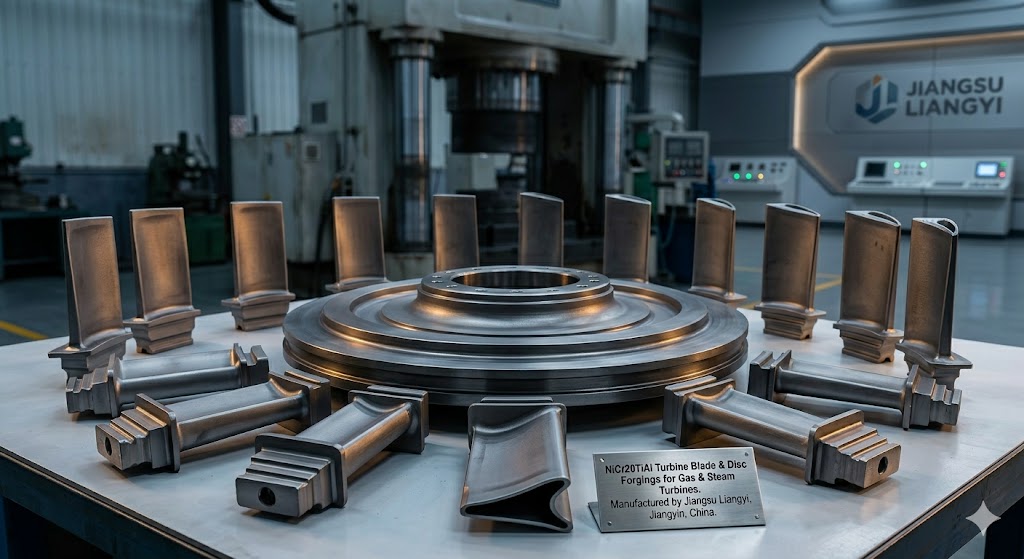
Gas & Steam Turbine Components
- Turbine blades and buckets
- Turbine discs and impellers
- Turbine blisks and rotors
- Guide rings and diaphragm nozzles
- LPT 1st & 2nd stage turbine casings
Why 2.4652? In 600–750°C turbine hot sections, the alloy's γ′ microstructure maintains dimensional stability over decades of thermal cycling. Unlike iron-based alloys, the creep rate of 2.4652 remains controlled enough at 650°C to prevent disc bore growth — a failure mode that has caused unplanned outages in older plant.
Success Case: Supplied over 5,000 pieces of 2.4652 turbine blades and 200+ turbine discs for 600MW and 1000MW thermal power plants in Southeast Asia. Our components have been operating reliably at temperatures up to 750°C for over 7 years with zero field failures.
Power Generation Valve Components
- Main Steam Valve (MSV) seats and cores
- Control Valve (CV) sleeves and spools
- Reheat Valve (CRV) discs and stems
- Valve spindles, rods and bonnets
- Stop valve and check valve components
Why 2.4652? A valve seat must maintain its sealing geometry under repeated thermal cycling, steam erosion, and mechanical impact. The combination of 320–400 HB hardness (which resists wire-drawing erosion by entrained particles) and dimensional stability up to 650°C makes 2.4652 the dominant material for supercritical and ultra-supercritical boiler valve seats in Europe and Asia.
Success Case: Manufactured complete sets of 2.4652 valve seats and spindles for 12 units of 660MW supercritical steam turbines in China. All components passed the OEM's dimensional and hardness audit at first inspection — a result we attribute to tightly controlled heat treatment uniformity in our pit furnaces.
High-Temperature Fasteners
- Double-ended studs and bolts
- High-temperature turbine bolts
- Special fasteners for critical flange joints
- Labyrinth ring fasteners
- Rotor end ring bolts
Why 2.4652? High-temperature bolts must maintain their clamping force over years of thermal cycling. This requires resistance to relaxation (stress relaxation under constant strain) rather than just creep. EN 10269 specifically lists 2.4652 as a fastener alloy because its yield-to-creep strength ratio at 650°C is favourable. We forge these to a fine-grained bar that produces consistent thread-root fatigue properties after machining.
Success Case: Provided NiCr20TiAl bolts and studs for leading European gas turbine manufacturers. Field monitoring confirmed that bolt preload was retained within design limits after 50,000 hours of operation at 650°C — significantly outperforming the iron-based bolts previously specified.
Automotive & Engine Components
- Heavy-duty diesel engine exhaust valves
- Valve spindles and guides
- Internal combustion engine parts
- Die casting inserts and cores
- High-temperature engine components
Why 2.4652? Exhaust valves in large marine and stationary diesel engines cycle between ambient and 700°C+ thousands of times per day. The valve face must resist hot corrosion from fuel sulphur compounds, thermal fatigue cracking, and impact loading from closing against the seat. 2.4631 (listed in EN 10090 for engine valves) provides this combination without requiring a weld-overlay cladding on the valve face, simplifying production.
Success Case: Supplied 2.4631 exhaust valves for a major German heavy-duty diesel engine manufacturer. Independent engine test bed evaluation showed 30% longer service life before reface compared to the incumbent competitor material.
Nuclear & Petrochemical Applications
- Nuclear boiler pipe support structures
- High-temperature process equipment internals
- Corrosion-resistant pressure vessel components
- Heat exchanger tube sheets and headers
- Reactor auxiliary system parts
Why 2.4652? In nuclear auxiliary systems operating at elevated temperature in a steam environment, the priority is dimensional stability over decades combined with the ability to document full traceability of every kilogram of material. Our ESR melt route and 3.2 witness-inspected mill certificates satisfy both requirements. The low iron content of 2.4652 (max 1.5%) reduces activation compared to iron-rich alloys, which is an advantage in reactor proximity.
Success Case: Manufactured NiCr20TiAl support components for auxiliary systems in two Chinese nuclear power plants. All 80+ pieces passed 100% UT plus radiographic examination — the acceptance rate was 100% at first inspection, eliminating rework delays for the project schedule.
Industrial Gas Compressors
- Compressor blades and vanes
- Compressor discs and impellers
- Seal rings and labyrinth packings
- Compressor casings and diffuser rings
- High-pressure compressor components
Why 2.4652? In natural gas compression, the gas stream carries entrained liquid droplets and fine abrasive particles. Compressor blades need high hardness to resist erosion combined with sufficient ductility to survive surge events without brittle fracture. The +AT heat treatment of 2.4652, delivering 320–400 HB with minimum 15% elongation, provides this balance better than harder but more brittle tool steels.
Success Case: Provided 2.4652 compressor blades and discs for three natural gas compression stations in the Middle East. After two years of operation in sour-gas service (H₂S present), corrosion inspection confirmed no pitting or stress-corrosion cracking, validating the alloy choice for this environment.
International Production Standards & Specifications
All our 2.4652 (2.4631, NiCr20TiAl) forged parts are manufactured in strict accordance with the following international standards. Understanding which standard applies to your component avoids costly specification errors at the procurement stage.
- EN 10269: 1999 — Steels and nickel alloys for fasteners with specified elevated and/or low temperature properties. Use this standard when specifying bolts, studs, nuts, and washers.
- EN 10090: 1998 — Valve steels and alloys for internal combustion engines. The reference standard for exhaust valves and valve seats in diesel and gas engines.
- EN 10302: 2008 — Creep resisting steels, nickel and cobalt alloys. The broadest standard covering structural forgings for power generation and process plant.
- ASTM B637 — Standard specification for precipitation-hardening and cold-worked nickel alloy bars, forgings, and forging stock. Used by North American OEMs and projects specified under ASME codes.
- AMS 5667 — Aerospace material specification for NiCr20TiAl alloy bars, forgings, and rings. Required for aerospace and defence applications in the United States.
- ASME SB-637 — The ASME Boiler and Pressure Vessel Code adoption of ASTM B637, required for pressure-retaining components in ASME-coded vessels.
Heat Treatment Conditions for 2.4652 (NiCr20TiAl) Forgings
The heat treatment of 2.4652 is a critical production step that determines the final microstructure and therefore the mechanical properties of the finished forging. Jiangsu Liangyi operates pit furnaces and car-bottom furnaces with type-N thermocouple calibration and automated chart recording, providing documented evidence that every charge has been processed correctly.
| Condition Code | Step 1: Solution Anneal | Step 2: Ageing | Resulting Properties | Typical Applications |
|---|---|---|---|---|
| +AT (Aged Treatment) |
1000–1050 °C Min 1 hr/25 mm section Air cool or water quench |
700–750 °C 16 hours minimum Air cool |
Rm 1100–1400 MPa Rp0.2 ≥ 725 MPa HB 320–400 |
Turbine discs, valve seats, high-temp fasteners, exhaust valves |
| +P (Precipitation Hardened) |
Not applicable (solution anneal omitted) |
700–750 °C 16 hours minimum Air cool |
Rm ≥ 1000 MPa Rp0.2 ≥ 600 MPa HB 280–360 |
Components where slightly higher ductility is required; less critical structural parts |
| +A (Annealed only) |
1050–1100 °C Min 1 hr/25 mm section Air cool |
Not applied | Rm ≥ 700 MPa Rp0.2 ≥ 250 MPa HB 170–230 |
Feedstock for subsequent cold working; weld filler applications |
Custom ageing cycles at different time-temperature combinations can be developed on request to achieve specific hardness targets or to match legacy drawing requirements from other manufacturers.
Why Choose Jiangsu Liangyi as Your 2.4652 Forging Partner?
Advanced Manufacturing Facility
Our 80,000 m² Jiangyin factory is equipped with 2000T–6300T hydraulic presses, 5M seamless ring-rolling mills, and fully automated heat treatment systems with chart recording.
Complete In-House Supply Chain
From ESR ingot melting through forging, heat treatment, NDT, machining, and certification — every step is performed under our ISO 9001:2015 quality system. No sub-contracting means no traceability gaps.
Strict Quality Assurance
Every 2.4652 forging undergoes chemical OES verification, 100% UT per ASTM A388, MT/PT surface inspection, and mechanical property testing before certification is issued.
Competitive Pricing
As a direct manufacturer in Jiangsu Province — China's primary forging industry belt — we eliminate distributor margins while our production scale keeps overhead per-kilogram low.
Fast Delivery Times
Our large production capacity and in-house heat treatment furnace fleet enable us to deliver standard raw forgings within 4–6 weeks of confirmed order and approved drawing.
Custom Forging Capability
Our engineering team reviews every customer drawing for forgeability before quoting. We produce from single prototypes to long-run production contracts and can advise on forging allowances to optimise material yield.
Global Export Experience
We have exported to 50+ countries and understand the specific documentation, marking, packaging, and export-control requirements of different regions and end-customer audits.
Complete Documentation Package
Every shipment includes EN 10204 3.1 or 3.2 MTC, UT/MT/PT reports, dimensional inspection records, heat treatment charts, and packing lists — the full document set that downstream quality audits require.
Quality Control & Testing Procedures
Our quality management system is certified to ISO 9001:2015 by an accredited certification body. The following inspection sequence applies as standard to every 2.4652 (NiCr20TiAl) forging order. Additional tests can be added at the customer's request.
Raw Material Inspection
- Full 11-element chemical composition analysis by OES spectrometer — verified against the incoming 3.1 certificate before any production begins
- Ultrasonic scan of incoming billet to detect macro-segregation or shrinkage defects
- Visual and dimensional inspection of billet surface condition
- Heat number marking verification and permanent transfer to the forging
In-Process Inspection
- Furnace temperature verification — thermocouple calibration records, chart recording of every heat treatment cycle
- Intermediate dimensional check after rough forging, before heat treatment
- Grain size metallography from discard samples to confirm reduction effectiveness
- Hot-work temperature monitoring: forging is stopped if metal temperature drops below 950°C to prevent hot-cracking
Final Inspection
- 100% ultrasonic testing (UT) per ASTM A388 — acceptance class agreed with customer (standard: Class C per EN 10228-3)
- Magnetic particle testing (MT) per EN ISO 17638 for ferromagnetic components; liquid penetrant testing (PT) per EN ISO 3452 for non-ferromagnetic or surface-critical components
- Mechanical property testing: tensile (Rm, Rp0.2, A, Z), Charpy impact (KV), and Vickers/Brinell hardness
- Metallographic examination: grain size, microstructure assessment
- Final dimensional inspection: full 100% check against drawing with CMM for machined components
Test sample orientation follows the applicable standard unless otherwise specified:
- Longitudinal for sections with diameter or thickness < 100 mm
- Transverse for sections with diameter or thickness ≥ 100 mm
- Tangential for forged rings and discs
Frequently Asked Questions (FAQ)
A: Both numbers refer to the same nickel-based superalloy NiCr20TiAl (W.Nr. 2.4952, UNS N07080). The only difference is the governing standard: 2.4631 appears in EN 10302 for creep-resisting structural applications, while 2.4652 is the EN 10269 fastener designation. Chemistry and heat treatment requirements are essentially identical. At Jiangsu Liangyi we issue the certificate under whichever designation your drawing specifies.
A: The alloy is rated for continuous mechanical service up to 815°C (1,500°F). At 750°C it retains approximately 480 MPa proof strength and 700 MPa tensile strength in the +AT condition. Above 800°C, γ′ precipitates begin to dissolve and long-term creep resistance falls sharply; for sustained use above this temperature, Waspaloy or higher-grade alloys are more appropriate.
A: We can produce 2.4652 forged round bars up to 2000 mm in diameter, seamless rolled rings up to 6000 mm outer diameter, and custom open die forgings in single-piece weights up to 30,000 kg (30 metric tons). For ring sections with a wall thickness below 80 mm and outer diameter above 2000 mm, please contact us to confirm rolling schedule availability.
A: Inconel 718 offers slightly higher room-temperature strength and is preferred for applications below 650°C where its delta-phase (Ni₃Nb) precipitation hardening is stable. Above 650°C, delta phase dissolves and 718's strength advantage over 2.4652 diminishes. 2.4652 is preferred for components above 650°C, for large forgings where 718's higher cost per kg is prohibitive, and wherever field welding is required (2.4652 is significantly more weldable).
A: Two standard delivery conditions: +AT (solution anneal at 1000–1050°C + ageing at 700–750°C for 16 hrs) giving 1100–1400 MPa tensile strength and 320–400 HB; and +P (precipitation hardened only) giving min 1000 MPa tensile strength and higher ductility. Custom ageing schedules for specific hardness targets are available on request.
A: Yes. Our Jiangyin facility has CNC turning centres, horizontal boring mills, and surface grinders capable of producing finished components from forgings in one supply chain step. Finished dimensions are verified on our coordinate measuring machine (CMM). We supply rough-machined, semi-finished, or fully finished condition — whichever the drawing specifies.
A: Standard lead time is 4–6 weeks for raw or rough forgings and 6–8 weeks for machined components, measured from receipt of confirmed purchase order and approved drawing revision. Expedited production slots are available for urgent orders — contact our sales team to check current schedule availability.
A: Standard NDT includes 100% ultrasonic testing (UT) per ASTM A388, magnetic particle testing (MT) per EN ISO 17638, and liquid penetrant testing (PT) per EN ISO 3452. Radiographic testing (RT) and eddy-current testing (ET) are available on request for complex geometries or aerospace-grade requirements.
A: Yes. We can arrange third-party inspection by SGS, Bureau Veritas (BV), TÜV Rheinland, Lloyd's Register, or any customer-nominated agency. We issue EN 10204 3.2 certificates for orders requiring witnessed verification. Please specify this requirement at the RFQ stage so we can schedule inspection slots with your agency.
A: The density of 2.4652 (NiCr20TiAl) is 8.19 g/cm³ (0.296 lb/in³) at 20°C. To estimate forging weight: multiply the billet volume in cm³ by 8.19 to obtain weight in grams. For rings, calculate the volume as π/4 × (OD² − ID²) × height. Add machining and test coupon allowances (typically 15–25% of finished weight) to estimate forging input weight for quoting.
A: There is no fixed minimum order quantity. We supply prototype single pieces as well as long-run production contracts. For small parts below approximately 10 kg each, a minimum batch of 50 pieces is typically recommended for cost efficiency due to fixed heat treatment and testing costs. For large forgings above 500 kg, single-piece orders are readily accepted.
A: Yes. This is our primary business model. We accept 2D drawings (DWG, PDF) and 3D models (STEP, IGES, Parasolid). Our engineering team reviews every drawing for forgeability, proposes optimal forging allowances and draft angles, and returns a DFM (design for manufacturability) comment sheet before the first production run. This review step is provided at no charge as part of our quotation process.
A: The mean thermal expansion coefficient of 2.4652 is 12.8 × 10⁻⁶/°C (20–500°C), rising to 13.6 × 10⁻⁶/°C over the 20–700°C range. This is notably lower than austenitic stainless steels (≈16–17 × 10⁻⁶/°C). When 2.4652 bolts are used with stainless steel flanges, the differential expansion is reduced compared to an all-stainless assembly, meaning less preload relaxation occurs over thermal cycles — an important advantage in high-integrity flange joints on steam turbines and pressure vessels.
A: We maintain a minimum total forging reduction ratio of 4:1 (cross-sectional area before forging divided by final cross-sectional area). This level of reduction is necessary to fully recrystallise the as-cast ESR microstructure and achieve the fine ASTM grain size 5–8 required for both mechanical property performance and ultrasonic inspectability. Higher reduction ratios (up to 10:1) are applied when the finished section is small relative to the starting billet.
Related Superalloy Forging Products
Contact Us for Your 2.4652 (NiCr20TiAl) Forging Needs
Jiangsu Liangyi is your trusted China manufacturer of high-quality 2.4652 (2.4631, NiCr20TiAl) forged parts. With our advanced manufacturing facilities, strict quality control, and 25+ years of experience, we are committed to providing you with the best superalloy forging solutions for turbines, valves, fasteners, and custom industrial components.
Send us your drawings, material specifications, and quantity requirements. Our engineering team will review your requirements and return a detailed, competitive quotation within 24 hours on business days.
Request Your Free Quotation Today+86-13585067993
www.jnmtforgedparts.com
Chengchang Industry Park, Jiangyin City, Jiangsu Province, China 214400