SCM415 Forging Parts | Custom Forged Steel Manufacturer from China
SCM415 Forging Parts: What Sets This Material Apart for Heavy-Duty Applications
Founded in 1997 and operating from an 80,000㎡ facility in Jiangyin, Jiangsu Province, Jiangsu Liangyi Co.,Limited has spent nearly three decades refining the exact processes that make SCM415 forging parts perform where others fail. We are an ISO 9001:2015 certified manufacturer with 120,000 tons of annual production capacity, supplying custom open die forgings and seamless rolled rings to over 1,000 industrial clients across 50+ countries. Our experience is not measured in certifications alone — it is measured in the thousands of components that have been operating continuously in oil fields, nuclear plants, marine vessels and industrial gearboxes around the world.
SCM415 is a low-alloy chromium-molybdenum carburizing steel standardized under JIS G4053. What distinguishes it from simpler carburizing steels — such as AISI 1020 or 20MnCr5 — is the deliberate synergy between its three primary alloying elements. Chromium (0.90–1.20%) forms stable carbides during carburizing that sharply increase surface hardness while simultaneously improving wear resistance. Molybdenum (0.15–0.30%) refines grain boundaries, dramatically reduces temper brittleness that would otherwise make the core unreliable under shock load, and increases hardenability so that even large-section forgings develop consistent properties through the full cross-section. The controlled low carbon content (0.13–0.18%) ensures the core remains ductile and tough after quenching — a balance that higher-carbon grades like SCM440 cannot achieve for carburizing applications.
In our production experience, the most common reason clients switch to SCM415 from generic carburizing steels is case depth consistency on large-cross-section forgings. Because of the Cr-Mo hardenability effect, SCM415 achieves a carburized case depth of 0.8–2.0mm with remarkable uniformity even on forgings exceeding 500mm cross-section — something that low-alloy structural steels simply cannot replicate. This translates directly to longer service life, reduced maintenance downtime, and lower total cost of ownership for the end user.
As a full-chain SCM415 forging manufacturer, we control every variable from ingot melting and forging ratio to carburizing atmosphere composition and quench cooling rate. We do not subcontract heat treatment or NDT testing. This integration is not a marketing claim — it is the operational structure that allows our engineering team to troubleshoot and optimize material performance for your specific application before a single kilogram of steel is purchased.
Our SCM415 Forging Product Range
We manufacture SCM415 forging parts in three primary product families. Each is produced with full in-house forging, heat treatment and NDT — no outsourcing at any stage. Dimensional tolerances, surface conditions and heat treatment parameters are customized to your engineering drawing and application requirements.
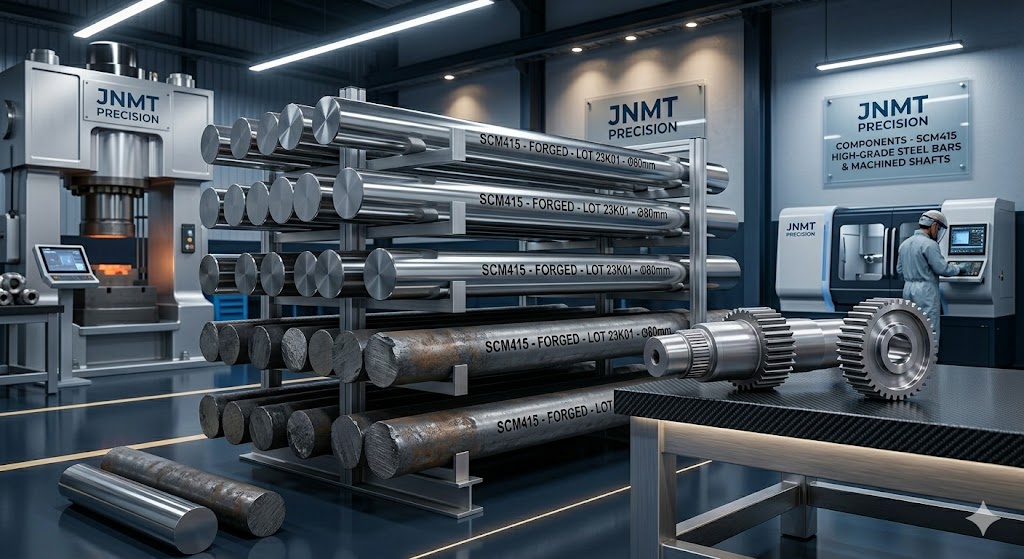
SCM415 Forged Bars & Shafts
Round bars (Ø50–Ø1,200mm), step shafts, gear shafts and pinion shafts up to 12,000mm length. Forging ratio maintained ≥3:1 throughout to ensure uniform grain flow and eliminate as-cast dendritic segregation. Supplied in annealed, normalized, or quenched-and-tempered condition per your specification.
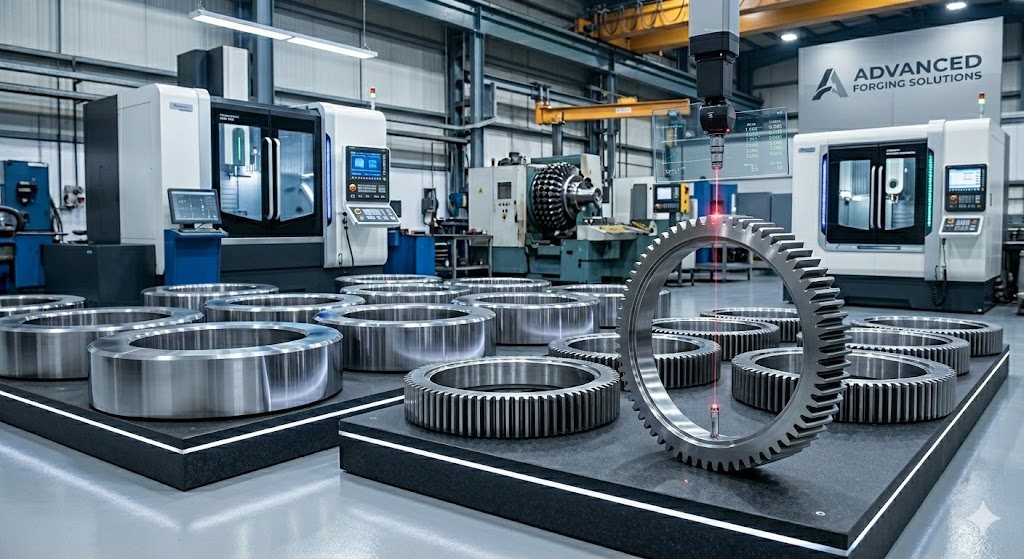
SCM415 Seamless Rolled Rings
OD 200mm to 5,000mm, wall thickness from 30mm to 800mm, height up to 800mm. Produced on our 1m and 5m ring rolling machines with continuous wall-thickness monitoring during rolling to hold OD/ID concentricity within 1.5mm. Ideal for gear rings, slewing rings, bearing races and flanged ring blanks.
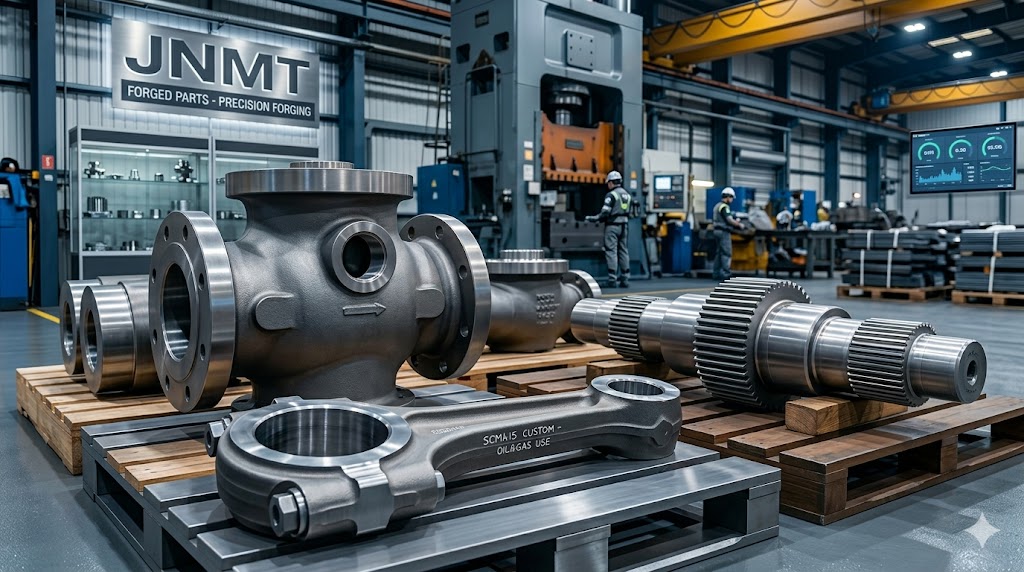
Custom SCM415 Forged Components
Fluid end blocks, valve bodies, pump housings, hollows, discs and special-geometry components produced strictly from your 2D/3D drawings. Single-piece weights from 30 kg to 35,000 kg. We review every drawing for forgeability before accepting the order, and propose optimized forging sequences that reduce your subsequent machining allowance.
SCM415 vs. Other Chromium-Molybdenum Steels: How to Choose the Right Grade
One of the most frequent engineering decisions we help our clients with is which Cr-Mo forging grade to specify. The JIS SCM series — SCM415, SCM418, SCM420, SCM421, SCM425, SCM430, SCM432, SCM435, SCM440, SCM445 — covers a carbon range from 0.13% to 0.48%. The right selection depends on your part geometry, section thickness, required surface hardness, core toughness target and heat treatment capability. Below is our direct technical perspective based on thousands of production orders.
| Grade | C% Range | Primary Use Case | Typical Surface HRC (Carburized) | Core Toughness (Akv) | Max Section for Full Through-Hardening |
|---|
| SCM415 | 0.13–0.18 | Carburized precision gears, shafts, frac pump components, nuclear parts | 58–62 HRC | ≥110 J (typical 120–150 J) | Up to Ø250mm (full); Ø500mm (surface) |
| SCM420 | 0.18–0.23 | Carburized gears, camshafts — slightly higher core strength than SCM415 | 58–62 HRC | ≥95 J | Up to Ø200mm (full) |
| SCM435 | 0.33–0.38 | Through-hardened shafts, bolts — quenched & tempered without carburizing | 50–55 HRC (Q&T surface) | ≥78 J | Up to Ø150mm (full) |
| SCM440 (≈ 42CrMo4) | 0.38–0.43 | Heavy shafts, structural forgings requiring high tensile strength without carburizing | 48–54 HRC (Q&T surface) | ≥63 J | Up to Ø120mm (full) |
| 20CrMo (GB/T) | 0.17–0.23 | Chinese domestic carburizing standard — closer to SCM420; lower Mo than SCM415 | 56–61 HRC | ≥85 J | Up to Ø150mm (full) |
| AISI 4118 (nearest US equiv.) | 0.18–0.23 | Carburized gears, shafts — slightly higher C than SCM415; good for smaller sections | 58–62 HRC | ≥90 J | Up to Ø180mm (full) |
When to Specify SCM415 (Not SCM420 or SCM440)
Based on our production experience, SCM415 is the correct choice when three conditions are simultaneously present: (1) the component requires carburizing to achieve surface hardness above 58 HRC, (2) the core must absorb repeated shock or impact loads without brittle fracture, and (3) the forging cross-section exceeds 150mm. When sections are below 100mm and shock resistance is not the primary concern, SCM420 delivers comparable surface performance at marginally lower material cost. When the application is through-hardening only — such as structural shafts or tie-rods — SCM440 or 42CrMo4 is a more appropriate choice because the higher carbon content delivers superior tensile strength without the carburizing step.
SCM415 vs. 18CrMo4 (DIN / EN) and AISI 4118: Are They Truly Interchangeable?
This question comes up regularly from European and North American clients. The answer is: mostly yes, with important caveats for large-section forgings. SCM415 (JIS), DIN 18CrMo4 (1.7264) and AISI 4118 overlap significantly in composition, but there are real differences in P and S limits (JIS G4053 specifies ≤0.030% each at standard grade; we produce to ≤0.025% P and ≤0.020% S as standard). For components under 100mm diameter, the grades are functionally interchangeable. For forgings above 200mm cross-section, the slightly higher Mo content in our SCM415 production (we target 0.20–0.28% Mo) provides measurably better deep-section hardenability compared to standard 18CrMo4 mill product, which is typically rolled bar and not forged. If your component was previously specified as 18CrMo4 from a European bar supplier and is now being made as a large forging, contact our engineering team — we will review your application and confirm whether SCM415 is the direct equivalent or whether an adjusted composition target is needed.
Full Range of Custom SCM415 Forged Steel Products
We produce every major forged shape in SCM415 steel, from prototype single pieces to production runs of hundreds of identical components. Maximum single-piece weight capacity is 35,000 kg. Below is our standard product range — if your required shape is not listed, contact us with your drawing. We have made custom shapes for wind turbine planetary carriers, nuclear reactor trunnions and offshore riser connectors that do not fit any standard category.
Forged Bars & Structural Shapes
- Round bars: Ø50mm to Ø1,200mm, lengths up to 12,000mm. Standard diameter tolerance: per EN 10243-1 Class D or tighter per agreement. Straightness: ≤1mm per 1,000mm standard, ≤0.5mm per 1,000mm premium grade.
- Square and flat bars: Width 50–800mm, thickness 30–600mm, length up to 6,000mm. Used primarily as machining blanks for valve bodies and fluid end components.
- Forged blocks and plates: Up to 3,000×2,000×800mm for large machined structures requiring forged material integrity rather than rolled plate.
- Step shafts and gear shafts: From Ø80/Ø50mm two-step to complex 6+ step configurations, maximum finished length 10,000mm. We maintain forging fiber flow direction parallel to shaft axis — critical for torsional fatigue strength that machined bar cannot provide.
- Crankshafts and eccentric shafts: Custom configurations for compressors and reciprocating pumps, where the continuous grain flow of a forged crankshaft provides fatigue life typically 3–5× longer than a machined bar equivalent.
Seamless Rolled Rings & Flange Components
- Plain rings: OD 200–5,000mm, wall thickness 30–800mm, height 30–800mm. Grain flow runs circumferentially through the full wall — the defining metallurgical advantage over a ring cut from a forged bar or plate.
- Gear rings and ring gears: Near-net-shape rolled profiles with gear tooth forms roughed into the ring OD or ID during rolling, reducing the machining stock per tooth from 20–30mm (from a plain ring) down to 5–8mm. This saves significant machining time on large-module gear rings.
- Slewing bearing outer and inner rings: OD 1,000–5,000mm, matched pair sets with hardness uniformity ≤15HB across the full circumference after heat treatment — our critical production specification for bearing rings.
- API wellhead flanges: Swivel ring flanges, studded adapter flanges, integral flanges and weld neck flanges produced per API 6A, ASME B16.5 and ASME B16.47 Series A & B dimensional and material requirements. Pressure class from 2,000 PSI to 20,000 PSI. (API 6A monogram certification is held by the OEM customer; we supply the forged blanks to their specification.)
- Contoured rolled rings: T-section, L-section, and stepped-OD rings rolled directly to near-net profile, eliminating the full face machining that plain rings require.
Hollow Forged Components
- Forged sleeves and bushings: ID 50–800mm, OD up to 1,500mm, length up to 3,000mm. Produced by upsetting and back-extrusion forging to create the bore, which delivers superior bore-direction grain flow compared to machining from solid bar — important for components that experience hoop stress in service.
- Forged cylinders and barrels: Used for hydraulic cylinders, pump barrels, and piston cylinders where pressure cycling creates combined wall-stress and bore-wear demands that only forged SCM415 reliably meets.
- Tube sheets for heat exchangers and pressure vessels: Full-face forged blanks up to 3,000mm diameter, drilled pattern per your TEMA or ASME BPVC design. We maintain impact testing certification for sub-zero temperatures down to -46°C where required for cryogenic service heat exchangers.
- Forged nozzles and transition pieces: Custom transition geometries for pressure vessels, capable of meeting ASME Section VIII Div.1, Div.2, PED 2014/68/EU and GB 150 material and dimensional requirements as specified in the customer order. Code stamping is applied by the customer's authorized Inspection Agency, not by us as the forging supplier.
Custom Precision Forged Parts
- Frac pump fluid end blocks: Our single-highest-volume SCM415 product for North American oil and gas clients. Produced with a forging ratio of ≥5:1 in the critical bore direction to achieve UT acceptance per EN 10228-3 Class 4 or ASTM E2375 Class 1 as required. Maximum single-piece weight: 4,500 kg. Designed to customer specifications for operating pressures up to 15,000 PSI.
- Gear shafts and pinion shafts for gearboxes: Carburized and case-hardened to 58–62 HRC surface hardness with case depth 0.8–2.0mm, core hardness 30–42 HRC. Tooth profile grinding allowance of 0.15–0.25mm per flank maintained consistently.
- Valve bodies and bonnets: Produced to customer drawings per API 6A, API 600 or ASME B16.34 material and dimensional requirements, in pressure classes from 150# to 2500# ANSI. Full body 100% UT per the acceptance criteria specified in the customer purchase order.
- Pump impellers and casings for industrial and nuclear pumps: Including SCM415 forgings for high-purity power generation components, produced with enhanced purity aims of P ≤ 0.010% and S ≤ 0.008% via EAF+LF+VD or VIM+PESR melting, to support customer nuclear material qualification programs.
We also manufacture the full range of alloy steel forging products in 42CrMo4, AISI 4140, 34CrNiMo6, 30CrNiMo8, 17-4PH, F51 duplex stainless, and carbon steels. See our full materials page for the complete list.
Why Jiangsu Liangyi SCM415 Forgings Outperform Generic Mill Supply
Every forging manufacturer can list certifications. What genuinely separates quality is process discipline — the specific decisions made during forging temperature selection, deformation sequence, cooling rate control and heat treatment atmosphere management. Here is our honest account of what we do differently:
Forging Ratio Discipline: Minimum 3:1, Target 5:1
We specify and verify the forging ratio for every SCM415 order. A minimum 3:1 reduction ratio is required to break down as-cast dendritic segregation and achieve ASTM grain size 5 or finer. For critical applications such as frac pump fluid ends and nuclear pump impellers, we target 5:1 or greater in the critical stress direction, which our process records confirm. This is not stated on most competitors' MTCs — because they do not measure it.
Composition Targeting Tighter Than JIS G4053
Our standard SCM415 production aim is C 0.14–0.17%, P ≤0.025%, S ≤0.020%, Mo 0.20–0.28%. These tighter aim points are not accidental — they are the result of 27 years of correlating heat treatment response with actual composition. Tighter C control (±0.015% vs. the standard ±0.025%) directly reduces heat-to-heat variation in case depth after carburizing, which is the number one root cause of scrap in carburized gear production.
Heat Treatment with ±5°C Furnace Temperature Uniformity
Our programmable pit furnaces maintain ±5°C uniformity across the full load volume, verified by calibrated K-type thermocouple quarterly (calibration records maintained per ISO 9001 quality system). This precision prevents the hardness scatter (>15HB variation across a single part) that causes problems in precision grinding and bearing fit applications. All heat treatment cycle data is automatically recorded and included with the MTC on request.
Full In-House NDT: Zero Third-Party Lag
We employ certified Level II NDT personnel (qualified per ASNT SNT-TC-1A or equivalent national qualification) for UT, MT and PT in-house. Third-party subcontracting of NDT introduces a 5–10 day scheduling delay and creates chain-of-custody documentation gaps that some clients' QA teams flag during source inspections. Our in-house capability eliminates both problems. For EN 10204 3.2 inspection, we coordinate third-party inspection directly from our facility with TÜV, Bureau Veritas, SGS and Lloyd's Register upon request.
27 Years Exporting to Tier-1 Industrial Clients
Since 1997, our SCM415 forgings have passed first-article inspection at clients including major frac pump OEMs in Texas, nuclear turbine manufacturers in France, and marine shaft fabricators in South Korea and Norway. We have supported clients through third-party audit preparation for PED 2014/68/EU and Lloyd's Register class surveys. We understand what Tier-1 procurement teams look for — and how to document it correctly.
Engineering Support Before You Place the Order
Our technical team reviews client drawings before quoting to identify: (a) any geometry that creates forging fill or fold risk, (b) heat treatment specifications that conflict with achievable case depth for the cross-section, and (c) UT acceptance criteria that may require EAF+LF+VD melting to achieve reliably. We raise these issues proactively — because discovering them after production is far more expensive for everyone.
Transparent Melting Process Selection
We offer five melting routes from standard EAF to VIM+PESR, and we explain honestly which one your application actually requires. Many clients specify ESR when EAF+LF+VD would fully meet their cleanliness requirements at lower cost. We do not upsell melting processes — we recommend the route that balances quality assurance with cost efficiency, and document our rationale in writing.
24-Hour Response, 48-Hour Technical Review
Inquiries submitted to sales@jnmtforgedparts.com receive a commercial acknowledgment within 24 hours. Technical drawing review and DFM (Design for Manufacturability) feedback is completed within 48 business hours by our engineering team. Quotations include material specification, forging sequence, heat treatment plan, NDT scope, lead time breakdown and delivery terms — not a single price number without context.
SCM415 Forging Applications by Industry: Technical Context and Project Experience
The industries that specify SCM415 forging parts share a common requirement: components that must simultaneously resist surface wear, absorb cyclic impact, and maintain dimensional integrity in environments where unplanned failure is not an option. Below we describe each major application area with the specific material performance rationale — not just what parts we make, but why SCM415 is the correct engineering choice for each.
Oil & Gas Industry: Frac Pump Components and Wellhead Equipment
Hydraulic fracturing imposes perhaps the most aggressive combined loading of any industrial application: reciprocating pressure cycles at 10,000–15,000 PSI, at 1–4 Hz frequency, with fluid containing abrasive sand proppant at concentrations of 1,000–2,500 lbs per barrel. The fluid end block — the heart of a frac pump — must resist both high-cycle fatigue from pressure cycling and fretting corrosion from the valve seat interface. SCM415, carburized and case-hardened to 58–62 HRC at the bore and valve seat surfaces with a 1.2–1.8mm case depth, outperforms through-hardened AISI 4140 in this application because the tough low-carbon core absorbs the tensile stress wave at each pressure cycle, preventing the through-cracking failure mode that 4140 blocks exhibit after 1.5–2M cycles.
Project Reference: Permian Basin Frac Fleet Component Supply (Ongoing Since 2018)
We have supplied SCM415 forged fluid end blocks, pinion shafts and bull gears to North American frac pump customers. Our fluid end blocks are produced with a minimum 5:1 forging ratio (verified by forging process record), EAF+LF+VD melting for inclusion cleanliness, and 100% UT per ASTM E2375 Class 1 acceptance. Clients in this segment report improved service life compared to through-hardened 4140 alternatives, consistent with the established fatigue advantage of the SCM415 carburized case-and-core structure described above.
Nuclear & High-Purity Power Industry: Reactor Pump Materials and Pressure Boundaries
Nuclear and high-purity power generation applications impose the most stringent material purity requirements of any industrial forging. For reactor coolant pump (RCP) components and pressure boundary parts in light water reactors, the primary concerns are hydrogen embrittlement resistance and long-term toughness stability. Our EAF+LF+VD and VIM+PESR melting routes can achieve P ≤ 0.010% and S ≤ 0.008% — far below the standard JIS G4053 limits. This ultra-low P+S specification reduces susceptibility to temper embrittlement (a grain boundary weakening mechanism triggered by long-term service at 250–350°C). We supply SCM415 forgings with enhanced purity documentation to customers who operate their own nuclear qualification programs, providing the material testing data and traceability records required as part of their qualification evidence package.
Our nuclear-industry material capability: Full chemical re-verification by OES; mechanical testing with longitudinal and transverse specimens; sub-zero Charpy testing down to -46°C; grain size verification at ASTM 6 or finer; full EN 10204 3.1 MTC with extended traceability. We support customer nuclear material qualification programs — the nuclear component certification itself is held by our customers, not by us, and we are transparent about this distinction.
Marine & Shipbuilding: Propeller Shafts and Stern Tube Components
Marine propeller shafts for vessels above 10,000 DWT are subject to classification society rules specifying minimum yield strength, impact energy and fatigue limits proportional to transmitted power. For a 40,000 DWT bulk carrier with main engine output of 8,000–12,000 kW, the propeller shaft requires minimum yield strength 490 MPa and Charpy impact energy 27J at 0°C. SCM415 in the quenched and tempered condition comfortably exceeds these requirements. Forged SCM415 shafts also exhibit significantly higher endurance limits compared to hot-rolled bar, because forging eliminates the surface seams and internal laps that act as fatigue initiation sites in rolled product. For shafts above Ø350mm, forging is the only reliable production method — rolled bar of this diameter does not develop uniform through-section properties.
Project Reference: Panamax Bulk Carrier Propeller Shaft Package (2022)
We have produced large-scale SCM415 propeller shafts for bulk carrier shipbuilding projects, with shaft weights in the 25–35 tonne range and finished diameters up to Ø550mm. Production includes EAF+LF+VD melting to achieve UT Class 4 acceptance per classification society rules. Immersion UT, journal zone induction hardening to 52–56 HRC, and complete EN 10204 3.1 certification are standard for marine shaft orders. Third-party classification society inspection (DNV, LR, ABS, BV) is coordinated from our facility upon customer request.
Industrial Gearboxes & Power Transmission: Case-Hardened Gear Shafts and Ring Gears
When carburized at 920–940°C for 8–20 hours depending on required case depth, SCM415 develops a 58–62 HRC surface with a compressive residual stress layer that directly extends bending fatigue life of gear teeth. Our carburizing process controls atmosphere carbon potential to ±0.05% via continuous CO/CO₂ analysis, which translates to case depth uniformity of ±0.1mm across the full gear face — the precision level that leading European gearbox OEMs specify and verify with core/case hardness traverses at incoming inspection.
Project Reference: Wind Turbine Gearbox Planet Carrier Shafts (2023–Ongoing)
We produce SCM415 forged planet carrier shafts for industrial gearbox applications including wind turbine transmissions. Each shaft is carburized to a controlled effective case depth (typically 1.5±0.1mm to the 50HRC limit), with surface and core hardness verified by hardness traverse on production test rings. Retained austenite in the case layer is maintained at ≤20% by X-ray diffraction — a specification increasingly required by European gearbox OEMs. We support customers' incoming QA programs including metallographic cross-section supply and full heat treatment traceability.
Petrochemical & Process Industry: Sour Service Pressure Vessel and Exchanger Components
In petrochemical service, SCM415 forgings are specified for components that must resist hydrogen sulfide (H₂S) stress corrosion cracking per NACE MR0175/ISO 15156. For sour service, the exposed surface hardness limit is ≤22 HRC (approximately 235 HB) — requiring high-temperature tempering. Our experience producing NACE-compliant SCM415 forgings means we understand the interplay between post-weld heat treatment (PWHT) cycles and final hardness. We design heat treatment parameters so the forging meets both the mechanical property minimum and the NACE hardness maximum after your specific PWHT cycle — a calculation our engineering team performs as part of the pre-production review.
Mining & Heavy Construction: Crusher Shafts, Hydraulic Cylinders and Drive Components
Mining applications demand SCM415 forgings that survive abrasive wear, rock-fragment impact, and continuous cyclic loading. Our crusher roll shafts and bowl liner support shafts have operated in copper and iron ore mines in South America, Australia and South Africa since 2010. The critical production requirement is a forging ratio of ≥4:1 in the transverse direction to achieve toughness isotropy — meaning the transverse Charpy value is at least 75% of the longitudinal value. This prevents the preferential transverse fracture mode responsible for catastrophic shaft failures in mining equipment made from insufficiently worked forgings.
For a full overview of our production equipment, visit our Equipment page. For our complete material grade portfolio, see our Materials page.
Discuss Your Application with Our Engineering Team
SCM415 Material Specifications, Standards and What the Numbers Actually Mean
The following specifications define SCM415 per JIS G4053 — but understanding why each element is present and what it does in service is what separates a metallurgically informed purchasing decision from a simple document match. All our SCM415 forgings are chemically verified per ASTM A751 (spectrometric analysis) and mechanically tested per ISO 683-2:2018 and JIS Z 2241. We retain every test record for a minimum of 10 years for traceability.
Chemical Composition (Mass Fraction, %): Standard Limits vs. Our Production Aim
The three columns below reflect: the JIS G4053 published limits, our standard production aim points (which are tighter), and a brief explanation of why each element matters for forging performance. The aim points represent the composition range where our 27 years of heat treatment correlation data shows the most consistent carburizing response and mechanical properties.
| Element | JIS G4053 Standard Limit | Our Production Aim Range | Metallurgical Role in SCM415 Forgings |
|---|
| Carbon (C) | 0.13 – 0.18% | 0.14 – 0.17% | Controls core hardness and case-hardening response. Tighter aim reduces heat-to-heat variation in case depth by ±0.05mm — critical for precision gear carburizing. |
| Silicon (Si) | 0.15 – 0.35% | 0.18 – 0.30% | Deoxidizer; strengthens ferrite matrix. Excessive Si above 0.35% can reduce toughness at low temperatures — our aim avoids the upper range for cold-climate and cryogenic service components. |
| Manganese (Mn) | 0.60 – 0.85% | 0.65 – 0.80% | Increases hardenability and strength. Combined with Cr and Mo, it ensures that forgings above Ø200mm achieve uniform through-section hardness after quenching. Excessive Mn increases hot shortness risk during forging — our aim avoids the upper range for heavy forgings. |
| Phosphorus (P) | ≤ 0.030% | ≤ 0.025% standard
≤ 0.010% nuclear grade | Embrittlement element that segregates to grain boundaries during tempering. Low P is essential for components subjected to elevated-temperature long-term service (nuclear, petrochemical) and low-temperature impact applications. |
| Sulfur (S) | ≤ 0.030% | ≤ 0.020% standard
≤ 0.008% nuclear grade | Forms MnS inclusions that reduce transverse toughness and become UT-detectable defects in large sections. Lower S is mandatory for shaft and pressure vessel forgings that require transverse Charpy testing or Class 3+ UT acceptance. |
| Chromium (Cr) | 0.90 – 1.20% | 0.95 – 1.15% | The primary carbide-forming element responsible for surface hardness after carburizing. Cr carbides formed during carburizing are harder and more wear-resistant than iron carbides. Cr also significantly increases hardenability — the depth to which the steel will harden during quenching. |
| Molybdenum (Mo) | 0.15 – 0.30% | 0.20 – 0.28% | The most important element for preventing temper brittleness and for improving deep-section hardenability in large forgings. Mo also refines grain size and reduces the risk of white-etching areas (WEA) in high-stress fatigue applications. Our higher Mo aim (0.20% vs. standard 0.15% minimum) provides measurably better properties in forgings above Ø300mm. |
Mechanical Properties (Quenched & Tempered, Room Temperature, Longitudinal Direction)
The mechanical properties below apply to the as-supplied quenched-and-tempered condition, which is the standard delivery state for shaft and structural forgings. Components that are subsequently carburized will have higher surface hardness (58–62 HRC) with the core properties below maintained in the un-carburized core region. Note that the "Our Typical Production Result" column reflects actual test data from 2021–2025 production, not estimated values.
| Mechanical Property | JIS G4053 Standard Requirement | Our Typical Production Result (2021–2025) | Design Significance |
|---|
| Tensile Strength (σb) | ≥ 440 MPa | 480 – 550 MPa | Governs static load capacity; our consistent margin above minimum allows engineering safety factors to be reliably maintained without material overtesting. |
| Yield Strength (σs / Rp0.2) | ≥ 295 MPa | 320 – 380 MPa | Design basis for pressure vessel wall thickness and shaft sizing. Our typical values provide ~25% margin above JIS minimum — important for components under pulsating load where the yield-to-tensile ratio affects fatigue performance. |
| Elongation (δ5 / A5) | ≥ 22% | 25% – 30% | Indicator of ductility reserve. Our margin above the JIS minimum is evidence of thorough forging and correct tempering temperature — forgings with elongation near the minimum limit often indicate insufficient tempering or a forging fold that is redistributing the stress during testing. |
| Reduction of Area (Ψ / Z) | ≥ 60% | 65% – 75% | The most sensitive indicator of inclusion content and forging quality. High RA% confirms low sulfide inclusion content (low S aim) and adequate forging ratio. For nuclear and marine class components requiring transverse RA%, our values exceed 50% in the transverse direction — the threshold for Class A material per several classification society rules. |
| Impact Energy (Akv at room temp.) | ≥ 94 J | 110 – 150 J | Critical for shock-loaded applications (frac pumps, mining equipment). Our typical values are 15–35% above the JIS minimum. For sub-zero impact testing (Charpy at -18°C or -46°C), contact us to discuss achievable values for your specific forging geometry and heat treatment. |
| Brinell Hardness (HB) | ≤ 179 HB (annealed)
Customizable (Q&T) | 150 – 175 HB (annealed)
220 – 280 HB (Q&T, depending on tempering) | Delivery hardness affects machinability and forms the basis for final machined surface finish planning. We agree the delivery hardness window with clients at quoting stage and guarantee it within ±15HB across the full forging. |
Carburizing Heat Treatment Parameters and Achievable Case Properties
For SCM415 gear shafts, ring gears and other carburized components, the following parameters represent our proven production process. These are not published theoretical values — they are the actual process parameters we use and the case properties we achieve, verified by metallographic section analysis on production parts.
| Parameter | Our Standard Production Range | Notes |
|---|
| Carburizing Temperature | 920 – 940°C | Controlled within ±5°C. Higher temperatures accelerate carburizing but can cause abnormal grain growth if held too long — we balance time and temperature to maintain ASTM grain size 6 or finer in the case. |
| Atmosphere Carbon Potential (Cp) | 0.85 – 1.10% C (endothermic + enrichment gas) | Controlled by continuous CO/CO₂ infrared analysis to ±0.05% Cp. This precision is the direct cause of our ±0.1mm case depth uniformity across the gear face. |
| Effective Case Depth (550HV limit) | 0.8 – 2.0mm (customizable) | For standard gearbox applications: 1.2–1.5mm. For heavy-duty frac pump bores: 1.5–2.0mm. For thin-wall ring sections: 0.8–1.0mm to avoid through-case hardening of the wall. |
| Surface Hardness after Case Hardening | 58 – 62 HRC | Measured at 5 points around circumference on a representative test ring. Max spread: 2 HRC points. If spread exceeds 2 HRC, the batch is re-evaluated. |
| Core Hardness (after case hardening + tempering) | 30 – 42 HRC (typically 33–38 HRC) | Controlled by core carbon content (0.14–0.17% C aim) and quench severity. Core HRC determines bending fatigue resistance of the gear tooth root — too soft means root fatigue failure; too hard means impact brittleness. |
| Retained Austenite (surface) | ≤ 20% (by X-ray diffraction) | Excessive retained austenite reduces surface hardness and causes dimensional instability during service. Our carbon potential control keeps RA below 20% without sub-zero treatment in most applications. Sub-zero treatment (-80°C) is available on request for precision fits requiring tight bore/shaft tolerances in service. |
Melting Process Selection Guide: Which Route Do You Actually Need?
The five melting routes we offer span a wide range of cleanliness levels and costs. The right choice depends on your component's NDT acceptance class, section size, and service conditions — not simply on which sounds most impressive. Here is our honest guide:
- EAF (Electric Arc Furnace) — Suitable for standard commercial forgings where UT Class 3 acceptance (per EN 10228-3) is the requirement. For SCM415 bars under Ø200mm and rings with wall thickness under 100mm where service conditions are non-critical. This is appropriate for the majority of general machinery applications.
- EAF + LF + VD (Ladle Furnace + Vacuum Degassing) — Our recommended standard for most industrial applications. VD reduces dissolved hydrogen to <1.5 ppm (preventing hydrogen-induced flaking in large forgings), reduces nitrogen to <80 ppm (improving toughness), and achieves UT Class 4 acceptance for most forging geometries above Ø300mm. This is the minimum we recommend for frac pump fluid ends, marine shafts and API pressure vessel nozzles.
- EAF + ESR (Electro Slag Remelting) — Recommended when UT Class 5 acceptance (per EN 10228-3) is required, or when sulfide inclusion shape control is critical (e.g., large bearing rings where MnS stringer orientation affects contact fatigue life). ESR reduces S to ≤0.005% and eliminates macro-segregation banding that persists through standard VD melting.
- EAF + PESR (Protective Atmosphere ESR) — For applications where reactive alloying elements must be protected from atmospheric oxidation during remelting, and where ESR slag contamination must be eliminated. Suitable for very high alloy or specialty grades; rarely required for standard SCM415.
- VIM + PESR (Vacuum Induction Melting + Protective Atmosphere ESR) — The highest cleanliness route, appropriate for nuclear Grade A material (P ≤ 0.010%, S ≤ 0.008%, O ≤ 15 ppm, H ≤ 1.0 ppm) and for bearing steels requiring UT Class 6 acceptance. This route may be required by nuclear customers for reactor coolant pump pressure boundary forgings under their own regulatory qualification programs. Do not specify it for standard industrial applications, as the cost premium is significant and the cleanliness level will not be detectable in your NDT without Class 6 UT equipment.
Our SCM415 Forging Production Process: Equipment, Controls and What We Actually Do Differently
Most forging websites list equipment. We are going to explain how we use that equipment to produce SCM415 forgings that consistently pass first-article inspection at demanding Tier-1 clients. The details below are based on our actual production practice, not marketing copy.
Forging Equipment and Why Capacity Alone Does Not Guarantee Quality
Our forging shop operates seven forging hammers (0.75T to 9T electro-hydraulic) and three hydraulic forging presses (2,000T, 4,000T and 6,300T). The 6,300T press is our primary tool for large open-die forgings above 5,000 kg, where the higher static force of a press (compared to a hammer's impact blow) gives better control over deformation rate and temperature drop during forging. For SCM415 specifically, press forging at the lower forging speed reduces adiabatic heating in the deformation zone, which helps maintain the forging temperature within the optimal hot-working window of 1,100–850°C without overheating the surface or allowing the core to drop below the recrystallization temperature. Hammer forging is preferred for smaller, complex-geometry parts where impact energy is needed to fill intricate die features.
- Electro-Hydraulic Forging Hammers: 0.75T, 1T, 3T, 5T, 6T, 9T — for complex shapes, step forging and precision die forgings up to 2,000 kg
- Hydraulic Forging Presses: 2,000T, 4,000T, 6,300T — for open-die forgings, large shafts and slabs up to 35,000 kg single piece
- Seamless Ring Rolling Mills: 1-meter mill (rings up to Ø1,200mm) and 5-meter mill (rings up to Ø5,000mm). The 5-meter mill is equipped with axial roll control for maintaining ring height during radial rolling, which eliminates the "barreling" defect (non-parallel end faces) that occurs on mills without axial roll control
- Heating Furnaces: 6 mobile hearth gas-fired furnaces with centralized automatic temperature cycle programming, ±10°C temperature uniformity across the hearth. Minimum preheat for SCM415: 800°C before charging to forging temperature; maximum forging temperature: 1,200°C to prevent grain growth
- Forging Manipulators: 12T, 24T, 36T and 70T rail-mounted manipulators allow continuous rotation and repositioning of the forging between press strokes — critical for achieving uniform deformation ratio around the full forging circumference on shaft forgings
Heat Treatment: Why Temperature Uniformity Matters More Than Maximum Furnace Size
We operate 10+ heat treatment furnaces with loading capacities from 20T to 80T and maximum component length of 16,000mm. But the specification that actually determines heat treatment quality is temperature uniformity — and ours is verified to ±5°C across the full furnace load volume by quarterly calibrated thermocouple verification (per our ISO 9001:2015 quality system). Here is why this matters specifically for SCM415:
- Quenching: SCM415 requires water or polymer quenching from 820–870°C (austenitizing temperature). Our quenching tanks are equipped with agitation systems and automatic temperature control (quench water maintained at 20–40°C). The cooling rate from 800°C to 200°C must exceed 30°C/second for large sections to achieve martensite transformation through the full cross-section — our agitation system ensures this for sections up to Ø250mm without polymer addition (polymer is added for larger sections to moderate the cooling rate and prevent quench cracking).
- Tempering: After quenching, SCM415 forgings are tempered at 150–200°C (for maximum hardness after case hardening) or 550–650°C (for structural Q&T condition with optimal toughness). Our programmable furnaces maintain a ±5°C uniformity during tempering — a variation of ±15°C or more (common in less controlled operations) can produce hardness scatter of ±20HB across a single large forging, which causes problems in precision machining and bearing fit applications.
- Carburizing: Performed in sealed, atmosphere-controlled furnaces with endothermic gas + enrichment gas atmosphere. Carbon potential measured continuously by CO/CO₂ infrared gas analysis, with automatic feedback to the enrichment gas valve. This closed-loop control is what produces our ±0.1mm case depth uniformity — without it, case depth can vary by ±0.3mm or more, which creates thin-case zones that fail contact fatigue testing.
- Full carburizing cycle capabilities available: Carburizing and direct quenching (CDQ), carburizing + slow cool + re-austenitizing + quenching (for complex parts requiring distortion control), carbonitriding (for enhanced corrosion resistance in case layer), and vacuum carburizing on request.
Five-Stage Quality Control System: What Happens at Each Step
Our quality control is not a documentation exercise — each stage has specific pass/fail criteria that can halt production. Below is the actual content of each stage for a typical SCM415 forging order:
- Stage 1 — Incoming Material Verification: Every SCM415 ingot or billet lot is re-verified by our in-house direct reading optical emission spectrometer (OES) before it enters the production queue. We do not rely solely on the steel mill's MTC. Re-analysis results are compared to both JIS G4053 limits and our tighter aim points. Lots outside aim points are quarantined for customer notification; lots outside JIS limits are rejected unconditionally. Frequency: 100% of heats, minimum 3 samples per heat.
- Stage 2 — In-Process Forging Control: Forging temperature is monitored by non-contact infrared pyrometer at the press/hammer. When the forging surface temperature drops below 850°C (the lower hot-working limit for SCM415), the forging is returned to the furnace for reheating. Maximum number of reheating cycles: 3 (excessive reheating produces grain coarsening and surface decarburization). Forging ratio is calculated from the measured ingot cross-section area divided by the minimum final cross-section area — the result is documented on the forging process record for every piece.
- Stage 3 — Post-Heat Treatment Verification: After quenching and tempering, hardness is verified by Brinell testing at a minimum of 3 positions (both ends + mid-length) on each forging. For ring forgings, hardness is measured at 4 equidistant positions around the circumference. Hardness spread tolerance: ≤20HB across a single forging (tighter tolerances available on request). Heat treatment cycle records (temperature vs. time charts for all furnace thermocouples) are filed with the batch records and available for review by third-party inspectors.
- Stage 4 — Nondestructive Testing: 100% ultrasonic testing (UT) is performed by our qualified Level II NDT operators for all forgings destined for pressure-containing, rotating or safety-critical applications. Standard acceptance: EN 10228-3 Class 3 for general industrial; Class 4 or 5 for oil and gas, marine and power generation. Magnetic particle testing (MT) per ASTM E709 and penetrant testing (PT) per ASTM E165 are performed for surface examination. Radiographic testing (RT) per ASTM E94 is available for weld repair qualification if required. All NDT personnel qualifications are current and available for third-party auditor review.
- Stage 5 — Final Inspection and Documentation Package: Using calibrated CMM and manual metrology to test dimensions per your drawing . Documentation package includes: Material Test Certificate (EN 10204 3.1 standard, 3.2 third-party witnessed on request), chemical analysis reports, mechanical test reports, hardness test reports, NDT reports with indication maps, heat treatment cycle records, forging process records, and dimension test report. All documents are provided in English and available in PDF format. Hard copies provided on request for customs and classification society purposes.
Inspection Laboratory Equipment
- Nondestructive Testing (NDT): Phased Array Ultrasonic Testing (PAUT) system for large forgings, plus conventional A-scan UT for routine inspection. Magnetic Particle Testing (MT) equipment (wet fluorescent method for sensitivity). Liquid Penetrant Testing (PT) equipment (fluorescent and color contrast methods). Radiographic Testing (RT): portable X-ray units for weld and casting verification.
- Chemical Analysis: Direct Reading Optical Emission Spectrometer (OES) for 26-element simultaneous analysis. Combustion infrared method for C/S verification. ICP-OES for trace element analysis in nuclear-grade material qualification.
- Mechanical Testing: 600 kN servo-hydraulic universal testing machine for tensile, yield and elongation testing. Charpy pendulum impact testing machine with sub-zero temperature bath (-80°C capability). Brinell, Rockwell and Vickers hardness testers (calibrated quarterly to ASTM E18, E10 and E92 respectively). Fatigue testing available through our testing laboratory partner for qualification programs.
- Metallographic Laboratory: Optical metallographic microscope with digital imaging for grain size (ASTM E112), inclusion rating (ASTM E45), decarburization depth and case depth measurement. Micro-Vickers hardness traverse for case depth determination per ISO 2639. Scanning Electron Microscope (SEM) available for failure analysis via our qualified laboratory partner.
Frequently Asked Questions About SCM415 Forging Parts: Answered by Our Engineering Team
These answers are written by our engineering team based on the questions we receive most often from procurement engineers, metallurgists and project managers at industrial clients worldwide. They reflect our actual manufacturing experience — not generic textbook answers.
SCM415 per JIS G4053 is most closely equivalent to: AISI/SAE 4118 (United States), DIN 18CrMo4 / 1.7264 (Germany), EN 18CrMo4 (Europe), and BS 708M20 (United Kingdom). However, these equivalences are approximate and should not be used without verifying specific composition limits. The key difference is that the JIS G4053 SCM415 standard specifies a slightly wider Mn range (0.60–0.85%) compared to DIN 18CrMo4 (0.50–0.80%), and the Mo content minimum in JIS SCM415 (0.15%) is slightly lower than in DIN 18CrMo4 (0.15%) but our production aim (0.20–0.28% Mo) exceeds both. For large-section forgings above Ø250mm, the difference in hardenability between a standard DIN 18CrMo4 rolled bar and a forged SCM415 billet can be significant — always specify forged condition and verify hardenability with the manufacturer when substituting.
Yes — custom-to-drawing manufacturing is our primary business. We accept drawings in DWG, DXF, STEP, IGES, PDF and SolidWorks formats. Before quoting, our engineering team reviews every drawing for forgeability: we check that all section transitions can be produced without underfill or fold defects, that the specified tolerances are achievable at the forged stage (versus finished machined), and that the heat treatment specification is compatible with the section thickness.If we find any issues we will raise them in writing prior to accepting the order.We support parts with weight ranges from 30 kg to 35,000 kg and sections from Ø50mm to Ø1,200mm diameter.
MOQ is 1 piece for trial parts and first article samples. Small orders of trial parts are a regular part of our business, because we know new product development needs sample confirmation before mass production. For prototypes, we provide the same full material documentation (EN 10204 3.1 MTC, UT report, dimensional inspection report) as production orders. Prototype lead times are typically 15–25 days from drawing approval. For recurring production orders, common run sizes range from 5 to 500 pieces per shipment depending on component weight and customer schedule. We maintain no minimum annual volume requirement for ongoing supply agreements.
Lead time depends on four factors: material availability, forging sequence complexity, heat treatment specification, and NDT scope. Our standard lead times: prototype/sample orders (1–3 pieces): 15–25 working days. Standard production batches (EAF melting, Q&T, standard UT): 25–35 working days. Large production batches with EAF+LF+VD melting, full NDT and witnessed third-party inspection: 35–50 working days. Forgings with VIM+PESR melting for nuclear customer qualification programs: 60–90 working days (dependent on customer's qualification program schedule). We provide a detailed lead time breakdown in every quotation — by melting, forging, heat treatment, NDT and documentation — so you can identify where schedule compression is possible if required. Express service for non-nuclear orders is available in some cases; contact us with your deadline and we will advise honestly whether it is achievable.
After carburizing and case hardening, SCM415 achieves a surface hardness of 58–62 HRC. Core hardness (in the un-carburized core) is 30–42 HRC depending on the tempering temperature selected. Effective case depth (to the 50HRC limit) is controllable from 0.8mm to 2.0mm depending on your application — our standard process achieves case depth uniformity of ±0.1mm across the full gear face, verified by Vickers micro-hardness traverse on metallographic cross-sections. Retained austenite in the case layer is maintained at ≤20% (measured by X-ray diffraction) to prevent dimensional instability. For applications requiring case depth greater than 2.0mm (e.g., very large gear modules or heavily loaded frac pump bores), contact our engineering team for assessment — extended carburizing cycles can achieve up to 3.5mm case depth with careful process control.
SCM415 forging parts are used across oil and gas (frac pump fluid ends, wellhead components, downhole tools), nuclear power (reactor coolant pump impellers and casings, pressure boundary nozzles), marine and shipbuilding (propeller shafts above Ø350mm, rudder stocks, stern tube components), industrial gearboxes and wind turbine transmissions (gear shafts, planet carrier shafts, ring gears), petrochemical (NACE-compliant pressure vessel nozzles and tube sheets), and mining and heavy construction (crusher shafts, hydraulic cylinder barrels, drive shafts). The most demanding applications from a metallurgical qualification standpoint are nuclear power (ultra-low P and S, strict material purity qualification required by the customer's nuclear regulatory program) and offshore wind turbine gearboxes (tight case depth uniformity, retained austenite control, dynamic balancing required). The most demanding applications from a structural load standpoint are hydraulic fracturing fluid ends (15,000 PSI cyclic, 18,000–22,000 hours service life target) and large marine propeller shafts (30–35 tonne single-piece forgings with 100% immersion UT to Class 4 required).
Standard documentation package with every SCM415 forging order includes: EN 10204 3.1 Mill Test Certificate (MTC) covering chemical composition (spectrometric), mechanical properties (tensile, yield, elongation, reduction of area, impact energy), hardness, grain size, and heat treatment records. UT report with scan coverage map and indication disposition (if applicable). Dimensional inspection report against your drawing. For EN 10204 3.2 (third-party witnessed inspection), we coordinate TÜV, Bureau Veritas, SGS, Lloyd's Register or your nominated inspection body directly from our facility — no additional client coordination required. Additional documentation available on request: forging process record (forging ratio verification), heat treatment cycle charts, sub-zero Charpy reports, retained austenite report, and NACE MR0175 compliance statement for sour service applications. All documents provided in English; Chinese copies available for projects requiring Chinese-language documentation.
Per JIS G4053, SCM415 chemical composition is: C 0.13–0.18%, Si 0.15–0.35%, Mn 0.60–0.85%, P ≤0.030%, S ≤0.030%, Cr 0.90–1.20%, Mo 0.15–0.30%. Our standard production aim is: C 0.14–0.17%, P ≤0.025%, S ≤0.020%, Mo 0.20–0.28%. Molybdenum content matters significantly for large-section forgings. Mo increases the "ideal critical diameter" (DI) — the theoretical maximum diameter at which a given steel will achieve 50% martensite in the center after quenching. At 0.15% Mo (the JIS minimum), SCM415 achieves approximately DI = 70mm. At 0.25% Mo (our typical aim), DI increases to approximately DI = 90mm. This means that our SCM415 forgings develop through-martensite transformation (and therefore full mechanical property achievement) in sections approximately 28% larger than those achievable at the minimum Mo content — a real and measurable difference for forging buyers specifying large-section components.
We have shipped SCM415 forgings to 50+ countries since 1997 and manage the full export process in-house. Our standard export documentation set includes: Commercial Invoice (USD or EUR denominated), Packing List with individual piece weights and dimensions, Bill of Lading or Airway Bill, Certificate of Origin (CO) — we issue China Certificate of Origin through the Jiangyin Chamber of Commerce for Form A (GSP preferential tariff) or standard non-preferential CO as required by the destination country. All material certificates (MTC, NDT reports) are provided in English. We work with freight forwarders experienced in heavy industrial cargo for FCL (Full Container Load), LCL (Less than Container Load), flat-rack containers for oversized forgings, and charter vessels for very large shipments. For EU imports, we can arrange CE marking consultation and PED-relevant documentation. Incoterms: FOB Jiangyin Port (standard), CIF destination port, or DDP on request. Payment terms: T/T (30% deposit + 70% before shipment) or L/C at sight from a top-rated international bank.