Nimonic® 75 (Alloy 75, UNS N06075) Forged Parts – China Manufacturer
Jiangsu Liangyi — Nimonic Alloy 75 Forgings from Jiangyin, China
Nimonic 75 at a Glance – Key Specifications
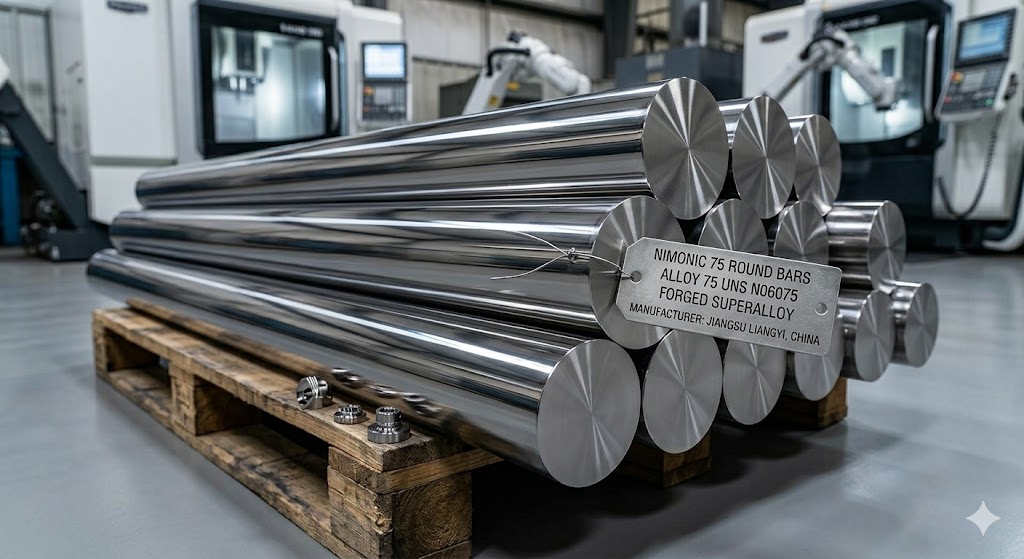
Nimonic 75 forged round bars – available in diameters up to 2000mm
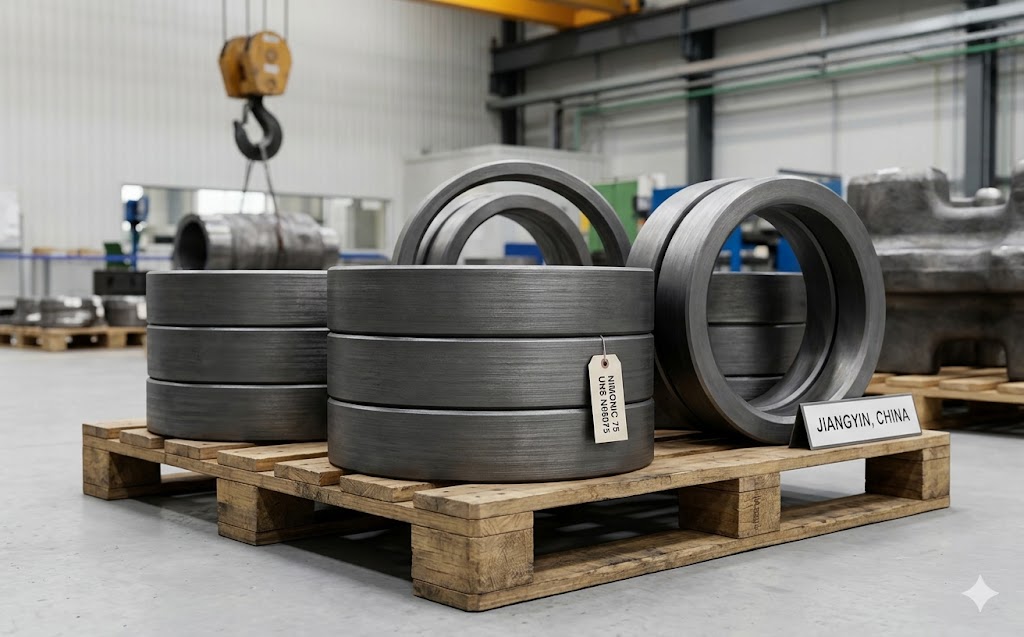
Nimonic 75 seamless rolled rings – up to 6 meters in diameter and 30 tons in weight
1. Material Overview
Common designations include UNS N06075, W.Nr. 2.4951 (solution annealed) and 2.4630, BS HR5 / HR203 / HR403 / HR504, AMS 5683 and 5651, and DIN/ISO NiCr20Ti. All refer to the same base specification with minor tolerance differences.
The alloy's primary service envelope is 550°C to 1100°C in oxidizing atmospheres. Below 550°C, austenitic stainless grades (321, 347) are typically more cost-effective. Above 815°C under sustained stress, precipitation-hardened alloys (Nimonic 80A, 263, Waspaloy) are preferred. Nimonic 75 is selected where oxidation resistance, weldability, and formability are required and stress levels are low to moderate.
The absence of aluminum, niobium, and cobalt keeps the alloy weldable and forgeable, but limits high-temperature strength compared with later Nimonic grades. The 18–21% Cr content forms a continuous Cr₂O₃ scale that provides oxidation protection to 1100°C; the Ti addition refines grain-boundary carbide distribution and improves scale adhesion under thermal cycling.
Jiangsu Liangyi produces Nimonic 75 in wrought form only — open-die forgings and seamless rolled rings. All parts are solution annealed at 1050°C, air cooled, and supplied with documented heat-treatment and test records.
2. Forging Capabilities
Jiangsu Liangyi's Jiangyin facility covers 80,000㎡ and is dedicated to open-die forging and seamless ring rolling. The plant is located in the Jiangyin forging cluster, 150 km from Shanghai Port.
2.1 Equipment
- Hydraulic presses: 2,000 t, 3,150 t, and 6,300 t open-die
- Forging hammers: 1 t, 3 t, and 5 t electro-hydraulic
- Ring rolling mills: 1 m and 5 m radial-axial
- Heat treatment: bogie-hearth furnaces with multi-zone thermocouples and documented uniformity surveys; 3 m vacuum furnace for bright anneal requirements
- Machining: CNC turning, milling, boring, and deep-hole drilling
- Testing: OES spectrometry, ambient and elevated-temperature tensile, Brinell, Rockwell, metallography (ASTM E112 methodology), phased-array UT, MT, PT
2.2 Product Forms
- Round bars: Ø 50–2000 mm
- Square, flat, and rectangular bars: to customer drawing
- Seamless rolled rings: OD 400–6000 mm, wall 25–400 mm, height to 800 mm
- Hollow forgings: OD to 3000 mm, with profiled ID on request
- Solid forgings: discs, blocks, plates, flanged blanks to 3000 mm OD
- Tubular preforms: pipe blanks, pressure-vessel casings, tube-sheet forgings
- Profiled forgings: step shafts, gear-shaft blanks, turbine rotor preforms, custom near-net shapes
2.3 Capacity Envelope
- Unit weight: 30 kg to 30,000 kg per forging
- Maximum shaft length: 15 m
- Maximum ring OD: 6 m
- Maximum disc / block OD: 3 m
- Surface finish options: rough forged (black), proof machined, or finish machined to drawing tolerance
2.4 Applicable Standards
Forgings are produced to ASTM B637, AMS 5683, AMS 5651, BS HR5 / HR203 / HR403 / HR504, DIN 17742, JIS NCF 75, and customer-specific specifications. Mill test certificates are issued per EN 10204 3.1 / 3.2 with third-party witness on request.
3. Manufacturing Process
Nimonic 75 forgings are produced through the following controlled sequence:
- Incoming material inspection. Each ingot is verified by OES spectrometry against the specified UNS N06075 composition, cross-checked against supplier mill certificates, and surface-inspected by dye penetrant. Non-conforming material is rejected at receipt.
- Preheat and soak. Ingots are heated in natural-gas soaking pits with a controlled ramp not exceeding 100°C/hr between 700°C and 1000°C. Soak time: minimum 1 hour per 100 mm of cross-section, 2 hours minimum overall.
- Open-die forging or ring rolling. Working window: 950°C minimum finish temperature, 1170°C maximum preheat, 1200°C absolute ceiling to avoid grain-boundary liquation. Minimum forging ratio 3:1. Multiple reheats as required, each limited to 30 minutes at temperature to control grain coarsening.
- Controlled cooling. Forgings are air-cooled on racks after final pass. Heavy sections (> 300 mm) are held in insulated soaking boxes above 500°C for a minimum of 4 hours to prevent thermal cracking.
- Solution anneal. 1050°C ± 15°C for 1 minute per mm of section thickness (30 minutes minimum). Charge-load thermocouples record the cycle. Forced-air cool for standard sections; water quench for sections > 500 mm to suppress grain-boundary carbide sensitization.
- Testing. A prolongation is machined from each forging for chemical analysis, tensile testing, Brinell hardness, and grain size per ASTM E112. 100% visual and ultrasonic inspection per SEP 1923 Class 2b. MT and PT on request.
- Proof machining, marking, and packing. Forging skin is removed to expose any subsurface defects. Parts are marked with heat number, PO, and part number in a non-critical area using vibration etching (not stamped). Export packing: VCI paper on machined surfaces, wooden cradles, ISPM-15 heat-treated pallets.
4. Main Properties of Nimonic 75 Alloy (UNS N06075)
4.1 Chemical Composition of Nimonic 75
The standard chemical composition of Nimonic 75 (UNS N06075) is strictly controlled to guarantee consistent performance in high-temperature applications:
| Element | Symbol | Weight % |
|---|---|---|
| Nickel | Ni | Balance (~75%) |
| Chromium | Cr | 18.0–21.0 |
| Carbon | C | 0.08–0.15 |
| Titanium | Ti | 0.2–0.6 |
| Iron | Fe | ≤ 5.0 |
| Manganese | Mn | ≤ 1.0 |
| Silicon | Si | ≤ 1.0 |
| Copper | Cu | ≤ 0.5 |
4.2 Mechanical Properties of Nimonic 75 (Annealed)
The typical room-temperature mechanical properties of solution-annealed Nimonic 75 forgings:
| Property | Metric | Imperial |
|---|---|---|
| Tensile Strength (Room Temperature) | 750 MPa | 109 ksi |
| Yield Strength (0.2% Offset) | 275 MPa | 40 ksi |
| Elongation at Break | 42% | 42% |
| Modulus of Elasticity | 206 GPa | 29,878 ksi |
| Hardness (Brinell) | ≤ 229 HB | ≤ 229 HB |
| Density | 8.37 g/cm³ | 0.302 lb/in³ |
| Melting Range | 1340–1380°C | 2440–2520°F |
4.3 Equivalent Standards & International Designations for Nimonic 75
Nimonic 75 is covered by multiple international specifications. The alloy is registered under more than a dozen designations across major industrial regions. When ordering or cross-referencing existing drawings, any of the following are acceptable identifiers for this 80/20 nickel-chromium superalloy:
| Country / Region | Standard / System | Designation |
|---|---|---|
| USA | UNS (Unified Numbering System) | N06075 |
| USA (Aerospace) | AMS | AMS 5683, AMS 5651, AMS 5542 |
| USA | ASTM / ASME | ASTM B637 (forgings), SB-637 |
| Germany | Werkstoff Number (W.Nr.) | 2.4951 (solution annealed), 2.4630 |
| Germany | DIN | DIN 17742, NiCr20Ti |
| UK | British Standard (BS) | BS HR5, HR203, HR403, HR504, HR600 |
| France | AFNOR | NC20T, NC20TA |
| Russia | GOST | ХН78Т (KhN78T) – similar composition |
| China | GB | GH3030, NS311 |
| Japan | JIS | NCF 75 (equivalent grade) |
| International | ISO | ISO 9723 NiCr20Ti |
| Trade Names | Proprietary | Nimonic® 75, Pyromet® 75, Haynes® 75 |
Note: The composition limits may differ slightly between national standards. Jiangsu Liangyi can supply Nimonic 75 forgings certified to any of the above specifications on request.
4.4 Physical & Thermal Properties of Nimonic 75
The following physical properties are critical for thermal analysis, finite-element simulation, and design of Nimonic 75 components operating in high-temperature environments. All values are for solution-annealed condition unless noted.
| Physical Property | Value | Test Temperature / Condition |
|---|---|---|
| Density (ρ) | 8.37 g/cm³ (0.302 lb/in³) | Room temperature (20°C) |
| Melting Range | 1340–1380°C (2440–2520°F) | Solidus–Liquidus |
| Curie Temperature | < −273°C (non-magnetic at service temp.) | Practically non-magnetic |
| Specific Heat Capacity (Cp) | 461 J/(kg·K) | 20–100°C |
| Specific Heat Capacity (Cp) | 565 J/(kg·K) | At 800°C |
| Thermal Conductivity (λ) | 12.0 W/(m·K) | At 20°C |
| Thermal Conductivity (λ) | 22.8 W/(m·K) | At 800°C |
| Electrical Resistivity (ρₑ) | 1.20 μΩ·m | At 20°C |
| Modulus of Elasticity (E) | 206 GPa (29,878 ksi) | At 20°C |
| Modulus of Elasticity (E) | 175 GPa | At 600°C |
| Shear Modulus (G) | 79 GPa | At 20°C |
| Poisson's Ratio (ν) | 0.30 | At 20°C |
4.5 Coefficient of Thermal Expansion (CTE) vs Temperature
Thermal expansion data is essential for matching Nimonic 75 with mating materials in assemblies such as turbine casings and bolted joints. The following mean linear expansion coefficients are measured from 20°C to the indicated temperature:
| Temperature Range | Mean CTE (α) | Imperial |
|---|---|---|
| 20–100°C | 11.6 × 10⁻⁶ /K | 6.4 × 10⁻⁶ /°F |
| 20–300°C | 13.2 × 10⁻⁶ /K | 7.3 × 10⁻⁶ /°F |
| 20–500°C | 14.2 × 10⁻⁶ /K | 7.9 × 10⁻⁶ /°F |
| 20–700°C | 15.2 × 10⁻⁶ /K | 8.4 × 10⁻⁶ /°F |
| 20–900°C | 16.5 × 10⁻⁶ /K | 9.2 × 10⁻⁶ /°F |
| 20–1000°C | 17.1 × 10⁻⁶ /K | 9.5 × 10⁻⁶ /°F |
4.6 Mechanical Properties at Elevated Temperature
Unlike strength at room temperature, high-temperature strength is what drives material selection for Nimonic 75. The alloy retains useful mechanical properties to 815°C (1500°F); beyond this point, creep becomes the dominant failure mechanism. Typical values for solution-annealed condition:
| Test Temperature | Tensile Strength (UTS) | 0.2% Yield Strength | Elongation |
|---|---|---|---|
| 20°C (RT) | 750 MPa (109 ksi) | 275 MPa (40 ksi) | 42% |
| 400°C (750°F) | 680 MPa (99 ksi) | 220 MPa (32 ksi) | 45% |
| 600°C (1110°F) | 620 MPa (90 ksi) | 200 MPa (29 ksi) | 48% |
| 700°C (1290°F) | 540 MPa (78 ksi) | 185 MPa (27 ksi) | 46% |
| 800°C (1470°F) | 380 MPa (55 ksi) | 165 MPa (24 ksi) | 50% |
| 900°C (1650°F) | 180 MPa (26 ksi) | 110 MPa (16 ksi) | 60% |
| 1000°C (1830°F) | 95 MPa (14 ksi) | 60 MPa (8.7 ksi) | 70% |
Values are typical minimums; actual strength depends on product form, section size, and heat treatment. For design calculations, consult AMS 5683 minima or contact our engineering team.
4.7 Creep & Stress-Rupture Performance
For parts operating above ~550°C, creep and stress-rupture data is the primary design criterion. Nimonic 75 has moderate creep resistance so that it is well suited to industrial furnaces and low-stress turbine parts. Higher-strength alternatives (Nimonic 80A, 90, 105, 263) are preferred when sustained stress exceeds ~80 MPa above 700°C.
| Temperature | 100-Hour Rupture Stress | 1,000-Hour Rupture Stress | 10,000-Hour Rupture Stress |
|---|---|---|---|
| 600°C (1110°F) | 345 MPa (50 ksi) | 270 MPa (39 ksi) | 205 MPa (30 ksi) |
| 700°C (1290°F) | 170 MPa (25 ksi) | 125 MPa (18 ksi) | 85 MPa (12 ksi) |
| 800°C (1470°F) | 80 MPa (12 ksi) | 55 MPa (8 ksi) | 35 MPa (5 ksi) |
| 900°C (1650°F) | 35 MPa (5 ksi) | 22 MPa (3.2 ksi) | 14 MPa (2 ksi) |
1% creep strain (1,000 hr) values are approximately 60% of the corresponding stress-rupture value. For specific creep design curves, refer to the material certificate or request our detailed datasheet.
4.8 Oxidation, Corrosion & Environmental Resistance
The 80/20 Ni-Cr matrix of Nimonic 75 forms a dense, adherent Cr₂O₃ (chromia) protective scale in oxidizing atmospheres, which is the basis of its excellent performance up to 1100°C. The small titanium addition helps pin grain boundaries and also forms TiO₂ in the outer scale, further improving spall resistance under thermal cycling.
✅ Oxidizing atmospheres (air, steam): Excellent up to 1100°C
✅ Nitriding atmospheres: Good resistance
✅ Carburizing atmospheres: Good up to 1050°C
⚠️ Sulphidation (SO₂, H₂S): Acceptable up to ~700°C, above which accelerated attack occurs
⚠️ Molten chloride salts: Not recommended
⚠️ Molten lead / zinc: Not recommended
⚠️ Hydrogen embrittlement: Minimal risk (low susceptibility)
Oxidation rate data (static air): Nimonic 75 exhibits a specific weight gain of approximately 1–3 mg/cm² after 1000 hours at 900°C, and 5–10 mg/cm² at 1000°C — significantly better than austenitic stainless steels (e.g., 304H, 310) in the same conditions. Under cyclic thermal conditions, performance depends on spallation behavior of the chromia scale; adding a pre-oxidation treatment at 980°C further improves scale adhesion.
Aqueous corrosion: Nimonic 75 has good resistance to dilute sulphuric and hydrochloric acids at room temperature, but it is not a primary choice for aqueous corrosion duties — Inconel 600, 625, or Hastelloy alloys are recommended for wet-chemical service.
4.9 Metallurgy, Microstructure & Phase Behavior
Understanding the microstructure is essential for specifying heat treatment and predicting long-term service behavior. Nimonic 75 is fundamentally a solid-solution-strengthened alloy — unlike the later precipitation-hardened Nimonic grades (80A, 90, 105, 115), it does not rely on γ' (gamma prime) Ni₃(Al,Ti) precipitation for strength.
- Matrix (γ phase): Face-centered cubic (FCC) austenitic nickel solid solution containing chromium, iron, and minor alloying elements. The FCC structure provides excellent ductility at all service temperatures.
- Primary Carbides: Titanium-rich MC carbides (TiC) form during solidification and remain stable to the solidus. These contribute to grain-boundary pinning during high-temperature exposure.
- Secondary Carbides: M₂₃C₆ (chromium-rich) carbides precipitate on grain boundaries during service exposure between 550°C and 900°C. These are beneficial in moderation (grain-boundary strengthening) but can be embrittling if continuous networks form after prolonged exposure.
- No γ' or γ'' strengtheners: The alloy's titanium content (0.2–0.6%) is below the threshold for significant γ' precipitation, which distinguishes Nimonic 75 from Nimonic 80A (γ' strengthened) and Inconel 718 (γ'' strengthened).
- Grain Size: Typically ASTM 4–7 after solution annealing; grain size can be controlled via forging reduction and solution temperature.
5. Material Selection: Nimonic 75 vs Alternatives
Selection between Nimonic 75 and related nickel-chromium alloys is driven by four variables: peak metal temperature, sustained stress, service atmosphere, and cost of ownership.
5.1 Property Comparison
| Property | Nimonic 75 | Nimonic 80A | Nimonic 90 | Inconel 600 |
|---|---|---|---|---|
| UNS Number | N06075 | N07080 | N07090 | N06600 |
| Nominal Ni / Cr | 75 / 20 | 76 / 20 | 58 / 20 (+18 Co) | 72 / 15 |
| Strengthening | Solid solution + grain-boundary carbides | γ' precipitation (Ni₃AlTi) | γ' precipitation + Co solid solution | Solid solution (Cr-Fe) |
| Tensile Strength (RT) | 750 MPa | 1240 MPa | 1240 MPa | 655 MPa |
| Yield (RT, 0.2%) | 275 MPa | 780 MPa | 810 MPa | 240 MPa |
| Max Oxidation Temp. | 1100°C | 815°C (structural) | 920°C (structural) | 1150°C |
| Max Useful Stress Temp. | ~815°C | ~815°C (with creep) | ~920°C (with creep) | ~650°C |
| Weldability | Excellent | Difficult (strain-age cracking) | Difficult (strain-age cracking) | Excellent |
| Relative Cost Index | 1.0 (baseline) | ~1.8 | ~3.5 (Co content) | ~0.9 |
| Typical Application | Hot oxidizing air, low-moderate stress, welded parts | Turbine bolts, blades, discs under sustained stress | High-temperature creep service | Corrosive aqueous and mildly hot atmospheres |
5.2 Selection Criteria
Apply these criteria in sequence:
- Sustained stress > 100 MPa above 700°C → Nimonic 80A, 90, Waspaloy, or Inconel 718
- Atmosphere contains sulphur compounds (SO₂, H₂S) above 700°C → Haynes 188 or 230
- Aqueous acids, chlorides, or seawater exposure → Inconel 625, Hastelloy C-276, or Alloy 59
- Oxidation resistance 815–1100°C, low-to-moderate stress, weldability required → Nimonic 75
- Non-critical service below 900°C, cost-sensitive → 310S stainless (UNS S31008) or Alloy 800H/HT (UNS N08810/N08811)
6. Heat Treatment
6.1 Standard Solution Anneal
All Nimonic 75 forgings are solution annealed to the following parameters:
- Temperature: 1050°C ± 15°C (1920°F ± 25°F)
- Soak time: 30–60 minutes, based on section thickness
- Cooling: air cool; water quench for sections > 500 mm
- Target hardness: ≤ 229 HB (typical 160–200 HB)
- Resulting microstructure: homogeneous γ matrix with primary MC carbides, ASTM grain size 4–7
- Atmosphere: nitrogen, argon, or vacuum preferred; air anneal with post-descaling acceptable
6.2 Stress-Relief Anneal (Optional)
For complex parts subject to heavy machining, an intermediate stress-relief cycle reduces distortion:
- Temperature: 870–900°C (1600–1650°F)
- Soak time: 1–2 hours based on section thickness
- Cooling: furnace cool to 540°C, then air cool
6.3 Customer-Specified Cycles
Customized heat treatment is available, including double solution treatment, protective-atmosphere annealing in vacuum furnace, and pre-oxidation at 980°C for enhanced scale adherence in cyclic-oxidation service.
7. Processing Guidelines
Reference data for hot forging, cold working, welding, machining, and surface treatment of Nimonic 75.
7.1 Hot Forging & Hot Working Window
Nimonic 75 is one of the more workable Nimonic alloys due to its relatively low alloy content and absence of γ' strengtheners. However, it still needs careful temperature control to avoid hot cracking and grain-boundary incipient melting:
- Preheat Temperature: 1080–1170°C (1975–2140°F)
- Finish-Forge Temperature: Not below 950°C (1740°F) to prevent strain-induced cracking
- Maximum Billet Temperature: 1200°C (2190°F) — exceeding this risks incipient melting at grain boundaries due to low-melting eutectics
- Reduction Ratio: Minimum 3:1 forging ratio recommended for wrought products to ensure uniform mechanical properties
- Reheating: Multiple reheats are acceptable; each reheat should not exceed 30 minutes soak to avoid grain coarsening
- Cooling After Forge: Slow cool from finish temperature to avoid thermal cracking in heavy sections
7.2 Cold Working & Forming
Nimonic 75 work-hardens rapidly but is generally considered cold-formable. Typical guidelines:
- Work-Hardening Rate: High — about 1.5× that of Type 304 stainless steel
- Intermediate Anneal: Recommended after 15–20% cold reduction to restore ductility (anneal at 1050°C, air cool)
- Springback: Significant — compensate in tooling design
- Lubrication: Chlorinated oils or dry film lubricants; avoid sulphur-bearing lubricants to prevent embrittlement
7.3 Welding of Nimonic 75
Nimonic 75 exhibits good weldability and can be joined by all common fusion processes — TIG (GTAW), MIG (GMAW), plasma arc, electron beam, and laser welding. It is not susceptible to post-weld strain-age cracking because it lacks γ' precipitation, making it among the easiest Nimonic alloys to weld.
| Parameter | Recommendation |
|---|---|
| Preferred Process | GTAW (TIG) with DCEN for thin sections; GMAW for thicker |
| Filler Metal | AWS A5.14 ERNiCr-3 (Inconel 82), or matching Nimonic 75 filler |
| Shielding Gas | Pure argon (99.995% purity); argon + 2% H₂ for autogenous welds |
| Back-purge | Required — pure argon to prevent root oxidation |
| Preheat | Not required (ambient, > 15°C) |
| Interpass Temperature | ≤ 150°C (300°F) |
| Post-Weld Heat Treatment | Usually not required; if service > 700°C, solution anneal at 1050°C recommended |
| Joint Cleaning | Stainless-steel wire brush (dedicated to nickel alloys); degrease thoroughly |
Avoiding common defects: (1) keep heat input moderate to prevent grain-boundary liquation; (2) strictly avoid contamination by sulphur, lead, zinc, or copper, which can cause catastrophic embrittlement; (3) grind out any oxidized start/stop craters before depositing the next pass.
7.4 Machining & Finishing
Like most nickel-chromium superalloys, Nimonic 75 is classified as "difficult to machine" due to its high work-hardening rate, low thermal conductivity, and tendency for chips to weld to the cutting tool. However, with proper parameters it machines well. Recommended starting parameters for turning with carbide tooling on solution-annealed material:
| Operation | Cutting Speed | Feed Rate | Depth of Cut |
|---|---|---|---|
| Rough Turning (carbide C2/C3) | 15–25 m/min (50–80 sfm) | 0.20–0.40 mm/rev | 2.0–5.0 mm |
| Finish Turning (carbide C2) | 25–40 m/min (80–130 sfm) | 0.10–0.20 mm/rev | 0.2–1.0 mm |
| Rough Milling (carbide) | 18–28 m/min (60–90 sfm) | 0.08–0.15 mm/tooth | 1.0–4.0 mm |
| Drilling (HSS-Co) | 6–10 m/min (20–33 sfm) | 0.05–0.15 mm/rev | — |
| Grinding (Al₂O₃ wheel) | 25–30 m/s wheel speed | Light, continuous dressing | < 0.03 mm/pass |
Machining best practices: (1) use rigid setups and sharp tools — dull tools cause work-hardening which accelerates tool wear; (2) use generous flood coolant (water-soluble emulsion or sulphur-free cutting oil); (3) maintain constant feed, never dwell on the workpiece; (4) take deep enough cuts to get below the previous work-hardened layer; (5) avoid climb milling unless the machine has zero backlash.
7.5 Surface Treatments & Coatings
While Nimonic 75 requires no protective coating for its native high-temperature service, the following surface treatments can extend life in aggressive environments:
- Aluminizing (Pack Cementation): Forms NiAl / Ni₃Al surface layer for extreme oxidation resistance up to 1150°C
- Pre-oxidation: Controlled exposure at 980°C for 2 hours in air develops a dense initial chromia scale, improving subsequent cyclic oxidation life
- Electropolishing: Improves surface finish and initial oxidation resistance for decorative or semiconductor applications
- Thermal Spray Coatings: MCrAlY bond coats + YSZ top coats for thermal barrier applications on turbine components
8. Comprehensive Quality Assurance & Testing
At Jiangsu Liangyi, quality is our top priority. We maintain strict quality control standards for all Nimonic 75 forged products that are made at our Jiangyin facility:
- Material Purity: Determined per DIN 50602-K1 with sum characteristics value K1 ≤ 2.0
- Delta Ferrite Control: < 5% (tested per ASTM E45 / Method A, Worst Field Method)
- Nondestructive Testing:
- 100% Visual Inspection of all surfaces
- 100% Ultrasonic Testing (UT) per SEP 1923, Quality Class 2b
- Magnetic Particle Testing (MT) and Liquid Penetrant Testing (PT) available on request
- Certifications: Complete mill test certificates (MTC) EN 10204 3.1 / 3.2 provided with every shipment
- Third-Party Inspection: Testing can be witnessed by a customer-nominated accredited third-party agency (such as BV, SGS, or TUV) on a per-project basis
- Defect-Free Guarantee: All forgings are free from cracks, flakes, seams, segregation, and non-metallic inclusions
9. Applications
9.1 Steam and Gas Turbines
Primary application segment. Typical components include:
- Valve bodies, bonnets, and internals for MSV, GV, CV, and CRV on utility-scale steam turbine sets
- Nozzle boxes, diaphragms, and partition plates for high-pressure stages
- Packing seal rings, labyrinth rings, and gland rings
- Exhaust casings and diaphragm rings for industrial gas turbines (1–4 m diameter)
- High-temperature bolting — studs, bolts, and fasteners for service > 550°C
Typical orders: valve bonnets forged from Ø 600–800 mm blanks, unit weight 180–420 kg, proof-machined with EN 10204 3.1 certification.
9.2 Nuclear Power — Non-Pressure-Boundary Components
Nimonic 75 is applied to internal and structural parts in nuclear plants — not to the primary pressure boundary, which typically requires Inconel 600, 690, or SA-508. Components include:
- Steam generator divider plate sub-assemblies
- Flow-limiter venturi forgings for main steam lines
- Reactor internals support rings and instrumentation guide tube blanks
- Primary pump flywheel stub shafts (where specified)
- Containment penetration sleeves for high-temperature instrumentation
Nuclear orders are delivered with complete material history (melt source, forge-reduction ratio, heat-treatment records), EN 10204 3.2 certification, and testing witnessed by a customer-nominated third-party agency. Lead time: 10–14 weeks.
9.3 Aerospace
- Combustor section casing blanks for industrial and aero gas turbines
- Exhaust nozzle rings and afterburner structural components
- Heat-shield rings
- Missile launch tube inserts and artillery breech reinforcement rings
9.4 Industrial Furnaces and Process Equipment
- Radiant tube supports, spiders, and beam components for walking-beam and pusher reheat furnaces
- Muffle retort ends for heat-treating furnaces operating above 1050°C
- Charge-car fixtures, hearth plates, and basket grids for continuous heat-treat lines
- Reformer tube hangers and petrochemical furnace internals
- Reactor internals and heat-exchanger tube sheets for ammonia, methanol, and hydrogen plants above 800°C
In furnace applications, Nimonic 75 is typically specified as an upgrade from 310S cast or HK-40 components that have shown premature scaling or distortion.
10. Failure Modes & Design Considerations for Nimonic 75 Components
Understanding how Nimonic 75 fails in service is essential for reliable design. Based on our field experience and documented case studies, the following are the principal degradation and failure mechanisms — and how to avoid them.
10.1 Typical Failure Modes
- High-temperature oxidation / spallation: Under cyclic thermal service above 950°C, the protective chromia scale can spall, leading to progressive metal loss. Mitigate with pre-oxidation treatment or aluminizing coating.
- Creep rupture: Below ~550°C, creep is negligible. Above 700°C at stresses > ~80 MPa, creep becomes the dominant life-limiting mechanism. Use stress-rupture data (Section 4.7) for Larson-Miller design.
- Thermal fatigue: Repeated thermal cycling induces strain in constrained components (e.g., turbine casings). Design for minimum thermal gradient; use generous fillets.
- Sulphidation attack: In SO₂/H₂S environments above 700°C, liquid Ni-Ni₃S₂ eutectic (m.p. 645°C) can form and cause catastrophic grain-boundary attack. Avoid use; switch to Haynes 188 or similar Co-base alloys.
- Carburization: Above 1050°C in strongly carburizing atmospheres, internal carbide precipitation can embrittle the matrix. Nimonic 75 performs better than austenitic stainless but is not immune.
- Stress-corrosion cracking: Very rare in Nimonic 75 due to high nickel content; not typically a design concern except in chloride-bearing aqueous environments.
- Grain boundary embrittlement from lead/zinc/sulphur contamination: Catastrophic. Ensure all tooling, lubricants, and marking materials are free of these contaminants during fabrication.
10.2 Design Best Practices
Temperature Mapping
Design against peak metal temperature, not bulk gas temperature. Use FEA thermal analysis to identify hot spots.
Stress Concentrations
Minimize stress raisers (sharp fillets, threads, drilled holes) in high-temperature zones. Blend transitions with generous radii.
Differential Expansion
Nimonic 75 CTE: 14.2 × 10⁻⁶/K at 500°C. Account for expansion mismatch with mating carbon-steel or ferritic components.
Grain Size Control
Specify ASTM 4–7 for balanced creep and fatigue performance. Fine grain favors fatigue resistance; coarse grain favors creep resistance.
Inspection Access
Provide in-service access for surface crack detection by dye penetrant or eddy current methods.
Protective Coatings
Specify aluminizing, chromizing, or MCrAlY coatings for service above 1000°C or in sulphur-bearing atmospheres.
10.3 When NOT to Use Nimonic 75
Despite its strengths, Nimonic 75 is not the optimal choice in every high-temperature application. Consider alternatives in the following scenarios:
- High stress above 700°C → Use Nimonic 80A, Nimonic 90, Waspaloy, or Inconel 718 (precipitation-hardened grades)
- Severe sulphidation environments → Use Haynes 188, Haynes 230, or Co-base alloys
- Aqueous corrosion (acids, seawater) → Use Inconel 625, Hastelloy C-276, or Alloy 59
- Very high strength at moderate temperature (< 650°C) → Use Inconel 718 or Waspaloy
- Cost-sensitive oxidation-only service below 800°C → Use Inconel 600 or 601 (lower cost, similar performance)
- Nuclear pressure boundary (regulated) → May require Inconel 690 for steam generator tubing; Nimonic 75 is acceptable for non-pressure-boundary components
11. Project Experience
Representative Nimonic 75 project categories. Customer names and specific project identifiers are withheld under confidentiality. References available on request subject to mutual NDA.
- Thermal power turbine auxiliaries: valve bonnets and hot-section forgings for ultra-supercritical coal-fired plants. Typical unit weight 300–450 kg, forged from Ø 600–800 mm blanks, proof-machined, EN 10204 3.1.
- Nuclear refurbishment: steam-generator component blanks, typical dimensions 1.5–2.0 m × 1.0–1.5 m × 60–100 mm. 100% phased-array UT, EN 10204 3.2 with customer-nominated third-party witness.
- Industrial gas turbine OEM programs: combustor section casing blanks, OD 700–1100 mm. Delivered to aerospace and power generation specifications with tightened grain-size control.
- Petrochemical: reformer tube hangers and muffle components, typical order volumes 10–30 tons over 6–12 months, replacing distressed Alloy 800H components.
- Industrial furnaces: radiant tube supports, hearth plates, and beam components for walking-beam reheat furnaces, replacing cast 310S equivalents.
- Turbine OEM MRO: labyrinth seal rings, packing rings, and diaphragm components on recurring supply arrangements. Typical order 20–40 rings per month, OD 600–2800 mm.
Export destinations include Asia, the Middle East, Europe, North America, Latin America, Africa, and Oceania.
12. Supplier Capabilities
Superalloy Specialization
Nickel-chromium superalloys are a core product family. Operators and metallurgical staff have extensive thermomechanical experience with Nimonic 75, 80A, 90, and Inconel grades.
Jiangyin Forging Cluster
Located within the Jiangyin forging industrial cluster, with access to ingot suppliers, complementary heat treatment services, and machining capacity within a 20 km radius.
Documented Heat Treatment
Furnaces surveyed for temperature uniformity. Multi-zone thermocouples record every cycle. Heat-treatment charts provided with mill certificates on request.
Integrated Production
Incoming inspection, forging, heat treatment, proof machining, finish machining, NDT, and final inspection on a single site with a unified traceability system.
In-House Testing
OES spectrometry, ambient and elevated-temperature tensile, Brinell, Rockwell, metallography per ASTM E112 methodology, phased-array UT, MT, PT. Third-party witness (BV, SGS, TUV, LRQA, ABS) arranged on request.
Standard Lead Times
Rough forged: 4–6 weeks. Finish machined: 6–8 weeks. Nuclear-grade with EN 10204 3.2 and third-party witness: 10–14 weeks.
Transparent Quotation
Quotations itemize ingot cost, forging conversion, heat treatment, machining, NDT, certification, packing, and logistics. Scope can be adjusted at line-item level.
Long-Term Supply
A significant share of export revenue is from repeat customers. Standing supply agreements and framework contracts are available for recurring requirements.
Engineering Review
Pre-quote review of customer drawings for forgeability, grain flow, and material cost optimization. Design-for-manufacturing feedback included at no charge.
Complete Traceability
Every heat retains full material history from melt source through final NDT. Historical shipments can be traced for field-failure investigation.
13. Logistics and Shipping
- Ocean freight via Shanghai Port (150 km from plant): FCL for 20 ft / 40 ft containers; breakbulk or flat-rack for oversized rings and long shafts. Typical transit: ~22 days to Los Angeles, ~30 days to Rotterdam, ~18 days to Singapore.
- Air freight via Shanghai Pudong: up to ~4,000 kg per piece. Used for urgent requirements and aerospace-grade components. 2–5 days transit to major hubs.
- Export packaging: VCI paper on machined surfaces, wooden cradles sized to forging geometry, ISPM-15 certified heat-treated pallets, foam edge protection on proof-machined bores.
- Documentation: commercial invoice, packing list, bill of lading, EN 10204 3.1 or 3.2 certificate, test reports, heat-treatment charts, NDT reports, ISPM-15 pallet certificate, and customer-specified COCs. Digital copies are available 48 hours before departure.
- Incoterms: FOB Shanghai (default), CIF, DAP (selected regions), EXW. Standing arrangements with COSCO, Maersk, CMA-CGM, and NVOCC partners.
14. Frequently Asked Questions
Common technical and commercial questions regarding Nimonic 75 (UNS N06075) forgings.
Nimonic 75 (UNS N06075, Alloy 75) is an 80/20 nickel-chromium superalloy with small amounts of titanium (0.2–0.6%) and carbon (0.08–0.15%) added. It can withstand oxidation up to 1100°C (2010°F) and retains useful mechanical strength up to 815°C (1500°F). It is widely used in gas turbines, nuclear steam generators, aerospace components, and industrial furnaces.
Nimonic 75 is an 80/20 nickel-chromium alloy that has been strengthened with solid solutions. It is used because it resists oxidation well and has moderate strength. Nimonic 80A is an alloy that has been hardened by precipitation and has more aluminum (1.0–1.8%) and titanium (1.8–2.7%). This makes it much stronger at temperatures up to 815°C.Choose Nimonic 75 when oxidation resistance and excellent formability are the primary requirements. Choose Nimonic 80A when high creep strength at elevated temperatures is required.
Nimonic 75 is designated UNS N06075 under the Unified Numbering System, and W.Nr. 2.4951 (solution annealed) or 2.4630 in the German material number system. Equivalent specifications include BS HR5, HR203, HR403, HR504, AMS 5683, and AMS 5651.
The nominal chemical composition of Nimonic 75 is: Nickel balance (approximately 75%), Chromium 18.0–21.0%, Carbon 0.08–0.15%, Titanium 0.2–0.6%, Iron ≤ 5.0%, Manganese ≤ 1.0%, Silicon ≤ 1.0%, Copper ≤ 0.5%.
Nimonic 75 provides oxidation resistance up to 1100°C (2010°F) and retains useful mechanical strength at service temperatures up to 815°C (1500°F). For higher-strength applications at elevated temperatures, consider Nimonic 80A or Nimonic 90.
We accept orders starting from 30 kg for prototype development and up to thousands of tons for large-volume production. As a China manufacturer with flexible production capacity, we supply Nimonic 75 forged parts in both small and large quantities.
Yes, we offer complete in-house CNC machining services to deliver finished Alloy 75 parts that are ready for assembly. Our machining capabilities include turning, milling, drilling, and finishing operations at our Jiangyin facility.
Our UNS N06075 forgings meet international standards including ASTM, AMS (5683, 5651), DIN, EN, JIS, BS (HR5, HR203, HR403, HR504), and customer-specific standards. We can produce parts based on most recognized standards from our China factory.
Yes. Mill test certificates (MTC) per EN 10204 3.1 are provided with shipments of Nimonic 75 forgings. EN 10204 3.2 certificates, which include testing witnessed by an independent third-party agency (such as BV, SGS, or TUV nominated by the customer), are available on request at project cost.
Standard lead time is 4–6 weeks for raw Nimonic 75 forgings and 6–8 weeks for machined parts. and we can also expedite production for urgent orders. Please contact us for specific lead time information.
Yes, we specialize in custom Nimonic 75 forgings strictly according to your drawings and specifications. Our engineering team in Jiangyin, China will review your requirements and provide technical feedback.
We can produce Nimonic 75 forgings up to 30 tons in weight, 6 meters in diameter for rings, and 15 meters in length for shafts at our Jiangyin, China factory. Please contact us with your specific requirements.
The density of Nimonic 75 is 8.37 g/cm³ (0.302 lb/in³) at room temperature. The melting range is 1340–1380°C (2440–2520°F). These values are essential for weight calculations and thermal analysis of Nimonic 75 components.
The mean linear coefficient of thermal expansion of Nimonic 75 ranges from 11.6 × 10⁻⁶/K (20–100°C) to 17.1 × 10⁻⁶/K (20–1000°C). At common service temperatures: 14.2 × 10⁻⁶/K at 500°C and 15.2 × 10⁻⁶/K at 700°C. CTE data is critical for matching with mating parts in bolted turbine assemblies.
Typical 1,000-hour stress-rupture values for Nimonic 75: 270 MPa at 600°C, 125 MPa at 700°C, 55 MPa at 800°C, and 22 MPa at 900°C. For long-term (10,000 hr) design, reduce by approximately 25–35%. Above 700°C at stresses exceeding 80 MPa, consider precipitation-hardened alternatives like Nimonic 80A.
Yes, Nimonic 75 has good weldability by all common fusion processes including TIG (GTAW), MIG, plasma arc, electron beam, and laser welding. Unlike precipitation-hardened Nimonic grades, it is not susceptible to strain-age cracking. Recommended filler is AWS A5.14 ERNiCr-3 (Inconel 82). No preheat required; post-weld solution anneal at 1050°C is recommended for service above 700°C.
For turning solution-annealed Nimonic 75 with carbide tooling: rough turning at 15–25 m/min (50–80 sfm) with 0.20–0.40 mm/rev feed; finish turning at 25–40 m/min with 0.10–0.20 mm/rev feed. Use rigid setups, sharp tools, flood coolant, and avoid dwelling. Nimonic 75 work-hardens rapidly (about 1.5× faster than 304 stainless), so maintain constant feed and take cuts below the previously work-hardened layer.
The hot working window for Nimonic 75 is 950–1170°C (1740–2140°F). Recommended preheat temperature is 1080–1170°C; finish-forge temperature should not fall below 950°C to prevent strain cracking; maximum billet temperature is 1200°C to avoid incipient melting at grain boundaries. A minimum forging ratio of 3:1 is recommended for uniform wrought properties.
No, Nimonic 75 is practically non-magnetic at all normal service temperatures. It has a face-centered cubic (FCC) austenitic matrix with a Curie temperature below −273°C, meaning it exhibits only very weak paramagnetic behavior. This makes it suitable for applications requiring non-magnetic materials.
Both are solid-solution-strengthened nickel-chromium alloys, but they are used for different purposes. Nimonic 75 (75% Ni, 20% Cr) is designed for dry high-temperature oxidation service up to 1100°C, with low iron content and added titanium. Inconel 600 (72% Ni, 15% Cr, 8% Fe) has less chromium but more iron, which provides better aqueous corrosion resistance and a slightly higher maximum oxidation temperature (1150°C), but lower high-temperature strength. Choose Nimonic 75 for turbine and furnace parts; choose Inconel 600 for water-corrosive and chemical processing applications.
Nimonic 75 is not recommended for: (1) high-stress service above 700°C (use Nimonic 80A, 90, or Waspaloy instead); (2) sulphidation environments above 700°C (use Haynes 188 or 230); (3) aqueous acid corrosion (use Inconel 625 or Hastelloy C-276); (4) molten chloride or molten lead/zinc contact; (5) applications requiring very high yield strength at moderate temperatures below 650°C (use Inconel 718 or Waspaloy).
Request a Quotation
For a quotation or technical consultation on Nimonic 75 (UNS N06075) forgings, please provide the following information:
- Part geometry (drawing or sketch) and unit weight
- Material specification (BS HR5, AMS 5683, or customer-specific)
- Service conditions: temperature, stress, atmosphere
- NDT and certification requirements (EN 10204 3.1 or 3.2, third-party witness)
- Quantity and required delivery date
- Finishing level (rough forged, proof machined, or finish machined)
Detailed quotations are typically returned within 2 working days, itemized by material, conversion, heat treatment, machining, inspection, and packing. For material selection queries, service condition details are sufficient.
sales@jnmtforgedparts.com
+86-13585067993
www.jnmtforgedparts.com
Chengchang Industry Park, Jiangyin City, Jiangsu Province 214400, China