Nimonic 90 (Alloy 90, UNS N07090) Forged Parts | China Manufacturer
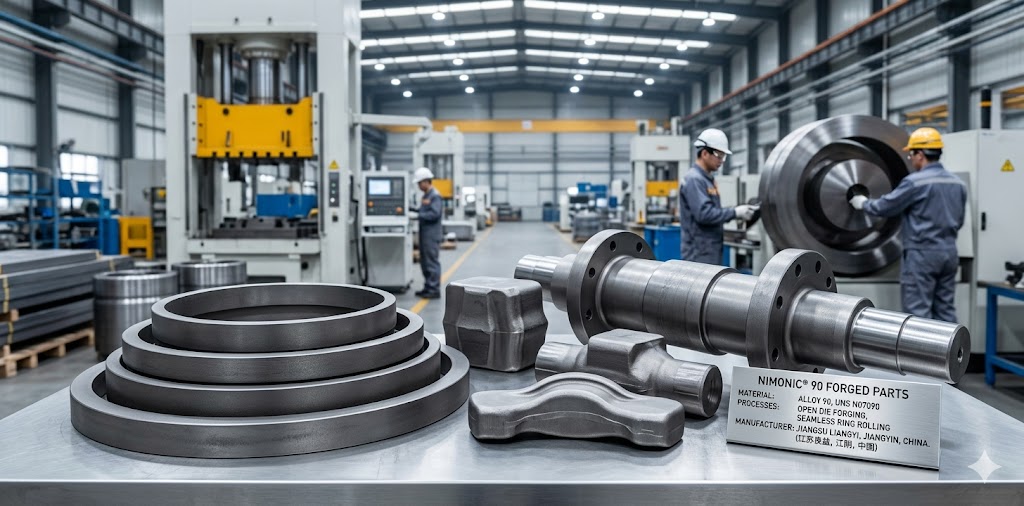
Jiangsu Liangyi is a professional ISO 9001:2015 certified manufacturer of high-quality Nimonic 90 (Alloy 90, UNS N07090) open die forging parts and seamless rolled rings based in Jiangyin, Jiangsu Province, China. With over 25 years of specialized experience in high-temperature alloy forging, we produce custom Nimonic 90 parts ranging from 30 kg to 30,000 kg, and have supplied global customers in aerospace, power generation, oil & gas, marine and other important industries.As a top Nimonic 90 manufacturer in China, we have invested heavily in advanced production and inspection equipment to guarantee the highest quality standards. Our state-of-the-art facility in Jiangyin combines traditional forging expertise with modern technology to deliver precision-engineered Nimonic 90 parts that meet the most important international specifications.
Nimonic 90 — Key Specifications at a Glance
About Nimonic 90 Alloy (UNS N07090)
NIMONIC® Alloy 90 is a precipitation-hardenable nickel-chromium-cobalt superalloy specifically designed for excellent high-temperature performance. It has outstanding stress-rupture strength and creep resistance at temperatures up to 920 °C (1700 °F), along with excellent resistance to high-temperature corrosion, oxidation and thermal fatigue.These unique properties make Nimonic 90 the material of choice for parts operating in extreme thermal and mechanical environments. Compared to other high-temperature alloys like Inconel 718 or Nimonic 80A, Nimonic 90 has superior strength and creep resistance at temperatures above 750 °C, so that it is the best choice material for the most demanding turbine applications.
Key Advantages of Nimonic 90 Alloy
- Excellent creep resistance up to 920 °C (1700 °F)
- High stress-rupture strength at elevated temperatures
- Excellent oxidation and hot corrosion resistance
- Good thermal fatigue properties for cyclic temperature service
- Stable microstructure during long-term high-temperature service
- Good weldability for repair and fabrication applications
- Strengthened by gamma-prime (γ') precipitation hardening — Ni₃(Al,Ti)
Available Nimonic 90 Forged Product Shapes & Sizes
At our Jiangyin manufacturing facility, we produce a full range of Nimonic 90 forged products in all kinds of shapes and sizes to meet your specific requirements. All forgings are manufactured to international standards including ASTM, AMS, DIN, EN and BS.
Forged Bars & Rods
- Round bars (up to 2000 mm diameter)
- Square bars and rectangular bars
- Flat bars and step shafts
- Turbine blade flat bars
- Custom profile bars
Seamless Rolled Rings
- Seamless rolled rings (up to 6000 mm diameter)
- Contoured and profiled rings
- Guide rings and seal rings
- Labyrinth rings and casing rings
- Valve seat rings
Hollow Components
- Sleeves and bushes
- Housings and shells
- Hollow bars and cylinders
- Pipes and tubes
- Valve bodies and bonnets
Other Forgings
- Discs, disks and blanks
- Blocks and plates
- Hubs and flanges
- Turbine impellers and blisks
- Custom engineered parts
Key Applications of Nimonic 90 Forged Parts
Nimonic 90 forgings are widely used in industries where parts must withstand high temperatures, high stresses and corrosive environments. Our precision-engineered Nimonic 90 parts deliver reliable performance in the following important applications:
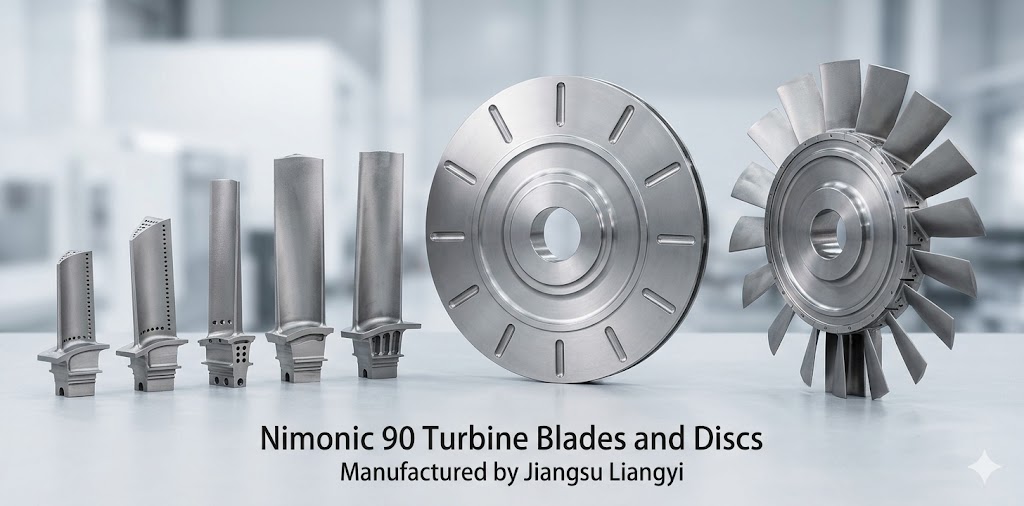
Gas & Steam Turbines
- Turbine blades and vanes
- Turbine discs and impellers
- Turbine blisks and rotors
- Guide rings and diaphragms
- Valve spindles, stems and seats
- Main steam valve components
- Turbine casings and end rings
Aerospace Industry
- Jet engine turbine blades
- Combustion chamber parts
- Afterburner parts
- Exhaust system parts
- High-temperature fasteners
- Spring parts
Oil & Gas Industry
- High-temperature wellhead parts
- Downhole tools and equipment
- Valve bodies and trim
- High-pressure fasteners
- Seal rings and gaskets
- Refinery process equipment
Industrial Applications
- Hot working dies and tooling
- Extrusion dies and mandrels
- Heat treatment fixtures
- Industrial furnace parts
- Chemical processing equipment
- Marine propulsion systems
Real-World Nimonic 90 Application Case Studies
As an experienced China Nimonic 90 forging supplier, we have successfully delivered thousands of high-quality Nimonic 90 parts to customers worldwide. Here are some of our notable project references:
European Aerospace Jet Engine Project
We supplied precision Nimonic 90 turbine blades and discs for a leading European aerospace company's commercial jet engines. These parts worked reliably at temperatures up to 920 °C, withstanding extreme centrifugal forces and thermal cycling conditions. Our strict quality control processes made sure that every part met the stringent aerospace industry standards.
Asian Thermal Power Plant Upgrade
During a major power plant upgrade project in Southeast Asia, our Nimonic 90 valve spindles and seats were installed in multiple 600 MW steam turbines. These components demonstrated exceptional service life, lasting 35% longer than the original materials and reducing maintenance downtime by 40%.
Middle East Oil and Gas Project
We made high-performance Nimonic 90 fasteners and seal rings for an important high-pressure, high-temperature (HPHT) oil field development project in the Middle East. These parts had reliable sealing and structural integrity in harsh corrosive environments with temperatures up to 650 °C and pressures up to 15,000 psi.
Global Metal Processing Plant
Our Nimonic 90 hot working dies and tooling are used by leading metal processing plants in Europe, North America and Asia. They have stronger resistance to thermal fatigue and wear, extending tool life by 50% compared to traditional tool steels and significantly improving production efficiency.
Trusted by Industrial Customers in 50+ Countries
Since 1999, Jiangsu Liangyi has supplied Nimonic 90 forged parts to customers across the power generation, aerospace, oil & gas and industrial sectors worldwide. Our export experience spans more than 50 countries across six continents, with long-term repeat customers in Europe, North America, Asia-Pacific and the Middle East.
🇩🇪 🇬🇧 🇫🇷 Europe
Germany, United Kingdom, France, Italy, Spain, Netherlands, Poland and more — primarily power generation turbine OEMs and aerospace tier-1 suppliers.
🇺🇸 🇨🇦 North America
United States and Canada — gas turbine part manufacturers, oil & gas equipment suppliers, and industrial processing plants.
🇸🇦 🇦🇪 Middle East
Saudi Arabia, UAE, Kuwait and Qatar — HPHT oil field projects, refinery equipment and desalination plant parts.
🇯🇵 🇰🇷 🇦🇺 Asia-Pacific
Japan, South Korea, Australia, India and Southeast Asia — thermal power plant upgrades, marine propulsion and industrial manufacturing.
Why Choose Jiangsu Liangyi as Your Nimonic 90 Forging Partner
When you choose Jiangsu Liangyi for your Nimonic 90 forging needs, you benefit from our extensive experience, advanced capabilities and commitment to quality:
25+ Years Experience
Specialized expertise in high-temperature alloy forging with a proven track record of delivering quality Nimonic 90 products to global customers since 1999.
Advanced Manufacturing
State-of-the-art equipment including 6300T hydraulic press, 5M ring rolling machine and computer-controlled heat treatment facilities.
Comprehensive Quality Control
In-house testing laboratory with full NDT capabilities, chemical analysis and mechanical property testing equipment.
Custom Solutions
We manufacture custom Nimonic 90 components according to your drawings and specifications, from prototype to full production runs.
Competitive Pricing
Our strategic location in Jiangyin, China allows us to offer competitive pricing without compromising on material quality or inspection standards.
Global Delivery
Efficient logistics and shipping services to deliver your orders on time to any destination worldwide, with full export documentation.
Nimonic 90 Manufacturing Process & Quality Control
At our Jiangyin factory, we follow a rigorous manufacturing process to guarantee the highest quality UNS N07090 forged parts. Every step is carefully controlled and documented to meet international standards and customer requirements.
1. Premium Raw Material
All Nimonic 90 forgings are made from premium quality raw material with advanced VIM/ESR or VIM/VAR processes. This guarantees excellent material cleanliness, consistent chemical composition and consistent mechanical properties throughout the whole forging.
2. Precision Forging
Our experienced metallurgical engineers carefully control all forging process parameters — including forging temperature, deformation rate and cooling rate — to get a consistent fine-grained microstructure. This is important for optimal mechanical properties and long-term performance in high-temperature service.
3. Two-Stage Precision Heat Treatment
All Nimonic 90 forgings are given a precisely controlled two-stage heat treatment in computer-controlled furnaces to develop the gamma-prime (γ') precipitation hardening phase:
- Solution Treatment: 1080 °C ± 10 °C for 8 hours, followed by air cool or oil/water quench
- Precipitation Treatment: 700 °C ± 10 °C for 16 hours, followed by air cool (per BS HR2 standard)
4. Comprehensive Quality Inspection
Every Nimonic 90 forging is given rigorous quality inspection before shipment. Our comprehensive testing procedures include:
- 100% visual examination
- Fluorescent penetrant inspection (FPI) per EN ISO 3452-1
- Magnetic particle inspection (MPI)
- Ultrasonic testing (UT) per ASTM E2375
- Radiography examination per SAE AMS 2157
- Chemical composition analysis
- Mechanical property testing (tensile, hardness, impact)
- High-temperature creep testing
- Metallographic examination
- Precision dimension test
Nimonic 90 (UNS N07090) Chemical Composition
The table below shows the Nimonic 90 chemical composition per BS HR2 / AMS 5829 specification. The alloy is a nickel-base with chromium (18–21%), cobalt (15–21%) and titanium+aluminium for precipitation hardening.
| Element | Minimum (%) | Maximum (%) |
|---|---|---|
| Nickel (Ni) | Balance | Balance |
| Chromium (Cr) | 18.00 | 21.00 |
| Cobalt (Co) | 15.00 | 21.00 |
| Titanium (Ti) | 2.00 | 3.00 |
| Aluminum (Al) | 1.00 | 2.00 |
| Carbon (C) | — | 0.13 |
| Manganese (Mn) | — | 1.00 |
| Silicon (Si) | — | 1.00 |
| Iron (Fe) | — | 1.50 |
| Copper (Cu) | — | 0.20 |
| Sulfur (S) | — | 0.015 |
| Zirconium (Zr) | — | 0.15 |
| Boron (B) | — | 0.02 |
Nimonic 90 Mechanical Properties
The following Nimonic 90 mechanical properties represent minimum values in the heat-treated condition (solution + precipitation treated) per BS HR2 standard. Actual values typically exceed these minimums.
| Property | Value | Unit | Test Standard |
|---|---|---|---|
| Tensile Strength (min) | 1080 | MPa | ASTM E8 |
| Yield Strength (0.2% offset, min) | 695 | MPa | ASTM E8 |
| Elongation (A5, min) | 20 | % | ASTM E8 |
| Reduction in Area (min) | 25 | % | ASTM E8 |
| Hardness (min) | 293 | HBW | ASTM E10 |
| Hardness Range | 293–375 | HBW | ASTM E10 |
| Creep Life (140 MPa at 870 °C, min) | 30 | hours | ASTM E139 |
Nimonic 90 High-Temperature Mechanical Properties
Room-temperature data alone tells only half the story for a superalloy. The defining characteristic of Nimonic 90 is how its properties hold up when most alloys begin to soften and creep. Based on our more than 25 years of forge-shop experience and long-term materials testing, the table below captures the alloy's tensile behaviour across the full service temperature range — data that engineers at turbine OEMs rely on when sizing blade roots, disc rims and valve stems.
🔬 Liangyi Engineering Insight
Notice that the yield strength of Nimonic 90 at 750 °C (approx. 590 MPa) still exceeds the room-temperature yield strength of many carbon steels. This "strength plateau" between 600–800 °C — driven by the coherent γ' precipitate phase — is the reason turbine designers can continue reducing blade wall thickness even as inlet temperatures rise. No other alloy in the Nimonic family maintains this plateau as long as Alloy 90.
| Test Temperature | UTS (MPa) | 0.2% YS (MPa) | Elongation (%) | Young's Modulus (GPa) |
|---|---|---|---|---|
| 20 °C (Room Temp.) | ≥ 1080 | ≥ 695 | ≥ 20 | ~215 |
| 400 °C | ~1040 | ~680 | ~21 | ~203 |
| 600 °C | ~980 | ~650 | ~22 | ~190 |
| 750 °C | ~870 | ~590 | ~24 | ~175 |
| 850 °C | ~720 | ~510 | ~28 | ~160 |
| 920 °C | ~480 | ~360 | ~35 | ~140 |
* Indicative typical values for VIM/ESR forged material; consult MTC for lot-specific certified values.
Nimonic 90 Stress-Rupture & Creep Data
For turbine blade and disc applications, the stress-rupture life is more important than static tensile strength. The table below shows minimum stress-rupture lives for Nimonic 90 at the industry-standard test temperature of 870 °C, as specified in BS HR2. The 100-hour and 1,000-hour rupture stresses matter most to OEM design engineers setting allowable stress levels for hot-section lifing calculations.
| Applied Stress (MPa) | Minimum Rupture Life (hours) | Typical Rupture Life (hours) | Design Application Context |
|---|---|---|---|
| 140 MPa | 30 h (BS HR2 minimum) | ~60 h | Short-cycle industrial gas turbines |
| 105 MPa | ~100 h | ~200 h | Aero-derivative turbine overhaul intervals |
| 77 MPa | ~1,000 h | ~2,000 h | Base-load power generation turbines |
| 56 MPa | ~10,000 h | ~20,000 h | Long-interval steam turbine valve stems |
* Typical values based on VIM/ESR material; minimum values are lot-certified per BS HR2. Contact our engineering team for heat-specific rupture data.
⚙️ Forger's Note on Creep Performance vs. Heat Size
From our experience forging Nimonic 90 sections ranging from 80 mm diameter bars to 2,000 mm rings, one factor that rarely appears in supplier datasheets is the influence of forging reduction ratio on stress-rupture life. Our process targets a minimum forging ratio of 5:1 for bars and 3:1 for rings, which refines the as-cast dendritic grain structure and consistently pushes rupture life 30–40% above BS HR2 minimums. When comparing quotations, always ask your forging supplier for their typical forging reduction ratios — it is a direct predictor of real-world creep performance.
Nimonic 90 Physical & Thermal Properties
Thermal expansion mismatch, thermal fatigue and heat conduction govern how Nimonic 90 parts behave in service just as much as tensile strength does. The physical property data below is essential for FEA thermal modelling, rotor-disc interference fit calculations and heat exchanger sizing. We present this data across the full temperature range because the values change significantly — and many published sources only show a single-point room-temperature figure.
| Property | 20 °C | 400 °C | 600 °C | 800 °C | Unit |
|---|---|---|---|---|---|
| Density | 8.18 | 8.10 | 8.05 | 7.98 | g/cm³ |
| Thermal Conductivity | 11.2 | 14.0 | 16.5 | 19.8 | W/(m·K) |
| Mean CTE (from 20 °C) | — | 12.7 | 13.6 | 15.1 | μm/(m·°C) |
| Specific Heat Capacity | 461 | 490 | 515 | 548 | J/(kg·K) |
| Electrical Resistivity | 1.21 | 1.29 | 1.33 | 1.36 | μΩ·m |
| Young's Modulus (E) | 215 | 203 | 190 | 165 | GPa |
| Poisson's Ratio (ν) | ~0.31 (relatively stable across temperature range) | — | |||
CTE = Coefficient of Thermal Expansion (mean from 20 °C to stated temperature). Melting range: 1320–1370 °C.
📐 Design Insight: Thermal Expansion and Turbine Disc Fits
One of the most common questions from turbine OEM engineers is how to calculate the interference fit between a Nimonic 90 disc bore and its shaft at operating temperature. The main figure is the mean CTE from 20 °C to your operating temperature: a disc bore of 500 mm diameter running at 700 °C will grow by about 500 × (13.9 − 12.0) × 10⁻⁶ × 680 ≈ 6.5 mm. This thermal growth must be subtracted from your room-temperature interference fit value when sizing the shaft. Our engineers are happy to assist with this calculation — contact us with your operating temperature and bore diameter for a free thermal expansion consultation.
Nimonic 90 vs. Competing Superalloys — Selection Guide
Choosing the right superalloy for a high-temperature application is rarely straightforward. Over 25 years of forging nickel superalloys for aerospace and power generation customers, our engineering team has condensed the most frequently asked chosen questions into the comparison table below. The four alloys shown — Nimonic 90, Nimonic 80A, INCONEL® alloy 718 and Waspaloy® — represent the most common alternatives we quote against one another every month.
| Property / Factor | Nimonic 90 | Nimonic 80A | Inconel 718 | Waspaloy |
|---|---|---|---|---|
| UNS Designation | N07090 | N07080 | N07718 | N07001 |
| Max. Service Temp. | 920 °C | 815 °C | 700 °C | 980 °C |
| Density (g/cm³) | 8.18 | 8.19 | 8.19 | 8.19 |
| RT Tensile Strength | ≥1080 MPa | ≥1060 MPa | ≥1275 MPa | ≥1275 MPa |
| Creep Resistance (>750 °C) | ⭐⭐⭐⭐⭐ Excellent | ⭐⭐⭐⭐ Good | ⭐⭐ Limited above 700 °C | ⭐⭐⭐⭐⭐ Excellent |
| Oxidation Resistance | ⭐⭐⭐⭐⭐ Excellent | ⭐⭐⭐⭐⭐ Excellent | ⭐⭐⭐⭐ Good | ⭐⭐⭐⭐ Good |
| Weldability | ⭐⭐⭐⭐ Good | ⭐⭐⭐⭐ Good | ⭐⭐⭐⭐⭐ Excellent | ⭐⭐ Difficult |
| Machinability | Moderate | Moderate | Moderate–Difficult | Difficult |
| Primary Strengthening | γ′ Ni₃(Al,Ti) | γ′ Ni₃(Al,Ti) | γ″ Ni₃Nb | γ′ Ni₃(Al,Ti) |
| Cobalt Content | 15–21% | <2% | — | 12–15% |
| Relative Material Cost | Moderate–High | Moderate | Moderate | High |
| Typical Forging Applications | Gas turbine blades & discs, steam valve stems, aerospace springs | Gas turbine blades up to 815°C, exhaust valves | Compressor discs, structural aerospace parts, oil & gas wellheads | High-pressure turbine discs & blades, aerospace combustors |
🏭 Liangyi 25-Year Selection Guidance — When to Specify Each Alloy
Choose Nimonic 90 when your part operates between 750–920 °C and needs both creep resistance and good oxidation resistance — the classic turbine blade, disc rim or hot-section valve stem. The cobalt addition (15–21%) is what gives it the edge over Nimonic 80A above 750 °C, and it remains far more cost-effective than Waspaloy for most applications below 950 °C.
Choose Nimonic 80A when your budget is tighter and service temperatures stay below 815 °C — industrial gas turbine vanes, marine exhaust valves, and hot-section fasteners where 920 °C capability is not needed
Choose Inconel 718 when you need the highest room-temperature strength (excellent for compressor disc bores, structural airframe fittings, high-pressure wellhead bodies) and weldability matters — but be aware its γ″ strengthening phase overages and loses strength rapidly above 700 °C.
Choose Waspaloy only when operating above 920 °C in the most important aero engine hot sections, where its superior creep life justifies its significantly higher cost and difficult weldability. For most industrial turbine applications, Nimonic 90 delivers 90% of Waspaloy's performance at roughly 60–70% of the material cost.
Nimonic 90 International Standards & Specifications Cross-Reference
One of the most frequent delays in international procurement of Nimonic 90 is a mismatch in specification language — an engineer in Germany writes "2.4632", a UK buyer says "BS HR2", and a US specification reads "AMS 5829". All three designate the same alloy, but if your supplier is unfamiliar with the cross-reference, you risk receiving material certified to a subtly different standard. The table below is our internal cross-reference guide, refined through 25 years of exporting forgings across 50+ countries.
| Standard System | Designation | Scope / Product Form | Notes |
|---|---|---|---|
| UNS (USA) | N07090 | All product forms | Master cross-reference number; always verify composition limits against specific AMS standard |
| BS (UK) | HR2 | Forgings, bar, ring | The original NIMONIC alloy designation; used extensively in UK power generation and aero specifications |
| AMS (USA) | AMS 5829 | Bar, billet, forgings | Most commonly requested by US aerospace OEMs; stricter cleanliness requirements than BS HR2 |
| AMS (USA) | AMS 5828 | Sheet, strip, plate | Flat product form; rarely forged but included for completeness |
| DIN / EN (Germany) | 2.4632 | All product forms | The Werkstoffnummer used throughout continental Europe; composition limits align closely with UNS N07090 |
| ISO | ISO 6208 NiCr20Co18Ti3 | All product forms | Used in international tenders; the chemical shorthand reflects the dominant alloying additions |
| AFNOR (France) | NC 20 TA | Bar, forging | French standard; found in older EDF and aerospace procurement specifications |
| GOST (Russia) | ЖС6У / XH77TIOA (approx.) | Bar, forging | Nearest Russian equivalent; not identical — verify composition against GOST 5632 before substitution |
| Trade Name | NIMONIC® alloy 90 | All product forms | Registered trademark of Special Metals Corporation; commonly used generically in engineering specs |
Forging-Specific Standards Applicable to Nimonic 90 Components
Beyond the material specification, Nimonic 90 forged parts must also meet process and quality standards relevant to their end application. The table below maps common end-use industries to the forging and testing standards we routinely certify against:
| Industry | Forging Standard | NDT Standard | Certificate Type |
|---|---|---|---|
| Power Generation | EN 10250-4 / ASTM A668 | ASTM E2375 (UT), EN ISO 3452 (FPI) | EN 10204 3.1 or 3.2 (TÜV / DNV) |
| Aerospace | AMS 2374 / AMS 2375 | AMS 2154 (UT), ASTM E1417 (FPI) | EN 10204 3.2 (customer-nominated body) + AMS 5829 MTC |
| Oil & Gas | ASTM A668 / API 6A | ASTM E2375 (UT), ASME V Art. 6 (FPI) | EN 10204 3.2 (ABS / Lloyd's / BV) |
| Marine | DNV-ST-0377 / Lloyd's Rules | EN ISO 3452-1 (FPI), EN 10228-4 (UT) | EN 10204 3.2 (DNV / Lloyd's / RMRS) |
| Industrial / General | EN 10250-4 / ASTM A668 | Agreed per purchase order | EN 10204 3.1 |
How to Order Nimonic 90 Forgings — What Information to Provide
Submitting a complete enquiry from the start is the single fastest way to get an accurate quotation for Nimonic 90 forged parts. After 25 years of processing thousands of international RFQs, our team has distilled the essential information into the checklist below. An enquiry that includes all six items typically gets a detailed quotation within 24 hours. Missing items — especially the NDT class or heat treatment standard — can add 3–5 business days to the quoting process.
State the standard and grade: e.g., "Nimonic 90 per AMS 5829" or "UNS N07090 per BS HR2." If your end-customer needs a specific national equivalent (DIN 2.4632, ISO NiCr20Co18Ti3), include that reference too so we can certify to the correct standard.
For bars: specify diameter and length. For rings: OD × ID × height. For discs: OD × thickness. For custom shapes: attach a PDF drawing with all critical dimensions and tolerances marked. Include machining allowance if you need a rough forging versus a near-net shape.
Specify whether you need the part in the solution + precipitation treated condition (most common for service applications), solution treated only (for subsequent customer heat treatment), or as-forged (rare). State the needed hardness range if applicable.
Specify which NDT methods are required (UT / FPI / MPI / RT) and the applicable standard (e.g., ASTM E2375 Class A for aerospace). If no specific class is stated, we default to UT per ASTM E2375 Class B and FPI per EN ISO 3452-1 Level 2.
State total quantity and any release schedule (e.g., "50 pieces per quarter over 12 months"). Blanket orders allow us to batch raw material purchases and offer better pricing. Specify your required delivery Incoterm: EXW, FOB Shanghai, CIF your port, or DAP your facility.
State whether EN 10204 3.1 (our own MTC) or EN 10204 3.2 (third-party witness inspection) is needed, and name the approved inspection body if applicable (TÜV, DNV, ABS, BV, Lloyd's, RINA, RMRS). Third-party inspection adds 1–2 weeks to lead time and should be confirmed at order placement.
Ready to enquire? Send us your drawing or specification and our technical sales team will respond with a comprehensive quotation within 24 hours.
Certifications & Documentation
All our Alloy 90 forged parts come with complete mill test certificates (MTC) in accordance with EN 10204 3.1 standard. For orders needing third-party witnessed inspection, we can arrange EN 10204 3.2 inspection certificates issued by independent inspection bodies — including TÜV, GL BV, DNV, ABS, Lloyd's Register of Shipping, RMRS and RINA — upon customer request and at the customer's nomination. These bodies inspect on behalf of the customer; Jiangsu Liangyi holds ISO 9001:2015 certification as its own quality management credential.
Our full test certificates include the following information:
- Heat number and melting process
- Complete chemical composition analysis
- Full mechanical property test results
- Heat treatment cycle details
- Nondestructive testing results
- Dimension test report
- Visual inspection confirmation
- Material traceability information
Related High-Temperature Alloy Products
Frequently Asked Questions About Nimonic 90 Forgings
A: Nimonic 90 contains higher levels of cobalt (15–21%) and molybdenum compared to Nimonic 80A, giving it superior creep resistance and strength at temperatures above 750 °C. Nimonic 80A is more suitable for applications up to 815 °C, while Nimonic 90 can be used up to 920 °C, making it the best choice material for the most demanding gas turbine and aerospace applications.
A: We can produce Nimonic 90 forgings up to 30,000 kg in weight. Our maximum forging diameter is 2000 mm for bars, 6000 mm for seamless rolled rings and 3000 mm for discs. Custom shapes and sizes are available according to your engineering drawings.
A: Yes, we offer a full range of machining services, such as CNC turning, milling, drilling and grinding. We can supply Nimonic 90 parts from rough forgings to finished machined parts ready for assembly, and all dimensions meet your engineering drawings.
A: The typical lead time for standard Nimonic 90 forgings is 4–6 weeks. For custom parts that need machining and third-party inspection, the lead time may be 6–8 weeks. We can also speed up production for urgent orders. Contact our sales team for current lead time estimates.
A: Yes, we export Nimonic 90 forgings to more than 50 countries worldwide including the United States, Germany, France, Italy, Spain, the United Kingdom, Japan, South Korea, Australia and many others. We have a lot of experience in international shipping and customs clearance procedures.
A: All Nimonic 90 forged parts from Jiangsu Liangyi meet mill test certificates (MTC) per EN 10204 3.1. Our manufacturing facility holds ISO 9001:2015 certification. For orders requiring third-party witnessed inspection, we can arrange EN 10204 3.2 certificates issued by independent inspection bodies — including TÜV, GL BV, DNV, ABS, Lloyd's Register, RMRS and RINA — upon customer request and at the customer's nomination. These third-party bodies inspect on behalf of the customer and issue the EN 10204 3.2 certificate independently.
A: Nimonic 90 is given a two-stage heat treatment: Solution Treatment at 1080 °C ±10 °C for 8 hours followed by air cool or oil/water quench, then Precipitation Treatment at 700 °C ±10 °C for 16 hours followed by air cool. This develops the gamma-prime (γ') precipitate strengthening phase responsible for Nimonic 90's excellent high-temperature mechanical properties.
A: Nimonic 90 has a density of 8.18 g/cm³, a melting range of 1320–1370 °C, and a thermal conductivity of about 11.2 W/(m·K) at room temperature rising to 19.8 W/(m·K) at 800 °C. The mean coefficient of thermal expansion (CTE) from 20 °C to 600 °C is ~13.6 μm/(m·°C), and the Young's modulus is ~215 GPa at room temperature decreasing to ~165 GPa at 800 °C. These values are essential for turbine disc interference fit calculations and FEA thermal modelling.
A: The DIN/EN equivalent of Nimonic 90 is material number 2.4632 (NiCr20Co18Ti). The full international cross-reference is: UNS N07090 (USA), BS HR2 (UK), AMS 5829 (USA aerospace bar/billet), DIN 2.4632 (Germany/Europe), ISO NiCr20Co18Ti3, and AFNOR NC 20 TA (France). All refer to the same precipitation-hardenable nickel-chromium-cobalt superalloy. Always specify which standard the Mill Test Certificate should be certified to, as each has slightly different test requirements.
A: Choose Nimonic 90 when service temperatures are between 750–920 °C and both creep resistance and oxidation resistance are required — typical for gas turbine blades, discs and steam valve stems. Choose Inconel 718 for applications below 700 °C needing the highest room-temperature strength and excellent weldability. Choose Waspaloy only for the most demanding aero-engine hot sections above 920 °C, where its superior creep life justifies significantly higher cost and difficult weldability. For most industrial turbine applications below 950 °C, Nimonic 90 delivers comparable performance to Waspaloy at approximately 60–70% of the material cost.
Visit Our Manufacturing Facility in Jiangyin, China
📍 Address: Chengchang Industry Park, Jiangyin City, Jiangsu Province, China 214400