Alloy Steel Field Guide
What Is 34CrNiMo6 (1.6582) Steel?
A working engineer's guide to the chemistry, mechanical behaviour, heat-treatment response and forged applications of one of the most relied-upon nickel-chromium-molybdenum quenched-and-tempered steels in heavy industry.
Quick answer
34CrNiMo6 (material number 1.6582) is a high-strength nickel-chromium-molybdenum alloy steel, standardised in EN 10083-3 and supplied in the quenched-and-tempered condition. It combines deep-section hardenability with high toughness and fatigue resistance, which makes it a default choice for forged shafts, gears, crankshafts and rolled rings in wind, mining, oil & gas, cement and rail equipment.
- EN grade / number
- 34CrNiMo6 / 1.6582
- Steel type
- Ni-Cr-Mo quenched & tempered
- Standard
- EN 10083-3
- Typical hardness
- 240–380 HB (section-dependent)
- Tensile strength
- 800–1300 MPa
- Density
- ≈ 7.85 g/cm³
- Elastic modulus
- ≈ 205 GPa
- Nearest US grade
- AISI/SAE 4340 (near-equivalent)
34CrNiMo6 is a high-strength, low-alloy structural steel built around a balanced addition of chromium, nickel and molybdenum. In plain terms, it is the grade engineers reach for when a part must carry heavy, repeated loads, survive impact, and keep its strength deep below the surface of a thick cross-section. It is supplied in the quenched-and-tempered condition and is one of the default choices for forged shafts, gears and rings across wind, mining, oil and gas, and rail.
If you have landed here from a drawing that simply says "34CrNiMo6" or "1.6582", this article explains what those numbers actually mean for the finished part — the chemistry behind the name, the strength you can expect at a given section size, how heat treatment unlocks that strength, and where the grade earns its keep. For ready-to-quote components, see our range of custom 34CrNiMo6 (1.6582) forging parts.
01 — IDENTITY
What the name and number mean
The designation looks cryptic but is descriptive once decoded. In the European naming convention, 34CrNiMo6 reads as roughly 0.34 % carbon, alloyed with chromium (Cr), nickel (Ni) and molybdenum (Mo); the trailing 6 indicates the alloying level. The parallel material number 1.6582 is simply the EN steel-register code for the same grade — the "1.6xxx" block is reserved for Ni-Cr-Mo steels. The two labels are interchangeable: a drawing may use either, and a mill certificate will normally show both.
The grade belongs to the same metallurgical neighbourhood as 42CrMo4 and the AISI 43xx family, but the deliberate combination of nickel and chromium and molybdenum is what separates it: nickel contributes toughness, chromium and molybdenum drive hardenability, and together they let the steel develop a uniform, tough microstructure even in large sections.
02 — CHEMISTRY
Chemical composition
The composition below reflects the standard ranges for 34CrNiMo6 to EN 10083-3. The narrow carbon window and the tight phosphorus and sulphur limits are the headline features — they keep the steel both strong and clean enough to resist brittle fracture.
| Element | Range (wt %) | Primary role |
|---|---|---|
| Carbon (C) | 0.30 – 0.38 | Strength & hardenability |
| Silicon (Si) | ≤ 0.40 | Deoxidation, slight strengthening |
| Manganese (Mn) | 0.50 – 0.80 | Hardenability, sulphur control |
| Phosphorus (P) | ≤ 0.025 | Limited — embrittling impurity |
| Sulphur (S) | ≤ 0.035 | Limited — affects toughness |
| Chromium (Cr) | 1.30 – 1.70 | Hardenability, wear, temper resistance |
| Molybdenum (Mo) | 0.15 – 0.30 | Hardenability, anti-temper-embrittlement |
| Nickel (Ni) | 1.30 – 1.70 | Toughness, low-temperature ductility |
The combined nickel + chromium loading of roughly 3 % is the defining trait. It is also why 34CrNiMo6 costs more than a plain Cr-Mo grade such as 42CrMo4 — you are paying for that nickel, and for the deep-section toughness it buys.
03 — METALLURGY
What each alloying element actually does
Reading a composition table is easy; understanding why the recipe works is what protects you from specifying the wrong heat-treatment route. Here is the practical logic behind the main additions:
- Carbon sets the ceiling on attainable hardness. At ~0.34 % it is high enough to give martensite real strength, yet low enough to keep the steel weldable with care and resistant to quench cracking.
- Nickel is the toughness element. It keeps the steel ductile and impact-resistant, particularly at low temperatures — the reason 34CrNiMo6 is favoured for cold-climate wind and offshore duty.
- Chromium deepens hardenability and improves resistance to softening during tempering, so the strength achieved survives moderately elevated service temperatures.
- Molybdenum further improves hardenability, sharpens the response in thick sections, and — importantly — suppresses temper embrittlement, a slow loss of toughness that can otherwise affect Ni-Cr steels.
- Manganese assists hardenability and ties up residual sulphur, while tight phosphorus and sulphur limits guard against the inclusions and segregation that start fatigue cracks.
Together these give the grade its signature: a steel that can be hardened uniformly through a substantial diameter and tempered back to a tough, fatigue-resistant condition — which is exactly the profile a heavily loaded shaft or gear needs.
04 — PERFORMANCE
Mechanical properties
One number you should never quote in isolation is "the strength of 34CrNiMo6", because the achievable strength falls as the section grows. The data below shows the quenched-and-tempered properties across increasing ruling section. Notice how tensile and yield strength taper while elongation rises — the classic strength-versus-section trade-off.
| Ruling section | Tensile Rm | Yield Re (min) | Elong. (min) | Hardness |
|---|---|---|---|---|
| 8 – 16 mm | 1100–1300 MPa | 900 MPa | 10 % | 331–380 HB |
| 20 – 40 mm | 1000–1200 MPa | 800 MPa | 11 % | 298–359 HB |
| 60 – 100 mm | 900–1100 MPa | 700 MPa | 12 % | 271–331 HB |
| 100 – 160 mm | 800–950 MPa | 600 MPa | 13 % | 240–286 HB |
The takeaway for buyers and designers is simple but often missed: specify the property you need at the controlling cross-section, not at a thin test bar. A 300 mm crusher shaft will not behave like a 25 mm coupon, and quoting only the grade name leaves that gap unaddressed.
05 — PROCESS
How heat treatment unlocks the steel
As delivered from forging, 34CrNiMo6 is not yet at full performance. Its working properties are created by a controlled thermal cycle:
- Austenitising at roughly 830–870 °C dissolves the carbides and homogenises the structure.
- Quenching — usually in oil or polymer for this grade — transforms the steel to hard martensite. The generous alloy content means even thick sections harden through rather than only at the surface.
- Tempering between about 540–660 °C trades a portion of that hardness for toughness and dimensional stability, tuning the part to its target hardness band.
The grade also responds well to surface treatments such as induction or flame hardening on running surfaces, and to nitriding where wear resistance is needed without sacrificing the tough core. Because molybdenum suppresses temper embrittlement, the steel tolerates the higher tempering temperatures that heavy sections require.
06 — HARDENABILITY
Why section size is the real decision
Hardenability — the depth to which a steel hardens during quenching — is where 34CrNiMo6 earns its premium over leaner grades. A part is only as good as its weakest, softest core. With less hardenable steel, a large forging can end up with a hard skin over a soft, weak centre that fails under load. The Ni-Cr-Mo package lets 34CrNiMo6 develop a consistent, fully transformed structure through far larger diameters.
If your part has a thick load-bearing cross-section, runs under impact or fatigue, and must keep its properties to the core, hardenability — not headline tensile strength — is the property that should drive grade selection. That is precisely the scenario 34CrNiMo6 was designed for.
07 — CROSS-REFERENCE
Equivalent and comparable grades
Buyers working across regions frequently need to map 34CrNiMo6 onto a local standard. The grades below are widely treated as near-equivalents — but treat them as starting points, not drop-in substitutes.
| Standard / region | Near-equivalent grade | Notes |
|---|---|---|
| EN (Europe) | 34CrNiMo6 / 1.6582 | Reference grade |
| AISI / SAE (USA) | 4337 / 4340 | Closest common US match; chemistry differs slightly |
| JIS (Japan) | SNCM439 | Close in composition and use |
| GB (China) | 34CrNi3Mo / 40CrNiMoA | Comparable Ni-Cr-Mo families |
| UNS | G43400 (vicinity) | Use only after property confirmation |
A grade-name cross-reference is not a guarantee of interchangeability. For critical forgings, compare the required properties at the controlling section, the heat-treatment route and the acceptance criteria — not just the catalogue name. When in doubt, confirm against the drawing and the mill certificate.
08 — IN SERVICE
Where 34CrNiMo6 is used
Because it combines deep-section strength with toughness and fatigue resistance, 34CrNiMo6 turns up wherever a component is both highly loaded and expensive to replace. Typical duty includes:
- Wind energy: gearbox gear shafts and ring gears for 2.5 MW–6 MW turbines, where low-temperature toughness and torque capacity matter.
- Mining & heavy machinery: gyratory-crusher eccentric shafts, slewing-bearing races, crane wheels and other impact-loaded parts.
- Oil & gas: mud-pump gear shafts, drilling-tool shafts and subsea joints, often with sour-service and NDT requirements.
- Cement & building materials: rotary-kiln pinion shafts, riding rings and vertical-mill gear shafts running under continuous high load.
- Rail & locomotive: transmission shafts and traction-motor housings needing strength plus impact resistance.
The common thread is rotating or structural parts whose failure is costly — exactly the parts that justify a tougher, more hardenable steel. You can see worked project examples on the 34CrNiMo6 forging parts page.
09 — FORM
Why these parts are forged, not cast
34CrNiMo6 components are overwhelmingly produced by forging, and that is a deliberate metallurgical decision. Forging works the steel under pressure, closing internal porosity, refining grain and — critically — aligning the grain flow with the direction of the loads the part will see. The result is superior fatigue life and impact resistance compared with a cast equivalent of the same chemistry.
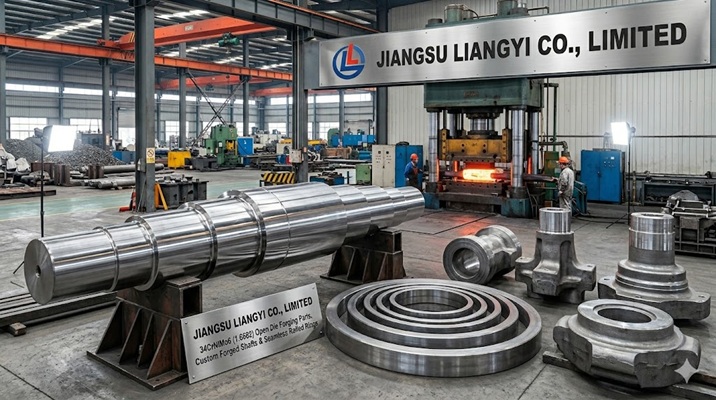
For long shafts, gear blanks and heavy rings, open-die forging and seamless ring rolling let the structure be broken down from the ingot and reshaped without the shrinkage and inclusion risks of casting. This is why a forged 34CrNiMo6 shaft routinely outlasts a nominally identical cast or bar-stock part under the same service.
10 — PROCUREMENT
How to specify it correctly
Most quotation problems with this grade come from under-specifying, not from the steel itself. To get a part that performs as intended, define more than the grade name:
- Controlling section & target properties — state the strength, hardness or impact value required at the ruling cross-section.
- Delivery condition — forged blank, rough-machined or finish-machined; normalised or quenched-and-tempered.
- Inspection scope — UT level, MPI/DPI, and the acceptance standard that applies.
- Certification — EN 10204 3.1 as standard, or 3.2 with third-party witness for critical work.
- Geometry & machining allowance — so forging weight and stock are estimated correctly.
Key takeaways
- 34CrNiMo6 = 1.6582: one Ni-Cr-Mo quenched-and-tempered steel under two labels.
- Its strength is section-dependent — always specify properties at the controlling diameter.
- Hardenability and toughness, not just tensile strength, are the reasons to choose it.
- It is normally supplied quenched and tempered and finished by machining.
- Equivalents like 4340 and SNCM439 are close, not identical — verify before substituting.
Ready to source the part?
Custom 34CrNiMo6 (1.6582) Forgings, Built to Your Drawing
From steel melting and open-die forging through heat treatment, NDT and full CNC machining — single pieces from 30 kg to 30,000 kg, with an EN 10204 3.1 mill test certificate as standard (3.2 with third-party inspection available on request).
11 — REFERENCES
Sources & standards
The data in this guide is drawn from the European standards that govern 34CrNiMo6 and the inspection documents normally supplied with it:
- EN 10083-3 — Steels for quenching and tempering: technical delivery conditions for alloy steels (defines 34CrNiMo6 / 1.6582 composition and property classes).
- EN 10250-3 — Open steel die forgings for general engineering purposes: alloy special steels.
- EN 10204 — Metallic products: types of inspection documents (3.1 and 3.2 mill test certificates).
- ISO 6336-5 / DIN 3990-5 — Material quality classes for gear applications.
Indicative property values are typical for the quenched-and-tempered condition and vary with section size and heat-treatment route. For a specific part, confirm against the approved drawing and the final Mill Test Certificate.
12 — FAQ
Frequently asked questions
Is 34CrNiMo6 the same as 1.6582?
Yes. 34CrNiMo6 is the European grade name and 1.6582 is its material number in the EN steel-numbering system. They describe the identical nickel-chromium-molybdenum quenched-and-tempered alloy steel, with the same chemistry and properties.
What is 34CrNiMo6 used for?
It is chosen for heavily loaded parts that need strength, toughness and fatigue resistance: wind-turbine gear shafts and ring gears, crankshafts, crusher eccentric shafts, crane wheels, hydraulic cylinders and seamless rolled rings across wind, mining, oil and gas, cement and rail.
What is the closest equivalent to 34CrNiMo6?
AISI/SAE 4340 is the most commonly cited near-equivalent, with JIS SNCM439 and GB 34CrNi3Mo also close. None is an exact match, so confirm the required properties, heat-treatment route and acceptance criteria before substituting.
What heat treatment does 34CrNiMo6 receive?
It is normally supplied quenched and tempered: austenitised around 830–870 °C, oil or polymer quenched, then tempered around 540–660 °C to the hardness and toughness target for the controlling section.
Is 34CrNiMo6 weldable?
It can be welded, but as a hardenable alloy steel it needs care: preheat, controlled interpass temperature and post-weld heat treatment are typically required to avoid cracking and to restore properties in the weld zone, following a qualified procedure.
Why is 34CrNiMo6 more expensive than 42CrMo4?
The added nickel content drives both the cost and the benefit. Nickel buys deep-section toughness and better low-temperature performance, which is why 34CrNiMo6 is preferred for larger, impact-loaded forgings where 42CrMo4 would be marginal.