34CrNiMo6 (1.6582) Forging Parts Manufacturer in China
What Are 34CrNiMo6 (1.6582) Forging Parts?
34CrNiMo6, also known as material number 1.6582, is a quenching and tempering alloy steel widely used for forged shafts, rings, gears, sleeves and other heavy-duty parts that require high strength, toughness and dependable fatigue resistance.
When evaluating a supplier, buyers usually focus on producible size range, heat treatment route, machining capability, NDT scope, standards compliance and whether EN 10204 3.1 or 3.2 certification can be provided with the order.
Who Is This Page For
This page is prepared for industrial buyers, OEMs, EPC contractors and engineering teams evaluating custom 34CrNiMo6 / 1.6582 forged parts for heavy-duty uses.
Before order approval, final chemistry, heat treatment, tolerances, NDT level and certificate requirements should be confirmed against the purchase order, approved drawings and final Mill Test Certificate.
Main Information for Buyers
- Material grade: 34CrNiMo6 / 1.6582 alloy steel
- Main forging methods: open die forging and seamless rolled rings
- Single piece weight range: 30 kg to 30,000 kg
- Maximum rolled ring outer diameter: 5000 mm
- Maximum forged shaft length: 12000 mm
- Typical documents: EN 10204 3.1 and optional 3.2 certificates
- Main inspections: UT, MPI/DPI, size, chemical and mechanical testing
- Typical parts: shafts, ring gears, bars, sleeves, cylinders, discs and blocks
Reference Price: From USD 1 / kg (FOB China, subject to order quantity, specifications and delivery condition — contact us for exact quotation)
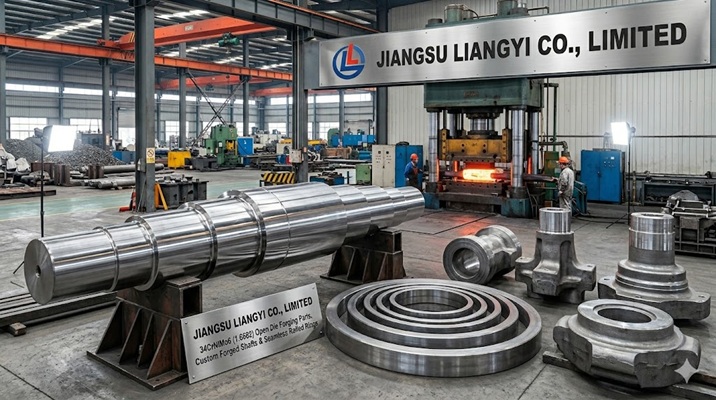
About Our 34CrNiMo6 (1.6582) Forging Products
Established in 1997, Jiangsu Liangyi Co., Limited is an ISO 9001:2015 certified professional manufacturer of 34CrNiMo6 (1.6582) open die forging parts and seamless rolled steel forged rings from Jiangyin City, Jiangsu Province, China — a leading global industrial forging hub. Our factory covers 80,000 ㎡ with an annual manufacturing capacity of 120,000 tons, offering full custom forging solutions from steel melting, forging, heat treatment to precision CNC machining, fully in accordance with EN, DIN, ASTM international standards, with complete Mill Test Certificate (MTC) 3.1/3.2 available for all orders.
Our Main Advantages for 34CrNiMo6 Forgings
25+ Years Forging Experience
Professional alloy steel forging manufacturer, served clients in 50+ countries worldwide
Full In-House Production
End-to-end service from steel melting, forging, heat treatment to final CNC machining
Strict Quality Control
100% NDT inspection per EN 10228-3, full mechanical & chemical testing before shipment
Full Customization Support
Custom production strictly per your drawings, single piece weight from 30kg to 30,000kg
Product Range of 34CrNiMo6 (1.6582) Forgings
We can produce various shapes of 34CrNiMo6 (1.6582) forged steel products strictly according to your custom drawings and technical manuals, with our advanced forging equipment:
Forged Bars & Rods
- 34CrNiMo6 forged round bars, square bars, flat bars and rectangular bars
Seamless Rolled Rings & Flanges
- 1.6582 seamless rolled rings, riding gear rings, flanges and couplings
Forged Shafts & Gear Parts
- 34CrNiMo6 gear shafts, pinion shafts, spindles, gear wheels, crankshafts and rotary shafts
Forged Housings, Sleeves & Cylinders
- 1.6582 forged hubs, housings, shells, sleeves, bushes, hollow bars, hydraulic honed cylinders and casings
Forged Discs, Plates & Blocks
- 34CrNiMo6 forged discs, blocks, plates and custom shaped forgings
Available Production Specifications
- Single piece weight range: 30kg to 30,000kg
- Max outer diameter for seamless rolled rings: 5000mm
- Max length for forged shafts: 12000mm
- Full CNC machining tolerance: up to ±0.02mm
Industry Uses & Project Cases of 34CrNiMo6 Forged Parts
34CrNiMo6 (1.6582) is a good quenching and tempering alloy steel with ultra-high strength, good toughness and great hardenability, ideal for heavy load, high impact and extreme working conditions. Below are our main cases for reference:
Wind Energy Industry
We custom-machined 34CrNiMo6 gearbox gear shafts and ring gears for European wind turbine manufacturers, in accordance with EN 10250-3 standard. All parts are vacuum degassed, quenched and tempered to ensure stable high toughness under extreme low temperature and high torque conditions. We have delivered over 10,000 qualified parts for 2.5MW to 6MW onshore and offshore wind turbines.
Mining & Engineering Industry
We supplied 34CrNiMo6 gyrator crusher eccentric shafts, excavator slewing bearing races and crane wheels for a large Australian mining group. The forgings use integral open die forging process, with hardness controlled between 271-331HB after heat treatment, and 100% passed ultrasonic NDT testing. The service life of our products is 40% longer than ordinary steel parts under high-load ore crushing operations.
Oil & Gas Industry
We provided 1.6582 material mud pump herringbone gear shafts, oil drilling tool gear shafts and subsea riser joints for Middle East oil and gas field projects. The products met NACE sour service requirements, passed strict magnetic particle inspection, and were suitable for high-pressure and corrosive deep-sea environments. They have been used in more than 10 deep-sea oil and gas development projects.
Cement & Building Materials Industry
We manufactured 34CrNiMo6 rotary kiln pinion shafts, riding rings and vertical mill gear shafts for Southeast Asian cement production enterprises. The integral forging process eliminates internal defects, adapting to continuous high-temperature and high-dust working conditions. More than 20 cement clinker production lines that make more than 5,000 tons of cement every day have been using our products.
Railway & Locomotive Industry
We customized 34CrNiMo6 locomotive transmission shafts and traction motor end housings for Chinese railway locomotive manufacturers, in accordance with EN 10083-3 standard. After quenching and tempering, the parts have high strength and impact resistance, and have been matched for more than 500 diesel and electric locomotives.
Other uses include sugar mill equipment, hydro turbine shafts, gas compressor crankshafts, conveyor pulleys, power shovel components and heavy duty industrial gearboxes.
Material Properties & Production Standards of 1.6582 Steel
Certifications & Accordance
- ISO 9001:2015 Certified Manufacturing Facility
- Fully in accordance with EN, DIN, ASTM, API 6A international standards
- Official Mill Test Certificate (MTC) EN 10204 3.1 provided with all orders
- Third-party inspection (MTC 3.2) acceptable upon customer's request
- 100% Nondestructive Testing (NDT) before shipment
International Production Standards
Our 34CrNiMo6 forgings are strictly in accordance with global standards, and we offer full range of alloy steel, stainless steel and nickel alloy forgings:
- EN 10277-5: 2008 Bright steel products. Technical delivery conditions. Steels for quenching and tempering
- EN 10083-3: 2006 Steels for quenching and tempering. Technical delivery conditions for alloy steels
- EN 10269: 1999 Steels and nickel alloys for fasteners with specified elevated and/or low temperature properties
- EN 10263-4: 2001 Steel rod, bars and wire for cold heading and cold extrusion. Technical delivery conditions for steels for quenching and tempering
- EN 10250-3: 2000 Open steel die forgings for general engineering purposes. Alloy special steels
Chemical Composition (34CrNiMo6 Forged Steel)
| Element | Standard Content Range |
|---|---|
| Carbon (C) | 0.30-0.38% |
| Silicon (Si) | ≤0.40% |
| Manganese (Mn) | 0.50-0.80% |
| Phosphorus (P) | ≤0.025% |
| Sulfur (S) | ≤0.035% |
| Chromium (Cr) | 1.30-1.70% |
| Molybdenum (Mo) | 0.15-0.30% |
| Nickel (Ni) | 1.30-1.70% |
Mechanical Properties (After Quenching & Tempering)
| Diameter Range | Tensile Strength | Yield Strength (Min) | Min Elongation | Hardness Range |
|---|---|---|---|---|
| 8-16mm | 1100-1300 MPa | 900 MPa | 10% | 331-380 HB |
| 20-40mm | 1000-1200 MPa | 800 MPa | 11% | 298-359 HB |
| 60-100mm | 900-1100 MPa | 700 MPa | 12% | 271-331 HB |
| 100-160mm | 800-950 MPa | 600 MPa | 13% | 240-286 HB |
Melting & Quality Control Requirements
Steel Melting Requirements
- Electric arc furnace (EAF) + ladle refining (LF) + vacuum degassing (VD) process
- Ultra-low sulfur and phosphorus content to ensure high impact toughness
- Non-radioactive material, fully in accordance with global environmental standards
- Quality class at least MQ per ISO 6336-5 / DIN 3990-5 for gear uses
Full Process Inspection & Testing
- Ultrasonic Testing (UT): Automatic and manual UT equipment for internal defect inspection
- Surface Testing: Magnetic Particle Inspection (MPI) or Dye Penetrant Inspection (DPI) for surface cracks
- Size Inspection: High-precision CMM and measuring equipment for full size verification
- Microstructure Analysis: Metallographic microscope for grain size and microstructure inspection
- Mechanical Testing: Full tensile, impact, hardness and fatigue testing equipment
- Chemical Analysis: Spectrometer for precise chemical composition verification
Mill Test Certificate (MTC) Details
The following details will be included in the official EN 10204 3.1/3.2 Mill Test Certificate for all finished 34CrNiMo6 (1.6582) forged parts:
- Heat Number and melting process details
- Full size inspection results
- Complete heat treatment cycle report
- Full chemical analysis results including trace elements
- All mechanical test results (individual test values)
- Ultrasonic and surface inspection results
- Visual inspection confirmation
- Results of any other tests required by your drawing or order
Procurement Guide for 34CrNiMo6 (1.6582) Forged Parts
For most industrial buyers, the grade name alone is not enough to issue a reliable purchase order. A practical RFQ for 34CrNiMo6 forgings normally needs the part geometry, delivery condition, machining scope, inspection level and certificate requirement so that the supplier can evaluate forging ratio, heat treatment route, testing plan and machining allowance correctly.
If the part works under high torque, shock load or thick cross section, buyers should confirm the final required properties at the controlling section, not only the nominal material grade. This is especially important for shafts, gear blanks, crusher parts, kiln parts and other heavy-duty forgings where section size strongly affects hardenability, ultrasonic testing sensitivity and final machining strategy.
- Confirm whether the order is a forged blank, a rough-machined forging or a fully finished part.
- Define any component that controls dimensions, unit weight and heat treatment performance.
- Tell the required delivery conditions, such as normalizing, quenching and tempering, rough machining or finish machining.
- Specify the required non-destructive testing methods and acceptance criteria, such as UT, MPI or DPI, and the applicable standard levels.
- If there is a conflict between standards, make sure to say whether EN, DIN, ASTM, or project-specific drawing requirements should come first.
- Request EN 10204 3.1 or 3.2 certification and any third-party witness requirement before production starts.
- List size tolerances, machining allowance, datum references and whether stock for final machining must be reserved.
- Confirm packing, marking, corrosion protection and export handling requirements for long or heavy forgings.
Main Manufacturing Route and Process Control
A complete manufacturing route helps buyers understand where quality is created and where risk must be controlled. For 34CrNiMo6 forgings, process discipline is just as important as nominal chemistry because the final strength and toughness depend on steel cleanliness, forging reduction, heat treatment uniformity and inspection after machining.
| Manufacturing Stage | Main Purpose | Main Buyer Checkpoint |
|---|---|---|
| Steel melting and refining | Control chemistry, cleanliness and harmful elements | Heat number, refining route, chemistry report |
| Forging and reduction | Break down ingot structure and achieve target shape | Forging ratio, drawing review, part orientation |
| Heat treatment | Develop required strength, toughness and hardness | Delivery condition, target properties, cooling and tempering requirements |
| Rough machining | Open inspection surfaces and prepare for dimensional control | Machining allowance, datum surfaces, straightness requirements |
| NDT and testing | Verify internal and surface quality plus mechanical properties | UT level, MPI or DPI scope, witness points, test coupons |
| Finish machining and final inspection | Get correct sizes and release for shipment | Final sizes, marking, certificate package, packing plan |
For large forgings, buyers often benefit from confirming at which stage UT will be performed and whether a second UT or surface inspection is required after rough machining. This avoids disputes caused by testing in different surface conditions or at different machining allowances.
Technical Delivery Options Buyers Commonly Confirm
The same 34CrNiMo6 material can be supplied in very different commercial scopes. A strong product page should show buyers what can be customized so that quotation and technical review are based on the same expectation.
| Scope Item | Common Options | Why It Matters |
|---|---|---|
| Supply form | Forged blank, rough machined, finish machined | Changes cost, lead time and inspection stage |
| Heat treatment condition | Normalized, quenched and tempered, per drawing requirement | Directly affects mechanical properties and hardness range |
| Inspection scope | UT, MPI, DPI, size check, chemistry and mechanical testing | Defines release quality and document package |
| Certificate package | EN 10204 3.1, optional 3.2, project-specific reports | Important for traceability and end-user approval |
| Machining scope | Allowance only, semi-finished, fully machined | Affects datum planning, stock allowance and logistics risk |
| Surface and packing | Rust preventive coating, export packing, identification marking | Important for sea shipment and site receiving |
Where projects involve long shafts, ring gears or heavy wall hollow parts, buyers should also confirm straightness, runout, concentricity and inspection accessibility. These details are often more critical to final acceptance than nominal chemistry alone.
34CrNiMo6 Compared with Similar Forging Grades
Buyers often compare 34CrNiMo6 with other alloy steel grades used for shafts, gears and heavy-duty forged parts. The right choice depends on section size, required toughness, hardenability, drawing standard and whether the use is more cost-sensitive or performance-sensitive.
| Grade | General Positioning | Main Buyer Decision Point |
|---|---|---|
| 34CrNiMo6 / 1.6582 | High-strength Ni-Cr-Mo alloy steel with good hardenability and toughness | Suitable when thick sections, impact resistance and stable heat treatment response are important |
| 42CrMo4 / 1.7225 | Widely used Cr-Mo engineering steel for general heavy-duty forgings | Often considered when strength is needed but cost sensitivity is higher and section size is less demanding |
| AISI 4140 | Common international engineering steel comparable in market use to 42CrMo4 | Useful for projects specified to American standards, but equivalence should be confirmed against property requirements |
| AISI 4340 | Ni-Cr-Mo alloy steel family with high strength and toughness potential | Can be considered for demanding duty, but chemistry, standard route and acceptance criteria must be checked carefully |
These grades should not be treated as automatic substitutes without reviewing the drawing, end-use standard, target properties at section size, heat treatment route and inspection requirements. In practical sourcing, the safer approach is to compare the final required properties and certification route rather than relying only on a grade name cross-reference.
Inspection Records and Documents Buyers Usually Request
For forged parts used in wind power, mining, oil and gas, cement or transmission systems, the document package is often part of the approval process. Clear document planning reduces approval delays and helps buyers compare suppliers on traceability, not only on unit price.
- Mill Test Certificate showing heat number, chemistry and mechanical properties.
- Heat treatment record or heat treatment summary referenced to the part or batch.
- Ultrasonic testing report with standard, acceptance level and tested condition.
- MPI or DPI report where surface integrity is contractually required.
- Size inspection report for controlled features or final machined sizes.
- Marking and traceability record linking part number, heat number and certificate number.
- Third-party witness or release note when the project requires independent inspection.
A high-value quotation normally becomes stronger when the supplier clarifies which reports are standard, which are optional and at what production stage they are generated. This gives the buyer a cleaner approval path and helps prevent late-stage document disputes.
Delivery Planning, Packing and Export Considerations
Lead time for 34CrNiMo6 forgings depends more on process route than on material name alone.Cross-sectional dimensions, forging progress, furnace load, machining depth, non-destructive testing holding points and third-party witness requirements will all affect the final production schedule.
- Heavy or thick cross-section forgings usually require more heat treatment and inspection fits than small parts.
- Parts ordered as precision machined parts usually require more planning than forged blanks or rough-machined parts.
- Additional witness checks, special non-destructive testing levels or project-specific tests can extend the release time.
- The export packaging of long shafts or large rings should take into account rust prevention, lifting points, bracing and marine protection.
- The accuracy of part marking, certificate matching and packing list is of great significance for on-site reception and final traceability.
For main projects, buyers should adjust the required delivery condition, inspection sequence and shipping method at RFQ stage. Early consistency usually reduces technical risks and avoidable progress losses in the later stage of the order cycle.
Frequently Asked Questions About 34CrNiMo6 (1.6582) Forgings
These questions cover grade identity, uses, size range, machining scope, certificates, inspection, quotation requirements and common buying decisions for heavy-duty forged parts.
Is 34CrNiMo6 the same as 1.6582 steel?
What is 34CrNiMo6 steel used for?
What is the maximum size you can produce?
Can you provide full CNC machining for 34CrNiMo6 forgings?
Do you provide Mill Test Certificate for 34CrNiMo6 forgings?
Can 34CrNiMo6 forgings be supplied as rough machined or finish machined parts?
What heat treatment condition is commonly specified for 34CrNiMo6 forgings?
What documents should buyers request for critical forged parts?
What information is needed for an accurate quotation?
How should buyers compare 34CrNiMo6 with grades such as 42CrMo4 or 4340?
Why Buyers Choose This Page
This page clearly identifies the supplier, plant location, manufacturing scope, size capacity, testing methods, standards references and quotation channels so that sourcing teams can review the offer efficiently.
For critical projects, buyers should still request drawing review, sample MTCs, heat treatment records, UT or MPI reports and machining tolerance confirmation for the exact part number being sourced.
RFQ Checklist Before You Send an Inquiry
For forged shafts, rolled rings, sleeves, discs and other custom 34CrNiMo6 parts, quotation speed depends heavily on the quality of the RFQ package. A complete inquiry helps confirm forging feasibility, estimated forging ratio, machining allowance, heat treatment route, NDT plan, document scope and export packing method before price confirmation.
For standard repeat parts, a concise inquiry may be enough. For critical transmission, wind power, mining, oil and gas or railway uses, buyers should send a complete technical package so the supplier can review the controlling section, service condition, acceptance standard and document requirements in one round.
What should be included in a standard RFQ package
- Drawings or sketches: including full sizes, tolerances, machining references, chamfers, radii, threads, oil holes, grooves and any key geometries.
- Part name and uses: State whether the part is a shaft, ring, gear blank, sleeve, cylinder, wheel, flange or other forged part, and mention the final equipment use.
- Material name: Specify 34CrNiMo6 / 1.6582 and the controlling standard if required by the project or drawing.
- Order quantity: Confirm sample quantity, batch quantity, annual demand and whether future frame orders are expected.
- Unit weight and delivery size: Clarify forged blank weight, rough-machined weight or finished-machined weight to avoid price mismatch.
- Heat treatment condition: Indicate annealed, normalized, quenched and tempered, or drawing-defined delivery condition with target mechanical properties.
- Inspection scope: Specify UT level, MPI or DPI requirement, size report, hardness check, impact test, microstructure review or third-party witness inspection.
- Document request: State whether EN 10204 3.1 or 3.2 certificate, heat-treatment chart, NDT report, chemical report or packing list format is required.
- Machining scope: Confirm as-forged, rough-machined or finished-machined delivery and identify surfaces that require stock allowance.
- Commercial terms: Add requested delivery time, shipping destination, Incoterm, packing type and destination port when available.
Minimum Data Needed for Fast Budget Quotation
| Item | Why It Matters | Recommended Level |
|---|---|---|
| Part geometry | Determines forging route, die/open-die feasibility and stock allowance | 2D drawing or clear size sketch |
| Quantity | Affects yield, setup cost and machining cost distribution | Trial quantity and batch quantity |
| Delivery condition | Changes heat-treatment cost and testing scope | Blank, rough-machined or finished-machined |
| NDT requirement | Defines UT/MPI/DPI process, acceptance class and inspection cost | Applicable standard or project requirement |
| Certification | Controls document package and witness inspection arrangement | EN 10204 3.1 or 3.2 |
| Delivery destination | Needed for packing, transport and export quotation | Country, port or final plant address |
Information That Prevents Re-Quotation Delays
- Identify controlling sizes and finished machining allowance so forging weight is estimated correctly.
- State whether the part works under impact load, torsion load, low temperature or fatigue-critical conditions.
- Confirm whether the drawing requires specific grain flow direction, reduction ratio or segregation control.
- List any limits on the condition of the surface, such as controlling decarburization, machining reference surfaces, or preserving the black skin.
- Indicate whether a third-party inspection by BV, SGS, TUV or customer witness is required before shipment.
- Clarify whether export seaworthy packing, rust prevention, barcode labels or part marking are required.
Recommended RFQ Sequence for Critical Forged Parts
- Send drawing, quantity, material grade and end-use description.
- Confirm forging route, rough forging size and machining allowance.
- Agree on heat treatment condition and target mechanical properties at the controlling section.
- Define inspection plan, acceptance criteria and certificate package.
- Approve commercial offer, lead time, packing method and shipment arrangement.
If the part is safety-critical or project-controlled, attach the latest drawing revision, specification sheet and approved supplier document list in the first inquiry. This reduces engineering back-and-forth and helps the quotation reflect the real manufacturing scope.
Contact Us for a 34CrNiMo6 Forging Quotation
Please send your drawing, required material condition, quantity, sizes, machining scope and inspection requirements. Our team will review the request and reply with technical feedback and quotation support within 24 hours.
Send Your InquiryCompany: Jiangsu Liangyi Co.,Limited
Inquiry Email: sales@jnmtforgedparts.com
Tel: +86-510-86107550
Phone/WhatsApp: +86-13585067993
Website: https://www.jnmtforgedparts.com
Factory Address: Chengchang Industry Park, Jiangyin City, Jiangsu Province 214400, China