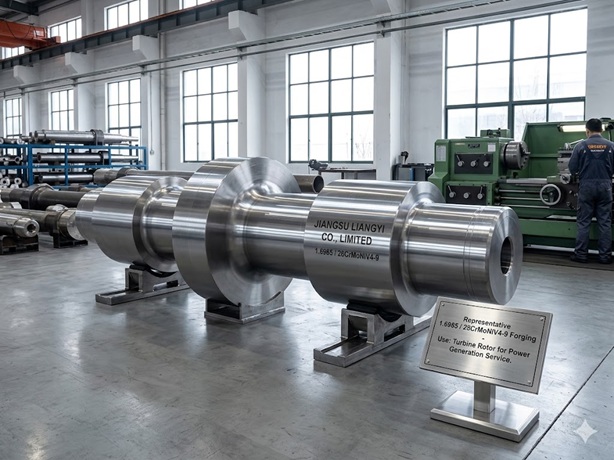
The Short Answer: What 1.6985 Is For
1.6985 — known on most engineering drawings as 28CrMoNiV4-9 — is a quenched-and-tempered low-alloy steel built for one demanding job: holding its strength while spinning at speed inside a hot steam turbine.
It is not a glamorous material. There is no exotic nickel-base chemistry and no fashionable alloy name. What it offers instead is reliability under a combination of loads — centrifugal stress, thermal stress and time — that quickly defeats ordinary structural steels.
This guide explains what the grade actually is: how to read its name, what goes into it, the numbers it has to hit, and the metallurgical logic that makes it the default choice for turbine rotors and shafts. If you already source this material and need full standards, sizes and supply detail, the dedicated 1.6985 / 28CrMoNiV4-9 forging material page covers the commercial side.
- 1.6985 is the EN material number; 28CrMoNiV4-9 is the chemical-symbol name for the same steel.
- It is a 1% Cr-Mo-Ni-V steel, quenched and tempered, with vanadium added for creep strength.
- Long-term service is centred around 538–565 °C — the working range of supercritical steam.
- Its real advantage is uniform properties through very thick forged sections.
Decoding "1.6985" and "28CrMoNiV4-9"
The two names describe the same alloy in two different systems. 1.6985 is the EN / Werkstoff material number — a registry index where the digits encode the steel's family rather than its chemistry. The more descriptive label is the chemical-symbol name 28CrMoNiV4-9, and once you know how to read it the composition is almost self-explanatory:
- 28 — roughly 0.28% carbon (the "28" is carbon content × 100).
- Cr Mo Ni V — the deliberate alloying elements, listed by importance: chromium, molybdenum, nickel and vanadium.
- 4-9 — index figures tied to the chromium and molybdenum levels, indicating roughly 1% Cr and around 1% Mo.
You will also meet it written as 28CrMoNiV4.9 or 28CrMoNiV49 in purchase orders and search queries — all the same grade, just punctuated differently. Closely related rotor steels in the same family (for example 30CrMoNiV5-11) shift the carbon and alloy balance for higher-temperature duty.
Chemical Composition of 28CrMoNiV4-9
What separates a turbine-grade steel from a general engineering steel is rarely the headline alloy content — it is the tightness of the control range and the limits placed on residual elements. Phosphorus and sulphur are held very low because they promote temper embrittlement and degrade transverse toughness in heavy sections. A representative controlled range looks like this:
| Element | Minimum | Maximum |
|---|---|---|
| Carbon (C) | 0.25 | 0.30 |
| Manganese (Mn) | 0.30 | 0.80 |
| Silicon (Si) | — | 0.15 |
| Phosphorus (P) | — | 0.010 |
| Sulphur (S) | — | 0.007 |
| Chromium (Cr) | 1.00 | 1.30 |
| Nickel (Ni) | 0.50 | 0.75 |
| Molybdenum (Mo) | 0.75 | 1.00 |
| Vanadium (V) | 0.25 | 0.35 |
| Aluminium (Al) | — | 0.010 |
The low silicon and aluminium ceilings, together with strict P and S limits, are deliberate: they keep the steel clean and reduce the non-metallic inclusions that would otherwise become fatigue-crack starters in a part expected to run for decades.
What Each Alloying Element Does
Every element in 28CrMoNiV4-9 earns its place. Read together, they explain why the grade behaves the way it does.
Carbon · 0.25–0.30%
Sets baseline strength and hardenability. Kept moderate so the steel stays tough and easy to forge and heat-treat rather than brittle.
Chromium · ~1%
Improves hardenability and oxidation resistance and forms stable carbides that resist softening when held hot for long periods.
Molybdenum · ~1%
The creep workhorse. Strengthens the matrix at temperature and strongly suppresses temper embrittlement — critical for thick rotors.
Nickel · 0.5–0.75%
Boosts hardenability and toughness, helping the core of a large forging reach properties close to those at the surface.
Vanadium · 0.25–0.35%
Forms fine, stable carbides that refine grain and pin the microstructure — the biggest single contributor to creep strength.
Residuals · very low
Held to a minimum because they segregate to grain boundaries, embrittling the steel and lowering transverse impact in big sections.
The vanadium is the difference between a steel that is merely strong and one that stays strong after ten years at 540 °C.
Mechanical Properties of 1.6985
Composition only sets the potential; heat treatment realises it. After quenching and tempering, a typical room-temperature property set for supplied forgings is shown below. Values are guaranteed in both the longitudinal and transverse directions — a stricter requirement than for ordinary bar stock, and a sign the grade is meant for parts loaded in every axis.
| Property | Typical value |
|---|---|
| Tensile strength, Rm | 700 – 850 MPa |
| Yield strength, Rp0.2 | ≥ 550 MPa |
| Elongation, A | ≥ 15 % |
| Reduction of area, Z | ≥ 40 % |
| Impact, AKv at +20 °C | ≥ 24 J / ≥ 16 J |
| Hardness | 210 – 250 HBW |
These are reference figures; the exact acceptance values are always pinned to the project specification, the section size and the governing code such as EN 10228-3, DIN 17240 or ASTM A470. Testing follows recognised methods including ISO 6892-1 for tensile and ISO 148-1 for impact.
Heat Treatment of 28CrMoNiV4-9
1.6985 only becomes a turbine steel after a carefully staged thermal route. In simplified terms:
- Normalising plus hydrogen-diffusion annealing after forging, to homogenise the structure and drive off dissolved hydrogen that could otherwise cause internal "white spots" or flakes.
- Austenitising and quenching to transform the structure and lock in hardenability through the full section.
- High-temperature tempering to bring hardness into the target band, relieve stress and develop the tough, stable tempered structure the application needs.
For the most critical rotating parts the steel is also melted more cleanly — ESR (electroslag remelting) on top of the standard EAF + LF + VD route — to cut inclusions and improve through-thickness consistency. Choosing between standard and ESR melting is one of the most common decisions buyers face when specifying rotors.
Why Steam Turbines Are Forged From It
A steam turbine rotor lives a brutal life. It carries its own weight across long bearings, spins fast enough to put the rim under heavy centrifugal load, and does all of this at temperatures where ordinary steel slowly stretches under constant stress — a phenomenon called creep. Pick the wrong material and the rotor either cracks from fatigue or quietly deforms over years until clearances are lost. 28CrMoNiV4-9 answers three problems at once:
- Mid-temperature creep resistance. The Cr-Mo-V carbide system keeps long-term strength stable in the 538–565 °C window typical of supercritical steam.
- Fatigue and toughness balance. Nickel and clean-steel practice give it the impact toughness to tolerate the start-stop thermal cycling of real plant operation.
- Large-section consistency. A rotor can weigh tens of tonnes; the alloy's hardenability lets the centre of that mass reach properties close to the surface — which a cheaper grade like 42CrMo4 cannot guarantee at scale.
That last point is decisive. Many alloys look competitive on a test-bar datasheet; far fewer hold those numbers in the heart of a one-metre-diameter forging. That gap is exactly where 1.6985 earns its keep — and the reason it remains a standard rotor steel decades after it was introduced.
How 1.6985 Compares to Other Turbine & Shaft Steels
Buyers most often weigh 28CrMoNiV4-9 against general-purpose alloy steels and against its American and higher-temperature equivalents. The table below summarises where each grade fits.
| Grade | System | Best suited to |
|---|---|---|
| 1.6985 / 28CrMoNiV4-9 | EN | Hot turbine rotors and shafts needing creep strength and large-section uniformity |
| 42CrMo4 (1.7225) | EN | General shafts and gears at moderate temperature; limited sustained creep duty |
| ASTM A470 Cl.8 | ASTM | The US-standard counterpart for Cr-Mo-V turbine rotor forgings |
| 30CrMoNiV5-11 | EN | Rotors running at the upper end of the temperature range |
The detailed 1.6985-vs-42CrMo4 trade-off is covered in a dedicated comparison article linked below.
Typical Forged Parts Made From 1.6985
Because of that property profile, the grade shows up wherever a hot, highly stressed rotating or pressure-bearing forging is needed:
- High- and intermediate-pressure turbine rotors, mono-bloc rotors and turbo-generator shafts.
- Turbine discs, blade-retaining rings, diaphragms and seal / labyrinth rings.
- Main-steam, governor and reheat valve seats, stems, spindles and bonnets.
- Compressor rotors, gear shafts and pressure-part forgings for heavy industry.
The full range of shapes, sizes and supply options — bars, shafts, seamless rolled rings, discs and drawing-based open-die forgings — is detailed on the main 28CrMoNiV4-9 forging page.
Need 1.6985 / 28CrMoNiV4-9 forgings?
Jiangsu Liangyi forges this grade to drawing with EAF + LF + VD or ESR melting, plus heat treatment and NDT, and supplies material test certificates (EN 10204 3.1; 3.2 with independent third-party inspection on request). Send sizes, quantity and inspection scope for a fast quote.
View the material page Request a quoteFrequently Asked Questions
What is 1.6985 (28CrMoNiV4-9) steel in one sentence?
It is a quenched-and-tempered, low-alloy Cr-Mo-Ni-V steel developed for high-temperature steam turbine rotors, shafts and heavy rotating forgings, balancing hardenability, toughness, fatigue strength and creep resistance.
What temperature can 28CrMoNiV4-9 handle?
Long-term service is typically centred around 538–565 °C. The permissible operating condition depends on stress, section size, environment and the design code, and should always be confirmed with the OEM and applicable standard.
Is 1.6985 the same as 28CrMoNiV4-9?
Yes. 1.6985 is the EN material number and 28CrMoNiV4-9 is the chemical-symbol name for the identical steel. You may also see 28CrMoNiV4.9 or 28CrMoNiV49 used interchangeably.
What is the chemical composition of 28CrMoNiV4-9?
Typical control ranges are 0.25–0.30% carbon, about 1% chromium, 0.75–1.00% molybdenum, 0.50–0.75% nickel and 0.25–0.35% vanadium, with very low phosphorus and sulphur to keep the steel clean.
Why not just use a cheaper alloy like 42CrMo4?
General-purpose grades lose strength faster at elevated temperature and cannot guarantee uniform properties through very thick sections. The vanadium-strengthened Cr-Mo-Ni-V chemistry of 1.6985 gives the creep resistance and large-section consistency that turbine rotors require.
What standards apply to 1.6985 forgings?
Depending on the part and destination market, a 1.6985 forging can be produced and inspected to standards such as EN 10228-3, DIN 17240 and ASTM A470. Additional code requirements (for example ASME BPVC or PED 2014/68/EU) are applied only when a customer specifies them for a given order. The manufacturer's own quality-system certification is ISO 9001:2015.
- EN 10228-3 — Non-destructive testing of steel forgings
- ISO 6892-1 — Metallic materials, tensile testing
- DIN 17240, ASTM A470, ASME BPVC Section VIII, PED 2014/68/EU (project-dependent)