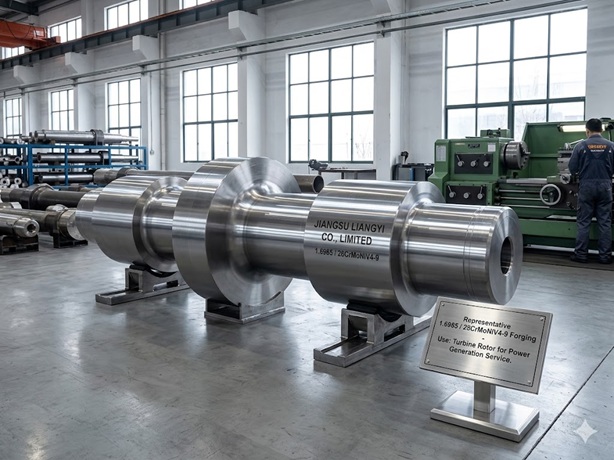
1.6985 / 28CrMoNiV4-9 Material Overview & Global Standard Accordance
Jiangsu Liangyi Co., Limited is a leading China manufacturer and global supplier of 1.6985 (also known as 28CrMoNiV4-9, 28CrMoNiV4.9, 28CrMoNiV49) open die forgings and custom forged steel parts, with over 25 years of experience serving EPC contractors, power plant operators, turbine OEMs and oil & gas companies in 50+ countries across Europe, the Middle East, Southeast Asia, North America, South America, Australia and the Eurasian Union.
Our 1.6985 forgings are produced for international project requirements including EN 10228-3, DIN 17240, ASTM A470, ASME BPVC Section VIII, PED 2014/68/EU, API 6A and regional client specifications. For buyers and search engines alike, the main commercial meaning is straightforward: this is a forging-grade alloy steel used when traditional grades are not enough for long-term hot-service reliability.
28CrMoNiV4-9 is a classic 1% Cr-Mo-Ni-V quenched and tempered alloy steel developed for high-temperature steam turbine parts in fossil power plants operating at pressures above 22 MPa and temperatures roughly between 538 and 565 °C. Its long service history in supercritical and ultra-supercritical units makes it a good choice when high-temperature strength, fatigue resistance and impact toughness must remain balanced in large forged sections.
Entity-level summary: 1.6985 / 28CrMoNiV4-9 is best understood as a turbine-grade forging steel for rotors, shafts, discs, rings and valve parts where clean steel practice, large-section hardenability and stable mechanical properties are more important than low cost alone.
Common Designations, Aliases and Buyer Search Names
This page includes the most common naming variants buyers use in RFQs and online searches so that procurement teams can quickly confirm that these terms refer to the same material grade.
- Main EN name: 1.6985
- General grade name: 28CrMoNiV4-9
- Different writing ways: 28CrMoNiV4.9, 28CrMoNiV49
- Main buyer intent searches: 1.6985 forging material, 28CrMoNiV4-9 turbine rotor forging, 1.6985 shaft forging, 28CrMoNiV4-9 rolled ring, 1.6985 valve seat forging
With these variants in the visible content helps the procurement teams find the correct grade naming without reducing technical clarity.
1.6985 Steel vs. Traditional Turbine Alloys: Main Competitive Advantages
Compared with common turbine alloy steels such as 42CrMo4 (1.7225), A182 F22 and 34CrNiMo6, 1.6985 / 28CrMoNiV4-9 has a more targeted performance profile for mid-to-high temperature power generation and heavy rotating service. It is not simply another alloy steel name; it is a grade chosen when long-term thermal stress and section-size uniformity matter.
- Good mid-temperature creep resistance: The Cr-Mo-V alloy balance helps maintain long-term strength around 538-565 °C, which is essential in supercritical power unit service.
- Balanced strength and toughness: Nickel improves hardenability and toughness, helping large forgings retain better core-to-surface property consistency.
- Good quenching and tempering response: Controlled heat treatment helps keep the hardness and mechanical properties the same across large areas.
- Service history:Long-term use of turbine systems in industry gives us confidence in their thermal fatigue and service life performance.
- Flexible steelmaking routes: EAF/LF/VD is suitable for standard requirements, while ESR is suitable for critical rotating parts that require ultra-clean steel.
Full Range of 1.6985 / 28CrMoNiV4-9 Forged Product Shapes
We can make 1.6985/28CrMoNiV4-9 forgings to meet international standards and your drawings.
Bar & Shaft Forgings
- Forged round bars, square bars, flat bars, rectangular bars and rods, with large-section capability for demanding projects.
- Step shafts, turbine rotor shafts, generator shafts, valve spindles, stems and rods up to long-length heavy-duty formats.
Seamless Rolled Rings & Hollow Parts
- Seamless rolled rings, contoured rings, gear rings, seal rings and labyrinth rings for turbine, pressure and industrial use.
- Hubs, housings, shells, sleeves, bushes, hollow bars, casings and tubular forged parts.
Custom Special-shaped Forgings
- Forged discs, blocks, plates, valve bodies, bonnets and covers.
- Turbine wheels, diaphragms, guide vanes and OEM drawing-based forgings.
Main Industrial Uses of 28CrMoNiV4-9 Forgings
1.6985 / 28CrMoNiV4-9 forgings are chosen for critical parts in thermal power generation and heavy industrial equipment where section size, elevated-temperature stability and inspection reliability are decisive.
Thermal Power Generation Steam & Gas Turbine Systems
- High-pressure and intermediate-pressure turbine rotors, mono bloc rotors, turbo-generator shafts and turbine discs for supercritical and ultra-supercritical units.
- Turbine diaphragms, nozzle boxes, guide rings, shrouds and blade retaining rings.
- Journal and thrust-bearing related forged parts, end rings and labyrinth seal parts.
Power Plant Valve & Flow Control Systems
- Main steam valve, governor valve, control valve and reheat valve seats, cores, sleeves and bonnets.
- Steam turbine control and reheat valve discs, spindles, stems and connecting rods.
- High-strength studs, bolts and related forged fastener products for critical pressure systems.
Other Heavy Industrial Uses
- Gas compressor rotors, impellers and casing parts for petrochemical and oil & gas plants.
- High-pressure reactor shells, heat exchanger parts and pressure-part forgings.
- Heavy-duty gear shafts, pinions and transmission parts for mining and construction equipment.
Global Cases of 1.6985 / 28CrMoNiV4-9 Forgings
To preserve the original content depth, the project cases below are retained in a problem-solution-result format so readers can quickly understand the use background, manufacturing approach and delivery outcome.
A 500 MW Supercritical Thermal Power Project - Southeast Asia
The client's challenge: This project requires high-performance turbine rotor forgings that can operate for a long time at 23 MPa and 540°C in tropical high-humidity environments, while strictly controlling non-metallic inclusions and lateral impact toughness.
Our solution: We supplied custom 1.6985 forged high- and intermediate-pressure mono bloc rotors, matched valve spindles and valve seats, using an EAF + LF + VD route and a forging ratio of at least 4:1 to improve microstructure uniformity.All products have passed the full set of UT/MT tests, and the inclusion controls are accordance with ASTM E45-A A/B/C/D≤1.5.
Delivery: The forgings were delivered on time and got MTC 3.2 certification, and have been stably used for more than five years.
800 MW Combined Cycle Power Station - Middle East
Client pain point: The project site was on the coast, where it was hot and salty, and the client needed seal and valve parts that were very stable in size, resistant to corrosion, and could be inspected by a third party according to PED 2014/68/EU.
Our solution: We provided seamless rolled sealing rings, labyrinth rings, reheated valve discs, and strong fasteners, as well as better heat treatment methods to make the material more resistant to stress corrosion. The production meets the standards set by the PED module.
Delivery: Over 200 sets of parts were supplied and accepted for use, and have been operating stably since 2021..
Gas Turbine Retrofit Project - Europe
Client pain point: The renovation scope requires the replacement of parts of the aging gas turbine unit, and there are strict requirements on purity, size accuracy, and acceptance as per EN 10228-3/ce.
Our solution: We delivered custom forged discs, diaphragm-related parts and precision-machined turbine parts using ESR material to enhance cleanliness and homogeneity, followed by close tolerance machining to match legacy drawings.
Delivery: The parts that were sent matched the installation requirements of the original unit and helped it run more efficiently.
1000 MW Ultra-supercritical Power Base - China
Client pain point: The project required batch supply of very large turbine-related forgings, including rotors and housings with strong section-property consistency across parts weighing up to tens of tons.
Our solution: We used large-tonnage hydraulic pressing, deep deformation control and staged quench-and-temper processing to improve section uniformity for casings, bearing housings, control rings and shielding parts.
Delivery: This batch of products has passed the inspection requirements of the power industry and has been smoothly put into commercial operation.
Custom Forging & Heat Treatment Process for 1.6985 / 28CrMoNiV4-9
We have full-process manufacturing capability for 28CrMoNiV4-9 forgings, from melting and forging to heat treatment, machining and final inspection. Technical buyers often focus on process-related qualifiers such as ESR, heat treatment, NDT, MTC 3.2 and large-section property consistency.
Different Ways to Melt
- EAF + LF + VD: The usual way to get stable chemistry, low gas content, and common industrial uses.
- ESR electroslag remelting: Preferred for critical turbine and rotating parts where lower inclusion content, better homogeneity and stronger transverse toughness are required.
Representative Production Process Flow
- Raw material melting and chemistry verification.
- Surface inspection and process planning according to forging geometry and use risk.
- Controlled heating and multi-directional forging with a forging ratio typically ≥3:1 and ≥4:1 for critical rotating parts.
- Post-forging normalization plus hydrogen diffusion annealing to reduce white-spot risk.
- Rough machining and preliminary UT.
- Quenching and tempering to get the required strength, hardness and toughness.
- Mechanical testing, metallographic inspection and hardness testing are accordance with recognized standards such as ISO 6892-1 and ISO 148-1.
- Semi-finish and finish machining according to drawing tolerances.
- Final size inspection, UT/MT/PT and remanence checks where required.
- Packaging and shipping that relieves stress and protects against rust, along with certification documents.
Chemical Composition of 1.6985 (28CrMoNiV4-9) Forging Steel
Our 1.6985 steel controls the chemistry range to ensure stable hardenability, forging response and heat-treatment consistency. The table below preserves the original content depth while keeping the data easy for buyers and machine readers to extract.
| Chemical element | Minimum content (wt%) | Maximum content (wt%) |
|---|---|---|
| Carbon (C) | 0.25 | 0.30 |
| Manganese (Mn) | 0.30 | 0.80 |
| Silicon (Si) | — | 0.15 |
| Phosphorus (P) | — | 0.010 |
| Sulfur (S) | — | 0.007 |
| Chromium (Cr) | 1.00 | 1.30 |
| Nickel (Ni) | 0.50 | 0.75 |
| Molybdenum (Mo) | 0.75 | 1.00 |
| Aluminum (Al) | — | 0.010 |
| Vanadium (V) | 0.25 | 0.35 |
Mechanical Properties of 28CrMoNiV4-9 Forgings
All mechanical-property tests are carried out according to applicable project requirements and internationally recognized standards. The values below preserve the original technical depth while remaining scannable for procurement teams comparing suppliers.
| Mechanical property | Guaranteed value |
|---|---|
| Tensile strength (Rm) | 700 - 850 MPa |
| Yield strength (Rp0.2) | ≥ 550 MPa |
| Elongation (A, 50 mm gauge length) | ≥ 15% (longitudinal & transverse) |
| Reduction of area (Z) | ≥ 40% (longitudinal & transverse) |
| Impact energy (AKv, +20 °C) | ≥ 24 J longitudinal | ≥ 16 J transverse |
| Brinell hardness (HBW) | 210 - 250 HBW (adjustable via heat treatment) |
Quality Control & Global Accordance Certification
We implement full-process quality control for all 1.6985 / 28CrMoNiV4-9 forgings. For high-value industrial pages, visible trust signals are essential for both conversion and search evaluation, so this section keeps the inspection and certification details explicit.
- Raw material inspection with chemistry verification and non-metallic inclusion control according to agreed methods such as ASTM E45-A.
- Process inspection includes heating, forging, heat treatment methods and complete traceable records.
- Final inspection including size checks, UT/MT/PT, hardness testing and mechanical-property verification.
- Certification support including MTC EN 10204 3.1 / 3.2 and optional third-party inspection by BV, SGS, TÜV or Lloyd's Register.
- Project support for PED 2014/68/EU, ASME BPVC, API 6A and other regional/customer accordance frameworks.
Our quality system is aligned with ISO 9001:2015, and we support export documentation for clients operating in Europe, North America, the Middle East, Southeast Asia and other international markets.
When to Use ESR Instead of Standard EAF + LF + VD Supply
This is one of the most practical decision points for buyers because many RFQs for turbine-grade forgings are intended to determine whether clean steel requirements justify ESR remelting.
| Scenario | Standard EAF + LF + VD | ESR remelted steel |
|---|---|---|
| General forged parts with traditional inspection scope | Usually suitable | Not always necessary |
| Critical rotating parts such as mono bloc turbine rotors | Project dependent | Often preferred |
| Very strict inclusion cleanliness and transverse toughness requirements | May be insufficient for premium projects | More suitable |
| High-value retrofit or OEM-critical replacement parts | Possible, depending on specification | Commonly chosen for risk reduction |
Procurement Guidance: What Buyers Usually Need Before RFQ
This section helps answer the common questions that purchasing teams and EPC engineers usually ask before sending a formal RFQ, while preserving the technical depth of the page.
Drawing and sizes
Send part drawings, machining allowance, finish sizes, quantity and target delivery condition.
Material route
Specify whether standard EAF/LF/VD is sufficient or ESR is required for cleaner steel and critical service.
Inspection level
Confirm UT/MT/PT requirements, acceptance criteria, witness points and need for third-party inspection.
Certification package
Clarify MTC level, PED/ASME/API needs, packing standard, shipment terms and destination market.
Main RFQ Checklist
- Part name and end-use use.
- Required steelmaking route and forging ratio if project-specified.
- Heat-treatment and target mechanical properties.
- Surface condition, machining scope and size tolerance.
- NDT scope, certification level and inspection agency requirements.
- Delivery schedule, packing method and destination port or project site.
Frequently Asked Questions (FAQ) About 1.6985 / 28CrMoNiV4-9 Forging Material
Contact Us for Custom 1.6985 / 28CrMoNiV4-9 Forging Solutions
Jiangsu Liangyi is a China-based manufacturer and global supplier of 1.6985 / 28CrMoNiV4-9 forging material and custom forged steel parts for power generation, oil & gas and heavy machinery industries. If you already have drawings or a target part list, we can quote faster when the RFQ includes sizes, quantity, delivery condition, inspection scope and certification requirements.
Inquiry email: [email protected]
Phone / WhatsApp: +86-13585067993
Official website: https://www.jnmtforgedparts.com
Factory address: Chengchang Industry Park, Jiangyin City, Jiangsu Province, China
Best for inquiries about:
- Turbine rotors and shafts
- Seamless rolled rings and discs
- Valve seats, stems and pressure parts
- ESR-grade critical rotating forgings
- MTC 3.1 / 3.2 and third-party inspection supply