Maraging 300 vs 4340 Steel: Which High-Strength Alloy Should You Forge?
Both reach ultra-high strength — but by completely different metallurgy. Here is how Maraging 300 (UNS K93120) and AISI 4340 actually behave in a forged component across strength, fracture toughness, weldability, distortion, sour service and cost, with a decision matrix you can specify from.
Maraging 300
4340 Steel
Quick answer
Forge Maraging 300 (UNS K93120) when you need the highest, most consistent strength combined with weldability, near-zero heat-treat distortion, NACE MR0175 sour-service resistance, or 300 °C-plus capability — it offers ~1862 MPa yield and ~77 MPa√m fracture toughness. Forge 4340 (AISI 4340) when cost is the priority and its ~1379 MPa yield with standard quench-and-temper processing is sufficient — 4340 costs several times less per kilogram. In short: 4340 is the cost-effective workhorse; Maraging 300 is the specialist for critical, weldable, or sour-service forgings.
Key takeaways
- Strength: Maraging 300 guarantees ≥1862 MPa yield vs ~1379–1600 MPa for quenched-and-tempered 4340, and holds it more uniformly through thick sections.
- Toughness: At equal hardness Maraging 300 keeps ~77 MPa√m fracture toughness; 4340 drops toward brittle behaviour when pushed to the same hardness.
- Weldability: Maraging 300 welds with no preheat; 4340 needs 200–320 °C preheat plus post-weld heat treatment.
- Distortion: Maraging 300 changes <0.02% on aging (no quench); 4340 distorts 0.1–0.3% on oil quench.
- Sour service & cost: Maraging 300 meets NACE MR0175 to 54 HRC; 4340 is far cheaper but limited in H₂S service.
Two roads to high strength
The most important thing to understand is that these alloys don't just differ in numbers — they get strong by fundamentally different mechanisms, and almost every practical difference downstream flows from that.
What is 4340 steel?
AISI 4340 is a low-alloy Ni-Cr-Mo steel with 0.37–0.43% carbon. Strength comes from hardening: austenitise, oil quench to form hard carbon martensite, then temper to trade some hardness back for toughness. The carbon is the strengthener — so raising strength means raising hardness, which the quench must chase, and that quench brings distortion and residual stress with it.
What is Maraging 300?
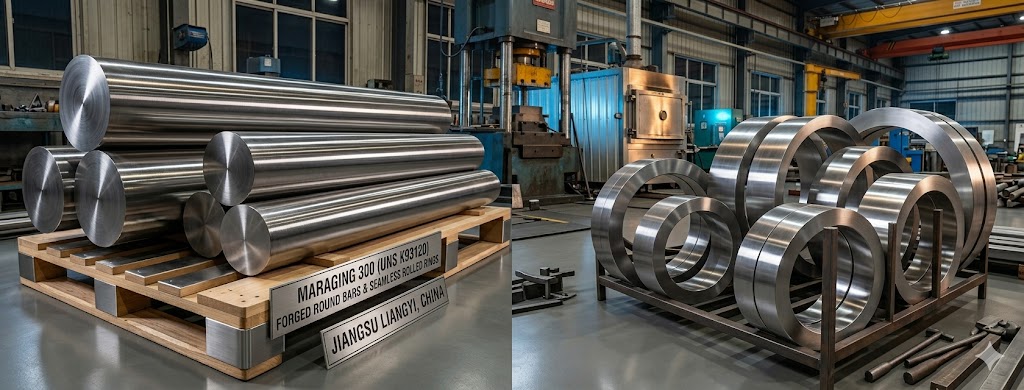
Maraging 300 (UNS K93120) takes the opposite route. With carbon deliberately held at ≤0.030%, it forms a soft, ductile iron-nickel martensite on simple air cooling — no quench. Strength is then built by aging at 482°C, where nanoscale Ni₃Mo, Ni₃Ti and Fe₂Mo intermetallics precipitate inside that martensite. Because strength comes from precipitates rather than carbon, Maraging 300 escapes the strength-versus-toughness-versus-weldability trade-off that constrains every conventional alloy steel. This mechanism is covered in depth on our Maraging 300 (UNS K93120) forged parts technical page.
Head-to-head property comparison
The dot marks the more favourable value for each property in typical high-strength forging service. "Better" is context-dependent — read it alongside the sections that follow.
| Property | Maraging 300UNS K93120 | 4340 SteelQ&T, ~50 HRC |
|---|---|---|
| Min. yield strength | 1862 MPa (270 ksi) | ~1379–1600 MPa |
| Tensile strength | ≥1965 MPa | ~1448–1800 MPa |
| Hardness | 50–54 HRC | 42–50 HRC |
| Fracture toughness KIc | ~77 MPa√m | ~35–55 MPa√m |
| Carbon content | ≤0.030% | 0.37–0.43% |
| Weldability | Excellent, no preheat | Difficult, 200–320°C preheat + PWHT |
| Distortion on hardening | <0.02% (aging) | 0.1–0.3% (quench) |
| H₂S / SCC (NACE MR0175) | Compliant to 54 HRC | Poor at high hardness |
| Max service temperature | ~538°C | ~300°C |
| Machinability (soft) | Good (28–32 HRC) | Good, lower cost |
| Relative raw material cost | High | Low |
Strength and consistency
On peak strength, Maraging 300 wins outright: a guaranteed 1862 MPa yield minimum, with production lots from clean VIM+VAR material routinely reaching 1930–2000 MPa. You can push 4340 toward higher hardness, but its practical strength ceiling is lower, and every step up the hardness scale erodes its toughness and fatigue behaviour faster than it does for Maraging 300.
Consistency matters as much as the peak. 4340's final properties depend on quench severity, section size and temper control, so a thick forging can show a soft, lower-strength core (hardenability limits). Maraging 300 develops its strength through a low-temperature age that penetrates the full section almost uniformly — a 300 mm block ages to essentially the same properties at the centre as at the surface.
Toughness at hardness — the trade-off 4340 can't escape
This is where the metallurgy shows. At equivalent hardness, Maraging 300 holds a fracture toughness of roughly 77 MPa√m — dramatically higher than a conventional alloy steel taken to the same hardness. For a rotating disk or a downhole shaft, that toughness is a damage-tolerance margin: a small undetected surface flaw can be tolerated under design load instead of triggering fast fracture.
Weldability: the fabrication dividing line
For anything welded — multi-piece structures, field assembly, weld repair — this is often the deciding factor. Maraging 300's ultra-low carbon means no HAZ cold-cracking risk and no preheat: weld it in the soft solution-annealed condition with TIG and a maraging filler, then age. The joint recovers 90–95% of base-metal strength.
4340, with ten times the carbon, demands 200–320°C preheat, tightly controlled heat input and mandatory post-weld stress relief — and still carries real HAZ cracking risk if any parameter drifts. For a subsea valve body assembled on-site, that difference is a project-schedule decision, not an academic one.
Distortion and dimensional control
4340's oil quench causes 0.1–0.3% dimensional change plus warpage and residual stress, so precision parts must be hard-machined or ground to tolerance after hardening — slow, tool-hungry work at 50 HRC with grinding-burn risk.
Maraging 300 changes by less than 0.02% during aging. The workflow becomes: semi-finish machine soft at 28–32 HRC with standard carbide tooling, age to full hardness, then a light finishing pass. For a precision impeller or valve plug held to microns, that is a genuine manufacturing advantage that offsets part of the raw-material premium.
Fatigue life and cleanliness
Fatigue is inclusion-driven, and this is a melting-route story. Maraging 300 for critical work is double-vacuum melted (VIM+VAR), reaching an A1B0C0D0 inclusion rating comparable to aerospace titanium — which lifts high-cycle fatigue strength well above single-melt material. 4340 is typically air- or single-vacuum melted; its fatigue life is sensitive to inclusion content and to surface decarburisation during heat treatment, both of which must be controlled to avoid early crack initiation.
Corrosion and sour (H₂S) service
NACE MR0175/ISO 15156 caps most low-alloy steels at 22 HRC for sour service — which effectively bars high-hardness 4340 from H₂S environments, because sulfide stress cracking initiates at its iron-carbide interfaces. Maraging 300 is explicitly permitted up to 54 HRC: with essentially no carbides to trap hydrogen, its iron-nickel martensite resists SSC by a different physical mechanism. For sour valves, wellheads and downhole tools, this alone often eliminates 4340 from consideration.
Elevated-temperature behaviour
4340 begins to over-temper and soften as service temperature climbs past a few hundred degrees, limiting it to roughly 300°C for sustained load. Maraging 300 retains useful strength to about 538°C short-term, thanks to the thermal stability of its Ni₃Ti precipitates — though for continuous service near the 482°C aging temperature, creep and slow over-aging must be evaluated with stress-rupture data.
Cost: raw price vs total cost of ownership
On raw material there is no contest — low-alloy 4340 is several times cheaper than Maraging 300, which carries 18–19% nickel, 8.5–9.5% cobalt, 4.5–5% molybdenum and a double-vacuum melting cost. If the design is a large, simple, cost-driven forging and 4340's properties are sufficient, 4340 is the pragmatic answer.
But raw price isn't total cost. For precision, weight-critical or welded parts, Maraging 300 can lower finished-part cost: machine-soft-then-age eliminates hard grinding, no-preheat welding cuts fabrication time, and near-zero distortion improves yield. Compare cost at the finished, installed-part level — not at the kilogram of bar stock.
When to specify each alloy
Choose Maraging 300
- You need the highest, most consistent yield strength through-section
- The part is welded or field-repaired
- Tight dimensional tolerances / minimal heat-treat distortion
- Sour H₂S service requiring NACE MR0175 compliance
- Weight-critical rotating parts — aerospace disks, downhole mandrels
- Service temperatures above ~300°C
Choose 4340
- Cost is the primary constraint and ~1400 MPa yield is adequate
- Large, simple structural forgings within hardenability limits
- No sour service and no field welding required
- Relaxed tolerances that tolerate quench distortion
- Well-established, widely second-sourced material is preferred
- Gears, crankshafts, axles, heavy-machinery shafts
Many programs use both: 4340 for the bulk structural parts and Maraging 300 for the few components where strength, toughness, weldability or sour resistance genuinely converge. If you're unsure which side a specific part falls on, send us the drawing and duty cycle — our metallurgical team will advise before you commit a specification.
Frequently asked questions
Is Maraging 300 stronger than 4340?
Yes. Maraging 300 guarantees a minimum yield of 1862 MPa (270 ksi) versus roughly 1379–1600 MPa for quenched-and-tempered 4340 — and, crucially, it holds that strength with much higher fracture toughness (~77 vs ~55 MPa√m) at equivalent hardness, so the strength is usable rather than brittle.
Can I substitute Maraging 300 into an existing 4340 forging design?
Frequently the geometry can carry over, but treat it as a design review rather than a drop-in. Maraging 300's higher strength often lets you reduce section or mass, and its processing (age at 482°C, no quench) and welding rules differ completely from 4340's quench-and-temper cycle. Re-check stress, fatigue and heat-treat call-outs.
Why is Maraging 300 several times more expensive than 4340?
Its chemistry is loaded with expensive elements — 18–19% nickel, 8.5–9.5% cobalt, 4.5–5% molybdenum — and critical grades are double-vacuum melted by VIM+VAR. 4340 is a lean low-alloy steel that is usually air-melted, so its raw cost is far lower. Compare total finished-part cost, where Maraging 300 narrows the gap on precision and welded parts.
Which alloy has better fatigue life in a forged shaft?
VIM+VAR Maraging 300 generally wins on high-cycle fatigue because its microstructure is extremely clean and homogeneous with very few inclusions (A1B0C0D0 rating). 4340 fatigue is achievable but more sensitive to inclusion content, surface finish and decarburisation, which must be tightly controlled.
Can both alloys be forged with the same equipment?
Both are open-die forged, but Maraging 300 has a narrower working window and benefits from higher reduction ratios (4:1–5:1) and careful thermocouple-controlled heating; finishing below ~950°C risks cracking. 4340 is more forgiving. The heat-treatment routes differ entirely — quench-and-temper for 4340, solution-anneal-plus-age for Maraging 300.
What standards apply to Maraging 300 and 4340 forgings?
Maraging 300 is specified to AMS 6514 / AMS 6512 / ASTM A538 Grade C (UNS K93120); as a low-carbon maraging grade it is eligible for H₂S sour service under NACE MR0175 (documented per order), with ultrasonic acceptance to ASTM A388. 4340 is specified to AMS 6415 / ASTM A29 (UNS G43400). Both are tensile-tested to ASTM E8 and hardness-tested to ASTM E18. These are the specifications parts are made and tested to; the company's held certification is ISO 9001:2015.
Standards cited in this guide
These are the industry specifications referenced in this comparison. Jiangsu Liangyi manufactures and tests to the relevant material specifications and documents the results on the material test report (MTR) supplied with each order. The company's own quality-management certification is ISO 9001:2015; the standards below are manufacturing and testing specifications, not third-party certifications held by the company.
- AMS 6514 — primary material specification for Maraging 300 (UNS K93120) forging and bar stock.
- ASTM A538 Grade C — precipitation-hardening (maraging) steel, 18Ni-300 grade.
- AMS 6415 / ASTM A29 — AISI 4340 alloy steel bars and forging stock (UNS G43400).
- NACE MR0175 / ISO 15156 — materials qualified for H₂S-containing (sour) oil and gas service.
- ASTM A388 — ultrasonic examination of heavy steel forgings (Class A / AA acceptance).
- ASTM E8 / ASTM E18 — tensile testing and Rockwell hardness testing of metallic materials.