Maraging 300 (UNS K93120) Forged Forging Parts | China ISO 9001:2015 Certified Manufacturer
Jiangsu Liangyi Co., Limited is a leading professional manufacturer of Maraging 300 (UNS K93120, Maraging C-300) open die forging parts, seamless rolled rings, and precision forged components in China. This alloy is also widely known in the industry under the trade name VASCOMAX® 300 (a registered trademark of Carpenter Technology Corporation) — our products are manufactured to the same UNS K93120 / AMS 6514 material specification. With over 25 years of focused experience in specialty alloy forgings, our in-house capability spans the complete manufacturing chain: from VIM+VAR double vacuum melting and large-tonnage open die forging, to precision CNC machining, age hardening heat treatment, and comprehensive non-destructive testing. We supply certified Maraging 300 forged products to engineering teams and procurement departments in more than 50 countries across North America, Europe, the Middle East, Asia Pacific, Latin America, and Africa.
Unlike general forging manufacturers who treat Maraging 300 as just another alloy steel, our team has built specific process expertise in this material's unique metallurgical behavior — including its narrow forging temperature window, the sensitivity of its aging response to section thickness, and the critical importance of double vacuum melting quality on final fatigue performance. This page shares that technical knowledge openly, because we believe that engineering-grade information is the foundation of long-term supplier relationships.
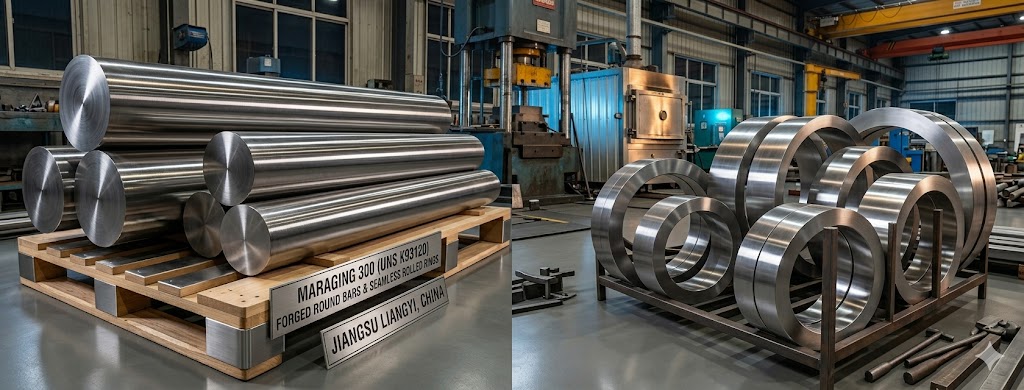
Maraging 300 Forged Bars & Seamless Rolled Rings
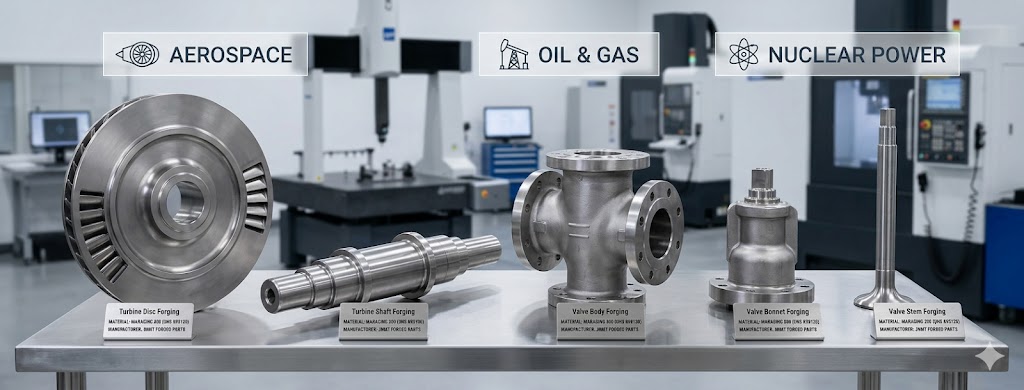
Maraging 300 (UNS K93120) Turbine & Valve Forged Components
What is Maraging 300 (UNS K93120) Steel? A Metallurgical Explanation
The name "Maraging" is a contraction of two metallurgical terms: Martensite + Aging. This portmanteau precisely describes the two-step mechanism by which this alloy achieves its extraordinary properties — and understanding this mechanism is essential for specifying and processing the material correctly.
Step 1: Martensite Formation (No Quench Required)
When Maraging 300 is solution annealed at 816°C and then simply air cooled to room temperature, it spontaneously transforms to a body-centered cubic (BCC) iron-nickel martensite. Unlike conventional high-carbon martensite, this transformation does not require rapid water or oil quenching — because the martensite start temperature (Ms) is approximately 200°C (390°F), the transformation is self-completing even at slow cooling rates. The resulting martensite is soft (28–32 HRC), ductile, and free of the quench cracking risk that plagues conventional alloy steels.
Step 2: Precipitation Hardening (The Aging Mechanism)
When the solution annealed material is reheated to 482°C (900°F) for 3 hours, fine intermetallic precipitates nucleate coherently within the martensite matrix. The primary hardening precipitates in Maraging 300 are:
- Ni₃Mo — the dominant strengthening phase, providing the majority of yield strength increase
- Fe₂Mo (Laves phase) — contributes to hardness at longer aging times
- Ni₃Ti — refines the precipitate distribution and contributes to elevated temperature strength retention
- Co₂Mo — forms at longer aging times; cobalt's primary role is to reduce Mo solubility in the matrix, dramatically accelerating precipitation kinetics
These nanometer-scale precipitates obstruct dislocation movement, raising yield strength from approximately 690–760 MPa in the soft annealed condition to a minimum of 1862 MPa (270 ksi) after standard aging — a strength increase of nearly 150% with no dimensional change exceeding 0.02% and no quench distortion whatsoever.
What Makes Maraging 300 Fundamentally Different from Conventional High-Strength Steels
High-strength alloy steels like 4340 or H13 derive their strength from a combination of martensite hardness (controlled by carbon content) and tempered carbide precipitates. This means that increasing strength requires increasing carbon content — which simultaneously degrades weldability, toughness, and corrosion resistance. Maraging 300 breaks this trade-off entirely. Its carbon content is deliberately kept at ≤0.030% (ten times lower than 4340), so all strength comes from the intermetallic precipitation mechanism. The result is a material that simultaneously offers ultra-high strength, excellent toughness, outstanding weldability, and stable corrosion resistance — a combination simply unavailable in the conventional alloy steel paradigm.
Engineering Insight: The "300" in Maraging 300 refers to its nominal strength target of 300 ksi (~2068 MPa) — the original design goal. However, in practice, AMS 6514 specifies a minimum yield strength of 1862 MPa (270 ksi) as the acceptance criterion, reflecting conservative engineering practice. Actual production lots from VIM+VAR melted material routinely achieve 1930–2000 MPa, and we report the actual certified values on each material test report rather than just the specification minimum.
Why VIM+VAR Double Vacuum Melting is Non-Negotiable for Maraging 300
Many forging suppliers offer Maraging 300 without specifying the melting route. This is a critical omission that engineering procurement teams should not overlook. The melting process is the single most important determinant of fatigue life and fracture toughness in a finished Maraging 300 forging.
The Problem with Single-Vacuum or Air-Melt Material
Maraging 300's high alloy content — 18–19% Ni, 8.5–9.5% Co, 4.5–5% Mo — creates severe macro-segregation during conventional solidification. Nickel, cobalt, and molybdenum all have partition coefficients significantly different from iron, meaning they redistribute unevenly between the solidifying solid and the remaining liquid. The result in a conventionally melted ingot is: composition gradients from surface to center exceeding 2% for Ni and 0.5% for Mo, centerline porosity and pipe shrinkage, and elevated inclusion counts from oxide and sulfide reactions with atmospheric gases. All of these defects reduce fatigue life (sometimes by more than 50%) and create scatter in mechanical properties that makes consistent quality impossible.
How VIM+VAR Eliminates These Problems
- VIM (Vacuum Induction Melting): Melting under vacuum reduces dissolved hydrogen to below 1 ppm (vs 3–5 ppm for air-melt), nitrogen below 20 ppm, and oxygen below 10 ppm. Precise composition control is achieved within the tight AMS 6514 chemistry window by adjusting additions under full vacuum monitoring. The result is a clean VIM ingot with minimal inclusions and exact target composition.
- VAR (Vacuum Arc Remelting): The VIM ingot is then used as a consumable electrode in a VAR furnace, remelting under high vacuum against a water-cooled copper crucible. This forces directional solidification from the bottom up, eliminating macro-segregation through controlled solute redistribution, closing all porosity and pipe, and producing a fully homogeneous ingot with uniform grain structure from surface to center.
- Measurable result: VIM+VAR Maraging 300 achieves an inclusion rating of A1B0C0D0 per ASTM E45 — comparable to aerospace-grade titanium alloys. This directly translates to high-cycle fatigue strength improvements of 20–35% compared to ESR (Electroslag Remelted) or single vacuum material of nominally identical composition.
Procurement Warning: When purchasing Maraging 300 forgings, always specify "VIM+VAR double vacuum melting" in your purchase order and request the melting route to be declared on the Material Test Report. Forgings produced from ESR-only or VIM-only material may meet the chemistry requirements of AMS 6514 while falling significantly short of the fatigue and fracture toughness performance that the standard's intent assumes. Jiangsu Liangyi uses exclusively VIM+VAR material and documents the full melting history on every MTR.
Maraging 300 vs Competing Ultra-High-Strength Materials: Engineering Comparison
Selecting the right ultra-high-strength material for a critical forged component requires comparing not just strength, but the complete set of properties that govern component life and manufacturability. The table below provides an honest, data-driven comparison of Maraging 300 against the most common competing materials in industrial applications:
| Property | Maraging 300 (UNS K93120) | Maraging 250 (UNS K92890) | 4340 Steel (Q&T) | 17-4PH (H900) | H13 Tool Steel (Hardened) |
|---|---|---|---|---|---|
| Min. Yield Strength | 1862 MPa | 1724 MPa | 1379 MPa | 1172 MPa | ~1600 MPa |
| Min. Tensile Strength | 1965 MPa | 1793 MPa | 1448 MPa | 1310 MPa | ~1700 MPa |
| Hardness (HRC) | 50–54 | 46–50 | 42–46 | 40–44 | 48–52 |
| Fracture Toughness KIc | ~77 MPa√m | ~110 MPa√m | ~55 MPa√m | ~50 MPa√m | ~25 MPa√m |
| Min. Elongation | ≥10% | ≥12% | ~10% | ~10% | ~8% |
| Carbon Content | ≤0.030% | ≤0.030% | 0.37–0.43% | ≤0.07% | 0.32–0.45% |
| Weldability | Excellent (No preheat) | Excellent (No preheat) | Difficult (200–320°C preheat) | Good (Low preheat) | Very Difficult (400°C+ preheat) |
| Dimensional Change on Hardening | <0.02% | <0.02% | 0.1–0.3% (quench) | ~0.05% | 0.1–0.4% |
| H2S / SCC Resistance | Excellent (NACE MR0175 ✓) | Excellent (NACE MR0175 ✓) | Poor at high hardness | Good | Poor |
| Max. Service Temperature | 538°C (1000°F) | 480°C | 300°C | 316°C | 600°C+ |
| Machinability (annealed) | Good (28–32 HRC) | Good | Moderate | Moderate | Difficult |
| Applicable Standards | AMS 6514, AMS 6512, ASTM A538 C | AMS 6512, ASTM A538 B | AMS 6415, ASTM A29 | AMS 5604, ASTM A564 | ASTM A681 |
| Relative Material Cost | High | Medium-High | Low | Medium | Medium |
Selection Guidance: Maraging 300 is the correct choice when you need the highest possible yield strength AND require at least two of the following: excellent weldability, dimensional stability during hardening, H2S/SCC resistance, or elevated temperature performance above 300°C. If toughness (KIc) is the primary criterion over absolute strength, consider Maraging 250. If cost is the primary constraint and dimensional tolerances are relaxed, 4340 remains the pragmatic option — but its weldability limitations and quench distortion must be managed accordingly.
Five Engineering Advantages of Maraging 300 Forgings That Competitors Rarely Discuss in Full
1. Ultra-High Strength with Engineering-Relevant Toughness (Not a Trade-Off)
The common misconception in material selection is that ultra-high strength always means brittle failure. For conventional alloy steels, this is largely true: increasing carbon and alloy content for strength reduces fracture toughness. Maraging 300 challenges this assumption directly. Its fracture toughness KIc of approximately 77 MPa√m at full aged hardness (50–54 HRC) is 40–50% higher than comparably hard conventional alloy steels like H13 (~25 MPa√m) or even 4340 at equivalent hardness (~35 MPa√m). For a turbine disk or downhole motor shaft, this means that if a small surface crack or manufacturing defect is present (as ASTM A388 UT acceptance allows), the component can still carry its design load without catastrophic fracture — providing a safety margin that conventionally strong materials simply cannot match at this hardness level.
2. Weldability: A Structural Game-Changer for Field Assembly and Repair
In oilfield and power generation applications, the ability to weld a component without lengthy preheat procedures or post-weld heat treatment cycles directly reduces installation costs and schedule risk. With 4340 or H13, weld repair in the field requires 200–400°C preheat, controlled heat input, mandatory post-weld stress relief at 150–200°C, and still carries significant HAZ cracking risk if any of these parameters drift. Maraging 300 forgings can be TIG-welded without preheat, at normal ambient temperature, with no post-weld stress relief required before aging. After standard aging at 482°C × 3h, the weld joint achieves 90–95% of base metal yield strength with no cold-crack risk. For a subsea valve body being assembled in a Norwegian fjord at -10°C, this difference is not academic — it is a project schedule decision.
3. Dimensional Stability: The Precision Engineer's Advantage
The volumetric change during aging is less than 0.02% — two orders of magnitude smaller than the 0.1–0.3% shrinkage that accompanies quenching of conventional alloy steels. In practical terms, this means a Maraging 300 valve plug or compressor impeller can be semi-finish machined in the annealed condition (at 28–32 HRC, using standard carbide tooling), then aged to full hardness, with only a final light grinding pass needed to reach final drawing dimensions. For a precision impeller with 10μm profile tolerances, this eliminates the rough grinding of a fully hardened workpiece at 50 HRC — reducing tool wear, machining time, and the risk of grinding burn and surface residual stress induction that can initiate fatigue cracking in service.
4. H2S and Stress Corrosion Resistance: Why NACE MR0175 Compliance Matters
NACE MR0175/ISO 15156 specifies a maximum hardness limit of 22 HRC (approximately 250 HV) for most carbon and low-alloy steels applied in H₂S sour service. This limit effectively bars all conventional high-strength alloy steels from sour oilfield applications.
The standard explicitly permits Maraging steels up to 54 HRC. It acknowledges that their precipitation-hardened iron-nickel martensite structure has an entirely different resistance to Sulfide Stress Cracking (SSC) compared with carbon martensite.This is not a loophole or conditional exemption; it comes down to material physical properties. SSC in ordinary steels occurs mainly due to hydrogen trapping along iron carbide boundaries, a mechanism nearly eliminated in Maraging 300 thanks to its ultra-low carbon composition. As a result, it is the only ultra-high-strength forging material that fully meets NACE requirements for sour gas service with no hardness limitation.
5. Full Traceability: Satisfying Nuclear, Aerospace, and IOC/NOC Audit Requirements
For nuclear island components, certified aerospace forgings, and oil and gas operator-approved valve parts (Saudi Aramco, ADNOC, Shell, BP), full material traceability from raw ingot to finished part is not a selling point — it is a non-negotiable regulatory requirement. Our VIM+VAR melting process assigns a unique heat number to every ingot, carried through billet preparation, forging, heat treatment (with time-temperature recorder printout for every furnace charge), NDT, and machining. This chain of custody is documented in a single complete dossier that we maintain for a minimum of 10 years, available for customer and third-party auditor review at any time. Partial heat lot material — purchased from distributors without direct mill identification — cannot meet this traceability requirement regardless of the chemistry.
Full Range of Maraging 300 Forged Steel Products (UNS K93120)
We manufacture custom Maraging 300 forged products across five primary product families, with single-piece weight from 30 kg to 30 tons. All products are available in solution annealed (ST) condition for customer machining and aging, or fully heat treated and aged (STA) with certified mechanical properties:
- Forged Bars & Rods: Maraging 300 forged round bars, square bars, flat bars, and step shafts. Maximum diameter up to 2000mm; standard bar diameters 50–600mm in stock for fast delivery. Forging reduction ratio ≥4:1 throughout full cross-section. Full UT per ASTM A388 Class A or AA. Straightness: ≤1mm/m standard; ≤0.5mm/m for precision shaft applications.
- Seamless Rolled Rings: Maraging 300 (UNS K93120) seamless rolled forged rings, gear rings, flanged rings, and contoured profile rings. Outer diameter range: 300mm–6000mm; wall thickness: 50mm–800mm; height: 100mm–2000mm. Concentricity within 0.3% of OD for valve body and casing applications. UT per ASTM A388.
- Hollow Forgings & Sleeves: UNS K93120 forged sleeves, bushings, housings, hollow bars, mandrels, and seamless heavy-wall tube forgings. For downhole tool mandrels, we forge to a 5:1 minimum reduction ratio for maximum fatigue resistance. ID/OD concentricity tolerance ±0.5mm standard.
- Discs, Blocks & Plates: Maraging C300 forged discs, impeller blanks, flange blanks, and rectangular blocks. Maximum disc diameter 2500mm; maximum block dimensions 3000 × 1500 × 1000mm. Macro-etch inspection on cut cross-sections available on request to verify microstructural uniformity.
- Complex Custom Open Die Forgings: Valve bodies, pump casings, turbine impeller preforms, compressor rotor blanks, structural aerospace forgings. We work directly from your 3D STEP/IGS or 2D DXF drawings to develop a forging plan, preform design, and tooling within 2 weeks. Prototype lead time: 45–60 days; production lead time: 30–90 days depending on weight and complexity.
Maraging 300 Heat Treatment: A Precise Engineering Guide
Maraging 300's heat treatment is simpler than conventional alloy steels but more sensitive to time-temperature parameters than many engineers realize. Deviating from the recommended conditions — particularly aging temperature and time — has a disproportionate effect on final properties. Below is the complete heat treatment specification with the engineering rationale behind each parameter.
Stage 1: Solution Annealing
- Temperature: 816°C ± 8°C (1500°F ± 15°F)
- Time: Minimum 1 hour per 25mm (1 inch) of maximum cross-section thickness; minimum absolute time 1 hour
- Atmosphere: Air, vacuum, or inert gas (argon/nitrogen) — inert atmosphere preferred for surface-finish-critical components
- Cooling: Air cool to room temperature (no quench medium required or beneficial)
- Result: Single-phase iron-nickel martensite, hardness 28–32 HRC, fully machinable
- Why 816°C specifically: Below ~790°C, undissolved molybdenum and titanium compounds persist, reducing the aging response and causing property scatter. Above ~850°C, austenite grain growth begins, reducing final toughness. The 816°C ± 8°C window balances complete dissolution against grain size control.
Stage 2: Age Hardening
- Temperature: 482°C ± 5°C (900°F ± 10°F)
- Time: 3 hours for sections up to 150mm; 6 hours for sections 150–300mm; consult engineering for sections exceeding 300mm
- Atmosphere: Air acceptable; inert gas (N₂ or Ar) eliminates surface oxidation for components where the aged surface is a final bearing or sealing surface
- Cooling: Air cool — rate is not critical after aging
- Achieves: Yield strength ≥1862 MPa, hardness 50–54 HRC
Critical Warning: The Overaging Phenomenon
Overaging Risk: If the aging temperature exceeds approximately 510°C, or if the component is held at 482°C for more than 8–10 hours, overaging occurs. The intermetallic precipitates coarsen (Ostwald ripening), lose coherency with the martensite matrix, and the yield strength drops — sometimes dramatically. At 538°C × 3h, yield strength can fall by 15–20% to approximately 1550–1600 MPa. At 593°C × 3h, the drop can exceed 30%. This is particularly important for components that see elevated temperature in service (e.g., turbine disks, exhaust valve seats): the component design temperature must remain below the aging temperature to prevent in-service overaging and unplanned strength reduction.
Re-Solutioning and Re-Aging
One unique advantage of Maraging 300 over conventional alloy steels is that it can be re-solution annealed and re-aged once, effectively "resetting" the material's properties if required dimensional corrections or weld repairs are needed after initial aging. The second aging response is essentially identical to the first, without significant grain growth penalty for the first re-solution cycle. This repairability is not available with conventionally hardened alloy steels and provides a valuable safety net for expensive, large-section forgings.
Welding Maraging 300: Practical Parameters and Best Practices
Maraging 300's weldability is one of its most commercially valuable properties, enabling field assembly, repair-welding, and joining of complex multi-piece structures without the preheat and cracking risks that accompany high-carbon alloy steel fabrication. Below are the practical welding parameters that our engineering team has validated through production experience:
| Parameter | GTAW (TIG) — Preferred | GMAW (MIG) — Acceptable | Notes |
|---|---|---|---|
| Preheat Temperature | None required | None required | Unique advantage over 4340 (200–320°C preheat), H13 (400°C+) |
| Interpass Temperature | ≤150°C | ≤150°C | Excessive interpass temperature risks grain growth in HAZ |
| Filler Wire | ER Maraging 200/250 or matching composition | Maraging 250 solid wire | Slightly undermatched filler (M250) provides optimal HAZ ductility |
| Shielding Gas | 100% Ar (DCEN) | Ar + 2% O₂ | Avoid CO₂ — risk of carbon pick-up |
| Joint Condition | Solution annealed (ST) condition strongly preferred over aged (STA) | ST condition is softer, more ductile, lower residual stress after welding | |
| Post-Weld Heat Treatment (PWHT) | Optional: re-solution at 816°C + age at 482°C × 3h for critical joints | Direct aging without re-solution achieves ~85–90% of base metal strength | |
| Weld Joint Strength After Aging | 90–95% of base metal | 85–90% of base metal | After GTAW + re-solution + age; far superior to conventional steel weld joints |
One common fabrication error is to attempt welding of Maraging 300 in the fully aged (STA, 50–54 HRC) condition. While the base material itself is not prone to HAZ cracking (due to low carbon), welding aged material introduces high residual stresses into a zone that cannot further redistribute through ductile deformation — potentially causing delayed cracking in large-section joints. We strongly recommend all welding be performed in the solution annealed condition, followed by a complete re-aging cycle.
Global Industry Applications & GEO-Targeted Project Cases of Maraging 300 Forgings
Our Maraging 300 (UNS K93120) forging parts serve critical functions in sectors where component failure has catastrophic consequences. Below we describe the specific engineering reasons why Maraging 300 is chosen in each sector, alongside regional project examples from our 25+ years of global supply experience.
Aerospace & Turbomachinery: Where Strength-to-Weight Ratio and Fatigue Life Are Non-Negotiable
In turbomachinery, every kilogram of rotating mass imposes centrifugal stress on the disk and blade root attachment — proportional to the square of rotational speed. Replacing a 4340-grade turbine disk with a Maraging 300 forging at the same design stress allows a 20–25% reduction in disk mass, which in turn reduces bearing loads, shaft deflections, and overall engine weight. More importantly, the KIc of ~77 MPa√m means that a disk with an undetected surface crack of 2mm depth can sustain its full design centrifugal load without fast fracture — while the same crack in a comparable 4340 disk would be at or beyond the critical crack size. This "damage tolerance" design approach is mandated by modern aerospace certification standards and is a primary driver of Maraging 300 adoption in aerospace disks and shaft applications.
Core Products & Regional GEO Applications
- North American Market: Maraging 300 forged turbine disks, compressor impellers, and blisks for US and Canadian aerospace and power generation projects, fully compliant with ASME BPVC and AMS 6514 standards. Certified by Bureau Veritas or SGS third-party inspectors per customer requirements.
- European Market: Maraging 300 (UNS K93120) turbine blades, labyrinth shaft seals and gas turbine casings for German, French and Italian power plants, with EN 10204 Type 3.2 mill test certificates countersigned by TÜV or Lloyd's Register. The CE certification (PED 2014/68/EU) is the responsibility of the equipment manufacturer, we support their process with full material documentation.
- Asia Pacific Market: UNS K93120 Steam turbine valve spindles, control reheat valve discs and MSV/GV/CV/CRV valve seats for thermal and nuclear power plants in China, Japan and South Korea. To JIS B 2220 and GB standards. Full heat treatment records and UT reports in Chinese available on request.
- Latin American & African Markets: Maraging C-300 forged turbo centrifugal compressor impellers, shrouded impellers, and gas compressor rotors for industrial projects in Brazil, Mexico, Nigeria, and South Africa, delivered with dual-language (English/Portuguese or English/French) mill test documentation where required.
Oil & Gas, Valve & Downhole Equipment: Where H2S, High Pressure, and Fatigue Converge
Downhole tool mandrels and mud motor splined shafts represent perhaps the most mechanically demanding application for any forged material. A mud motor shaft at 5000m depth simultaneously experiences: torsional fatigue stress from bit torque cycling at 10–100 Hz; bending fatigue from lateral wellbore curvature; axial tension from tool string weight; and exposure to drilling mud that often contains H2S and chloride ions. No conventional high-strength alloy steel can meet all four of these requirements simultaneously — high-carbon martensitic steels fail in H2S, austenitic stainless steels lack sufficient strength, and precipitation-hardening grades offer insufficient fatigue resistance. Maraging 300 satisfies all four: 1862 MPa yield strength resists torsional yield, KIc of 77 MPa√m provides safe-life fatigue tolerance, ultra-low carbon eliminates SSC susceptibility per NACE MR0175, and the forged wrought microstructure (vs casting) provides the grain flow alignment needed for maximum axial fatigue strength.
Core Products & Regional GEO Applications
- Middle East Market: UNS K93120 forged valve balls, bodies, stems, seat rings, and bonnet flanges for ball valves, gate valves, check valves, and choke valves used in Saudi Aramco, ADNOC, KOC, and QatarEnergy onshore and offshore projects. All parts manufactured per Saudi Aramco SAMSS/SAES material specification requirements and NACE MR0175 compliance documentation provided.
- North American Market: Maraging 300 downhole mud motor splined drive shafts, ESP motor splined shafts, double studded adapter (DSA) flanges, and directional drilling tool mandrels for US Permian Basin shale oil and Canadian oil sands SAGD projects. Full UT per ASTM A388 Class AA required — provided as standard.
- European Market: Maraging C-300 cryogenic high-performance butterfly valve (HPBV) shafts and LNG loading arm joint pins for LNG terminal projects in Norway, the Netherlands, and the UK, with charpy impact testing at -196°C (liquid nitrogen temperature) where specified. EN 10204 Type 3.2 MTR with TÜV or Lloyd's countersignature available to support customer's PED 2014/68/EU compliance process.
- Global Market: Maraging 300 oil measurement valve spools, ultrasonic flow meter body forgings, and custody transfer metering skid components for petrochemical and LNG projects in over 30 countries, with full API 6A and API 6D compliance documentation.
Nuclear Power: Where Material Traceability and Radiation Stability Are Certification Requirements
Nuclear power applications impose the most stringent material qualification requirements of any industrial sector. In most nuclear regulatory frameworks (including ASME NQA-1, RCC-M, and IAEA safety standards), the forging manufacturer must be a pre-qualified vendor on the nuclear utility's Approved Vendor List (AVL), with full QA documentation demonstrating process control from raw material receipt through final inspection. Maraging 300's combination of ultra-high strength, moderate to good radiation stability (nickel-cobalt-iron alloys show significantly lower radiation-induced hardening than ferritic pressure vessel steels at equivalent dose levels), and 100% full material traceability from VIM+VAR heat to finished component makes it the material of choice for specific high-load nuclear reactor components where conventional stainless steels lack sufficient strength.
Core Products & Regional GEO Applications
- Maraging 300 (UNS K93120) forged nuclear reactor coolant pump (RCP) rotor impellers for Generation II and III pressurized water reactor (PWR) plants in China and Europe, with full NDE to ASME Sec. V and ASTM E2375 acceptance criteria.
- Maraging C-300 forged RCP casing sections, motor shell segments, containment boundary seal housings, and mechanical seal cartridge bodies, with complete ITP (Inspection and Test Plan) and AS-BUILT package for nuclear regulatory submission.
- Maraging 300 forged pressure vessel nozzle forgings, tube sheet blanks, and channel end closures for nuclear steam supply system (NSSS) heat exchangers and pressurizers, with material chemistry and mechanical testing per the applicable RCC-M or ASME Sec. III article requirements.
General Industrial & Heavy Machinery: 50+ Countries, 25+ Sectors
Beyond the headline industries, we supply custom Maraging 300 forged components to precision tooling manufacturers (where dimensional stability during aging enables tighter tool-life tolerances), to high-pressure pump OEMs (where 1862 MPa yield strength allows smaller-envelope cylinder designs), and to marine equipment builders (where weight reduction on rotating components reduces vessel fuel consumption over a 20-year service life). Full EN 10204 3.1 MTR certification is included as standard for all products; 3.2 (third-party countersigned) available upon request with 5–7 additional working days for inspection scheduling.
Core Products & Regional GEO Applications
- Maraging C-300 forged pump casings, high-pressure barrels, impeller discs, shaft sleeves, and wear rings for global industrial pump and compressor OEMs in Germany, Italy, and the US.
- Maraging 300 (UNS K93120) forged venturi cone meter bodies, differential pressure transmitter flanges, and orifice plate holders for flow metering applications in process plants across Asia, Europe, and the Americas.
- Maraging 300 forged precision die inserts, forging dies, and cold heading tooling — where the combination of high hardness (50–54 HRC) and superior toughness (vs conventional H13) extends tool life by 30–60% in demanding cold-forming operations.
- Oceania Market: UNS K93120 forged components for Australian mining mill equipment — specifically high-torque drive shaft flanges for large SAG and ball mill drives — compliant with AS 1210 and AS 3992 material requirements. Delivered with full Lloyds Register or DNV-GL inspection endorsement available.
Maraging 300 (UNS K93120) Chemical Composition, Elemental Roles & Certified Specifications
Our Maraging 300 steel fully complies with AMS 6514, AMS 6512, and ASTM A538 Grade C. The composition is precisely controlled within the narrow AMS specification window — not simply "within spec," but targeting the optimal composition band that our 25 years of processing experience has identified for maximum aging response and fracture toughness balance.
| Element | Weight % Range | Element | Weight % Range |
|---|---|---|---|
| Nickel (Ni) | 18.0 – 19.0 | Cobalt (Co) | 8.5 – 9.5 |
| Molybdenum (Mo) | 4.5 – 5.0 | Titanium (Ti) | 0.5 – 0.7 |
| Aluminum (Al) | 0.05 – 0.15 | Carbon (C) | ≤ 0.030 |
| Silicon (Si) | ≤ 0.10 | Manganese (Mn) | ≤ 0.10 |
| Phosphorus (P) | ≤ 0.010 | Sulfur (S) | ≤ 0.010 |
| Zirconium (Zr) | ≤ 0.02 | Boron (B) | ≤ 0.0030 |
| Iron (Fe) | Balance | ||
The Engineering Role of Each Key Alloying Element
- Nickel (18–19%): Stabilizes the BCC martensite phase and lowers the martensite finish temperature (Mf) to below room temperature — ensuring complete transformation on air cooling from solution annealing without retained austenite. Also contributes to corrosion resistance and H2S tolerance.
- Cobalt (8.5–9.5%): Cobalt does not form precipitates directly. Its critical function is to reduce molybdenum solubility in the martensite matrix, dramatically increasing the volume fraction of Mo-containing precipitates that form during aging. Without cobalt, Maraging 300's strength would be approximately 300–400 MPa lower. Cobalt also raises the Ms temperature slightly, ensuring martensite forms rapidly on cooling.
- Molybdenum (4.5–5.0%): The primary precipitate-forming element. Mo combines with Ni during aging to form the dominant Ni₃Mo hardening phase. The tight 4.5–5.0% range is critical: below 4.5%, insufficient precipitate volume reduces hardness; above 5.0%, brittle Fe₂Mo (Laves phase) precipitates form preferentially at grain boundaries, reducing toughness.
- Titanium (0.5–0.7%): Forms Ni₃Ti precipitates that increase the number density and refine the distribution of strengthening phases. Ti is particularly important for elevated temperature strength retention: Ni₃Ti precipitates are more thermally stable than Ni₃Mo and resist coarsening (overaging) up to higher temperatures. Too much Ti (>0.8%) leads to TiN and TiC inclusions that reduce fatigue life.
- Aluminum (0.05–0.15%): Deoxidizer during melting; also participates in forming some Al-containing intermetallics at longer aging times. The low Al content distinguishes aerospace Maraging from older commercial grades and avoids brittle AlN formation at grain boundaries.
- Carbon (≤0.030%), Silicon (≤0.10%), Manganese (≤0.10%): All deliberately minimized. Carbon is the primary target: eliminating carbon eliminates iron carbide grain boundary films that cause intergranular brittle fracture in conventional alloy steels and are the primary SSC initiation site in sour gas service. Si and Mn are limited to avoid silicate and manganese sulfide inclusions that reduce fatigue performance.
Complete Mechanical Properties of Maraging 300 Steel — Standard and Elevated Temperature
All Maraging 300 forgings from Jiangsu Liangyi undergo the standard two-step heat treatment (solution anneal 816°C + age 482°C × 3h) before mechanical testing. The following certified minimum values apply to the longitudinal (L) test direction for wrought forgings per AMS 6514. Transverse (T) direction properties are typically 5–10% lower and can be specified separately on request.
Room Temperature Mechanical Properties (after STA Heat Treatment)
| Property | Specification Minimum | Typical Achieved Values | Test Method |
|---|---|---|---|
| Tensile Strength (UTS) | ≥ 1965 MPa (285 ksi) | 2000–2050 MPa | ASTM E8 |
| Yield Strength (0.2% offset) | ≥ 1862 MPa (270 ksi) | 1930–1980 MPa | ASTM E8 |
| Elongation (4D gauge length) | ≥ 10% | 10–12% | ASTM E8 |
| Reduction of Area | ≥ 40% | 50–60% | ASTM E8 |
| Hardness | 50 – 54 HRC | 51–53 HRC | ASTM E18 |
| Charpy V-Notch Impact Energy | ≥ 20 J (15 ft·lbf) | 22–28 J | ASTM E23 at 23°C |
| Fracture Toughness KIc | ~77 MPa√m (typical) | 70–90 MPa√m | ASTM E399 (L-T orientation) |
Elevated Temperature Mechanical Properties
- Tensile Strength at 316°C (600°F): approximately 1655 MPa (240 ksi)
- Tensile Strength at 427°C (800°F): approximately 1517 MPa (220 ksi)
- Tensile Strength at 538°C (1000°F): 1158 MPa (168 ksi)
- Yield Strength at 538°C (1000°F): 1056 MPa (153 ksi)
- Elongation at 316°C (600°F): ≥ 12.0%
- Reduction of Area at 427°C (800°F): ≥ 61.3%
Important Design Note — Elevated Temperature Service: The elevated temperature strength data above reflects short-term tensile properties. For components in continuous service above 300°C, creep and stress rupture behavior must also be evaluated. At 482°C (the aging temperature), sustained loads will cause slow overaging of the microstructure over time scales of thousands of hours. For continuous service at temperatures approaching 430–480°C, stress-rupture testing should be specified and the long-term strength calculated using the Larson-Miller parameter. Contact our engineering team for specific creep data for your temperature-time design point.
Full-Process Manufacturing & Quality Control: How Jiangsu Liangyi Produces Maraging 300 Forgings
Our quality management philosophy for Maraging 300 is built on a simple principle: defects cannot be inspected out — they must be prevented. Every step of our manufacturing process is designed with this in mind, from the choice of VIM+VAR raw material through to the final dimensional inspection before shipment.
Stage 1: Raw Material Control — VIM+VAR Ingot Receipt and Verification
We purchase Maraging 300 ingots exclusively from qualified VIM+VAR melting facilities with a minimum 5-year supply history with our QA department. On receipt, every ingot is verified against the mill certificate for heat number, chemical composition (verified by our in-house OES spectrometer against the ingot chemistry for 100% heat lot confirmation), and surface condition. Ingots failing any criterion are returned to supplier — no exceptions, regardless of lead time pressure.
Stage 2: Billet Preparation — Crop Ratio and Macro-Segregation Verification
Ingot top and bottom crops of minimum 12% each end are removed to discard the highest-segregation zones. For large-diameter ingots (>600mm), a transverse section is cut and macro-etched per ASTM E381 to verify internal soundness before billet allocation to production orders. This pre-forging verification prevents defective material from consuming expensive forging and machining resources.
Stage 3: Forging — Temperature Window and Reduction Ratio Control
Billets are charged into gas-fired or electric furnaces at 1100–1200°C for forging heating. Our certified thermocouple-equipped furnaces maintain ±10°C uniformity across the billet cross-section — critical for large cross-sections where cold cores cause forging-induced cracking. Forging is completed above 950°C; working below this temperature risks adiabatic shear banding and surface cracking from dynamic strain aging, both of which are invisible in the as-forged condition but manifest as fatigue cracks in service. Our standard minimum forging ratio is 4:1; for aerospace disk and downhole shaft applications, we target 5:1 as the standard, with macro-etch sectioning to verify grain flow alignment with the primary stress direction.
Stage 4: Heat Treatment — Precision Time-Temperature Control
Our dedicated heat treatment furnaces are calibrated quarterly per AMS 2750 (Pyrometry) requirements with furnace temperature uniformity surveys (TUS) performed to verify ±5°C control across the working zone. Each heat treatment charge is documented with a continuous time-temperature recorder printout, which becomes part of the permanent traceability record for that batch of forgings. Aging atmosphere is controlled – air or inert gas depending on specification – and parts are loaded to prevent contact and ensure uniform heat penetration.
Stage 5: Non-Destructive Testing (NDT)
- Ultrasonic Testing (UT): 100% volumetric UT per ASTM A388, acceptance Class A (general industrial) or Class AA (aerospace/nuclear) per customer specification. We use contact UT with calibrated angle-beam and straight-beam transducers, with calibration blocks machined from certified Maraging 300 reference material to ensure accurate sensitivity calibration. Phased array UT (PAUT) available for complex geometries on request.
- Dye Penetrant Testing (PT): Per ASTM E165, all machined surfaces are PT-inspected after final machining to detect surface-breaking defects. Sensitivity Level 2 is standard; Level 3 available for aerospace applications.
- Magnetic Particle Testing (MPT): Per ASTM E1444, for surface-finish-critical regions where PT sensitivity is insufficient for fine linear indications.
- Dimensional Inspection: CMM (Coordinate Measuring Machine) inspection for complex geometry forgings; conventional measurement for bars and rings. Full dimensional inspection report with as-manufactured dimensions against drawing tolerances provided for every part.
Stage 6: Mechanical Testing and MTR Certification
Mechanical test samples (test coupons) are taken from the prolongation or integral sacrificial test block of each forging, heat treated in the same furnace charge as the production part, and tested to the following minimum test program: tensile (UTS, YS, elongation, reduction of area per ASTM E8); hardness (Rockwell C scale per ASTM E18 at minimum 3 locations per part); Charpy impact at 23°C where specified; and chemical composition (OES on the forging body, not just the ingot certificate). All results are recorded in a signed and dated MTR per EN 10204 Type 3.1, with Type 3.2 (countersigned by an approved third-party inspection body) available on request.
How to Write a Correct Purchase Specification for Maraging 300 Forgings: An Engineer's Guide
Poorly written purchase specifications are the most common cause of quality disputes and cost overruns in specialty alloy forging procurement. Based on our experience handling hundreds of Maraging 300 purchase orders from engineers across 50+ countries, we have compiled the following guidance to help you specify correctly the first time:
Essential Elements of a Correct Maraging 300 Forging Specification
- Material Grade and Standard: Specify “Maraging 300 per AMS 6514 (preferred) or ASTM A538 Grade C.” Simply stating “Maraging Steel” or “18Ni300” is ambiguous and can lead to material that only meets the minimum, not the full AMS requirements.
- Melting Route: State “VIM+VAR double vacuum melting required; ESR or air-melt not acceptable.” This must be stated explicitly on the purchase order. If the purchase order does not state this, the supplier is not obligated to provide VIM+VAR material.
- Heat Treatment Condition: ST or STA – solution treated, annealed, soft for customer machining and aging or solution treated and aged, fully hardened. If STA, verify who will do the final aging – supplier or customer. This affects test coupon location and scope of certification.
- Mechanical Properties Testing Direction: For bars and shafts specify ‘longitudinal (L) direction’ or For discs and rings specify ‘tangential (T) or radial (R) direction’ if transverse properties are design-critical. If direction is not specified the supplier will choose an orientation favourable to the property being tested, but this may not be the same as the orientation of the stress in service.
- NDT Class: For general industrial applications, specify "ASTM A388 Class A." For aerospace, nuclear, or downhole tools, specify "ASTM A388 Class AA." The difference in acceptance limits significantly affects yield rate and, therefore, cost — ensure you are specifying the class your application actually requires, not the most stringent class by reflex.
- Certification Level: Specify "EN 10204 Type 3.1" (standard) or "Type 3.2" (third-party countersigned, required for nuclear and many European pressure equipment applications). Type 3.2 requires a third-party inspection body to be agreed and scheduled in advance — add 5–7 working days and the relevant inspector's witnessing fee to your schedule and budget.
- Dimensional Tolerances: Provide a dimensioned drawing (2D DXF or 3D STEP accepted) with explicit tolerances for all critical dimensions. "Standard forging tolerances" is not a specification — different suppliers define this differently. For precision components, specify finish machined dimensions if you require a machined-to-drawing delivery.
Common Specification Mistakes That Cause Cost Overruns
- Specifying hardness limits on unaged forgings: Measuring hardness on an "as-forged" or solution-annealed Maraging 300 forging is meaningless — hardness in this condition (28–32 HRC) tells you nothing about final properties. Only hardness after full aging (50–54 HRC) is a useful property verification. Do not reject solution-annealed forgings for "low hardness."
- Excessive surface finish before NDT: Specifying a fine machined surface finish (Ra <1.6μm) on all surfaces before UT inspection is counterproductive — this level of finish is harder to achieve in the annealed condition and can fill or smear crack indications, making PT less sensitive. Specify "machined to Ra 3.2μm for NDT purposes" with finer finish required only on functional surfaces after aging.
- Requiring room-temperature Charpy impact without specifying notch orientation: A Charpy impact value without specifying notch orientation (L-T, T-L, etc.) is uninterpretable — the anisotropy of wrought forgings means L-T results can be 50–100% higher than T-S results on the same material. Always specify the notch orientation relative to the forging's primary grain flow direction.
Global Compliance & Standards for Maraging 300 Forged Components
Our Maraging 300 forged parts are manufactured to comply with the following material and quality standards, and can be produced to support customer compliance with the referenced codes and regulations. We maintain current copies of all referenced standards in our QA library and update our procedures whenever new revisions are published:
- Material Standards: AMS 6514 (primary aerospace material specification), AMS 6512 (alternative aerospace standard), ASTM A538 Grade C (ASTM commercial standard), UNS K93120 (composition designation), EN 10269, DIN 1.6356, JIS SCr445
- North American Codes: API 6A (wellhead and tree equipment — 21st Edition), API 6D (pipeline valves), NACE MR0175/ISO 15156 (sour service), ASTM A388 (UT for steel forgings), ASTM E8 (tensile testing), ASTM E18 (Rockwell hardness). For ASME BPVC and nuclear-code applications, we produce material to the required mechanical and chemistry specification; customers are responsible for final code compliance and third-party inspection arrangements.
- European Standards: EN 10204 Type 3.1 and 3.2 (mill test certificate format), ISO 9001:2015 (quality management). For applications requiring CE marking under PED 2014/68/EU or ATEX 2014/34/EU, we supply material and forgings to the required specification and support customer-arranged Notified Body inspection; CE certification is the responsibility of the equipment manufacturer.
- Middle East Operator Standards: Saudi Aramco SAMSS-045, SAES-A-206, ADNOC AGES-GL-09-001, KOC material specification GIS-MET-007. We produce to these material specifications; vendor list (AVL) qualification is managed directly between the end customer and the operator.
- Asia Pacific & Oceania Standards: JIS B 2220 (Japan), GB/T 6396 (China), NB/T 47008 (China nuclear pressure vessels — material supply only), AS 1210 (Australia), AS/NZS 3992 (Australia/New Zealand)
For every shipment, we provide 3 original signed copies of a dated material test report (MTR) with full heat chemistry, mechanical test data, heat treatment time-temperature records, NDT report reference numbers, and dimensional inspection sign-off. Digital copies (PDF) are provided by email simultaneously with physical shipment.
Frequently Asked Questions About Maraging 300 Forging Parts
"Maraging" is a contraction of Martensite Aging — the two-step hardening mechanism: (1) the alloy forms a soft BCC iron-nickel martensite on air cooling from solution annealing (no quench required, Ms ≈200°C), then (2) aging at 482°C precipitates Ni₃Mo, Ni₃Ti, and Fe₂Mo intermetallics within this martensite matrix, raising yield strength from ~700 MPa to ≥1862 MPa. The "300" designation refers to the nominal 300 ksi (≈2068 MPa) target strength. The alloy is standardized as UNS K93120 and is marketed by Carpenter Technology Corporation under the registered trade name VASCOMAX® 300.
The three grades differ primarily in cobalt and titanium content, which controls the amount of precipitation strengthening achieved during aging. Maraging 250 (UNS K92890): 7–8.5% Co, 0.3–0.5% Ti → ≥1724 MPa YS, 46–50 HRC, KIc ~110 MPa√m — preferred where toughness is the primary criterion. Maraging 300 (UNS K93120): 8.5–9.5% Co, 0.5–0.7% Ti → ≥1862 MPa YS, 50–54 HRC, KIc ~77 MPa√m — the best balance of strength and toughness for most critical applications. Maraging 350 (UNS K93160): 11.5–12.5% Co, 1.3–1.6% Ti → ≥2345 MPa YS, 58–60 HRC, but KIc drops to ~40–50 MPa√m and weldability is reduced. Maraging 350 is used only where maximum hardness trumps all other considerations (e.g., certain tooling and impact applications). Most aerospace and oilfield applications are served by Maraging 300.
Yes — Maraging 300 is exceptionally weldable. Its ultra-low carbon content (≤0.030%) eliminates HAZ cold-cracking risk, so no preheat is required. Key parameters: weld in the solution annealed (ST) condition; use GTAW (TIG) with 100% argon shielding and Maraging 250 or matching filler wire; keep interpass temperature below 150°C; after welding, age at 482°C × 3h (or re-solution at 816°C + age for critical joints). Post-weld aging restores 90–95% of base metal yield strength at the weld joint. This is fundamentally superior to 4340 (200–320°C preheat, mandatory PWHT, frequent HAZ cracking) or H13 (400°C+ preheat, extreme cracking risk). The weldability advantage is a major reason why Maraging 300 is preferred for complex fabricated structures in the nuclear and LNG sectors.
In the solution annealed condition: 28–32 HRC — soft enough for standard carbide machining. After aging at 482°C × 3h: 50–54 HRC. Peak hardness occurs at approximately 3–4 hours at 482°C; aging beyond 6 hours causes overaging (precipitate coarsening) and strength drops. For heavy sections (>150mm wall), we extend aging to 6 hours to ensure full hardening throughout the cross-section. The negligible dimensional change during aging (<0.02%) allows precision machining before aging, unlike conventional quench-and-temper steels where dimensional correction after hardening is mandatory.
Yes. Maraging steels (≥18% Ni, precipitation hardened) are listed explicitly as acceptable materials for H2S sour gas service in NACE MR0175/ISO 15156 Part 2, with the explicit provision that hardness is limited to a maximum of 54 HRC (which Maraging 300 meets exactly).This compliance is not a "gray area" interpretation: the standard's reasoning is based on the physical reality that Sulfide Stress Cracking (SSC) in conventional steels is initiated at iron carbide interfaces, which are essentially absent in Maraging 300 due to its ≤0.030% carbon content. All our Maraging 300 forgings for oilfield applications include a written NACE MR0175 compliance statement on the MTR, and hardness is certified to ≤54 HRC from multiple test locations on each part.
In the solution annealed condition (28–32 HRC), Maraging 300 machines readily with standard carbide tooling — cutting speeds and feeds comparable to medium-carbon alloy steels. After aging to 50–54 HRC, machining requires CBN inserts or ceramic tooling, cutting speeds must be reduced by 60–70%, and the risk of grinding burn and surface tensile residual stress increases substantially. The key enabling factor is the material's dimensional stability during aging: parts change in dimension by less than 0.02% during the aging thermal cycle, meaning precision-machined annealed parts require only light final grinding after aging to reach drawing tolerance. For a 500mm valve plug with an OD tolerance of ±0.05mm, the aging-induced change is approximately ±0.10mm — requiring only a brief finishing pass — far preferable to grinding the full allowance from a 50-HRC hard surface.
Maximum single-piece weight: up to 30 tons. Forged bars: max diameter 2000mm; standard stock range 50–600mm diameter. Seamless rolled rings: max OD 6000mm, wall thickness 50–800mm, height up to 2000mm. Forged shafts: max length 15 meters. Forged discs: max diameter 2500mm, max thickness 1500mm. Rectangular blocks: max dimensions 3000 × 1500 × 1000mm. All custom dimensions produced to customer drawings; prototype lead time 45–60 days; production lead time 30–90 days depending on complexity and inspection requirements.
Maraging 300's high alloy content (18–19% Ni, 8.5–9.5% Co, 4.5–5% Mo) makes it highly prone to macro-segregation during conventional solidification. Vacuum Induction Melting (VIM) removes dissolved gases (H₂ to <1 ppm, N₂ to <20 ppm) and achieves precise composition control. Vacuum Arc Remelting (VAR) then remelts the VIM ingot under vacuum in a water-cooled copper crucible, forcing directional solidification that eliminates macro-segregation, porosity, and centerline pipe. VIM+VAR Maraging 300 achieves inclusion ratings of A1B0C0D0 per ASTM E45 — comparable to aerospace titanium — translating to 20–35% higher fatigue life versus ESR-only or VIM-only material. AMS 6514 implicitly assumes VIM+VAR material for its mechanical property guarantees. For critical rotating, downhole, and nuclear components, VIM+VAR is not optional — it is the difference between a material that meets the spec letter and one that delivers the full expected service life.
Standard documentation package (included with every order): EN 10204 Type 3.1 Material Test Report (signed by our QA Manager) with heat number, full chemical composition (OES from the forging body), mechanical test results (UTS, YS, elongation, reduction of area, hardness), heat treatment records with time-temperature charts, UT test report reference (ASTM A388 Class A or AA), and dimensional inspection report. Optional documentation (by request): EN 10204 Type 3.2 (third-party countersigned by BV, SGS, TÜV, or Lloyd's — add 5–7 days), NACE MR0175 compliance statement, Charpy impact test at cryogenic temperature (−40°C or −196°C), metallographic macro/micro-etch examination report, raw material ingot melting records (VIM+VAR heat log), and ISIR (Initial Sample Inspection Report) for first-article qualification. All records retained for minimum 10 years.
Jiangsu Liangyi offers Maraging 300 forgings with zero minimum order quantity. We routinely produce single piece prototype orders as well as production runs of 50 to 200 pieces. Delivery times depend on the type of product: For solution annealed bar sizes in standard diameters (50-300mm) we have semi-finished stock and can deliver within 15-25 days. For custom forged bars, rings, or shafts (solution annealed), typical lead time is 30–45 days after drawing approval. For fully heat-treated (STA) forgings with complete mechanical testing and NDT, allow 45–70 days. Complex custom open die forgings requiring new tooling: 60–90 days. Expedited lead times are available for urgent requirements — please discuss with our sales team at time of inquiry. We ship by air freight for urgent small parcels, and by sea freight (CIF or FOB Shanghai/Ningbo/Tianjin) for regular production orders.
Contact Jiangsu Liangyi for Custom Maraging 300 Forging Solutions
Jiangsu Liangyi Co., Limited is your technically competent, ISO 9001:2015 certified China-based manufacturing partner for Maraging 300 (UNS K93120) forged parts — the same alloy specification as the industry-recognized VASCOMAX® 300 (registered trademark of Carpenter Technology Corporation). We welcome engineering-level technical discussions as well as RFQ (Request for Quotation) submissions — our team includes metallurgical engineers with direct Maraging alloy forging experience who can review your drawings and specifications and advise on optimal forging preform design, heat treatment sequence, and inspection requirements before you finalize your purchase order.
To receive a precise quotation, please submit your inquiry with: material specification (AMS 6514 or ASTM A538 Grade C), heat treatment condition (ST or STA), forging shape and key dimensions (drawing or STEP file preferred), required mechanical properties, NDT class, MTR type, and required delivery quantity and schedule. Our technical team will respond within 24 hours with a detailed technical review and commercial quotation.
Inquiry Email: sales@jnmtforgedparts.com
Phone / WhatsApp: +86-13585067993
Official Website: https://www.jnmtforgedparts.com
Factory Address: Chengchang Industry Park, Jiangyin City, Jiangsu Province, China