Duplex and super duplex stainless steel share the same ~50/50 ferrite–austenite structure; the difference is the degree of alloying. Super duplex (e.g. 2507 / 1.4410) carries more chromium, molybdenum and nitrogen, giving it a PREN of 40+ (typically 42–46) versus about 35 for standard duplex (2205 / 1.4462) — so it resists chloride pitting, crevice attack and sour service better, and is stronger, at roughly 1.4–1.6× the cost.
Key takeaways
- PREN is the dividing line: super duplex ≥ 40 (usually ≥ 42); standard duplex ≈ 35.
- Super duplex is stronger: 530 MPa minimum yield vs 450 MPa for 2205 — enabling thinner, lighter sections.
- Corrosion is the reason to upgrade: super duplex tolerates warmer, more chloride-rich and sour environments where 2205 becomes marginal.
- Upgrade trigger: chloride > ~500 ppm, temperature > ~60 °C, seawater, or unrestricted NACE MR0175 sour service.
- Same limits at the extremes: both are usable to −46 °C and capped near 250 °C by sigma-phase risk.
Duplex and super duplex stainless steels share the same headline idea: a microstructure that is roughly half ferrite and half austenite, combining the strength and stress-corrosion resistance of the ferritic phase with the toughness and pitting resistance of the austenitic phase. The difference between the two is not the concept — it is how far the alloying is pushed, and therefore where the material stops working.
Standard duplex (2205 / 1.4462, PREN ≈ 35) is the workhorse: strong, weldable and cost-effective for moderate chloride and temperature service.
Super duplex (2507 / 1.4410, PREN ≥ 42) buys a wider safety margin — higher pitting and crevice resistance, higher yield strength and unrestricted sour-service approval — at roughly 1.4–1.6× the material cost. You pay for headroom, and in aggressive service that headroom is the difference between a 20-year part and a 2-year replacement cycle.
This article walks through the metallurgy that creates that gap, quantifies it property by property, and ends with a decision framework you can apply to a real specification. The reference grades throughout are 2205 (UNS S32205 / EN 1.4462) for standard duplex and 2507 (UNS S32750 / EN 1.4410 / X2CrNiMoN25-7-4) for super duplex.
The duplex family is a ladder, not two rungs
"Duplex" and "super duplex" are two points on a continuum defined almost entirely by PREN (Pitting Resistance Equivalent Number). As chromium, molybdenum and nitrogen rise, so does PREN — and the family climbs from lean duplex through to hyper duplex.
Low-Mo, low cost
The reference grade
25Cr-7Ni-4Mo-N
Niche, hard to forge
The threshold that matters for procurement is PREN 40: that is the internationally recognised line above which an alloy is classified as super duplex. Most super duplex project specifications set the bar slightly higher, at PREN ≥ 42, to leave margin for heat-to-heat composition scatter. Everything at or above that line is what this article means by "super duplex"; 2205 and the leaner grades sit below it.
What actually separates duplex from super duplex
Moving from 2205 to 2507 is not a wholesale redesign of the alloy — it is a coordinated increase in three elements, sometimes called the "triple increment". Each element does a specific metallurgical job:
| Element | 2205 (typ.) | 2507 (typ.) | What it buys |
|---|---|---|---|
| Chromium (Cr) | ~22% | ~25% | Base corrosion resistance; +1 PREN point per 1% Cr |
| Molybdenum (Mo) | ~3% | ~4% | Crevice & pitting resistance; +3.3 PREN per 1% Mo |
| Nitrogen (N) | ~0.17% | ~0.28% | Strength + pitting + phase stability; +16 PREN per 1% N |
Those changes push PREN from around 35 to above 42. The formula that ties it all together:
Nitrogen deserves special attention because it does three jobs at once. It is a potent solid-solution strengthener (roughly eight times as effective as carbon, but without the sensitisation risk); it stabilises the austenite phase so the ferrite/austenite balance holds through heat treatment; and it slows the formation of the brittle sigma phase during cooling. That last point is why super duplex, despite being more heavily alloyed, remains forgeable in heavy sections — the nitrogen buys kinetic time. For a full derivation of the index, see our companion guide on how to calculate PREN.
Two phases, two defences
Both grades rely on the same ~50/50 dual-phase structure. The value of that structure is that the two phases cover each other's weaknesses — and alloying elements partition between them to build a layered electrochemical defence at the microscopic scale.
The tough phase
- Ductility & impact toughness to low temperature
- Enriched in nickel and nitrogen
- Carries pitting resistance in aggressive media
The strong phase
- High yield strength (~2× austenitic steel)
- Enriched in chromium and molybdenum
- Resistant to chloride stress-corrosion cracking
In super duplex, both phases are pushed harder: more Cr and Mo in the ferrite, more N in the austenite. The net effect is that every property migrates in the favourable direction simultaneously — strength, pitting resistance and crevice resistance all improve together, which is unusual in materials engineering where gains normally trade off against each other.
The catch is that this balance is fragile. Hold either grade too long in the 600–1000 °C range and brittle intermetallic phases (sigma, chi) precipitate at the phase boundaries, collapsing both toughness and corrosion resistance. Super duplex, being more alloyed, precipitates sigma faster — which is exactly why super duplex 2507 (1.4410) forgings demand tighter forging and heat-treatment control than standard duplex.
Strength and toughness compared
Duplex grades already roughly double the yield strength of austenitic stainless like 316L. Super duplex adds another step on top. Higher strength is not just a robustness bonus — it lets designers specify thinner walls for the same pressure rating, cutting weight and, in large structures, material cost.
| Property | 316L (ref.) | 2205 Duplex | 2507 Super Duplex |
|---|---|---|---|
| 0.2% proof strength | 170 MPa | 450 MPa | 530 MPa |
| Tensile strength | 485–690 | 620–880 | 730–930 MPa |
| Elongation (min) | 40% | 25% | 25% |
| Charpy at −46 °C | good | ≥45 J | ≥45 J |
| Hardness (typ.) | ≤200 HB | ≤290 HB | 260–310 HB |
Both duplex grades keep useful toughness down to −46 °C, which qualifies them for North Sea and Arctic offshore work — an area where standard austenitic grades are fine but where the strength penalty of 316L would force much heavier sections. The fatigue behaviour also favours duplex: the two-phase structure delivers a fatigue limit near 60% of tensile strength, versus around 45% for austenitic steel, which matters for pump shafts, impellers and dynamically loaded offshore connections.
Where super duplex earns its premium
Corrosion resistance is the real reason to pay for super duplex. Three failure modes drive the material selection, and super duplex outperforms standard duplex on all three.
Pitting corrosion
Measured by Critical Pitting Temperature (CPT) in the ASTM G48 Method A test. 316L pits below 15 °C, 2205 around 35 °C, and 2507 at or above 50 °C. In practical terms, that ~15 °C gap between duplex and super duplex is the boundary between a component surviving warm seawater and one that begins to pit.
Crevice corrosion
Crevices — under gaskets, at flange faces, beneath deposits — always initiate attack at a lower temperature than open surfaces. The molybdenum increment in super duplex is aimed squarely at crevice resistance, which is why 2507 is specified for flanged and gasketed seawater equipment where 2205 would be marginal.
Chloride stress-corrosion cracking (SCC)
This is the failure mode that eliminates austenitic stainless from hot chloride service entirely. In the boiling 26% MgCl₂ screening test, 316L cracks within hours; both duplex grades resist far longer because the ferrite phase is inherently immune to chloride SCC. Super duplex extends that resistance to higher temperatures and chloride concentrations.
| Test / property | 2205 Duplex | 2507 Super Duplex |
|---|---|---|
| PREN | ~35 | ≥42 |
| CPT (ASTM G48A) | ~35 °C | ≥50 °C |
| Practical seawater limit | ambient, controlled | warm / chlorinated seawater |
| Chloride SCC | resistant | resistant to higher T & Cl⁻ |
Sour service and NACE MR0175
In oil and gas, the presence of H₂S (sour service) is often the deciding factor. Under NACE MR0175 / ISO 15156, standard duplex is accepted for sour service but with restrictions — limits on H₂S partial pressure, temperature and hardness. Super duplex is accepted across a broader envelope with fewer restrictions, which is why it dominates wellhead, Christmas-tree and subsea equipment where sour conditions are severe.
The single most important compliance parameter is hardness: NACE caps super duplex at 36 HRC (≈ 343 HB). Well-controlled 2507 forgings run comfortably below this, typically 260–290 HB, giving a documented safety margin on every mill certificate. If your specification calls out sour service above modest H₂S levels, super duplex is usually the correct — and sometimes the only compliant — choice for high-strength oil & gas forgings.
Service temperature window
Both duplex families share the same fundamental limitation: an upper temperature ceiling set by sigma-phase precipitation, and a well-defined low-temperature toughness floor.
| Minimum | Maximum (corrosive service) | |
|---|---|---|
| 2205 & 2507 | −46 °C (qualified) | ~250 °C continuous |
Above roughly 250–300 °C, prolonged exposure risks in-service sigma precipitation for both grades, so neither is a high-temperature material — for hot, non-chloride service, austenitic grades such as 321H or 310S are more appropriate. At the cold end, both are qualified to −46 °C, covering Arctic and LNG-adjacent duty. Note that neither grade is suitable for truly cryogenic temperatures where fully austenitic or nickel alloys are required.
Cost, weight and lifecycle
Super duplex carries a material-cost premium of roughly 40–60% over standard duplex, driven by the higher molybdenum and nickel content and the tighter processing required. That premium is easy to see on a purchase order and easy to over-weight in a decision.
Two factors push back the other way. First, the higher yield strength allows thinner sections, so the delivered weight — and therefore part of the cost — can be lower than a like-for-like comparison suggests, especially in large rings and pressure parts. Second, and more decisively, is lifecycle cost: in the aggressive service where super duplex belongs, standard duplex or austenitic parts corrode and are replaced on a cycle measured in months to a few years, while super duplex runs for decades. Against nickel alloys such as Alloy 625, super duplex delivers comparable corrosion performance at a fraction of the cost, which is why it occupies the broad "moderate-to-severe corrosion" band that covers most real projects.
Forging, welding and machining
The heavier alloying that makes super duplex tougher in service also makes it harder to manufacture — the practical trade-off buyers should understand before specifying.
Forging: Super duplex has a narrower hot-working window (finish above ~950 °C, start below ~1180 °C) and precipitates sigma faster, so solution annealing and rapid water quenching are mandatory and must be tightly controlled. This is why not every forge shop that runs 2205 can reliably run 2507. Choosing a dedicated super duplex forging manufacturer with verified ferrite content, documented quench rates and heat-by-heat PREN matters far more than for standard duplex. Seamless components benefit particularly, since rolled rings avoid a weld seam entirely.
Welding: Both grades are weldable with over-alloyed super duplex filler (e.g. ER2594), no preheat, and a controlled interpass temperature (max ~150 °C). Neither should be stress-relief annealed in the sigma range — if any post-weld treatment is needed, it is a full solution anneal and quench, never a low-temperature stress relief.
Machining: Both work-harden and cut more slowly than 316L; super duplex is the more demanding of the two, requiring rigid setups, sharp tooling and lower speeds with higher feeds. Machining allowances should reflect this.
When to choose duplex vs super duplex
Reduced to a working rule: use standard duplex unless a specific service condition pushes you over a threshold that only super duplex safely clears. The matrix below maps common triggers to a recommendation.
When several rows point at super duplex, the decision is usually already made. When you are near a threshold and unsure, the safe engineering move is to size the margin with the actual service data — chloride concentration, peak temperature, H₂S partial pressure — rather than the nominal design point, because corrosion is governed by the worst hour, not the average one.
Need 2507 / 1.4410 forged parts to spec?
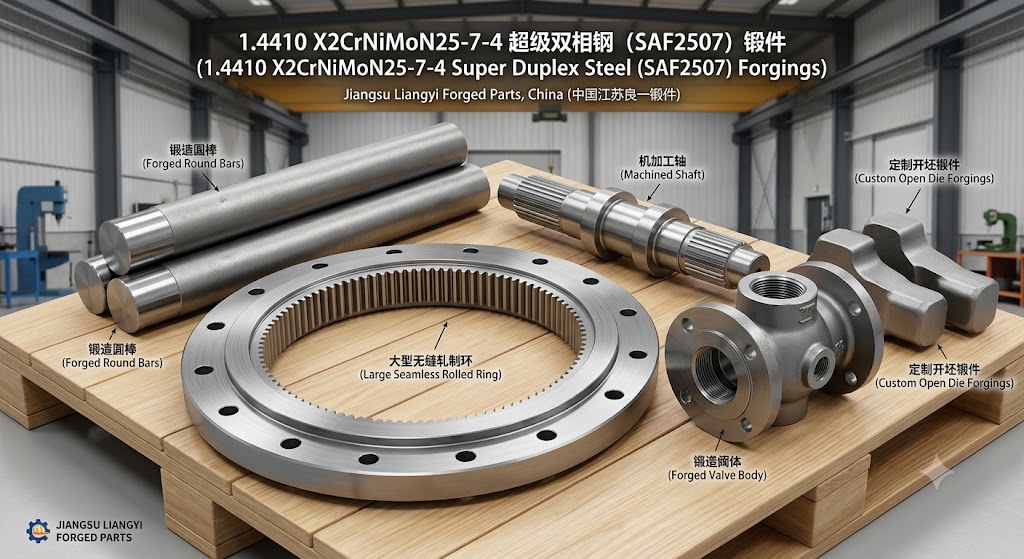
Jiangsu Liangyi is an ISO 9001:2015 certified super duplex forging manufacturer — open-die forgings, seamless rolled rings, bars and custom components from 30 kg to 30 t. Every part ships with heat-by-heat PREN and ferrite verification and an EN 10204 3.1/3.2 mill test certificate, manufactured to comply with the material requirements of NACE MR0175, NORSOK M-630, ASME and EN standards.
Key terms explained
- Duplex stainless steel
- A stainless steel with a roughly 50/50 ferrite–austenite microstructure, combining high strength with good corrosion resistance.
- Super duplex stainless steel
- A more heavily alloyed duplex grade with PREN ≥ 40, giving higher pitting, crevice and sour-service resistance (e.g. 2507 / 1.4410).
- PREN
- Pitting Resistance Equivalent Number = %Cr + 3.3×%Mo + 16×%N. A single index ranking chloride pitting resistance.
- Sigma phase
- A brittle intermetallic phase forming between ~600–1000 °C that sharply reduces toughness and corrosion resistance if not avoided.
Frequently asked questions
What is the difference between duplex and super duplex stainless steel?
Is 2205 duplex or super duplex?
When should I upgrade from 2205 to super duplex 2507?
Is super duplex harder to weld and forge than standard duplex?
Can duplex and super duplex be used at high temperature?
The bottom line
Duplex and super duplex are the same idea executed to different intensities. Standard duplex (2205) covers most moderate corrosive service at the best cost. Super duplex (2507 / 1.4410) exists for the step beyond — warmer, more chloride-rich, sour or higher-pressure environments — where its PREN ≥ 42, 530 MPa yield and unrestricted NACE approval turn a marginal design into a durable one. Specify by service condition, not by habit: match the grade to the worst-case chloride, temperature and H₂S the part will ever see.
- Standards referenced: EN 10088-3, EN 10222-5, ASTM A182 (F51/F53), ASTM G48, NACE MR0175 / ISO 15156, NORSOK M-630.
- Certification scope: Jiangsu Liangyi Co., Limited holds ISO 9001:2015 (quality management system). References to NACE MR0175, NORSOK, ASME, API and EN describe the material requirements our forgings are manufactured and documented to comply with, evidenced by EN 10204 3.1/3.2 mill test certificates — they are not third-party product certifications or manufacturing licences.
- Further reading on duplex fabrication practice: International Molybdenum Association (IMOA) and the Nickel Institute.