Decoding AMS 5773E: What the Standard Actually Requires for FV520B
Two bars of 1.4594 can share the same chemistry on paper and still be worlds apart. The difference is the specification they were built to. Here is what AMS 5773E actually demands — clause by clause — before an FV520B forging can be called compliant.
Key takeaways
- AMS 5773E is a specification, not an alloy. It is the SAE aerospace standard that governs how FV520B-type stainless is melted, treated, tested and certified — the alloy itself is 1.4594 / X5CrNiMoCuNb14-5.
- Premium double melting is mandatory: EAF + secondary refining, then ESR or VAR remelting for cleanliness.
- Supply condition is fixed: solution (~1050 °C) plus double precipitation (~750 °C then ~550 °C), the over-aged condition.
- Mechanical floor: ≥ 800 MPa yield, 925–1090 MPa tensile, ≥ 15% elongation, ≥ ~55 J Charpy, 274–341 HBW.
- Compliance needs proof: ultrasonic/NDT plus EN 10204 3.1 / 3.2 mill certificates with full heat-lot traceability.
What AMS 5773E really is
AMS 5773E is an SAE International aerospace material specification for premium-melted FV520B — a 13Cr-6Ni-2Mo-2Cu-Nb precipitation-hardening stainless steel — supplied as bars, forgings and rings in the solution-treated and double-aged condition.
The word carrying the weight is aerospace. Plenty of mills can pour a heat that lands inside the FV520B chemistry window. What the aerospace specification adds on top is a controlled chain of obligations.
Those obligations cover how the steel is melted, how clean it must be, what condition it ships in, which properties it must hit, how it is tested, and how every step is documented and traceable to a heat lot. In other words, AMS 5773E is not a description of a metal — it is a contract for how that metal is made and proven.
For the base material itself, see our full FV520B forged steel reference; this article stays on the specification behind it.
Compliance is a system, not a data point. A forging is AMS 5773E only when its melting route, delivery condition, property results, cleanliness and certification all satisfy the released revision — not simply because the chemistry looks right.
Scope & product forms
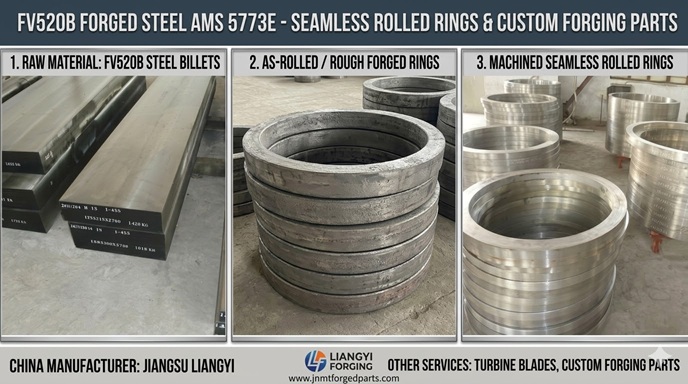
The specification covers wrought product ordered for demanding service: bars, forgings, forging stock and rolled rings. That matters because the same requirements must hold whether the part leaves the shop as a 60 mm round bar or as a multi-tonne seamless rolled ring for a turbine casing.
Two consequences follow. First, a supplier quoting to AMS 5773E must carry the property and cleanliness requirements through the forging reduction, not just prove them on a test bar. Second, larger cross-sections need enough forging work and consistent heat treatment to develop uniform properties from surface to core — which is why press capacity and furnace uniformity are part of a credible compliance story, not an afterthought.
Melting & cleanliness
This is where an aerospace specification separates itself from a commercial grade. AMS 5773E is written around premium, double-melted material. The intent is low inclusion content, tight chemistry control and minimal segregation — the conditions a precipitation-hardening steel needs to age predictably and resist pitting in service.
In practice the route runs in two stages:
- Primary melting & refining — electric arc furnace (EAF), then ladle-furnace refining and vacuum degassing (VD/VOD) to set chemistry and strip dissolved gases.
- Consumable-electrode remelting — electro-slag remelting (ESR) or vacuum arc remelting (VAR) to rebuild the ingot with a clean, directional structure and far fewer non-metallic inclusions.
At our own plant this is EAF + LF + VD/VOD followed by ESR (up to 32 t) or VAR, with bottom-poured ingots to limit segregation. The remelt step is not optional dressing — it is what lets the finished forging pass ultrasonic inspection cleanly and age to spec.
A copper-and-niobium hardening system is unforgiving of dirty steel. Coarse inclusions become fatigue initiation sites and pitting anchors, so cleanliness is effectively a durability requirement in disguise.
Chemical composition limits
The composition clause fixes the alloy window. Each element earns its place: chromium and molybdenum drive corrosion resistance, nickel stabilises a tough martensitic matrix, and the copper–niobium pair is the actual hardening engine, forming the fine precipitates that give FV520B its strength on ageing.
| Element | Content | Element | Content |
|---|---|---|---|
| Carbon (C) | 0.07 max | Molybdenum (Mo) | 1.20–2.00 |
| Chromium (Cr) | 13.20–14.70 | Phosphorus (P) | 0.035 max |
| Manganese (Mn) | 1.00 max | Niobium (Nb) | 0.20–0.70 |
| Nickel (Ni) | 5.00–6.00 | Sulphur (S) | 0.025 max |
| Silicon (Si) | 0.70 max | Copper (Cu) | 1.20–2.00 |
Note how tight the residual limits are: carbon capped at 0.07% keeps the steel weldable and corrosion-resistant, while low phosphorus and sulphur protect toughness and cleanliness. Values shown reflect our standard supply; always confirm the exact ranges against the revision cited on your order.
Heat-treat condition
AMS 5773E does not just ask for a chemistry — it specifies the condition the steel is delivered in. FV520B reaches its useful properties through a solution treatment followed by a double precipitation (over-ageing) cycle:
- Solution treat at roughly 1050 °C, then air cool — dissolves the alloying elements and resets the matrix to soft, low-carbon martensite.
- First precipitation near 750 °C, held and air cooled — begins copper precipitation and develops toughness-improving reverted austenite.
- Final precipitation near 550 °C, held and air cooled — grows the strengthening precipitates to peak, balanced properties.
Ordering to AMS 5773E means ordering the over-aged, double-precipitation condition — not raw solution-treated stock. The delivery condition is part of the specification, and mechanical acceptance is judged in that condition.
We walk through the metallurgy of each step in the companion guide, FV520B Heat Treatment Explained.
Mechanical requirements
With the condition fixed, the specification sets the property floor the material must clear at room temperature. These are acceptance minimums, not marketing figures — a forging that misses any one of them is non-conforming.
| Property | Requirement | Note |
|---|---|---|
| Ultimate tensile strength (Rm) | 925–1090 MPa | Full-strength window |
| 0.2% proof / yield (Rp0.2) | 800 MPa min | Design-limiting value |
| Elongation (A) | 15% min | Ductility floor |
| Hardness | 274–341 HBW | Verifies ageing |
| Charpy impact (V-notch) | ≈ 55 J min | Room-temp toughness |
The combination is the point: high yield strength and a real toughness minimum. That pairing is why FV520B is trusted for compressor blades, pump shafts and turbine hardware where a stronger-but-brittle steel would be a liability.
Testing & certification
The final block of obligations is what turns a good heat into a certifiable part. AMS 5773E-class supply pulls through a set of verification and traceability steps:
- Ultrasonic inspection of bars and forgings for internal soundness, to an agreed acceptance level (e.g. ASTM A388 / EN 10228 practice).
- Cleanliness & structure checks — inclusion rating and, where required, macro/micro examination for segregation and grain integrity.
- Mechanical test coupons representative of the delivered condition and cross-section.
- Heat-lot traceability with full mill test reports and material marking back to the melt.
Every heat ships with an EN 10204 3.1 mill test report and full heat-lot traceability. A 3.2 report with independent third-party inspection (for example SGS, BV or TÜV) can be arranged when your order specifies it. Without traceable records, a part may meet the numbers yet still fail to demonstrate AMS 5773E compliance.
What buyers should verify
If you are sourcing FV520B to AMS 5773E, the specification only protects you when your purchase order and inspection plan actually invoke it. A quick field check before you release an order:
- Revision named. Confirm the exact released revision on the PO and the certificate.
- Melting route stated. EAF + secondary refining plus ESR or VAR remelt.
- Condition specified. Solution + double precipitation (over-aged), tested in that condition.
- Property report attached. Tensile, yield, elongation, hardness and Charpy on the actual lot.
- NDT record included. Ultrasonic acceptance level agreed and reported.
- Traceable MTR. EN 10204 3.1 as standard (3.2 if required), heat number marked.
Get those six lines right on paper and the metallurgy tends to take care of itself — because a supplier who can satisfy all six is running the process the standard was written to enforce.
Need certified FV520B forgings, not just a chemistry match?
We melt with EAF + ESR/VAR, forge on presses up to 6000 t, and deliver FV520B bars, rings and custom forgings manufactured to AMS 5773E requirements — each heat with an EN 10204 3.1 mill certificate and full traceability. Delivered to 50+ countries.
Frequently asked questions
Is AMS 5773E the same as FV520B?
No. FV520B is the material family — a 13Cr-6Ni-2Mo-2Cu-Nb precipitation-hardening stainless steel, also known as 1.4594 / X5CrNiMoCuNb14-5. AMS 5773E is an SAE aerospace specification a given FV520B part can be melted, processed, tested and certified to. A commercial 1.4594 bar is not automatically AMS 5773E.
What melting practice does AMS 5773E require?
Premium, double-melted cleanliness. Primary melting in an electric arc furnace with ladle refining and vacuum degassing, followed by consumable-electrode remelting — electro-slag remelting (ESR) or vacuum arc remelting (VAR) — to control inclusions and segregation.
What heat-treat condition is specified?
The solution-treated and double-precipitation-hardened (over-aged) condition: solution at about 1050 °C, a first precipitation near 750 °C, and a final precipitation near 550 °C. Mechanical acceptance is judged in this condition.
What are the mechanical minimums under this standard?
In the standard supply condition, typical figures are 925–1090 MPa tensile strength, 800 MPa minimum 0.2% yield, 15% minimum elongation, 274–341 HBW hardness and roughly 55 J minimum Charpy at room temperature. Confirm against the released revision on your order.
What is the equivalent grade to AMS 5773E FV520B?
FV520B corresponds to EN material number 1.4594 and designation X5CrNiMoCuNb14-5, and to British Standard BS S143 / 2S143. AMS 5773E is the aerospace supply specification applied to this grade.
Which certificates should accompany AMS 5773E FV520B?
A mill test report to EN 10204 3.1 or 3.2 with heat-lot traceability, the mechanical property results for the delivered lot, the ultrasonic/NDT record, and third-party inspection (SGS, BV, TÜV) where the order calls for it.
Standards referenced
- SAE AMS 5773 — aerospace material specification, FV520B-type PH stainless steel.
- ASTM A388 / EN 10228 — ultrasonic examination of forgings.
- EN 10204 — types of inspection documents (3.1 / 3.2 mill test reports).
Figures reflect Jiangsu Liangyi's standard supply; always verify against the released revision cited on your order.