X22CrMoV12-1 (1.4923) is a martensitic chromium–molybdenum–vanadium heat-resistant steel used for steam and gas turbine components in continuous service up to about 600°C. Standardised in EN 10269, it combines high creep-rupture strength (about 180 MPa for 100,000 hours at 600°C), tensile strength of 900–1050 MPa in the QT900 condition, and good oxidation resistance, which makes it a standard choice for turbine blades, valve internals, forged rings and casings.
This article is a technical reference on the X22CrMoV12-1 / 1.4923 grade itself — its metallurgy, data and behaviour. Product forms, available sizes, certificates and pricing are handled on the dedicated forging material product page linked in the sections below.
Key takeaways
- What it is: a 12% chromium martensitic heat-resistant steel (EN designation X22CrMoV12-1, EN number 1.4923).
- Service temperature: up to ~600°C continuous; derate to ~580°C for 100,000-hour design lives.
- Strength: tensile 900–1050 MPa (QT900) or 800–950 MPa (QT800); creep rupture ~180 MPa at 600°C / 100,000 h.
- Delivered: quenched & tempered — never used as-quenched, because untempered martensite is brittle.
- Welding: possible only with 400–450°C preheat and post-weld tempering at 740–780°C.
- Main uses: turbine blades, guide vanes, diaphragms, valve discs and stems, seamless rolled rings, casings.
- Closest alternative: the lower-carbon, tougher, more weldable X20CrMoV11-1 (1.4922).
Section 01What X22CrMoV12-1 Actually Is
Every power station hides a short list of materials it cannot run without, and on that list — somewhere between the boiler tubing and the generator rotor — sits a quietly indispensable alloy known by its EN number, 1.4923, and its compositional name, X22CrMoV12-1. It is not glamorous. It will never appear on a brochure cover. Yet it spends decades inside steam and gas turbines doing the one job most steels fail at: holding its strength while red-hot.
At its core, X22CrMoV12-1 is a martensitic chromium–molybdenum–vanadium heat-resistant steel. The compositional name reads almost like a recipe: roughly 0.22% carbon (the X22), around 12% chromium (the Cr…12), with molybdenum and vanadium (MoV) added in deliberate amounts. Those last two elements are the whole point. Vanadium ties up carbon as fine, stable carbides that refuse to coarsen at temperature — which is exactly what gives the grade its resistance to creep, the slow permanent stretching that destroys ordinary steels held under load in the heat.
It is worth settling one question early, because buyers ask it constantly: is it stainless? The chromium content is high enough to call it corrosion-resisting on paper, but in practice the grade is specified as a heat-resistant steel, not a stainless one. Its chromium is spent on oxidation and creep resistance at temperature, not on shrugging off rust in a damp warehouse. Leave a bar outdoors in salt air and it will not behave like 316. Put it inside a 580°C steam path and it will outlast almost everything around it.
Section 02The Specification Snapshot
Before the detail, here is the grade reduced to the handful of numbers an engineer actually carries around in their head. Treat the rest of this guide as the reasoning behind each figure.
Steam and gas turbine blades, guide vanes and diaphragms; high-temperature valve discs, seats and stems; seamless rolled rings and casings; high-temperature bolting. The common thread is sustained load at temperature — anywhere a part must stay dimensionally honest while running near 600°C for tens of thousands of hours.
Section 03Chemical Composition
The composition window below follows EN 10269. None of these ranges are arbitrary — each element is balanced against the others to land a fully martensitic structure that tempers predictably and keeps a tight grip on its carbides at temperature.
| Element | Min % | Max % | Role in the alloy |
|---|---|---|---|
| Carbon (C) | 0.18 | 0.24 | Hardenability, carbide former |
| Chromium (Cr) | 11.0 | 12.5 | Oxidation & scaling resistance |
| Molybdenum (Mo) | 0.80 | 1.20 | Solid-solution creep strength |
| Vanadium (V) | 0.25 | 0.35 | Stable fine carbides — creep |
| Nickel (Ni) | 0.30 | 0.80 | Toughness, austenite balance |
| Manganese (Mn) | 0.40 | 0.90 | Deoxidation, hardenability |
| Silicon (Si) | — | 0.50 | Deoxidation |
| Phosphorus (P) | — | 0.025 | Residual — kept low |
| Sulfur (S) | — | 0.015 | Residual — kept low |
The most important balancing act here is between chromium and the austenite-stabilising elements (carbon, nickel, manganese). Push chromium too high without compensating, and the melt retains soft delta ferrite — patches of the wrong phase that never harden and act as weak links in a turbine blade. Good practice keeps delta ferrite below 5% for general work and below 1% for aerospace and rotating turbine parts.
Section 04Metallurgy & Microstructure
The behaviour of X22CrMoV12-1 only makes sense once you picture what is happening at the grain scale. After hardening, the alloy is fully tempered martensite: a fine, needle-like matrix laced with carbides. The matrix supplies room-temperature strength; the carbides — chromium- and vanadium-rich — supply the high-temperature staying power.
What separates this grade from a plain carbon-and-chrome martensitic steel is carbide stability. Ordinary carbides drift and coalesce when held hot, and as they coarsen the steel softens and creeps. Vanadium carbides are stubborn; they stay small and well-dispersed for far longer, which is the metallurgical reason the grade can be trusted at 600°C for design lives measured in years.
Strength at room temperature is easy. Strength that survives ten years at 600°C is metallurgy — and that is what this grade was engineered to deliver.
Section 05Mechanical Properties
X22CrMoV12-1 is normally supplied in one of two quenched-and-tempered (QT) conditions. The higher-strength QT900 condition suits static parts where hardness and rigidity dominate; the slightly softer QT800 condition trades peak strength for better toughness and is favoured where impact resistance matters. Both are room-temperature figures in the delivery condition.
| Property | QT900 | QT800 |
|---|---|---|
| 0.2% Yield Strength (Re) | ≥ 700 MPa | ≥ 600 MPa |
| Tensile Strength (Rm) | 900–1050 MPa | 800–950 MPa |
| Elongation (A) | ≥ 11% | ≥ 14% |
| Reduction of Area (Z) | ≥ 35% | ≥ 40% |
| Impact KV (20°C) | ≥ 20 J | ≥ 27 J |
| Hardness | 265–310 HBW | 230–302 HBW |
The choice between the two is genuinely a design decision, not a default. A turbine blade governed by hardness and resonance behaviour leans toward QT900; a valve stem that must absorb thermal shock and stay ductile leans toward QT800. A reputable supplier will let you specify either and adjust the tempering temperature accordingly.
Section 06How It Behaves at 600°C
Room-temperature numbers are reassuring but largely beside the point — this steel exists to work hot. The table below is the data that actually drives turbine design: guaranteed properties at the 600°C service ceiling, including the long-term creep rupture value that sets the safe stress for a 100,000-hour design life.
| Property | Value |
|---|---|
| 0.2% Proof Stress | ≥ 285 MPa |
| Tensile Strength | ≥ 380 MPa |
| Elongation | ≥ 18% |
| Reduction of Area | ≥ 60% |
| Creep Rupture (100,000 h) | ≈ 180 MPa |
Two practical points follow. First, scaling resistance holds up well in superheated steam and high-pressure gas to roughly 600°C, which is why the grade is comfortable in the hot end of a steam path. Second, for very long design lives — 100,000 hours and beyond — many engineers quietly derate the working temperature to around 580°C to keep accumulated creep strain inside the design envelope. The grade can see 600°C; whether it should over a 30-year life is a creep-life calculation, not a catalogue figure.
Section 07Heat Treatment
Almost everything that makes this grade valuable is unlocked in heat treatment. Get the cycle right and you have a tough, creep-resistant component; get it wrong and you have an expensive billet of brittle, untempered martensite. The standard route is quench and temper.
1 · Austenitising & quench
Hold at 1020–1070°C to dissolve carbides and form a uniform austenite, then quench in air, oil or polymer to convert fully to martensite. Air hardening is possible because the grade's high alloy content gives it generous hardenability — useful for large turbine sections that cannot be quenched aggressively without cracking.
2 · Tempering
Temper at a minimum of 650°C (typically 640–740°C), holding long enough to even out the structure, then cool under control. Tempering temperature is the main lever for hitting QT800 versus QT900 — higher tempering softens toward QT800; lower tempering keeps strength toward QT900.
3 · Stress relief
Straightened or heavily machined parts get a stress-relief soak about 30°C below the actual tempering temperature, cooled slowly to keep residual stress — and the distortion it causes during later machining — to a minimum.
Never put this grade into service in the as-quenched state. Fresh martensite is hard and brittle and will crack under almost any meaningful load. Tempering is not optional finishing — it is what turns a fragile part into a turbine component. Always confirm the delivery condition (e.g. +QT, +QT+SR) on the certificate.
Section 08The Forging Route
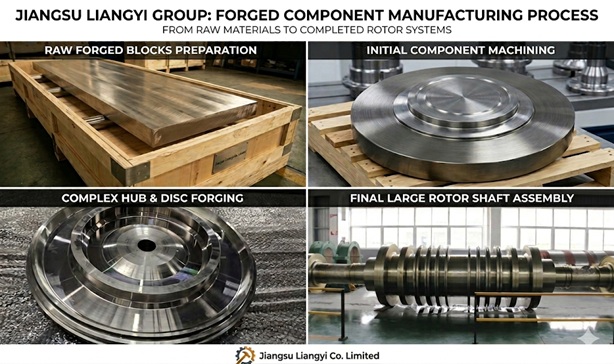
Most critical X22CrMoV12-1 parts are forged rather than cast or simply machined from bar, because forging closes internal porosity and aligns the grain flow with the part's load path — directly improving fatigue life in blades and rings.
- Heat gently first (a preheat around 850°C) before raising to the forging heat of 1150–1180°C, working within a 950–1180°C window and never forging once the steel drops below the lower limit.
- Maintain a forging reduction ratio of at least 4:1, rising toward 8:1 on the most critical sections, to break down the cast structure and refine the grain.
- Cool slowly after forging — typically in a furnace or in dry ash — to avoid the thermal-stress cracking a fast air cool would invite in a hardenable grade like this.
For the highest-purity applications — aerospace auxiliary power units, the most demanding turbine blades — the melt itself is refined further by electroslag remelting (ESR), which strips out non-metallic inclusions and tightens chemical homogeneity. For a full breakdown of available product forms, melting routes and certification, see our 1.4923 / X22CrMoV12-1 forging material product page.
Section 09Welding — Possible, but Disciplined
X22CrMoV12-1 is weldable, but it is unforgiving of shortcuts. As a hardenable martensitic grade, its weld zone will transform to brittle martensite and crack if you weld it cold. A controlled procedure is mandatory:
- Preheat to roughly 400–450°C and hold an interpass temperature around 400–500°C throughout welding.
- After welding, allow the joint to cool to about 100–150°C so martensitic transformation completes before tempering.
- Apply a post-weld temper of at least four hours at 740–780°C, then cool slowly.
This sensitivity is one reason engineers sometimes reach for the lower-carbon sister grade X20CrMoV11-1 (1.4922) on parts that must be field-repair-welded — more on that comparison below.
Section 10Where the Grade Is Used
Pull apart a steam or gas turbine and you will find X22CrMoV12-1 scattered through the hottest, most loaded regions. The applications cluster into a few families:
- Turbine blading and vanes — stationary and rotating blades, guide vanes and inlet guide vanes where hot strength and fatigue resistance decide the design.
- Diaphragms and nozzles — turbine diaphragms, diaphragm nozzles and heat shields in the hot gas path.
- Valve internals — control and reheat valve discs, seats, cores and stems on power-plant steam systems, plus high-temperature valve bodies and bonnets.
- Rings and casings — seamless rolled rings, seal and labyrinth rings, casing rings and low-pressure turbine casings.
- High-temperature bolting — studs and fasteners for turbine and valve assemblies running hot.
Beyond power generation, the same properties make it useful in petrochemical high-temperature valve systems, aerospace auxiliary power units, industrial boilers and marine propulsion. The unifying requirement is always the same: load plus heat plus time.
Section 11How It Compares to Neighbouring Grades
X22CrMoV12-1 rarely gets specified in a vacuum — it is usually weighed against one of two close relatives. The table draws the practical lines.
| Grade | 1.4923 | F91 (1.4903) | 1.7380 |
|---|---|---|---|
| Max continuous temp | ~600°C | ~650°C | ~540°C |
| Chromium | 11.0–12.5% | 8.0–9.5% | 2.3–2.7% |
| Tensile (QT) | 900–1050 | 585–760 | 800–950 |
| Best for | Blades, valves | Steam pipes | Mid-temp parts |
1.4923 vs 1.4922 (X20CrMoV11-1)
This is the comparison that matters most in day-to-day specifying. The two grades are metallurgical siblings; the difference comes down to a sliver of carbon. X22CrMoV12-1 carries slightly more carbon and chromium, giving a harder, stronger matrix — the right call for static parts like blades and guide vanes. The lower-carbon X20CrMoV11-1 is noticeably tougher (impact energy ≥40 J versus ≥27 J) and easier to weld, which is why it tends to win on rotating shafts, valve spindles and any part that may need field repair welding.
1.4923 vs A182 F91
F91 (a 9% chromium grade) tolerates a slightly higher temperature and is the default for main steam pipework and headers, but it is softer. Where the design needs hardness and strength — turbine blading, valve discs — X22CrMoV12-1 is the stronger and more appropriate choice.
Section 12Equivalent Grades & Designations
The same steel travels under several names, which causes endless confusion on purchase orders. These all refer to the same alloy:
- EN number: 1.4923
- EN name: X22CrMoV12-1 (also written X22CrMoV12.1 or X22CrMoV121)
- Standards: EN 10269, DIN EN 10302, VdTÜV 110
- Closely related: X20CrMoV11-1 (1.4922) — the lower-carbon sibling
- Often benchmarked against: ASTM A182 F91 for high-temperature piping duty
Need X22CrMoV12-1 forgings to drawing?
Jiangsu Liangyi forges 1.4923 / X22CrMoV12-1 bars, seamless rolled rings, discs, casings and turbine components manufactured and tested to EN 10269 material requirements, with full NDT and an EN 10204 3.1 mill test certificate supplied as standard (EN 10204 3.2 third-party inspection available on request). Send a drawing and get a quotation in 24 hours.
View our 1.4923 / X22CrMoV12-1 forgings →Section 13Specifying & Sourcing It Well
Because this grade ends up in safety-critical, long-life equipment, the paperwork is part of the product. When you buy X22CrMoV12-1 forgings, a few specifics separate a part you can trust from one you cannot:
- State the delivery condition. QT800 or QT900, and confirm whether stress relief (+SR) is included.
- Specify the certificate level. EN 10204 3.1 is the standard mill test certificate issued by the manufacturer; an EN 10204 3.2 certificate adds independent third-party inspection (for example by TÜV, DNV, BV or SGS) arranged per order, and is usual for turbine and pressure work — request it when your project requires it.
- Define the NDT scope. Ultrasonic testing to an agreed quality class, plus magnetic-particle and visual inspection on critical parts.
- Set the delta-ferrite ceiling — below 1% for rotating turbine and aerospace parts.
- Agree the melting route — standard EAF+LF+VD for most work, ESR where purity is paramount.
For the full set of available product forms, dimensional limits, applicable standards and project case studies, our 1.4923 / X22CrMoV12-1 forged parts and specifications page is the most complete reference, and a technical enquiry will get you a material recommendation against your drawing.