Technical Comparison · Grade Selection
AMS 5610 VS AMS 5504: 416 vs 410 Stainless Steel Compared
In short: AMS 5610 (AISI 416) and AMS 5504 (AISI 410) are the same 12–14% chromium martensitic stainless steel — except 416 adds ≥0.15% sulfur to become free-machining. Choose 416 for high-volume precision machining with no welding; choose 410 when the part must be welded or needs a little more toughness and corrosion margin.
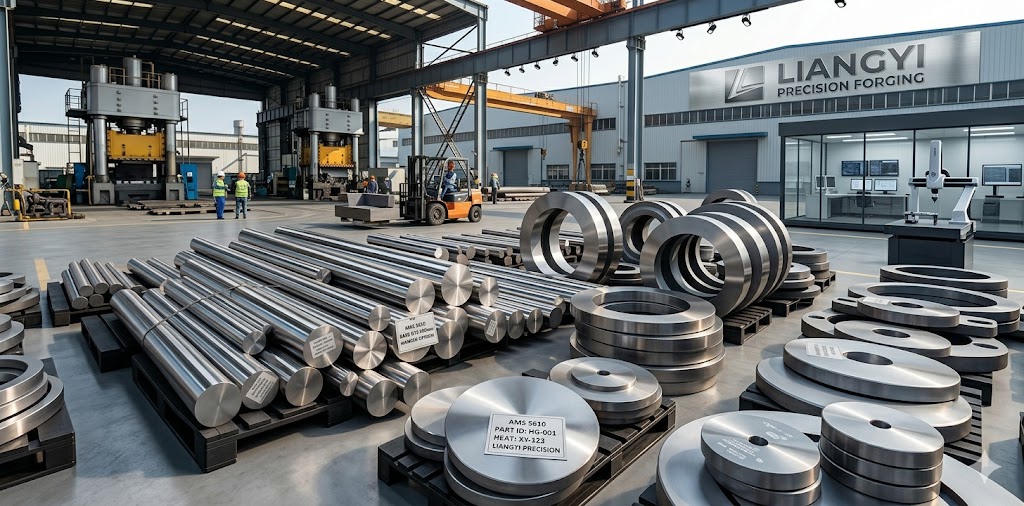
AMS 5610 · The Machining Specialist
416
UNS S41600 · EN 1.4005 · SUS 416
- Machinability ~85%
- Sulfur ≥ 0.15%
- Weldable No
- Peak hardness HRC 42–45
AMS 5504 · The All-Rounder
410
UNS S41000 · EN 1.4006 · SUS 410
- Machinability ~50%
- Sulfur ≤ 0.03%
- Weldable Yes*
- Peak hardness HRC 38–42
Key takeaways
- Same alloy, one difference: 416 is 410 plus a mandatory ≥0.15% sulfur addition that forms manganese sulfide inclusions.
- Machinability: 416 rates ~85% vs B1112; 410 rates ~50%. 416 delivers 2–4× longer tool life.
- Weldability: 410 is weldable with preheat and PWHT; 416 is effectively non-weldable due to sulfur hot cracking.
- Toughness & corrosion: 410 holds a small edge on both; both sit near PREN 12 and suit only mild environments.
- Decision rule: machining-heavy and unwelded → 416; welded or toughness-sensitive → 410.
The 30-second verdict
AMS 5504 (410) is the baseline 12–14% chromium martensitic stainless steel. AMS 5610 (416) is the same base alloy with sulfur deliberately added. That single change trades away weldability and a little corrosion resistance in exchange for the highest machinability of any standard stainless steel grade.
Bottom line
Pick the grade around your dominant cost driver, not the datasheet.
If the part is machining-heavy and never welded — valve stems, pump shafts, threaded bodies, fittings produced in volume — 416 (AMS 5610) wins on speed, tool life, and finished-part cost.
If the part must be welded, or needs a little more toughness and corrosion margin — turbine blades, fabricated assemblies, general structural duty — 410 (AMS 5504) is the safer, more forgiving choice.
The one line that separates them
Line up the two specifications and almost everything matches: both are hardenable martensitic stainless steels, both sit at roughly 12–14% chromium, both carry up to 0.15% carbon, and both are strongly magnetic in every condition. The decisive difference is a minimum sulfur requirement.
AMS 5504 keeps sulfur low, typically under 0.03%, so the steel stays clean and ductile. AMS 5610 mandates a minimum of 0.15% sulfur. During melting that sulfur bonds with manganese to form manganese sulfide (MnS) inclusions distributed through the matrix. Those soft inclusions are the entire reason 416 exists — and also the source of every trade-off that follows. Everything below is downstream of this one chemistry decision.
Round 1Chemistry & classification
Both grades belong to the martensitic family, meaning they transform to hard martensite when quenched from austenitizing temperature and can be tempered back to a target hardness. The chromium band is nearly identical, so their corrosion ceilings and hardening behavior start from the same place. The manganese and sulfur windows are where they diverge: 416 runs higher manganese specifically so it forms manganese sulfide rather than brittle iron sulfide, while 410 keeps both elements low to preserve toughness and weld integrity.
Practically, this means you cannot substitute one for the other on chemistry alone. A 410 forging will never machine like a 416, and a 416 forging will never weld like a 410, even though a quick glance at chromium and carbon suggests they are interchangeable.
Round 1 · Draw — same family, different intentRound 2Machinability — where 416 pulls away
This is the round AMS 5610 was engineered to win. The manganese sulfide inclusions do two jobs at the cutting edge. First, they have very low shear strength, so chips fracture cleanly into short breaks instead of the long, stringy swarf that standard 410 produces — that alone transforms unattended CNC and automatic-lathe work. Second, MnS smears at the tool–chip interface as a solid lubricant, dropping cutting temperature and friction.
The result is a machinability index around 85% relative to B1112 free-machining steel for 416, against roughly 50% for 410. In the shop that shows up as higher cutting speeds, better surface finish, and — most valuable of all — tool life that is commonly 2–4 times longer. On a high-volume precision component, machining is usually the single largest cost, so this advantage compounds across every part in the run.
Round 2 · 416 wins decisivelyRound 3Weldability — where 410 answers back
The same sulfur that helps the cutting tool ruins the weld. When 416 is welded, MnS inclusions liquefy in the heat-affected zone and reprecipitate as low-melting films along grain boundaries, leaving the zone prone to hot cracking. For this reason AMS 5610 is treated as effectively non-weldable for structural duty.
AMS 5504 is genuinely weldable — with discipline. It still needs preheat (typically 200–300 °C), a matching or austenitic filler, and a post-weld heat treatment to restore toughness and corrosion resistance in the heat-affected zone, but a sound joint is achievable. If your design contains any welded joint in the martensitic component itself, 410 is the correct grade. The alternative for 416 is to remove the weld entirely by producing the part as a single-piece forging.
Round 3 · 410 wins clearlyRound 4Strength, hardness & toughness
In annealed and hardened conditions the two grades are close, because their hardenability comes from the same chromium–carbon system. AMS 5610 can be pushed to a marginally higher peak hardness — around HRC 42–45 after low-temperature tempering — which suits wear surfaces and valve seats. AMS 5504 lands slightly lower at peak but tends to hold a small advantage in impact toughness and ductility at a comparable strength, because it has no elongated sulfide inclusions to act as internal notches.
That toughness gap matters most in the transverse direction. Because MnS inclusions are stretched along the working direction, 416 shows noticeably lower transverse impact energy than longitudinal — a real design consideration for rotating parts under multi-axial stress. Both grades, incidentally, must be kept out of the 370–540 °C tempering window, where martensitic stainless steels suffer temper embrittlement.
Round 4 · 410 edges it on toughnessRound 5Corrosion resistance
Neither grade is a corrosion performer. Both sit near a Pitting Resistance Equivalent Number (PREN) of about 12, which limits them to mild environments — clean water, dry or mildly humid air, sweet petroleum, dilute organics. Neither is appropriate for seawater, high-chloride streams, or sour (H₂S) service above HRC 22.
Within that shared ceiling, AMS 5504 has a slight edge. The MnS inclusions in 416 are preferential pit-initiation sites, so in borderline conditions 410 will typically resist localized attack a little longer. It is a difference of degree, not category: if corrosion is a genuine concern, both grades are the wrong tool and you should be evaluating 17-4PH, a higher-chromium grade, or duplex stainless.
Round 5 · 410 wins narrowlyRound 6Total cost of ownership
Per kilogram, the raw materials are close, with 410 usually a few percent cheaper because it skips the controlled sulfur addition. Judged only on purchase price, 410 wins this round on paper.
But finished-part cost is a different calculation. On a component that requires extensive machining, the machining operation — not the billet — dominates cost. There, 416's faster cutting and far longer tool life routinely produce a lower delivered cost per part despite the slightly higher stock price. The honest answer is that the winner depends on your part: simple, low-machining, weld-dependent parts favor 410; complex, high-volume, machining-intensive parts favor 416.
Round 6 · Draw — it depends on the partFull side-by-side comparison
| Property | AMS 5610 · 416 | AMS 5504 · 410 |
|---|---|---|
| SAE spec | AMS 5610 | AMS 5504 |
| AISI / UNS | 416 · S41600 | 410 · S41000 |
| EN equivalent | 1.4005 (X12CrS13) | 1.4006 (X12Cr13) |
| Type | Martensitic, free-machining | Martensitic, standard |
| Carbon (max) | 0.15% | 0.15% |
| Chromium | 12.0–14.0% | 11.5–13.5% |
| Sulfur | ≥ 0.15% (added) | ≤ 0.03% (impurity) |
| Machinability | Excellent (~85%) | Fair (~50%) |
| Peak hardness | HRC 42–45 | HRC 38–42 |
| Toughness | Moderate (lower transverse) | Good |
| Weldability | Not recommended | Fair (pre/post-weld HT) |
| Corrosion (PREN) | ~12 (pit-prone at MnS) | ~12 (slightly better) |
| Relative stock cost | 1.0× (baseline) | ~0.95× |
| Best for | High-volume precision machining | Weldable / general-purpose parts |
Which grade should you choose?
Choose AMS 5610 · 416
- The part needs extensive CNC or automatic-lathe machining
- Production volume is high and tool life drives cost
- No welding is required anywhere in the component
- You need heat-treatability to HRC 30+ for wear surfaces
- Moderate corrosion service is acceptable
Choose AMS 5504 · 410
- The design includes a welded joint in the martensitic part
- You want a little more impact toughness or ductility
- Corrosion margin is borderline and every bit helps
- Machining volume is low, so free-machining offers little payoff
- Lowest raw stock price is a priority over machining speed
For genuinely borderline cases — a part that is both machining-heavy and welded, for example — the right move is often to redesign the weld out and forge the component in one piece, which lets you keep 416's machining advantage without its welding penalty. If that points you toward 416, our AMS 5610 forging page details the manufacturing options for a one-piece design.
Forging both grades to your drawing
Forging route, dimensional limits, melting selection and certification apply equally to both grades, so they sit outside the scope of this head-to-head — the choice between 416 and 410 is made on the properties above, not on how the part is produced.
Once you have settled on a grade, the full manufacturing detail lives on our complete guide to AMS 5610 forging parts, which covers dimensional capability, the four heat-treatment routes, melting-route selection (VIM / ESR / VAR) and material certificates in depth. Send your drawing and chosen grade to our engineering team for a quotation.
Frequently asked questions
What is the main difference between AMS 5610 and AMS 5504?
AMS 5504 (410) is a standard martensitic stainless steel; AMS 5610 (416) is the same 12–14% chromium base with a mandatory sulfur addition of at least 0.15%. That sulfur forms manganese sulfide inclusions that make 416 free-machining, but it also removes reliable weldability and slightly lowers corrosion resistance and transverse toughness.
Can AMS 5610 (416) be welded like AMS 5504 (410)?
No. The sulfur that gives 416 its machinability causes hot cracking in the weld heat-affected zone, so AMS 5610 is treated as effectively non-weldable for structural work. AMS 5504 (410) is weldable with preheat and post-weld heat treatment. If welding is required, choose 410; for 416, redesign the joint out as a single-piece forging.
Which is more corrosion resistant, 416 or 410?
AMS 5504 (410) has a slight edge. Both grades sit near PREN 12 and suit only mild environments, but the manganese sulfide inclusions in 416 act as pit-initiation sites, so 410 resists localized attack marginally better. Neither grade is suitable for seawater, high chlorides, or sour service above HRC 22.
Is 416 stronger than 410?
Their hardenability is similar. AMS 5610 (416) reaches a slightly higher peak hardness (about HRC 42–45), while AMS 5504 (410) offers marginally better impact toughness and ductility at a given strength. For most structural duty the two are close; machining volume and weldability decide the choice, not raw strength.
Which grade is cheaper?
Raw stock cost is close, with 410 typically a few percent lower per kilogram. On machining-heavy parts, however, 416 usually wins on total cost of ownership because it cuts faster with 2–4× longer tool life, reducing the largest cost driver on precision components.
Request a quotation
Not sure which grade fits your part?
Send us your drawing, service conditions, and quantity. Our engineering team will recommend 416 or 410 — with a written technical rationale — and quote your forging within 24 hours.
Get your 24-hour quote →✉️ Inquiry Email: sales@jnmtforgedparts.com
📞 Phone / WhatsApp: +86-13585067993
🌐 Website: www.jnmtforgedparts.com
📍 Address: Chengchang Industry Park, Jiangyin City, Jiangsu Province, China