AMS 5610 Forging Parts — Complete Technical Guide & China Manufacturer
AMS 5610 is an SAE International aerospace material specification that governs AISI 416 free-machining martensitic stainless steel in the product forms of bars, wire, forgings, and rings. It occupies a specific and well-defined niche in the stainless steel family: the only martensitic grade engineered specifically for high-volume precision machining, achieved by mandating a minimum 0.15% sulfur content while retaining the hardenability of a 12–14% chromium martensitic structure. This combination makes AMS 5610 the preferred material wherever engineers need both extensive machining operations and the ability to harden the final component.
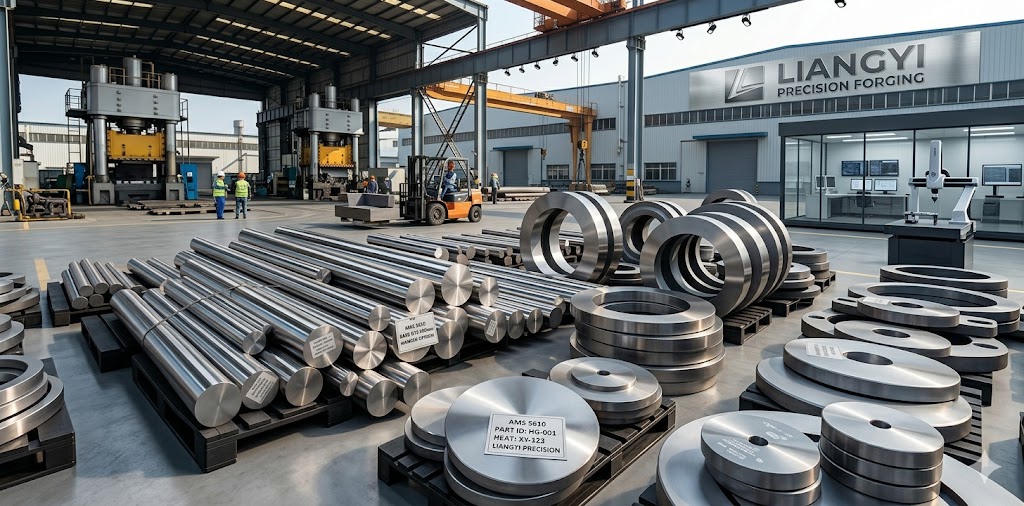
Jiangsu Liangyi Co., Limited — established in 1997 in Jiangyin City, Jiangsu Province, China — is an ISO 9001:2015 certified open die forging and seamless ring rolling manufacturer with over 25 years of experience producing AMS 5610 forged components. With an annual forging capacity of 120,000 metric tons and a press fleet ranging from 1,000 to 8,000 tonnes, we manufacture AMS 5610 forgings from 30 kg to 30,000 kg, exporting to more than 50 countries in power generation, nuclear, oil & gas, and aerospace industries.
AMS 5610 At-a-Glance Reference
- Specification
- AMS 5610 (SAE International)
- Equivalent Grades
- AISI/SAE 416 · UNS S41600 · EN 1.4005 (X12CrS13) · JIS SUS416 · GB 1Cr13
- Steel Family
- Free-machining martensitic stainless steel
- Key Differentiator
- ≥ 0.15% sulfur → MnS inclusions → 85% machinability vs B1112
- Chromium
- 12.00–14.00%
- Heat-treatable
- Yes — HRC 26–45 depending on tempering temperature
- Yield Strength (ann.)
- ≥ 345 N/mm²
- Tensile Strength (ann.)
- ≥ 540 N/mm²
- Forging Temp. Range
- 1,050–1,200 °C (Δ150°C window — narrower than austenitic grades)
- Min. Reduction Ratio
- 4:1 (standard) / 6:1 (nuclear & aerospace)
- Welding
- Not recommended (sulfur causes HAZ hot cracking)
- PREN
- ~12–14 (moderate; not suitable for seawater or chloride-rich service)
- Max Piece Weight
- 30,000 kg
- Max Ring OD
- 6,000 mm (seamless rolled)
- Max Bar Diameter
- 2,000 mm
- Max Shaft Length
- 15 m
- Melting Routes
- VIM+VAR (double) · VIM+ESR+VAR (triple)
- Quality Certification
- ISO 9001:2015 (certified quality management system)
- Material Documents
- EN10204 3.1 (standard) · EN10204 3.2 (third-party, on request)
- Produced Per
- ASTM A788, EN 10228 (forging production standards)
- Delivery
- Quotation within 24 h · Standard lead time 4–12 weeks
• Complete vertical integration: steel melting → forging → heat treatment → precision machining under one roof
• Triple melting (VIM+ESR+VAR) capability for aerospace and nuclear purity requirements
• 100% UT + MT/PT nondestructive testing on every forging before shipment
• EN10204 3.1 as standard; third-party 3.2 available (BV, SGS, TÜV, Lloyds)
• 25+ years of AMS 5610 forging experience — not a trading company
• Dedicated technical team for drawing review, DFM optimization and material selection advice
AMS 5610 Forged Product Range & Dimensional Capabilities
Jiangsu Liangyi manufactures a complete range of AMS 5610 forging forms, from standard bars and rings to complex near-net-shape custom forgings. All products are forged from certified AMS 5610 ingots with traceability from melting heat through to final shipment.
AMS 5610 Forged Round Bars & Step Shafts
- Round bars: Diameter 80–2,000 mm; length up to 15,000 mm; weight up to 30 tons per piece
- Square and flat bars: Cross-section up to 1,200 × 800 mm; custom dimensions by drawing
- Step shafts and gear shafts: Multi-diameter shafts up to 15 m in total length; complex step profiles achievable by open die forging with controlled reduction at each step
- Pump and turbine shafts: Forged as one piece to eliminate joints; minimizes stress concentration compared to built-up assemblies
- All round bars undergo 100% automatic ultrasonic testing (AUT) per ASTM A388 or EN 10228-3
AMS 5610 Seamless Rolled Rings
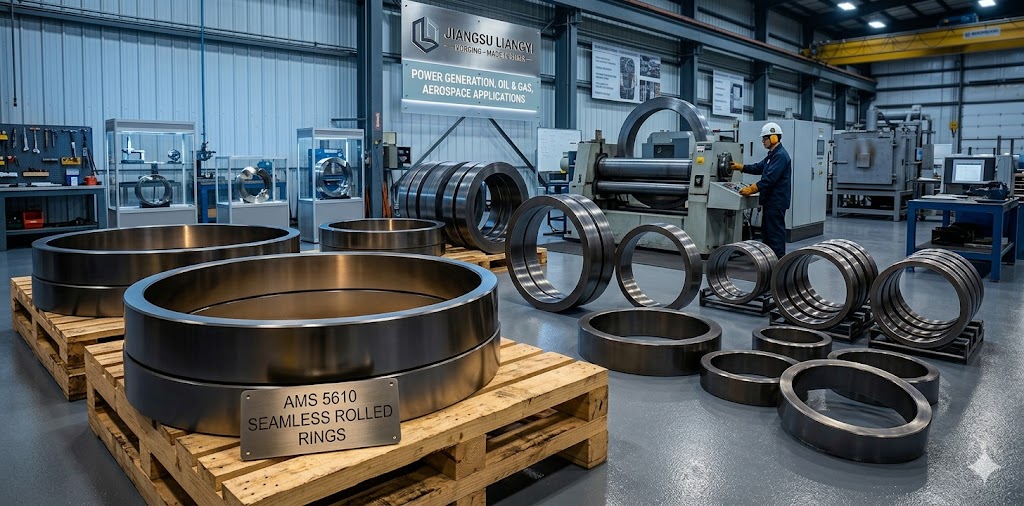
- Standard seamless rings: OD 300–6,000 mm; ID 150–5,800 mm; height 50–3,000 mm; weight up to 30 tons
- Contoured rings: T-section, L-section, U-section and flanged profiles rolled to reduce machining stock
- Gear rings and ring gears: Pre-toothed ring profiles for gear manufacturing
- Seal rings and labyrinth rings: Precision-tolerance rings for turbine sealing systems
- Seamless ring rolling ensures 100% circumferential grain flow — superior to welded rolled plate rings which have a straight-grain weld seam acting as a potential stress riser
AMS 5610 Hollow Forgings (Sleeves, Bushings, Casings)
- Hollow bars and sleeves: OD up to 3,000 mm; wall thickness 30–800 mm; length up to 5,000 mm
- Pump casings and barrel bodies: Near-net-shape hollow forgings reduce machining stock compared to solid bars, saving material cost on large components
- Heavy wall cylinders: For high-pressure containment applications; hydraulic proof testing available
AMS 5610 Disc & Block Forgings
- Turbine discs and impellers: Diameter up to 2,000 mm; custom hub-to-rim thickness profiles
- Flanged blanks and bossed blanks: Single and double-bossed designs; integral flanges forged in rather than welded on
- Flat blocks and plates: Up to 1,200 × 1,200 mm × 500 mm thick; delivered ultrasonically tested and heat-treated
The Metallurgy of AMS 5610 — Why This Steel Is Different
To specify AMS 5610 intelligently, engineers must understand not just what the specification requires, but why each alloying decision was made. The following sections explain the metallurgical logic behind AMS 5610 in a way that directly informs forging specification decisions.
Chemical Composition & Element Functions
| Element | Limit (%) | Metallurgical Role | Engineering Impact |
|---|---|---|---|
| Carbon (C) | 0.15 max | Forms martensite on quenching; controlled to balance hardness vs. toughness | Low C (0.08–0.12%) = better toughness; higher C = higher achievable hardness |
| Chromium (Cr) | 12.00–14.00 | Minimum 10.5% Cr forms passive oxide film; excess Cr stabilizes ferrite and reduces hardenability if too high | 12–14% is the "sweet spot" for moderate corrosion resistance without destabilizing the martensitic transformation |
| Sulfur (S) | 0.15 min | Combines with manganese to form MnS inclusions; these provide built-in chip breakers during cutting | The defining characteristic of AMS 5610; reduces cutting forces by ~30–40% vs. AISI 410; extends tool life 2–4× |
| Manganese (Mn) | 1.25 max | Partners with sulfur to form MnS instead of FeS; austenite stabilizer; improves hardenability | Higher Mn:S ratio (≥ 8:1) ensures MnS forms rather than FeS, which is brittle and harmful |
| Molybdenum (Mo) | 0.60 max | Solid solution strengthener; improves high-temperature creep resistance; slightly improves pitting resistance | Presence at 0.40–0.60% extends useful service temperature range for turbine and valve applications |
| Silicon (Si) | 1.00 max | Deoxidizer during melting; ferrite stabilizer; slightly raises transformation temperature | Typical content 0.30–0.80%; excessive Si reduces toughness |
| Phosphorus (P) | 0.06 max | Impurity; segregates to grain boundaries and causes temper embrittlement | Controlled to 0.030% or lower in premium grades; critical for components tempered in 370–540°C range |
| Iron (Fe) | Balance | Matrix element; forms BCC ferrite below Ac1, FCC austenite above; transforms to BCT martensite on rapid cooling | The martensitic lattice provides the hardenability unique to this grade family |
Free-Machining Mechanism: The Science of Sulfide Inclusions
The machinability advantage of AMS 5610 is not simply an empirical observation — it arises from a specific and well-understood physical mechanism that engineers should know when comparing grades.
During steelmaking, sulfur added to the melt combines preferentially with manganese (rather than iron) to form manganese sulfide (MnS) inclusions. MnS has several properties that make it an ideal machining aid:
- Low shear strength: MnS inclusions are far weaker in shear than the surrounding steel matrix. When a cutting tool cuts the work piece, crack propagation prefers to follow these weak paths, giving clean, short chip breaks and eliminating the stringy chips that wrap around tooling in non-free-machining grades.
- Lubrication effect: MnS acts as solid lubricant at the tool-chip interface to reduce friction coefficient and cutting temperatures. In controlled studies this results in a reduction of cutting forces by about 30–40% as compared to AISI 410 under the same conditions.
- Tool life extension: Lower cutting temperature directly translates to reduced tool wear. Production shops using AMS 5610 vs. non-free-machining stainless grades routinely report 2–4× longer tool life, and cutting speeds 20–40% higher with equivalent surface finish.
The machinability index of AMS 5610 / AISI 416 is rated at approximately 85% relative to B1112 free-machining carbon steel — making it one of the most machinable stainless steel grades available. By comparison: AISI 304 rates at ~45%, AISI 410 at ~50%, and AISI 440C at ~40%.
Microstructure, Grain Size & Their Effect on Properties
The as-forged microstructure of AMS 5610 consists of tempered martensite with dispersed carbides and MnS inclusions. The final grain size — measured on ASTM E112 scale — significantly affects the balance of properties:
| ASTM Grain Size Number | Approx. Grain Diameter | Tensile / Yield Strength | Impact Toughness | Typical Application |
|---|---|---|---|---|
| 3–4 (coarse) | ~90–125 µm | Lower | Higher | Pump casings, valve bodies (lower-stress duty) |
| 5–6 (medium) | ~45–65 µm | Intermediate | Good | General industrial, oil & gas valves, turbine shafts |
| 7–8 (fine) | ~22–32 µm | Higher | Moderate | Turbine discs, critical rotating components, aerospace |
| ≥ 9 (very fine) | < 22 µm | Highest | Lower | Special applications with strict strength requirements |
At Jiangsu Liangyi, forging reduction ratios and austenitizing temperatures are controlled to target the grain size range specified by the customer. For nuclear and aerospace applications, ASTM grain size requirements are verified on metallographic specimens and documented in the material test certificate.
Mechanical Properties & Design Data
AMS 5610 mechanical properties span a wide range depending on the heat treatment condition. The table below provides design data across all major conditions, enabling engineers to select the appropriate heat treatment for their application.
AMS 5610 Mechanical Properties — All Heat Treatment Conditions
| Condition | Yield Rp0.2 (MPa) | Tensile Rm (MPa) | Elongation A5 (%) | Reduction of Area (%) | Hardness (HRC/HB) |
|---|---|---|---|---|---|
| Annealed | ≥ 345 | ≥ 540 | ≥ 17 | ≥ 55 | ≤ HB 241 / ≤ HRC 23 |
| Hardened + Tempered 150–200°C | 1,100–1,300 | 1,300–1,550 | 8–10 | 30–40 | HRC 40–45 |
| Hardened + Tempered 250–370°C | 900–1,100 | 1,100–1,350 | 10–14 | 40–50 | HRC 33–40 |
| Hardened + Tempered 540–600°C | 620–760 | 800–1,000 | 14–18 | 50–60 | HRC 24–30 |
| Hardened + Tempered 650–700°C | 480–620 | 690–850 | 17–22 | 55–65 | HRC 18–24 / HB 200–250 |
Physical Properties of AMS 5610
| Property | Value | Condition |
|---|---|---|
| Density | 7.70–7.75 g/cm³ | Annealed |
| Elastic Modulus (E) | 200–210 GPa | Room temperature |
| Thermal Conductivity | 24.9 W/(m·K) | 100°C |
| Coefficient of Thermal Expansion | 9.9 × 10⁻⁶ /°C | 20–100°C range |
| Specific Heat Capacity | 460 J/(kg·K) | Room temperature |
| Electrical Resistivity | 0.57 µΩ·m | Annealed |
| Magnetic Permeability | Strongly magnetic | All conditions |
| Melting Range | 1,480–1,530°C | — |
Note: AMS 5610 is strongly ferromagnetic in all conditions. This must be considered in applications involving MRI equipment, strong magnetic fields, or magnetic particle inspection (MPI) interpretation.
Complete Heat Treatment Guide for AMS 5610
Heat treatment is the critical post-forging step that determines AMS 5610's final mechanical properties. Jiangsu Liangyi operates atmosphere-controlled furnaces with full data logging and thermocouples calibrated with traceable calibration per national metrology standards (<±5°C accuracy). All heat treatment parameters — including time-temperature charts — are documented in the lot-specific material test certificate.
Route 1 — Annealing (Softening for Machining)
Purpose: Achieve maximum machinability and lowest hardness before final machining operations.
- Temperature: 790–900°C (optimal at 845–870°C)
- Hold time: Minimum 1 hour per 25 mm of cross-section; minimum 2 hours total
- Cooling: Furnace cooling at ≤ 25°C/hour to below 600°C, then air cool
- Result: Hardness ≤ HB 241 (≤ HRC 23); maximum machinability; excellent dimensional stability during machining
- Microstructure: Spheroidized carbides in ferritic matrix; minimal internal stress
Route 2 — Hardening + Low-Temperature Tempering (Maximum Hardness)
Purpose: Achieve maximum wear resistance and hardness for valve seats, bearing surfaces, and similar applications.
- Austenitizing: 925–1,010°C (optimal at 980°C); hold minimum 30 min per 25 mm section; do not exceed 1,010°C as excessive carbide dissolution reduces corrosion resistance
- Quench: Oil quench for sections ≤ 75 mm; forced air or inert gas quench for larger sections to minimize distortion risk
- Temper: 150–200°C for HRC 42–45; 250–370°C for HRC 35–41
- Hold at temper temp: Minimum 2 hours per 25 mm; minimum 3 hours total
- Double tempering: Strongly recommended for sections > 100 mm and for all aerospace/nuclear applications; second temper at same or slightly lower temperature ensures full martensite transformation
- Result: HRC 35–45; highest wear resistance; moderate toughness
Route 3 — Hardening + High-Temperature Tempering (Optimal Toughness)
Purpose: Balance of strength, toughness and corrosion resistance for structural applications, turbine shafts, pump shafts.
- Austenitizing: 950–1,000°C; same hold time as Route 2
- Quench: Oil or accelerated air
- Temper: 550–680°C (avoiding 370–540°C embrittlement range — see warning above)
- Result: HRC 22–30; Rp0.2 typically 620–760 MPa; Rm 800–1,000 MPa; good ductility and impact resistance
- Corrosion resistance: High-temperature tempering partially reprecipitates chromium carbides and restores some corrosion resistance; best condition for corrosive service
Route 4 — Stress Relieving (After Rough Machining)
Purpose: Relieve machining-induced residual stresses before precision finish machining to minimize distortion.
- Temperature: 650–760°C
- Hold time: 1–2 hours
- Cooling: Slow furnace or still air
- Result: No significant change in hardness; residual stress reduced by 60–80%
AMS 5610 vs Competing Stainless Steel Grades — Full Comparison
Selecting AMS 5610 over alternative grades is a trade-off analysis, not a default choice. This section provides the comparative data engineers need to make an informed decision — including situations where AMS 5610 is not the best choice.
| Property | AMS 5610 (AISI 416) | AISI 410 (AMS 5504) | AISI 420 (AMS 5506) | AISI 440C | 17-4PH (AMS 5643) | AISI 304 / 316 |
|---|---|---|---|---|---|---|
| Steel Type | Martensitic FM | Martensitic | Martensitic | Martensitic | PH Martensitic | Austenitic |
| Cr Content (%) | 12–14 | 11.5–13.5 | 12–14 | 16–18 | 15–17.5 | 18–20 |
| Machinability | Excellent (85%) | Good (50%) | Moderate (45%) | Poor (40%) | Poor (35–45%) | Poor (40–45%) |
| Max Hardness (HRC) | 42–45 | 38–42 | 50–52 | 56–58 | 40–46 (H900) | N/A (not H/T) |
| Corrosion Resistance | Moderate (PREN ~12) | Moderate (PREN ~12) | Moderate (PREN ~13) | Good (PREN ~18) | Good (PREN ~16) | Good–Excellent |
| Weldability | Poor (S causes cracking) | Fair (pre/post HT required) | Poor | Poor | Fair | Excellent (304) / Good (316) |
| Toughness | Moderate | Good | Moderate | Low | Good | Excellent |
| Typical Tensile (MPa) | 540–1,550 (by condition) | 540–1,380 | 700–1,900 | 900–1,970 | 1,170–1,310 (H900) | 515–690 (304) |
| Cost Relative to AMS 5610 | 1× (baseline) | ~0.95× | ~1.0× | ~1.3× | ~2.5–3.5× | ~1.0–1.4× |
| Best For | High-volume precision machined parts | Good balance; weldable applications | Cutlery, surgical, bearings | Bearings, wear parts | High strength + corrosion | Corrosion critical, food, medical |
Why Open Die Forging Outperforms Rolled Bar Stock for AMS 5610
For components operating under cyclic stress, high pressure, or elevated temperature, the choice of starting product form — forging vs. machined bar stock — has a direct and quantifiable effect on component reliability. This is particularly important for AMS 5610 applications in power generation, nuclear, and oil & gas sectors where field failure has severe consequences.
Forging vs. Bar Stock: Key Structural Differences
| Structural Attribute | Open Die Forging | Machined from Bar Stock |
|---|---|---|
| Grain Flow | Deliberately oriented to follow component geometry; grain flow aligned with critical stress paths | Straight, parallel — may be perpendicular to critical stress paths after machining |
| Internal Soundness | Center-line porosity, shrinkage voids and ingot segregation eliminated by minimum 4:1 reduction ratio | Depends on bar mill quality; center segregation and micro-porosity may persist in large diameters |
| Fatigue Life | 20–40% higher than equivalent bar stock in rotating bending fatigue tests; grain flow continuity resists crack initiation | Baseline fatigue life; grain boundaries transverse to stress can act as crack initiation sites |
| Surface Residual Stress | Compressive residual stress in forged surfaces delays fatigue crack initiation | Tensile or neutral residual stress from rolling; may require additional shot peening for high-fatigue applications |
| Grain Size Uniformity | Controlled by forging reduction and temperature; verified per ASTM E112 | Set by rolling mill parameters; less adjustable for specific requirements |
| Custom Geometry | Near-net-shape possible; step shafts, flanges, bossed blanks forged as one piece | Only cylindrical; complex shapes require heavy machining or multiple welds |
| Maximum Weight | Up to 30 tons per piece | Limited by rolling mill capability; typically < 5 tons in stainless grades |
AMS 5610 Forging Process Parameters at Jiangsu Liangyi
Ingot Preparation & Heating
AMS 5610 ingots are soaked at 1,150–1,220°C to ensure temperature uniformity through the full cross-section before forging. Soak time is minimum 1 hour per 100 mm of diameter. Excessive soak time or temperature is avoided to prevent incipient melting of MnS inclusions (liquidus ~1,620°C for MnS, but interface melting occurs earlier).
Initial Breakdown (Cogging)
The ingot is cogged at 1,050–1,200°C, breaking down the as-cast dendritic structure and welding any centerline porosity. A minimum total reduction ratio of 4:1 (6:1 for nuclear/aerospace) is maintained. Temperature is monitored with optical pyrometer; if the forging drops below 950°C, it is returned to the furnace before continuing.
Shape Forging
The broken-down billet is shaped to the target geometry — ring rolling, shaft forging, or disc pressing. Press selection (1,000–8,000 t) depends on cross-section and material flow requirements. Die preheating to 150–250°C prevents thermal shock cracking at die-workpiece interface.
Post-Forge Cooling & Annealing
After forging, AMS 5610 components are immediately transferred to a holding furnace at 700–750°C to prevent hydrogen flaking and cracking on rapid cooling. Full annealing at 845°C is performed after cooling to eliminate martensite formed on fast air cooling, preparing the component for machining or subsequent hardening.
Heat Treatment, NDT & Dimensional Inspection
Final heat treatment per customer specification (routes 1–4 above). After heat treatment, full NDT (UT, MT or PT as applicable) and dimensional inspection per customer drawing or standard (ASTM A788, EN 10228). Documentation compiled and submitted before shipment.
Advanced Melting Technologies: VIM, ESR, VAR — What They Mean for Your Parts
The cleanliness and homogeneity of an AMS 5610 forging begins at the melting stage. For most applications, standard EAF (electric arc furnace) + AOD (argon oxygen decarburization) melting is adequate. For critical applications, advanced vacuum and remelting processes are required. Understanding which is appropriate for your application avoids both over-specification (unnecessary cost) and under-specification (risk of field failure).
| Melting Route | Process Description | Key Benefits | Recommended For |
|---|---|---|---|
| EAF + AOD | Electric Arc Furnace melting followed by Argon Oxygen Decarburization refining | Good chemical control; lowest cost; suitable for most commercial applications | General industrial: pump parts, valve bodies, general engineering |
| Double Melted (VIM + VAR) | Vacuum Induction Melting (primary) + Vacuum Arc Remelting (secondary electrode) | Drastically reduces oxygen, nitrogen, and non-metallic inclusions; better chemical homogeneity; eliminates macro-segregation from ingot solidification | Oil & gas downhole tools; power generation turbines; nuclear components (non-primary circuit) |
| Triple Melted (VIM + ESR + VAR) | VIM (primary) + Electroslag Remelting (ESR, secondary) + VAR (tertiary) | Maximum inclusion cleanliness; ESR stage refines non-metallic inclusions and homogenizes chemical composition; VAR eliminates residual porosity; finest achievable microstructure | Aerospace engine components; primary circuit nuclear hardware; safety-critical rotating parts; applications requiring highest fracture toughness and fatigue life |
Corrosion Resistance — Capabilities & Service Limitations
One of the most consequential decisions in AMS 5610 specification is determining whether its corrosion resistance is adequate for the intended service environment. This grade's chromium content of 12–14% provides a Pitting Resistance Equivalent Number (PREN = %Cr + 3.3×%Mo) of approximately 12–14, which is the lowest tier of stainless steel corrosion performance.
Environments Where AMS 5610 Performs Well
- Dry or mildly humid air at ambient temperatures
- Fresh water and clean water service (rivers, potable water, cooling tower water with low chloride, < 20 ppm Cl⁻)
- Dilute organic acids (acetic, formic) at room temperature
- Mild petroleum streams without H₂S (sweet crude)
- Steam at moderate temperatures (up to ~350°C in clean steam service)
- Mildly alkaline environments (dilute NaOH, sodium carbonate)
- Indoor atmospheres without industrial pollution or marine spray
Environments Where AMS 5610 Should NOT Be Used
- Seawater and marine splash zone: High chloride concentration (> 1,000 ppm Cl⁻) will cause pitting corrosion; use duplex or super duplex stainless instead
- H₂S-containing environments (sour service): AMS 5610 in hardened condition is susceptible to sulfide stress cracking (SSC); check NACE MR0175/ISO 15156 for allowable hardness in sour service (≤ HRC 22 for martensitic grades)
- Strongly oxidizing acids: Concentrated nitric acid will attack the grain boundaries due to sensitization from carbide precipitation
- High-chloride process streams (> 200 ppm Cl⁻ at elevated temperature): Crevice corrosion risk at gasket interfaces and threaded connections
- Reducing acids: Hydrochloric, sulfuric acids — even dilute concentrations will cause rapid attack
Welding Advisory for AMS 5610
AMS 5610 is classified as a difficult-to-weld grade, and for the majority of structural applications, welding should be avoided. This is not a minor limitation — it is a fundamental material characteristic that must be considered at the design stage.
Why AMS 5610 Is Difficult to Weld
- Sulfur-induced hot cracking: The MnS inclusions that provide excellent machinability become liquid at weld temperatures and migrate to grain boundaries in the heat-affected zone (HAZ). On solidification, low-melting-point Fe-Mn-S films form at grain boundaries, making the HAZ highly susceptible to hot cracking (solidification cracking and liquation cracking).
- Martensite HAZ hardening: Rapid cooling in the HAZ transforms austenite to martensite, creating a brittle zone. Without post-weld heat treatment (PWHT), this HAZ is highly prone to hydrogen-induced cold cracking.
- Sensitization: Slow cooling through 450–850°C allows chromium carbide precipitation at grain boundaries, depleting adjacent zones of chromium and making them susceptible to intergranular corrosion.
When Welding Is Unavoidable: Procedure Requirements
- Preheat: Minimum 200–300°C for base metal before welding begins; maintain interpass temperature ≥ 150°C
- Filler metal: Use AISI 410 (ER410) or austenitic 309L filler, NOT a free-machining filler; there are no standard free-machining welding consumables
- Process: Use low heat input TIG (GTAW) or plasma; avoid SMAW with high heat input
- Post-weld heat treatment (PWHT): Full anneal at 790–845°C + slow cool is required; simply stress relieving is not sufficient to recover corrosion resistance or HAZ toughness
- Non-destructive testing of welds: 100% PT or MT plus volumetric UT of welds is recommended given the high cracking susceptibility
AMS 5610 Forging Parts — Industry Applications
The following sections describe specific application contexts where our AMS 5610 forged components provide optimized performance. For each industry, we note the specific attributes of AMS 5610 that make it the preferred material selection.
Power Generation Industry
AMS 5610 is selected for power generation applications primarily for its combination of machinability (allowing complex precision machined contours in turbine components) and heat-treatability (enabling the hardness required for wear-resisting valve seats and sealing surfaces). Typical operating temperatures in these applications are 350–550°C, within AMS 5610's reliable service range before significant creep onset.
- Gas and steam turbine disks, impellers, blisks and wheel discs
- Turbine blades, guide rings, seal rings and labyrinth packing rings
- Turbine valve spindles, stems, rods, seats, cores and sleeves
- Main steam valve covers, bonnets and sleeves (MSV / GV / CV / CRV)
- Steam turbine control and reheat valve discs (IPCV, LSV)
- Gas and air compressor rotors and shrouded impellers
Nuclear Energy Industry
Nuclear applications for AMS 5610 are typically confined to secondary systems and auxiliary components, not primary coolant loop piping. Projects in this sector are frequently governed by codes such as ASME Section III, RCC-M and KTA, which demand the highest levels of material traceability, inclusion cleanliness and documentation. We supply AMS 5610 forgings to customers whose nuclear procurement specifications require dedicated heat numbers, full chemical lot traceability, and independent third-party EN10204 3.2 certification — all of which we routinely provide. Customers are responsible for qualifying our facility against their applicable code requirements.
- Nuclear power reactor coolant pump rotors, shaft sleeves and impellers
- Reactor coolant pump casings, shells and bodies
- Containment seal chambers for reactor coolant pumps
- Pressure vessel nozzles and forged flanges (secondary circuit)
- Valve components for nuclear island auxiliary systems
Oil and Gas Industry
In oil and gas, AMS 5610 is valued for valve and wellhead components where the combination of machinability and hardness (for seating surfaces) is critical. For sour service (H₂S-containing) applications, AMS 5610 is specified in the annealed condition to ensure hardness ≤ HRC 22, complying with NACE MR0175.
- Valve balls, bonnets, bodies, stems, closures, seat rings and cores
- Ball valves, check valves, gate valves and back pressure valve components
- Butterfly valve main shafts and spindles
- Downhole drilling tool mud motor splined drive shafts
- Electric submersible pump (ESP) motor splined shafts
- Double studded adapter flanges and wellhead components
- Ultrasonic flow meter bodies, venturi cone meter bodies
Aerospace Industry
Aerospace customers typically require triple-melted AMS 5610 with inclusion cleanliness verified to standards such as AMS 2300 or AMS 2303 — these are customer-specified requirements that we support through metallographic testing and full material traceability documentation. Fatigue requirements commonly dictate fine grain size (ASTM 7–8), verified on cross-sectional specimens and documented in the material test certificate.
- Aircraft engine compressor blades and vanes
- Engine seal rings, labyrinth seals and knife edge seals
- Actuator components and hydraulic system parts
- Fasteners and structural hardware (in annealed condition for machining, then hardened)
General Industrial Applications
- Pump casings, impellers, shafts, housings and wear rings
- Compressor labyrinth shaft seals and transition cones
- Tube sheets, baffle plates, nozzles and channel flanges for heat exchangers
- Gears, pinions, axles and precision lead screws (machined to final geometry in annealed condition, then case-hardened or through-hardened)
- Pressure vessel components requiring post-fabrication machining
Material Selection Guide: When to Choose AMS 5610
Use the following guide as a first-pass screening tool. If your application meets the conditions in the "Choose AMS 5610" column and avoids the "Reconsider" conditions, AMS 5610 is likely the appropriate grade. Our engineering team is available to discuss borderline cases.
✔ Strong Indicators for AMS 5610
- Component requires extensive precision CNC machining
- High production volume (tool life critical)
- Need heat-treatability to HRC 30+ for wear surfaces
- Moderate corrosion environment (fresh water, mild petrochemicals)
- Operating temperature below 480°C for sustained service
- No welding required in fabrication
- Strong magnetic properties acceptable or required
- Cost sensitivity rules out 17-4PH or duplex grades
⚠ Reconsider AMS 5610 If…
- Service environment contains seawater, chlorides > 200 ppm at temperature, or H₂S (sour service above HRC 22)
- Structural welding is required in the final assembly
- Maximum service temperature exceeds 550°C continuously
- Austenitic or non-magnetic material is required
- High transverse impact toughness is critical (< −20°C service with impact loading)
- Component size exceeds 2,000 mm diameter (verify with our engineering team)
Alternative Grades to Evaluate
- AISI 410 (AMS 5504) — if welding is needed; slightly lower machinability
- 17-4PH (AMS 5643) — if higher strength and corrosion resistance justify 2–3× higher cost
- AISI 440C — if maximum hardness (HRC 55+) is required for bearing or cutlery applications
- 316L / 317L — if chloride resistance is critical and strength is secondary
- Duplex 2205 — if both higher strength and chloride resistance are required
Global AMS 5610 Forging Parts — Application Cases
Our AMS 5610 forged parts have been deployed across critical infrastructure on six continents. The following examples illustrate how specific material and manufacturing decisions were matched to application requirements. Explore our project references for more.
North America
- US Petrochemical Refineries (Texas & Louisiana): Supplied double-melted AMS 5610 pressure vessel nozzle forgings, heat exchanger tube sheet blanks and multi-turn valve body forgings. Customer specified EN10204 3.2 third-party certification (Bureau Veritas). Components are in continuous service in hydrotreater and FCC unit service.
- Canadian Oil Sands (Alberta): Delivered AMS 5610 pump shaft and impeller forgings in annealed condition (NACE MR0175 sour service compliant, ≤ HRC 22) for produced-water injection pump service. Near-net-shape forged impellers reduced machining time by approximately 35% vs. bar stock blanks.
Europe
- European Nuclear Projects: Supplied triple-melted (VIM+ESR+VAR) AMS 5610 forgings for nuclear auxiliary system applications — including pump shaft sleeves and casing components — with full heat traceability, EN10204 3.2 third-party material test certificates and 100% NDT documentation as required by customer procurement specifications.
- European Aerospace Sector: Manufactured triple-melted AMS 5610 compressor component blanks and seal ring forgings to customer-specified inclusion cleanliness requirements, verified by metallographic examination. Precision near-net-shape forgings to minimize buy-to-fly ratio.
- European Thermal Power Plants: AMS 5610 turbine disc and main steam valve disc forgings for large steam turbine units, heat-treated to customer-specified strength conditions for high-temperature cycling service.
Middle East
- Saudi Arabian Oilfields: AMS 5610 forged valve bodies, stems, seat rings and downhole mud motor drive shafts for a major national oil company. Components specified in annealed condition (≤ HRC 22) for sour service compliance; all shipped with NACE MR0175 conformity statement in the MTC.
- UAE Petrochemical Complex: Large-diameter AMS 5610 seamless rolled rings (OD 1,200–2,400 mm) for gas compressor seal ring and flange applications in a major LNG expansion project.
Asia-Pacific
- Southeast Asian Thermal Power Plants (Thailand, Malaysia, Indonesia): AMS 5610 turbine disc forgings, valve spindles and CRV disc sets for 300–600 MW coal and gas power units. Supplied with high-temperature tempering condition (Rm 850 MPa target) for optimal toughness at operating temperatures of 450–540°C.
- Australian Mining Operations: AMS 5610 pump impeller, shaft and wear-ring forgings for high-volume slurry transfer pumps in copper and iron ore mining. Hardened to HRC 35–40 at sealing surfaces for abrasion resistance; softer core (lower HRC) in shaft sections for toughness. Delivered with 100% UT and full CMM dimensional reports.
Quality Assurance & Inspection Capabilities
Quality at Jiangsu Liangyi is not an end-of-line check — it is embedded throughout the manufacturing process from raw material receipt to final documentation. Our quality management system is certified to ISO 9001:2015 and our inspection capabilities satisfy the most demanding industry standards in nuclear, aerospace, and oil & gas.
Incoming Material Control
- Chemical composition verified by OES (Optical Emission Spectrometry) on each heat, before production begins
- Ingot quality assessment including macro etching and ultrasonic testing before forging
- Full material traceability chain maintained: melt heat number → ingot number → forging number → test piece number
In-Process Quality Monitoring
- Forging temperature monitored by optical pyrometer at each press stroke; records maintained with forging log
- Heat treatment furnace temperature recorded by calibrated thermocouples (traceable calibration per national metrology standards, <±5°C accuracy); time-temperature charts provided with MTC
- Hardness checks after heat treatment on each piece before proceeding to NDT
Nondestructive Testing (NDT)
- Automatic Ultrasonic Testing (AUT): Immersion or contact scanning with data acquisition; per ASTM A388, EN 10228-3, or customer-specific UT procedures; 100% scan coverage on bars and rings
- Manual Ultrasonic Testing: For complex geometries and confirmation of AUT indications
- Magnetic Particle Inspection (MT): Per ASTM E709 / EN 10228-1; detects surface and near-surface linear defects; 100% for nuclear and aerospace forgings
- Liquid Penetrant Inspection (PT): Fluorescent or visible dye; per ASTM E165 / EN 10228-2; for surface-breaking defects on non-magnetic areas or after machining
- Hardness Testing: Brinell or Rockwell per EN ISO 6506 / ASTM E10; multiple points per piece for uniformity verification
Mechanical Testing
- Tensile testing per EN ISO 6892-1 / ASTM E8 (Rp0.2, Rm, A%, Z%)
- Charpy V-notch impact testing per EN ISO 148-1 / ASTM E23 (room temperature and sub-zero as specified)
- Hardness testing: Brinell, Rockwell HRC, Vickers HV
- Bend test and ring burst test (for seamless rings) on request
Metallographic & Chemical Analysis
- Chemical composition: OES spectrometer (all elements) + combustion analysis (C, S)
- Grain size measurement per ASTM E112 / ISO 643
- Inclusion rating per ASTM E45 (for premium melted grades)
- Microstructure examination by optical metallography and SEM (Scanning Electron Microscopy)
Dimensional Inspection
- Coordinate Measuring Machine (CMM) for complex geometries and tight-tolerance features
- Standard hand tools, height gauges, bore gauges, and ring gauges for routine dimensions
- Full dimensional inspection report with actual measured values provided on request
Documentation Package
- Standard: EN10204 3.1 MTC (chemical composition + mechanical properties, certified by Jiangsu Liangyi QC)
- Optional: EN10204 3.2 MTC (third-party certification by BV, SGS, TÜV, Lloyds, or customer-nominated inspector)
- NDT reports, heat treatment time-temperature charts, dimensional inspection reports
- All documents are traceable to the unique forging/heat/lot number
Procurement Guide: Lead Times, MOQ & How to Place an Order
Minimum Order Quantity (MOQ)
There is no fixed minimum order quantity. We accept single-piece prototype orders through to full production campaigns. For very small orders (single piece, weight < 500 kg), please note that minimum heat / ingot charges may apply for premium melting routes — our team will advise on this when reviewing your enquiry.
Typical Lead Times
| Forging Type | Standard Lead Time | Rush Lead Time (subject to scheduling) |
|---|---|---|
| Small forgings (< 500 kg, EAF+AOD material) | 4–6 weeks | 3–4 weeks |
| Medium forgings (500 kg–5,000 kg) | 6–10 weeks | 5–7 weeks |
| Heavy forgings (> 5,000 kg) | 10–16 weeks | 8–12 weeks |
| Double-melted (VIM+VAR) — add to above | +2–4 weeks (ingot production) | +2–3 weeks |
| Triple-melted (VIM+ESR+VAR) — add to above | +4–8 weeks (ingot production) | +3–5 weeks |
| Third-party inspection (EN10204 3.2) | +1–2 weeks | +1 week (expedited inspector scheduling) |
How to Get a Quotation
To receive an accurate quotation within 24 hours, please provide the following in your enquiry:
- Drawing or sketch with all dimensions (forging or machined final dimensions); PDF or DWG format accepted
- Material specification: AMS 5610; melting route (EAF, VIM+VAR, or VIM+ESR+VAR)
- Heat treatment condition: Annealed, or hardened + tempered to specific hardness/strength requirements
- Quantity and delivery requirements
- Inspection and certification requirements: EN10204 3.1 or 3.2; NDT standards (ASTM, EN, or customer spec); any special requirements (NACE, nuclear code, etc.)
- Destination port for shipping quotation
Packaging & Shipping
- Forgings are protected with rust-preventive oil and wrapped in moisture-barrier film before packaging
- Wooden crates or steel frames for export; ISPM15 heat-treated wood certification for all countries requiring it
- Dimensional and weight details provided for freight booking; consolidation shipments available for multiple small pieces
- Standard Incoterms: FOB Qingdao or Shanghai; CIF available on request
Frequently Asked Questions About AMS 5610 Forgings
Request a Quotation for AMS 5610 Forging Parts
Jiangsu Liangyi's engineering team is available to review your drawing, advise on material selection, melting route, heat treatment condition, and inspection requirements — and provide a detailed quotation within 24 hours. We welcome single-piece prototypes and full production campaigns alike.
Send us your drawing (PDF, DWG), material specification, quantity, delivery target and certification requirements to receive a precise quotation. All enquiries are treated in strict confidence.
Request Your Quotation — Response Within 24 Hours