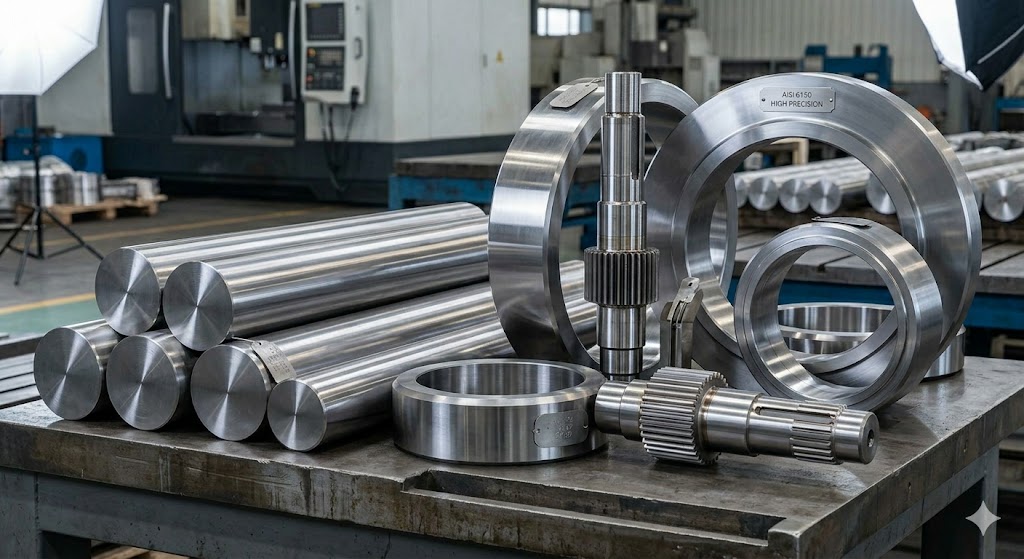
For most forged shafts under heavy fatigue, wear or shock loading — gear shafts, pinion shafts, eccentric crusher shafts — AISI 6150 is the better steel because vanadium refines the grain for higher fatigue strength and wear resistance. For large-diameter shafts that must through-harden, or where machinability, weldability, cost and fast availability matter most, AISI 4140 is the better choice thanks to its molybdenum-driven deep hardenability.
Ask ten engineers which alloy steel to forge a shaft from and you will hear "4140" before the question is finished. It is the safe, universal answer — but safe and universal is not the same as best for the part. For shafts that live under heavy cyclic load, wear or shock, AISI 6150 frequently outperforms it. This guide explains the real differences so you can choose on engineering grounds rather than habit.
Key takeaways
- AISI 6150 is a chromium-vanadium steel (~0.50% C, 0.15% V min) — best for fatigue- and wear-critical shafts.
- AISI 4140 is a chromium-molybdenum steel (~0.40% C, 0.15–0.25% Mo) — best for deep hardenability, machinability and cost.
- 6150 reaches higher hardness (up to ~58 HRC) and higher fatigue strength; 4140 hardens more reliably through large sections.
- For gear, pinion, eccentric and torsion shafts, choose 6150; for general drive shafts, large diameters and welded parts, choose 4140.
- European equivalents: 6150 ≈ 50CrV4 (1.8159); 4140 ≈ 42CrMo4 (1.7225).
Neither steel wins outright — the load case decides
Choose AISI 4140 for general-purpose drive shafts and axles, large cross-sections that must through-harden, and parts that need heavy machining, welding, or fast, low-cost sourcing.
Choose AISI 6150 for fatigue-critical and wear-loaded shafts — gear shafts, pinion shafts, eccentric crusher shafts, torsion shafts — where the vanadium-refined grain and higher attainable hardness pay off over the part's life.
What each steel actually is
The headline difference is one alloying philosophy versus another. These are not "high vs low quality" grades — they are tuned for different failure modes.
AISI 4140 — the chromium-molybdenum all-rounder
4140 carries roughly 0.40% carbon with chromium and a deliberate dose of molybdenum. Molybdenum deepens hardenability so thick sections harden uniformly to the core, and it resists temper softening and embrittlement. The result is a steel that is forgiving, predictable, stocked worldwide, and comfortable to machine and weld. For most industrial shafts, 4140 is genuinely the correct, economical answer.
AISI 6150 — the chromium-vanadium fatigue specialist
6150 runs higher carbon (around 0.50%) and replaces the molybdenum emphasis with a minimum 0.15% vanadium. Vanadium forms fine, stable carbides that pin grain boundaries during forging and heat treatment, giving an exceptionally fine, uniform grain. That fine grain is the source of 6150's signature strengths: higher fatigue endurance, better wear resistance, and good property retention at moderately elevated temperatures. It is, in spirit, a spring-and-shaft steel.
Chemistry side-by-side
The composition explains everything that follows. Note the higher carbon and the vanadium in 6150, versus the molybdenum in 4140.
| Element | AISI 6150 (Cr-V) | AISI 4140 (Cr-Mo) |
|---|---|---|
| Carbon (C) | 0.48 – 0.53 | 0.38 – 0.43 |
| Chromium (Cr) | 0.80 – 1.10 | 0.80 – 1.10 |
| Manganese (Mn) | 0.70 – 0.90 | 0.75 – 1.00 |
| Silicon (Si) | 0.15 – 0.35 | 0.15 – 0.35 |
| Molybdenum (Mo) | — | 0.15 – 0.25 |
| Vanadium (V) | 0.15 min | — |
Strength, hardness & hardenability
Both are medium-carbon alloy steels and both respond well to quench-and-temper. In the annealed condition they are similar. The differences appear after heat treatment — and, crucially, in how those properties hold across a large cross-section.
| Property | AISI 6150 | AISI 4140 |
|---|---|---|
| Carbon level | Higher (~0.50%) | Lower (~0.40%) |
| Max attainable hardness | up to ~58 HRC | up to ~55 HRC |
| Typical QT shaft hardness | 28 – 45 HRC | 28 – 34 HRC |
| Deep / through hardenability | Good | Excellent (Mo) |
| Fatigue endurance | Higher (fine grain) | Good |
| Wear resistance | Higher | Good |
| Impact toughness | Good | Very good, balanced |
| Elevated-temp stability | Better (V carbides) | Good (Mo) |
The most important practical distinction: 4140's molybdenum gives more reliable hardenability in large diameters. On a 400 mm forged shaft that must be hard and strong to the core, 4140 is often the lower-risk choice. On a 90 mm pinion shaft that fails by surface fatigue, 6150's fine grain and higher hardness win.
Property scorecard
A visual summary of the same trade-offs. The bars are a relative comparison for forged-shaft duty, not absolute test values.
Shaft decision matrix
The fastest way to decide is to match the shaft's dominant duty to the steel, then validate with your design calculations.
| Shaft / duty | Dominant demand | Better fit |
|---|---|---|
| General drive / line shaft | Balanced strength, cost | AISI 4140 |
| Large diameter (>300 mm) | Through-hardening | AISI 4140 |
| Gear & pinion shaft | Contact fatigue, wear | AISI 6150 |
| Eccentric / crusher shaft | Shock + wear | AISI 6150 |
| Torsion / spring-type shaft | Cyclic elastic load | AISI 6150 |
| Shaft with welded features | Weldability | AISI 4140 |
| Moderate hot service (≤300 °C) | Property retention | AISI 6150 |
| High-volume, cost-sensitive | Availability, price | AISI 4140 |
When to choose which
Pick AISI 6150 when…
- The shaft fails by fatigue or surface wear, not by overload.
- You need high surface hardness and high fatigue strength together.
- Loads are cyclic, shock-laden or spring-like.
- Grain refinement and consistency matter (gear-quality parts).
- Service runs warm, up to roughly 300 °C.
Pick AISI 4140 when…
- It is a general-purpose shaft and "good enough" is the target.
- The cross-section is large and must harden to the core.
- The part is machined heavily or includes welded features.
- Global availability, short lead time and low cost rule.
- You want the most documented, predictable processing route.
Forging & heat treatment notes
Both grades forge well in the same temperature window and are normally supplied annealed or normalized for machining, then quench-and-tempered to the final spec. A few practical points separate them on the shop floor.
6150 rewards tight forging-temperature control — overheating coarsens the grain and throws away the vanadium advantage. Its higher carbon means oil quenching and careful tempering to hit target hardness without losing toughness. 4140 is more tolerant: its molybdenum makes the quench less section-sensitive, so it develops core properties more easily across a range of sizes.
Cost, availability & lead time
This is where 4140 quietly wins for many buyers. As one of the most-produced alloy steels on earth, 4140 stock is available almost everywhere, in nearly any size, usually at lower price and shorter lead time. 6150 is more specialised — readily produced by a dedicated forging mill, but less of a shelf commodity. If two designs are technically acceptable and the part is not fatigue-critical, the 4140 route is often cheaper and faster. When the application genuinely needs 6150's fatigue and wear edge, that premium is money well spent over the service life. For detailed specifications, available sizes and a quotation, see our AISI 6150 forging parts page.
Equivalent grade reference
| Standard | AISI 6150 | AISI 4140 |
|---|---|---|
| UNS | G61500 | G41400 |
| EN / DIN | 50CrV4 (1.8159) | 42CrMo4 (1.7225) |
| JIS | SUP10 | SCM440 |
| GB (China) | 50CrVA | 42CrMo |
Three mistakes to avoid
1. Defaulting to 4140 for a fatigue-critical shaft. If a gear or eccentric shaft is failing prematurely, the steel grade — not just the heat treatment — may be the cause. 6150's fatigue advantage is real.
2. Specifying 6150 in a heavy section without checking hardenability. On very large diameters you may not develop full core properties; 4140 (or a deeper-hardening grade) can be the more honest choice.
3. Comparing only annealed data. Both steels look similar annealed. The differences live in the quench-and-tempered, in-service condition — compare them there.
Frequently asked questions
Is AISI 6150 stronger than AISI 4140?
What is the main difference between AISI 6150 and AISI 4140?
Can AISI 4140 replace AISI 6150 for a gear or pinion shaft?
Which is easier to machine and weld?
What are the European and JIS equivalents?
Can you supply custom forged shafts in both grades?
Need forged shafts in 6150 or 4140?
Send your drawing or specification and our engineering team will recommend the right grade, heat-treatment route and inspection plan — with a quote inside 24 working hours.
Standards referenced
Material selection should always be verified against the controlling drawing and specification. Our forgings are produced in accordance with the applicable standards below; our company holds ISO 9001:2015 quality-management certification, and material documents are issued per order. Commonly referenced standards for these grades include:
- ASTM A29/A29M — standard for hot-wrought carbon and alloy steel bars
- EN 10083-3 — alloy steels for quenching and tempering (50CrV4, 42CrMo4)
- DIN 17200 / EN 10250 — alloy steel forgings
- ISO 683-1 — heat-treatable steels
- ISO 6336-5 / DIN 3990-5 — material quality for gears
- EN 10204 — material certificate types (3.1 issued by the manufacturer; 3.2 countersigned by an independent inspector)