2.4733 Ni62Cr22W14Mo2 Forging Parts | China ISO 9001 Certified Manufacturer
Jiangsu Liangyi Co., Limited is a top ISO 9001:2015 certified manufacturer of 2.4733 Ni62Cr22W14Mo2 open die forging parts and seamless rolled forged rings located in Jiangyin, Jiangsu Province, China. With over 25 years of professional forging experience, we specialize in custom high-temperature nickel alloy forgings, supplying premium 2.4733 forged parts to aerospace, power generation, petrochemical, and industrial heat treatment customers across more than 50 countries worldwide.
2.4733 Ni62Cr22W14Mo2 — Key Facts at a Glance
- DIN Standard
- 2.4733 / NiCr22W14Mo2
- UNS Equivalent
- N06230 (Haynes 230®)
- Max Continuous Service Temp.
- 1200°C (short-term: 1250°C)
- Density
- 8.97 g/cm³ (0.324 lb/in³)
- Tensile Strength Rm (RT)
- Min 758 MPa
- Tensile Strength Rm (1000°C)
- ~265 MPa (typical)
- Yield Strength Rp0.2 (RT)
- Min 310 MPa
- Elongation (A5)
- Min 40%
- Hardness
- Max HB 241
- Solution Anneal Temp.
- 1163–1191°C, rapid cool
- Certification
- ISO 9001:2015, EN10204 3.1/3.2
- Lead Time (standard bars/rings)
- 15–20 working days
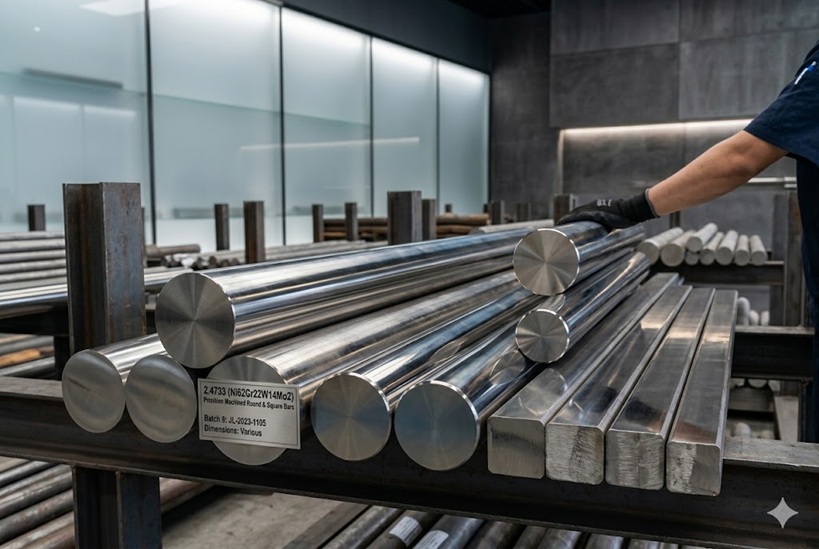
Full Range of 2.4733 Ni62Cr22W14Mo2 Forged Products
We manufacture custom 2.4733 Ni62Cr22W14Mo2 forging products based on international standards and client drawings, with single-piece weight capacity from 30 KG to 30,000 KG. Our complete product range includes:
- Forged Bars & Rods: 2.4733 forged round bars, square bars, flat bars, rectangular bars and step shafts, the max diameter is up to 2000 mm
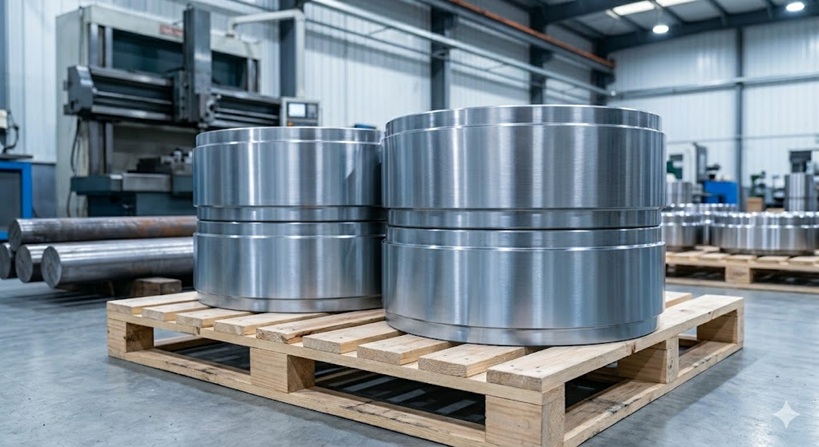
- Seamless Rolled Rings: Ni62Cr22W14Mo2 seamless rolled rings, contoured forged rings, seal rings and turbine casing rings, the max diameter is up to 6000 mm
- Hollow Forgings: 2.4733 forged sleeves, bushes, housings, shells, heavy-wall cylinders and hollow bars, the max OD is up to 3000 mm
- Turbine & Engine Components: Ni62Cr22W14Mo2 forged turbine blades, discs, impellers, blisks, rotors, casings and fasteners for gas & steam turbines
- Valve & Pressure Parts: 2.4733 forged valve stems, valve seats, valve cores, bonnets, flanges, tube sheets and baffle plates for high-temperature valves and heat exchangers
- Custom Forgings: Ni62Cr22W14Mo2 forged discs, blocks, die blocks, hot work dies, and custom machined parts per client drawings
All our open die forgings are available with full EN10204 3.1/3.2 Mill Test Certificates (MTC) and third-party inspection support by TÜV, SGS, BV and other international authorities.
Available 2.4733 Forging Dimensions by Product Form
The table below summarizes our standard supply capability range for 2.4733 Ni62Cr22W14Mo2 forgings. All dimensions can be customized beyond these ranges — contact us with your specific requirements.
| Product Form | Key Dimensions | Weight Range | Surface Condition |
|---|---|---|---|
| Round Bars / Rods | Dia. Ø20–2000 mm Length up to 6000 mm | 0.5–15,000 kg | Black (as-forged), turned, or ground |
| Flat Bars / Slabs | T: 20–500 mm W: 40–1500 mm L: up to 4000 mm | 5–20,000 kg | Black or milled flat |
| Seamless Rolled Rings | OD: 300–6000 mm ID: 200–5800 mm Height: 50–1000 mm Wall: 30–500 mm | 10–25,000 kg | As-rolled or machined bore/face |
| Forged Discs / Blocks | Dia. up to 3000 mm Height up to 1500 mm Block: up to 3000×1500×800 mm | 50–30,000 kg | Black or face-milled |
| Hollow Cylinders / Sleeves | OD: 100–3000 mm Wall: ≥30 mm Length up to 3000 mm | 20–18,000 kg | As-forged or rough-machined |
| CNC Machined Parts | Per customer drawing 5-axis capability | 0.5–5,000 kg | Finish-machined, Ra 0.8–6.3 μm |
2.4733 Equivalent Grades & International Standard Cross-Reference
2.4733 Ni62Cr22W14Mo2 has different designations in international standards. The table below gives the complete cross-reference for procurement, specification preparation, and import/export documents.
| Standard System | Designation / Grade | Applicable Standard Documents | Primary Market |
|---|---|---|---|
| DIN (German) | 2.4733 / NiCr22W14Mo2 | DIN 17742, DIN 17750–17754, DIN 17754 | Europe (primary standard) |
| UNS (USA) | N06230 | ASTM B435 (sheet/plate), B572 (rod/bar), B564 (forgings), B622 (tube) | North America, Global |
| Trade Name (USA) | Haynes 230® | Haynes International specification | North America, Aerospace |
| EN (European) | NW6230 / NiCr22W14Mo2 | EN 10095, EN 10302, EN 10028-7 | EU, EEA countries |
| AMS (Aerospace) | AMS 5878 (sheet/strip/plate) AMS 5891 (bar/rod/wire) | SAE Aerospace Material Specifications | Aerospace (US/NATO) |
| ASME (Pressure Vessel) | SB-435, SB-572, SB-564 | ASME BPVC Section II Part B | Pressure equipment (global) |
| GB/T (China) | GH5188 (approximate) | GB/T 14996, GB/T 15067 | China domestic market |
| JIS (Japan) | NW6230 | JIS H4551, JIS H4554 | Japan, Southeast Asia |
| BS (UK) | NA 22 | BS 3072–3076 | UK, Commonwealth countries |
Why Choose 2.4733 Ni62Cr22W14Mo2 Nickel Alloy?
2.4733 (also known as Ni62Cr22W14Mo2) is a carbide-strengthened nickel-chromium-tungsten-molybdenum superalloy, designed for extreme high-temperature use above 980°C. Compared with common nickel alloys such as Inconel® 601, Haynes® 214 and 310S stainless steel, it has unmatched performance advantages:
| Performance Index | 2.4733 Ni62Cr22W14Mo2 | Inconel 601 | 310S Stainless Steel |
|---|---|---|---|
| Max Continuous Service Temp. | 1200°C | 1150°C | 1050°C |
| Oxidation Resistance (1000°C) | Excellent | Good | Moderate |
| High-Temp. Creep Strength | Outstanding | Moderate | Poor |
| Carburization & Nitridation Resistance | Excellent | Moderate | Poor |
| Structural Stability at High Temp. | Outstanding | Good | Poor |
Extreme High-Temperature Oxidation Resistance
Excellent oxidation resistance at temperatures above 980°C, further improved by micro-addition of rare earth element lanthanum
Superior High-Temperature Strength
Tungsten and molybdenum solid solution strengthening delivers excellent creep resistance and stress rupture performance
Excellent Corrosion Resistance
Excellent resistance to carburization, nitridation, and high-temperature gas corrosion in harsh industrial environments
Excellent Structural Stability
Stable microstructure and mechanical properties during long-term high-temperature service, no brittle phase precipitation
The “14% Tungsten Advantage”: Why Composition Is the Key to 2.4733’s Dominance Above 1000°C
Most engineers choosing high-temperature alloys focus on nickel and chromium content. What genuinely separates 2.4733 from competing alloys is its 13–15% tungsten (W) addition — a level rarely achieved in commercial nickel superalloys and the primary reason for its exceptional performance above 1000°C.
Why Tungsten Changes Everything at Extreme Temperatures
Tungsten has the highest melting point of all metals (3422°C). When dissolved into the nickel matrix at 13–15%, it creates profound solid-solution strengthening that remains effective at temperatures where other strengthening mechanisms begin to fail. Specifically:
- At 871°C, 2.4733 retains a tensile strength of about 465 MPa — compared to just ~310 MPa for Inconel 601 at the same temperature.
- At 982°C, where most stainless steels and even some nickel alloys become structurally unreliable, 2.4733 still delivers ~285 MPa tensile strength, sufficient for structural loading in industrial furnaces and gas turbine casings.
- Above 1000°C, the alloy’s tungsten carbide (W₂C, WC) precipitates along grain boundaries, providing grain boundary strengthening — increasing creep rupture life by up to 30% compared to Inconel 601 in long-term exposures.
The Lanthanum Factor
The micro-addition of lanthanum (La) at 0.005–0.05% — often overlooked in material data sheets — plays an important role in oxidation resistance. Lanthanum gathers in the Cr₂O₃ oxide layer and greatly slows its growth. In real use, parts made from 2.4733 show oxide layer thickness about 40% thinner than similar Inconel 601 parts after 1000 hours at 1100°C. This is why Jiangsu Liangyi invests in VIM+ESR or VIM+VAR double-melt processes — to ensure tungsten and lanthanum are distributed homogeneously in the final forging.
Chemical Composition of 2.4733 Ni62Cr22W14Mo2 Alloy
| Element | Min. Content (%) | Max. Content (%) | Role in Alloy |
|---|---|---|---|
| Nickel (Ni) | Balance (~62%) | — | Austenitic matrix, corrosion resistance base |
| Tungsten (W) | 13.0% | 15.0% | Primary solid-solution strengthener; creep resistance above 900°C |
| Chromium (Cr) | 20.0% | 24.0% | Oxidation & corrosion resistance; forms Cr₂O₃ scale |
| Carbon (C) | 0.05% | 0.15% | M₆C carbide formation; grain boundary strengthening |
| Molybdenum (Mo) | 1.00% | 3.00% | Secondary solid-solution strengthener; corrosion resistance |
| Aluminum (Al) | 0.2% | 0.5% | Deoxidizer; enhanced oxidation resistance via Al₂O₃ sub-scale |
| Lanthanum (La) | 0.005% | 0.050% | Rare earth addition; reduces oxide scale growth rate by ~40% |
| Manganese (Mn) | 0.30% | 1.00% | Deoxidizer; enhances hot workability |
| Silicon (Si) | 0.25% | 0.75% | Oxidation resistance; deoxidizer |
| Cobalt (Co) | — | 5.00% | Solid solution strengthener (residual from raw materials) |
| Iron (Fe) | — | 3.00% | Controlled residual — higher Fe reduces high-temp. performance |
| Copper (Cu) | — | 0.50% | Controlled tramp element |
| Titanium (Ti) | — | 0.10% | Controlled — avoids TiC competition with M₆C carbides |
| Boron (B) | — | 0.015% | Micro-addition for grain boundary cohesion |
| Phosphorus (P) | — | 0.02% | Controlled harmful impurity |
| Sulfur (S) | — | 0.015% | Controlled harmful impurity |
Mechanical Properties of 2.4733 Ni62Cr22W14Mo2 Forgings
| Mechanical Property | Standard Minimum Requirement | Typical Achieved Value |
|---|---|---|
| Ultimate Tensile Strength (Rm) | Min 758 MPa | 790–860 MPa |
| 0.2% Offset Yield Strength (Rp0.2) | Min 310 MPa | 345–400 MPa |
| Elongation (A5) | Min 40% | 45–55% |
| Reduction in Area (Z) | Min 35% | 50–65% |
| Charpy V-notch Impact (KV) | Min 68 J | 100–150 J |
| Hardness | Max HB 241 | HB 175–220 (typical) |
| Young’s Modulus (E) | — | 211 GPa |
High-Temperature Mechanical Properties of 2.4733 Forgings
The following high-temperature tensile data shows typical values from solution-annealed 2.4733 Ni62Cr22W14Mo2 forged bars, tested lengthwise. These values are for engineering reference only; actual design limits should be determined by qualification testing on your specific forging shape and heat number.
| Test Temperature | Tensile Strength Rm (MPa) | Yield Strength Rp0.2 (MPa) | Elongation A5 (%) | Notes |
|---|---|---|---|---|
| 23°C (Room Temp.) | 790–860 | 345–400 | 45–55 | Standard acceptance condition |
| 538°C (1000°F) | 730–780 | 295–345 | 42–50 | Typical creep-service start point |
| 760°C (1400°F) | 615–665 | 255–290 | 38–48 | Gas turbine compressor casing range |
| 871°C (1600°F) | 450–490 | 230–260 | 38–46 | Important service threshold for many designs |
| 982°C (1800°F) | 265–300 | 185–215 | 50–60 | Industrial furnace part range |
| 1093°C (2000°F) | 130–155 | 110–130 | 65–80 | Maximum design use — creep governs |
Creep rupture reference data: At 871°C / 35 MPa, 2.4733 exhibits a stress rupture life exceeding 1000 hours. At 982°C / 20 MPa, typical rupture life is 500–800 hours depending on grain size and heat treatment. Contact our metallurgical team for application-specific creep allowable data.
Physical & Thermal Properties of 2.4733 Ni62Cr22W14Mo2 Alloy
| Property | Value at 23°C (RT) | Value at 500°C | Value at 871°C | Unit |
|---|---|---|---|---|
| Density | 8.97 | — | ~8.75 | g/cm³ |
| Melting Range | 1301–1371°C (2374–2500°F) | °C | ||
| Young’s Modulus (E) | 211 | 193 | 172 | GPa |
| Shear Modulus (G) | 82 | 75 | 67 | GPa |
| Poisson’s Ratio (ν) | 0.288 | — | — | — |
| Thermal Conductivity (λ) | 8.9 | 14.1 | 18.1 | W/(m·K) |
| Specific Heat (Cp) | 397 | 435 | 473 | J/(kg·K) |
| CTE (mean, 23–93°C) | 12.7 | — | — | μm/(m·K) |
| CTE (mean, 23–538°C) | — | 14.0 | — | μm/(m·K) |
| CTE (mean, 23–871°C) | — | — | 15.6 | μm/(m·K) |
| Electrical Resistivity (ρ) | 1.26 | 1.35 | 1.41 | μΩ·m |
| Thermal Diffusivity (α) | 2.50×10⁻⁶ | — | 4.40×10⁻⁶ | m²/s |
Heat Treatment Specifications for 2.4733 Ni62Cr22W14Mo2 Forgings
Correct heat treatment is essential for getting the full performance of 2.4733 alloy. Unlike precipitation-hardened nickel alloys, 2.4733 is a solid-solution strengthened alloy whose properties are mainly controlled by solution annealing temperature and cooling rate.
| Heat Treatment Step | Temperature Range | Holding Time | Cooling Method | Purpose & Effect |
|---|---|---|---|---|
| Solution Annealing (Primary) | 1163–1191°C | Min 30 min/25 mm section | Rapid air cool or water quench (>75 mm sections) | Fully dissolves carbides, restores maximum ductility and corrosion resistance |
| Post-Forge Anneal (Intermediate) | 1080–1120°C | Min 1 h per 25 mm thickness | Rapid air cool | Grain refinement; ASTM grain size ≥ 5 for fatigue-critical applications |
| Stress Relief (Post-Machining/Post-Weld) | 900–960°C | 1–4 hours | Air cool or furnace cool to 500°C, then air cool | Reduces machining or weld-induced residual stresses |
| Stabilization Aging (Optional — Creep Service) | 700–760°C | 16 hours | Air cool | Improves long-term creep rupture strength by 10–15% |
| Sensitization Recovery (Post-Weld Full Anneal) | 1163–1191°C | 30 min per 25 mm, min 30 min total | Rapid air cool or water quench | Dissolves Cr-depleted zone at grain boundaries after welding |
Our Exclusive Manufacturing Advantages for 2.4733 Alloy Forgings
2.4733 Ni62Cr22W14Mo2 is a high-tungsten nickel superalloy with a narrow hot working window (1050–1200°C), which is prone to cracking and grain coarsening during forging. With over 25 years of experience in nickel alloy forging, we have developed exclusive process solutions:
- Premium Melting Process: All 2.4733 forgings are made by VIM+ESR or VIM+VAR double melting. We strictly control impurity elements and gas content to guarantee high material purity and fatigue performance.
- Precision Hot Forging: Infrared real-time temperature monitoring throughout forging, multi-pass small deformation strategy, avoiding internal cracks and guaranteeing consistent fine-grained microstructure (ASTM grain size ≥ 5).
- Customized Heat Treatment: Standard solution anneal (1163–1191°C) with option for stabilization aging (700°C for 16 hours); parameters adjustable per application.
- Full-Process Quality Control: Full traceability from raw ingot to finished part; in-house OES + ICP chemical analysis, mechanical testing lab, metallographic inspection, and NDT ensure 100% conformance.
Our forging workshop is equipped with 2000T–6300T hydraulic forging presses, 1–5T electro-hydraulic forging hammers, 1–5M seamless rolling machines and 10+ heat treatment furnaces with thermocouple-certified temperature uniformity.
Machining & Fabrication Guidelines for 2.4733 Ni62Cr22W14Mo2 Forgings
2.4733 alloy is much harder to machine than stainless steels and standard nickel alloys. Its high tungsten content causes rapid work hardening, and grain boundary carbides speed up tool wear.
Recommended Machining Parameters
| Parameter | Value | Notes |
|---|---|---|
| Roughing Speed | 25–40 m/min | Carbide or CBN tooling |
| Finishing Speed | 40–60 m/min | Sharp, uncoated carbide or CBN |
| Feed Rate (Rough) | 0.10–0.30 mm/rev | Avoid light feeds that burnish |
| Feed Rate (Finish) | 0.05–0.10 mm/rev | Per Ra requirement |
| Depth of Cut (Rough) | 2–5 mm | Deeper cuts preferred |
| Tool Material | C-2 Carbide | TiAlN or uncoated; CBN for finishing |
| Coolant | High-pressure flood | Water-soluble oil, 8–12% concentration, chloride-free |
| Operation | Wheel Type | Wheel Speed | Work Speed | Infeed |
|---|---|---|---|---|
| Surface grinding | CBN or Al₂O₃ vitrified, 46–60 grit | 25–33 m/s | 10–20 m/min | 0.01–0.025 mm/pass |
| Cylindrical grinding | CBN or Al₂O₃, 46–80 grit | 30–35 m/s | 8–15 m/min | 0.005–0.015 mm/pass |
| Internal grinding | Al₂O₃ or CBN, 60–80 grit | 20–30 m/s | 5–12 m/min | 0.003–0.010 mm/pass |
5-Step Specification Checklist: How to Order 2.4733 Forgings Without Errors
- Specify the governing standard AND the grade designation together. Example: “2.4733 per DIN 17754” or “UNS N06230 per ASTM B564 Class 1”. If your end customer needs EN10204 3.2 (third-party witnessed inspection), include this in your RFQ — it will influence production scheduling and cost.
- State the required heat treatment condition. Options: (a) As-forged [lowest cost, not recommended for service], (b) Solution-annealed [standard — best corrosion resistance and ductility], (c) Solution-annealed + stabilization-aged [best creep performance for 850°C+ service]. Always state: “Supply in solution-annealed condition, 1163–1191°C, rapid air cooled.”
- Specify grain size requirement for fatigue-critical applications. For fatigue-important uses (rotating parts, pressure-cycled parts), specify “ASTM grain size ≥ 5 (fine grain)”. For creep-important applications (static furnace parts, sustained high-temperature load), coarser grain (ASTM 3–5) may offer better creep rupture life.
- Define NDT requirements explicitly. Minimum standard: 100% UT testing per ASTM A388. For critical applications, also request PT per ASTM E165; MT; and/or RT as required.
- Confirm dimensional tolerances and machining allowance. Specify: “Supply with 5 mm machining allowance on all surfaces.” When ordering finished machined parts, provide a finished drawing including tolerances (h6/H7 etc.) and surface roughness (Ra).
Global Industry Standards & Certifications
- European Union: EN material standards (EN 10095, EN 10302); material documentation supporting customer PED 2014/68/EU and AD 2000 Merkblatt qualification.
- North America: Material meeting ASTM B564 chemical and mechanical requirements; ASME BPVC Section II Part B material properties; material documentation supporting customer AMS aerospace qualification.
- Oil & Gas Industry: Material properties meeting API 6A material requirements; NACE MR0175/ISO 15156 material compliance (by alloy chemistry and hardness).
- Power Generation Industry: Material documentation compatible with GE, Siemens, and Mitsubishi turbine material specifications.
- Quality System: ISO 9001:2015 certified quality management system; qualified NDT personnel; calibrated in-house testing laboratory.
Global Project Cases & Targeted Applications
EU Power Generation & Aerospace
Markets: Germany, France, Italy
We have supplied 2.4733 forgings including LPT turbine casings, combustion cans, transition ducts and flame holders to European aerospace firms and thermal power plants, complete with material documentation supporting PED 2014/68/EU qualification.
Middle East Oil & Gas
Markets: Saudi Arabia, UAE, Oman
We have supplied customized 2.4733 forgings including valve stems, valve seats, bonnets and high-temperature furnace parts for petrochemical projects, with material properties fully meeting API 6A and NACE MR0175 requirements.
North America Gas Turbine
Markets: USA, Canada
We have supplied 2.4733 forgings including turbine blades, discs, impellers, fasteners and thermocouple protection tubes for land-based gas turbine projects, with complete material documentation complying with ASME B564 requirements.
Southeast Asia Power Generation
Markets: Thailand, Indonesia, Malaysia
We have supplied 2.4733 forged reheat valve discs, valve spindles, tube sheets and heat shields for biomass and geothermal power plants.
Australia Mining & Heat Treatment
Markets: Australia, New Zealand
We have supplied customized 2.4733 forged heat-treating baskets, grates, trays, nitriding furnace internals and hot work die blocks for Australian mining and heat treatment enterprises.
Global Chemical Process Industry
Markets: Worldwide
We have supplied 2.4733 forged catalyst grid supports for ammonia burners, high-temperature heat exchangers, bellows, sparger tubes and cyclone internals for large-scale chemical projects.
Quality Control & Non-Destructive Testing (NDT)
- Raw Material Inspection: OES + ICP chemical composition analysis, gas content testing (O, N, H by LECO fusion), incoming material traceability verification to VIM ingot heat number.
- Forging Process Inspection: Continuous infrared pyrometer monitoring, deformation ratio control per forge plan, in-process microstructure sampling.
- Heat Treatment Inspection: Thermocouple-calibrated furnace temperature uniformity verification, hardness testing on every batch, grain size metallographic examination per ASTM E112.
- Non-Destructive Testing (NDT): 100% Ultrasonic Testing (UT) per ASTM A388; Dye Penetrant Testing (PT) per ASTM E165; Magnetic Particle Testing (MT); Radiographic Testing (RT) as specified.
- Mechanical Property Testing: Tensile testing per ASTM E8/E21, Charpy V-notch impact per ASTM E23, high-temperature tensile as required.
- Final Inspection: 3D CMM dimension test, surface finish measurement, documentation package review and sign-off.
All NDT procedures are carried out by qualified inspectors with formal certification records. Full material traceability is kept from the original ingot heat number to the final inspection report. Third-party witnessing of NDT is available through internationally recognized inspection bodies.
Technical FAQ for 2.4733 Ni62Cr22W14Mo2 Forgings
What is the maximum continuous service temperature of 2.4733 Ni62Cr22W14Mo2 alloy?
What welding process is suitable for 2.4733 Ni62Cr22W14Mo2 alloy?
What is the difference between 2.4733 and Haynes 230 / UNS N06230?
Can you provide custom CNC machining for 2.4733 forgings?
What is the lead time for 2.4733 Ni62Cr22W14Mo2 forgings?
How does grain size affect 2.4733 forging performance in service?
What is the density of 2.4733 and how does the tungsten content affect component weight?
What test certificates and documentation do you provide?
Optional on request: EN10204 3.2 MTC (third-party witnessed by TÜV, SGS, BV, or Lloyd’s); high-temperature tensile test results; Charpy impact results; corrosion test reports; NACE MR0175 compliance statement.
Can 2.4733 forgings meet NACE MR0175 / ISO 15156 for sour gas service?
What is the minimum order quantity for 2.4733 forgings?
Global Supply & Customization Capability
- Customization Scope: Custom shapes and sizes per your drawings, from 30 KG small parts to 30,000 KG heavy forgings; near-net-shape forging to minimize your machining cost.
- Production Mode: Single prototype to large-batch production; dedicated lot traceability maintained throughout.
- Global Delivery: FOB Shanghai, CIF, DDP and other Incoterms; VCI anti-corrosion export packaging standard for all sea freight shipments.
- Technical Support: Metallurgical engineers available for material selection guidance, forging process optimization, failure analysis consultation, and post-delivery technical support.
- Third-Party Inspection: TÜV, SGS, BV, Lloyd’s — we accommodate all major international inspection agencies in our facility.
Inquire About 2.4733 Ni62Cr22W14Mo2 Forging Parts
Jiangsu Liangyi Co., Limited is your reliable global supplier of high-quality 2.4733 Ni62Cr22W14Mo2 forging parts. Whether you need standard forged bars and rings, or custom intricate turbine parts, we provide the best solution. Send your drawings, material requirements, quantity, and application details for a detailed technical quotation within 24 hours.
Contact Our Forging Experts Today
Get in touch for a competitive quote and technical consultation on your 2.4733 application.