The short answer
Pay the 1.4410 premium when the service combination of temperature × chloride × H₂S pushes past the safe envelope of 2205 — practically, above roughly 1,000 ppm chloride, above roughly 60 °C, or in any NACE MR0175 sour-gas duty with meaningful H₂S. Below that, 2205 usually does the identical job for less money. And do not buy super duplex for strength alone — the yield gain over 2205 is only about 18%.
Key takeaways
- Same family: 2205 and 1.4410 are both ferritic-austenitic duplex steels; both far exceed 316L in strength and chloride SCC resistance.
- Cost gap: a finished 1.4410 forging typically costs ~1.3–1.6× an equivalent 2205 forging, tracking the molybdenum and nickel markets.
- The deciding number is CPT: ~40–50 °C for 2205 versus >85 °C for 1.4410 — the reason super duplex survives hot, high-chloride brine.
- Choose 1.4410 for: seawater above ambient, hot high-chloride media, NACE sour service, and high-consequence pressure equipment.
- Choose 2205 for: low-chloride (<~200 ppm), cool (<~60 °C), non-sour, or weld-heavy service — where the premium never pays back.
01 — The real size of the premium
What you are actually paying extra for
Both alloys belong to the same duplex family — a roughly 50/50 ferrite–austenite microstructure that gives them their signature blend of strength and stress-corrosion resistance. The gap between them comes down to three deliberately raised alloying elements in 1.4410: molybdenum (about 4% vs 3% in 2205), nitrogen (about 0.30% vs 0.17%), and slightly higher chromium. Those additions are exactly what the PREN formula rewards — PREN = %Cr + 3.3×%Mo + 16×%N — pushing 1.4410 across the super-duplex threshold of 40.
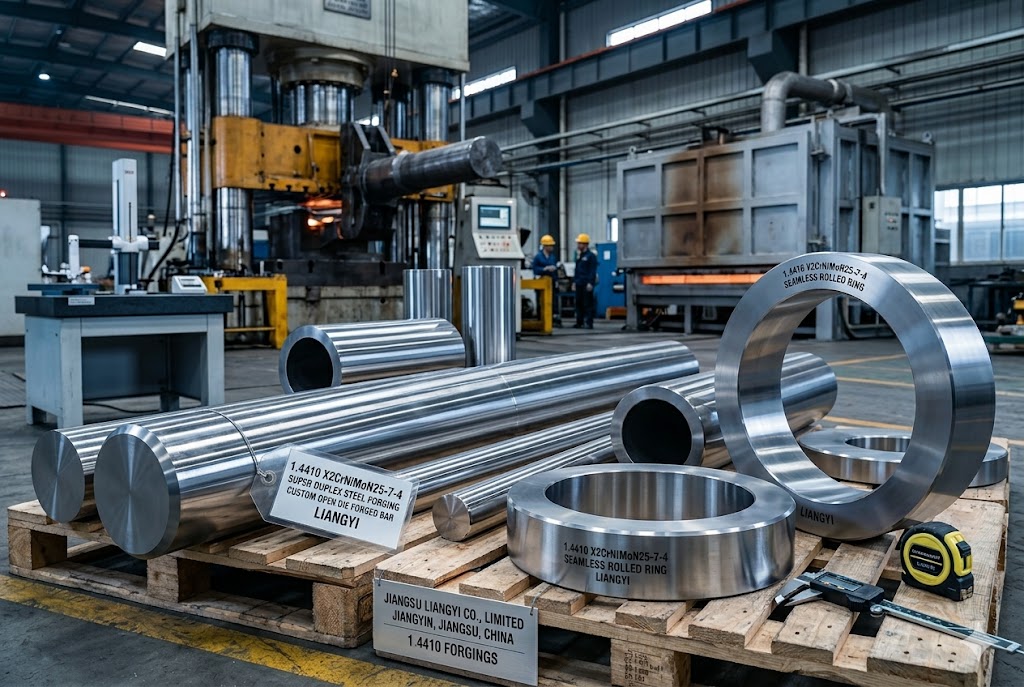
As a rough working figure, the finished forged-part cost of 1.4410 typically runs 30–60% above an equivalent 2205 forging. Part of that is raw-material chemistry, so the exact delta rises and falls with the molybdenum and nickel markets. But a real portion is process cost: 1.4410 has a narrower hot-working window, a stronger tendency toward sigma-phase embrittlement, and therefore demands tighter temperature control, faster quenching and more metallographic verification per heat. That extra discipline is not optional — it is the difference between a properly forged 1.4410 (X2CrNiMoN25-7-4) super duplex forging that performs and one that quietly fails a low-temperature impact test.
The premium is not linear with performance
Going from 316L to 2205 buys a large jump in both strength and chloride resistance for a modest cost step. Going from 2205 to 1.4410 buys a smaller, sharply targeted gain in corrosion resistance for a similar or larger cost step. You are paying for the top of the corrosion curve — which only matters if your environment lives there.
02 — Where the two are genuinely equal
Both already beat austenitic stainless
Before comparing them to each other, it helps to remember what they share. Against 316L, both 2205 and 1.4410 offer roughly double the yield strength and vastly better resistance to chloride stress-corrosion cracking (SCC) — the failure mode that quietly cracks austenitic piping above about 50 °C in seawater. In moderate service a 2205 forging and a 1.4410 forging will behave identically: same corrosion outcome, same SCC survival, same decades of life. In that band, the money spent on super duplex earns nothing back. Specifying it there is a common and expensive habit — engineers reach for the “best” grade out of caution rather than analysis.
03 — Side by side
The numbers that separate them
| Property | 2205 (1.4462) | 1.4410 (2507) |
|---|---|---|
| PREN (pitting index) | 34–38 | ≥42 |
| Critical Pitting Temp (G48 C) | ~40–50 °C | >85 °C |
| Min. yield Rp0.2 | 450 MPa | 530 MPa |
| Chloride SCC resistance | Good | Excellent |
| NACE MR0175 sour service | Limited H₂S envelope | Meets requirements |
| Forgeability | Moderate — wider window | High difficulty — narrow window |
| Relative finished cost | Baseline | ~1.3–1.6× |
The single most decision-relevant row is Critical Pitting Temperature. PREN is a ranking index; CPT is closer to a real-world limit. The jump from roughly 45 °C to above 85 °C is the whole reason super duplex exists — it is what lets a component sit in hot, high-chloride brine that would pit 2205 within its first operating season.
04 — The decision
Four questions that actually settle it
Skip the grade-preference debate. Answer these four in order — the first “yes” that lands in the super-duplex column usually justifies 1.4410 on its own.
Temperature × chloride
Combine your operating temperature with your chloride load. Hot brine, seawater above ambient, or high-salinity produced water all erode the pitting margin of 2205 fast.
> ~1,000 ppm Cl AND > ~60 °C → 1.4410
Sour service (H₂S)
NACE MR0175 / ISO 15156 limits how far 2205 can go in H₂S. 1.4410 carries a fuller sour-service envelope at full strength without hardness penalties.
Meaningful H2S partial pressure → 1.4410
Crevice geometry
Gaskets, threaded joints, tube-to-tubesheet gaps and deposits create crevices where pitting starts well below the open-surface CPT. Tight geometry shifts the safe line down.
Crevice-prone + chloride → favor 1.4410
Consequence of failure
A subsea wellhead body or a desalination high-pressure pump that fails costs orders of magnitude more than the material delta. Criticality buys margin.
High-consequence + corrosive → 1.4410
05 — A common mistake
Do not buy super duplex for strength alone
It is tempting to justify the premium on mechanical grounds, but the arithmetic is thin. Minimum yield rises from about 450 MPa (2205) to 530 MPa (1.4410) — roughly an 18% gain. In a wall-thickness or weight-limited design that translates into only a modest section reduction, rarely enough by itself to offset a 30–60% material premium. If corrosion is not the driver, 2205 already delivers the duplex strength advantage over austenitic grades at lower cost. The justified reason to pay for 1.4410 is almost always corrosion resistance and sour-service compliance — not the strength line on the datasheet.
06 — The break-even line
Where the premium starts paying for itself
Service severity vs. justified grade
Chloride concentration and temperature rising left → right
07 — Life-cycle economics
The premium looks different next to failure cost
The purchase-price comparison is the wrong frame for critical service. A super duplex forging that costs a fraction more up front is trivial against the cost of an unplanned shutdown, a replacement subsea intervention, or a desalination train offline while a pitted 2205 component is cut out and replaced. In high-consequence corrosive service the material delta is often recovered in a single avoided failure. The honest version of this argument runs the other way too: in benign service there is no failure to avoid, so the premium simply never returns — which is precisely why grade selection has to be tied to the environment, not to caution.
Rule of thumb
If a corrosion failure in this component would cost more than a few times the total order value, the corrosion margin of 1.4410 is cheap insurance. If the same component sits in mild service where neither grade would ever fail, that insurance is pure cost.
08 — The honest counter-case
When 2205 is simply the smarter buy
A supplier that only ever recommends the pricier grade is selling, not advising. These are the situations where 2205 is the correct engineering choice:
- Freshwater or low-chloride service (< ~200 ppm) below roughly 60 °C.
- Non-sour environments with no meaningful H₂S partial pressure.
- Structural or moderately corrosive duty where the duplex strength jump over austenitic grades is the real goal.
- Large weldment-heavy fabrications, where 2205’s wider processing window lowers total fabrication risk and cost.
- Budget-constrained projects where a documented CPT-margin analysis confirms 2205 sits safely inside its envelope.
When your analysis lands here, the right move is 2205 — and a good forging partner should be comfortable telling you so.
09 — Quick answers
Frequently asked questions
Is 1.4410 always better than 2205?
No. It is more corrosion-resistant, but “better” only has meaning relative to the environment. In cool, low-chloride, non-sour service the two behave identically in practice, so 2205 delivers the same outcome for less money and with easier forging.
How much more expensive is super duplex than standard duplex?
As a rough guide, expect the finished forged-part cost of 1.4410 to run about 30–60% above an equivalent 2205 forging. The exact figure moves with the molybdenum and nickel markets, and part of it reflects the tighter process control super duplex demands rather than raw chemistry alone.
Can I specify 1.4410 for higher strength instead of corrosion?
Rarely worth it. Minimum yield rises only from about 450 to 530 MPa — roughly 18%. That seldom offsets the premium on strength grounds alone. If corrosion and sour service are not driving the choice, 2205 already gives you the duplex strength advantage.
Are 1.4410 and 2205 interchangeable in a design?
Not automatically. They share duplex behaviour but differ in corrosion envelope, sour-service approval and forging process. Any substitution should be checked against the CPT margin, NACE requirements and the applicable pressure code for the actual operating conditions.
Need the super-duplex side of the decision made in metal?
Jiangsu Liangyi forges custom 1.4410 (X2CrNiMoN25-7-4 / 2507) super duplex forgings — open die forgings, seamless rolled rings, bars, shafts and hollow forgings, in-house melt to machined component. Our quality system is ISO 9001:2015 certified; material is manufactured to meet NACE MR0175 requirements and supplied with our EN 10204 3.1 mill test certificate (3.2 with third-party witness available on request). Send your service conditions and we will tell you honestly whether the premium is worth it for your part.
Contact Jiangsu Liangyi
- Inquiry Emailsales@jnmtforgedparts.com
- 📞 Phone / WhatsApp+86-13585067993
- 🌐 Websitehttps://www.jnmtforgedparts.com
- 📍 AddressChengchang Industry Park, Jiangyin City, Jiangsu Province, China