1.4410 (X2CrNiMoN25-7-4) Super Duplex Steel Forgings | China Jiangsu Liangyi Manufacturer
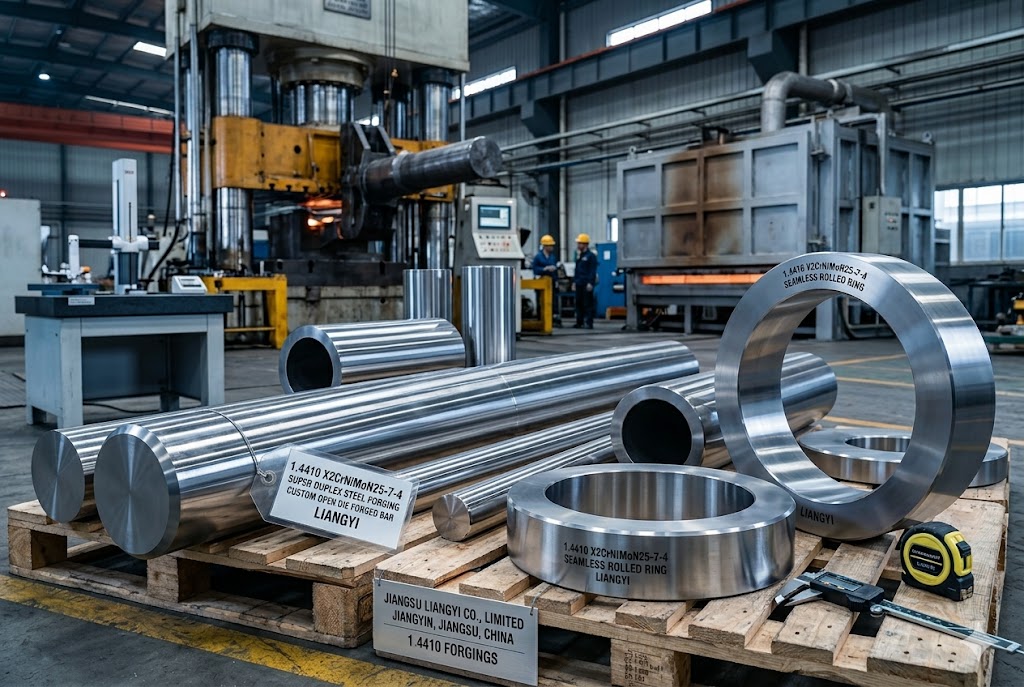
1.4410 X2CrNiMoN25-7-4 Super Duplex Steel Forgings — Manufacturer Overview
Established in 1997, Jiangsu Liangyi Co., Limited is a professional ISO 9001:2015 certified manufacturer of 1.4410 (X2CrNiMoN25-7-4) super duplex steel forgings based in Chengchang Industry Park, Jiangyin City, Jiangsu Province, China. Our 80,000 m² facility — equipped with 30 t EAF+LF+VOD+ESR in-house melting, 2000T–6300T hydraulic forging presses, and a comprehensive in-house inspection laboratory — represents one of the most integrated super duplex steel forging supply chains in China.
We produce the full range of 1.4410, X2CrNiMoN25-7-4 (UNS S32750 / 2507) open die forging parts and seamless rolled forged rings, with single-piece weight capacity from 30 kg to 30 tons and an annual manufacturing capacity of 120,000 tons. All products are delivered with complete MTC EN 10204 3.1 (or 3.2 on request) documentation, traceable from melt heat to finished component.
In over 25 years of operating, Jiangsu Liangyi has never changed its core quality discipline: every 1.4410 forging is produced with strict control of nitrogen content (0.28–0.32%), a tightly managed forging temperature window (950–1180 °C), and a post-forge solution anneal at 1080–1120 °C with water quench — a process sequence that consistently delivers ferrite content within the 30–70% target band and eliminates the risk of sigma phase embrittlement. This is not a claim made for marketing; it is verified on every heat by in-house metallographic section analysis and third-party NDT before any shipment leaves our Jiangyin factory.
The term super duplex is not a marketing label — it has a precise metallurgical meaning. Any stainless steel must achieve a PREN ≥40 to qualify as super duplex, calculated by the formula: PREN = %Cr + 3.3×%Mo + 16×%N. Standard duplex 2205 (1.4462) achieves PREN ~34–38. By increasing molybdenum to 3.5–4.5% and nitrogen to 0.24–0.35%, 1.4410 reaches PREN ≥42 — crossing the threshold that makes it viable for seawater injection systems, sour gas environments, and chloride-containing chemical processing at elevated temperatures where 2205 is simply not safe.
Metallurgical Science: Why 1.4410 X2CrNiMoN25-7-4 Outperforms Other Grades
Understanding why 1.4410 performs the way it does — not just that it does — is essential for specifying the right forging grade and processing parameters. The following is an original engineering-level analysis based on Jiangsu Liangyi's 25+ years of production data.
The Role of Each Alloying Element in 1.4410
The designation X2CrNiMoN25-7-4 directly encodes four of the five critical alloying elements. Here is what each one does and why the balance matters in forged components:
The primary corrosion-resistant element. At 24–26%, chromium forms a dense Cr₂O₃ passive film that self-heals in oxidizing environments. Raising Cr above 22% also promotes ferrite formation, so the exact level must be balanced with Ni and N to maintain the target duplex ratio. Cr content also contributes the largest single term to the PREN formula.
At 6–8%, nickel stabilizes the austenitic phase against the ferritic tendency of high chromium. In a correctly processed 1.4410 forging, the Ni content — together with the N addition — ensures the austenite fraction stays between 40–60%, preserving toughness and ductility that would otherwise be lost in a fully ferritic structure.
Molybdenum is the most potent single addition for pitting and crevice corrosion resistance, contributing 3.3× its weight in the PREN formula. At 3.5–4.5%, Mo dramatically increases the Critical Pitting Temperature (CPT) by stabilizing the passive film in chloride environments. However, Mo also promotes sigma phase (σ) formation above 700 °C — which is why precise heat treatment is non-negotiable for super duplex forgings.
Nitrogen contributes 16× its weight to the PREN formula, making it the most efficient element for pitting resistance per unit added. In 1.4410, N at 0.28–0.32% also acts as a powerful solid solution strengthener (raising yield strength without reducing toughness), suppresses sigma phase formation, and accelerates austenite re-formation after forging — giving the alloy its forgiving response to small temperature deviations during forging. Jiangsu Liangyi's VOD process precisely controls N to 0.28–0.32%, avoiding the losses that occur in EAF-only melting.
The "X2" in X2CrNiMoN25-7-4 means carbon ≤0.03% (our factory target: ≤0.025%). Carbon must be minimized because it forms chromium carbides (Cr₂₃C₆) at grain boundaries during the 550–900 °C range, depleting chromium locally and creating sensitization zones that are vulnerable to intergranular corrosion. At ≤0.025%, this risk is essentially eliminated even if the material briefly passes through that temperature during cooling after forging.
Sulfur forms MnS inclusions, which are initiation sites for pitting corrosion. The EN standard allows ≤0.015%, but Jiangsu Liangyi controls S to ≤0.010% using desulfurization during LF refining. At this level, MnS inclusions are essentially absent, which is measurable in the improvement of CPT versus material produced at the specification limit.
The Danger Zone: Intermetallic Phase Precipitation in 1.4410
Super duplex steels are more vulnerable to harmful phase precipitation than standard duplex steels, because their higher Mo and Cr content lowers the threshold temperature at which sigma phase (σ), chi phase (χ), and Cr₂N nitrides begin to form. This is the most critical metallurgical risk for any super duplex forging manufacturer, and it is where inexperienced suppliers routinely fail.
⚠ Critical Risk: Sigma phase (σ) in 1.4410 can begin forming at temperatures as high as 1000 °C and precipitates most rapidly between 700–900 °C. Even brief exposure — as little as 1–2 minutes at 850 °C in heavy sections — can cause a >50% drop in Charpy impact energy and a measurable reduction in CPT. For forgings with section thickness above 200 mm, this risk is amplified during the initial free-surface cooling phase if the forge is not immediately transferred to the quench tank.
At Jiangsu Liangyi, we address this with three specific process controls not found at lower-tier suppliers:
- Continuous infrared temperature monitoring on all forging surfaces throughout the hot-working sequence, with automatic press stops if surface temperature drops below 950 °C.
- Section-specific quench time calculations for every heavy forging: minimum water flow rate is calculated to bring the heaviest section through the 600–1000 °C range in under 3 minutes, regardless of OD.
- Mandatory post-quench metallographic section analysis for all forgings above 300 mm section: 4% oxalic acid electrolytic etch at 1 A/cm² reveals any sigma phase as a distinct orange-brown phase at 200× magnification, with zero tolerance for any detectable sigma fraction before release.
Forging vs. Casting for 1.4410 Components — A Quantitative Comparison
Buyers sometimes ask whether 1.4410 castings can substitute for forgings to reduce cost. The answer depends on the application, but for pressure-critical and corrosion-critical components, the mechanical data tells a clear story:
| Property | 1.4410 Open Die Forging (Jiangsu Liangyi) | 1.4410 Sand Casting (Typical) |
|---|---|---|
| Grain Size (ASTM) | ASTM 5–8 (refined) | ASTM 1–3 (coarse, dendritic) |
| Internal Porosity / Shrinkage | Eliminated by forging deformation | Present — risk of SCC initiation |
| Charpy Impact at −46 °C (Long.) | Typically ≥120 J | Typically 60–80 J |
| Yield Strength Rp0.2 | ≥550 MPa (typical) | ≥500 MPa (EN standard minimum) |
| Ferrite/Austenite Uniformity | Highly uniform — forging breaks banding | May have phase segregation bands |
| Acceptable for NACE MR0175 | Yes — with hardness ≤36 HRC (22–28 HRC typical) | Possible, but hardness more variable |
| Dimensional Accuracy (OD) | ±0.5 mm after CNC (IT6) | ±2–5 mm after machining |
| Section Thickness Capability | Up to 3000 mm OD | Virtually unlimited, but property degradation in heavy sections |
Engineering Note: For BOP bodies, wellhead connectors, pump casings, and pressure vessel nozzles — all of which experience cyclic pressure and operate in corrosive media — the superior toughness and internal integrity of forgings translate directly into longer fatigue life and lower probability of stress corrosion cracking initiation. Jiangsu Liangyi recommends forgings for all wall thicknesses above 30 mm and all service environments involving H₂S or chloride concentrations above 1000 ppm.
Grade Selection Guide: When to Specify 1.4410 and When Not To
Selecting the right corrosion-resistant alloy is a balance of performance, fabricability, and cost. This section provides an honest, engineering-based comparison — including situations where 1.4410 may not be the optimal choice — so that buyers can make informed decisions.
| Performance Indicator | 1.4410 / 2507 (X2CrNiMoN25-7-4) | 2205 / 1.4462 (Standard Duplex) | 316L (Austenitic) | 1.4501 / Z100 (Super Duplex) | 904L / 1.4539 (High-Alloy Austenitic) |
|---|---|---|---|---|---|
| PREN | ≥42 | ~34–38 | ~24–26 | ≥40 | ~32–36 |
| Min. Yield Strength (Rp0.2) | 530 MPa | 450 MPa | 170 MPa | 550 MPa | 220 MPa |
| Chloride SCC Resistance | Excellent | Good | Poor (<50 °C) | Excellent | Moderate |
| Critical Pitting Temp (CPT, ASTM G48C) | >85 °C | ~40–50 °C | ~15–20 °C | >80 °C | ~35–45 °C |
| NACE MR0175 Sour Gas Approval | Full Compliance | Partial (limited H₂S) | Not Approved | Full Compliance | Not Approved |
| Forging Process Difficulty | High — narrow temp window | Moderate | Easy | Very High — Cr28 segregation risk | Easy |
| Relative Raw Material Cost | High | Moderate | Low–Moderate | Very High | High |
| Jiangsu Liangyi Forging Capability | Full range, all sizes | Full range, all sizes | Full range, all sizes | Full range, all sizes | Full range, all sizes |
When 1.4410 Is the Right Choice
- Seawater service at temperatures above 25 °C (where 316L has already failed in chloride pitting)
- Sour gas applications requiring full NACE MR0175/ISO 15156 compliance (H₂S + CO₂ + chlorides)
- High-pressure wellhead and subsea equipment requiring both strength and corrosion resistance
- Chloride-containing chemical processes at 80–300 °C where 2205 shows pitting onset
- Desalination plant pressure vessels and pump components in brine at high temperatures
- Offshore and marine components requiring classification society approval with high safety factors
When 1.4410 May Be Over-Specified
- Freshwater or low-chloride (<200 ppm) service below 60 °C: 2205 is usually adequate at lower cost
- Atmospheric service at ambient temperature: 316L or 304 may be sufficient
- Very thick sections (>600 mm) where heat treatment quench rate cannot be guaranteed: consult our engineering team on feasibility
- Applications requiring welding of complex assemblies: 1.4410 weldments require highly controlled heat input; if the finished component will be predominantly welded, consider whether a duplex base material with super duplex cladding may be more cost-effective
Full Range of 1.4410 X2CrNiMoN25-7-4 Forging Products — Sizes, Shapes & Capabilities
Our complete portfolio of X2CrNiMoN25-7-4 forged steel products covers every common forging geometry, with in-house capability for custom shapes per client drawing. All products are available from our 30 t EAF-melted stock or per-heat custom melting for chemistry-controlled projects.
1.4410 Open Die Forged Bars, Round Bars & Custom Shafts
X2CrNiMoN25-7-4 forged steel round bars, square bars, flat bars, step shafts, gear shafts, splined drive shafts, pump shafts, and multi-step complex shafts. Maximum forging diameter: 2,000 mm. Maximum forging length: 15,000 mm. Minimum deformation ratio maintained at ≥4:1 to ensure full grain refinement from surface to core — verified by macro-etch inspection. Typical tolerances (as-forged): OD ±2% or ±10 mm; after CNC rough turning: ±0.5 mm; after finish turning (IT6): ±0.05–0.10 mm. All bars supplied with EN 10204 3.1 MTC, hardness survey map, and UT report per EN 10228-3.
X2CrNiMoN25-7-4 Seamless Rolled Forged Rings
1.4410 seamless rolled forged rings, gear rings, valve seat rings, flanged rings, contoured rings, and custom-profiled rings. Maximum OD: 6,000 mm. Maximum single-piece weight: 30 tons. Ring rolling at Jiangsu Liangyi uses our radial-axial ring rolling mill, which applies simultaneous radial and axial deformation to maintain near-perfect circumferential grain orientation — critical for applications where the ring will experience primarily hoop stress (pressure vessels, wellhead connectors, turbine rings). All rolled rings are supplied with UT per ASTM A388, hardness survey at 4 quadrants, ferrite measurement by Fischer Feritscope, and full mechanical test coupon results.
1.4410 Hollow Forgings, Thick-Wall Cylinders & Pressure Components
1.4410 forged steel hubs, housings, shells, sleeves, bushes, seamless hollow bars, heavy-wall cylinders, pipe tubes, and casing components. Maximum OD: 3,000 mm. Maximum wall thickness: limited by quench rate calculation — for OD 3000 mm, maximum wall thickness with guaranteed sigma-phase-free microstructure is typically 250 mm. For thicker walls, Jiangsu Liangyi can provide an engineering assessment of achievable properties with specific heat treatment parameters before order confirmation. All hollow forgings are bored by our in-house deep-hole boring machine to finished bore tolerance ±0.2 mm.
X2CrNiMoN25-7-4 Discs, Plates, Tube Sheets & Flanges
X2CrNiMoN25-7-4 forged discs, disks, blanks, blocks, plates, flanges (weld neck, slip-on, blind, orifice), tube sheets, baffle plates, and impeller blanks to ASME B16.5 / B16.47 and custom flange standards. Maximum disc OD: 3,500 mm. Tube sheet OD up to 2,500 mm. Flange classes: ASME 150# to 2500#, PN10 to PN420. All tube sheets and baffle plates are supplied with 100% UT per ASTM A435 or ASME BPVC Section V Art. 5, with hole pattern drilling and finish machining available in-house.
Custom Complex Forged Components — One-Stop Service
Jiangsu Liangyi's full in-house capability — from melt to final CNC machining — allows us to manufacture complex near-net-shape forged components that other suppliers cannot produce without sub-contracting, including: multi-diameter stepped shafts with integral flanges, forged valve bodies with bored seats, forged pump casings with complex internal profiles, and forged pressure vessel nozzles with reinforcing pads. We accept DXF, DWG, STEP, IGES, and PDF drawing formats, and provide DFM (design for manufacturability) review as a free service before order.
Global Industry Applications & Verified GEO Project Cases
The following applications and project cases are drawn from Jiangsu Liangyi's actual delivery records across more than 25 years of operation. Performance data is based on client feedback and third-party inspection reports received after commissioning.
Oil & Gas — Sour Service & Wellhead Equipment (Middle East & North America)
The oil and gas industry is the single largest consumer of 1.4410 super duplex steel forgings globally, driven by the combination of H₂S, CO₂, high-salinity formation water, and elevated temperatures that make NACE MR0175-compliant materials mandatory. Our X2CrNiMoN25-7-4 forgings serve throughout the upstream and downstream oil and gas chain: forged drill collars, BOP bodies, Christmas tree bodies and bonnets, wellhead casing heads, tubing heads, casing hangers, tubing hangers, spool bodies, and forged valve bodies for choke and kill manifolds.
A critical and often misunderstood design point: for BOP RAM bodies specifically, the full-body integral forging design used at Jiangsu Liangyi eliminates the weld seams that are a common failure initiation point in fabricated BOP designs. Our BOP bodies are forged as single-piece blanks with the bore machined to final size — providing a fully wrought microstructure throughout the entire high-stress zone at the bore-to-body transition, where stress corrosion cracking most commonly initiates in sour service.
We supplied X2CrNiMoN25-7-4 forged BOP RAM bodies, drill collars, and Christmas tree body forgings for a sour gas development project in the Middle East. All forgings were manufactured to meet NACE MR0175/ISO 15156 requirements, with full chemical composition control, ferrite content verification, and 100% UT inspection. Third-party inspection was arranged per customer requirements.
Custom X2CrNiMoN25-7-4 forged valve bodies and wellhead connector forgings were supplied to a North American shale gas project for high-pressure, high-temperature (HPHT) downhole service with H₂S and high-chloride brine. All forgings were manufactured to meet NACE MR0175 and ASME BPVC material requirements and exhibited improvements in corrosion resistance over the client’s previous standard duplex 2205 components.
Petrochemical & Seawater Desalination (Europe & Southeast Asia)
In the petrochemical sector, 1.4410 is specified for valve bodies, tube sheets, and reactor nozzles where chloride concentrations exceed the tolerance of standard duplex 2205. The material's resistance to uniform corrosion in sulfuric and phosphoric acid media is a secondary benefit in many chemical processing applications. For seawater desalination, 1.4410's CPT >85 °C means it can handle hot brine concentrate at temperatures that would cause rapid pitting in 2205 — a critical requirement for multi-stage flash (MSF) and reverse osmosis (RO) high-pressure pump systems.
Supply of forged tube sheets and forged pump body blanks for a large seawater reverse osmosis desalination plant operating in high-chloride seawater service. All components were manufactured to EN 10250-4 and ASTM A182 material standards with full EN 10204 3.1 MTC documentation. Third-party inspection was arranged per customer requirements. Designed for long-term resistance to seawater pitting and crevice corrosion.
Special forged reactor nozzles and pressure vessel shell forgings of X2CrNiMoN25-7-4 for a chlorinated media at elevated temperature at a petrochemical facility. Delivered with full chemical composition, ferrite content, mechanical test and NDT report. Client selected 1.4410 to overcome the limitations of corrosion performance with the previous material in chloride-containing process conditions. EN 10222-5 Standard.
High-Pressure Industrial & Power Generation (Asia-Pacific Market)
Our 1.4410 forged steel components are used in high pressure industrial and power generation applications including pressure vessel nozzles, boiler and heat exchanger tube sheets, baffle plates, channel flanges and pump casings. All products are produced to ASME BPVC material standard requirements and applicable EN standards, with full EN 10204 3.1 mill test certificates.
We supplied X2CrNiMoN25-7-4 forged pump casings and pressure vessel components for a high-pressure industrial facility in China operating in corrosive media service. All forgings were manufactured with full in-house chemical composition control, ferrite content verification by Feritscope, 100% UT and PT inspection, and complete mechanical testing. EN 10204 3.1 MTC was provided with each delivery.
Mining & Mineral Processing — Wear and Corrosion Combined (Australia)
Mining presents a dual challenge that eliminates most alloy steels: the combination of highly abrasive slurry (which mechanically damages passive films) and acidic or saline process water (which attacks the freshly exposed metal surface). 1.4410's high yield strength means its passive film, once damaged by abrasion, reforms before significant metal dissolution occurs — a mechanism known as corrosion-abrasion synergy resistance. This is why super duplex steel impellers and pump shafts consistently outperform even high-alloy wear steels in acidic slurry service above pH 2.
We supplied X2CrNiMoN25-7-4 forged slurry pump impellers, integral forged shafts, and wear rings for a mineral processing plant operating with acidic saline slurry. 1.4410 was selected for its high yield strength and excellent resistance to pitting in chloride-acidic environments, providing a longer lifetime than the client’s previous material in this aggressive dual corrosion-abrasion environment.
Turbomachinery & Marine Engineering (Global)
We supply 1.4410 forged turbine and compressor components — including labyrinth shaft seals, centrifugal compressor impellers, shrouded impellers, pump casings, pump barrels, and pump wear rings — for offshore platforms, marine pump systems, and power generation turbines worldwide. Marine classification society inspection (DNV, LR, BV, ABS, CCS) can be arranged upon customer request as part of the third-party inspection plan. The forged microstructure is particularly important for rotating components, where fatigue crack initiation is the primary failure mode: the refined grain structure (ASTM 6–8) of Jiangsu Liangyi's forgings, combined with clean sulfide-free steel from our low-sulfur melt practice, delivers superior fatigue properties compared to cast equivalents in rotating service.
Chemical Composition of 1.4410 (X2CrNiMoN25-7-4) — Standard vs. Jiangsu Liangyi Factory Control
Our 1.4410 super duplex steel is melted in our in-house 30 t EAF+LF+VOD smelting system, with ESR available for applications requiring ultra-low inclusion content (subsea-critical and demanding pressure vessel projects). The following composition table shows both the EN 10088-1 standard limits and our actual factory control targets — the tighter factory controls reflect our experience that staying well within specification limits is the best way to consistently achieve PREN ≥42 and ferrite content in the 40–55% range (the optimal center of the 30–70% window):
| Element | EN 10088-1 Standard (wt %) | Jiangsu Liangyi Factory Target (wt %) | Role & Engineering Significance |
|---|---|---|---|
| Carbon (C) | Max 0.030 | Max 0.025 | Ultra-low C prevents Cr₂₃C₆ sensitization at grain boundaries; critical for intergranular corrosion resistance |
| Silicon (Si) | Max 1.0 | Max 0.8 | Promotes ferrite formation; kept below 0.8% to support austenite balance and reduce intermetallic precipitation kinetics |
| Manganese (Mn) | Max 2.0 | Max 1.5 | Austenite stabilizer; low Mn reduces MnS inclusion density, improving pitting initiation resistance |
| Nickel (Ni) | 6.0 – 8.0 | 6.5 – 7.5 | Primary austenite stabilizer; together with N, maintains target 45–55% austenite fraction in forged and heat-treated condition |
| Phosphorus (P) | Max 0.035 | Max 0.025 | Impurity element; segregates to grain boundaries and can embrittle at elevated temperature — kept minimal by LF refining |
| Sulfur (S) | Max 0.015 | Max 0.010 | Forms MnS pitting initiation sites; controlled to near-zero by LF desulfurization. Our S ≤0.010% measurably improves CPT vs. S at spec limit |
| Chromium (Cr) | 24.0 – 26.0 | 24.5 – 25.5 | Primary passive film element; the largest contributor to PREN. Centered in the range to balance corrosion resistance against sigma phase risk |
| Molybdenum (Mo) | 3.0 – 4.5 | 3.5 – 4.0 | Largest per-unit PREN contributor (×3.3); dramatically increases CPT. Controlled below 4.0% to minimize sigma phase formation risk in slower-cooled sections |
| Nitrogen (N) | 0.24 – 0.35 | 0.28 – 0.32 | Highest per-unit PREN contributor (×16); strongest solid-solution strengthener; suppresses sigma phase. Controlled to tight band via VOD process to ensure consistent PREN ≥42.5 |
PREN Calculation Verification: Using Jiangsu Liangyi’s factory center targets Cr 25.0%, Mo 3.75%, N 0.30% PREN = 25.0 + (3.3 x 3.75) + (16 x 0.30) = 25.0 + 12.375 + 4.80 = 42.175This is higher than the super duplex threshold (PREN ≥40) and the standard procurement specification of PREN ≥42, giving a consistent margin above the minimum on every heat.
Mechanical Properties of 1.4410 Forgings — Standard Minimums & Typical Achievable Values
All 1.4410 X2CrNiMoN25-7-4 forgings from Jiangsu Liangyi are delivered after solution annealing at 1080–1120 °C with rapid water quenching, ensuring optimal duplex microstructure. The following table presents both the applicable standard minimums (EN 10250-4, EN 10222-5) and our typical achievable values based on statistical process control data from 2022–2024 production:
| Property | Standard Min./Range | Jiangsu Liangyi Typical | Significance |
|---|---|---|---|
| Tensile Strength (Rm) | 730 – 930 MPa | 780 – 850 MPa | ~2× that of 316L; enables thinner walls and lighter components in pressure-critical design |
| Yield Strength (Rp0.2) | Min 530 MPa | Min 550 MPa (typical 570–620) | ~3× that of 316L (170 MPa); permits significant wall thickness reduction vs. austenitic alternatives |
| Longitudinal Elongation (A) | Min 25 % | Min 30 % (typical 32–38%) | Indicates ductility reserve for plastic deformation before fracture; critical for pressure vessel safety factor |
| Reduction of Area (Z) | Min 40 % | Typically 50–60% | Transverse property indicator; values above 50% confirm clean steel with minimal inclusion content |
| Charpy Impact, Long. at −46 °C | Min 100 J (avg of 3) | Min 120 J (typical 140–180 J) | Ensures toughness at cryogenic and low-temperature operating conditions; important for Arctic and deepwater applications |
| Hardness | ≤290 HB | 220 – 265 HB (typical) | NACE MR0175 requires ≤36 HRC (~340 HV / ~322 HB); our typical range of 220–265 HB provides significant margin |
| Ferrite Content (Feritscope) | EN 10088-1: 30–70% FN | 40 – 58% FN (production target) | Optimum corrosion resistance and toughness are achieved at 45–55% ferrite; our process centers the distribution in this optimal range |
| Corrosion Rate (ASTM A262 E) | N/A (not mandatory) | <0.50 g/m²·h (available on request) | Intergranular corrosion test — confirms absence of sensitization from inadequate solution annealing |
Design Stress Reference — Engineering Guidance
For pressure vessel and piping design, the allowable stresses for 1.4410 (UNS S32750) are defined in ASME BPVC Section II Part D. Buyers should consult the current edition of the applicable ASME code directly for design allowable values at their specific operating temperatures. As a general orientation, the high yield strength of 1.4410 (minimum 530 MPa Rp0.2 versus 170 MPa for 316L) translates into significantly higher design allowable stresses compared to 316L at equivalent temperatures — meaning 1.4410 forgings can achieve the same pressure rating in substantially thinner wall sections, which can offset a meaningful portion of the higher alloy cost in weight-sensitive designs. Contact our engineering team for preliminary wall thickness guidance based on your specific pressure and temperature requirements.
Full-Cycle Manufacturing Process — How Jiangsu Liangyi Produces 1.4410 Forgings
Super duplex steel 1.4410 is one of the most technically demanding alloys to forge and heat treat correctly. The process requires precise control at every stage — a mistake at any step cannot always be corrected later. The following describes our full manufacturing sequence as actually practiced at our Jiangyin, Jiangsu factory.
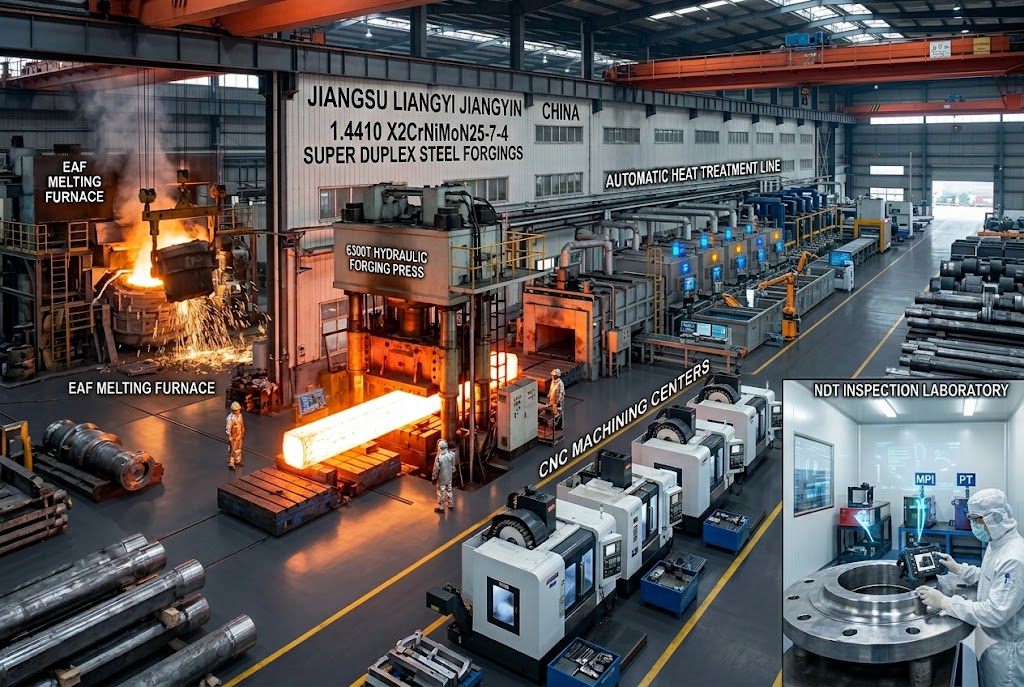
Raw Material Melting: EAF + LF + VOD + ESR
We begin with a 30-ton electric arc furnace (EAF) charge from verified-grade scrap and alloying additions. After initial melt, the heat transfers to our ladle refining furnace (LF) for desulfurization (S to ≤0.010%) and compositional fine-tuning. The heat then moves to the vacuum oxygen decarburization (VOD) vessel — a step not performed by every manufacturer — where carbon is reduced to ≤0.025% under vacuum while nitrogen is simultaneously added to the target 0.28–0.32% range. This is the only reliable way to achieve tight nitrogen control without risking residual atmospheric nitrogen pick-up. For applications requiring ultra-low inclusion content (subsea-critical, demanding pressure vessel applications), a final electroslag remelting (ESR) pass further reduces oxide inclusions and improves longitudinal-to-transverse property ratios. Chemical composition is verified by in-house optical emission spectrometry (OES) before ingot casting.
Ingot Homogenization & Blooming
As-cast 1.4410 ingots contain compositional segregation from solidification — particularly Mo and Cr segregation that can create local PREN variations of ±4 across the ingot cross-section. We address this with a mandatory homogenization anneal at 1200–1220 °C for 8–16 hours (depending on ingot size) before blooming. This step — which many lower-cost suppliers skip — is essential for achieving uniform corrosion resistance throughout large-section forgings. After homogenization, ingots are bloomed to billets on our 6300T press before final forging to the customer's shape.
Precision Forging: Temperature & Deformation Control
Forging of 1.4410 must occur between 950 °C (minimum — below which deformation cracking risk increases sharply) and 1180 °C (maximum — above which excessive ferrite fraction can form). Our 2000T, 4000T, and 6300T hydraulic forging presses are equipped with infrared pyrometers that continuously monitor workpiece surface temperature. An automated interlock prevents the press from applying force if the surface temperature reading drops below 960 °C — at which point the workpiece is returned to the furnace for reheating. Minimum deformation ratio (forging ratio) for all 1.4410 products is ≥4:1, ensuring full breakdown of the cast dendritic structure and refinement to target grain size ASTM 6 or finer. For ring rolling, radial and axial feed rates are calculated to maintain uniform deformation across the ring cross-section, preventing the outer-to-inner property gradient that is common in quickly rolled rings from less experienced manufacturers.
Solution Annealing & Water Quenching
After forging, every 1.4410 component is solution annealed at 1080–1120 °C in one of our 10+ computer-controlled gas-fired annealing furnaces, with a holding time calculated as: t (minutes) = max section thickness (mm) × 1 min/mm, minimum 30 minutes. Temperature uniformity in the furnace chamber is controlled and verified to ±10 °C at 1100 °C. After soaking, the component is transferred to the water quench tank within 60 seconds — a logistics requirement that demands coordination between our furnace and press floor teams for large components. Our quench tanks use recirculated water at <35 °C, with calculated flow rates to bring the slowest-cooling point (geometric center of the heaviest section) through the 600–1000 °C range in under 3 minutes. Quench performance is assessed by thermal calculation for new component geometries above 200 mm section thickness, and by thermocouple measurement in qualification forgings for new product types.
CNC Precision Machining (If Required)
Our in-house CNC machining workshop is equipped with 3-axis and 5-axis machining centers capable of finish-machining forgings up to 3000 mm OD and 10,000 mm length. We rough, semi-finish and finish machine all forged surfaces including bores, faces, threads (API, ACME, metric), grooves and complex profiles as per customer drawings. Machining tolerance: IT6 (typical ±0.05-0.10 mm on critical features). All machined features are inspected with in-house CMM (coordinate measuring machine) and reported in a dimensional inspection report provided with the shipment. CNC machining of 1.4410 requires sharp tooling and appropriate cutting speeds to avoid work-hardening and machining-induced residual stresses — our operators are trained specifically for super duplex and other high-nitrogen stainless steels.
Full-Process Quality Inspection & Documentation
Every 1.4410 forging from Jiangsu Liangyi undergoes a comprehensive inspection sequence before release. This is not a box-checking exercise — it is the verification that the metallurgical targets have been achieved. Our in-house inspection lab performs: (a) Chemical composition re-verification by OES on a coupon from the actual forging (not just the heat); (b) Ferrite content measurement by Fischer Feritscope FMP30 at minimum 5 locations; (c) 100% Ultrasonic Testing per EN 10228-3 Class 3 or ASTM A388 (higher class on request); (d) Surface inspection — dye penetrant (PT) per EN 10228-2 Level 1 as minimum; (e) Full mechanical testing from a coupon in the same heat treatment charge as the delivery forgings; (f) Metallographic section analysis at 100× and 500× for grain size, ferrite distribution, and intermetallic phase check. All results are compiled in an EN 10204 3.1 Mill Test Certificate, with full heat traceability. Independent third-party inspection can be accommodated at any or all hold points upon client request — please specify your inspection requirements at time of inquiry.
Global Compliance, Industry Certifications & Applicable Standards
Jiangsu Liangyi's 1.4410 X2CrNiMoN25-7-4 forging parts are designed to comply with the full range of international standards across all major end-use markets. The following matrix shows the applicable standards by category:
| Standard Category | Applicable Standard(s) | Scope | Jiangsu Liangyi Status |
|---|---|---|---|
| Quality Management | ISO 9001:2015 | Factory QMS certification | Certified — annual audit |
| Material Standard (EN) | EN 10088-1 / EN 10088-3 | Chemical composition, designation | Products manufactured to standard |
| Forged Bar (EN) | EN 10250-4 | Open die steel forgings — corrosion-resistant grades | Products manufactured to standard |
| Forged Pressure Components (EN) | EN 10222-5 | Steel forgings for pressure purposes | Products manufactured to standard |
| Forged Plate / Disc (EN) | EN 10028-7 | Flat products for pressure purposes — stainless steel | Products manufactured to standard |
| Material Standard (ASTM) | ASTM A182 / A965 / A276 | Forged fittings, forgings, bars | Products manufactured to standard |
| Mechanical Testing | ASTM A370 | Mechanical testing of steel products | In-house lab testing per standard |
| Pressure Vessel Material (ASME) | ASME BPVC Section II Part A | Material specification for pressure vessel construction | Material manufactured per ASME Section II — ASME pressure vessel stamp (U/N) is buyer's responsibility |
| Sour Service Material | NACE MR0175 / ISO 15156 | Material requirements for H₂S-containing environments | Material meets NACE MR0175 requirements — documented in MTC |
| Wellhead Material | API 6A Material Requirements | Material for wellhead and Christmas tree equipment | Material manufactured to API 6A material requirements on request — API product monogram requires buyer's own API license |
| Offshore / Subsea | NORSOK M-650 | Qualification of manufacturers of special materials | Documentation support available for buyer's NORSOK qualification process |
| European Pressure Equipment | PED 2014/68/EU | Pressure equipment safety in the EU market | Material documentation supplied to support buyer's PED/CE process — CE marking requires buyer's Notified Body involvement |
| Marine Classification | DNV, LR, BV, ABS, CCS | Marine and offshore material approval | Material documentation and test witness available to support buyer's classification society submission |
| MTC Type | EN 10204 3.1 / 3.2 | Material test certificate | 3.1 issued as standard; 3.2 with third-party witness available on request |
Quality Testing & Inspection Procedures — What We Test and Why
Every Jiangsu Liangyi 1.4410 forging passes through a documented multi-stage inspection sequence. The following explains not just what we test, but why each test is required for super duplex steel specifically — so that buyers can verify that their supplier is performing meaningful tests, not just generating paper.
- Chemical Composition (OES) from Forging Body: We retest chemistry from a coupon cut from the actual forging, not just from the original heat. This catches any inadvertent contamination or mixing error between melt and forging. Required for every piece by our QCP. Result: C, Si, Mn, P, S, Cr, Ni, Mo, N, Cu — all elements in EN 10088-1.
- Ferrite Content (Fischer Feritscope FMP30): Measured at minimum 5 locations per forging (surface and bored bore if applicable). Ferrite content is the fastest indicator of correct heat treatment — below 30% indicates incomplete ferrite formation (over-heated or too slow to reach temperature); above 70% indicates sigma phase formation or incomplete austenite development. Our factory alert threshold: any reading outside 35–65% triggers metallographic investigation before release.
- Ultrasonic Testing (UT): 100% volumetric UT per EN 10228-3 Class 3 (or ASTM A388 equivalent, or upgraded per customer specification). UT is performed by qualified personnel trained to EN ISO 9712 requirements. For ring forgings, both radial (through-wall) and axial (circumferential) scanning is performed to detect laminations and planar defects. For demanding pressure vessel and subsea-critical forgings, EN 10228-3 Class 4 can be applied on request.
- Dye Penetrant Testing (PT) — Surface: 100% surface coverage per EN 10228-2 Level 1 (or client specification). PT reveals surface-breaking discontinuities including laps, folds, and seams that can be initiation points for stress corrosion cracking in service. Color contrast method: red dye developer on white background, with minimum 10-minute penetrant dwell time.
- Metallographic Section Analysis: Mandatory for all forgings above 200 mm maximum section, and for all subsea-critical orders. Etching: electrolytic oxalic acid (4% oxalic acid, 1 A/cm², 90 seconds) and modified Beraha's reagent. Examination at 100× and 500× magnification by a qualified metallurgist. Checks: grain size per ASTM E112, austenite/ferrite phase distribution, sigma phase (none acceptable), secondary austenite (γ2), Cr₂N nitrides. Photomicrograph included in MTC for demanding-specification orders.
- Mechanical Testing: Full room-temperature tensile (Rm, Rp0.2, A, Z), Charpy V-notch impact at −46 °C (average of 3 specimens, minimum individual), and hardness survey (Vickers HV10 at minimum 4 locations, reported in HV and converted to HB and HRC for NACE compliance verification). Low-temperature tensile at −60 °C available on request. All test coupons are taken from the qualification coupon heat-treated in the same batch as the delivery forgings.
- Corrosion Testing (ASTM G48 Method C) — On Request: Critical Pitting Temperature (CPT) measurement per ASTM G48 Method C (Green Death solution: FeCl₃ + HCl, test duration 24 h). For Jiangsu Liangyi's controlled-chemistry 1.4410, we consistently achieve CPT >85 °C. This test is not required by EN 10250-4 but is available as an additional qualification test for demanding applications (subsea umbilicals, HPHT wellhead). Lead time for CPT testing: +5 working days.
- Hydrostatic Pressure Testing — On Request: For hollow forgings and pressure components, hydrostatic testing at 1.5× design pressure per ASME BPVC requirements is available using our in-house pressure test facility (capacity: 500 bar, bore diameter up to 800 mm). Certificate included in MTC package.
Buyer's Procurement Guide — How to Qualify a 1.4410 Super Duplex Forging Supplier
Super duplex steel forgings are a technically complex product category where the quality difference between suppliers cannot be judged by price alone — or even by ISO certification alone. Based on 25+ years of supply to demanding international clients, Jiangsu Liangyi recommends the following qualification checklist for any buyer selecting a China-based 1.4410 forging manufacturer:
10-Point Supplier Qualification Checklist
- In-house melting capability: Ask whether the supplier melts their own steel or purchases billets. In-house EAF+LF+VOD melting is the only way to control nitrogen to ±0.02%, which is the difference between PREN 41.5 and PREN 42.5. Billet purchasers cannot verify the original melt chemistry with sufficient certainty for critical applications.
- VOD or similar nitrogen control: Confirm that VOD (vacuum oxygen decarburization) or equivalent is used. EAF-only nitrogen control is unreliable for super duplex steels — atmospheric nitrogen pick-up during tapping creates uncontrolled variation.
- Forging temperature monitoring records: Request sample forging temperature records. Every heat should show continuous pyrometer data. If the supplier cannot provide this, they cannot prove that the 950–1180 °C forging window was maintained throughout the forging sequence.
- In-house heat treatment with quench time data: Confirm that the supplier heat treats in their own furnaces and quenches in their own tanks — not at a sub-contracted facility. Request heat treatment records showing actual soak temperature, hold time, and quench start time for a recent order.
- Metallographic inspection as standard practice: Ask whether metallographic section analysis (with photomicrograph) is included in the standard MTC. Any supplier confident in their process will provide this for free. If it is treated as an expensive extra, the supplier is not performing it routinely.
- Ferrite content measurement: Ask how ferrite is measured (Feritscope, image analysis, or metallographic estimate). In-process Feritscope measurement on every forging is the minimum acceptable. Point-count metallographic estimates are too slow and variable for production quality control.
- In-house mechanical testing laboratory: Confirm that tensile and impact testing is performed in-house, not by a sub-contracted test lab. Sub-contracted labs introduce delays and chain-of-custody risks. Our in-house lab equipment is regularly calibrated and maintained to ensure measurement accuracy and traceability.
- Third-party inspection track record: Ask for references of orders where BV, SGS, TUV, or equivalent third-party inspectors witnessed production. A supplier who regularly works with third-party inspection is used to scrutiny and maintains their documentation accordingly.
- Sigma phase testing capability: Ask whether the supplier can perform the oxalic acid electrolytic etch test for sigma phase, and whether they have a qualified metallurgist on staff (not just a lab technician) to interpret the results. This test takes less than 10 minutes per sample — if a supplier says it is unavailable, that is a red flag.
- Production capacity vs. order size: A supplier whose press capacity is matched to your order size will manage the forging sequence more carefully than one producing your critical components on a press 10× too large or too small. Ask about press tonnage vs. your forging weight requirements.
A 1.4410 forging that costs 15% less but fails NACE MR0175 hardness compliance, or shows sigma phase in the metallographic section, is not a bargain — it is a liability. The cost of replacing a failed BOP body or wellhead component, or the cost of a forced outage at a desalination plant, vastly exceeds any material savings. Jiangsu Liangyi's pricing reflects our full process capability: in-house melt, controlled VOD nitrogen, mandatory metallographic inspection, and comprehensive mechanical testing on every heat. We are competitive on price for the level of process control we provide, but we do not cut corners to win on price alone.
Technical Glossary — Key Terms for 1.4410 Super Duplex Steel Buyers
The following definitions are provided for engineers, procurement teams, and project managers who may be less familiar with super duplex steel terminology. These are the author's original definitions based on Jiangsu Liangyi's technical team knowledge, not copied from external sources.
- PREN (Pitting Resistance Equivalent Number)
- A calculated index predicting a stainless steel's resistance to pitting corrosion in chloride environments. Formula: PREN = %Cr + 3.3×%Mo + 16×%N. Higher is better. The "super duplex" classification requires PREN ≥40. 1.4410 achieves PREN ≥42 consistently. PREN is a ranking tool, not a pass/fail test — it must always be used alongside actual corrosion testing such as ASTM G48.
- CPT (Critical Pitting Temperature)
- The temperature at which pitting initiation first occurs on a material in a specific corrosive solution, measured per ASTM G48 Method C (Green Death solution: 6% FeCl₃ + 1% HCl). 1.4410 from Jiangsu Liangyi achieves CPT >85 °C, vs ~50 °C for 2205 and ~20 °C for 316L. CPT is the most practical single indicator of pitting resistance for material selection in chloride environments.
- Sigma Phase (σ)
- A hard, brittle intermetallic compound (approximately FeCr or FeMoCr composition) that precipitates in the ferrite phase of duplex stainless steels when exposed to temperatures of 600–1000 °C. Sigma phase reduces toughness by up to 90% and decreases corrosion resistance. It forms most rapidly in super duplex grades due to their high Mo and Cr content. Prevention: avoid the 600–1000 °C range; rapid quenching after solution annealing is mandatory.
- Ferrite Content (FN)
- The volume fraction of body-centered cubic (ferrite) phase in a duplex stainless steel microstructure, expressed as a percentage or in Ferrite Number (FN). For 1.4410, the target range is 30–70% FN per EN 10088-1. Jiangsu Liangyi targets 40–58% FN in production for optimal corrosion resistance and toughness balance. Measured using a Fischer Feritscope (magnetic induction method) calibrated to FN standards.
- NACE MR0175 / ISO 15156
- The internationally recognized standard for materials selection in H₂S-containing oil and gas environments (sour service). For 1.4410 super duplex steel, key requirements include: maximum hardness ≤36 HRC (equivalent to ~340 HV), ferrite content within the 25–65% range, and solution annealed plus water quenched heat treatment condition. All Jiangsu Liangyi 1.4410 forgings are delivered in compliance with these requirements, documented in the MTC.
- Solution Annealing
- The heat treatment applied to 1.4410 forgings to dissolve all intermetallic phases formed during forging and restore the optimal duplex microstructure. Temperature: 1080–1120 °C. Mechanism: at this temperature, sigma phase and other precipitates dissolve back into the ferrite and austenite phases; upon rapid quenching, the austenite and ferrite are re-established in their equilibrium proportions (~50/50) without time for intermetallic re-precipitation.
- EN 10204 3.1 / 3.2 Mill Test Certificate
- A document certifying that tested materials conform to the order specification. Type 3.1 is issued by the manufacturer's own authorized representative and verified by an independent inspection body representative of the manufacturer. Type 3.2 is additionally countersigned by a third-party inspector (e.g., BV, SGS, TUV) appointed by the buyer. For critical pressure equipment applications, 3.2 is typically required by the end-user or Notified Body. Jiangsu Liangyi issues 3.1 as standard; 3.2 is available on request at additional cost.
- Forging Ratio (Deformation Ratio)
- The ratio of original cross-sectional area to final cross-sectional area achieved during forging, expressed as n:1 (e.g., 4:1). A higher forging ratio indicates more deformation work has been applied, resulting in finer grain size and better breakdown of the as-cast structure. For 1.4410, Jiangsu Liangyi requires a minimum 4:1 deformation ratio on all products — insufficient deformation leaves residual cast dendritic structure that reduces toughness and creates anisotropic corrosion resistance.
- SCC (Stress Corrosion Cracking)
- A failure mode in which tensile stress (applied or residual) and a corrosive environment together cause crack propagation at stress levels far below the material's UTS. Austenitic stainless steels (316L, 304) are highly susceptible to chloride SCC above ~50 °C. Duplex and super duplex steels resist SCC because the ferrite phase does not support the chloride-induced crack propagation mechanism that attacks austenite grain boundaries. 1.4410's higher ferrite content and stronger passive film provide superior SCC resistance vs. 2205 in the most aggressive environments.
- VOD (Vacuum Oxygen Decarburization)
- A secondary metallurgy process that uses a vacuum chamber and oxygen injection to reduce carbon content in stainless steel melts while simultaneously allowing controlled nitrogen addition. For 1.4410, VOD is essential for achieving C ≤0.025% and N 0.28–0.32% simultaneously — a combination that cannot be reliably achieved by EAF alone. The vacuum prevents atmospheric nitrogen contamination during N addition, allowing precise stoichiometric control.
Frequently Asked Questions About 1.4410 Super Duplex Steel Forgings
1.4410 (X2CrNiMoN25-7-4) and 2507 (UNS S32750) refer to the same alloy under different designation systems. 1.4410 is the European EN designation (EN 10088); 2507 is the ASTM/UNS designation used in North America. Both require: Cr 24–26%, Ni 6–8%, Mo 3–5%, N 0.24–0.32%, C ≤0.03%, and PREN ≥42. A Jiangsu Liangyi forging supplied to EN 10250-4 Grade 1.4410 will meet ASTM A182 Grade F55 (UNS S32750) requirements, and vice versa. We routinely cross-certify to both on the same MTC for clients supplying into multiple markets. The designations are fully interchangeable for procurement purposes.
1.4410's high molybdenum content (3.5–4.5%) creates a strong thermodynamic driving force for sigma phase (σ) precipitation between 600–1000 °C. Sigma phase is hard, brittle, and severely depletes the surrounding matrix of Cr and Mo — making those zones both brittle and more susceptible to pitting corrosion. If a 1.4410 forging is solution annealed at too low a temperature (below 1080 °C), sigma phase will not fully dissolve. If the quench is too slow (section center spends more than 3–4 minutes in the 600–1000 °C range), sigma will re-precipitate on cooling. The result is a forging that may appear visually and dimensionally correct, and may even pass basic mechanical testing (Rm, Rp0.2) at room temperature, but will fail catastrophically in impact at low temperature and will show accelerated pitting in service. This is why Jiangsu Liangyi performs mandatory metallographic sigma phase inspection on every heavy-section forging — to catch and reject any heat treatment non-conformance before it reaches the customer.
PREN is calculated as: PREN = %Cr + 3.3×%Mo + 16×%N. For Jiangsu Liangyi's factory center-target chemistry (Cr 25.0%, Mo 3.75%, N 0.30%): PREN = 25.0 + (3.3 × 3.75) + (16 × 0.30) = 25.0 + 12.375 + 4.80 = 42.18. In practice, because we control the chemistry tightly (Cr 24.5–25.5%, Mo 3.5–4.0%, N 0.28–0.32%), our production PREN values range from 41.6 to 43.1, with a statistical average around 42.3. We can provide the PREN value calculated from the actual OES composition result for every heat on request, as part of the MTC documentation. Note that PREN is a calculated index, not a measured test — it must be used in conjunction with actual corrosion testing (ASTM G48 CPT measurement) for critical applications.
This depends on the specific geometry and our quench tank capacity. For solid round bar forgings, we can routinely guarantee sigma-phase-free microstructure to the center at diameters up to 400 mm using our high-flow-rate water quench system. For sections above 400 mm, we perform a thermal simulation (using finite element heat transfer modeling) to calculate the expected cooling rate at the geometric center, and confirm whether it meets the <3 minutes requirement through the 600–1000 °C range before accepting the order. For hollow forgings (rings and tubes), the wall thickness is the governing dimension, not the OD — a ring with OD 2000 mm but wall 150 mm can be reliably quenched. Contact our engineering team with your specific geometry for a project-specific assessment at no charge before order placement.
Yes, 1.4410 (X2CrNiMoN25-7-4) forgings are weldable, but welding requires strict control of heat input and interpass temperature. Key guidelines: (1) Use superduplex filler metal (ER2594 / AWS A5.9 or equivalent) which has slightly over-alloyed Ni content (~9%) and N addition to compensate for the slower austenite re-formation in the weld zone; (2) Limit interpass temperature to ≤150 °C to avoid overheating the previously deposited weld and HAZ; (3) Control heat input to 0.5–2.5 kJ/mm — below this range, the HAZ cools too quickly and excessive ferrite forms; above this range, sigma phase can precipitate; (4) In critical applications, a post-weld solution anneal at 1080–1120 °C with water quench is recommended to restore optimal microstructure in the HAZ. Preheat is generally NOT required for 1.4410 at ambient temperatures above 5 °C. For clients who will weld our forgings, Jiangsu Liangyi can provide welding procedure documentation and, if required, supply a weld test coupon of our material for WPS qualification testing.
Yes — all Jiangsu Liangyi 1.4410 forgings are manufactured in full conformance with NACE MR0175 / ISO 15156 material requirements. The standard requires: hardness ≤36 HRC (we deliver 22–28 HRC typically — a comfortable margin), ferrite content 25–65% (we deliver 40–58%), carbon ≤0.03% (we deliver ≤0.025%), and solution annealed + water quenched condition (our mandatory heat treatment for all 1.4410). The EN 10204 3.1 Mill Test Certificate we issue includes: heat composition by OES, ferrite content by Feritscope, full mechanical test results, hardness survey, and a declaration of conformance to NACE MR0175 / ISO 15156 material requirements with the relevant section reference. For clients requiring third-party witness of compliance testing, we can arrange independent third-party inspection at any or all test stages — contact us at time of inquiry to include this in the quotation.
Standard lead time from order confirmation to delivery at our Jiangyin, Jiangsu factory gate: 3–4 weeks for small batch orders (total weight under 5 tons, simple geometries such as bars and discs); 4–6 weeks for medium complexity orders (rings, hollow forgings, or heavier bars up to 20 tons total); 6–10 weeks for large or highly complex custom components (BOP bodies, large tube sheets, multi-step shafts above 10 tons each). Expedited production can typically reduce lead time by 1–2 weeks for orders placed with premium scheduling — contact us to discuss. Minimum order quantity: there is no strict MOQ. We have supplied single-piece prototype forgings as small as 30 kg for R&D projects, and routine production orders from 500 kg to 30 tons. For orders below 500 kg total, the fixed cost of per-heat chemistry certification (EAF melt) may be significant — contact us to discuss options including supply from certified stock heats.
Yes — all Jiangsu Liangyi 1.4410 forgings can be produced to customer drawings. We accept: DWG, DXF (AutoCAD 2D drawings), STEP, IGES, STP (3D CAD models), PDF (general arrangement / outline drawings), and proprietary formats on request.Before you place an order, our engineering team will run a free DFM (Design for Manufacturability) review, highlighting any features that would require additional process steps or tooling and confirming the forging and machining sequence. For complex geometries, we can provide a 3D forging simulation showing metal flow and die fill before you commit to production. All drawings and technical data are kept strictly confidential under NDA, which Jiangsu Liangyi signs as a matter of routine for all new client projects.
Contact Jiangsu Liangyi — Custom 1.4410 X2CrNiMoN25-7-4 Forging Inquiry
As a China super duplex steel forging manufacturer with over 25 years of demonstrated experience in Jiangyin, Jiangsu, Jiangsu Liangyi combines genuine metallurgical expertise with full vertical integration — from melt to machined component — to deliver 1.4410 forgings that perform reliably in the world's most demanding applications. We work directly with engineers, procurement teams, EPCs, and end-users to find the right solution for each project.
To request a quotation, please provide: material grade (1.4410 / X2CrNiMoN25-7-4 / 2507 / UNS S32750), forging shape and dimensions (or DWG/STEP file), quantity and weight, applicable standards (EN / ASTM / ASME / NACE / API), required inspection level (3.1 MTC / 3.2 with third-party / specific NDT class), and required delivery date. Our engineering sales team will respond with a detailed technical offer within 24 hours on working days.
Inquiry Email: sales@jnmtforgedparts.com
Phone / WhatsApp: +86-13585067993
Official Website: https://www.jnmtforgedparts.com
Factory Address: Chengchang Industry Park, Jiangyin City, Jiangsu Province 214400, China
Response Time: Within 24 hours on working days. Technical sales engineers available in English and Chinese.