For seawater, 1.4547 wins — and not by a small margin. Its 6% molybdenum plus a deliberate nitrogen addition push PREN to ≥43 and Critical Pitting Temperature above 60 °C. 904L, with ~4.5% Mo and almost no nitrogen, sits near PREN 34 and pits in warm seawater above roughly 40 °C.
904L is not the weaker alloy in every sense — it was born for reducing acids, and in hot dilute sulphuric duty its ~25% nickel still earns its keep. But "which one for seawater?" has a clear answer, and this article shows exactly why.
Key takeaways
- PREN: 1.4547 ≥43 clears the seawater threshold (40); 904L ~34 falls below it.
- CPT: 1.4547 resists pitting to ~60 °C; 904L to only ~37 °C — a ~23 °C margin.
- Strength: 1.4547 proof strength ~300 MPa vs ~220 MPa, thanks to nitrogen — thinner walls possible.
- 904L's home turf: hot reducing acids (sulphuric, phosphoric), where high nickel wins.
- Sour service: 1.4547 is the material routinely specified for NACE MR0175 sour service; 904L rarely is.
- Rule of thumb: chloride/seawater → 1.4547; reducing acid → 904L.
Same family, very different recipes
Both grades are fully austenitic, both are far tougher than 316L in chloride service, and both are commonly grouped as "super austenitic." But their compositions were tuned for different enemies. 1.4547 was engineered to beat chloride pitting in seawater; 904L was originally developed to resist reducing acids. That single difference in intent drives almost everything below.
| Element | 1.4547 (S31254) | 904L (N08904) |
|---|---|---|
| Chromium (Cr) | 19.5–20.5 | 19.0–23.0 |
| Nickel (Ni) | 17.5–18.5 | 24.0–26.0 |
| Molybdenum (Mo) | 6.0–6.5 | 4.0–5.0 |
| Nitrogen (N) | 0.18–0.22 | ≤0.15 (trace) |
| Copper (Cu) | 0.50–1.00 | 1.20–2.00 |
| Carbon (C) | ≤0.020 | ≤0.020 |
Read the table as two design bets. 1.4547 spends its budget on molybdenum and nitrogen — the two elements that fight chloride pitting hardest. 904L spends its on nickel and copper — the pair that shines in sulphuric and phosphoric acid. Neither is "more alloyed" overall; they are alloyed for different jobs.
Why chloride pitting decides this fight
Seawater is a relentless chloride solution with dissolved oxygen, biofilm and warm splash-zone temperatures. The failure mode that ends stainless steel here is not general wastage — it is localised pitting and crevice corrosion, where the passive film breaks down at a single point and a self-accelerating pit drills through the wall. A component can look pristine and still be perforated.
Resistance to that attack is governed mainly by molybdenum and nitrogen, and it is summarised by one number: the Pitting Resistance Equivalent Number (PREN). Corrosion engineers treat PREN 40 as the practical floor for immersed seawater. Cross that line and the alloy holds its passive film; fall below it and warm seawater finds a way in.
PREN and CPT, against the seawater line
PREN = %Cr + 3.3 × %Mo + 16 × %N. Plug in the numbers and the gap is structural, not marginal — 1.4547 clears the seawater threshold, 904L does not.
Pitting Resistance Equivalent Number (PREN)
Higher is better · scale 0–50 · black line = PREN 40 seawater threshold
PREN predicts whether an alloy resists pitting; the Critical Pitting Temperature (CPT) tells you how hot the service water can get before it does. Measured in ferric chloride per ASTM G48, the temperature gap is just as decisive.
Critical Pitting Temperature (CPT, 6% FeCl₃)
Higher is better · approximate · surface & test dependent
In tropical seawater intakes, brine-heater inlets and splash zones, service temperatures routinely exceed 40 °C. That is precisely where 904L becomes vulnerable to pitting and 1.4547 keeps a stable passive film. That margin is often the difference between decades of reliable service and premature, unplanned failure — though actual service life always depends on the specific environment and design.
Nitrogen gives 1.4547 a second advantage
The nitrogen that lifts 1.4547's PREN also strengthens it. Its minimum 0.2% proof strength is roughly 300 MPa, against about 220 MPa for 904L — a meaningful margin when you are sizing a pressure-retaining ring or valve body.
| Property | 1.4547 | 904L |
|---|---|---|
| 0.2% proof strength, Rp0.2 | ≥300 MPa | ≥220 MPa |
| Tensile strength, Rm | 650–850 MPa | 490–740 MPa |
| Elongation, A | ≥35% | ≥35% |
| Cryogenic toughness | to −196 °C | good |
Higher allowable stress means a thinner section for the same pressure rating. On a large seamless rolled ring or a heavy valve body, that reduction in wall thickness trims weight and machining time — and it quietly offsets part of 1.4547's alloy premium.
Where 904L still deserves the job
This would be a dishonest comparison if it stopped at chlorides. 904L was developed for reducing acids, and there its recipe pays off. Its ~25% nickel and 1.2–2.0% copper give excellent resistance to dilute-to-mid-strength sulphuric acid across a wide temperature band, plus strong resistance to chloride stress-corrosion cracking.
In sulphuric-acid plant duty, phosphoric-acid handling, pickling lines and some flue-gas scrubber service, 904L's high nickel can outperform 1.4547 in strongly reducing conditions — often at a similar or slightly lower cost. If chlorides are secondary, 904L is a rational, proven pick.
1.4547 is no slouch in acid either — its copper addition suppresses active dissolution in dilute sulphuric — but 904L's nickel content gives it the edge in the hottest, most reducing sulphuric environments. The honest rule: let the dominant corrosion mechanism decide. Chloride pitting → 1.4547. Reducing acid → 904L is firmly in the conversation.
Price, nickel exposure and NACE duty
On raw alloy content the two are closer than people assume. 904L carries more nickel (a costly, volatile element); 1.4547 carries more molybdenum plus nitrogen processing. Depending on the nickel and molybdenum markets, 1.4547 usually commands a modest premium — but its higher strength can claw part of that back through reduced section thickness. Neither is remotely as expensive as a nickel-base alloy such as Alloy 625, which is why both remain the pragmatic middle ground for seawater and process duty.
For oil-and-gas sour service, 1.4547 is the more routinely qualified choice: as a material it meets the NACE MR0175 / ISO 15156 requirements (hardness ≤260 HB, controlled yield strength) — note this is a material standard, not a company certification — and it is widely specified for subsea and wellhead forgings that see H₂S, CO₂ and chlorides together. 904L is far less commonly specified for sour duty.
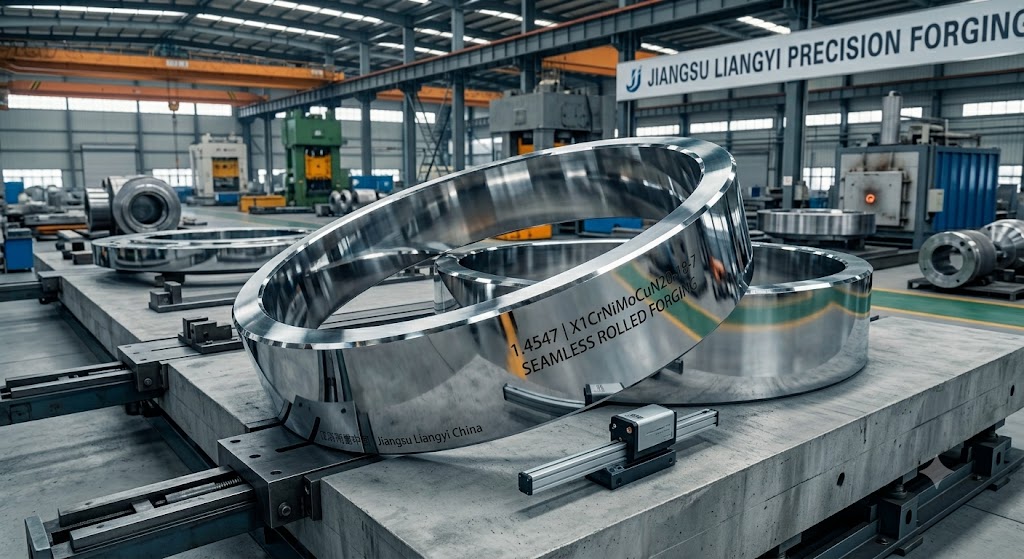
Whichever grade you pick, forging matters. Both alloys segregate molybdenum during solidification; only hot working plus a proper solution anneal restores a homogeneous, seawater-grade passive layer. For product forms, dimensions and certification, see our 1.4547 (X1CrNiMoCuN20-18-7) forging parts →
Which one, for which duty
Pick 1.4547
- Immersed or splash-zone seawater above ~30 °C
- Offshore wellheads & subsea forgings (NACE sour service)
- Desalination tube sheets & brine-heater components
- Marine seawater cooling & fire-water systems
- Where higher strength lets you cut wall thickness
- Cryogenic + chloride combined (LNG near the sea)
Pick 904L
- Dilute-to-mid sulphuric acid, warm
- Phosphoric acid handling & fertiliser plant
- Pickling lines and mixed-acid process streams
- Some flue-gas desulphurisation scrubber duty
- Chloride SCC risk with modest pitting demand
- When acid — not seawater — is the main enemy
If your specification names "seawater," "offshore," "subsea," "brine" or "sour," the engineering answer is 1.4547 almost every time. If it names "sulphuric," "phosphoric" or "acid plant," give 904L a serious look. When both threats coexist and chlorides are hot, 1.4547's 6% Mo is the safer bet.
Definitions in plain language
- PREN
- Pitting Resistance Equivalent Number = %Cr + 3.3×%Mo + 16×%N. Higher means better chloride pitting resistance; 40 is the practical seawater floor.
- CPT
- Critical Pitting Temperature — the lowest temperature at which stable pitting starts in a ferric chloride test (ASTM G48). Higher is better.
- Super austenitic
- A high-alloy austenitic stainless steel, typically ~6% molybdenum with nitrogen, sitting between duplex steels and nickel alloys in pitting resistance.
- Sour service
- Oil & gas service with H₂S present. Materials must meet NACE MR0175 / ISO 15156 limits such as hardness ≤260 HB.
1.4547 vs 904L — quick answers
Is 1.4547 always better than 904L?
No — it is better for chloride and seawater service. For hot reducing acids such as sulphuric, 904L's higher nickel content can outperform it. The right choice depends on the dominant corrosion mechanism in your environment, not on a single "better alloy" verdict.
Can 904L be used in seawater at all?
Yes, but with limits. 904L performs acceptably in cool, clean or intermittently wetted seawater below roughly 40 °C. In warm, stagnant, biofouled or splash-zone conditions it becomes vulnerable to pitting and crevice attack, which is where 1.4547 is specified instead.
Why does 1.4547 have higher strength?
Its deliberate nitrogen addition (0.18–0.22%) is a solid-solution strengthener. That raises minimum 0.2% proof strength to about 300 MPa versus roughly 220 MPa for 904L, allowing thinner walls for the same pressure rating.
Are they interchangeable in a purchase spec?
Not safely. They are distinct grades with different UNS numbers (S31254 vs N08904), different PREN, and different qualified applications. Always state the exact grade — and for chloride service, confirm 1.4547 rather than accepting a 904L substitution.
What is the PREN of 1.4547 and 904L?
1.4547 has a PREN of at least 43 (typically 43–45), comfortably above the PREN 40 seawater threshold. 904L sits around PREN 34–36. The difference is driven mainly by molybdenum and nitrogen content.
Do you supply forgings in both grades?
Yes. Jiangsu Liangyi produces seamless rolled rings, bars, discs, hollow forgings and valve components in 1.4547 and other super austenitic and duplex grades, with EN 10204 3.1 certification as standard. Request a quote using the form below.
- EN 10088-3 — chemical composition of stainless steel bars and semi-finished products (1.4547, 1.4539).
- EN 10222-5 — steel forgings for pressure purposes: stainless and heat-resisting steels.
- ASTM A182 / ASME SA-182 — forged flanges, fittings and valves (Grade F44 = S31254; N08904).
- ASTM G48 Method C — ferric chloride pitting / Critical Pitting Temperature test.
- NACE MR0175 / ISO 15156 — materials for H₂S-containing (sour) oil & gas service.
- PREN formula: %Cr + 3.3×%Mo + 16×%N (austenitic and super-austenitic grades).
Keep exploring
Get a 1.4547 forging quote in 24 hours
Seamless rolled rings to 6 m OD / 30 t, bars, discs, valve bodies and custom profiles — certified to ISO 9001:2015, with EN 10204 3.1 material certificates supplied as standard and material able to meet NACE MR0175 / ISO 15156 requirements on request.