1.4547 (X1CrNiMoCuN20-18-7) Forging Parts | China Professional Manufacturer
Jiangsu Liangyi Co., Limited, headquartered in Jiangyin City, Jiangsu Province, China, is a specialist manufacturer of 1.4547 (X1CrNiMoCuN20-18-7) open die forgings and seamless rolled rings in super austenitic stainless steel. With more than 25 years of production experience and an annual capacity of 120 000 tonnes, the company serves critical-service customers across the oil and gas, nuclear power, chemical processing, marine and desalination industries in over 50 countries.
The facility operates 6 300-ton hydraulic presses, 5-metre ring rolling machines, 30-ton electric arc furnaces and a fully equipped in-house quality laboratory. Single-piece weights reach 30 tonnes; seamless rolled rings extend to 6 000 mm outer diameter. All products carry EN 10204 Type 3.1 material test certificates as standard and are produced under an ISO 9001:2015 quality management system. Forgings can be manufactured to meet API 6A and NACE MR0175/ISO 15156 material requirements upon customer request.
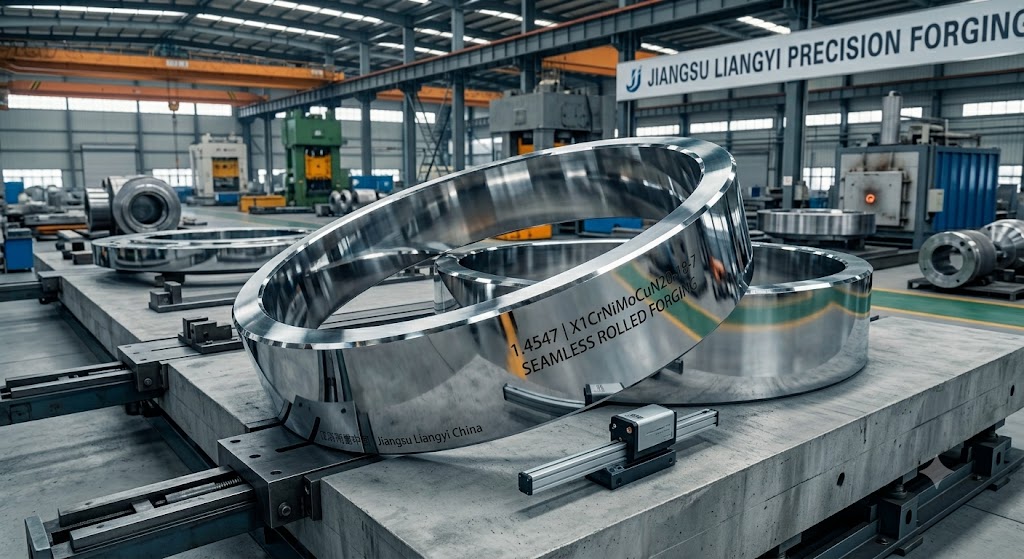
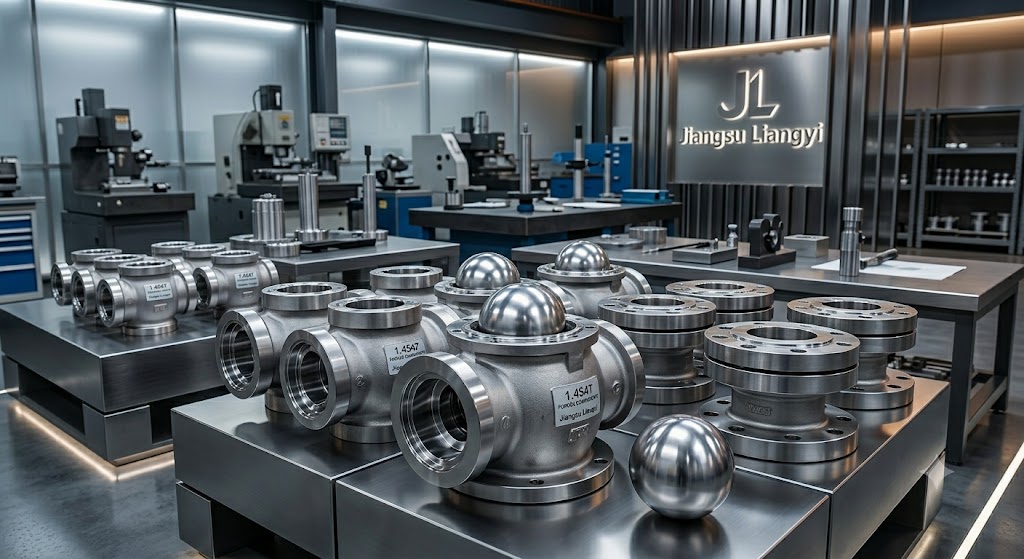
What makes 1.4547 exceptional: The alloy's 6% molybdenum content pushes its Pitting Resistance Equivalent Number (PREN) to ≥ 43 — the threshold widely recognised by corrosion engineers as the minimum for seawater service. Combined with nitrogen strengthening (0.18–0.22% N) and deliberate copper additions (0.50–1.00% Cu) that suppress active dissolution in sulphuric acid, 1.4547 occupies a unique performance space between conventional super duplex steels and nickel alloys, at a significantly lower material cost than the latter.
Why 6% Molybdenum Is the Critical Threshold for Seawater Service
Molybdenum (Mo) is the most potent single-element addition for improving pitting corrosion resistance in austenitic stainless steels. Its mechanism is threefold: Mo stabilises the passive film on the steel surface, slows the growth of pit nuclei once they form, and dramatically raises the electrochemical potential required to initiate stable pitting (the pitting potential, Epit). However, Mo is not a linear additive — its effectiveness in chloride media follows a highly non-linear relationship.
Decades of field data from offshore platforms and seawater cooling systems have established that PREN 40 is approximately the minimum practical threshold for immersed seawater service, and PREN 43 provides the margin of safety necessary to account for weld heat-affected zones, surface condition variability and fluctuating temperatures. Grades below PREN 40 — including the widely used 316L (PREN ≈ 24), 317L (PREN ≈ 28) and 904L (PREN ≈ 35) — suffer active pitting at seawater temperatures above 20–40 °C, making them unsuitable for long-term immersed or splash-zone service without cathodic protection or biocide injection.
The jump from standard grades to 1.4547's 6% Mo is therefore not merely incremental — it represents a step-change in capability. The alloy routinely achieves Critical Pitting Temperatures (CPT, measured by ASTM G150 or EN ISO 17864 in NaCl solution) above 60 °C, compared to approximately 15 °C for 316L and 35–40 °C for 904L. This is why 1.4547 has become the de-facto choice wherever engineers need an austenitic stainless steel that will not pit in chloride-rich service without resorting to nickel-base alloys.
Direct answer: 6% Mo is the critical threshold because it raises PREN above 43, which is the minimum recognised by corrosion engineers for reliable passive film stability in seawater and chloride-containing process streams. Below 5% Mo, pitting initiation in warm seawater is effectively unavoidable without additional corrosion control measures.
Understanding PREN: How It Is Calculated and Why It Matters
PREN (Pitting Resistance Equivalent Number) is a calculated index, not a measured property, derived from the chemical composition of a stainless steel. Despite its empirical origins, it has proven to be one of the most reliable single-number predictors of chloride pitting performance in common use. The most widely accepted formula for austenitic and super-austenitic grades is:
For the nominal 1.4547 composition (Cr 20%, Mo 6.1%, N 0.20%):
PREN = 20.0 + (3.3 × 6.1) + (16 × 0.20) = 20.0 + 20.13 + 3.20 = 43.33
Several important observations follow from this formula. First, nitrogen is a remarkably effective alloying element: its coefficient in the PREN formula (16) means that 0.20% N contributes as much to pitting resistance as an additional 3.2% Cr. This is why 1.4547's controlled nitrogen addition (0.18–0.22%) is tightly specified and not simply a by-product of melting — it is an intentional contribution to corrosion performance. Second, the minimum PREN of 43 quoted for 1.4547 is based on the lower limits of the alloy's composition window; actual heats typically achieve PREN values of 43–45. Third, the PREN formula does not account for copper, which is an additional corrosion benefit in 1.4547 not captured by the number alone.
Forging introduces one additional nuance: the PREN of a forged component depends on the homogeneity of the heat after solution annealing. If a casting is not properly solution annealed, dendritic molybdenum segregation creates local Mo-depleted regions where the effective PREN can be as low as 35–38 — below the seawater threshold. Forging, by mechanically breaking up the cast dendritic structure and then solution annealing, produces a chemically homogeneous product where the certified PREN reflects the actual local composition throughout the cross-section.
1.4547 vs Other Corrosion-Resistant Alloys: PREN & Critical Temperatures
| Grade (EN / UNS) | Mo% | Cr% | Ni% | N% | PREN | CPT (approx.) | Seawater suitability |
|---|---|---|---|---|---|---|---|
| 316L / S31603 | 2.5 | 17 | 12 | — | ~24 | ~15 °C | Limited — pits above ~20 °C |
| 317L / S31703 | 3.5 | 18.5 | 13 | — | ~28 | ~25 °C | Poor in warm seawater |
| 904L / 1.4539 / N08904 | 4.5 | 21 | 25 | — | ~35 | ~40 °C | Moderate — good in dilute H₂SO₄ |
| SAF 2205 / S32205 (duplex) | 3.1 | 22 | 5.5 | 0.17 | ~35 | ~35 °C | Moderate — also stress-corrosion benefit |
| SAF 2507 / S32750 (super duplex) | 4.0 | 25 | 7 | 0.28 | ~42 | ~55 °C | Good — but brittle <−50 °C |
| 1.4547 / S31254 (also known as 254 SMO®) |
6.1 | 20 | 18 | 0.20 | ≥ 43 | ≥ 60 °C | Excellent — seawater, sour gas, HCl |
| Alloy 625 / N06625 | 9.0 | 22 | 62 | — | ~51 | >100 °C | Outstanding — very high cost |
CPT values are approximate and vary with surface condition, test method and test duration. Values above are representative of smooth machined or pickled surfaces in 6% FeCl₃ (ASTM G48 Method C or equivalent). Field performance may differ. 1.4547 data: Jiangsu Liangyi production experience, consistent with published literature.
1.4547 (X1CrNiMoCuN20-18-7) Material Properties
Chemical Composition (EN 10088-3 / EN 10222-5)
| Element | Symbol | Limit / Range (%) | Metallurgical role |
|---|---|---|---|
| Carbon | C | ≤ 0.020 | Kept ultra-low to prevent sensitisation (Cr₂₃C₆ carbide precipitation) during welding and slow cooling |
| Silicon | Si | ≤ 0.80 | Deoxidiser; high Si can reduce impact toughness |
| Manganese | Mn | ≤ 1.00 | Austenite stabiliser; kept low as it dilutes corrosion resistance at high levels |
| Phosphorus | P | ≤ 0.030 | Tramp element; degrades toughness at grain boundaries |
| Sulfur | S | ≤ 0.015 | Controlled to minimise MnS inclusions which are preferential pitting initiation sites |
| Chromium | Cr | 19.5 – 20.5 | Primary passive film former; contributes 20 PREN units |
| Nickel | Ni | 17.5 – 18.5 | Full austenite stabiliser; prevents martensite during fabrication; improves acid resistance |
| Molybdenum | Mo | 6.0 – 6.5 | Primary pitting-resistance additive; contributes ~20 PREN units; also improves resistance to reducing acids |
| Nitrogen | N | 0.18 – 0.22 | Solid-solution strengthener; contributes 3.2 PREN units; retards sigma-phase formation |
| Copper | Cu | 0.50 – 1.00 | Reduces corrosion rate in sulphuric acid; not captured in PREN but a meaningful benefit in acid service |
Mechanical Properties — Solution Annealed and Water Quenched
| Property | Symbol | Value | Note |
|---|---|---|---|
| Tensile Strength | Rm | 650 – 850 MPa | Upper limit prevents excessive hardness in sour service per NACE MR0175 |
| 0.2% Proof Strength | Rp0.2 | ≥ 300 MPa | ~75% higher than 316L minimum (170 MPa) — a significant wall-thickness benefit |
| Elongation (A5) | A | ≥ 35% | High ductility supports cold forming after forging where required |
| Impact Toughness (KV at +20 °C) | KV | ≥ 100 J | Maintains toughness down to −196 °C for cryogenic applications |
| Hardness (Brinell) | HB | ≤ 260 HB | NACE MR0175 maximum hardness for sour service compliance |
| Elastic Modulus | E | ~195 GPa | Slightly lower than ferritic/duplex grades; relevant for deflection calculations |
Physical and Thermal Properties
| Property | Value | Significance to design |
|---|---|---|
| Density | 8.0 g/cm³ | Slightly denser than carbon steel (7.85); affects weight estimates for large forgings |
| Thermal Conductivity | 14 W/(m·K) | Approximately one-third of carbon steel (50 W/(m·K)); important for heat exchanger tube sheet and flange thermal gradient calculations |
| Thermal Expansion (20–100 °C) | 15.5 × 10⁻⁶ /K | Higher than carbon steel (12 × 10⁻⁶); must be accounted for in mixed-material piping systems to avoid thermal fatigue |
| Specific Heat Capacity | 500 J/(kg·K) | Relevant to heat treatment soak time calculations — larger forgings require proportionally longer holds at 1 100 °C |
| Electrical Resistivity | 0.85 µΩ·m | Much higher than carbon steel; negligible for most applications but relevant for electromagnetic inspection methods |
| Magnetic Permeability | ~1.002 (non-magnetic) | Fully austenitic — non-magnetic at all temperatures, including after heavy cold work (unlike 316L which can partially transform) |
Why Forged 1.4547 Outperforms Cast 1.4547: A Metallurgical Comparison
Both forgings and castings of 1.4547 are commercially available, and procurement engineers sometimes ask whether the additional cost of forging is justified. Based on the metallurgical characteristics of 6% Mo alloys, the answer for most critical-service applications is unambiguous: forging provides measurable performance advantages that castings cannot fully replicate, regardless of heat treatment quality.
Forged 1.4547 — Microstructural Characteristics
- Hot working eliminates the dendritic solidification structure, producing a wrought, equiaxed grain structure (ASTM grain size 4–6 typical)
- Continuous, uninterrupted grain flow follows the contour of the part, improving directional tensile and fatigue properties
- No porosity, no shrinkage cavities — defects intrinsic to solidification cannot form in a wrought product
- Mechanical break-up of Mo-rich interdendrites ensures chemical homogeneity; local PREN variations across the cross-section are typically < 1 PREN unit after solution annealing
- Charpy impact toughness at −196 °C routinely exceeds 80 J — essential for cryogenic service qualification
Cast 1.4547 — Inherent Limitations
- Solidification produces a coarse dendritic grain structure (ASTM 1–2) that solution annealing refines only partially
- Dendritic Mo segregation creates bands with local Mo as low as 3–4% — local PREN as low as 35–38, below the seawater threshold
- Shrinkage porosity and micro-casting defects require extensive radiographic inspection and can cause in-service leaks under cyclic loading
- Impact toughness is typically 30–50% lower than a forged equivalent; low-temperature applications may require cryogenic testing to qualify
- Wall thickness must be increased relative to a forging to compensate for reduced mechanical properties — partially negating any cost saving
Corrosion Resistance of 1.4547: Performance in Key Environments
The corrosion resistance of 1.4547 (X1CrNiMoCuN20-18-7) is not a single attribute — it encompasses multiple distinct failure modes that engineers must evaluate individually when qualifying the alloy for a specific service environment. The following analysis draws on standardised test data and the experience of Jiangsu Liangyi's engineering team working with global customers.
Chloride Pitting and Crevice Corrosion
Pitting and crevice corrosion in chloride-containing environments are the most common failure modes for stainless steels in offshore and process industries. 1.4547's PREN of ≥ 43 provides reliable resistance to pitting in natural seawater at temperatures up to approximately 35 °C (when considering practical crevice geometries and biofouling effects), and in clean seawater or treated cooling water at temperatures approaching 50–60 °C. The Critical Crevice Temperature (CCT), which is typically 15–20 °C below the CPT, is approximately 35–45 °C for 1.4547 in aggressive crevice geometries — approximately double the CCT of 904L.
Sour Service: Hydrogen Sulphide and Stress Corrosion Cracking
1.4547 qualifies under NACE MR0175/ISO 15156 for service in environments containing hydrogen sulphide (H₂S), CO₂, chlorides and elemental sulphur — conditions collectively described as "sour service" in the oil and gas industry. The key requirements for qualification are: (a) maximum hardness ≤ 260 HB, (b) yield strength in the 300–700 MPa range, and (c) solution-annealed microstructure with no sensitisation. All three conditions are standard features of Jiangsu Liangyi's 1.4547 forgings. The austenitic matrix of 1.4547 also provides inherent resistance to sulphide stress cracking (SSC) and hydrogen-induced cracking (HIC) that duplex grades do not offer at the same level — duplex microstructures are more susceptible to SSC under cathodic protection conditions.
Acids: Sulphuric, Phosphoric and Hydrochloric
The copper addition (0.50–1.00% Cu) in 1.4547 provides a specific benefit in dilute to moderate sulphuric acid (H₂SO₄) environments by suppressing active dissolution below the passive potential. In dilute H₂SO₄ (5–20% concentration) at ambient temperature, 1.4547 exhibits corrosion rates well below 0.1 mm/year — a threshold commonly used to define "acceptable" performance in process design. For hydrochloric acid (HCl) service, 1.4547 is suitable only at low concentrations (< 1%) and temperatures below 20 °C; higher HCl concentrations require nickel-base alloys. Phosphoric acid resistance of 1.4547 is excellent across a wide concentration range, making it a preferred material for phosphoric acid pump casings and impellers.
Cryogenic Service: Down to −196 °C
Unlike ferritic, martensitic and duplex stainless steels, the fully austenitic structure of 1.4547 does not undergo a ductile-to-brittle transition at low temperatures. Impact toughness measured by Charpy V-notch test at −196 °C (liquid nitrogen temperature) typically exceeds 80 J for Jiangsu Liangyi forgings — well above the 41 J threshold commonly specified for cryogenic pressure equipment. This makes 1.4547 one of the few alloys that simultaneously offers seawater-grade pitting resistance, sour-service compliance and cryogenic toughness, a combination required by LNG receiving terminal equipment exposed to both sea spray and liquid natural gas temperatures.
Welding 1.4547 Forgings: Filler Metals, Procedures and Critical Considerations
1.4547 is weldable by all standard fusion welding processes — GTAW (TIG), GMAW (MIG), SMAW (MMA) and SAW — subject to appropriate procedure qualification and filler metal selection. The alloy presents three specific challenges that distinguish it from standard austenitic grades, and Jiangsu Liangyi's engineering team routinely advises customers on these during the pre-order technical review.
Filler Metal Selection
The standard matching filler for 1.4547 is AWS A5.9 ER385 (UNS W31254), commonly marketed under designations such as "6% Mo filler" or by EN classification as W.Nr. 1.4547. This filler nominally matches the base metal chemistry but in practice the weld deposit PREN is typically 2–4 units lower than the base metal due to Mo burn-off and dilution effects. For applications where the weld must meet the same CPT requirement as the base metal, an overalloyed filler is preferred: AWS A5.14 ERNiCrMo-3 (Alloy 625, N06625) provides a weld PREN exceeding 50 and eliminates any concern about weld-zone pitting initiation. For sour-service applications under NACE MR0175, the nickel-base filler also avoids any hardness compliance risk that can arise from dilution variations with the 6% Mo matching filler.
Sigma Phase and Post-Weld Heat Treatment
The high Mo and Cr content of 1.4547 makes it susceptible to sigma phase (σ-phase) formation in the temperature range 600–1 000 °C. Sigma phase is an intermetallic compound that precipitates preferentially at grain boundaries, depleting the adjacent matrix of Mo and Cr, and severely degrading both corrosion resistance and toughness. In the welding heat-affected zone (HAZ), the thermal cycle passes through the sigma formation temperature range during both heating and cooling, meaning that — unlike austenitic grades such as 316L — sigma precipitation in the HAZ is a real risk for 1.4547 welds with slow interpass temperature control or multi-pass welds without heat input limitation. Maximum interpass temperature must be controlled to 150 °C; heat input should be limited to ≤ 2.0 kJ/mm. For critical corrosion-resistant applications, a post-weld solution anneal at 1 100–1 150 °C with water quench fully dissolves any sigma that has formed and restores the original corrosion properties.
Thermal Distortion Considerations
1.4547 has a thermal expansion coefficient of 15.5 × 10⁻⁶/K and low thermal conductivity (14 W/m·K). Relative to carbon steel, this produces larger thermal gradients during welding and greater distortion risk. Back-step welding sequences and symmetrical welding about the neutral axis of the forging are recommended, particularly for large flanges and tube sheet assemblies. Jiangsu Liangyi can supply forgings with pre-machined weld-prep surfaces and dimensional allowances calculated specifically for the expected thermal distortion during field welding, reducing rework at the fabrication stage.
Available 1.4547 Forged Product Forms, Dimensions & Tolerances
Jiangsu Liangyi produces all major forged product forms in 1.4547 from a single, fully integrated facility — from steel melting through to precision CNC machining. The dimensional ranges below reflect standard production capabilities; tighter tolerances and special geometries are accommodated with pre-order engineering review.
Seamless Rolled Rings
- Outer diameter range: 300 mm to 6 000 mm
- Wall thickness: 50 mm minimum (practical limit for rolling stability)
- Height: 50 mm to 1 500 mm (taller profiles available as stacked-ring forgings)
- Single-piece weight: 30 kg to 30 000 kg
- Profiles available: Rectangular (flat face), contoured (T-profiles, flanged, grooved), gear ring profiles
- Dimensional tolerance: OD ±0.5% (better than EN 10222-5 standard); face-to-face height ±2 mm standard, ±0.5 mm after finish machining
Open Die Forged Bars & Shafts
- Round bars: 50 mm to 2 000 mm diameter, up to 15 m length
- Square / flat bars: 50 mm to 1 500 mm across flats
- Step shafts and spindles: Multi-diameter profiles per customer drawing; maximum weight 30 t
- Dimensional tolerance: Per EN 10222-5 Table 1; tighter tolerances to ±0.5 mm OD achievable after turning
Hollow Forgings (Sleeves, Cylinders, Hubs)
- OD range: 200 mm to 3 000 mm
- ID / bore: Customer-specified; ID machined to H7 tolerance standard
- Wall thickness: Minimum practical wall ≈ 40 mm (thinner walls require drawing review)
- Typical products: Pump casings, compressor body rings, containment sleeves, ESP motor housings
Discs, Plates & Flat Forgings
- Diameter: Up to 3 000 mm; thickness 30 mm to 800 mm
- Flanges and tube sheets: Machined faces, bolt hole patterns, nozzle bores to customer drawings
- Valve components: Valve bodies, bonnets, balls (full-bore and reduced-bore), stems, seat rings — all produced in-house with CNC machining to finish dimensions
Complete Reference: Industry Standards for 1.4547 (S31254) Forgings
1.4547 and its UNS equivalent S31254 are covered by a larger number of international standards than most stainless steel grades, reflecting the alloy's widespread use across high-stakes industries. Jiangsu Liangyi maintains in-house reference copies of all standards listed below and can supply forgings compliant with any combination of them as specified by the customer.
| Standard | Scope | Key requirement for 1.4547 |
|---|---|---|
| EN 10222-5 | Steel forgings for pressure vessels — Part 5: stainless and heat-resisting steels | Primary European forging standard; defines chemistry, mechanical properties and surface condition for 1.4547 pressure vessel forgings |
| EN 10088-3 | Stainless steels — technical delivery conditions for semi-finished products, bars, rods, wire, sections and bright products | Chemistry windows and mechanical property requirements for 1.4547 bars and semi-finished forgings |
| ASTM A182 / A182M — Grade F44 | Forged or rolled alloy and stainless steel pipe flanges, fittings and valves | North American flanges and fittings; UNS S31254; Rp0.2 min. 310 MPa, Rm 655–895 MPa |
| ASTM A276 / A276M | Stainless steel bars and shapes | Bars and shapes in UNS S31254; covers hot-rolled, hot-finished and cold-finished conditions |
| ASTM A240 / A240M | Chromium and chromium-nickel stainless steel plate, sheet and strip for pressure vessels | S31254 plate, referenced when forged plate sections are used as pressure vessel shells |
| ASTM A262 Practice E | Detecting susceptibility to intergranular attack in austenitic stainless steels | Copper-sulphate-sulphuric acid test; confirms absence of sensitisation in solution-annealed condition |
| ASTM G48 Method C | Pitting and crevice corrosion resistance of stainless steels and related alloys | 6% FeCl₃ CPT test; 1.4547 forgings by Jiangsu Liangyi consistently pass at ≥ 50 °C |
| API 6A | Wellhead and tree equipment for oil and gas | Jiangsu Liangyi can manufacture forgings to meet API 6A material, dimensional and NDE requirements at customer request. Note: Jiangsu Liangyi holds ISO 9001:2015; customers requiring an API 6A Licensed manufacturer should confirm current licence status directly. |
| NACE MR0175 / ISO 15156 | Materials for use in H₂S-containing environments in oil and gas production | 1.4547 material qualifies as a corrosion-resistant alloy (CRA) under this standard when hardness ≤ 260 HB and yield strength ≤ 700 MPa — both verified and documented in the EN 10204 3.1 certificate. Note: this is a material requirement, not a company certification. |
| EN 10204 Type 3.1 / 3.2 | Metallic products — types of inspection documents | 3.1: certificate by manufacturer's own representative; 3.2: countersigned by independent third party. 3.1 is standard supply; 3.2 on request |
| EN 10228-3 | Non-destructive testing of steel forgings — ultrasonic testing of ferritic and martensitic steels | Applied by extension to austenitic forgings; acceptance class agreed per customer specification |
| ISO 9001:2015 | Quality management systems | Jiangsu Liangyi is certificated; all processes documented and auditable |
Industrial Applications of 1.4547 Forgings: Engineering Rationale
The following sections go beyond a simple application list to explain why 1.4547 is specified for each use case — the specific failure mode it is preventing, the alternative materials that were considered and rejected, and the engineering trade-offs involved. This level of material selection understanding is central to Jiangsu Liangyi's approach as a technical partner rather than simply a commodity supplier.
Offshore Oil & Gas — Wellhead and Subsea Equipment
Offshore wellheads operate in one of the most demanding combined-corrosion environments on earth: warm seawater externally, and produced fluids containing H₂S, CO₂, high-salinity brines and free water internally. Carbon steel and low-alloy steels require thick corrosion allowances and aggressive inhibitor injection programmes that add cost and operational complexity; 316L stainless steel pits catastrophically in warm seawater above 20 °C; duplex 2205 can suffer hydrogen embrittlement under cathodic protection in the subsea environment; and nickel alloys, while technically superior, typically cost 4–6 times more per kilogram than 1.4547.
1.4547 strikes the optimal engineering balance: its material properties meet the NACE MR0175 hardness and yield strength criteria for sour-service CRA designation, it is pitting-resistant at the surface temperatures found on the North Sea seabed (4–12 °C) and Gulf of Mexico wellheads (15–25 °C), and it is immune to cathodic protection hydrogen damage. These properties make it widely used for Christmas tree bodies, BOP RAM bodies and subsea component forgings. Jiangsu Liangyi manufactures these product forms to the dimensional and material requirements specified by customers' project engineers.
- Christmas tree bodies and spools — full-bore valve bodies up to 1 500 mm OD; sour-service rated to ISO 15156
- BOP RAM bodies and annular bodies — large hollow forgings, typically 600–1 200 mm OD, wall thickness 80–200 mm
- Subsea manifold components — flanges, reducers, tees; seamless rolled rings for hub connectors
- ESP (Electric Submersible Pump) shafts — long step-shafts up to 5 m length, straightness within 0.5 mm/m
- Mud motor drive shafts — splined profiles, high torsional fatigue life requirement
Nuclear Power — Reactor Coolant System Components
Nuclear power plants present a unique combination of requirements: exceptionally high purity primary coolant water (to prevent radioactive contamination), elevated temperature (280–320 °C for PWR primary loop), cyclic pressure, and an absolute requirement against localised corrosion that could allow radioactive coolant to leak. 1.4547's ultra-low carbon content (≤ 0.020%) prevents sensitisation during the high-temperature service cycles that occasionally challenge conventional austenitic grades in nuclear environments. The alloy has a long and well-documented service history in French, German and South Korean nuclear plants in reactor coolant pump (RCP) casings, seal chambers and heat exchanger tube sheets.
The primary limitation of 1.4547 in nuclear service is its susceptibility to irradiation-induced sensitisation at very high neutron fluences — a concern relevant only for components in the immediate reactor vessel region. For secondary coolant systems, balance-of-plant heat exchangers and seawater-cooled condensers in coastal nuclear stations, 1.4547 is the preferred austenitic material.
Chemical Industry — Pump and Compressor Components in Aggressive Media
Process pumps handling chloride-rich process streams, sulphuric acid, phosphoric acid, bleaching solutions and mixed-acid streams represent the largest volume application for 1.4547 pump forgings. The combination of high PREN (resistance to pitting from chlorides) and copper addition (resistance to sulphuric acid) allows 1.4547 to replace nickel-base alloys such as Alloy 20 (N08020) and Alloy 825 (N08825) in many pump applications at a significant cost saving.
Pump components manufactured by Jiangsu Liangyi in 1.4547 include: centrifugal pump casings (split-case and end-suction), pump barrels for multi-stage pumps, impellers (semi-open and closed, precision-machined from forged disc blanks), diffuser rings, wear rings and shaft sleeves. For chemical pump applications, dimensional tolerances on impeller OD typically require ±0.1 mm post-machining — achieved routinely using the facility's CNC machining centres.
Desalination — Multi-Stage Flash (MSF) and Reverse Osmosis (RO) Equipment
Seawater desalination plants — particularly the large MSF plants of the Arabian Gulf — represent one of the most chloride-aggressive environments imaginable: near-saturation salinity, temperatures reaching 120 °C in the brine heater stages, oxygen-containing water and occasional bacterial contamination that creates under-deposit crevice corrosion conditions. 1.4547 is the benchmark material for desalination tube sheets, heat exchanger flanges and brine pump casings in this service, where the combination of CPT ≥ 60 °C and resistance to dealloying (not a concern for austenitic stainless steels, unlike copper alloys used in older plants) has delivered 20+ year service lives in reference installations in Saudi Arabia, UAE and Oman.
Marine Industry — Seawater Handling Systems
Ships and offshore platforms require seawater cooling systems, fire-fighting systems and ballast systems that must function reliably in full seawater at temperatures up to 40 °C in tropical regions. 1.4547 seamless rolled rings are used for pump bodies and impeller rings in seawater lift pumps; flanges and valve bodies in seawater cooling lines; and riser joints in dynamic seawater risers. The combination of corrosion resistance, weldability and availability in large ring sizes makes 1.4547 the dominant material in seawater service on FPSO vessels and semi-submersible drilling rigs.
Cryogenic Equipment — LNG and Industrial Gas
The austenitic structure of 1.4547 and its high nitrogen-stabilised toughness at cryogenic temperatures make it suitable for valves, pump bodies and manifold flanges in liquid natural gas (LNG) service at −162 °C and liquid nitrogen service at −196 °C. The high PREN is beneficial even in cryogenic service because these components are frequently exposed to ambient seawater-rich atmospheres during installation and maintenance, when the equipment returns to ambient temperature.
Jiangsu Liangyi's Manufacturing Process for 1.4547 Forgings
The following description of Jiangsu Liangyi's production process goes beyond the standard sequence list to explain the metallurgical reasoning behind each stage — why each step is performed the way it is, and what defect or failure mode it prevents.
-
Raw Material Qualification and Incoming Inspection
All incoming 1.4547 billet or ingot material is qualified against Jiangsu Liangyi's internal raw material specification — which is more stringent than EN 10222-5 in several respects, particularly for sulphur (internal limit ≤ 0.010% vs. standard ≤ 0.015%) and for cleanliness (non-metallic inclusion rating by ASTM E45 Method A). Lower sulphur reduces the incidence of MnS inclusions, which are preferred pitting initiation sites that are not controlled by PREN alone. Chemical composition is verified by optical emission spectrometry (OES) on a representative sample from each heat. Any heat outside specification is rejected before production begins. -
Electric Arc Furnace Melting and Ladle Refining
Jiangsu Liangyi's 30-ton EAF is charged with carefully selected scrap — predominantly virgin stainless steel scrap to minimise tramp element contamination — and ferro-alloys for Mo, Cr, Ni and Cu additions. After initial melting, the heat is transferred to the ladle refining furnace (LRF) for fine chemistry adjustment, particularly the critical Mo (6.0–6.5%) and N (0.18–0.22%) specifications. Nitrogen is added as nitrogen gas injection into the liquid steel — a controlled process that avoids the porosity risk associated with solid nitriding alloys. Carbon is reduced to ≤ 0.020% by argon-oxygen decarburisation (AOD) if required. The liquid steel is teemed into ingots or continuously cast billets depending on the final forging weight. -
Heating and Forging
Billets are uniformly heated to 1 150–1 200 °C in gas-fired furnaces with programmable temperature profiles. Forging must be initiated within this temperature window and completed before the surface temperature of the billet falls below 900 °C. Below 900 °C, the 1.4547 austenite work-hardens rapidly, and continued deformation at low temperatures can introduce residual stresses and deformation bands that reduce corrosion performance in the finished part. For large forgings requiring multiple forging passes, the billet is reheated to the forging temperature between passes — a process that adds time but is essential for metallurgical quality. The 6 300-ton hydraulic press is used for the initial breakdown of large ingots; the ring rolling machine (5-metre capacity) is used for all seamless ring products. -
Solution Annealing and Water Quenching — The Most Critical Step
After forging, the workpiece is charged into the solution annealing furnace and heated to 1 100–1 150 °C, held for a minimum of 1 minute per millimetre of ruling section (plus a fixed furnace stabilisation period), then immediately discharged and immersed in agitated water. This step is the most metallurgically critical in the entire process. Its purpose is threefold: (1) dissolve any sigma phase (Fe-Cr-Mo intermetallic) that may have precipitated during slow cooling after forging; (2) homogenise the molybdenum distribution across the microstructure, eliminating the localised Mo gradients left from the as-cast dendrite structure; and (3) recrystallise the deformed austenite grains into a uniform, equiaxed structure that delivers consistent mechanical properties and corrosion resistance. Water quenching rather than air cooling is mandatory — 1.4547 begins precipitating sigma phase at approximately 900 °C, and natural air cooling through this range takes minutes, sufficient for measurable sigma precipitation. Water quenching reduces the time in the critical range to seconds. Jiangsu Liangyi monitors quench water temperature continuously; water above 40 °C is replaced to maintain quench severity. Heat treatment temperature and time records are retained for five years and are included in the material documentation package. -
CNC Machining to Customer Dimensions
Following heat treatment and dimensional inspection of the rough forging, final machining is performed on multi-axis CNC turning and milling centres. 1.4547 is a work-hardening material — machining parameters (cutting speed, feed rate, depth of cut and cutting fluid specification) must be set to cut through the work-hardened surface layer of each pass rather than riding on it. Jiangsu Liangyi's CNC programming standards are specific to 6% Mo austenitic alloys and have been refined over years of production experience to achieve consistent surface finish (Ra ≤ 3.2 µm standard; Ra ≤ 1.6 µm available) and dimensional tolerance without introducing surface tensile residual stresses that could initiate crevice corrosion. -
Non-Destructive Testing, Mechanical Testing and Chemical Verification
Completed forgings undergo a comprehensive inspection programme: (a) Ultrasonic testing (UT) to EN 10228-4 for internal defects — all forgings > 100 mm ruling section are 100% UT scanned; (b) Dye penetrant testing (PT) or magnetic particle testing (MT) of all accessible surfaces; (c) Dimensional inspection by co-ordinate measuring machine (CMM) for complex geometries; (d) Hardness testing by Brinell at multiple locations to confirm ≤ 260 HB for NACE compliance; (e) Tensile testing and Charpy impact testing from coupons taken from the same heat; (f) Chemical composition verification by OES from a product sample (not just the incoming billet). All test results are logged in the quality management system under the unique heat number and forging identification number for full traceability. -
Preservation, Certification and Export Packaging
Machined surfaces are treated with approved rust-inhibiting oil compatible with food-grade and process-industry cleanliness requirements. Forgings are individually wrapped in moisture-proof barrier film, packed in wooden crates with moisture-absorbing desiccant, and marked with heat number, material designation, weight and customer order reference. EN 10204 Type 3.1 material test certificates, heat treatment records, NDT reports and dimensional reports are compiled into a documentation package and sent electronically in advance of shipment. For API 6A orders, a full data book is produced meeting the API 6A documentation requirements. Export packing complies with ISPM-15 phytosanitary requirements for wooden packaging materials.
Quality Assurance, Inspection Capabilities and Certifications
Quality at Jiangsu Liangyi is not a final inspection step — it is embedded in every production stage through the ISO 9001:2015 quality management system. The following describes the specific inspection capabilities maintained in the company's in-house laboratory and the third-party certifications that validate the system.
In-House Inspection Equipment
Chemical & Metallurgical Analysis
- Optical emission spectrometer (OES) — 25-element simultaneous analysis; calibration to certified reference materials; traceable to NIST standards
- Carbon / sulphur analyser (combustion method) — independent verification of C ≤ 0.020% and S ≤ 0.015%
- Optical metallographic microscope — grain size determination to ASTM E112; phase identification; inclusion rating to ASTM E45
- Scanning electron microscope (SEM) with EDS — elemental mapping for sigma phase identification and Mo distribution analysis
Mechanical Testing
- 100-ton universal tensile testing machine — tensile strength, yield strength (Rp0.2) and elongation to ISO 6892-1
- 300-J Charpy impact testing machine with sub-ambient cooling to −196 °C — impact toughness at test temperatures down to liquid nitrogen
- Brinell, Vickers and Rockwell hardness testers — portable Brinell for large forgings where specimen extraction is not practical
- Bend testing fixture for weld qualification testing
Non-Destructive Testing (NDT)
- Phased array ultrasonic testing (PAUT) — enhanced sensitivity for near-surface defects and complex geometries
- Conventional UT with multi-channel scanning — 100% volumetric scan for critical forgings
- Fluorescent dye penetrant (FPT) — Class 1 sensitivity for surface-breaking defects; applicable to complex machined profiles
- Magnetic particle testing (MPT) — applicable to ferritic areas; rarely required for austenitic 1.4547 but available for bi-metallic weld interfaces
Dimensional and Corrosion Testing
- Co-ordinate measuring machine (CMM) — 3D dimensional verification for complex profiles and tight-tolerance bores
- Digital height gauges, bore gauges, thread gauges, surface roughness profilometers
- ASTM G48 Method C pitting test facility — CPT determination in 6% FeCl₃; used for qualification testing and project-specific requirements
- ASTM A262 Practice E intergranular corrosion test — verifies absence of sensitisation in solution-annealed condition
Certificates and External Accreditation
- ISO 9001:2015 — Quality management system; scope covers design, manufacture, inspection and testing of forged steel products. Third-party certified; certificate available for download on request.
- Manufactured to API 6A technical requirements — Jiangsu Liangyi can produce forgings meeting API 6A material, dimensional and NDE requirements, and can prepare the associated documentation package, when specified by the customer's purchase order. Customers requiring forgings from a holder of an API 6A Monogram licence should confirm licence status at the time of enquiry.
- Third-party inspection welcome: Bureau Veritas (BV), SGS, TÜV Rheinland, TÜV SÜD, Lloyd's Register, Intertek, DNV and equivalent organisations are regularly hosted at the Jiangyin facility. Inspection at any production stage can be arranged with 72 hours' advance notice.
Engineer's Procurement Guide: What to Specify When Ordering 1.4547 Forgings
Incomplete purchase specifications are the most common cause of delays and disputes when procuring special alloy forgings. The following checklist reflects what Jiangsu Liangyi's engineering team regularly advises customers to include in the purchase order or technical specification to ensure first-time-right supply.
- Material designation: Specify EN 1.4547 / X1CrNiMoCuN20-18-7 AND UNS S31254 to avoid any ambiguity across supply chain documents
- Product standard: State the governing standard — EN 10222-5 (Europe), ASTM A182 F44 (North America/global), or customer proprietary specification
- Heat treatment: Confirm "solution annealed and water quenched" — this is standard for 1.4547 but should be explicitly stated, as some fabricators incorrectly supply "as-forged" or air-cooled material
- Sour service requirement: If NACE MR0175/ISO 15156 compliance is required, state this explicitly and specify "hardness ≤ 260 HB per NACE MR0175"
- Material certificate type: EN 10204 Type 3.1 is standard; specify Type 3.2 if required by your project QA plan, and name the third-party inspection body
- NDT standard and acceptance class: E.g. "UT to EN 10228-4, acceptance class UC4" or "UT to ASTM A388, with acceptance criteria to ASME SA-388 acceptance level" — do not leave NDT requirements undefined
- Dimensional tolerance: State the applicable tolerance standard (EN 10222-5 Table 1 is default for forgings) or specify machined dimensions directly on a drawing
- Supplementary tests: If ASTM G48 CPT testing or ASTM A262 Practice E intergranular corrosion testing is required by the project, specify test temperature and acceptance criterion (e.g. "CPT ≥ 50 °C per ASTM G48 Method C")
- Third-party inspection hold points: If hold points or witness points are required for a specific third-party inspector, list them: e.g. "BV witness at heat treatment and final inspection"
- Marking and packaging: API 6A products require specific die-stamping content; specify if colour-coding, RFID tagging or special export packaging is required
Why Choose Jiangsu Liangyi as Your 1.4547 Forging Partner?
Choosing a supplier for safety-critical forgings in 1.4547 is not simply a commercial decision — it is a technical partnership selection. The following capabilities distinguish Jiangsu Liangyi from general-purpose forging suppliers and trading companies.
- 25+ Years of Verified Production Experience: Jiangsu Liangyi has been producing 1.4547 and other 6% Mo alloy forgings since the late 1990s — before many competitors had even acquired the alloy knowledge. This means the company's process parameters, tooling wear patterns and heat treatment calibration data are based on decades of production records, not theoretical specifications.
- Complete In-House Vertical Integration: From steel melting (EAF + LRF) through forging, heat treatment, CNC machining and in-house NDT to documentation — every step is under one roof. There are no sub-contractors, no hand-offs to third-party heat treaters and no uncertainty about traceability. Every heat and every forging carries an unbroken chain of custody from liquid steel to shipping document.
- ISO 9001:2015 Certification: Quality management system covering design, manufacture, inspection and testing of forged steel products. Third-party certified. Certificate available for review on request. Jiangsu Liangyi can manufacture to the technical requirements of API 6A (including PSL documentation and traceability) for customers whose purchase orders specify API 6A compliance.
- 6 300-Ton Press Capacity: Very few forging mills in China operate a 6 300-ton hydraulic press. This capacity enables single-piece forgings that would require welded assemblies at mills with smaller presses — eliminating weld joints in pressure-retaining locations and the associated NDE, PWHT and documentation requirements.
- 5-Metre Ring Rolling Machine: Large seamless rolled rings in 1.4547 up to 6 000 mm OD are available from a very limited number of global manufacturers. Ring rolling eliminates the circumferential weld seams and associated risks inherent in fabricated rings, and produces superior grain flow that improves fatigue and pressure containment performance.
- Responsive Technical Support: Jiangsu Liangyi's engineering team includes metallurgists and welding engineers who can review customer specifications, propose material alternatives where 1.4547 is specified but a different grade would be more suitable, and advise on forging sequence optimisation for unusual geometries. This service is provided at no charge as part of the quotation process.
- Global Export Track Record: Over 50 countries, including USA, Germany, UK, France, Norway, Netherlands, Saudi Arabia, UAE, Australia and South Korea. The company has experience with the specific documentation, marking, packaging and customs requirements of all major importing markets, reducing the administrative burden on customers' procurement teams.
- Competitive Factory-Direct Pricing: There are no intermediaries in Jiangsu Liangyi's supply chain to customers. All enquiries are handled directly by the company's sales and engineering team in Jiangyin.
Frequently Asked Questions: 1.4547 Forgings — Detailed Technical Answers
-
What is the difference between 1.4547 and 316L stainless steel?
The difference is primarily molybdenum content and the resulting corrosion performance gap. 316L contains 2–3% Mo (PREN ≈ 24); 1.4547 contains 6.0–6.5% Mo (PREN ≥ 43). This doubles the pitting resistance in chloride environments and raises the Critical Pitting Temperature from approximately 15 °C for 316L to over 60 °C for 1.4547 in standard FeCl₃ testing.
In practice, 316L pits actively in natural seawater above ambient temperature in stagnant or low-flow conditions. 1.4547 maintains a stable passive film at seawater temperatures found throughout the world's offshore operating regions. For sour-gas service, 1.4547 qualifies under NACE MR0175/ISO 15156; 316L does not. Additionally, 1.4547's nitrogen addition (0.18–0.22% N) raises yield strength to ≥ 300 MPa versus 316L's ≈ 170 MPa minimum — a 75% strength advantage that enables thinner wall sections for equivalent pressure ratings, partially offsetting the higher alloy cost.
316L is the appropriate choice for mildly chloride-containing environments at temperatures below 20 °C, for non-saline aqueous service, and for applications where cost is the dominant constraint and regular replacement is acceptable. 1.4547 is the correct choice wherever long-term reliability in chloride-rich, potentially sour or high-temperature aqueous service is required.
-
Are your 1.4547 forgings NACE MR0175 compliant?
Yes — 1.4547 (X1CrNiMoCuN20-18-7) material meets the requirements of NACE MR0175/ISO 15156-3 for use as a corrosion-resistant alloy (CRA) in sour service. It is important to understand that NACE MR0175 is a material standard, not a company certification: it sets limits on hardness (≤ 260 HB) and yield strength (≤ 700 MPa) that the material must satisfy, and any manufacturer who produces 1.4547 to the correct chemistry and heat treatment can supply NACE MR0175 compliant product. Jiangsu Liangyi's ISO 9001:2015-controlled production process ensures these limits are verified and documented on every order.
EN 10204 Type 3.1 certificates issued by Jiangsu Liangyi include: heat chemistry (full elemental analysis by OES), tensile test results (Rm, Rp0.2, A), Charpy impact results (temperature specified by customer), Brinell hardness measurements (minimum 3 impressions), and heat treatment records. Type 3.2 certificates, countersigned by BV, SGS, TÜV or the customer's nominated inspection body, are available on request.
-
What is the maximum size of 1.4547 seamless rolled rings you can produce?
Jiangsu Liangyi's 5-metre ring rolling machine produces 1.4547 seamless rolled rings up to 6 000 mm (6 m) outer diameter and 30 tonnes single-piece weight. The minimum ring OD is approximately 300 mm; minimum wall thickness is approximately 50 mm. Ring heights from 50 mm to 1 500 mm are produced; taller rings are available as stacked forgings that are joined by the customer during fabrication.
For rings between 4 000 mm and 6 000 mm OD, the rolling process is performed in multiple passes with intermediate reheats to maintain forging temperature above 900 °C throughout — a critical control point to prevent the work-hardening and residual stress accumulation that can occur in 6% Mo alloys deformed at lower temperatures. Jiangsu Liangyi's production records show that rings in this size range have been supplied to customers in Germany, Netherlands, Saudi Arabia and South Korea for use as valve body rings, pump casing segments and heat exchanger shell rings. For enquiries about rings larger than 6 000 mm OD, the engineering team can assess feasibility for specific wall thickness and height combinations.
-
What is the equivalent grade of 1.4547 in other standards?
1.4547 (X1CrNiMoCuN20-18-7) is the European EN/DIN designation. Its direct equivalents in other standard systems are: UNS S31254 (ASTM/SAE unified numbering); 254 SMO® (a registered trade name of Outokumpu Oyj, widely used to identify this alloy); ASTM A182 Grade F44 for forgings (flanges, fittings, valves); ASTM A276 S31254 for bars and shapes; ASTM A240 S31254 for plate; and ASME SA-182 F44 for ASME Boiler and Pressure Vessel Code applications.
All of these designations refer to the same nominal composition: 19.5–20.5% Cr, 17.5–18.5% Ni, 6.0–6.5% Mo, 0.18–0.22% N, 0.50–1.00% Cu, C ≤ 0.020%. When cross-referencing purchase orders and inspection certificates, it is good practice to list both the EN and UNS designations to avoid any ambiguity in multi-national supply chains.
-
Why choose forged 1.4547 over cast 1.4547?
Forgings outperform castings in four measurable ways for 1.4547 specifically: (1) Corrosion homogeneity: Castings solidify with dendritic Mo and Cr segregation, creating regions with local PREN as low as 35–38. Forging breaks up the dendrites and solution annealing homogenises the Mo distribution, so the certified PREN accurately reflects the actual localised corrosion resistance throughout the part. (2) Mechanical properties: Forgings achieve 40–50% higher Charpy impact toughness than castings in 1.4547, important for cryogenic and pressure-cycle applications. (3) Integrity: Forgings have no porosity or shrinkage defects inherent to solidification; castings require extensive RT to detect these, and repair welding of castings requires careful procedure qualification. (4) Grain size and fatigue: ASTM grain size 4–6 for forgings versus ASTM 1–2 for castings; finer grain size improves fatigue crack initiation resistance, important for valve bodies and pump components under cyclic pressure loading.
The practical implication: for a valve body specified to NACE MR0175 in seawater service above 40 °C, a forging provides a reliability margin that a casting in the same material cannot guarantee without ASTM G48 CPT testing on the actual casting — which adds cost and lead time that can often exceed the forging premium.
-
What heat treatment is required for 1.4547 forgings?
The mandatory and only valid heat treatment for 1.4547 is solution annealing at 1 100–1 150 °C followed by immediate water quenching. No other heat treatment (stress relief, normalising, tempering) is appropriate for this alloy, and stress relief in the 500–900 °C range is actively harmful — it precipitates sigma phase and chi phase, permanently degrading corrosion resistance to a degree that cannot be recovered without a full re-solution anneal.
The minimum temperature of 1 100 °C is set by the need to dissolve sigma phase, which remains stable up to approximately 1 050–1 070 °C in 1.4547. The maximum of 1 150 °C prevents excessive grain growth (grain coarsening above ASTM 3 can reduce impact toughness). The soak time must be sufficient to achieve temperature uniformity through the full cross-section — Jiangsu Liangyi uses a minimum of 1 minute per mm of ruling section, measured from furnace thermocouple confirmation that the charge has reached temperature. Water quench must be rapid and agitated — still water is insufficient for large section sizes above ~200 mm ruling section, where the centre-to-surface cooling rate can fall into the sigma-formation range.
Heat treatment records (furnace chart showing time and temperature) are retained as a quality document and included in the material certificate package supplied with each order.
-
What filler metal should be used when welding 1.4547 forgings?
Two filler metal options are accepted for welding 1.4547 (S31254): the matching filler AWS A5.9 ER385 (UNS W31254), and the overalloyed nickel-base filler AWS A5.14 ERNiCrMo-3 (Alloy 625, N06625).
The matching ER385 filler is preferred for non-critical applications and where weld metal colour-match to the base metal is required. However, because Mo and Cr burn-off during welding typically reduces the weld deposit PREN by 2–5 units below the base metal, ER385 welds may have a lower CPT than the parent 1.4547 — approximately 50–55 °C versus ≥ 60 °C for the forging. For most process applications this is acceptable, but for critical seawater service above 40 °C, the Alloy 625 filler is recommended.
Alloy 625 (ERNiCrMo-3) produces a weld deposit with PREN exceeding 50 — higher than the 1.4547 base metal — ensuring the weld is never the weakest link in the corrosion resistance chain. This filler is also mandatory under some project specifications for NACE MR0175 service, as it eliminates the hardness variability risk that can occasionally appear in ER385 weld deposits due to dilution variations. No preheating is required for welding 1.4547 in either case; maximum interpass temperature 150 °C; heat input ≤ 2.0 kJ/mm.
-
Can 1.4547 forgings be used in cryogenic service at −196 °C?
Yes. 1.4547 is fully austenitic and does not exhibit a ductile-to-brittle transition at cryogenic temperatures. Charpy V-notch impact toughness at −196 °C (liquid nitrogen) for Jiangsu Liangyi's 1.4547 forgings typically exceeds 80 J — well above the 41 J minimum commonly specified for cryogenic pressure equipment per EN 13445 and ASME VIII. No special heat treatment beyond the standard solution anneal is required for cryogenic service qualification.
The austenitic structure of 1.4547 and its high toughness at cryogenic temperatures make it suitable for valves, pump bodies and manifold flanges in LNG service at −162 °C and liquid nitrogen service at −196 °C. The high PREN is beneficial even in cryogenic service because these components are frequently exposed to ambient seawater-rich atmospheres during installation and maintenance, when the equipment returns to ambient temperature.
-
What is the typical lead time for 1.4547 forgings from Jiangsu Liangyi?
Lead time depends on the size, complexity and quantity of the order. For standard product forms (bars, discs, rings up to 2 000 mm OD) from held stock of 1.4547 billet, rough forging and heat treatment can be completed within 4–6 weeks. CNC machining and full inspection documentation add 2–4 weeks depending on the complexity of the finished dimensions and the extent of NDT required. Total lead time for a standard machined ring or bar with 3.1 certificate is typically 6–10 weeks from purchase order.
For very large forgings (rings > 3 000 mm OD, hollow forgings > 5 tonnes) or for orders requiring customer-specific qualification activities (ASTM G48 CPT testing, API 6A-specification factory acceptance testing, third-party witness inspection), lead times of 12–16 weeks are typical. Rush orders can sometimes be accommodated — contact the sales team with your delivery requirement for a realistic schedule assessment.
Request a Quotation for 1.4547 (X1CrNiMoCuN20-18-7) Forgings
Jiangsu Liangyi supplies 1.4547 (X1CrNiMoCuN20-18-7) forging parts direct from factory to customers worldwide. Whether you are a procurement engineer specifying standard rings and bars, or a project engineer with complex custom geometries requiring detailed technical review, Jiangsu Liangyi's team has the metallurgical depth and production capability to support your project from concept to delivery.
To receive a detailed, itemised quotation, please send us your enquiry with: material specification (EN 1.4547 and/or UNS S31254), product form and dimensions (drawing preferred), quantity, required material certificate type, applicable standards, and target delivery date. Our engineering-qualified sales team will respond within 24 hours with a quotation and, where appropriate, a technical review note. We serve customers from the United States, Germany, Norway, UK, Netherlands, Saudi Arabia, UAE, Australia, South Korea, Japan and over 40 further countries.
Request a Free Quote — Response Within 24 Hours