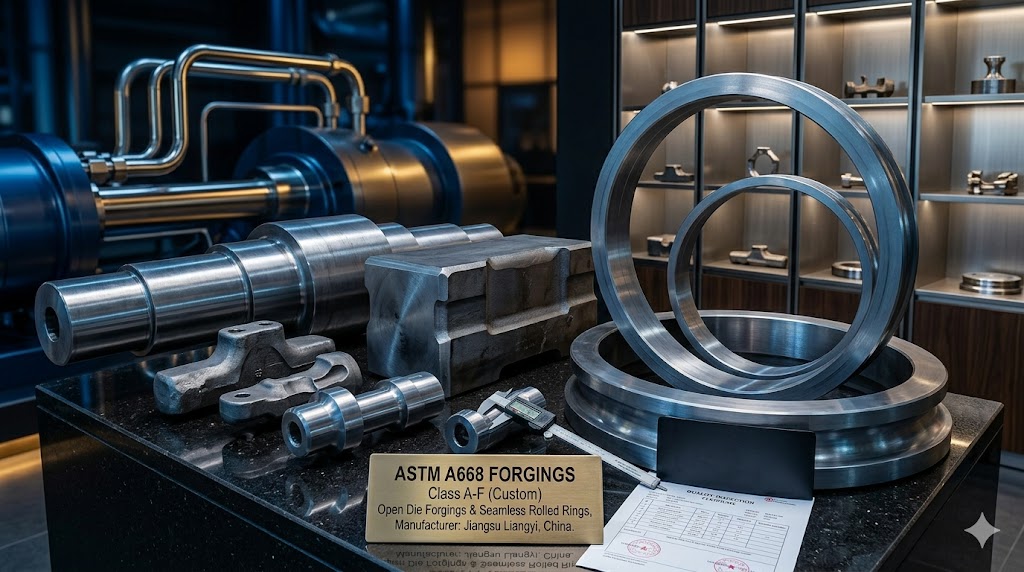
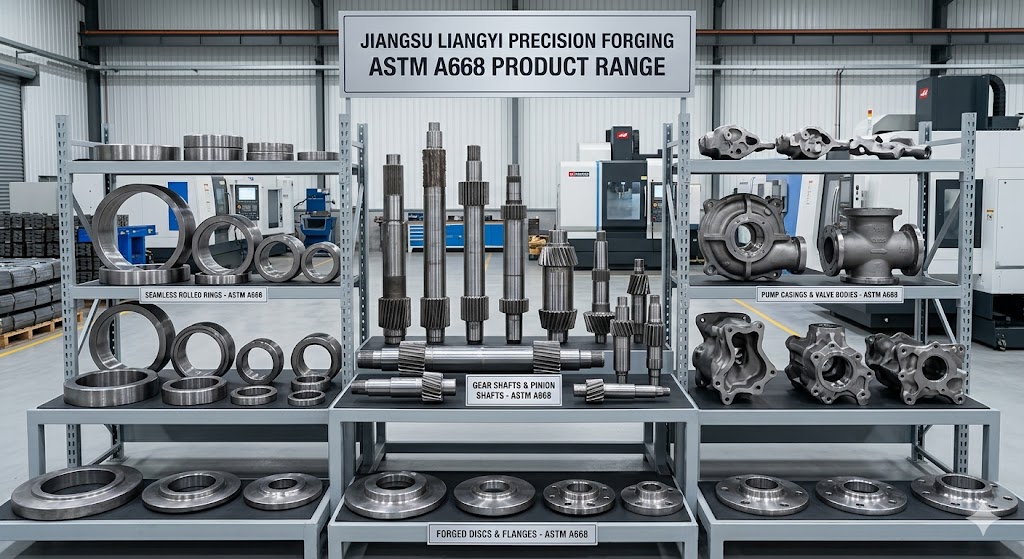
Founded in 1997 in Jiangyin City — one of China's most concentrated heavy forging manufacturing zones along the Yangtze River Delta — Jiangsu Liangyi Co., Limited has spent over 25 years building a singular focus: the engineering and production of large-scale, application-critical carbon and alloy steel forgings for global heavy industry. Unlike general-purpose forging suppliers who produce across dozens of unrelated standards, our production engineering team has accumulated deep, first-hand expertise in ASTM A668 / ASTM A668M forgings, working directly with engineers in over 50 countries to solve real procurement and engineering challenges.
We operate from an 80,000m² fully integrated production campus — not an assembly or outsourcing facility — where every stage from steel ingot receipt, open die forging, heat treatment, CNC rough machining, and final non-destructive testing is performed under our ISO 9001:2015 Quality Management System. Our total fixed asset base exceeds USD 40 million, and our annual forging output capacity reaches 120,000 metric tons. Critically, we maintain single-piece production capability from 30 kg to 30,000 kg (30 metric tons), covering the full weight range demanded by hydroelectric turbine components, oilfield pressure vessels, mining gearboxes, and marine propulsion systems.
Our ASTM A668 / ASTM A668M forged parts — covering all grades from Class A through Class F — are exported to North America, Europe, the Middle East, Southeast Asia, Australia, and South America. We serve OEM equipment builders, engineering procurement and construction (EPC) firms, MRO distributors, and end-user industries who require traceable, certified material data and consistent mechanical performance across production batches. Every inquiry received is reviewed by our in-house engineering team free of charge, and we provide complete drawing-based quotations without requiring a minimum order quantity.
What Is the ASTM A668 / ASTM A668M Standard? A Complete Technical Overview
ASTM A668 (imperial) and its metric companion ASTM A668M are the standard specifications published by ASTM International covering carbon and alloy steel forgings for general industrial use. First introduced to address the absence of a unified mechanical performance benchmark for open-die forged steel components across diverse heavy industrial sectors, ASTM A668 remains one of the most broadly referenced forging procurement standards in global engineering practice — alongside ASTM A105 (flanges and fittings), ASTM A182 (high-temperature alloy forgings), and ASTM A266 (pressure vessel forgings).
What makes ASTM A668 distinctive is its class-based mechanical property system. Rather than specifying a single fixed chemistry and heat treatment for all applications, the standard defines six discrete classes — Class A through Class F — each representing a different combination of tensile strength, yield strength, elongation, reduction of area, and corresponding heat treatment route. This architecture allows engineers and procurement teams to specify exactly the mechanical performance level required for their application, without over-engineering the material and increasing cost unnecessarily.
ASTM A668 Class A–F: Full Mechanical Properties Reference Table
The following table presents the mandatory minimum mechanical property requirements for each ASTM A668 class as manufactured in our facility. All values are tested on specimens taken from the forged component or from a test prolongation forged integrally with the component.
Note: Values above represent standard minimums. Client-specified enhanced mechanical properties (e.g. elevated Charpy impact toughness at sub-zero temperatures) can be accommodated through alloy selection and heat treatment parameter adjustment. Contact our engineering team to discuss enhanced property requirements.
ASTM A668M vs. ASTM A668: What Is the Difference?
ASTM A668M is the metricated parallel specification to ASTM A668. The underlying engineering requirements — chemical composition windows, mechanical property minimums, heat treatment routes, inspection methods, and documentation standards — are identical. The only important difference is the unit system used for dimensional tolerances, material quantities and test values: ASTM A668M uses SI units (MPa, mm, kg) while ASTM A668 uses inch-pound units (ksi, inches, pounds). When ordering, simply tell us what unit designation you have on your project’s engineering drawings.Our production team is equally fluent in both, and our mill test certificates can be issued in either unit system at no additional cost.
How ASTM A668 Compares to Related Forging Standards
Standard
Scope
Key Differentiator vs. ASTM A668
Typical Applications
ASTM A668 / A668M
C & alloy steel forgings, general industrial use, Class A–F
— (Reference standard)
Turbines, gearboxes, mining, sugar mills, cement, oil & gas
ASTM A105
C steel forgings for ambient/elevated-temperature piping
Narrower scope: flanges, fittings, valves — NOT large open-die forgings
Pipe flanges, valve bodies, fittings up to ~600°C service
ASTM A182
Alloy & stainless forgings for high-temp/pressure service
Specifically grades for high-temperature pressure service; tighter chemistry
Narrower to pressure-vessel use; fewer grades; no equivalent to A668 Class D gear-grade
Pressure vessel shells, nozzles, flanges, heads
EN 10250-2 / -3
European open die steel forgings (C and alloy steel)
European designation system; grade overlap but non-identical chemistry windows
General engineering forgings in EU and export markets requiring CE/PED compliance
Engineering Note: ASTM A668 is often the most cost-effective and logistically efficient standard for large open-die forgings when precise pressure-vessel or high-temperature-alloy certifications are not mandated. If your application requires ASME Boiler and Pressure Vessel Code compliance or API-certified grades, our engineering team can advise on the appropriate ASTM standard and cross-reference equivalent chemical compositions for your review.
We produce the full spectrum of open-die forging shapes and seamless ring-rolled profiles to all ASTM A668 / ASTM A668M class designations. Our in-house manufacturing capability covers single-piece weights from 30 kg to 30,000 kg, seamless ring outer diameters from 200 mm to 5,000 mm, and shaft lengths from 500 mm to 12,000 mm. All configurations are produced strictly to client engineering drawings, with dimensional tolerances agreed upon at the RFQ stage.
ASTM A668 Class A — Case-Hardening Grade Forgings
Class A is intended for applications where a tough soft core and a hardened surface layer are required. In our production process Class A forgings are supplied in annealed or normalized condition optimized for subsequent carburizing or carbonitriding. The relatively low bulk hardness (typically 160–200 HB) guarantees excellent machinability prior to case hardening, while the alloy window supports achieving case depths of 2–8 mm with surface hardness of 58–63 HRC after heat treatment by the end-user. Typical products include ground and finish-machined pinion shafts for cement rotary kilns, locomotive axle gears, paper mill drive shafts, and sugar mill roller journals.
ASTM A668 Class B — Normalized General Industrial Forgings
Class B fills the role of a cost-effective general engineering forging where through-hardening or case hardening is not required. Produced in the normalized or normalized-and-tempered condition, these forgings offer a balanced combination of strength (minimum 485 MPa tensile) and toughness suitable for structural frames, press platens, machine bases, cross-heads, tie-rods, and general heavy-equipment load-bearing components. Our Class B forged blanks are also widely supplied for subsequent machining into flanges, couplings, and custom structural shapes.
ASTM A668 Class C — Medium-Strength Multi-Application Forgings
Class C is our highest-volume ASTM A668 grade, driven by the enormous demand from the global hydroelectric power, sugar processing, and general heavy-industry sectors. Produced via normalized and tempered (N+T) heat treatment, Class C forgings deliver a minimum tensile strength of 550 MPa combined with excellent toughness, weldability, and dimensional stability under operational loads. Key product forms include: hydro turbine thrust rings (upper and lower), main shaft flanges, turbine runner crowns, sugar mill crushing roller shafts, large hollow cylinders, pressure vessel shells, and disc forgings for pumping equipment.
ASTM A668 Class D — Quenched & Tempered High-Strength Gear Forgings
Class D is the workhorse grade for the global gear and power transmission industry. Quenched and tempered to achieve a minimum tensile strength of 620 MPa and yield of 415 MPa, this grade develops a uniform through-hardened microstructure — typically fine-grained tempered martensite or bainite — that provides the fatigue resistance, contact strength, and torsional stiffness required for heavily loaded gear applications. Our Class D forging portfolio covers: large gear blanks (OD up to 4,500 mm), forged pinion shafts, gearbox input and output shafts, ring gears for ball mills and rotary kilns, drilling rig top drive components, and high-torque marine gear transmission shafts.
ASTM A668 Class E — High-Strength Pressure and Structural Forgings
Class E, produced via quench and temper to minimum 690 MPa tensile strength, is selected when both high strength and pressure-containing integrity are required. This grade is the primary specification for forged pump casings in boiler feed water service, large valve bodies for high-pressure pipeline isolation, impellers for multi-stage centrifugal pumps, and heavy structural forgings in offshore platforms and crane booms. Our heat treatment protocols for Class E forgings include controlled quench rates calibrated to section size, with post-temper stress relief performed where client specifications or residual stress concerns require it.
ASTM A668 Class F — Seamless Rolled Rings & Extreme-Duty Forgings
The highest mechanical performance level in the ASTM A668 system is Class F. Minimum tensile is 795 MPa and yield is 655 MPa after quench and temper. This grade is most commonly specified for seamless ring-rolled components — including bearing rings, valve seat rings, valve balls for high-pressure API 6D service, and wellhead connector hubs — where the combination of maximum strength, precise dimensional tolerances, and full through-wall mechanical homogeneity is critical. Our ring rolling facility produces seamless ASTM A668 Class F rings from OD 200 mm to OD 5,000 mm, with wall thickness from 30 mm to 800 mm, in both rectangular and custom-profiled cross-sections.
Our ASTM A668 Forging Process: From Ingot to Certified Component
The quality of an ASTM A668 forged component is not determined solely by chemistry — it is built incrementally through every step of the manufacturing chain. At Jiangsu Liangyi, we control the complete production sequence in-house, eliminating quality and traceability risks that arise when critical steps are subcontracted. Following is our actual production workflow for ASTM A668 / ASTM A668M forgings:
1
Steel Ingot Procurement & Incoming Inspection
We source carbon and alloy steel ingots from qualified electric arc furnace (EAF) and ladle refining furnace (LRF) steelmakers whose chemical composition windows are pre-verified against the applicable ASTM A668 class requirements. Each ingot lot is sampled and verified by spectrographic analysis in our in-house laboratory before it enters the forge. Ingot weights range from 500 kg to 45,000 kg depending on final forging weight and required forging ratio.
2
Ingot Heating & Temperature Control
Our ingots are heated in natural gas fired furnaces with a PLC controlled temperature control system. The heating curves are programmed in advance according to the ingot cross section, alloy grade and target forging temperature window. Uniform through-temperature is verified by multiple thermocouple readings before forging begins, preventing cold spots that lead to forging cracks or non-uniform grain structure.
3
Open Die Forging or Ring Rolling
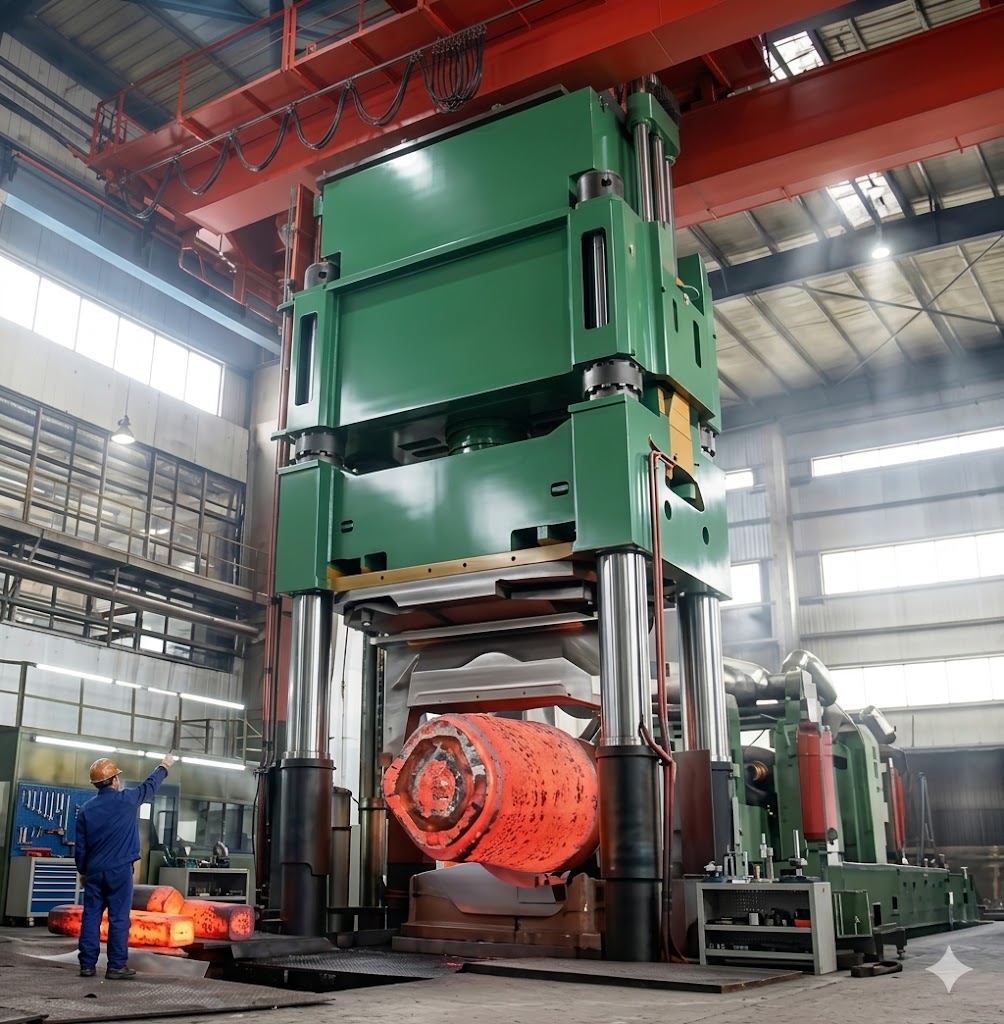
Depending on the component geometry, the heated ingot is worked on our 6,300T hydraulic press (open die forging) or 5-metre seamless ring rolling mill. Open die forging progressively refines the as-cast ingot grain structure through multiple reduction passes, closing porosity and developing the characteristic fibrous grain flow pattern aligned with the component's service-load direction. Our minimum forging ratio is 3:1 on all ASTM A668 components, and 4:1 or greater for critical Class D, E, and F grades.
4
Post-Forge Cooling & Intermediate Heat Treatment
Following the final forging pass, components are slowly cooled or placed in insulated boxes to prevent thermal cracking caused by rapid surface-to-core temperature differentials. Where required, a stress-relief or intermediate anneal is performed before rough machining to guarantee dimensional stability during subsequent machining operations. This step is particularly important for Class D, E, and F components with complex geometries.
5
Rough Machining to Inspection Dimensions
Components are rough-machined on our in-house CNC turning centres and boring mills to bring them to inspection dimensions — at which mechanical test specimens and non-destructive testing can be performed to a representative cross-section close to finished part size, as required by ASTM A668. We maintain a dedicated fleet of CNC lathes capable of turning components up to Ø 2,500 mm × 10,000 mm.
6
Final Heat Treatment (Normalize, Quench & Temper, or Anneal)
This is the most critical step in determining final mechanical properties. Our heat treatment facility includes pit furnaces, car-bottom furnaces, and a quench tank capable of handling components up to 5,000 mm diameter. Heat treatment parameters — including heating rate, soak temperature (±10°C control tolerance), soak duration calculated from section thickness, quench medium (water or polymer), and tempering temperature — are all recorded in real time in our manufacturing execution system (MES) and form part of the final documentation package.
7
Mechanical Testing & Chemical Analysis
After heat treatment, mechanical test specimens are machined from designated sampling locations (quarter-thickness for most ASTM A668 classes) and tested for: tensile strength, 0.2% proof stress (yield strength), elongation, reduction of area, and Charpy V-notch impact energy (if specified). Hardness surveys are conducted across the full cross-section. Chemical composition is verified by optical emission spectrometer (OES) from ladle analysis, and by product check analysis from the test specimen for critical grades.
8
Non-Destructive Testing (NDT) — UT, MT, PT
All ASTM A668 forgings undergo ultrasonic testing (UT) to acceptance criteria aligned with ASTM A388 (standard UT method for heavy forgings), with full scan reports issued for each component. Magnetic particle testing (MT) per ASTM E709 is performed on all carbon and alloy steel components for surface and near-surface discontinuity detection. Liquid penetrant testing (PT) per ASTM E165 is applied where MT is impractical. Third-party NDT by a client-nominated inspection body is fully accommodated.
9
Final Dimensional Inspection & Certification
The dimensions of each part are checked dimensionally against customer drawings with calibrated coordinate measuring machines, and all results are recorded in a dimensional inspection report. Material Test Certificates (MTCs) are normally issued to EN 10204 3.1 standard, while EN 10204 3.2 certification countersigned by TÜV, Bureau Veritas, SGS, Intertek or other authorized bodies can be provided on request. All parts go through surface treatment, are marked with heat number and part code, then properly packed for ocean freight export.
Why Open Die Forgings Outperform Castings and Bar Stock for ASTM A668 Applications: The repeated mechanical working of the open die forging process eliminates as-cast porosity, breaks up coarse dendrite structures, refines austenite grain size, and aligns the material's fibrous grain flow along the primary stress direction of the finished component. The result is a part with superior fatigue strength (typically 20–30% higher than equivalent cast steel), better toughness at sub-zero temperatures, and more consistent mechanical properties across the full cross-section compared to hot-rolled bar stock of the same diameter — translating directly into longer service life and reduced maintenance costs for the end user.
Industry Applications & Global Project Case Studies
The following are representative case summaries from our ASTM A668 / ASTM A668M forging production programme, illustrating the types of engineering challenges and solutions we address across global industries. Details have been generalized to protect client confidentiality. For verifiable project references, please visit our Project References page or contact our sales team directly.
Southeast Asia — 500 MW Hydroelectric Turbine Rings & Main Shafts
Project Background: A regional EPC contractor developing three run-of-river hydro power plants in the Mekong basin needed large forged rings and main shafts for 500 MW Francis turbine units. The project programme was 16 weeks from approval of drawings to dispatch from works with zero defects on all rotating structural components.
Our Solution: We supplied ASTM A668 Class C forged upper and lower thrust rings (OD 3,200 mm, wall 220 mm, weight 8,400 kg each) and ASTM A668 Class E forged main shafts (Ø 680 mm × 5,400 mm, weight 12,600 kg each) for each turbine unit. All rings and shafts were produced with a minimum forging ratio exceeding 4:1, and passed full UT per ASTM A388, MT per ASTM E709, and dimensional inspection within the agreed tolerances. EN 10204 3.2 certificates were co-signed by a client-nominated third-party inspection body. All components were dispatched on schedule with zero non-conformances recorded.
Middle East — High-Pressure Oilfield Valve Forgings, API 6D Service
Project Background: A valve manufacturer who supply Saudi Arabia’s upstream oilfield projects needed forged valve bodies and gate internals. These parts had to operate continuously under 10,000 PSI Class 2500 working pressure and had to resist sour gas with hydrogen sulfide. The products shall fully meet API 6D and NACE MR0175 / ISO 15156 for resistance to sulfide stress cracking.
Our Solution:We produced ASTM A668 Class D forged valve bodies and bonnets (450–2,800 kg each) and ASTM A668 Class F forged gate slabs and seat ring blanks in a low-alloy, low-sulfur chemistry (S ≤ 0.005%) with a maximum hardness of 22 HRC after Q+T heat treatment, meeting NACE MR0175 SSC resistance requirements per the customer’s specification. The client’s further demands specified a minimum average of 40J for Impact testing at −46°C. This was met, and all parts of the supply batch were fully UT accepted. The certificates included material traceability documentation referencing API 6D material requirements, EN 10204 3.2 co-signed by a client nominated third party inspection body and full heat treatment records.
Australia — Mining Gearbox Gear Shafts for Open-Pit Drilling Rigs
Project Background: An Australian mining equipment OEM designing mud pump gearboxes for rotary drilling rigs operating 24/7 in iron ore and coal mining sites required forged gear shafts and pinion shafts with exceptional fatigue life under high cyclic torque loads. The previous cast steel gear shafts had been experiencing fatigue failures at 14–18 months of service.
Our Solution: We replaced the client's casting specification with ASTM A668 Class D open die forged gear shafts (Ø 320 mm × 2,600 mm, weight 1,860 kg) and pinion shafts (Ø 220 mm × 1,900 mm, weight 720 kg), produced with a minimum forging ratio of 4.5:1 and Q+T heat treated to 280–320 HB surface hardness. The forged grain flow orientation was aligned axially, improving bending fatigue resistance over the equivalent casting (consistent with published materials science data showing typical 20–30% fatigue improvement for forgings vs. castings), and after 30+ months of operational service, no fatigue failures have been reported by the client — significantly exceeding the previous service interval.
Europe — Boiler Feed Pump Casings for Supercritical Thermal Power Stations
Project Background: A German pump manufacturer supplying boiler feed water pumps for supercritical thermal power plants in Central Europe required forged pump casings capable of containing water at 250 bar, 260°C operating conditions, compliant with the European Pressure Equipment Directive (PED 2014/68/EU) and EN 10204 3.2 certified.
Our Solution:We manufactured ASTM A668M Class E forged pump barrel casings (OD 890mm, wall 145mm, length 1800mm, weight 7200kg) with controlled chemical composition tightened over standard A668M minimums to improve creep resistance at elevated temperature.Post-Q+T mechanical testing indicated tensile strength, yield, elongation and Charpy impact values well exceeding ASTM A668M Class E minimums and the client’s improved supplementary requirements. All certificates were endorsed by a third party inspection by a client nominated inspection body. All components passed final RT and hydrostatic proof testing without rejection.
North America — Marine Propeller Shafts with Cold-Weather Impact Requirements
Project Background: A North American defense and commercial shipbuilding procurement office required large-diameter propeller shafts for container vessels, with full material traceability from ingot to final machined dimension, and impact properties retained down to −20°C for cold-water North Atlantic service.
Our Solution: ASTM A668 Class D forged propeller shafts (Ø 520 mm × 8,200 mm, weight 13,700 kg) were produced from a 25-tonne ingot at a minimum forging ratio of 5:1 on the critical journal diameter sections. Charpy V-notch impact tests at -20°C confirmed values well in excess of the minimum requirement of the client. 100% ultrasonic scanning per ASTM A388 acceptance criteria showed zero reportable indications Each shaft was provided with full heat treatment records and traceability of heat number to EN 10204 3.2 certificates.
South America — Sugar Mill Roller Shafts & Crusher Drive Components
Project Background: A Brazilian sugar and ethanol processing group needed roller shafts and drive gear shafts capable of handling the combined bending, torsion and impact loads of 24/7 continuous sugarcane crushing, with a target minimum maintenance interval of 21+ months continuous operation.
Our Solution: ASTM A668 Class C forged roller shafts (Ø 450 mm × 3,200 mm, weight 4,050 kg) and Class D drive gear shafts (Ø 380 mm × 2,700 mm, weight 2,430 kg) were produced with consistent mechanical properties, and they are verified by hardness traverse testing from surface to centre at 25 mm intervals. Post-installation service reports confirmed that by harvest season three, no shaft failures had occurred — a 30%+ improvement in service life compared to the previous supplier's components, reducing annual maintenance cost per crushing line.
China & Southeast Asia — Cement Rotary Kiln Pinion Shafts, 4000 t/d Lines
Project Background: Multiple cement plant operators in China (Jiangsu, Shandong, Guangdong provinces) and Thailand required replacement and OEM-supply ground pinion shafts for 4,000 t/d rotary kiln drive systems, where the pinion shaft transmits up to 3,500 kW of continuous drive power through a case-hardened gear mesh operating in high-dust, elevated-ambient-temperature environments.
Our Solution: ASTM A668 Class A forged pinion shaft blanks (Ø 560 mm × 4,100 mm, weight 7,900 kg) were produced with chemistry optimized for case depth uniformity after gas carburizing. Core hardness after normalization was 170–185 HB (ideal for uniform carburizing response), and dimensional tolerances on journal and gear seat diameters were held to h6 tolerance — eliminating corrective machining at the client's factory and reducing assembly lead time by 4 days per kiln line. Ongoing framework supply agreements are now in place covering an estimated annual volume of 24 pinion shafts per year.
Manufacturing Equipment & Full-Process Quality Control for ASTM A668 Forgings
The quality of every ASTM A668 forged component we produce is the result of controlled processes, calibrated equipment, and documented inspection — not post-production sorting. Our Quality Management System is certified to ISO 9001:2015, and our internal quality protocols routinely exceed the minimum inspection and testing requirements of the ASTM A668 / A668M standard itself.
Core Production Equipment
Equipment Type
Specification / Capacity
Role in ASTM A668 Production
Hydraulic Open Die Forging Press
6,300T (primary) + 2,000T (secondary)
Primary forging of ingots up to 45T into all open-die shapes; Class A–F capable
Seamless Ring Rolling Mill
5-metre maximum rolling diameter
Production of seamless rolled rings OD up to 5,000 mm for Class C, D, E, F
Gas-Fired Heating Furnaces
Multiple: 30T, 20T, and 10T capacity; PLC temperature control ±10°C
Uniform ingot heating and re-heating for multi-pass forging operations
Car-Bottom & Pit Heat Treatment Furnaces
Maximum working temperature 1,100°C; PLC-programmed curves
Normalize, anneal, quench and temper, and stress relief for all A668 classes
Quench Tank
Capacity: components up to Ø 5,000 mm; water and polymer quench media
Rapid quenching for Class D, E, F Q+T heat treatment
CNC Vertical / Horizontal Lathes
Max turning diameter Ø 2,500 mm; max turning length 12,000 mm
Rough and finish machining of shafts, rings, and disc forgings
CNC Boring Mill
Working table up to 4,000 mm × 4,000 mm
Precision boring of large housings, casings, and flanged components
In-House Testing Laboratory Capabilities
Test Type
Method / Standard
Equipment
Chemical Analysis
OES (Optical Emission Spectrometry)
Direct-reading spectrometer; 30-element analysis in under 3 minutes
Tensile Testing
ASTM E8 / E8M; ASTM A668
600kN servo-hydraulic universal testing machine
Impact Testing
ASTM E23 Charpy V-notch; temperatures from −60°C to +25°C
300J Charpy impact machine with sub-zero cooling chamber
Hardness Testing
Brinell (HB), Rockwell (HRC), Vickers (HV)
Portable Brinell hardness tester + bench Rockwell/Vickers unit
Ultrasonic Testing (UT)
ASTM A388; client-specific acceptance criteria
Phased-array UT system (PAUT) + conventional single-probe UT units
Magnetic Particle Testing (MT)
ASTM E709; ASTM A275
Fluorescent MT bench + portable magnetic yoke units
Pre-Production Qualification & Manufacturing Process Plan (MPP)
Before production begins on any ASTM A668 forging order, we compile and submit a detailed Manufacturing Process Plan (MPP) tailored to the specific component, grade, and application. This document covers:
Ingot source qualification: Steelmaker name, EAF/LRF/VD process route, maximum ingot weight, and pre-production ingot testing requirements for critical components
Forging sequence plan: Number of forging heats, target forging temperatures (upper and lower), minimum finish forging temperature, and forging ratio calculation by cross-section
Heat treatment specification: Precise temperature, ramp rate, soak time (calculated from section thickness), quench medium and agitation method, and tempering temperature and duration with required hardness range
Inspection and testing plan: Sampling location for mechanical test specimens, test standards and acceptance criteria, NDT method, acceptance class, and third-party inspection arrangements
First Article Qualification
For new clients, new component types, or critical safety-class applications, we support a full first-article qualification process including dissection of one forging from the first production heat. Specimens are taken from mid-radius, quarter-thickness, and center locations to map mechanical property variation across the full cross-section — data we retain in our engineering records. This step may be waived where our production records document equivalent prior production history on the same component geometry and ASTM A668 class.
Batch Inspection & Certification Package
Every completed production batch of ASTM A668 forged parts is released only upon completion of a full inspection package delivered to the client with each shipment:
EN 10204 3.1 Material Test Certificate covering chemical composition, mechanical test results, heat treatment records, and NDT results
EN 10204 3.2 certificate (third-party inspection body co-signature) upon client request, with inspection body selected by client or from our approved list (TÜV, Bureau Veritas, SGS, Intertek, CCIC, Lloyds Register)
Dimensional inspection report with as-built measurements against drawing tolerances
Full NDT reports (UT scan maps, MT inspection records) per ASTM A388 and ASTM E709
Heat treatment process records (temperature-time charts from furnace data logger)
Packing list and export documentation for customs clearance
Why Global Engineers & Procurement Teams Choose Jiangsu Liangyi for ASTM A668 Forgings
There is no shortage of forging suppliers in China who will quote ASTM A668. What distinguishes Jiangsu Liangyi is the combination of metallurgical depth, process ownership, and long-term client relationships — factors that matter most when the component being ordered will operate inside a turbine, wellhead, or gearbox for 15–25 years.
🏭
100% In-House Production — Zero Subcontracting
We own and operate every step of the production chain: steel procurement, forging, heat treatment, rough machining, and NDT. No critical step is outsourced to a third party, so quality and schedule remain fully under our control.
🔬
Deep ASTM A668 Engineering Expertise
Our metallurgical and forging engineers have spent 25+ years specifically working with ASTM A668 Class A–F grades. We understand the standard's nuances — supplementary requirements, first-article qualification, and enhanced chemistry windows — not just its minimum requirements.
📐
Free Drawing Review & Engineering Support
Every RFQ receives a detailed engineering review. We check forgeability, suggest shape optimizations to reduce cost and lead time, and recommend the most appropriate heat treatment route for your application — at zero cost.
📋
EN 10204 3.1 / 3.2 Material Test Documentation
We issue EN 10204 3.1 Material Test Certificates (MTCs) as standard practice for all orders — not as a premium add-on. EN 10204 3.2 third-party inspection co-signature (by your nominated inspection body) is fully supported for any order quantity.
⚖️
No Minimum Order Quantity
Whether you need one sample forging for design validation or a 200-piece annual supply agreement, we apply the same rigorous quality standards and provide the same complete documentation package for every order size.
🌍
Proven Global Export Logistics
With 25+ years of export experience to 50+ countries, we manage all export documentation, packing, marking, and customs requirements for ocean freight. FOB, CIF, CPT, DAP, and DDP Incoterms available.
Frequently Asked Questions About ASTM A668 / ASTM A668M Forgings
ASTM A668 / ASTM A668M is a standard specification for carbon and alloy steel forgings for general industrial use, published by ASTM International (American Society for Testing and Materials). It covers the requirements for chemical composition, mechanical properties, heat treatment, permissible inspection and testing methods, and required documentation for steel forgings used across a wide range of heavy industrial applications. ASTM A668 uses inch-pound units, while ASTM A668M is the SI-unit equivalent — both specify identical engineering requirements. The standard is maintained by ASTM International's Committee A01 on Steel, Stainless Steel, and Related Alloys, and is widely referenced by OEM equipment builders, engineering contractors, and procurement specifications globally.
Each ASTM A668 class defines specific minimum mechanical properties and a corresponding heat treatment route: Class A (415 MPa tensile, annealed/normalized) is designed for components that will receive surface hardening — such as carburizing or induction hardening — making it the specification of choice for case-hardened pinion shafts and locomotive gearing. Class B (485 MPa tensile, normalized) is the lowest-cost general industrial grade for non-critical structural and load-bearing applications. Class C (550 MPa tensile, normalized + tempered) is the most widely used medium-strength grade, covering hydro turbine rings, sugar mill shafts, and general heavy equipment. Class D (620 MPa tensile, quenched + tempered) is specified for through-hardened gear blanks, drilling equipment and high-torque transmission components. Class E (tensile 690 MPa, Q+T) is used for high-strength pressure containing applications such as boiler feed pump casings. Class F (795 MPa tensile, Q+T) is the highest strength ASTM A668 grade, typically called out for seamless rolled rings in wellhead and valve service.
ASTM A668 forged parts are used in a wide range of heavy industrial applications where quality of raw material, traceability and uniformity of mechanical properties are essential: Hydroelectric and thermal power generation (turbine rings, main shafts, impellers); Oil and gas (high-pressure valve bodies, wellhead forgings, API 6D and NACE MR0175 compliant gate internals); Mining and mineral processing (gearbox shafts, ring gears, crusher components); Cement manufacturing (rotary kiln pinion shafts, girth gear blanks); Sugar and ethanol processing (mill roller shafts, drive gear shafts, crushing spindles); Marine shipbuilding (propeller shafts, rudder stocks, stern tube components); Aerospace and defense (structural forgings, landing gear components); Heavy construction machinery (crane hooks, press frames, boom pin shafts).
Our ASTM A668 single-piece forging capacity ranges from 30 kg to 30,000 kg (30 metric tons). For specific product forms: seamless rolled rings up to OD 5,000 mm with wall thickness ≥ 30 mm; forged shafts and round bars up to Ø 1,500 mm diameter and 12,000 mm length; forged discs and gear blanks up to OD 4,500 mm; hollow cylinders and shells up to OD 3,500 mm and 8,000 mm length. For components outside these parameters, contact our engineering team — forge-machining strategies can sometimes achieve effective final dimensions beyond these nominal limits.
Every ASTM A668 forging we produce is released with a complete documentation package. EN 10204 3.1 Material Test Certificates (MTCs) — signed by our own Quality Manager — covering chemical composition, full mechanical test results, heat treatment records, and NDT results are issued as standard for all orders. EN 10204 3.2 MTCs — where the document is additionally co-signed by an independent third-party inspection body of the client's choice — are available upon request. Common inspection bodies our clients use include TÜV SÜD, Bureau Veritas, SGS, Intertek, CCIC, and Lloyd's Register, though any accredited body nominated by the client can be accommodated. Additional project-specific documentation — such as material traceability referenced to API 6D material requirements, hardness records per NACE MR0175 criteria, or PED-related conformity documentation — can be prepared where required by the application. All MTCs include full heat number traceability from ingot to finished component. Note: EN 10204 3.1 and 3.2 are document types (material test report formats), not certifications held by our company.
Yes — all our ASTM A668 forgings are manufactured to client engineering drawings and technical specifications. There is no catalog stock: every component we produce is engineered to order. Our in-house engineering team reviews your drawing upon receipt, free of charge, for forgeability, NDT access, heat treatment feasibility, and dimensional tolerance achievability. We accept drawings in all common formats (PDF, DWG, DXF, STEP, IGES, SolidWorks, CATIA) and can provide reverse-engineering measurement services for worn components without existing drawings.
Lead time for ASTM A668 forgings varies primarily with component weight, heat treatment class, and required inspection level. As a general guide: Small components (under 500 kg), Classes A–C, standard inspection: 4–6 weeks from drawing approval. Medium components (500–5,000 kg), Classes C–E, with EN 10204 3.1: 6–10 weeks. Large components (5,000–30,000 kg), Classes D–F, with EN 10204 3.2 third-party inspection: 10–16 weeks. Rush orders can sometimes be accommodated subject to current production loading — contact our team with your required delivery date at the RFQ stage for a committed schedule. Lead time begins from drawing approval and deposit receipt.
We do not enforce a minimum order quantity (MOQ) for ASTM A668 forgings. Single-piece prototype orders are accepted and receive the same full quality management, heat treatment, and documentation process as multi-piece production orders. Unit pricing naturally reflects economies of scale, but there is no commercial or logistical barrier to ordering a single critical component. For clients establishing a new supplier or qualifying a new component design, ordering a single first-article piece is a common and fully supported approach in our production system.
Yes — we provide full global delivery for all ASTM A668 forged parts, with 25+ years of export experience serving clients in over 50 countries across North America, Europe, the Middle East, Southeast Asia, Australia, and South America. We manage all export documentation (commercial invoice, packing list, bill of lading, certificate of origin), customs clearance coordination, and sea freight booking in-house. Available Incoterms include FOB Ningbo/Shanghai, CIF destination port, CPT, DAP, and DDP. Oversize components (over 3T) requiring flat-rack or open-top container loading are a routine part of our export logistics programme.
Class selection should be driven by the actual mechanical property requirements of the application at the finished component cross-section — not by selecting the highest-strength class available. The key selection factors are: (1) Tensile and yield strength required at the governing cross-section, derived from your stress analysis or equipment specification. (2) Toughness / impact energy requirements — particularly for low-temperature service or dynamic load applications. (3) Heat treatment compatibility — if secondary heat treatment (carburizing, nitriding, induction hardening) is applied after forging, Class A is typically the starting point. (4) Applicable code or standard — if API 6D, PED, or ASME applies, the qualifying code may dictate a minimum ASTM A668 class. Our engineering team provides free class selection guidance as part of every RFQ review.
Yes — ASTM A668 forgings can be manufactured to meet NACE MR0175 / ISO 15156 sour service (H2S-containing environment) requirements, provided the correct class, chemistry, and heat treatment controls are applied. The key requirement for carbon and low-alloy steel forgings under NACE MR0175 is a maximum hardness of 22 HRC (approximately 248 HBW or 237 HV10). ASTM A668 Class D forgings, when quenched and tempered to a tempering temperature that achieves ≤ 22 HRC, typically fulfil this requirement, provided the chemistry is controlled to avoid susceptibility to hydrogen-induced cracking (HIC) — which means specifying maximum sulfur content (achievable to S ≤ 0.005% through ladle refining on request), maximum phosphorus, and appropriate carbon equivalent limits. Our engineering team has extensive experience with NACE-compliant ASTM A668 forgings for Middle East and offshore oil and gas clients.
We offer flexible commercial terms tailored to the order value and client relationship. For new clients, our standard terms are a 30% deposit upon order confirmation with the balance (70%) payable against copy shipping documents (T/T before shipment) or via an irrevocable documentary Letter of Credit (L/C at sight) issued by a first-class international bank. For established clients with a completed order track record, extended payment terms and open-account arrangements can be discussed. Pricing currency is USD as standard, with EUR or CNY options available by agreement. We issue a proforma invoice upon order confirmation and a commercial invoice with full shipping documents upon completion of inspection and packing.
Get Your Free Custom ASTM A668 Forgings Quote
Contact Us for Your Custom ASTM A668 Forging Requirements
We welcome all inquiries for custom ASTM A668 / ASTM A668M Class A, B, C, D, E, and F forged parts — single pieces, prototype orders, and serial production. As an ISO 9001:2015 certified China forging manufacturer with 25+ years of proven ASTM A668 export experience, we combine engineering depth, full in-house manufacturing control, and complete EN 10204 3.1/3.2 documentation to deliver components that meet your technical requirements and your project schedule. For full product details, visit: https://www.jnmtforgedparts.com/astm-a668-forgings.html