ASTM A182 F6A Forged Parts | China Professional Forging Manufacturer
Established in 1997, Jiangsu Liangyi Co.,Limited is an ISO 9001:2015 certified open die forging factory located in Jiangyin, Jiangsu Province, China — one of China's most established heavy manufacturing corridors. With 29 years of dedicated production experience, an 80,000㎡ facility housing a 6,300-ton hydraulic press as our main forging equipment, and an annual output of 120,000 metric tons, we are among the very few Chinese forging manufacturers capable of producing ASTM A182 Grade F6A forged parts from single pieces of 30 kg all the way to 30,000 kg within the same facility, with no outsourced subcontracting. Our F6A forgings serve customers in over 50 countries across North America, Europe, the Middle East, Southeast Asia, and Oceania.
ASTM A182 F6A Forged Parts: What Makes This Grade Exceptional
ASTM A182 Grade F6A — designated under UNS S41000 and commonly referenced as A182-F6A Class 1, Class 2, Class 3, or Class 4 — is a martensitic chromium stainless steel defined by ASTM A182/A182M for high-temperature and high-pressure forged or rolled alloy components. The controlled chromium content of 11.5–13.5% sits at the precise threshold where the alloy forms a self-healing passive chromium oxide layer (Cr₂O₃) without transitioning to the fully austenitic microstructure seen in 300-series stainless steels — giving F6A its unique combination of magnetic permeability, high hardness, and moderate corrosion resistance that austenitic grades cannot economically replicate at the same strength levels.
Why Martensitic Structure Matters for Critical Forgings
The martensitic transformation in F6A occurs during controlled air or oil quenching from the austenitizing temperature range (typically 925–1010°C). The resulting body-centered tetragonal (BCT) crystal lattice is supersaturated with carbon, which — upon tempering — precipitates as fine carbides along grain boundaries. This controlled carbide morphology is what gives each F6A class its distinctive mechanical profile: Class 1 forgings, tempered at the highest temperatures (generally ≥620°C), produce the coarsest carbide distribution, highest toughness, and lowest hardness, making them ideal for flanges and fittings requiring weldability. Class 4 forgings, tempered at lower temperatures, retain a finer carbide structure and achieve tensile strengths exceeding 895 MPa — suitable for high-load valve stems and downhole tools where a Class 1 part would yield under operating stress.
F6A vs. Alternative Stainless Grades: A Practical Comparison
Purchasing engineers frequently ask why F6A is specified over F304, F316, or duplex grades for certain applications. The answer lies in three distinct engineering trade-offs. First, F6A's hardness range (143–321 HBN depending on class) far exceeds what F304 (typically 90–130 HBN) can achieve, making F6A the correct choice wherever wear resistance, galling resistance, or seating hardness is critical — such as in valve ball-and-seat interfaces or downhole fishing tool components. Second, F6A's density (7.75 g/cm³) and thermal conductivity (approximately 24.9 W/m·K) make it thermally more stable than austenitic grades in cyclic heat environments, reducing thermal fatigue cracking in turbine disc applications. Third, while F316 provides superior pitting resistance in chloride environments, F6A manufactured to NACE MR0175 Class 1 or Class 2 (hardness ≤22 HRC) remains the standard industry choice for sour service wellhead equipment because its magnetic properties permit more reliable non-destructive testing with magnetic particle inspection — a capability F316 lacks entirely.
As a professional China forging manufacturer with 29 years of continuous F6A production experience, we have developed proprietary heat treatment cycle parameters beyond the minimum ASTM A182 specification requirements for each class, optimized through over 2,000 documented production batches. All F6A forged parts are produced with full traceability from raw material heat certificate to final machined component, compliant with ASTM A182, NACE MR0175/ISO 15156, API 6A, ASME BPVC, EN 10228, and DIN specifications. Our in-house forging and heat treatment equipment — including a dedicated 12-zone pit furnace for large-section F6A components — ensures uniform through-thickness hardness on forgings up to 1,200 mm in cross-section diameter.
Available ASTM A182 F6A Forged Shapes & Custom Forms
We manufacture custom ASTM A182 F6A forged components across the full spectrum of open die and ring rolling techniques, covering single-piece weights from 30 kg to 30,000 kg and seamless rolled ring outer diameters from 200 mm to 5,000 mm. Every shape listed below is produced entirely in-house — we do not purchase billets or semi-finished forgings from external suppliers — ensuring that the full forging ratio (typically ≥3:1 on critical components per ASTM A182 requirements) is achieved and documented within our own production facility.
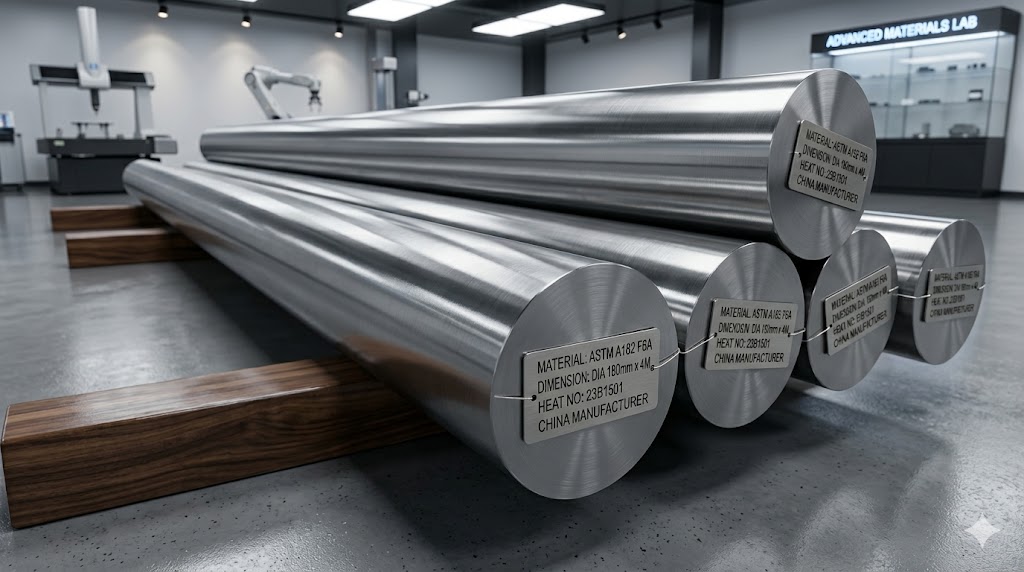
A182 F6A Forged Bars & Rods
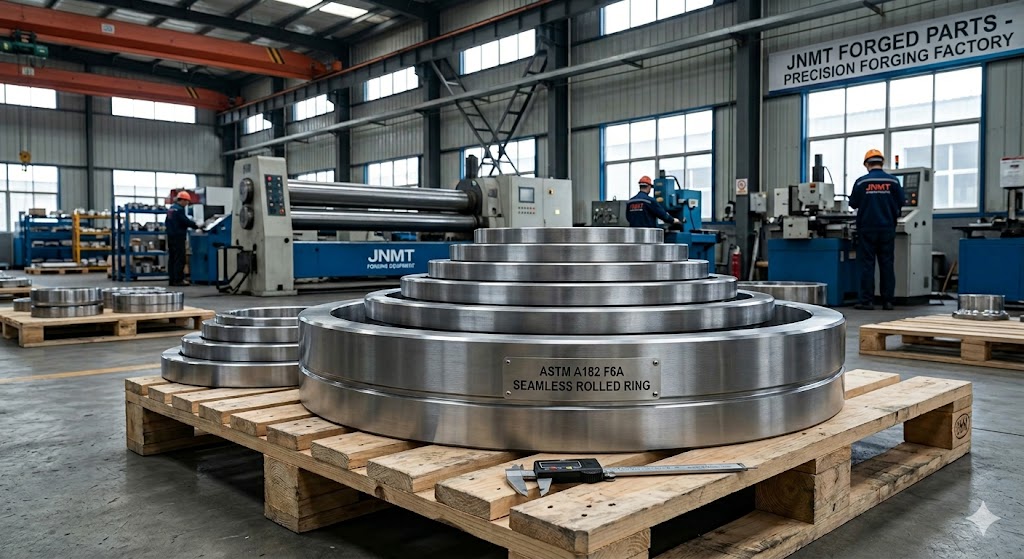
A182 F6A Seamless Rolled Rings
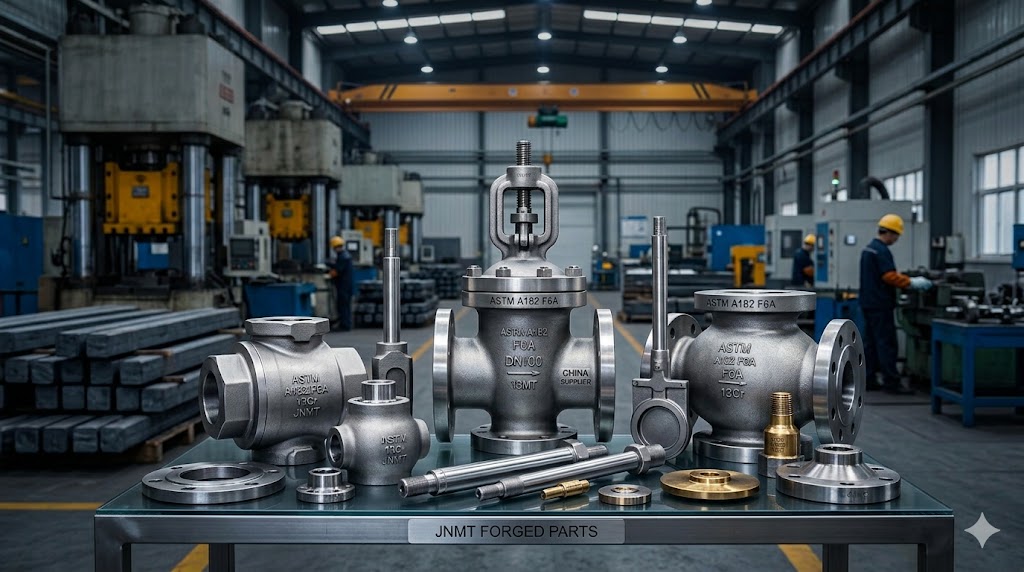
A182 F6A Forged Valve Components
- Forged Bars, Rods & Shafts: ASTM A182 F6A round bars (solid and hollow-bored), square bars, flat bars, hexagonal bars, step shafts, multi-diameter shafts, turbine shafts, pump shafts, compressor shafts, and gear shafts. All bars are press-forged with controlled reduction ratios to ensure full grain refinement and axial fibre alignment — unlike rolled bar, open die forged bars eliminate the centreline porosity and segregation that cause premature fatigue failures in rotating equipment. Typical diameter range: 80–1,200 mm; maximum length: 6,000 mm.
- Seamless Rolled Rings: A182 F6A seamless rolled rings in plain rectangular, flanged, contoured (profile-rolled), and T-section configurations. Our ring rolling mill accepts ingots up to 10 tonnes and achieves outer diameters from 200 mm to 5,000 mm with wall thicknesses as low as 30 mm. The circumferential grain flow achieved through ring rolling provides superior hoop strength compared to plate-cut rings — critical for high-pressure valve seat rings, pressure vessel closure heads, and gas turbine seal ring applications. Available forms include: gear rings, flange rings, valve seat rings, labyrinth seal rings, bearing races, slewing rings, and retaining rings.
- Hollow Forged Components: F6A hollow forged shells, barrels, cylinders, sleeves, bushings, casings, hubs, housings, and piping shells produced by mandrel press forging or punching and drawing. The mandrel-forged process produces a circumferential grain pattern through the tube wall — giving up to 30% better fatigue life in pressure cycling applications compared to machining from solid bar. Wall thickness uniformity is controlled to ±3–5% on standard tolerances, tighter on request. Typical OD range: 300–2,500 mm; wall thickness: 30–500 mm.
- Solid Forged Components: A182 F6A forged discs, disk blanks, plates, square and rectangular blocks, flanges, step flanges, nozzle flanges, and large anchor blocks. Solid components are produced by upsetting or die pressing to achieve the required grain flow pattern. All disc and plate forgings are 100% ultrasonically tested per ASTM A388 after rough machining to confirm the absence of internal laminations, pipe, or macro-inclusions prior to finish machining.
- Valve, Wellhead & Flow Control Parts: F6A forged valve bodies (gate, ball, globe, butterfly, check, and needle types), valve bonnets, end caps, stem forgings, ball blanks, seat ring preforms, bore-through bodies, Christmas tree blocks, frac head forgings, choke bodies, casing head flanges, tubing head flanges, and spool bodies. These components are typically produced from F6A Class 3 or Class 4 material for maximum wear resistance and sour service compatibility. We maintain full API 6A Annex F traceability records for all wellhead-rated components.
- Fully Machined Custom Parts: Complete CNC precision machining from rough forging to finished-to-drawing dimensions, including internal bores, threaded connections, keyways, sealing grooves, flange faces, and complex external profiles. Tolerances achievable: ±0.05 mm on critical diameters; surface finish Ra 0.4–3.2 μm depending on service requirements. Third-party inspection available from BV, SGS, TÜV, DNV, LLOYDS, or customer-nominated agencies.
ASTM A182 F6A Forged Parts: Industry Applications & Engineering Rationale
ASTM A182 F6A is not a universal choice — it is a precision specification selected when three specific engineering conditions converge simultaneously: the need for hardness above what austenitic stainless steels can provide, moderate corrosion resistance in mildly aggressive media, and manufacturability through forging to achieve directional grain properties that cast or machined-from-bar components cannot match. Our experience across 50+ countries and 29 years of production has given us a detailed understanding of the specific service conditions that drive F6A specification decisions in each industry below.
Oil & Gas: Upstream Wellhead, Completion & Downhole Equipment
F6A is the dominant material for wellhead equipment governed by API 6A (pressure classes from 2,000 PSI through 20,000 PSI) for one core engineering reason: it satisfies NACE MR0175/ISO 15156 sour service requirements at Class 1 and Class 2 hardness levels (≤22 HRC equivalent to ≤241 HBN Brinell) while providing the wear resistance and tensile strength that soft austenitic grades like F304L cannot deliver in sliding-contact wellhead components. F6A Class 3 and Class 4 are used in non-sour high-pressure applications where tensile strength is the governing design criterion. Key F6A applications in this sector include:
- Christmas Tree & Wellhead Bodies: Gate valve bodies, cross-overs, wing valves, master valves, and swab valves — typically Class 2 or Class 3, with bore-to-bore hardness uniformity verified by individual Brinell testing
- Casing Heads & Tubing Heads: Large hollow shell forgings up to 1,000 mm OD requiring clean ultrasonic maps across the entire bore wall — a routine product in our facility
- High-Pressure Frac Equipment: Frac head blocks, missile blocks, and fluid end housings for hydraulic fracturing service at 15,000 PSI and above — Class 3 or Class 4 material with 100% UT and MPI
- Downhole Tools: Fishing tool components, packer mandrels, and drilling jar housings in Class 4 material where the combination of >895 MPa tensile strength and moderate corrosion resistance determines wellbore tool life
- Subsea Components: Subsea X-tree bodies and connector hubs requiring NACE MR0175 compliance combined with Charpy impact testing at −46°C per ASTM A370
Industrial Valve Manufacturing: Ball, Gate, Globe & Butterfly Valves
Valve manufacturers specify F6A for three distinct functional reasons: hardness for galling-resistant seating surfaces, magnetic detectability for quality inspection by MPI, and machinability that is superior to duplex grades when tight tolerances are required on threaded stems and precision-ground balls. For high-cycle butterfly and ball valve service in natural gas transmission pipelines, F6A Class 2 seat rings provide a hardness differential against softer body materials that prevents cold welding under repeated cycling. For API 6D gate valves above DN 200, solid F6A forged gate discs replace cast alternatives because the homogeneous grain structure eliminates the shrinkage porosity that causes API 6D seat leakage failures in high-cycling service.
Power Generation: Gas Turbines, Steam Turbines & Nuclear Auxiliary Systems
In gas turbine compressor sections operating below the 500°C threshold where F6A retains its martensitic strength without excessive creep relaxation, F6A Class 3 and Class 4 are specified for compressor disc and impeller blanks because the high yield strength (≥585 MPa at Class 3) resists the centrifugal burst stress that would cause a Class 1 part to deform progressively over the design life of 100,000+ operating hours. Our turbine disc forgings are produced with controlled forging reductions in the radial direction to align grain flow parallel to the centrifugal stress axis — a design feature we document in the forging process specification provided with each MTC package. For steam turbine auxiliary systems including steam chest components and throttle valve bodies operating at ≤565°C, F6A Class 2 is the standard specification, balancing creep resistance with ductility at the operating temperature.
Petrochemical & Refinery: Heat Exchangers, Reactors & Pressure Vessels
Refineries select F6A for heat exchanger tube sheets, channel flanges, and nozzle forgings in services where hydrogen sulfide partial pressure exceeds the NACE MR0175 threshold (0.0003 MPa H₂S) and the operating temperature remains below 260°C — conditions where austenitic grades face chloride stress corrosion cracking risks but F6A Class 1 or Class 2 (with controlled hardness ≤22 HRC) maintains structural integrity. For atmospheric and vacuum distillation unit side-cut nozzles in crude oil service, the self-passivating chromium oxide layer of F6A withstands naphtenic acid corrosion that carbon steel cannot — without the expense and fabrication challenges of F316L.
Pump & Rotating Fluid Equipment
In multi-stage centrifugal pump impellers handling produced water, brine, or slightly corrosive process fluids, F6A Class 3 provides the optimal combination of tensile strength (≥760 MPa) for high-speed impeller stress and surface hardness for cavitation damage resistance — outperforming cast CF8M (equivalent to 316 stainless) which, while more corrosion resistant, has lower yield strength and is prone to casting porosity. For high-pressure reciprocating plunger pump components in frac or injection service, F6A Class 4 plunger rods and pony rod forgings provide the necessary surface hardness (≥263 HBN) to resist packing abrasion over extended pump life.
Marine & Offshore: Propulsion & Platform Equipment
Marine classification societies (DNV, Bureau Veritas, Lloyds Register) approve F6A for propeller shaft segments and intermediate shafting in vessels operating in port environments where atmospheric chloride exposure requires moderate corrosion resistance, while the mechanical demands of torque transmission under shock loading require the higher tensile properties that austenitic shafting cannot deliver without doubling the shaft diameter. Our marine shaft forgings are typically Class 2 material with Charpy impact testing included in the MTC documentation to confirm toughness at the operational temperature range of the classification society rules.
Global Project Case Studies
1. USA Permian Basin Shale Operator — 10,000 PSI Wellhead Equipment
Order quantity: 240 pieces of ASTM A182 F6A Class 2 forged valve bodies and cross-overs, outer diameter ranging from 180 mm to 620 mm, supplied for pad drilling projects of a big shale operator in the Permian Basin.Technical requirements: Meet NACE MR0175 standard, with hardness controlled at ≤22 HRC and verified by individual Brinell testing on each piece; 100% ultrasonic testing following ASTM A388, magnetic particle inspection in line with ASTM E709; provide complete EN 10204 3.2 material test certificate with witness inspection by Bureau Veritas.Delivery: Finished within 22 working days, covering heat treatment, bore profile machining and official sign-off of BV inspection.Final result: No non-conformance records were found during incoming inspection at the customer’s facility in Texas.
2. Germany — Cryogenic Butterfly Valve Components for North Sea Gas Pipeline
Order: Custom F6A Class 2 forged valve body pairs (split-body butterfly design) and integral shaft forgings for a German valve OEM's DN 600 cryogenic butterfly valves rated −196°C service on a North Sea liquefied gas pipeline. Engineering challenge: F6A at cryogenic temperatures exhibits a ductile-to-brittle transition — the customer required Charpy impact values ≥27 J at −80°C, achieved by specifying our proprietary controlled-cooling temper cycle that produced tested values of 42–56 J at −80°C across the production batch. Compliant with EN 13480, PED 2014/68/EU, and API 6D. Full EN 10204 3.2 MTC with TÜV Rheinland witness inspection.
3. Saudi Arabia — Aramco-Approved Refinery Pressure Vessel Nozzles
Order: 380 pieces of Class 1 forged F6A nozzle flanges, blind flanges and weld-neck flanges for hydroprocessing reactor inlet/outlet connections at a Saudi Aramco refinery expansion.Requirement SAES-A-206 Aramco Engineering Standard compliance (including but not limited to NACE MR0175 and ASME BPVC Section II Part A requirements), Positive Material Identification (PMI) on 100% of pieces, hardness not more than 22 HRC per each individual piece Brinell test, full chemical and mechanical certification per EN 10204 3.1. All flanges are machined to ASME B16.5 Class 600 and Class 1500 facing and bolt circle dimensions with Go/No-Go gauging included in the delivery package.
4. Thailand — 600 MW Power Plant Turbine Disc Forgings
Order: 12 pieces of ASTM A182 F6A Class 3 forged turbine disc blanks, 1,050 mm OD × 280 mm height, for a 600 MW combined-cycle power plant under construction in Rayong, Thailand. Technical requirements: minimum forging reduction ratio 4:1 from ingot, grain size ASTM 6 or finer verified by ASTM E112, 100% UT per ASTM A388, Charpy impact testing at −40°C (minimum 40 J average, 30 J individual). Our proprietary radial-direction forging schedule aligned grain flow parallel to the centrifugal stress axis, with final tensile results averaging 798 MPa UTS and Charpy values of 54–72 J at −40°C — well above specified minimums. Certified to ASME BPVC Section II Part A (SA-182) with SGS Thailand third-party inspection sign-off.
5. Australia — LNG Plant Compressor Impeller Blanks
Order: F6A Class 3 forged round bar blanks, 450 mm OD × 220 mm height, for centrifugal compressor impeller machining at a Darwin LNG train expansion. The customer required a minimum forging reduction ratio of 5:1 from ingot (documented in our forging procedure sheet), grain size ASTM 6 or finer, 100% UT, and Charpy impact testing at −40°C. Final tensile results averaged 812 MPa UTS, 618 MPa Rp0.2 — well above the Class 3 minimums — with Charpy impact values of 68–84 J at −40°C. Compliant with AS 4037 and the customer's specific material requisition with SGS Australia third-party inspection sign-off.
6. UAE — Offshore Platform Gate Valve Trim Package
Order: Complete F6A Class 3 gate valve trim forging packages — including gate discs, seats, stems, and backseat bushings — for a series of 48 subsea gate valves rated to ANSI Class 1500 (Tr225 bar) for an Abu Dhabi offshore platform. Requirement: DNV GL Type Approval, 100% hardness mapping across gate discs to confirm uniform ≥235 HBN surface hardness, full dimensional report per API 6D trim tolerances, and preservation in VCI film packaging for offshore humidity protection. All 48 valve trim sets delivered and installed without site rejections during final valve assembly inspection.
Custom ASTM A182 F6A Forging Capabilities: Full Process Flow
Our manufacturing value chain for A182 F6A forged parts covers 11 distinct production stages under one roof — a level of vertical integration that eliminates the inter-supplier quality gaps that cause material traceability disputes and heat treatment inconsistencies in multi-vendor supply chains. Below is a technical description of each stage as it applies specifically to F6A martensitic stainless steel production.
Stage 1 — Raw Material Procurement & Incoming Inspection
All F6A heats are procured from qualified EAF + VD (Electric Arc Furnace + Vacuum Degassing) or ESR (Electro-Slag Remelting) steel mills whose mill certificates are pre-approved in our Qualified Suppliers List (QSL). VD degassing is mandatory for all F6A to guarantee hydrogen content below 2.0 ppm — important for preventing delayed hydrogen cracking in thick-section forgings. ESR is specified for parts needing superior cleanliness, such as subsea and nuclear auxiliary applications. Incoming ingot inspection includes PMI (Positive Material Identification) by X-ray fluorescence, surface condition check, and ingot dimension verification against our forging plan calculations.
Stage 2 — Ingot Soaking & Heating
F6A ingots are soaked in our natural gas-fired car-bottom furnaces at 1,150–1,220°C for a minimum of 1 hour per 100 mm of diameter or diagonal — typically 6–18 hours for large ingots — to get full thermal homogenization before pressing. Temperature uniformity across the furnace chamber is verified by calibrated thermocouples with ±5°C accuracy. For ingots above 5,000 kg, a stepped heating profile (low-temperature soak at 850°C then ramp to forging temperature) prevents thermal shock cracking in large section ingots.
Stage 3 — Open Die Press Forging (6,300-Ton Hydraulic Press)
Our 6,300-ton hydraulic press delivers precise, programmable press force — unlike older steam-hammer systems, hydraulic pressing allows controlled deformation rates that prevent adiabatic shear bands in high-chromium martensitic steels. F6A is forged in the range 900–1,150°C with a finish forging temperature above 850°C to prevent forging into the carbide precipitation zone. Forging ratio is a minimum 3:1 measured from ingot to forging cross-section area, with ≥4:1 specified for turbine discs, high-pressure valve bodies, and other fracture-important parts. All forging parameters (force, temperature, pass sequence, reduction per pass) are recorded by our SCADA-connected press control system for traceability.
Stage 4 — Ring Rolling (Up to Ø5,000 mm)
Seamless ring rolling for F6A is performed on our radial-axial ring rolling mill after pre-forging the ingot into a donut preform on the hydraulic press. The rolling process simultaneously reduces wall thickness and height while expanding the OD — developing a strong circumferential grain flow that is unique to ring-rolled products. F6A ring rolling requires careful temperature management (finish roll above 880°C) to prevent surface cracking from martensitic transformation during rolling. Wall thickness uniformity across the ring circumference is kept to ±3 mm on standard tolerances by our mill's closed-loop control system.
Stage 5 — Rough Machining
Following forging and normalizing (if required prior to heat treatment), all F6A forgings are rough-machined to remove surface decarburization layer (typically 3–8 mm per surface) before heat treatment. This is an important — and often omitted by less rigorous manufacturers — step that makes sure heat treatment hardness results reflect the main material properties rather than the decarburized surface layer that shows artificially low hardness readings. Rough machining allowance is calculated per our forging plan for each component.
Stage 6 — Heat Treatment: Austenitizing, Quenching & Tempering
Heat treatment is the most important manufacturing step for achieving the target F6A class. Our dedicated heat treatment facility includes: four car-bottom furnaces (capacity up to 60 tonnes per load, temperature uniformity ±10°C per AMS 2750 Class 4), two pit furnaces for long shaft forgings, a forced-air quench bay with adjustable airflow velocity for controlled cooling rates, an oil quench tank, and a separate slow-cool chamber for Class 1 material requiring sub-critical annealing. Heat treatment records — furnace ID, load chart, thermocouple traces, ramp rates, hold times, quench start and end temperatures — are digitally archived and included in the MTC package for every order.
Austenitizing temperatures: 925–1010°C depending on section size (larger sections require higher temperatures for full austenite transformation). Tempering temperatures by class: Class 1 — ≥620°C; Class 2 — 590–620°C; Class 3 — 540–590°C; Class 4 — 480–540°C. All tempering cycles include a minimum hold time of 1 hour per 25 mm of effective section thickness.
Stage 7 — Non-Destructive Testing (NDT) After Rough Machining
After rough machining and heat treatment, all F6A forgings are given 100% ultrasonic testing per ASTM A388 (or EN 10228-3 for European projects) using contact scanning with calibrated reference blocks. Our UT technicians hold PCN/ASNT Level II certification. Valve and wellhead parts are given Magnetic Particle Inspection (MPI) per ASTM E709, to reveal surface and near surface linear indications. The inspection plan released with order placement specifies the acceptance criteria agreed with the customer before production start.
Stage 8 — Finish CNC Machining
Our CNC machining center includes horizontal and vertical turning lathes (maximum swing Ø3,500 mm), horizontal boring mills, and machining centers capable of 5-axis simultaneous contouring for complex valve body profiles. Surface roughness is verified by profilometer (Mitutoyo SJ-410) against Ra or Rz specifications. Important dimensions are measured by calibrated CMM (Coordinate Measuring Machine) with measurement uncertainty documented in the dimension test report included in the delivery package.
Stage 9 — Mechanical Property Testing
Test coupons are machined from the prolongation of each forging (or from sacrificial test rings in the case of seamless rings) and tested at our in-house laboratory per the applicable standard. Testing includes: tensile testing per EN ISO 6892-1 (room temperature) and ASTM E21 (elevated temperature where specified), Brinell hardness testing per ASTM E10 (minimum 3 individual readings per piece per ASTM A182 requirements), Charpy impact testing per ASTM E23 where specified by the customer or applicable standard, and grain size estimation per ASTM E112.
Stage 10 — Chemical Analysis
Chemical composition is verified by OES (Optical Emission Spectrometry) at our in-house spectrometer (Bruker Q8 Magellan) from samples taken from the test coupon — not from the mill certificate alone. Results are compared against ASTM A182 Table 1 limits and reported on the MTC. For NACE MR0175 sour service orders, sulfur content is additionally verified to ≤0.010% (below the 0.030% ASTM maximum) as part of our standard NACE compliance protocol.
Stage 11 — Final Inspection, Preservation & Dispatch
Final visual and dimension test is conducted on every piece before packing. Machined surfaces are coated with rust-preventive oil or wax. Threaded connections are protected with plastic caps. Flanges faces are protected with plywood or PE film. Large forgings are wrapped in waterproof VCI film. Packing options include wooden cases (ISPM 15 heat-treated for export), steel pallets, or open-rack crating depending on component geometry and transport mode (sea, air, or road). All packages include a packing list with individual piece weights, dimensions, and heat/lot numbers for customs clearance and receiving inspection.
- Single piece weight: 30 kg to 30,000 kg
- Seamless rolled rings: Ø200 mm to Ø5,000 mm OD
- Machining tolerances: ±0.05 mm on important diameters (standard: ±0.1 mm)
- MOQ: 1 piece (prototype and short-run orders welcome)
- Standard lead time: 15–30 working days (rush service available on request)
- Third-party inspection: BV, SGS, TÜV, DNV, Lloyds, ABS, or customer-nominated agency
- Full range of forged steel materials beyond F6A: carbon steel, low-alloy steel, stainless steel (300 and 400 series), nickel alloys, titanium alloys, and copper alloys
ASTM A182 F6A Material Specifications & Technical Data
Applicable International Standards & Cross-References
Our ASTM A182 F6A forged parts are manufactured and certified according to the following international standards. Where a customer's project needs a specific standard, we issue the MTC with explicit reference to that standard's acceptance criteria — not a generic multi-standard certificate that leaves verification to the end user.
- ASTM A182/A182M: Primary forging standard — Specification for Forged or Rolled Alloy and Stainless Steel Pipe Flanges, Forged Fittings, and Valves and Parts for High-Temperature Service. This standard defines all four F6A classes, chemical composition limits, mechanical property requirements, heat treatment requirements, and test and marking requirements.
- NACE MR0175 / ISO 15156: Petroleum and Natural Gas Industries — Materials for Use in H₂S-Containing Environments in Oil and Gas Production. F6A Class 1 and Class 2 are qualified for sour service when hardness is verified ≤22 HRC (≤241 HBN Brinell) on an individual piece basis. We include individual Brinell hardness test results for every piece in NACE MR0175 orders — not batch averages.
- API 6A (21st Edition): Specification for Wellhead and Christmas Tree Equipment. F6A is listed as a qualified material for multiple API 6A product specification levels (PSL 1–4), pressure classes (2,000–20,000 PSI), and temperature classes (K, L, N, P, S, T, U, V). We also maintain API 6A Annex F material traceability requirements on all wellhead orders.
- ASTM A276/A276M: Standard Specification for Stainless Steel Bars and Shapes — cross-referenced for bar product forms.
- ASTM A479/A479M: Standard Specification for Stainless Steel Bars and Shapes for Use in Boilers and Other Pressure Vessels — cross-referenced for pressure vessel part applications.
- ASME BPVC Section II Part A (SA-182): ASME boiler and pressure vessel code adoption of ASTM A182 — required when a component is used in an ASME-stamped pressure vessel or piping system. We can provide ASME Material Test Reports (MTRs) referencing SA-182 F6A designation on request.
- EN 10088-3: Stainless steels — Technical delivery conditions for semi-finished products, bars, rods, wire, sections and bright products. F6A is cross-referenced to EN designation X12Cr13 (1.4006). We can provide dual-certified EN/ASTM MTCs for EU Pressure Equipment Directive (PED 2014/68/EU) compliance.
- EN 10228-3: Non-destructive testing of steel forgings — Ultrasonic testing of ferritic or martensitic steel forgings. Applied for all European projects requiring UT documentation to Quality Classes 1 through 4.
- API 6D (25th Edition): Specification for Pipeline and Piping Valves — cross-referenced for F6A valve trim parts.
Chemical Composition — ASTM A182 Grade F6A (UNS S41000)
| Element | ASTM A182 Limit | Typical Mill Heat Actual | Role in Alloy |
|---|---|---|---|
| Carbon (C) | ≤ 0.15% | 0.08–0.13% | Primary hardener via martensite formation; higher C raises hardness but reduces corrosion resistance and weldability |
| Chromium (Cr) | 11.5 – 13.5% | 12.0–13.0% | Forms passive Cr₂O₃ oxide film; minimum 10.5% Cr required for stainless classification; range kept below 14% to maintain martensitic transformation range |
| Manganese (Mn) | ≤ 1.00% | 0.30–0.70% | Deoxidant and sulfide shape control; contributes modestly to hardenability |
| Nickel (Ni) | ≤ 0.50% | 0.10–0.35% | Kept low to preserve martensitic transformation; higher Ni stabilizes austenite and reduces hardness achievable |
| Silicon (Si) | ≤ 1.00% | 0.25–0.50% | Deoxidant; improves oxidation resistance at elevated temperature; higher Si reduces toughness in thick sections |
| Phosphorus (P) | ≤ 0.040% | ≤ 0.025% | Tramp element; grain boundary segregation promotes temper embrittlement — controlled to minimum practical levels in our heats |
| Sulfur (S) | ≤ 0.030% | ≤ 0.010% | Tramp element; forms MnS inclusions that act as fatigue crack initiation sites and reduce UT cleanliness — our NACE orders require ≤0.010% S verified by spectrometer |
Mechanical Properties by Class — ASTM A182 F6A (Room Temperature per ASTM A182)
| Mechanical Property | Class 1 | Class 2 | Class 3 | Class 4 |
|---|---|---|---|---|
| Tensile Strength (UTS), Min. | 485 MPa / 70 ksi | 585 MPa / 85 ksi | 760 MPa / 110 ksi | 895 MPa / 130 ksi |
| Yield Strength (Rp0.2), Min. | 275 MPa / 40 ksi | 380 MPa / 55 ksi | 585 MPa / 85 ksi | 760 MPa / 110 ksi |
| Elongation A50, Min. | 18% | 18% | 15% | 12% |
| Reduction of Area, Min. | 35% | 35% | 35% | 35% |
| Brinell Hardness (HBN), Range | 143 – 207 | 167 – 229 | 235 – 302 | 263 – 321 |
| Approx. Rockwell (HRC) | ≤ 14 HRC | ≤ 22 HRC | 22 – 32 HRC | 27 – 34 HRC |
| NACE MR0175 Sour Service | ✅ Qualified (≤22 HRC) | ✅ Qualified (≤22 HRC) | ❌ Not qualified (>22 HRC) | ❌ Not qualified (>22 HRC) |
| Typical Heat Treatment | Anneal or temper ≥620°C | Q&T; temper 590–620°C | Q&T; temper 540–590°C | Q&T; temper 480–540°C |
| Typical Applications | Sour service wellheads, weldable flanges, NACE MR0175 fittings | Pipeline valves, sour service parts, general pressure service | High-pressure valves, turbine parts, compressor parts (non-sour) | Downhole tools, high-load valve stems, wear-critical parts |
Physical Properties (Typical Values at Room Temperature)
| Physical Property | Value | Unit |
|---|---|---|
| Density | 7.75 | g/cm³ |
| Elastic Modulus (Young's Modulus) | 200 | GPa |
| Thermal Conductivity (at 100°C) | 24.9 | W/m·K |
| Mean Coefficient of Thermal Expansion (20–300°C) | 10.2 × 10⁻⁶ | K⁻¹ |
| Specific Heat Capacity | 460 | J/kg·K |
| Electrical Resistivity | 0.57 × 10⁻⁶ | Ω·m |
| Magnetic Permeability | Ferromagnetic (700–1,000 μr typical) | — |
| Melting Range | 1,480 – 1,530 | °C |
Cross-Reference: F6A Equivalent Grades in Other Standards
| Standard | Grade Designation | Key Differences / Notes |
|---|---|---|
| ASTM A182 | Grade F6A (Class 1–4) | Primary forging standard — UNS S41000 |
| ASTM A276 | Type 410 | Bar and shape product standard; same alloy composition as F6A |
| ASTM A479 | Type 410 | Pressure vessel bar and shape standard; same alloy |
| EN 10088-3 | X12Cr13 / 1.4006 | European equivalent; slightly different C max (0.12%) — confirm with engineer |
| DIN 17006 | X10Cr13 | German standard equivalent; lower C content (≤0.12%) |
| JIS G4303 | SUS410 | Japanese standard; same Cr range, slightly different C limit (≤0.15%) |
| BS 970 | 410S21 | UK historical designation; equivalent composition |
| UNS | S41000 | Unified Numbering System designation used in all US standards |
Quality Control & Non-Destructive Testing: Our 8-Stage QC System
Our quality control system for ASTM A182 F6A forged parts operates across eight documented inspection checkpoints from raw material receipt to final dispatch. Every checkpoint is defined in a product-specific Inspection and Test Plan (ITP), reviewed and approved by the customer or their nominated third-party inspector before production commences. No F6A forging advances to the next production stage without a formal pass record at the preceding checkpoint — a discipline enforced by our Quality Management System certified to ISO 9001:2015 since 2002.
QC Checkpoint 1 — Incoming Raw Material Inspection
Every incoming F6A ingot or billet is subject to: visual surface inspection (cracks, seams, surface laps), dimensional check (weight vs. purchase order, ingot geometry), PMI verification by XRF gun against ordered composition, and review of the steel mill's original heat certificate. Only ingots with full traceability documentation (heat number, VD/ESR process confirmation, ladle chemistry) are released to production. Non-conforming ingots are quarantined and returned to supplier — a zero-waiver policy regardless of delivery schedule pressure.
QC Checkpoint 2 — Pre-Heat Furnace Check
Before every ingot enters the soaking furnace, the furnace temperature uniformity survey (TUS) certificate is reviewed for validity (per AMS 2750E, TUS valid for 12 months) and the temperature data logger is confirmed active and calibrated. Heating curves are programmed into the furnace controller and compared to the approved forging process specification before the furnace door is closed.
QC Checkpoint 3 — Forging Dimension & Temperature Monitoring
Using calibrated calipers and templates our press operator measures the forging at each pass and compares it to the forging plan. The surface temperature of the forging is measured every 2-3 passes with the infrared pyrometer to confirm that the metal does not fall below the minimum forging temperature (850°C for F6A). If surface temperature drops below 880°C, the forging returns to the furnace for a reheat — preventing cold forging defects (laps, shuts, cracks) that only appear on UT after rough machining.
QC Checkpoint 4 — Post-Forging / Pre-Heat Treatment Dimensional Check
After forging and normalizing (where specified), the as-forged dimensions are measured against the forging drawing with approved machining allowances. Surface condition is visually inspected for forging defects. Any surface cracks or laps identified at this stage are recorded, assessed, and either removed by controlled grinding (with re-inspection) or cause rejection of the forging — no surface defect is accepted on the basis that machining will remove it, as internal crack propagation cannot be guaranteed without a documented grinding and re-inspection record.
QC Checkpoint 5 — Post-Heat Treatment Hardness Survey
Immediately after heat treatment and before rough machining, a Brinell hardness survey is performed on at least 3 separate surfaces of each forging using a calibrated Brinell hardness tester (Brinell Hardness Tester HB-3000B, calibrated per ASTM E10). For NACE MR0175 orders, the hardness survey is performed after rough machining (which removes the decarburized surface layer) to ensure hardness readings reflect core material properties. Results must fall within the ASTM A182 range for the specified class — out-of-range parts are re-tempered (where technically feasible) and re-tested, or rejected.
QC Checkpoint 6 — Ultrasonic Testing (UT) After Rough Machining
All F6A forgings are 100% ultrasonically tested by manual contact scanning after rough machining. Our UT technicians hold PCN Level II or ASNT Level II certification for the forging product sector. Reference calibration blocks are machined from F6A material (same grade, similar acoustic velocity) with flat-bottomed holes at standard depths per ASTM A388 or EN 10228-3. Scan coverage is verified by a scan map documenting the index points used. Test reports include: calibration block details, scanning frequency, probe type, scan pattern, sensitivity level, and a full listing of any indications recorded with location coordinates.
Standard ultrasonic acceptance criteria for F6A forgings (customer-specific criteria always take precedence):
- Reject: Any crack, linear indication, or lamination regardless of amplitude
- Reject: Any single indication equivalent to or exceeding a Ø3 mm flat-bottomed hole (FBH) reference reflector
- Reject: Any cluster of indications equivalent to Ø1.5 mm FBH extending over a length ≥ 30 mm
- Report Required: Any indication equivalent to Ø2 mm FBH or greater
- Report Required: Any indication equivalent to Ø1.5 mm FBH with measurable length extension
QC Checkpoint 7 — Mechanical Property & Chemical Testing
Test coupons are machined from the prolongation of each forged piece (or from the test ring in seamless ring orders) and submitted to our in-house laboratory for:
- Tensile Testing: Per EN ISO 6892-1 (room temperature); on a calibrated Zwick/Roell Z600 universal testing machine. Test report includes UTS, Rp0.2, elongation, and reduction of area.
- Charpy Impact Testing: Per ASTM E23 (at −40°C, −60°C, or −80°C as specified); on a calibrated Charpy impact tester. Three specimens per test; average and minimum individual values reported.
- Hardness Testing: Per ASTM E10 (Brinell) or ASTM E18 (Rockwell); minimum 3 individual readings per piece recorded on the MTC.
- Chemical Analysis (OES): Per ASTM A751; all elements per ASTM A182 Table 1 verified from test coupon sample — independent of mill certificate values. Results compared against specification limits and printed on MTC.
- Grain Size Estimation: Per ASTM E112; reported as ASTM grain size number. Typically ASTM 5–7 for properly heat-treated F6A forgings.
- Macroetching: Per ASTM A604 (where specified); section taken from test coupon and acid-etched to reveal forging flow lines, segregation patterns, and pipe indications at the cross-section level.
- Creep Rupture Testing: Per ISO 204 (where specified for high-temperature service above 400°C); carried out by accredited external laboratory with results reported on supplemental test certificate.
QC Checkpoint 8 — Final Visual, Dimensional & Surface Inspection
Before packing, every machined F6A forging receives a full dimension test against the order drawing dimensions using calibrated instruments (vernier calipers, micrometer, bore gauge, height gauge, or CMM for complex parts). Surface finish is verified by profilometer where specified. Threaded dimensions are verified by Go/No-Go gauges. All surfaces are checked visually for machining marks, burrs, nicks, and corrosion. Parts failing final inspection are returned to the machining department for correction or scrapped — no cosmetic acceptance deviations are granted without formal customer approval via a concession/waiver.
Certification & Documentation: What Comes With Every F6A Order
Documentation quality is the most frequent complaint global buyers report about Chinese forging suppliers — vague MTCs, missing heat treatment records, batch-average hardness instead of individual readings, and copy-paste chemical results from the steel mill without independent verification. Our documentation package for ASTM A182 F6A forged parts is designed to delete every one of these issues, providing the traceability evidence that quality auditors, third-party inspectors, and end users require for important service applications.
Standard MTC Package — EN 10204 Type 3.1 (Manufacturer-Certified)
Every F6A order is accompanied by a Type 3.1 mill test report (MTC) signed and stamped by our Quality Manager — an authorized representative independent of production. The 3.1 MTC includes:
- Order Identification: Customer PO number, our work order number, part number/description, quantity, and piece mark cross-references for full lot traceability
- Material Identification: ASTM A182 Grade F6A, Class (1/2/3/4), UNS S41000, applicable standards, and our internal heat number linking to the original steel mill certificate
- Original Mill Certificate: Scanned copy of the steel producing mill's original certificate, including melting method (EAF+VD or ESR), ladle chemistry, heat number, and ingot number — not a transcribed summary
- Independent Chemical Analysis: OES spectrometer results from our laboratory taken from the test coupon machined from the forging — all elements per ASTM A182 Table 1, verified against specification limits
- Heat Treatment Records: Furnace ID, furnace calibration validity date, load chart scan (time-temperature curves for austenitizing, quench, and tempering stages), thermocouple positions, temperature uniformity survey validity
- Mechanical Test Results: Full tensile test data (UTS, Rp0.2, % elongation, % RA), hardness test results with individual reading per piece (not batch average), Charpy impact values (if specified), grain size result (if specified)
- NDT Records: UT test report reference number and pass result, MPI report reference number and pass result (where applicable), summary of acceptance criteria applied
- Dimensional Compliance Statement: Confirmation of compliance with drawing dimensions (or detailed dimensional report on request)
- NACE MR0175 Compliance Statement: For sour service orders — explicit statement of compliance with NACE MR0175/ISO 15156 Part 1 Section 7 requirements, with individual piece hardness ≤22 HRC evidence
- Quantity and Weight: Exact piece count, individual piece weights (or calculated from dimensions for ring forgings), total batch net weight
Optional Upgrade: EN 10204 Type 3.2 (Third-Party Witnessed Inspection)
For projects requiring independent third-party validation — typically API 6A PSL 3 and PSL 4, ASME-stamped vessel parts or any project with a customer quality audit requirement — we offer EN 10204 Type 3.2 certification, where all test records and inspection results are witnessed and co-signed by an accredited independent inspection body. Our approved third-party inspection agencies include Bureau Veritas (BV), SGS, TÜV SÜD, TÜV Rheinland, DNV GL, Lloyds Register, ABS, RINA, and Intertek. Customers may also nominate their own agency — we have experience accommodating Saudi Aramco's SAIC inspection team, Shell GSAP inspectors, and BP-approved inspection agencies.
Additional Documentation Available on Request
- Forging process specification (forging ratio, furnace charge, pass sequence summary) — provided at no extra cost for important applications
- Heat treatment procedure (HTP) — full written procedure referenced to the specific forging class and section size, available for customer quality engineer review
- Welding Procedure Specification (WPS) and Procedure Qualification Record (PQR) for weld-neck flanges and socket weld fittings — available for ASME Section IX and EN ISO 15614-1 compliance
- PPAP (Production Part Approval Process) documentation — available for automotive-adjacent applications
- Country of Origin Certificate and Manufacturer's Declaration of Conformity (DoC) for CE marking and customs clearance purposes
- RoHS / REACH compliance declaration — available for customers needing material compliance for EU environmental regulations
- Preservation and packaging records — photographic evidence of packing condition and VCI film application for long sea-transit orders
Frequently Asked Questions About ASTM A182 F6A Forged Parts
Request a Quote for Custom ASTM A182 F6A Forged Parts
Jiangsu Liangyi Co.,Limited has been manufacturing and exporting ASTM A182 F6A forged parts to global industrial customers since 1997 — nearly three decades of specialized experience that reflects in our technical response quality, heat treatment consistency, and documentation standards. Whether you need a single prototype piece for material qualification testing or a repeat production program of hundreds of components per year, our engineering and sales team handles inquiries with the same technical seriousness and response speed.
We respond to all technical inquiries within 24 business hours (Monday–Friday, 08:00–17:30 CST) with a formal quotation including unit price, tooling costs (if any), lead time, shipping estimate, and a complete list of documentation included. For drawings received in STEP or DWG format, we include a forging feasibility comment with our quotation at no charge.
What to Include in Your Inquiry
- Part drawing or basic dimensions (OD × ID × length, or equivalent) — PDF, DWG, or STEP format accepted
- Material specification: ASTM A182 F6A and the required class (1, 2, 3, or 4) — or describe the service condition and we will recommend the class
- Quantity required and whether this is a one-time or recurring order
- Required standards and testing: NACE MR0175, API 6A, ASME, EN — and specific testing requirements (UT, MPI, Charpy, etc.)
- Documentation level: EN 10204 3.1 or 3.2 (third-party witnessed)
- Required delivery date and destination port or address
- Any special requirements: specific inspection agency, customer-hold points, surface finish requirements, preservation or packaging specifications
Official Product Page: https://www.jnmtforgedparts.com/astm-a182-f6a-forged-parts.html
📧 Inquiry Email: sales@jnmtforgedparts.com
📞 Phone/WhatsApp: +86-13585067993
🌐 Official Website: https://www.jnmtforgedparts.com
📍 Factory Address: Chengchang Industry Park, Jiangyin City, Jiangsu Province, China 214400
🕒 Business Hours: Monday – Friday, 08:00 – 17:30 CST (UTC+8)
Send Your Inquiry — Get a Quote Within 24 Hours