Why Choose Jiangsu Liangyi for ASTM A182 F11 Forged Parts?
Founded in 1997, Jiangsu Liangyi Co., Limited is an ISO 9001:2015 certified professional maker of ASTM A182 F11 forged parts, with more than 27 years of focused experience in chrome-moly alloy steel forgings. We are different from trading companies that buy goods from many factories. We are a fully integrated direct producer. Our 80,000 square meter factory is located in Jiangyin, Jiangsu, and covers the whole production process in one site. This includes electric arc furnace steel making, ladle refining, press forging, ring rolling, heat treatment, fine machining and in-house NDT testing. This complete production mode lets us strictly control chemical composition, metal grain flow, size stability and document traceability, which cannot be achieved by suppliers that source goods from multiple factories.
We have annual production capacity of 120,000 metric tons. We use forging presses from 800T to 5,000T, and ring rolling machines that can make seamless ring parts with an outer diameter up to 5 meters. For ASTM A182 F11 products, we keep fixed tool sets and material heat data files for more than 200 standard and custom F11 forging shapes. This helps us offer fast price quotes and cut production preparation time for repeated orders from global clients.
🏭 Fully Integrated Production Chain
Electric arc steelmaking → ladle refining → forging press (800T–5,000T) → ring rolling (Ø up to 5m) → gas/electric heat treatment furnaces → CNC machining centers → in-house NDT lab. No outsourcing. Every process is traceable, scheduled, and quality-controlled at Jiangsu Liangyi's own facility.
🔬 Four-Stage NDT Quality Protocol
Every F11 forging batch undergoes our mandatory four-stage inspection: (1) incoming raw material PMI verification and chemical re-check, (2) post-forge dimensional and visual inspection, (3) post-heat-treatment hardness mapping and mechanical testing per ASTM A370, (4) final UT/MT/PT/RT inspection to ASTM A388 / ASME Section V requirements before packing and shipment.
📐 Engineering-Level Customization
Our technical team holds professional metallurgical and mechanical engineering qualifications and works directly with your drawings, PFMEA documents, and material specifications. We support DXF/STEP/IGES/PDF drawing formats, can produce first-article inspection (FAI) reports with CMM verification, and offer DFM (Design for Manufacturability) reviews to improve grain flow, reduce stress risers, and lower machining costs for complex F11 parts.
🌍 Proven Global Supply Track Record
In 27+ years we have built long-term partnerships with procurement departments across North America (USA, Canada), Europe (UK, Germany, Netherlands, Norway), the Middle East (Saudi Arabia, UAE, Kuwait), Southeast Asia (Singapore, Indonesia, Malaysia, Vietnam), and Australia. Our familiarity with region-specific documentation requirements — from ASME Code compliance documentation for North American pressure vessel and piping projects to EN 10204 3.2 with TÜV/BV for European PED requirements — helps customers complete their regulatory documentation without delays.
⏱ Reliable Lead Time Commitment
We keep F11 billet stock and published production scheduling transparency. Standard raw forgings: 15–25 working days. Fully machined finished parts: 25–35 working days. Rush production slots are reserved for time-critical projects. All lead times are confirmed in writing with our purchase orders, not estimated verbally — we treat on-time delivery as a contractual obligation, not a target.
💰 Direct Factory Pricing Advantage
As the manufacturer — not a trading company — we delete intermediary margins. For ASTM A182 F11 forgings, this typically means 15–30% cost advantage versus European or North American domestic forging suppliers for equivalent quality and certification, with no compromise on standard compliance. Volume pricing tiers and annual blanket order programs are available for high-frequency procurement customers.
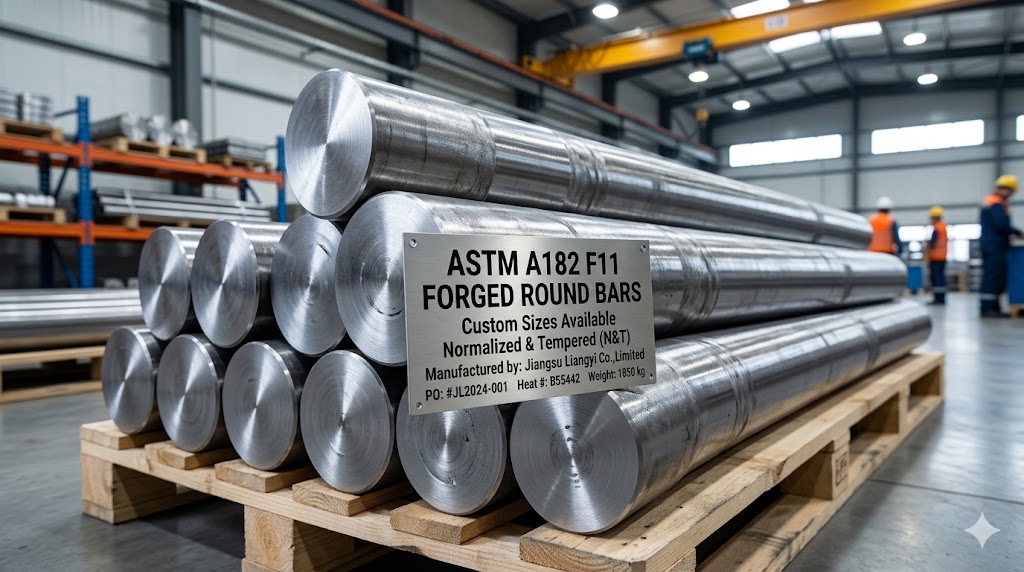
A182 F11 Forged Round Bars & Step Shafts
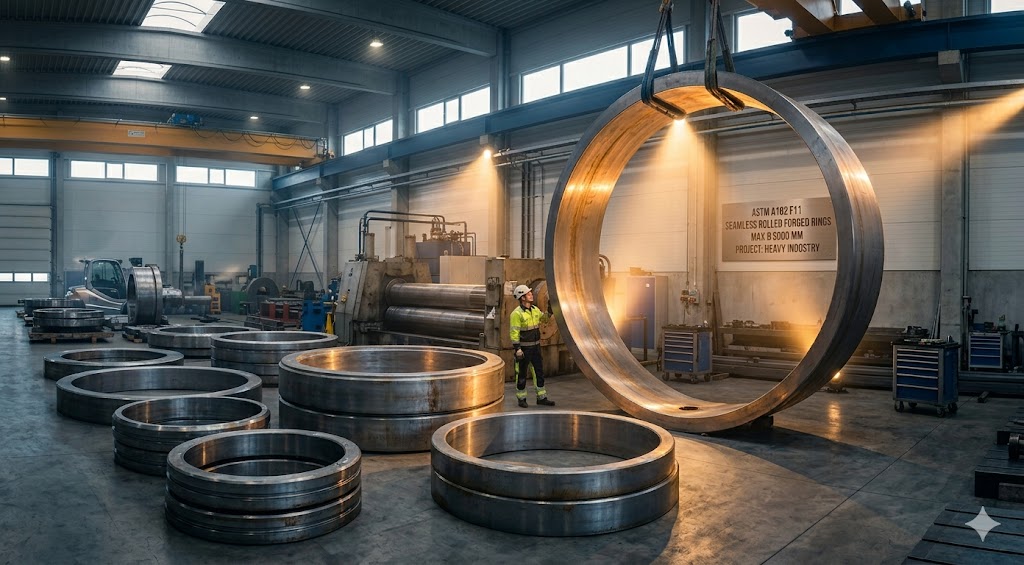
A182 F11 Seamless Rolled Rings (Ø up to 5m)
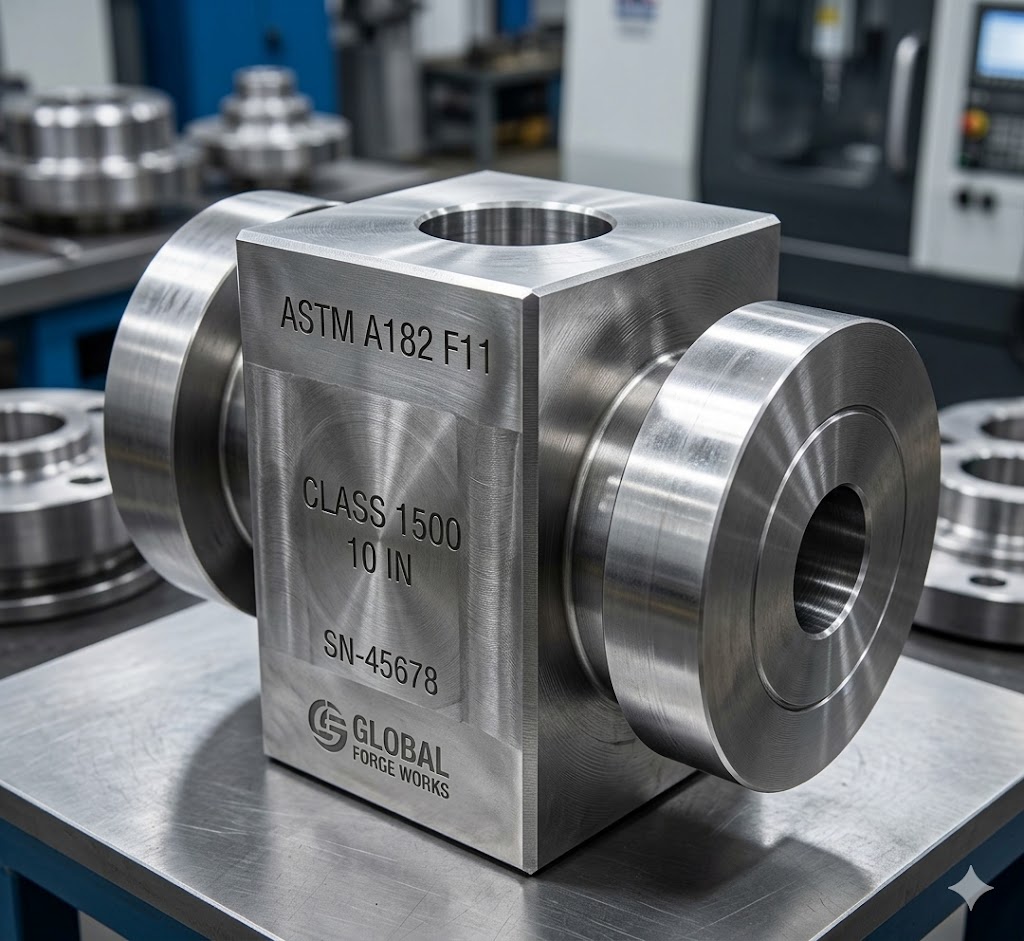
A182 F11 Forged Valve Bodies & Bonnets
What is ASTM A182 F11 Alloy Steel? — Metallurgy, Designation & Industrial Significance
ASTM A182 F11 is a low alloy steel containing 1.0–1.5% chromium and 0.44–0.65% molybdenum. It follows ASTM A182/A182M, a common standard for forged or rolled alloy steel and stainless steel pipe flanges, forged connectors, valves and related parts used in high-temperature working conditions. The mark F11 stands for the specific chemical makeup of Grade F11 in the A182 standard system. This system also includes other grades like F5, F9, F22, F91 and F92. Each grade has a different ratio of chromium and molybdenum, designed to fit steadily rising working temperature needs.
F11 is great for high-temperature industrial use because it has two connected material mechanisms. First, chromium levels of 1.0–1.5% make a strong, stable oxide film on the surface of the material, mostly Cr₂O₃. This layer slows down high-temperature oxidation and carbon penetration in fuel gas environments a lot, and it also protects against oxidation.Second, 0.44–0.65% molybdenum mixes into the basic ferrite structure. It strengthens the steel at high temperatures by locking grain boundaries and slowing atomic movement, so the material resists creep deformation better. Together, these two elements let F11 show much better creep fracture strength than regular carbon steel at 400°C to 550°C. For this reason, it is widely used as the standard material for steam boiler parts, pressure pipe connectors and valve bodies, where stable long-term performance under continuous load is required.
It is necessary to tell ASTM A182 F11 for forged parts apart from ASTM A335 P11 for seamless pressure pipes and ASTM A387 Grade 11 for pressure vessel plates. All three share the same basic 1.25Cr-0.5Mo alloy content, yet A182 F11 adds extra rules made only for forged products. These include required forging performance checks, controlled compression ratios to form fine grain structures, and mechanical tests taken from standard sample spots that truly reflect the inner performance of forged sections, instead of only surface or basic molten steel data. This key difference explains why choosing formal A182 F11, rather than general 1.25Cr-0.5Mo steel, plays a vital role in keeping pressure systems safe and fully meeting industry compliance rules.
Jiangsu Liangyi manufactures custom open die forgings and seamless rolled rings from verified A182 F11 heat-certified raw material. Our material traceability system links every finished forging back to its originating melt heat number, EAF/LRF refining records, billet rolling parameters, and all subsequent processing records — providing the full material genealogy that EPC contractors, ASME Code project engineers, and third-party inspectors require. We also supply a full range of alloy steel, stainless steel, and nickel alloy forging grades for parallel material requirements in your project.
Available Shapes & Forms of ASTM A182 F11 Forged Components
Jiangsu Liangyi's open die press forging and radial-axial ring rolling capabilities cover the full geometric range of ASTM A182 F11 forged parts specified in industrial procurement packages. All forms are produced with controlled forging reduction ratios (minimum 3:1 unless otherwise qualified), followed by mandatory normalized and tempered heat treatment, and are available in as-forged, rough-machined, or fully machined-to-drawing conditions:
Forged Round Bars, Square Bars & Step Shafts
ASTM A182 F11 forged round bars are our best-selling product type. We provide standard round bars with diameters from 50mm to 1,200mm and a maximum standard length of 12,000mm. We make step shafts, gear shafts, turbine rotor shafts, pump drive shafts and splined shafts based on customer drawings. The standard outer diameter tolerance for rough turning is ±3mm, and ±1mm tolerance can be offered upon request. Final finished machining meets IT8 grade or higher precision. All round bars are given ultrasonic testing under ASTM A388, and the inspection limits are set by customer requirements or ASME standards. We also sell forged flat bars and rectangular bars with cross sizes that range from 50 mm by 50 mm to 500 mm by 2,000 mm. These bar products are often used to make structures and weld overlay clad parts.
Seamless Rolled Rings (Forged Ring Blanks & Contoured Rings)
Our radial-axial ring rolling machines make ASME SA182 F11 seamless rolled rings. The outer diameter ranges from 300mm to 5,000mm, with wall thickness from 50mm to 1,200mm and ring height from 50mm to 2,000mm. We supply many ring styles, such as flat rings for different flange blanks, shaped rolled rings for special structural needs, turbine guide rings, bearing rings, large gear rings and custom near-net-shape rings. These custom rings cut down extra material removal during later machining work. Every ring gets full ultrasonic scanning along the circle and axial direction. We also run full hardness checks over the whole cross-section to ensure even heat treatment effect across the whole part.
Hollow Forgings, Forged Hubs & Pressure Vessel Shells
Forged hollow parts include valve pressure housings, pump barrel casings, compressor cylinders, pressure vessel shells, nozzles and blind flanged hubs. We make these items through hole piercing and mandrel forging on our hydraulic press line. This process creates seamless, fully forged hollow bodies with better mechanical performance than rolled and welded options. The inner bore diameter ranges from 80mm to 1,500mm, outer diameter reaches up to 2,800mm, and wall thickness falls between 30mm and 800mm. The standard inner bore tolerance after rough machining is ±2mm, and finished boring can reach ±0.5mm.
Forged Discs, Blocks, Tube Sheets & Plate Forgings
ASTM A182 F11 forged discs and blocks are made as thick cylinder sections. They feature balanced grain structure, which is key for tube sheets, pressure vessel end covers, orifice plates and heavy-load structural bases. Even material quality is essential for tube sheets, where dense hole drilling needs steady inner structure across the whole part. The disc products have a maximum diameter of 3,500mm, thickness up to 1,500mm, and single piece weight up to 30 metric tons. We can supply tube sheet forgings as raw forged blanks, or provide finished products with pre-drilled tube holes, outer diameter processing and surface cutting, fully made to customer heat exchanger drawings.
Forged Valve Bodies, Bonnets & Pressure Retaining Components
Block forgings and near-net-shape die impression forgings for gate valve bodies, globe valve bodies, check valve bodies, ball valve blocks, valve bonnets, yokes, and actuator flanges are a specialized product line at Jiangsu Liangyi. Our F11 valve forgings routinely meet API 600, API 602, API 6A, and BS 1414 end user specifications, with body bore and seat bore machining completed in-house. Pressure class coverage: 150# to 4500# (ASME B16.34), NPS 2" through NPS 48". All valve forgings are subject to hydrostatic shell test simulation (optional) and full PMI verification before shipment.
Forged Pipes, Barrels, Casings & Tubular Shapes
Long hollow tubular forgings — including drill collar forgings, downhole tool housings, barrel pump bodies, gun barrels, heat exchanger channel barrels, and reactor vessel shells — are produced by our mandrel forging process on 3,000T and 5,000T hydraulic presses. L/D ratios up to 10:1 achievable. ID from 80mm to 1,000mm, OD up to 2,000mm, length up to 8,000mm per section (longer assemblies available via controlled butt-welded joint). Thread machining (API connections, Acme thread, trapezoidal thread) available in-house.
Industry Applications & Global Project Cases of ASTM A182 F11 Forgings
The 1.25Cr-0.5Mo chemistry of ASTM A182 F11 occupies a precisely defined engineering niche: it delivers meaningfully superior high-temperature strength and oxidation resistance versus plain carbon steels (A105, A350 LF2) while remaining significantly more economical than higher-alloy grades like F22 (2.25Cr-1Mo) or F91 (9Cr-1Mo-V). This cost-performance position makes F11 the most widely specified Cr-Mo forging grade in global energy and process industry procurement. Below is our application engineering reference organized by industry sector, with documented project case data from Jiangsu Liangyi's global supply history:
Oil & Gas Industry — Upstream Wellhead, Midstream Pipeline, Downstream Refining
ASTM A182 F11 is NACE MR0175/ISO 15156 compliant for sour service (H₂S-containing) environments when heat-treated to ≤22 HRC (approximately ≤235 HBW) — a hardness level our production process routinely achieves and verifies by hardness mapping across full cross-sections, not merely surface spot checks. This NACE compliance qualification is what distinguishes F11 forgings for wellhead service from standard low-alloy forgings and is a non-negotiable requirement for upstream oilfield procurement in most operating company specifications.
- Wellhead Equipment: Christmas tree spool bodies, casing head flanges, tubing head flanges, mandrel hangers, HPHT adapter spools, fracturing head adapters (rated to 15,000–20,000 PSI working pressure)
- Blowout Prevention: BOP stack body forgings, ram block forgings, accumulator cylinder forgings, and choke manifold block bodies manufactured to API 16A requirements
- Downhole Tooling: Mud motor power section housings, drill head cases, ESP pump stage casings, centralizer body forgings, and MWD/LWD tool housings requiring impact resistance combined with NACE compliance
- Pipeline & Midstream: High-pressure swivel ring assemblies, pipeline pig launcher/receiver closures, header block manifold forgings, pipeline T-piece block bodies, and scraper trap body forgings
- Refinery & Downstream: Hydrocracker inlet/outlet head forgings, catalytic reformer reactor vessel nozzle forgings, high-temperature heat exchanger tubesheet forgings, and pressure relief valve body forgings for elevated temperature service
Power Generation — Thermal Power, Combined Cycle, Waste-to-Energy
In fossil fuel and combined-cycle power plants, F11 is commonly used for steam working conditions of 400°C to 550°C and 100–200 bar. This temperature and pressure range sits between the working limits of carbon steel and high-alloy steel grades. F11 offers stable creep rupture strength in this range, while costing much less in raw material and welding work compared with F22 or P91. For this reason, it is the best choice material for steam boiler pressure parts, main steam pipe connectors and feedwater heater tube sheet forgings in sub-critical and partial supercritical power station designs. ASME BPVC Section II Part D records the allowable stress values of SA182 F11 at high temperatures. Our steel materials consistently meet or go above these standard values, based on real test data from every single production heat batch.
- Superheater and reheater header end cap forgings and nozzle stub forgings in sub-critical boiler pressure parts service
- Main steam stop valve body forgings and turbine bypass valve body forgings for 16.7–25 MPa steam systems
- High-pressure feedwater heater channel head forgings, tubesheet forgings, and integral shell-and-channel flange forgings
- Gas turbine compressor case ring forgings, combustion transition piece flange rings, and exhaust diffuser vane carrier rings
- Waste-to-energy boiler drum nozzle block forgings and pressure vessel shell forgings for waste heat recovery systems
Nuclear Power — Auxiliary & Secondary System Forged Components
Jiangsu Liangyi provides ASME SA182 F11 forged parts for auxiliary systems and secondary circuit use in nuclear power plants. We follow strict quality rules set by buyers or equipment makers, who hold local certified nuclear quality management system qualifications. We produce all forgings to meet exact standards for chemical composition, mechanical performance, size accuracy and non-destructive testing. We also offer full traceable paperwork as required by the buyer’s quality plan and local industry rules. For all nuclear-related orders, third-party witness checks arranged by the customer’s appointed inspection group are completed as a regular standard step.
- Auxiliary cooling system pump casing forgings, bearing bracket ring forgings, and mechanical seal housing forgings
- Secondary circuit heat exchanger tubesheet forgings and channel head forgings
- Emergency feedwater system pipeline fitting forgings and pressure vessel nozzle forgings for secondary applications
- Containment cooling system heat exchanger shell forgings and flange ring forgings
Valve & Pump Manufacturing — OEM Long-Term Supply Programs
Jiangsu Liangyi keeps long-term approved supplier cooperation with many top global valve and pump manufacturers. We supply F11 forgings for the valve industry under bulk supply contracts, with fixed annual output, unified size rules and confirmed first-piece approval steps. This setup removes repeated qualification checks and speeds up every order delivery. We maintain tight tolerance control from forging to rough machining. Valve manufacturers can directly use our rough turned blanks for CNC processing, with no extra straightening or surface trimming work needed. This cuts extra production steps and lowers overall costs for large-scale valve production.
- Gate Valve Bodies & Bonnets: ASTM A182 F11 body forgings NPS 2"–NPS 48" in Class 150# through Class 4500#, machined to API 600 / ASME B16.34 body dimensional tolerances
- Globe & Check Valve Bodies: Straight pattern, angle pattern, and Y-pattern body forgings with integral flanged ends or butt-weld ends, including precision seat pocket bore machining
- Ball Valve Blocks: Solid block forgings for trunnion-mounted ball valve bodies in Class 900# to Class 4500# for HPHT service, machined to API 6D or ASME B16.34 pressure ratings
- Pump Casings & Impeller Hubs: High-pressure centrifugal pump casing forgings, radially split casing forgings, between-bearing pump barrel forgings, and impeller hub forgings with balance bore and keyway machining
- Cryogenic Extension Stems: A182 F11 forged extension stem forgings for cryogenic service valves (LNG, liquid nitrogen, liquid oxygen service — confirmed PWHT condition for low-temperature toughness)
Petrochemical Processing — Reactors, Heat Exchangers & High-Temperature Piping
In petrochemical and chemical processing plants, ASTM A182 F11 forgings meet two main technical needs: good resistance to hydrogen embrittlement and strong protection against high-temperature sulfide corrosion. This steel also meets the Nelson Curve requirements of API 941 for working environments with hydrogen partial pressure. The chromium content in F11 keeps the material within the safe range of the API 941 Nelson Curve for 1.25Cr alloys at working temperatures up to nearly 510°C under hydrogen pressure. For this reason, many refinery design standards select F11 as the standard material for hydroprocessing reactor inlet nozzle parts, heat exchanger shell forgings and high-temperature pump casing parts.
- Hydrocracker reactor inlet/outlet nozzle forgings and manway cover forgings for H₂ partial pressure service to API 941
- Catalytic reformer reactor shell ring forgings and channel head forgings for 350–510°C service
- High-temperature heat exchanger tubesheet forgings and shell forgings for process fluid service with PWHT
- Sulfur recovery unit (SRU) and tail gas treating unit (TGTU) high-temperature valve body forgings
- Ethylene cracking furnace transfer line flange ring forgings and high-temperature fitting forgings
ASTM A182 F11 vs F22 vs F91 vs F5 — How to Choose the Right Cr-Mo Forging Grade
One of the most frequent technical questions our engineering and procurement customers ask is: "Should I specify F11 or F22 (or F91) for my application?" The answer is not about brand preference — it is a temperature-and-stress engineering decision. The table below summarizes the key differentiating characteristics of the four principal Cr-Mo forging grades within the ASTM A182 specification to support your material selection:
| Property / Criterion | F5 (5Cr-0.5Mo) | F11 (1.25Cr-0.5Mo) | F22 (2.25Cr-1Mo) | F91 (9Cr-1Mo-V) |
|---|---|---|---|---|
| Cr Content (%) | 4.0 – 6.0 | 1.0 – 1.5 | 2.0 – 2.5 | 8.0 – 9.5 |
| Mo Content (%) | 0.44 – 0.65 | 0.44 – 0.65 | 0.87 – 1.13 | 0.85 – 1.05 |
| Max Service Temp (continuous) | ~650°C | ~550°C | ~600°C | ~650°C |
| Tensile Strength (Min ASTM) | 415 MPa | 415 MPa | 415 MPa | 585 MPa |
| 100,000hr Creep Rupture Strength at 550°C | ~90 MPa | ~65 MPa | ~105 MPa | ~180 MPa |
| NACE MR0175 Sour Service Compliance | Yes (≤22 HRC) | Yes (≤22 HRC) | Yes (≤22 HRC) | Restricted — consult NACE |
| API 941 Nelson Curve Position | 5Cr curve — very favorable | 1.25Cr curve — good to ~510°C | 2.25Cr curve — good to ~540°C | 9Cr curve — excellent |
| Weldability (preheat required) | Moderate (200–300°C) | Good (150–200°C) | Moderate (200–250°C) | Complex (250–300°C + PWHT) |
| Relative Material Cost (F11 = 1.0×) | 1.4 – 1.8× | 1.0× (baseline) | 1.3 – 1.6× | 2.8 – 3.5× |
| Typical Application Range | High-sulfur refinery, high-temp corrosion | Boiler fittings, valves, wellheads <550°C | Hydroprocessing, steam piping <600°C | Ultra-supercritical boilers, steam turbines |
Our material selection recommendation: Choose ASTM A182 F11 for working temperatures between 400°C and 550°C, when NACE sour service standards must be met, and when cost control is prioritized while keeping reasonable long-term creep performance. If your design temperature goes above 550°C, or your hydrogen partial pressure working conditions need a higher safety rating under the API 941 Nelson Curve, we suggest upgrading to F22 grade steel. Please tell our technical team your exact operating parameters, and we will send you an official letter suggesting the best materials for your project.
Our ASTM A182 F11 Forging Process — From Raw Steel to Certified Finished Part
Understanding our production process helps procurement engineers and quality managers assess how Jiangsu Liangyi's manufacturing controls translate into consistent ASTM A182 F11 forging quality. Following are the detailed summaries of our standard six-stage production workflow for F11 forged parts:
Stage 1 — Raw Material Procurement & Incoming Verification
We only buy F11 steel billets and ingots from qualified Chinese mill partners who send us mill-certifiable EAF + LRF + VD (vacuum degassing) refined steel with full heat chemistry reports. When we get a heat lot, we do the following: (1) check the elements against the heat certificate using a portable XRF (PMI), (2) do an independent spectrometer combustion analysis for C, S, and P re-verification, and (3) check the billets with ultrasound according to ASTM A388 acceptance criteria before any forging work starts.No billet with a chemistry deviation exceeding ±10% from heat certificate values or any UT-rejectable indication proceeds to the press floor. This upstream material gatekeeping is the foundation of our traceability system.
Stage 2 — Heating & Press Forging
In gas-fired regenerative furnaces with calibrated thermocouple monitoring (±5°C accuracy), F11 billets are evenly heated to the austenizing forging temperature range of 1,100°C–1,250°C. Forging is done on hydraulic presses that can handle 800T to 5,000T of weight. The minimum forging reduction ratio is 3:1, which is needed to get the right grain refinement and hot-worked fiber flow alignment.Our press operators follow F11-specific forging procedure specifications (FPS) that define working temperature windows, maximum pass reductions, and mandatory reheat schedules — preventing the decarburization and coarse grain formation that result from over-soaking or forging below the Ar₃ transformation temperature.
Stage 3 — Ring Rolling (for Ring Products)
Preformed ring blanks from the press forging step are transferred to our radial-axial ring rolling mills for ring expansion. Rolling temperature is kept above 950°C to guarantee complete recrystallization of the austenite during ring growth. Rolling speed and feed rates are controlled to get circularity within 0.5% of nominal OD as-rolled. Contoured and profiled rings are rolled on specially configured multi-pass tooling schedules developed from our proprietary F11 ring rolling database, which documents over 150 distinct ring profiles produced to date.
Stage 4 — Normalized & Tempered Heat Treatment
ASTM A182 F11 needs normalizing and tempering heat treatment to get the specified mechanical properties. Our heat treatment procedure for F11 follows a precisely controlled cycle: normalize at 900°C–950°C (soak time calculated per EN ISO 17663 as function of section thickness), air cool to ambient, then temper at 650°C–700°C (minimum 1 hour per 25mm of cross-sectional thickness). All furnaces have been calibrated per ASTM E220 requirements, with a minimum of 3 calibrated thermocouples per furnace zone and chart-recorded time-temperature histories retained for every load. For NACE MR0175 sour service compliance orders, we additionally verify that the tempering temperature achieves a core hardness ≤22 HRC (≤237 HBW) by destructive coupon testing from companion test pieces in each furnace load.
Stage 5 — Machining & Dimensional Verification
Rough machining to customer drawing dimensions is performed on our fleet of CNC turning centers (Ø up to 3,000mm, length up to 12,000mm), CNC boring mills, and CNC machining centers. Dimension test is performed using calibrated measurement instruments traceable to national standards: CMM (Coordinate Measuring Machine) for 3D feature verification, calibrated digital micrometers and bore gauges for critical fits, surface roughness tester for Ra verification, and ultrasonic thickness gauging for hollow sections. All inspection records are digitally logged and linked to the forging heat number for traceability.
Stage 6 — Final NDT Inspection, Certification & Packing
Final acceptance NDT is performed per the applicable specification requirement or customer specification — typically ASTM A388 (UT), ASTM E709 / ASME Section V (MT), or ASTM E165 (PT) — by our in-house NDT inspectors qualified to ASNT SNT-TC-1A Level II / Level III requirements. Acceptance criteria are documented and agreed with the customer before production begins, with any additional acceptance criteria (ASME Section VIII Div.1, API 6A PSL-3, or customer-specific UT acceptance levels) documented in the quality plan. Following final inspection acceptance, the Mill Test Certificate (MTC) is compiled including all specified data fields, digitally signed by our QA manager, and issued with the physical shipment. Packing uses steel frame cradles, VCI anti-corrosion paper, wooden crates, and ISPM 15-compliant fumigation for export.
Material Standards & Compliance — What Each Standard Means for Your Project
Specifying "ASTM A182 F11" in a purchase order is a technical instruction, not a general material description. Each standard listed below has distinct scope, requirements, and implications for your pressure system design, third-party inspection, and import documentation. Our quality system is built around producing evidence of compliance with each applicable standard — not merely claiming compliance:
- ASTM A182/A182M (Primary Product Standard): Governs chemistry, heat treatment condition, mechanical property requirements (tensile, yield, elongation, reduction of area, hardness), test specimen location and orientation rules, and retesting requirements for ASTM A182 F11 forged parts. All our F11 forgings are tested per A182 coupon location rules — test specimens are taken from the forging body, not from excess material or test bars that may not represent the actual forging section properties.
- ASME SA182 (ASME Boiler & Pressure Vessel Code Equivalent): The ASME Section II Part A version of A182, with identical technical requirements but issued under ASME authority. Required for ASME Code-stamped pressure systems in North America (ASME Section I, VIII, III, B31.1, B31.3). Our SA182 F11 forgings are produced identically to ASTM A182 F11 but are certified with ASME SA material designation on the MTC — a distinction that matters for Authorized Inspector acceptance during ASME Code pressure vessel or piping construction.
- NACE MR0175 / ISO 15156 (Sour Service Compliance): This standard governs materials for oil and gas production environments containing H₂S. For ASTM A182 F11 forgings to comply with NACE MR0175, the heat treatment must get a maximum hardness of 22 HRC (approximately 237 HBW) throughout the cross-section — not just on the surface. Our NACE compliance protocol includes: mandatory tempering temperature verification (≥650°C), companion test piece hardness testing at core locations, and hardness mapping across the full cross-section of representative forgings per heat lot. Surface readings alone are not accepted as NACE compliance evidence at Jiangsu Liangyi.
- EN 10222-2 (European Pressure Vessel Forgings Standard): The European equivalent specification for steel forgings for pressure vessels. Grade P11QH1 in EN 10222-2 corresponds closely to ASTM A182 F11. European purchasers who specify EN 10222-2 instead of ASTM A182 will find our technical offer covers both, with the MTC formatted to EN 10204 3.1 or 3.2 as required for EU Pressure Equipment Directive (PED 2014/68/EU) compliance documentation.
- API 6A (Wellhead & Christmas Tree Equipment): For upstream oilfield wellhead parts, API 6A defines additional material qualification requirements including Charpy V-notch impact testing at specified temperatures (typically 0°F / -18°C or lower), hardness uniformity across the cross-section (not just surface), and full cross-section macro examination. Our F11 forgings for API 6A service are produced with API 6A Material Class EE (all wetted parts NACE-compliant) or FF specifications available, and can be coordinated with the buyer's API 6A Monogram-licensed facility's documentation requirements upon request.
- ASTM A370 (Mechanical Testing): All mechanical property testing on our F11 forgings — tensile, yield, elongation, Charpy impact — is performed per ASTM A370 testing procedures by our in-house testing lab or a qualified third-party testing laboratory. Test reports include specimen dimensions, test machine calibration reference, and actual numerical results (not pass/fail only).
- Custom Standards — DIN, JIS, BS, DNV-GL, Lloyd's: We have made F11 forgings to meet the requirements of specific projects, such as DIN 17175 (German), JIS G4107 (Japanese alloy steel bolting), BS 1503 (British pressure vessel forgings), and DNV-GL / Lloyd's Register witness inspection projects. Please send your project specifications along with your request to confirm that compliance coverage applies.
Chemical Composition of ASTM A182 F11 — Element Functions & Our Tighter Production Control
The chemical composition of ASTM A182 F11 is engineered by element, not by formula. Each alloying element serves a specific metallurgical function, and understanding these functions explains why F11 behaves as it does at elevated temperatures. The table below shows the ASTM A182 standard permitted ranges alongside Jiangsu Liangyi's internal aim chemistry — which is tighter than the ASTM limits to reduce heat-to-heat property scatter and provide a documented margin against non-conformance at the extremes of the permitted range:
| Element | ASTM A182 F11 Standard Range | Our Production Aim Range | Metallurgical Function in F11 |
|---|---|---|---|
| Carbon (C) | 0.05 – 0.15% | 0.08 – 0.12% | Primary strengthening element. Low carbon (<0.15%) balances strength with weldability and toughness. Carbon above 0.15% risks excessive carbide precipitation at grain boundaries, reducing impact toughness at lower temperatures. |
| Manganese (Mn) | 0.30 – 0.60% | 0.40 – 0.55% | Deoxidizer during steelmaking; improves hardenability; combines with sulfur to form MnS inclusions (preventing iron sulfide hot-shortness). Controlled below 0.60% in F11 to avoid excessive bainite formation that would compromise low-temperature toughness. |
| Silicon (Si) | 0.50 – 1.00% | 0.60 – 0.80% | Deoxidizer in steelmaking (prevents gas porosity); improves oxidation resistance at elevated temperature by contributing to the protective surface oxide film. F11's relatively high Si range (vs. carbon steel) is intentional for oxidation resistance at 400–550°C service. |
| Sulfur (S) | 0.030% Max | ≤ 0.010% | Harmful tramp element. Even within ASTM limits, elevated sulfur forms elongated MnS inclusions during rolling/forging that reduce transverse ductility and toughness (anisotropy). Our tighter ≤0.010% control minimizes inclusion elongation and significantly improves through-thickness CVN impact values — critical for thick section forgings. |
| Phosphorus (P) | 0.030% Max | ≤ 0.015% | Harmful tramp element. Phosphorus segregates to austenite grain boundaries during solidification and temper embrittles the steel during heat treatment in the 370–560°C range — a failure mode known as "temper embrittlement" that is especially dangerous for thick-wall forgings in hydrogen service. Our ≤0.015% target provides meaningful margin against this failure mode versus the 0.030% ASTM limit. |
| Chromium (Cr) | 1.00 – 1.50% | 1.10 – 1.35% | Primary oxidation resistance element (forms Cr₂O₃ surface oxide film); improves hardenability for consistent through-thickness heat treatment response in large forgings; essential for hydrogen service Nelson Curve compliance (API 941). Our aim avoids the lower 1.00% limit to maintain consistent oxidation resistance and Nelson Curve position across all production heats. |
| Molybdenum (Mo) | 0.44 – 0.65% | 0.50 – 0.60% | The primary creep strength element in F11. Mo dissolves in ferrite and forms fine Mo₂C carbides that pin grain boundaries and resist dislocation climb — the atomic mechanism of creep deformation — at temperatures up to 550°C. Mo also suppresses temper embrittlement in combination with controlled P and Sb content. Our aim avoids the lower 0.44% limit, where creep strength degrades measurably in long-term service at the upper temperature range. |
Harmful residual element control: Beyond the elements listed in ASTM A182, Jiangsu Liangyi additionally monitors and controls residual elements that are not required by the standard but affect long-term service reliability: Antimony (Sb ≤ 0.010%), Tin (Sn ≤ 0.015%), and Arsenic (As ≤ 0.020%). These elements contribute to reversible temper embrittlement in Cr-Mo steels and are controlled in our production heats for applications where Step Cooling treatment (per ASTM A541 Supplement S20) or equivalent embrittlement assessment is specified by the purchaser's engineers.
Mechanical Properties of ASTM A182 F11 — Room Temperature & Elevated Temperature Data
All Jiangsu Liangyi ASTM A182 F11 forged parts are supplied in the normalized and tempered (N+T) condition as required by the standard. Our heat treatment protocol is designed to get mechanical properties not merely at the ASTM minimum threshold, but with a consistent production margin that protects against test failures from minor heat treatment variability. Below we present the ASTM A182 F11 minimum requirements alongside our typical production values from internal statistical process control data, followed by ASME-published elevated temperature allowable stress data that is relevant for pressure system design calculations:
Room Temperature Mechanical Properties (per ASTM A182/A370 Test Procedure)
| Mechanical Property | ASTM A182 F11 Minimum Requirement | Our Typical Production Value | Engineering Significance |
|---|---|---|---|
| Tensile Strength (UTS) | 415 MPa (60 ksi) | 485 – 560 MPa | Ultimate load-bearing capacity. Our values are 17–35% above ASTM minimum, providing conservative design margin for pressure system code calculations. |
| Yield Strength (0.2% Proof) | 205 MPa (30 ksi) | 280 – 360 MPa | The design basis stress for most ASME Code allowable calculations. Higher yield reduces needed wall thickness in pressure vessel and piping design, enabling weight and cost optimization. |
| Elongation (GL = 4D or 50mm) | 20% min | 25 – 32% | Ductility indicator. Higher elongation reduces risk of brittle fracture during overload events and improves fatigue life under cyclic thermal stress — important for boiler fittings and valve bodies subject to startup/shutdown cycling. |
| Reduction of Area (RA) | 45% min | 55 – 65% | Through-thickness ductility. High RA values indicate a cleaner, more isotropic microstructure with lower inclusion content — a direct reflection of our tight S and P control during steelmaking. |
| Hardness (Brinell HBW) | ≤ 207 HBW (as-specified) or ≤ 237 HBW (NACE) | 155 – 185 HBW | Our production hardness is well below both limits, providing substantial margin for NACE MR0175 compliance and indicating consistent through-section tempering. We routinely verify hardness at multiple cross-section locations — not just the surface. |
| Charpy V-Notch Impact (–29°C / 0°F) | Not required by ASTM A182 (available on request) | ≥ 27 J (20 ft-lbs) — typical production | Available on request for API 6A service, offshore/arctic applications, or low-temperature rated valve service. Our N+T condition F11 routinely achieves ≥40 J at –29°C based on our internal heat qualification database. |
Elevated Temperature Allowable Stress — ASME Section II Part D Reference Data
For pressure system design engineers, the following table shows ASME BPVC Section II Part D published allowable stresses (S values) for SA182 F11 forgings at elevated temperature service conditions. These values are used directly in ASME Section I, Section VIII Div.1, and B31.1 pipe stress calculations. Our F11 material consistently meets or exceeds the tensile and yield strength basis values from which these allowables are derived:
| Service Temperature | ASME Allowable Stress S (MPa) | ASME Allowable Stress S (ksi) | Application Note |
|---|---|---|---|
| 20°C (ambient) | 138 MPa | 20.0 ksi | Baseline ambient design stress |
| 200°C (392°F) | 124 MPa | 18.0 ksi | Feedwater heater, low-pressure steam service |
| 300°C (572°F) | 117 MPa | 17.0 ksi | Typical steam piping and boiler fitting service |
| 400°C (752°F) | 110 MPa | 16.0 ksi | High-pressure boiler header forgings |
| 500°C (932°F) | 93 MPa | 13.5 ksi | Upper range for continuous F11 service; creep-governed |
| 550°C (1022°F) | 62 MPa | 9.0 ksi | Near service limit for F11; consider F22 upgrade above this temperature |
Note: The representative allowable stress values shown above are derived from ASME BPVC Section II Part D Table 1A for reference and educational purposes. ASME standards are copyrighted publications of the American Society of Mechanical Engineers. Designers should always reference the edition of the ASME Code specified for their project, as values may be revised between editions. Jiangsu Liangyi's technical team can provide material property documentation correlated to the ASME Code edition required by your project.
Full-Process Quality Control System for ASTM A182 F11 Forged Parts
Jiangsu Liangyi's quality system for ASTM A182 F11 forgings is built on the principle that quality is manufactured into the product, not inspected in at the end. Our ISO 9001:2015 certified quality management system — covering planning, process control, inspection, calibration, and documentation — is applied from raw material selection through final packing and shipment. The following describes our quality control architecture in the sequence in which a forging batch progresses through our facility:
Stage 1 — Incoming Material Control & Chemistry Verification
Before any F11 raw steel billet goes into forging production, it must be given strict incoming inspection. We use portable XRF spectrometers for PMI testing to check chemical composition and match data with factory test reports. Independent combustion testing is also carried out to recheck carbon and sulfur content. Our staff visually inspect billet surfaces to find folding defects, seams and surface cracks. Full ultrasonic testing follows ASTM A388 standards to detect inner shrinkage, uneven material matrix and non-metallic inclusions. Any billet with unqualified chemical makeup, ultrasonic defects or poor surface quality will be isolated and sent back to raw material suppliers. These unqualified materials will never be put into production, and all non-conforming goods are fully recorded and separated.
Stage 2 — In-Process Forging Controls
During press forging operations, our forging procedure specifications (FPS) define the permissible forging temperature window (typically 1,100°C–1,250°C start, minimum 900°C finish for F11), the minimum forging reduction ratio per pass, and the mandatory pre-heat and reheat schedules. Furnace temperatures are recorded continuously by calibrated Type K thermocouples (calibrated per ASTM E220 annually), and the chart records are linked to each heat lot in our quality records system. Press load and stroke are monitored per forging cycle. Die condition is inspected before each production run to prevent under-fill or fold defects from worn tooling.
Stage 3 — Post-Forge Dimensional & Visual Inspection
After forging and before heat treatment, each piece is individually dimensionally inspected against the process drawing using calibrated measurement tools. Critical dimensions — OD, ID (for hollow forgings), length, and perpendicularity — are recorded on the in-process inspection card linked to the heat number. Visual inspection per ASTM A182 surface quality requirements identifies and evaluates surface discontinuities. Acceptable minor surface seams or laps are removed by grinding with subsequent smooth blending; any discontinuities deeper than the drawing dimensional tolerance are cause for dimensional non-conformance review.
Stage 4 — Heat Treatment Verification & Mechanical Testing
Every furnace load of ASTM A182 F11 forgings is accompanied by a companion test coupon of equivalent cross-sectional thickness, heat-treated in the same furnace charge. Following heat treatment, the time-temperature chart is reviewed and signed off by our QA Manager before test coupons are released for destructive mechanical testing. Mechanical testing per ASTM A370 includes: tensile test (UTS, 0.2% YS, elongation, RA), Brinell hardness test at multiple locations, and Charpy V-notch impact test (when specified). Test results are entered into our digital quality records system, where automatic conformance checking flags any result outside the specification limits before MTC preparation begins.
Stage 5 — Final NDT Inspection (Non-Destructive Testing)
Final NDT is performed after machining by our NDT inspectors qualified to ASNT SNT-TC-1A Level II and Level III requirements using the following methods, applied as required by specification or customer purchase order:
- Ultrasonic Testing (UT) per ASTM A388: Straight beam UT for internal discontinuity detection (pipe, segregation, inclusions, cracks) using calibrated reference blocks per ASTM E428. Scanning coverage: 100% of the forging cross-section for premium specifications (PSL-3/4 or equivalent); selective grid scanning for standard specifications. Acceptance criteria per ASME Sec. V Article 5 or customer specification.
- Magnetic Particle Testing (MT) per ASTM E709 / ASME Sec. V Art. 7: Yoke or coil magnetization method for detection of surface and near-surface linear indications. Applied to all forgings where surface crack detection is part of the specified acceptance criteria. Continuous wet visible or fluorescent particle method available.
- Liquid Penetrant Testing (PT) per ASTM E165 / ASME Sec. V Art. 6: Solvent-removable or water-washable penetrant for surface-open discontinuity detection on finished machined surfaces. Applied where MT is not suitable due to geometry (non-ferromagnetic regions after machining are not applicable, but PT is used for weld-end preparation faces and complex geometry features).
- Hardness Testing per ASTM E10 (Brinell) / ASTM E18 (Rockwell): Final hardness check on the actual forging surface — not only on a companion coupon. For NACE MR0175 orders, hardness is verified at minimum 3 locations on each piece; for thick-section forgings, ID bore and OD surface hardness are both verified to confirm through-section tempering uniformity.
- Dimensional Final Inspection: Final dimension test against the customer drawing using calibrated CMM (Ø up to 3,000mm) or hand instruments traceable to national standards. First Article Inspection (FAI) report with 100% dimension reporting is available for new part introductions or vendor qualification programs.
Inspection Standards Applied at Jiangsu Liangyi
- ASTM A370 — Mechanical Testing of Steel Products
- ASTM E10 / ASTM E18 — Brinell and Rockwell Hardness Testing
- ASTM E140 — Hardness Conversion Tables (Brinell ↔ Rockwell ↔ Vickers)
- ASTM A388/A388M — Ultrasonic Examination of Heavy Steel Forgings
- ASTM E709 / ASME Section V Article 7 — Magnetic Particle Testing
- ASTM E165 / ASME Section V Article 6 — Liquid Penetrant Testing
- ASTM E428 — Fabrication and Control of Ultrasonic Reference Blocks
- ISO 148-1 — Charpy Pendulum Impact Test for Metallic Materials
- ASTM E220 — Calibration of Thermocouples by Comparison Techniques
- EN 10204 — Metallic Products — Types of Inspection Documents (3.1 standard, 3.2 third-party)
Complete Documentation Package Delivered With Every F11 Forging Order
Every completed ASTM A182 F11 forging order from Jiangsu Liangyi is shipped with a complete documentation package specifically assembled for the customer's project requirements. The package includes:
- EN 10204 3.1 Mill Test Certificate (MTC): Includes forging heat number, raw material heat number linkage, chemical composition (heat analysis + product check analysis), all mechanical test results with specimen location diagram, heat treatment record summary (temperature, duration, cooling method), NDT results summary, hardness results, and dimensional conformance statement — signed by our QA Manager.
- EN 10204 3.2 Third-Party Inspection Certificate (on request): Inspection witnessed and co-signed by an authorized representative of BV (Bureau Veritas), SGS, TÜV, Intertek, or other accredited third-party body specified by the purchaser. Third-party inspector can also attend and witness our heat treatment loading, mechanical testing, or NDT operations.
- Heat Treatment Record: Full time-temperature furnace chart for each heat treatment batch, showing measured thermocouple readings (not just setpoints), furnace zone uniformity, and load configuration — retained for a minimum of 10 years in our quality records archive.
- NDT Reports: Individual UT, MT, and/or PT report with inspector name, certification level, instrument calibration reference, scanning coverage map, and recorded indication summary (or clean indication statement).
- Dimensional Inspection Report: All specified dimensions recorded against drawing nominal and tolerance, with measurement method and instrument calibration reference for each feature.
- Full Material Traceability Chain: Document linking finished forging piece marking → forging heat lot → raw material heat certificate → billet incoming inspection record → heat treatment furnace load record → all test and inspection records. This genealogy document is provided as standard for ASME Main projects and is available for all orders on request.
Frequently Asked Questions (FAQ) — ASTM A182 F11 Forgings: Technical & Procurement
ASTM A182 F11 is a 1.25% chromium / 0.5% molybdenum (1.25Cr-0.5Mo) low alloy steel, specified under ASTM A182 for forged parts in high-temperature pressure service (valves, flanges, fittings, and pressure vessel components). It belongs to the Cr-Mo steel family where increasing Cr and Mo content provides progressively higher temperature capability: F5 (5Cr-0.5Mo), F11 (1.25Cr-0.5Mo), F22 (2.25Cr-1Mo), F91 (9Cr-1Mo-V). F11 occupies the lowest-alloy, most economical position in this family and is chosen when operating temperatures are in the 400°C–550°C range, NACE sour service compliance (≤22 HRC) is required, and weldability without complex pre/post-heat treatment procedures. Unlike F22 or F91, F11 can often be welded with standard Cr-Mo consumables and conventional PWHT procedures without requiring specialized qualified welding procedures, reducing site construction costs significantly.
In oil and gas, F11 is the dominant material for NACE MR0175-compliant wellhead equipment (Christmas tree spools, BOP bodies, frac pump fluid ends), high-pressure valve bodies (gate valves, globe valves, ball valves in Class 600# to 4500#), and pipeline fittings for sour gas service. In power generation, F11 is used for sub-critical and some supercritical boiler pressure part forgings (header nozzles, valve bodies, flange rings), steam turbine casing ring forgings, and high-pressure feedwater heater tubesheet and channel head forgings. In petrochemical processing, F11 appears in hydrocracker inlet/outlet nozzle forgings, catalytic reformer reactor pressure part forgings, and heat exchanger shell and tubesheet forgings for service below the API 941 Nelson Curve limit for 1.25Cr alloy. The common thread: applications needing elevated-temperature strength and oxidation resistance that carbon steel cannot provide, but where the cost premium of higher-alloy grades (F22, F91) is not justified by the temperature-stress conditions.
These three designations refer to the same nominal 1.25Cr-0.5Mo alloy chemistry but different product forms and standard bodies: ASTM A182 F11 and ASME SA182 F11 are both forged parts specifications — SA182 is simply the ASME Boiler & Pressure Vessel Code adoption of ASTM A182, with identical technical requirements but ASME designation needed for ASME Code-stamped pressure systems in North America. ASTM A335 P11 is a seamless alloy steel pipe specification covering the same 1.25Cr-0.5Mo chemistry in tubular (pipe) form. The product forms are fundamentally different: A182 F11 governs forged blanks, blocks, valve bodies, and rings; A335 P11 governs seamless pipes. Never substitute one for the other in a pressure system design — the inspection, test, and dimensional requirements are entirely different, and the substitution would be a Code violation. When procuring forgings for ASME Code projects, specify ASME SA182 Grade F11 explicitly on the purchase order for unambiguous Code documentation compliance.
Our standard ASTM A182 F11 forgings comply with: ASTM A182/A182M, ASME SA182 (ASME BPVC Section II Part A), NACE MR0175/ISO 15156 (sour service hardness ≤22 HRC), and EN 10204 3.1/3.2 inspection documentation. We additionally comply with API 6A Material Class EE, API 6D, ASME B16.34, EN 10222-2 (P11QH1), and BS 1503 upon request. For project-specific supplementary requirements — company specifications from Shell, ExxonMobil, Saudi Aramco, BP, Equinor, or other operating companies, or EPC contractor specifications from Bechtel, Technip, Samsung E&A, or others — please include your project specification document with your inquiry. In most cases, our standard production procedure already satisfies supplementary requirements related to chemistry tightening, additional testing (Charpy impact, macro examination, magnetic particle per batch), or document formatting. Where additional qualification or procedure documentation is required, we can provide this as part of the project kick-off process.
ASTM A182 F11 needs delivery in the normalized and tempered (N+T) heat treatment condition. This means two sequential furnace operations: (1) Normalizing — heating to approximately 900°C–950°C (above the upper critical transformation temperature Ac₃) to fully austenitize the steel, then cooling in still air to ambient temperature. This refines and homogenizes the grain structure, deleting any banding or hot-working texture from the forging operation. (2) Tempering — reheating to approximately 650°C–700°C (below the Ac₁ transformation temperature) for a minimum soak period (calculated per section thickness), then cooling in still air. Tempering converts the martensite or bainite formed during normalizing cooling into tempered sorbite, dramatically improving toughness and ductility while reducing hardness to the needed ASTM/NACE range. The resulting microstructure — fine, uniformly distributed carbides (predominantly Cr-Mo carbides) in a tempered martensite/bainite matrix — is what provides F11's characteristic combination of elevated-temperature strength, reasonable toughness, and NACE sour service hardness compliance. At Jiangsu Liangyi, we never skip the tempering step to save cycle time, and we never accept a forging if the heat treatment chart shows a furnace excursion that places any zone of the load below the minimum tempering temperature for the needed soak duration.
Yes. EN 10204 3.1 Mill Test Certificate (MTC) is our standard documentation for every ASTM A182 F11 forging order, provided at no additional charge. The 3.1 MTC is issued by Jiangsu Liangyi's own authorized Quality Assurance department, signed by our QA Manager, and includes: full heat chemical composition (heat analysis and product check analysis), all mechanical test results (UTS, YS, elongation, RA, hardness) with specimen location description, heat treatment record summary (temperature, duration, cooling method, furnace calibration reference), NDT results summary, dimensional conformance statement, and ASTM A182 F11 compliance statement. EN 10204 3.2 third-party inspection (TPI) certificates are available upon request, with additional TPI charges applicable. Recognized third-party inspection bodies we work with include Bureau Veritas (BV), SGS, TÜV Rheinland, Intertek, Lloyds Register, DNV GL, and Bureau Veritas Marine & Offshore. The TPI inspector can attend and witness mechanical testing, heat treatment loading, and NDT operations at our facility during scheduled production — please advise your TPI preference and scope of witness activities at the time of purchase order placement so we can schedule accordingly.
For raw as-forged parts (normalized + tempered, rough-turned), the lead time is 15–25 working days; For fully machined and inspected finished parts, the lead time is 25–35 working days. These lead times begin from the date of purchase order confirmation and receipt of approved drawings, and include our full heat treatment cycle, mechanical testing, NDT, and documentation preparation time. Lead time varies with section thickness (thicker sections require longer heat treatment soak times), forging weight (heavier pieces require longer press cycling), and our production queue at the time of order placement. We can also expedite production for urgent orders, reducing lead time by 20–40% — please discuss your required delivery date in your inquiry. We do not over-promise lead times: our purchase orders include a contractual delivery date commitment, and we proactively communicate any schedule risk no later than 5 working days before it becomes a delivery date risk.
Our current ASTM A182 F11 forging size capabilities are: Open die forged bars and blocks: Unit weight from 30 kg to 30,000 kg (30 metric tons); forged bar/shaft length up to 12,000 mm; forged block dimensions up to 3,500 mm × 2,000 mm × 1,500 mm. Seamless rolled rings: Outer diameter from 300 mm to 5,000 mm; wall thickness (OD-ID/2) from 50 mm to 1,200 mm; ring height from 50 mm to 2,000 mm. Hollow forged parts (mandrel-forged): OD up to 2,000 mm, ID from 80 mm to 1,000 mm, length up to 8,000 mm. Forged discs and tubesheet blanks: Diameter up to 3,500 mm, thickness up to 1,500 mm. For dimensions outside these ranges, please contact our technical team — we assess feasibility on a case-by-case basis and can sub-contract to partnered facilities under our quality supervision for specific oversized requirements. For forgings above 10,000 kg, please allow additional technical review time for feasibility confirmation before commercial quotation.
We have no minimum order quantity (MOQ) restriction for ASTM A182 F11 forgings in terms of piece count — we accept single-piece orders for engineering prototypes, spare parts, and R&D qualification samples. However, orders of a single piece or very small quantities involve economic considerations: the fixed costs of heat treatment batch setup, mechanical testing (destructive coupon testing consumes material), NDT setup, and documentation preparation are spread over fewer pieces, which raises the per-piece cost versus a production batch of 10–50 pieces of the same part. For small quantities (1–5 pieces), we recommend discussing your total annual volume requirement with our sales team — a blanket purchase order with staged deliveries often provides significant per-piece cost improvement while keeping the scheduling flexibility you need. There is no minimum order value restriction. We ship everything from a single 30 kg prototype forging to a 50-metric-ton production batch within the same quality, documentation, and service framework.
Yes. ASTM A182 F11 is an inherently NACE MR0175/ISO 15156 compliant material when supplied in the normalized and tempered condition with hardness ≤22 HRC (≤237 HBW). Our NACE compliance verification protocol is specifically designed to address the failure mode that causes most field rejections of supposedly NACE-compliant forgings: the situation where surface hardness meets ≤22 HRC but core hardness (especially in thick-section forgings where tempering heat penetration is limited) exceeds the NACE limit. Our protocol for NACE orders includes: (1) Companion test coupon heat-treated in the same furnace load and taken from a location representing the thickest section of the forging; (2) Destructive sectioning of the test coupon to verify core hardness at the geometric center, not just the surface; (3) Hardness mapping of actual production forgings at OD surface, mid-wall, and ID bore locations for hollow forgings; (4) Complete hardness results with location coordinates documented on the MTC. This sub-surface verification approach is what makes our NACE compliance certifiable to even the most demanding operating company specifications, such as those from Saudi Aramco, Shell, or BP that often require section hardness verification rather than surface-only testing.
ASTM A182 F22 (2.25Cr-1Mo) contains nearly double the chromium and molybdenum of F11 (1.25Cr-0.5Mo). The practical engineering result is that F22 provides approximately 30–50% higher creep rupture strength at temperatures above 500°C, and a more favorable position on the API 941 Nelson Curve for hydrogen service. The trade-offs are: F22 costs approximately 30–60% more in raw material terms, requires higher preheat (200–250°C vs 150–200°C for F11) and mandatory PWHT for most welding applications, and has a smaller available base of qualified weld procedure specifications in the field. Our recommendation: Upgrade from F11 to F22 when (1) your continuous service temperature exceeds 550°C, (2) your hydrogen partial pressure and temperature places your operating conditions above the API 941 Nelson Curve for 1.25Cr alloy, or (3) your code calculation using SA182 F22 allowable stresses at temperature results in a meaningfully thinner, lighter, or lower-cost pressure vessel or piping design that offsets the higher material unit price. If none of these conditions apply, F11 is the economically correct choice. We manufacture both F11 and F22 forgings and can provide engineering guidance on your material selection if you share your operating parameters with us.
Surface finish options for our ASTM A182 F11 forgings include: (1) As-forged (black scale surface): Suitable for forgings that will be fully machined by the customer. Shot-blasted clean per SA 2.5 or Sa 2.0 is available as a preparation option. (2) Rough-turned (gray machined surface): OD/ID machined to a rough-turned allowance (typically +5 to +10 mm on diameter versus finish dimensions), with surface roughness Ra 6.3–12.5 μm. (3) Finished-machined to drawing: Full machining to customer drawing dimensions, tolerances, and surface finish requirements (Ra 0.8 – 6.3 μm standard; Ra 0.4 μm achievable on precision contact faces). Part marking (stamping or low-stress vibro-engraving) follows ASTM A182 needed markings: manufacturer's name or trademark, material designation (A182 F11 or SA182 F11), heat number, heat treatment condition (N+T), and size/weight. Additional customer-required markings (part number, purchase order number, customer material code) can be applied. For pressure-retaining components where impact stamping is prohibited (fatigue-sensitive areas), low-stress vibro-marking or paint-stencil marking is available as standard alternatives.
How to Procure ASTM A182 F11 Forgings from Jiangsu Liangyi — Buyer's Guide
For first-time buyers and experienced industrial procurement professionals alike, the following outlines the information we need to provide you with an accurate quote and confirms our procurement process from initial inquiry to delivery:
Information to Include in Your F11 Forging Inquiry
In order to get the fastest and most accurate quotation, please send us the following information: (1) Drawing or dimensional sketch in PDF, DXF, STEP, or IGES format — or clear dimensional table with all critical dimensions, tolerances, and surface finish requirements; (2) Material specification — confirm ASTM A182 F11 or ASME SA182 F11, plus any supplementary specification requirements (NACE, API, EN, project spec number); (3) Quantity and delivery — number of pieces required, required delivery date or lead time, and preferred incoterms (FOB Qingdao or Shanghai, CIF named port, or DAP destination); (4) Inspection and documentation requirements — EN 10204 3.1 standard, or 3.2 with named TPI body; any witness/hold/review inspection points required; (5) Any special testing requirements — Charpy impact testing temperature, additional chemistry elements, NACE MR0175 compliance, PMI on finished part, first article inspection (FAI) report. The more detail you provide upfront, the more accurate and complete our quotation will be — and the smoother the production and delivery process.
Our Quotation & Order Process
Upon receipt of your complete inquiry, we respond with a technical offer within 24 hours (working days) that includes: confirmed material specification compliance statement, proposed production schedule with milestone dates, unit price and total price, packing and shipping cost estimate (if requested), and any technical clarification questions. After commercial agreement, we issue a formal purchase order acknowledgment, our quality plan for your review, and a drawing sign-off request. Production begins upon receipt of your purchase order and drawing approval — no deposit required for established customers or reasonable order values from new customers in most cases.
Contact Us for Your ASTM A182 F11 Forging Requirements
Jiangsu Liangyi is your direct-factory, ISO 9001:2015 certified China-based manufacturer of ASTM A182 F11 forged parts. We manufacture fully custom F11 forgings from 30 kg to 30 metric tons, with complete normalized & tempered heat treatment, full NDT inspection, EN 10204 3.1/3.2 certification, and seamless export documentation to over 50 countries worldwide. Send us your drawing, material specification, quantity, and delivery requirements — we will respond with a complete technical offer within 24 hours, backed by 27+ years of proven global supply experience.
Send Your F11 Forging Inquiry — 24-Hour Response GuaranteedInquiry Email: sales@jnmtforgedparts.com
Phone & WhatsApp: +86-13585067993
Official Website: https://www.jnmtforgedparts.com
Product Page URL: https://www.jnmtforgedparts.com/astm-a182-f11-forged-parts.html
Factory Address: Chengchang Industry Park, Jiangyin City, Jiangsu Province, China 214400
Business Hours: Monday – Friday, 08:00 – 18:00 CST (UTC+8) | WhatsApp available after hours