About AMS 5743 & AMS 5744 Forged Components
Established in 1997 in Jiangyin City, Jiangsu Province — one of China's most concentrated forging industry clusters — Jiangsu Liangyi Co., Limited has spent over 25 years developing the specific process expertise required to produce compliant, high-performance AMS 5743 and AMS 5744 forging parts. We are ISO 9001:2015 certified and supply custom forgings to customers in 50+ countries across six continents.
Our focus on AM 355 (UNS S35500) forgings is not incidental. The alloy's unusual dual-phase metallurgy — capable of transitioning between a formable austenitic condition during forging and a high-strength martensitic condition after heat treatment — demands a forging partner who understands how processing variables directly affect final mechanical performance. Over 25 years, we have developed proprietary forging process windows for AM 355 that reliably achieve the tight property bands required by turbine OEMs and power generation contractors, without the property scatter that plagues less experienced suppliers.
AMS 5743 and AMS 5744 are both SAE International Aerospace Material Specifications governing the AM 355 alloy. AMS 5743 covers bars, forgings, and rings intended for structural and rotating applications where tensile strength exceeding 1380 MPa is routinely required. AMS 5744 extends coverage to sheet and plate forms. For industrial forging purposes, the two specifications share identical chemical composition and mechanical property targets; the distinction matters primarily for procurement documentation and traceability.
forging experience
worldwide
capacity
before shipping
Why AMS 5743 (AM 355) — Alloy Selection Guide & Comparison
Engineers specifying materials for high-temperature rotating and valve components frequently ask: why choose AM 355 (AMS 5743) over other precipitation-hardening stainless steels? The following comparison, drawn from our field experience supplying components to turbine OEMs across multiple industries, explains the technical trade-offs that drive material selection decisions.
AMS 5743 (AM 355) vs. Competing PH Stainless Steel Alloys
| Property | AM 355 (AMS 5743) SCT 850°F | 17-4PH H900 | 15-5PH H900 | 17-7PH CH900 | Custom 465® H950 |
|---|---|---|---|---|---|
| UNS / Spec | S35500 / AMS 5743 | S17400 / AMS 5604 | S15500 / AMS 5659 | S17700 / AMS 5529 | S46500 / AMS 5936 |
| UTS (typical) | 1480–1550 MPa | 1310 MPa | 1310 MPa | 1655 MPa | 1720 MPa |
| 0.2% YS (typical) | 1255–1310 MPa | 1170 MPa | 1170 MPa | 1550 MPa | 1590 MPa |
| Elongation A5 | 12–19% | 10–15% | 10–14% | 6% | 8% |
| Service temp. limit | ~400°C | ~315°C | ~315°C | ~260°C | ~370°C |
| Corrosion resistance | Very Good | Good | Good | Good | Excellent |
| Forgability | Excellent | Good | Excellent | Moderate | Moderate |
| Magnetic (in service) | Semi-magnetic (martensitic) | Magnetic | Magnetic | Low magnetic | Magnetic |
| Relative material cost | Medium | Low–Medium | Medium | Medium | High |
| Best for | Hot-section valves, turbine seals, high-temp rotating parts | General high-strength structural | Premium structural, aerospace | Flat springs, clips, fasteners | Ultra-high strength shafts, landing gear |
When to Specify AMS 5743 Over AISI 410 or 416 Stainless Steel
AISI 410 and 416 martensitic stainless steels are lower-cost alternatives commonly found in steam turbine hardware. However, they are limited to a maximum UTS of approximately 930 MPa in the heat-treated condition. When your design load, fatigue life, or corrosion environment requires performance above that threshold — particularly for valve spindles, turbine disc fasteners, or rotating seal components — AMS 5743 (AM 355) is the correct engineering choice, not an over-specification. The strength premium over 410 is roughly 60%, and the weight saving this enables in rotating parts can directly improve turbine efficiency.
Custom AMS 5743 & AMS 5744 Forging Shapes & Production Capacity
We produce AMS 5743 and AMS 5744 forging parts across the full spectrum of industrial forging shapes. Every order is engineered against your specific 2D/3D drawings, tolerancing scheme, and mechanical property requirements. We provide a formal Design for Manufacturability (DFM) review for complex geometries before tooling commitment, which routinely reduces both lead time and unit cost for customers new to open die forging procurement.
AMS 5743 Forged Bars, Shafts & Long Products
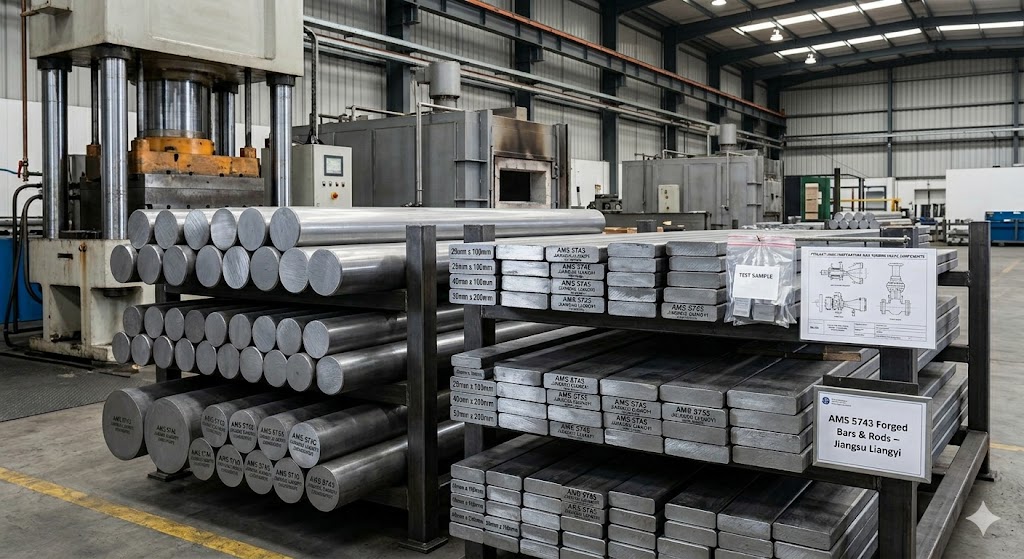
Round bars, square bars, flat bars, and hexagonal bars in AMS 5743 are produced by our open die press line from 30 kg to approximately 8 tons per piece. Dimensional tolerances follow EN 10243 or ASTM A788 as applicable. For valve spindles, turbine shaft sections, and stepped multi-diameter shafts, we forge to a pre-machined envelope (typically +3/+5 mm stock allowance per surface) to minimize downstream CNC cycle time. Standard surface condition is forged black, but we can supply rough-turned or finish-machined to drawing.
- Round bars: Ø30 mm to Ø600 mm, length up to 6,000 mm; tolerance to ±1 mm diameter on machined bars
- Flat bars & blocks: Thickness from 20 mm to 500 mm; width up to 1,200 mm; length up to 4,000 mm
- Stepped shafts: Multi-step profiles with individual sections Ø50–Ø500 mm; total length up to 4,500 mm
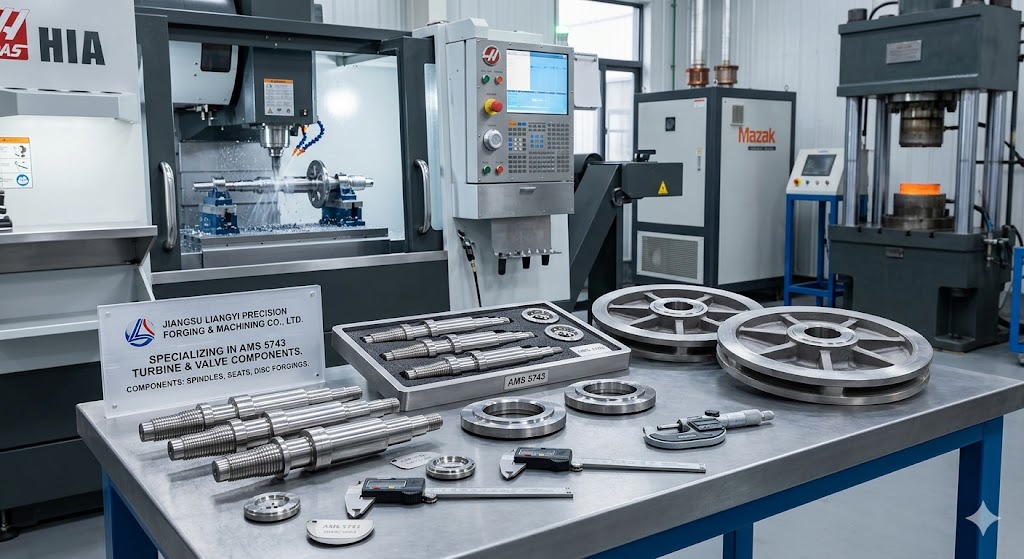
- Valve stems & spindles: Supplied finish-machined to drawing with thread, runout, and surface finish controlled
AMS 5743 / AMS 5744 Seamless Rolled Rings
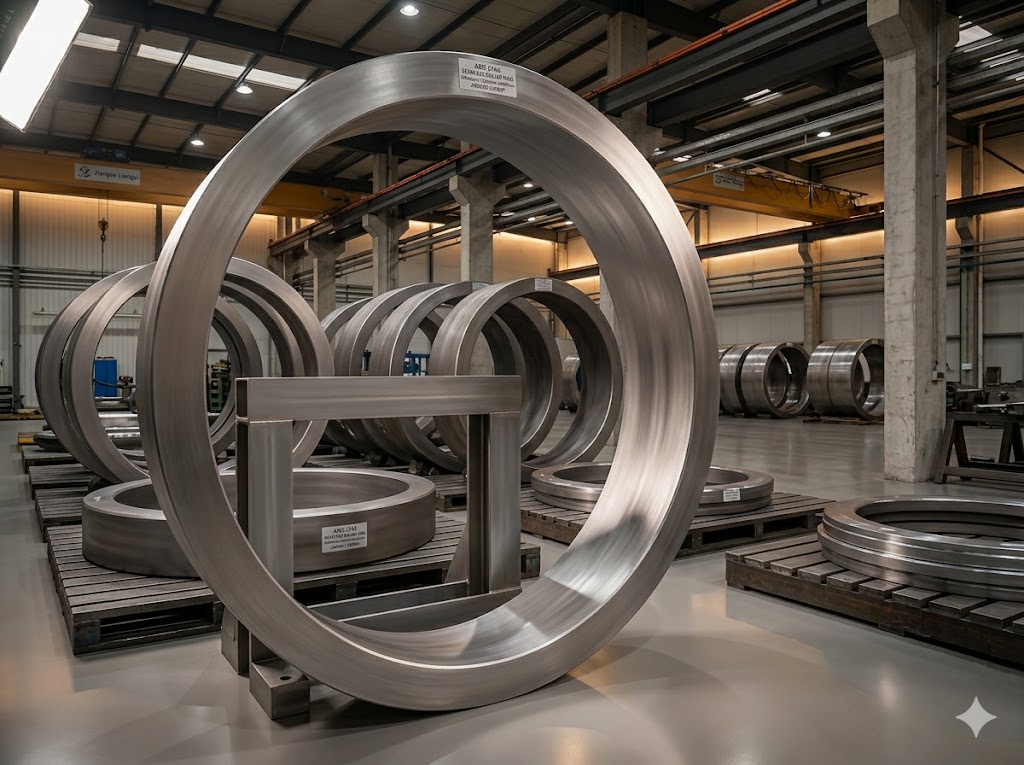
Seamless ring rolling is one of our core competencies. Unlike forged blanks with subsequent machining, a rolled ring achieves a continuous grain flow that follows the ring circumference — providing superior fatigue strength in the hoop direction, which is exactly the stress mode that matters for turbine casings, seal rings, and bearing journals. We roll rings from Ø200 mm to Ø3,000 mm in AMS 5743/5744 material.
- Ring OD range: 200 mm to 3,000 mm; wall thickness from 20 mm to 400 mm
- Contoured (profiled) rings: Flanged, stepped, and T-section rings rolled to near-net shape; machined to final drawing dimensions
- Seal rings & labyrinth rings: Tight-tolerance rings with bore concentricity within 0.2 mm TIR after finish machining
- Gear rings & bearing races: Supplied finish-machined with gear tooth or raceway features to drawing
AMS 5743 Hollow Forgings, Sleeves & Casings
Hollow-section forgings in AM 355 — including pressure vessel shells, turbine casing segments, sleeve-type valve bodies, and thick-wall pipe blanks — are produced using mandrel forging techniques that maintain consistent wall thickness and avoid the central porosity risk associated with solid-billet machined equivalents. Single piece weight: 80 kg to 15 tons; bore diameter: 100 mm to 1,200 mm; wall thickness: 30 mm to 350 mm.
Heavy Discs, Turbine Wheels & Impellers
Heavy disc and wheel forgings represent the most demanding category of AM 355 forgings, requiring careful management of the temperature gradient during both forging and heat treatment to ensure uniform properties through thickness. Our largest press (8,000-ton) can produce single-piece disc forgings up to Ø2,000 mm × 600 mm thick, weighing up to 25 tons. These are supplied with full through-thickness UT per AMS 2630 to verify internal soundness before machining begins — saving customers the cost of machining a defective piece.
Production Capability Summary
| Capability Parameter | Specification | Notes |
|---|---|---|
| Single piece weight | 30 kg – 30 tons | Heavier pieces available on request |
| Max forging diameter | Ø3,000 mm | Seamless ring rolling |
| Max forging length | 12,000 mm | Long bar / shaft forgings |
| Press capacity | Up to 8,000 tons | Multiple press lines |
| Annual production | 120,000 tons | All materials combined |
| Melting routes | EAF + AOD + VOD; optional ESR | ESR for tightest cleanliness requirements |
| CNC machining | Full in-house | 5-axis capability for complex profiles |
| Minimum order weight | 30 kg | No minimum piece count |
View our full production and inspection infrastructure on our Equipment page.
AMS 5743 (AM 355) Complete Material Data: Composition, Mechanical & Physical Properties
Understanding the full material profile of AM 355 is essential for confident engineering design. Below we provide the complete specification data alongside practical commentary drawn from our manufacturing experience — information that goes significantly beyond what a simple data sheet provides.
1. Chemical Composition — AMS 5743 Requirements (wt.%)
| Element | Min (%) | Max (%) | Role in Performance |
|---|---|---|---|
| Carbon (C) | 0.10 | 0.15 | Controls carbide precipitation; critical to Ms temperature management |
| Chromium (Cr) | 15.00 | 16.00 | Primary corrosion resistance element; narrow range maintains phase balance |
| Manganese (Mn) | 0.50 | 1.25 | Austenite stabilizer; assists in hot workability |
| Molybdenum (Mo) | 2.50 | 3.25 | Enhances pitting corrosion resistance; solid solution strengthener |
| Nickel (Ni) | 4.00 | 5.00 | Lowers Ms temperature; controls martensite transformation on cooling |
| Nitrogen (N) | 0.07 | 0.13 | Interstitial strengthener; stabilizes austenite; must be tightly controlled |
| Phosphorus (P) | – | 0.040 max | Grain boundary embrittlement risk; kept as low as feasible |
| Sulfur (S) | – | 0.030 max | MnS inclusion former; controlled for improved transverse toughness |
| Silicon (Si) | – | 0.50 max | Deoxidizer; excessive Si reduces hot ductility |
2. Mechanical Properties — Standard Heat Treatment Conditions
| Condition | Treatment Description | UTS | 0.2% YS | Elongation (A5) | Reduction of Area | Hardness |
|---|---|---|---|---|---|---|
| SCT 850°F (Long.) | Solution + Sub-zero + Temper at 455°C | 1489 MPa | 1255 MPa | 19% | 38% | ~44 HRC |
| SCT 850°F (Trans.) | Solution + Sub-zero + Temper at 455°C | 1517 MPa | 1276 MPa | 12% | 21% | ~44 HRC |
| SCT 1000°F (Long.) | Solution + Sub-zero + Temper at 538°C | 1276 MPa | 1179 MPa | 19% | 57% | ~40 HRC |
| SCT 1000°F (Trans.) | Solution + Sub-zero + Temper at 538°C | 1276 MPa | 1165 MPa | 15% | 40% | ~40 HRC |
| Annealed | Full anneal at ~1010°C, furnace cool | ~758 MPa | ~414 MPa | 35% | 65% | ~88 HRB |
3. Physical Properties of AM 355 (AMS 5743)
| Physical Property | Value | Condition / Temperature |
|---|---|---|
| Density | 7.80 g/cm³ | Room temperature |
| Melting range | 1399–1427°C | Solidus to liquidus |
| Elastic modulus (E) | 196 GPa | Room temperature |
| Thermal conductivity | 15.5 W/m·K | at 100°C |
| Thermal expansion (CTE) | 10.4 × 10⁻⁶ /°C | 21–316°C |
| Electrical resistivity | 0.79 μΩ·m | Room temperature |
| Specific heat capacity | 480 J/kg·K | Room temperature |
| Ms temperature (typical) | -45°C to -70°C | After solution treatment; varies with exact chemistry |
4. Heat Treatment Process Detail
The heat treatment sequence for AM 355 is more complex than standard martensitic stainless steels and requires precise temperature control, cooling rate management, and sub-zero treatment capability. Our heat treatment facility uses multi-zone calibrated thermocouples with regular temperature uniformity verification, and a full temperature-time chart is recorded on every load — providing complete traceability for every heat treatment cycle.
- Solution Treatment (Austenitizing): Heat to 1010–1050°C, hold to get full dissolution of carbides and homogenization of the austenite. Soak time is calculated based on section thickness (minimum 1 hour per 25 mm). Quench in oil or forced gas — the cooling rate must be fast enough to prevent chromium carbide precipitation at grain boundaries, which would degrade both strength and corrosion resistance.
- Sub-zero (Cryogenic) Treatment: Cool to ≤-73°C (typically using dry ice/acetone bath or liquid nitrogen for large sections) and hold for ≥3 hours. This step drives the martensite transformation to completion. Skipping sub-zero treatment or using insufficient temperatures is the root cause of below-specification strength in AM 355 forgings from less experienced suppliers.
- Tempering (Aging): For SCT 850°F: temper at 455 ± 8°C for 3 hours, air cool. For SCT 1000°F: temper at 538 ± 8°C for 3 hours, air cool. A double-temper cycle is sometimes specified for large sections to ensure complete stress relief and uniform hardness distribution.
Explore all available alloy specifications and corresponding heat treatment routes on our Materials page.
Our AMS 5743 Forging Manufacturing Process — From Raw Material to Delivery
Producing a compliant AMS 5743 forging part is a multi-stage engineering process, not simply a matter of pressing hot steel. Every stage below directly influences the final microstructure, mechanical properties, and dimensional accuracy of your component. We manage all stages in-house, eliminating the subcontracting risks that compromise both quality and delivery performance at many Chinese forging suppliers.
Raw Material Procurement & Incoming Inspection
We source AM 355 stock from qualified melt shops with full AMS 5743 compliance records. Incoming steel billets undergo spectroscopic chemical verification (OES analysis) and visual surface inspection before entering our forge shop. Heats that do not meet AMS 5743 chemistry limits are quarantined and returned — no exceptions. Heat number traceability is maintained from this point through every subsequent operation.
Steel Melting & Refining (for Custom Chemistry Orders)
For large-volume or ESR-grade orders, we produce custom heats using our Electric Arc Furnace (EAF) + Argon Oxygen Decarburization (AOD) + Vacuum Oxygen Decarburization (VOD) route. This triple-refining sequence achieves the tight S/P limits required for high-toughness applications and provides the lowest possible dissolved gas content. Electroslag Remelting (ESR) is available for the most demanding applications — ESR ingots show superior centerline cleanliness and tighter property uniformity through large section thicknesses.
Billet Preparation & Heating
Cast ingots are forged down to refined billets to break the as-cast dendritic structure and achieve a wrought microstructure. Billet heating for AM 355 is performed in gas-fired furnaces at 1100–1180°C, with temperature uniformity monitored by multiple zone thermocouples. We use a controlled soak-and-transfer protocol to maintain temperature within the hot workability window of AM 355 — above the δ-ferrite formation threshold and below the incipient melting point.
Open Die Forging / Ring Rolling
Hot working is performed on our 800-ton to 8,000-ton press line (for open die forgings) or our radial-axial ring rolling mill (for seamless rings). Minimum forging reduction ratios are calculated per AMS 5743 requirements to ensure adequate grain refinement. For critical components, we use a multi-heat forging sequence to maximize reduction while maintaining temperature control. The final forging is allowed to air-cool or controlled-cool depending on section size before proceeding to heat treatment.
Heat Treatment
Solution treatment, sub-zero treatment, and tempering are performed in AMS 2750-compliant furnaces with full temperature recording. Furnace atmosphere is controlled to minimize surface decarburization. Large sections may receive a stress-relief treatment between the forging and solution treatment steps to reduce distortion risk. A first-piece hardness check is performed after tempering before proceeding to machining.
Rough Machining & Dimensional Survey
After heat treatment, forgings proceed to our CNC turning and milling centers for rough machining to the pre-agreed envelope. A coordinate measuring machine (CMM) survey confirms that adequate material stock remains for finish machining to drawing dimensions. Any piece that has moved beyond tolerance during heat treatment is flagged at this stage rather than after final machining — our process controls are designed to catch problems early.
Full Non-Destructive Testing (NDT)
Every AMS 5743 forging undergoes the NDT sequence required by the applicable standard and your project specification: UT for internal soundness, MPI or PT for surface discontinuities, and PMI for chemical identity confirmation. NDT is performed by qualified, experienced NDT personnel operating to documented written procedures with defined acceptance criteria. Calibration records and rejection criteria are included in every NDT report issued to the customer.
Precision CNC Finish Machining
For machined-to-drawing components, finish machining is performed on our multi-axis CNC machining centers to the dimensional tolerances and surface finish requirements (Ra value) specified on your drawing. We hold general tolerances to ±0.5 mm on most features and can get ±0.1 mm or better on important bores and mating surfaces. All machine programs are revision-controlled and linked to your part drawing revision.
Final Inspection, Documentation & Packing
A full final inspection report including dimensional, mechanical, chemical, and NDT results — is compiled and reviewed against the purchase order specification before release. The complete documentation package is issued electronically in PDF format simultaneously with shipment dispatch. Parts are protected with rust-preventive coating and VCI film, packed in ISPM-15 compliant wooden or steel crates suitable for your import destination, and marked with heat number, part number, and customer reference for full traceability upon receipt.
Industrial Applications & Global Project Case Studies
The combination of ultra-high strength, corrosion resistance in steam and hydrocarbon environments, and reliable property maintenance up to approximately 400°C makes AMS 5743 and AMS 5744 forged parts the material of choice for the most demanding components in energy and process industry equipment. Below we describe the primary application categories and illustrate each with real project experience.
Gas Turbine Hot-Section Components
In industrial gas turbines operating on natural gas or liquid fuel, the compressor and turbine sections subject components to simultaneous high stress and elevated temperature. AMS 5743 forgings are used for inlet guide vanes (IGV), compressor diaphragm nozzles, stage sealing rings, and shaft end nuts — components that require the high UTS of AM 355 to achieve safe margins while controlling component weight. The forging process is critical here: cast AM 355 would not achieve the fatigue performance these components require, and machined-from-plate AM 355 lacks the directional grain structure that enhances rotating component life.
Steam Turbine Valve Components
Main stop valves (MSV), control valves, and reheat stop valves in coal, gas, and combined-cycle power plants operate in steam conditions that combine high temperature, high pressure, and erosive steam flow. AMS 5743 is specified for valve seats, valve discs (clappers), stem spindles, bonnet bushings, and packing sleeves — all of which require the alloy's combination of high strength (to resist seating load deformation), corrosion resistance (to prevent erosion-corrosion from wet steam), and dimensional stability over hundreds of valve cycles. Inadequate material selection in these components is frequently the root cause of high-pressure steam leaks and unplanned outages.
Turbine Sealing Systems
Labyrinth seals, brush seals, and carbon seal carriers in gas and steam turbines require AMS 5743 rings and machined carriers that maintain geometric precision after thousands of thermal cycles. The alloy's relatively low thermal expansion coefficient (10.4 × 10⁻⁶ /°C) and high elastic modulus help maintain seal clearances across the operating temperature range, directly influencing turbine efficiency. We supply seamless rolled seal rings and machined seal housings to multiple turbine OEMs globally.
Petrochemical & Refinery Equipment
Process valves, pump shaft sleeves, compressor impellers, and pressure-boundary fasteners in hydrocarbon processing environments are subject to hydrogen sulfide, chloride-containing condensate, and elevated pressures that demand materials combining corrosion resistance with structural integrity. The 2.5–3.25% Mo content in AM 355 provides meaningful resistance to pitting in chloride environments, while the high strength allows wall thickness reduction that lowers component weight — an advantage in rotating equipment where unbalance forces scale with mass.
Global Field-Proven Project References
Case 1: Complete MSV Valve Component Set — 600 MW Combined Cycle Power Plant
A combined cycle power plant EPC contractor in Southeast Asia required a complete set of AMS 5743 forged valve components for the main steam system: MSV valve seats (DN500, pressure class 900#), valve disc clappers, stem spindles (Ø120 mm × 1,400 mm), bonnet bushing sleeves, and stuffing box packing rings. The challenge was achieving the specified contact hardness (42–46 HRC) on the seating surface while maintaining ductility in the spindle body to survive valve slam loading — two requirements that are in tension with each other if heat treatment is not precisely controlled.
We produced the full component set in AMS 5743 SCT 850°F condition, achieving UTS of 1,510 MPa and seating surface hardness of 43.5 HRC across all pieces. 100% MPI and dimensional inspection was witnessed by a client-nominated third-party inspector. The components were installed during commissioning and have operated without incident through four scheduled maintenance cycles over three years. Plant data shows a 35% reduction in valve-related unplanned maintenance compared with the previous 17-4PH components they replaced.
Case 2: Low-Pressure Turbine Casing Forgings — 300 MW Thermal Power Plant
A power plant operator in the Middle East engaged us for replacement AMS 5744 heavy casing forgings for the first and second stage low-pressure turbine (LPT) casings and inner shroud rings of a 300 MW steam turbine undergoing life extension. The original casings had exhibited creep-induced dimensional distortion after 20+ years of operation. The requirement was for one-piece forged replacement casings — eliminating the welded segmented design that had contributed to the distortion — with tighter dimensional tolerances and an upgraded material specification.
We produced four ring forgings (OD range 1,800–2,400 mm) using our largest ring rolling mill, with wall thicknesses up to 180 mm. Post-forging heat treatment was performed in a purpose-configured batch furnace that accommodated the full ring diameter without the temperature non-uniformity that would arise from cutting the rings into segments for treatment. Final mechanical testing confirmed UTS exceeding 1,480 MPa across all test positions. Third-party dimensional inspection (BV) verified concentricity within 0.5 mm TIR — well within the ±1.0 mm tolerance specified by the turbine OEM. The overhauled turbine achieved its rated output within three percent of design on first light-up.
Case 3: Corrosion-Resistant Fasteners & Seal Rings — European Petrochemical Refinery
A major European refinery operating process units handling H₂S-rich hydrocarbon streams specified AMS 5743 forged fasteners, seal rings, and valve sleeve components for a scheduled turnaround replacement program. The specification requested EN 10204 Type 3.2 mill test certificates witnessed by TÜV and compliance with NACE MR0175/ISO 15156 for sour service compatibility. The challenge was to meet the NACE hardness limit (maximum 28 HRC for components in wetted sour service) and still have enough strength to handle the hydraulic loading requirements – a combination that required a modified tempering cycle specific to AM 355.
We produced 4,200 individual fasteners (studs, bolts, nuts) and 380 seal rings across 14 different part numbers in an 8-week production campaign. All pieces were produced to SCT 1000°F condition, achieving hardness values of 26–28 HRC — at the upper limit of the NACE envelope to maximize strength while remaining compliant. Independent TÜV 3.2 certification was issued for every production batch. Zero field failures were reported at the 12-month post-turnaround review, and the refinery has since placed the program on a three-year repeat supply agreement.
Case 4: Gas Turbine Rotating Component Program — North American Turbine OEM
We have supplied AMS 5743 forged turbine blades, IGV airfoils, stage diaphragm nozzle sectors, and rotating disc forgings for an industrial gas turbine manufacturer in North America. The program required full dimensional and mechanical compliance verification on first-article pieces prior to serial production release, with stringent documentation requirements for each delivery batch.
Our process engineering team optimized the forging steps to match grain flow with the main stress directions of each part, which is key to guaranteeing long fatigue life for rotating parts. All first sample pieces satisfied the required dimensional and mechanical property standards. Mass production has maintained steady part quality across all batches, and every shipment has passed the customer’s incoming inspection successfully.The supply relationship has continued with repeat orders across multiple product variants.
View our complete portfolio of global industrial projects on our Reference page.
Strict Quality Control & Full Inspection Process
Our quality philosophy is prevention, not correction. The most expensive quality problem is the one discovered after machining has begun — or worse, after installation in service. Our quality system is structured around early detection at each process stage, with clear hold points that prevent non-conforming work from advancing to the next operation.
In-Process Quality Gates
- Material release gate: We use OES chemical analysis to check that the material chemistry meets AMS 5743 standards before any forging starts. We also verify the Certificate of Conformance (CoC) and the supplier's 3.1 mill test certificate against the AMS 5743 limits.
- Forging temperature monitoring: Thermocouple-monitored furnace records are reviewed for each heat. Any piece that was below the minimum forging temperature due to a furnace anomaly is set aside for engineering review — not forced through on schedule pressure.
- Post-forge hardness check: Brinell hardness is measured on every piece after forge to confirm the forging was fully hot-worked and not work-hardened below the expected range.
- Post-heat treatment hardness survey: Vickers or Rockwell hardness is mapped at multiple locations on a sample basis per heat treatment batch to confirm uniformity. Statistical control charts track hardness trends over time.
- Dimensional first-piece inspection (FAI): A CMM fully inspects the first part of a new production order before releasing the batch. This catches tooling, fixturing or program errors before they cascade through the whole order.
Final Inspection Methods & Standards
- Ultrasonic Testing (UT): Per AMS 2630 (bars and forgings) or ASTM A388. Contact method with immersion calibration where required. Rejection criterion: FBH #1/64" equivalent reflector or as specified by customer. 100% scanning coverage for forgings above 200 mm cross-section.
- Magnetic Particle Inspection (MPI): Per ASTM E1444. AC yoke or wet fluorescent bench method depending on component geometry. Detects surface and near-surface discontinuities down to approximately 0.5 mm length. Applied to all forgings in the SCT (martensitic) condition.
- Liquid Penetrant Testing (PT): Per ASTM E1417 / EN 3452-1. Used for non-ferromagnetic forgings or when MPI cannot achieve required field orientation on complex geometries.
- X-Ray Radiographic Testing (RT): Per ASTM E1742 for complex castings-replacement forgings or weld-in components where internal geometry makes UT scanning incomplete. Available on request.
- Positive Material Identification (PMI): 100% XRF screening on all forgings before shipment to confirm alloy identity. PMI is particularly important for AM 355, which can be visually confused with common 316L or 17-4PH without testing.
- 3D CMM Dimensional Inspection: Renishaw CMM arm or fixed-bridge CMM for machined components. Report format per ASME Y14.5 GD&T or ISO 2768 as specified.
- Mechanical Property Testing: Full tensile, hardness (Brinell and Rockwell), and Charpy impact testing per the applicable heat treatment batch, performed in our in-house testing laboratory using calibrated equipment with full traceability to national measurement standards.
- Corrosion Resistance Testing: Intergranular corrosion test per ASTM A262 Practice E (Huey test in boiling nitric acid) available for applications where sensitization risk must be confirmed. Results are not routinely included but can be specified.
Sourcing AMS 5743 Forgings: What to Verify Before You Place an Order
Based on 25+ years of supplying AMS 5743 and AMS 5744 forgings to global industrial customers, our technical team has seen the full range of quality failures that result from inadequate supplier qualification. The checklist below is designed to help procurement engineers and project engineers evaluate any AMS 5743 forging supplier — including us — before committing to a purchase order.
Technical Capability Checks
- Does the supplier have documented experience with AM 355 specifically — not just generic stainless steel forging? Ask for test records from previous heats showing actual achieved chemistry and mechanical properties, not just specification limits.
- Does the supplier operate a sub-zero (cryogenic) treatment capability in-house? AM 355 SCT heat treatment requires cooling to ≤-73°C, which is a specialized facility many forging shops do not have. If they outsource this step, ask who performs it and request the subcontractor's calibration records.
- Are the heat treatment furnaces regularly calibrated with documented temperature uniformity records? Request furnace calibration logs and thermocouple calibration certificates for the actual furnace that will process your order. Well-managed heat treatment operations maintain these records as a matter of course.
- What is the supplier's NDT capability and how is it documented? Ask to see the NDT written practice, the personnel qualification records, and a sample NDT report from a recent production order — not a template. This tells you whether NDT is a controlled process or a box-ticking exercise.
- Can the supplier demonstrate adequate forging reduction ratio records for AM 355? The forging reduction ratio directly determines the degree of grain refinement. Minimum 3:1 reduction is commonly required for AM 355 bar forgings; ask how this is documented in their work instructions.
Quality System Checks
- Is the quality management system certified to ISO 9001:2015 by an accredited certification body? Verify the certificate directly on the certification body's online registry — supplier-provided copies can be forged.
- Does the supplier have a formal Material Review Board (MRB) process for non-conformances? Ask to review a redacted example of a non-conformance record and disposition to assess the rigor of their corrective action process.
- Can the supplier provide EN 10204 Type 3.1 certification as standard, and Type 3.2 (third-party witnessed) on request? Type 2.2 test reports are insufficient for most AMS 5743 turbine and pressure vessel applications.
- What is the supplier's policy on material traceability? Heat number tracking must be maintained from incoming steel through every operation to the final documentation package. Ask how they prevent heat mix-up on the shop floor.
Commercial & Logistics Checks
- Does the supplier have direct export experience to your country? Import regulations for industrial steel components, HS code classification, and ISPM-15 packaging requirements vary by destination. A supplier without export experience to your region creates unnecessary customs and logistics risk.
- Can the supplier provide references — with contact details — from at least two customers who have received AMS 5743 forgings for applications similar to yours? Past performance in turbine or pressure-boundary applications is the best predictor of future success.
- What is the supplier's formal process for managing engineering changes, revision updates, and document control during a multi-part order? Change management breakdowns are a common source of incorrect parts being shipped.
Frequently Asked Questions — AMS 5743 & AMS 5744 Forgings
AMS 5743 is a SAE International Aerospace Material Specification that defines the requirements for AM 355 (UNS S35500), a semi-austenitic precipitation-hardening chromium-nickel-molybdenum stainless steel. For forged parts, AMS 5743 specifies the exact chemical composition limits, minimum mechanical property requirements after heat treatment, acceptable surface conditions, and inspection criteria that the forgings must satisfy. This is the design reference and procurement traceability standard for turbine OEMs, power generation contractors and petrochemical engineers who require high strength, corrosion resistant components with a documented compliance chain.
Both AMS 5743 and AMS 5744 govern the AM 355 (UNS S35500) alloy with identical core chemical composition and mechanical property targets. The distinction lies in the product forms each specification covers: AMS 5743 applies to bars, forgings, and rings used in high-strength structural and rotating applications; AMS 5744 extends to sheet, strip, and plate forms where forming characteristics are also addressed. For a forging manufacturer, both specifications are produced from the same AM 355 alloy heat and treated with the same SCT heat treatment cycle. The choice of which specification to cite on your order documentation is primarily a function of your engineering drawing callout and your quality system's traceability requirements.
AM 355 outperforms 17-4PH in two key areas for turbine applications: higher strength ceiling and better elevated temperature property retention. In the SCT 850°F condition, AM 355 achieves UTS of approximately 1,480–1,550 MPa versus 17-4PH H900's 1,310 MPa. More significantly, 17-4PH begins to lose meaningful strength above approximately 315°C, while AM 355 retains more of its room-temperature strength through approximately 400°C — the temperature range that matters for hot-section valves and seals in gas and steam turbines. The trade-off is that 17-4PH is easier to heat treat (no sub-zero treatment required), lower cost, and more widely available, making it the right choice for room-temperature structural applications where AM 355's additional strength is unnecessary.
Yes. We begin with a DFM (Design for Manufacturability) review of your 2D and 3D drawings. Our engineering team will check if your design can be forged, plan the tooling or ring rolling process, and point out any shapes that would work better with small changes. These small changes will make forging easier or help us use less material. We then draw up a formal process plan outlining the forging temperature window, reduction sequence, heat treatment cycle and machining plan. We can hold general machined tolerances to ±0.5 mm, and tolerances on critical bores and mating surfaces to ±0.1 mm. Our one-stop service covers the full scope from raw material to finished, inspected, documented parts ready for your incoming goods inspection.
Every AMS 5743 / AMS 5744 delivery includes: an ISO 9001:2015 Quality Certificate; EN 10204 Type 3.1 Mill Test Certificate as standard; chemical analysis report with heat number traceability; mechanical test report (tensile strength, yield strength, elongation, reduction of area, hardness); heat treatment record with calibrated furnace charts; dimensional inspection report; and NDT reports (UT, MPI/PT per applicable standard). For projects requiring EN 10204 Type 3.2 certification (independently witnessed), customers may nominate a third-party inspection agency such as BV, SGS, TÜV, or Intertek — we fully support on-site witnessing and co-ordination with the inspector at no additional process disruption. All documents are issued in English.
The normal lead time is 20–35 working days from receipt of order confirmation, approved drawings, and deposit payment. For parts in simple shapes, such as rolled rings, round bars, or disc forgings — with standard SCT heat treatment and straightforward NDT requirements, the lead time is 20–25 working days. For complex shapes requiring multi-step forging sequences, multiple heat treatment cycles, extensive CNC machining, or Type 3.2 third-party inspection witnessing, the lead time is 30–35 days. We can also speed up production for urgent orders. Contact us with your required delivery date and we will advise on expedited production feasibility — in many cases we can compress the schedule by pre-positioning raw material and dedicating priority press time.
Our minimum order is 30 kg net forging weight. There is no minimum on piece count — we regularly produce single-piece prototype forgings for R&D and first-article qualification programs, as well as high-volume production runs of thousands of small components. For prototype orders, we strongly recommend ordering 2–3 pieces to allow one piece for destructive testing (mechanical properties, metallography) while retaining a certified-spare for production verification. This approach avoids the situation of consuming your only piece in testing and then needing to repeat the entire production order before machining can begin.
We perform the full AMS 5743 SCT heat treatment sequence entirely in-house, including sub-zero treatment using liquid nitrogen chambers capable of reaching -100°C — well below the ≤-73°C requirement. Our furnaces are calibrated to AMS 2750 Class 2 standards. Heat treatment options available include: SCT 850°F (solution + sub-zero + 455°C temper) for maximum strength; SCT 1000°F (solution + sub-zero + 538°C temper) for improved ductility and NACE sour-service hardness compliance; annealed condition for forming operations prior to final heat treatment; and custom tempering temperatures within the specification range to meet your specific property targets. All heat treatment cycles are fully documented with time-temperature charts provided as part of the delivery documentation.
Our standard NDT suite for AMS 5743 forgings comprises: Ultrasonic Testing (UT) per AMS 2630 or ASTM A388 for internal defect detection — 100% scanning coverage for sections above 200 mm; Magnetic Particle Inspection (MPI) per ASTM E1444 using wet fluorescent technique for surface and near-surface discontinuities; Liquid Penetrant Testing (PT) per ASTM E1417 where MPI orientation is not achievable; and Positive Material Identification (PMI) via XRF on 100% of parts prior to shipment. Radiographic Testing (RT) per ASTM E1742 is available on request. All NDT is performed by qualified, experienced NDT personnel following documented written procedures and defined acceptance criteria. Full calibration records and reject criteria are included in every NDT report provided with your delivery.
Yes. NACE MR0175 / ISO 15156 limits the maximum hardness of wetted metallic components in H₂S-containing environments.For AM 355, the compliant heat treatment is SCT 1000°F (temper at 538°C), which achieves hardness in the 25–29 HRC range — within the NACE limit of 28 HRC for this alloy. We have extensive experience of producing AM 355 forgings for petrochemical refinery customers under NACE compliance requirements, including European clients who need the compliance to be verified and documented by a TÜV or equivalent Type 3.2 certifier. When ordering for NACE service, please specify NACE MR0175 compliance on your purchase order so we can select the correct tempering cycle and include the appropriate documentation.
For ongoing supply agreements, we implement a locked-process approach: a dedicated quality engineer is assigned to your account; the raw material heat source is selected from our list of pre-qualified AM 355 melt shops with a consistent chemistry track record; forging die sets, heat treatment furnace programs, and NDT procedures are version-controlled against your first-article-approved baseline; and SPC charts tracking key mechanical properties (UTS, YS, hardness) across batches are maintained and available for customer review at any time. We also retain representative material coupons and test samples from each production batch for a minimum of five years, providing a resource for failure investigation should a field performance question arise. This infrastructure is why customers who consolidate their AM 355 forging supply to us see a significant reduction in incoming inspection rejection rates compared to their previous multi-supplier approach.
Every forging is individually protected with a rust-preventive coating (VCI film or Tectyl-type compound depending on destination climate), then packed in ISPM-15 compliant heat-treated wooden crates or steel crates for sea freight, or foam-padded plywood cases for air freight. Each piece is marked with heat number, material grade, part number, customer purchase order number, and net/gross weight for complete receiving traceability. Export documentation includes: commercial invoice, packing list, certificate of origin (CO), EN 10204 MTC, inspection reports, and ECCN / Schedule B / HS code classification sheets. We have active experience with import procedures for North America (USITC), the European Union (TARIC), Australia (ABF), the UAE, India, Japan, and South Korea — and maintain relationships with freight forwarders experienced in the specific import requirements of each region.
Contact Us — AMS 5743 & AMS 5744 Forging Quotation
As a professional China forging manufacturer with over 25 years of specialized experience in AM 355 (AMS 5743/5744) forgings, we are committed to providing technically compliant, fully documented components with competitive pricing and responsive service. Whether your requirement is a single prototype piece, a turnaround replacement set, or a long-term supply program, we have the process expertise and quality infrastructure to meet it.
To obtain a quotation within 24 hours, please send us the following information: part drawing (2D PDF or 3D STEP file), material specification callout (AMS 5743 or AMS 5744, heat treatment condition), required quantity and delivery date, applicable design code or inspection standard, and any special requirements (third-party inspection, NACE compliance, ESR melting, etc.).
For more information about our full product range, please visit: https://www.jnmtforgedparts.com/ams-5743-ams-5744-forging-parts.html
Get Your Custom AMS 5743 & AMS 5744 Forging Solution Today
From raw material melting to finished, fully documented machined parts — one supplier, one quality system, zero uncertainty. ISO certified. Global delivery. 25+ years of AM 355 forging expertise.
Send Inquiry Now →