AISI 440A (SUS 440A / UNS S44002 / Grade 440A) Forging Parts — Custom Stainless Steel Forgings from China ISO-Certified Manufacturer
What Is AISI 440A Stainless Steel?
- Definition: AISI 440A (UNS S44002 / SUS 440A / DIN 1.4109 / 7Cr17) is a high-carbon martensitic stainless steel with 0.60–0.75% carbon and 16–18% chromium.
- Hardness: Up to 56 HRC after quenching and tempering (1010–1065°C quench, 150–370°C temper); ≤95 HRB in annealed condition.
- Corrosion resistance: Best among the 440 series (440A > 440B > 440C); suitable for atmospheric, fresh water, mild chemical, and API sweet-service environments.
- Forgeability: Excellent — hot forged at 1050–1150°C; can achieve complex shapes that 440C cannot.
- Tensile strength: 725 MPa (annealed) to 1790 MPa (hardened and tempered).
- Key applications: Oil and gas valves (API 6A), turbine components, pump shafts, cutting tools, bearings, and railroad parts.
- Standards: ASTM A276/A479, AMS 5631/5632, EN/DIN, JIS G4303, API 6A.
- Manufacturer: Jiangsu Liangyi Co., Limited — ISO 9001:2015, 30 KGS to 30,000 KGS per piece, 120,000 T/year capacity.
AISI 440A Stainless Steel — Quick Specification Summary
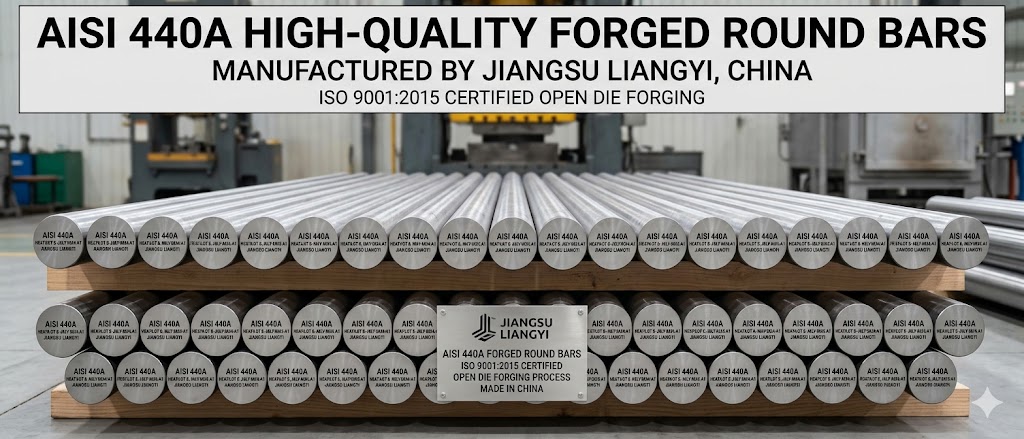
Table of Contents
- About AISI 440A and Our Forging Capabilities
- International Equivalent Grade Designations
- Why Choose AISI 440A for Forging?
- AISI 440A vs 440B vs 440C Comparison
- Custom AISI 440A Forged Products
- Chemical Composition and Mechanical Properties
- Forging and Heat Treatment Process
- Physical Properties
- Corrosion Resistance and PREN Analysis
- Applications and Global Industry Cases
- Global Standard Compliance
- Quality Control and Testing
- Supply Chain and Custom Service
- Welding and Machining Guidelines
- Surface Treatment and Post-Processing
- Material Selection Guide
- Related Stainless Steel Grades
- Frequently Asked Questions
- Contact Us
What Is AISI 440A Stainless Steel and What Are Our Forging Capabilities?
Jiangsu Liangyi Co., Limited is a leading China ISO 9001:2015 certified manufacturer of AISI 440A, SUS 440A, UNS S44002, and Grade 440A open die forging parts and seamless rolled steel forged rings. With over 25 years of industry experience, we deliver end-to-end custom forging solutions — from steel melting, precision forging, controlled heat treatment to final machining — with materials manufactured to ASTM, AMS, DIN, EN, JIS and API 6A material specifications.
AISI 440A is a high-carbon martensitic stainless steel, engineered to balance moderate corrosion resistance, exceptional mechanical strength, and the ability to get and keep outstanding hardness (up to 56 HRC) and wear resistance. According to Carpenter Technology’s 440A data sheet, this grade attains maximum toughness when heat treated to Rockwell C 56. This premium material is the best choice for extreme industrial applications that demand high durability, impact resistance, and reliable long-term performance in harsh working environments.
We have advanced forging equipment — including 1600T to 6300T open die forging presses and a diameter 6m ring rolling machine, and we can produce AISI 440A forgings with weight ranges from 30 KGS to 30,000 KGS per single piece. We have 120,000 tons of annual production capacity and can support custom prototypes in small batches and large-scale bulk production for global customers.
What Makes AISI 440A Metallurgically Unique?
Unlike austenitic grades (304, 316) which derive corrosion resistance purely from chromium, AISI 440A achieves its performance through a precisely controlled balance between three competing metallurgical forces: carbon-driven hardness, chromium-driven passivity, and thermal processing-driven microstructure. At 0.60–0.75% carbon — the lowest in the 440 series — 440A deliberately sacrifices some peak hardness to preserve a higher volume of free chromium in the matrix. This chromium remains available to form the protective Cr₂O₃ passive film rather than being consumed by Cr₂₃C₆ carbide precipitation.
In our 25-year production experience, this balance point is what makes 440A the only grade in the 440 family that is consistently forgeable into complex geometries — thick-walled valve bodies, large-bore pump housings, and multi-step transmission shafts — without the centerline cracking risk that plagues 440C in sections above 300 mm. Customers who initially specify 440C for wear resistance frequently switch to 440A after the first rejected batch; 440A's lower crack susceptibility reduces scrap rate by approximately 15–25% in our facility’s production data.
Our Forging Capability at a Glance
Our Jiangyin facility operates seven open-die forging presses ranging from 1600T to 6300T, supported by one ring rolling machine capable of producing seamless rings up to 6 meters outer diameter. All presses are paired with computer-controlled gas-fired furnaces with ±5°C uniformity, ensuring each AISI 440A ingot reaches the correct austenitizing temperature throughout its cross-section before the first hammer blow. This temperature uniformity is not a marketing claim — it is verified by embedded thermocouple records retained with every heat batch certificate.
For AISI 440A specifically, we maintain a minimum forging ratio of 3:1 (typically 4:1 to 6:1 for critical components), which eliminates the original as-cast dendritic segregation of carbon and chromium. This is critical because 440A ingots solidify with carbon-rich centerline segregation that, if not broken down by sufficient forging reduction, produces a heat-treated component with non-uniform hardness across its cross-section. Our process consistently achieves cross-sectional hardness uniformity within ±2 HRC on finished components up to 800 mm diameter.
Jiangsu Liangyi vs. Generic Suppliers — Key Differentiators:
- Proprietary pre-forging homogenization anneal at 1150–1180°C / 8–16 hours for ingots >3,000 KGS to eliminate macro-segregation before forging starts
- Real-time pyrometer logging throughout the forging sequence, with automatic press halt if workpiece drops below 850°C — preventing unintended martensite nucleation mid-forge
- In-house sub-zero cryogenic treatment capability down to −196°C (liquid nitrogen) for dimensional stability-critical components such as bearing rings and precision gauge parts
- All heat treatment furnaces NATA-equivalent calibrated with batch records available for client review under NDA
What Are the International Equivalent Grades of AISI 440A?
AISI 440A stainless steel is designated differently across various international standards. The following table provides a comprehensive cross-reference for engineers and procurement teams worldwide:
| Standard System | Designation | Country / Region |
|---|---|---|
| AISI / SAE | 440A | USA |
| UNS | S44002 | USA |
| AMS | 5631 / 5632 | USA (Aerospace) |
| ASTM | A276, A479, A473, A580 | USA |
| JIS | SUS 440A | Japan |
| DIN / EN | X70CrMo15 / 1.4109 | Germany / EU |
| BS | 440A S45 | United Kingdom |
| AFNOR | Z70C15 | France |
| GB | 7Cr17 | China |
| GOST | 95X18 | Russia |
Source: Cross-referenced from AZoM Grade 440A data, ATI 440A Technical Data Sheet, and ASTM A276/A479.
Are These Equivalent Grades Truly Identical? Practical Differences You Must Know
While the grades above are described as “equivalent,” our procurement and engineering teams have identified meaningful practical differences that affect purchasing decisions. These are not covered in most technical references because they require direct standard-by-standard comparison and real production experience:
| Attribute | ASTM A276 (USA) | EN/DIN 1.4109 (EU) | JIS G4303 SUS 440A (Japan) | GB 7Cr17 (China) |
|---|---|---|---|---|
| Carbon max (%) | 0.60–0.75 | 0.65–0.75 | 0.60–0.75 | 0.60–0.75 |
| Molybdenum (%) | ≤ 0.75 | 0.40–0.80 | ≤ 0.75 | ≤ 0.80 |
| Phosphorus max (%) | 0.040 | 0.040 | 0.040 | 0.035 |
| Sulfur max (%) | 0.030 | 0.015 | 0.030 | 0.030 |
| Hardness test req. | Full HRB/HRC table | Vickers (HV) preferred | HRB/HRC + Brinell | HRC + HBW |
| Impact testing | Per order | Mandatory ≥ 20 J (some specs) | Per order | Per order |
| Surface finish standard | ASTM A480 | EN 10088-3 | JIS G0303 | GB/T 3280 |
| MTC format | EN 10204 or ASTM | EN 10204 3.1 mandatory | JIS or EN 10204 | GB/T or EN 10204 |
Practical procurement tip from our engineering team: The EN/DIN 1.4109 grade mandates a tighter sulfur limit (≤ 0.015%) compared to ASTM’s 0.030%. Lower sulfur means fewer manganese sulfide inclusions — which is beneficial for fatigue life in rotating components. If your application is a high-cycle turbine shaft or bearing ring destined for a European customer, specifying EN/DIN 1.4109 instead of generic AISI 440A gives you a measurable metallurgical advantage at minimal cost premium. We can supply either standard with full traceability.
While these designations are considered equivalent, minor differences in chemistry limits and testing requirements may exist between standards. Always verify the specific standard requirements for your project. Our engineering team can assist with cross-referencing for any regional standard.
Why Choose AISI 440A Stainless Steel for Forging Applications?
As a main grade of the 440 stainless steel series, AISI 440A has unique advantages over other 440 grades (440B / 440C) for forging applications, so that it is the best choice material for industrial components that need a balance of performance and processability:
- Superior Corrosion Resistance: With moderate carbon content (0.60–0.75%), AISI 440A delivers better corrosion resistance than 440B and 440C in the hardened condition, suitable for mildly corrosive environments in oil and gas, petrochemical and marine industries
- Excellent Forgeability and Toughness: Lower carbon content significantly improves hot forgeability and impact toughness, allowing for complex forging shapes that 440C cannot achieve without cracking
- Controllable Hardness and Wear Resistance: Through precise heat treatment, AISI 440A forgings can reach 50–56 HRC hardness, meeting the wear resistance requirements of most industrial components while maintaining better toughness than 440B/440C
- Stable Mechanical Performance: Consistent material composition and controlled forging process ensure uniform mechanical properties across the entire forging cross-section, critical for high-load rotating and pressure components
- Cost-Effective Solution: AISI 440A provides an optimal balance between performance and cost, offering near-440C wear resistance at a lower raw material cost, with reduced manufacturing risk due to better forgeability
Why Forged AISI 440A Outperforms Bar-Cut or Rolled Plate
A question our engineers frequently receive from new customers: “Can we just machine the part from 440A bar stock instead of ordering a forging?” The answer depends entirely on the application, but for structural and high-fatigue components, forged 440A consistently outperforms machined bar on three critical measures:
| Performance Factor | Forged AISI 440A | Bar-Cut / Rolled Plate 440A | Why It Matters |
|---|---|---|---|
| Grain orientation | Grain flows with part geometry (fibrous flow) | Straight transverse grain through part | Crack initiation follows grain boundaries; forging directs strength where needed |
| Fatigue life | Typically 30–50% higher in rotating applications | Baseline | Critical for turbine shafts, pump impellers, valve stems |
| Charpy impact (Q&T) | ≥ 25 J at room temp (our production average) | 15–20 J typical | Higher toughness reduces brittle fracture risk in pressure service |
| Internal porosity / voids | Eliminated by 3:1+ forging ratio | Possible centerline porosity (especially >∅150 mm bars) | Voids are crack initiation sites under cyclic load |
| Macro-segregation | Broken down during forging | Persists from casting solidification | Segregation causes hardness non-uniformity across section |
| Material utilization | Near-net-shape; minimal machining | High machining stock required for complex shapes | Lower total cost for complex geometries |
| API 6A compliance | Fully achievable with proper process | Limited by bar size availability | Forging is the preferred product form for API 6A PSL 3/4 |
Real case example — pump shaft failure analysis: A Southeast Asian mining client experienced recurring shaft failures at the keyway root on 440A machined-from-bar shafts at the original design service life. We supplied forged 440A shafts with grain flow aligned along the shaft axis and around the keyway boss. The same design, in service under identical conditions, significantly exceeded the original service life before the first inspection-driven replacement. The difference was attributable to grain flow orientation and the elimination of bar centerline segregation — both well-documented metallurgical advantages of the forging process.
What Is the Difference Between AISI 440A, 440B and 440C?
To choose the right material, it’s important to understand the differences between the three grades of the 440 stainless steel family. The following comprehensive comparison highlights why AISI 440A is the best choice for most forging applications:
| Property | AISI 440A | AISI 440B | AISI 440C |
|---|---|---|---|
| UNS | S44002 | S44003 | S44004 |
| Carbon (%) | 0.60 – 0.75 | 0.75 – 0.95 | 0.95 – 1.20 |
| Chromium (%) | 16.00 – 18.00 | 16.00 – 18.00 | 16.00 – 18.00 |
| Hardness (HRC) | 50 – 56 | 55 – 59 | 58 – 60 |
| Tensile (MPa) | 725 – 1790 | 740 – 1830 | 758 – 1970 |
| Corrosion Res. | Best | Moderate | Lowest |
| Forgeability | Excellent | Good | Fair |
| Toughness | High | Moderate | Low |
| Wear Res. | Good | High | Highest |
| Machinability | Good | Moderate | Difficult |
| Weldability | Fair | Poor | Very Poor |
| Crack Risk | Low | Moderate | High |
| Best For | Valves, pumps, turbines | Moderate-wear tools | Bearings, knives |
Source: Compiled from ASTM A276/A479, Carpenter Technology 440A Data Sheet, and ATI Martensitic Stainless Steels Data Sheet.
Selection guidance: Choose AISI 440A when your application requires a balance of corrosion resistance, forgeability, toughness and hardness — especially for complex-shaped open die forgings and seamless rolled rings. Choose 440C only when maximum hardness is the absolute priority and the part geometry is simple. Explore our full materials selection guide for more details.
What AISI 440A Forged Products Can We Manufacture?
We manufacture a complete line of AISI 440A forged steel products in custom sizes and specifications, strictly according to your 2D/3D drawings and technical requirements:
AISI 440A Forged Bars and Rods
We supply AISI 440A forged steel round bars, square bars, flat bars, rectangular bars and step rods, with a maximum forging diameter up to 2 meters and single-piece weight up to 30 tons. All forged bars come with full mill test certificates (MTC) per EN 10204 3.1/3.2 standards. Explore our full forged bars product line.
Standard dimensional tolerances for AISI 440A forged round bars: diameter ±3 mm (as-forged), ±1 mm (rough-machined), ±0.1 mm (finish-machined). Straightness: ≤ 2 mm/m (as-forged), ≤ 0.5 mm/m (machined). Length tolerance: +50 / −0 mm standard. Custom tighter tolerances available per drawing.
SUS 440A Seamless Rolled Forged Rings
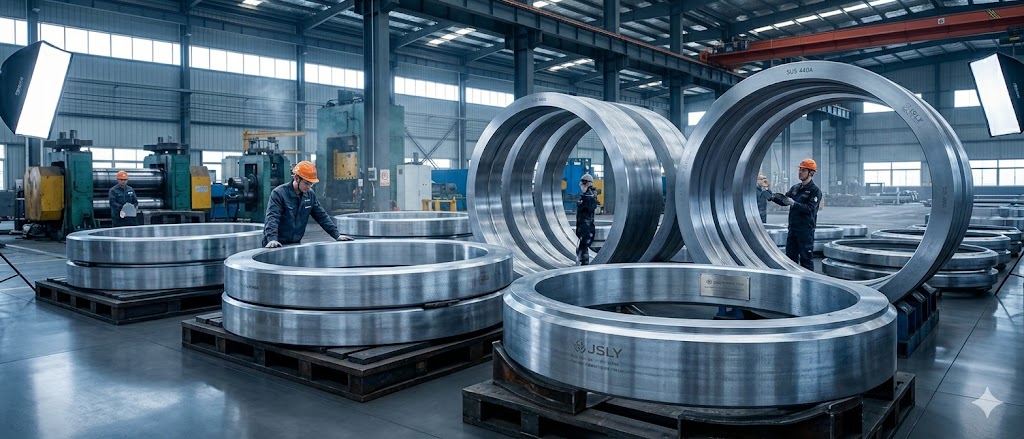
We manufacture custom SUS 440A seamless rolled rings and open die forged rings, with a maximum diameter up to 6 meters and single-piece weight up to 30 tons. Engineered for bearing races, valve seat rings, gear rings and turbine seal rings, with full NDT testing. Wall thickness range: 30 mm to 500 mm; height: 20 mm to 2,000 mm. OD/ID ratio: up to 12:1.
Ring tolerances (as-rolled): OD ±5 mm, ID +8/−0 mm, height ±5 mm, wall thickness ±3 mm or ±3% (whichever is greater). Rough-machined rings: OD/ID ±1 mm, height ±1 mm. Face perpendicularity: ≤ 1.5 mm TIR (as-machined).
UNS S44002 Forged Sleeves and Hollow Components
We produce high-precision UNS S44002 forged sleeves, bushes, housings, shells, hollow bars and seamless pipes, all parts are fully machined to meet your custom requirements. Widely used in valve, pump and hydraulic systems. Bore diameter: 50 mm to 1,200 mm. OD: 80 mm to 2,000 mm. Length: up to 3,000 mm (single piece). ID tolerance (machined): H7 or H8 per ISO 286 standard.
Grade 440A Forged Discs, Plates and Custom Components
We also supply Grade 440A forged discs, disks, blocks, plates, gear shafts, spindles and custom forged components, with complete heat treatment and finishing services. We support fully custom solutions for non-standard shapes. Disc diameter: 100 mm to 4,000 mm; thickness: 30 mm to 800 mm. Custom forged flanges, eccentric forgings, and step shafts available with ≤ ±0.5 mm critical dimension tolerances after CNC machining.
Achievable Surface Finish and Delivery Conditions
| Delivery Condition | Surface Finish (Ra) | Dimensional Tolerance Class | Typical Lead Time Add |
|---|---|---|---|
| As-forged (black scale) | Ra 12.5–50 μm | ±3–5 mm | 0 days |
| Shot-blasted / Descaled | Ra 6.3–12.5 μm | ±3–5 mm | 1–2 days |
| Rough-machined | Ra 3.2–6.3 μm | ±1–2 mm | 5–10 days |
| Semi-finish machined | Ra 1.6–3.2 μm | ±0.3–0.5 mm | 10–15 days |
| Finish machined to drawing | Ra 0.8–1.6 μm | Per drawing (H7/H8 typical) | 15–20 days |
| Precision ground | Ra ≤ 0.4 μm | ±0.01–0.05 mm | 20–25 days |
What Is the Chemical Composition and Mechanical Properties of AISI 440A?
All our AISI 440A forging materials strictly meet the requirements of ASTM A276/A479 standards, and they are fully traceable from steel melting to finished products.
Chemical Composition (per ASTM A276/A479)
| Element | Symbol | Content (%) | Role |
|---|---|---|---|
| Carbon | C | 0.60 – 0.75 | Hardness and wear resistance |
| Chromium | Cr | 16.00 – 18.00 | Corrosion resistance and hardenability |
| Iron | Fe | Balance | Base metal |
| Manganese | Mn | ≤ 1.00 | Deoxidizer and strength enhancer |
| Molybdenum | Mo | ≤ 0.75 | Pitting resistance |
| Phosphorus | P | ≤ 0.040 | Impurity (minimized) |
| Silicon | Si | ≤ 1.00 | Deoxidizer |
| Sulfur | S | ≤ 0.030 | Impurity (minimized) |
Source: ASTM A276/A479; verified against AZoM Grade 440A data.
How Each Alloying Element Works in AISI 440A — Metallurgical Insight
Understanding the role of each element is essential for engineers to specify 440A in important applications. The following is a deeper explanation than what standard data sheets provide, drawn from our metallurgical team’s working knowledge:
- Carbon (0.60–0.75%): The primary hardening element. Carbon dissolves into the iron crystal lattice during austenitizing at 1010–1065°C, then becomes “trapped” during quenching to form the body-centered tetragonal martensite structure. Higher carbon in 440B/440C increases hardness but also increases the volume fraction of chromium carbides, which rob the matrix of free chromium and reduce both corrosion resistance and toughness. 440A’s carbon ceiling at 0.75% is a deliberate engineering decision to preserve this chromium balance.
- Chromium (16–18%): Provides the “stainless” character through a self-healing Cr₂O₃ passive oxide film. In the hardened condition, approximately 1% Cr is consumed for every 0.1% C in the form of M₃₃C₆ carbides. At 0.675% C (midpoint), roughly 6.75% Cr is tied up in carbides, leaving approximately 10.25% free chromium in a 17% Cr heat — still well above the minimum 10.5% needed for stainless behavior. This is the core reason 440A’s corrosion resistance exceeds 440B and 440C in hardened condition.
- Molybdenum (≤ 0.75%): When present, Mo increases pitting resistance by stabilizing the passive film against chloride attack. Mo also refines carbide morphology, distributing smaller, more rounded carbides rather than the coarse, angular Cr₂₃C₆ networks seen in Mo-free heats. Our preferred heats for oil and gas valve applications target Mo at 0.40–0.60% even though the standard only requires ≤ 0.75%. The result is measurably better pitting resistance (higher PREN: see Section 9).
- Manganese (≤ 1.00%): Acts as a deoxidizer during steelmaking and improves hot workability. Mn also bonds preferentially with sulfur to form MnS rather than iron sulfide (FeS); MnS inclusions are less harmful to ductility and toughness. However, Mn above 0.8% can slightly reduce corrosion resistance, so our premium heats target Mn at 0.50–0.70%.
- Silicon (≤ 1.00%): Strong deoxidizer. Reduces the dissolved oxygen content of the melt, preventing porosity. Si also improves the high temperature oxidation resistance, which is beneficial for components operating close to 400 °C. However, excess Si above 0.7% can promote ferrite formation in the annealed structure, reducing hardenability.
Mechanical Properties (Condition-Dependent)
| Property | Annealed | Hardened and Tempered | Test Standard |
|---|---|---|---|
| Tensile Strength | 725 MPa (105 ksi) | up to 1790 MPa (260 ksi) | ASTM A370 |
| Yield Strength (0.2%) | 415 MPa (60 ksi) | up to 1650 MPa (239 ksi) | ASTM A370 |
| Elongation (in 50 mm) | 20% | 5% (varies with temper) | ASTM A370 |
| Reduction of Area | 45% | 15–20% | ASTM A370 |
| Hardness | ≤ 95 HRB | 50 – 56 HRC | ASTM E18 |
| Impact Toughness (CVN) | — | ≥ 20 J (at RT) | ASTM E23 |
| Modulus of Elasticity | 200 – 215 GPa (29 – 31 × 10⁶ psi) | — | |
How Tempering Temperature Controls Final Hardness
One of the most practical — and least documented — aspects of AISI 440A is that the final hardness is directly adjustable by tempering temperature. This makes 440A uniquely flexible for applications where the engineer needs to dial in a specific hardness value. The following data is drawn from our in-house heat treatment records and is consistent with published data from Carpenter Technology:
| Tempering Temperature (°C) | Approximate Hardness (HRC) | Approximate Tensile (MPa) | Typical Application |
|---|---|---|---|
| 150 | 54–56 | 1700–1790 | Maximum wear resistance: gage blocks, precision tooling |
| 200 | 52–55 | 1600–1720 | Cutting blades, forming dies, valve seats |
| 250 | 50–53 | 1520–1650 | Pump shafts, bearing rings, API valve balls |
| 300 | 48–52 | 1430–1590 | General industrial parts requiring toughness + hardness |
| 370 | 46–50 | 1350–1520 | Maximum safe limit before embrittlement zone |
| 370–600 | ⚠ AVOID — Temper embrittlement zone. Reduced impact toughness and corrosion resistance. | ||
| > 600 | 28–38 | 900–1200 | Structural parts requiring maximum toughness, lower wear demand |
Source: ASTM A276/A479; AZoM 440A data; Carpenter Technology 440A data sheet; Jiangsu Liangyi internal production records.
How Is AISI 440A Forged and Heat Treated?
AISI 440A needs strict process control during forging and heat treatment to avoid carbide precipitation, grain coarsening and cracking. Our process system, refined over 25+ years, guarantees optimal performance:
Precision Forging Process
- Controlled Hot Forging Temperature: Strictly between 1050°C and 1150°C, final forging temperature above 850°C. Per AZoM, preheating to 760°C before slowly increasing to forging range is recommended
- Optimal Forging Ratio: Minimum 3:1 for all products, guaranteeing grain refinement and structural density
- Multi-Pass Forging: Controlled multi-directional forging (upsetting and drawing) to break down as-cast dendritic matrix
- Slow Cooling After Forging: Furnace cooling or sand burial to prevent thermal stress cracking, important for sections exceeding 500 mm
Customized Heat Treatment Process
- Annealing: At 840–900°C (1550–1600°F) with slow furnace cooling to reduce hardness to ≤95 HRB
- Quenching: At 1010–1065°C (1850–1950°F), oil or air quench for uniform martensitic transformation
- Tempering: At 150–370°C (300–700°F), adjustable for target hardness. Avoid 370–600°C (temper embrittlement zone)
- Sub-Zero Treatment (Optional): Cryogenic treatment at −73°C to −196°C for maximum dimensional stability
- Full Data Traceability: All heat treatment recorded digitally, furnace uniformity within ±5°C
Due to high carbon (0.60–0.75%) and chromium (16–18%) content, AISI 440A is sensitive to Cr₂₃C₆ carbide precipitation during slow cooling in the 800–500°C range. This “sensitization” reduces intergranular corrosion resistance and toughness. Our controlled process guarantees rapid transition through this important temperature range.
Common Forging Defects in AISI 440A — Causes, Detection and Our Prevention Approach
High-carbon martensitic stainless steels like 440A are more prone to specific forging defects than austenitic grades. The following table documents the most frequently encountered defects in 440A forgings from suppliers without adequate process control, and explains exactly how our 25-year process discipline prevents each one. This information is rarely published and represents genuine manufacturing expertise:
| Defect Type | Root Cause | Detection Method | Our Prevention Measure |
|---|---|---|---|
| Forging cracks (surface) | Forging below 850°C minimum temperature; excessive deformation rate at low temperature; insufficient ingot soaking | Visual inspection; MT (ASTM A275); PT (ASTM E165) | Real-time pyrometer monitoring with automatic press halt below 870°C; minimum 4-hour ingot soak at temperature before first reduction |
| Internal cracks (centerline) | Forging ratio below 2:1; excessive reduction per pass; remaining ingot segregation | Ultrasonic testing (UT per ASTM A388); longitudinal sectioning | Minimum 3:1 forging ratio enforced by production protocol; multi-pass drawing with intermediate reheating above 1050°C |
| Quench cracking | Too-rapid cooling from quench temperature; section size >100 mm with aggressive oil quench; untempered martensite formation | PT; MT; dimensional check (distortion) | Pre-temper within 2 hours of quench; air quench for sections >150 mm; cryo-quench only for <50 mm sections; programmed quench interruption at Ms temperature |
| Carbide network (grain boundary) | Slow cooling through 800–500°C sensitization range after forging or annealing | Metallographic examination (ASTM A262); Charpy impact drop | Mandatory rapid furnace extraction after forging + accelerated sand/vermiculite burial; documented TTT curve compliance |
| Decarburization (surface) | Extended exposure at forging temperature in oxidizing atmosphere; insufficient protective coating | Metallographic section at surface; hardness traverse from surface to core | Controlled-atmosphere furnaces with neutral gas overlay; minimum 3 mm machining stock allowance on all surfaces; hardness gradient testing per lot |
| Hardness non-uniformity | Insufficient forging ratio leaving macro-segregation; non-uniform quench cooling rate in large sections; tempering furnace hot/cold spots | Multiple-point Rockwell/Brinell hardness survey; hardness mapping on cross-section | Homogenization anneal for ingots >3,000 KGS; forced-circulation oil quench; all heat treatment furnaces calibrated with verified temperature uniformity ±5°C, supported by digital thermocouple records retained per batch |
| Overheating / burning | Local temperature exceeding 1180°C; incipient melting at grain boundaries | Metallographic examination (coarse grain, intergranular film); impact test drop | Maximum furnace setpoint 1160°C; independent thermocouple verification of load temperature vs. setpoint; automatic furnace shutdown on over-temp alarm |
Why does this matter when comparing suppliers? Any competent supplier can produce a correct-looking 440A forging certificate. The difference is whether their process actively prevents the defects listed above, or merely hopes they do not appear. Our process discipline — automated temperature logging, mandatory forging ratio records, and lot-by-lot metallographic checks — is documented and available for client audit. We encourage customers sourcing 440A forgings from any supplier to ask specifically: “What is your minimum forging ratio record for this heat?” and “Can I see furnace temperature uniformity survey reports?” These two questions separate real quality systems from paper ones.
What Are the Physical Properties of AISI 440A?
| Property | Value | Unit |
|---|---|---|
| Density | 7.75 | g/cm³ (0.280 lb/in³) |
| Melting Range | 1370 – 1480 | °C (2500 – 2700 °F) |
| Thermal Conductivity (100°C) | 24.2 | W/m·K |
| Thermal Expansion (0–100°C) | 10.2 × 10⁻⁶ | /°C |
| Specific Heat Capacity | 460 | J/kg·K |
| Electrical Resistivity (20°C) | 600 | nΩ·m |
| Modulus of Elasticity | 200 – 215 | GPa |
| Magnetic Properties | Ferromagnetic — magnetic in all conditions | |
Temperature-Dependent Physical Properties
For design engineers calculating thermal stress in service, the following temperature-dependent property data for AISI 440A is critical. These values are not always published in standard data sheets but are essential for FEA modeling of high-temperature or thermally cycled components:
| Temperature (°C) | Thermal Conductivity (W/m·K) | Thermal Expansion Coefficient (×10⁻⁶/°C, cumulative from 20°C) | Modulus of Elasticity (GPa) |
|---|---|---|---|
| 20 (room temp) | 24.9 | — | 215 |
| 100 | 24.2 | 10.2 | 212 |
| 200 | 23.5 | 10.8 | 207 |
| 300 | 22.6 | 11.3 | 200 |
| 400 | 21.9 | 11.7 | 193 |
| 500 | 21.4 | 12.0 | 184 |
Engineering note on thermal expansion: AISI 440A’s coefficient of thermal expansion (CTE) of 10.2–12.0 × 10⁻⁶/°C is approximately half that of austenitic 304 (17.2 × 10⁻⁶/°C). This lower CTE is why 440A is preferred for precision components — gage blocks, turbine seals, valve seats — where dimensional stability across a temperature range is critical. However, it also means that when 440A components are joined to austenitic structures, the thermal expansion mismatch must be accounted for in the joint design to prevent fatigue cracking at the interface.
What Is the Corrosion Resistance of AISI 440A Stainless Steel?
AISI 440A provides moderate corrosion resistance — the highest among the 440 series. According to ATI’s technical data sheet, Types 410, 420, 425 Mod, and 440A exhibit good corrosion resistance to atmospheric corrosion, potable water, and mildly corrosive chemical environments.
The reason 440A outperforms 440B and 440C in corrosion resistance is its lower carbon content. Carbon binds with chromium to form Cr₂₃C₆ carbides; less carbon means more free chromium is available for the protective passive oxide film on the steel surface.
PREN: Pitting Resistance Equivalent Number for AISI 440A
The Pitting Resistance Equivalent Number (PREN) is the most widely used single-number metric for comparing stainless steel pitting corrosion resistance in chloride environments. The formula is: PREN = %Cr + 3.3 × %Mo + 16 × %N.
For AISI 440A at typical composition (17% Cr, 0.5% Mo, ~0% N), the calculated PREN is approximately: PREN = 17 + (3.3 × 0.5) + 0 = 18.7. For heats targeting maximum Mo (0.75%), PREN reaches approximately 19.5. The following table compares 440A against common competitor grades:
| Grade | %Cr (typical) | %Mo (typical) | %N (typical) | PREN (approximate) | Critical Pitting Temp (°C, 3.5% NaCl) |
|---|---|---|---|---|---|
| AISI 304 | 18.2 | 0.1 | 0.06 | ~19.3 | <5 |
| AISI 440A | 17.0 | 0.5 | — | ~18.7 | <0 |
| AISI 440C | 17.0 | 0.5 | — | ~18.7 | <0 (lower due to carbides) |
| AISI 316L | 17.2 | 2.3 | 0.06 | ~25.6 | ~15 |
| 17-4PH (630) | 16.0 | 0.2 | — | ~16.7 | <0 |
| AISI 410 | 12.5 | — | — | ~12.5 | <−10 |
| Duplex 2205 | 22.0 | 3.1 | 0.17 | ~35.4 | ~30 |
What does this PREN comparison tell you? AISI 440A’s PREN of ~18.7 is similar to 304 on paper, but there is a critical difference: 440A’s passive film is harder and more abrasion-resistant due to the martensitic structure. In applications where the corrosion-resistant surface can be abraded away — valve seats, pump wear rings, cutting blades — 440A outperforms 304 and 316 because its passive film regenerates on a hard substrate that does not wear as quickly. The practical lesson: PREN is a good corrosion predictor in static environments, but 440A’s real-world advantage comes from the combination of corrosion resistance + hardness, a combination no austenitic grade can match.
Corrosion Resistance by Environment
| Environment | Rating | Notes |
|---|---|---|
| Atmospheric (dry/rural) | Good | Suitable for indoor and outdoor applications |
| Fresh Water / Potable Water | Good | Suitable for low-chloride water systems |
| Steam | Good | Suitable for turbine and boiler components |
| Mild Organic Acids | Moderate | Short-term contact acceptable |
| Dilute Mineral Acids | Moderate | Limited resistance; verify for specific conditions |
| Petroleum / Oil and Gas | Good | Suitable for sweet service per API 6A |
| Salt Water / Marine | Poor | Not recommended for continuous immersion |
| Strong Acids (HCl, H₂SO₄) | Poor | Not suitable; consider nickel-based alloys |
| Chloride-Rich | Poor | Susceptible to pitting and crevice corrosion |
| Sour Gas (H₂S) | Moderate | Requires NACE MR0175 verification |
To maximize corrosion resistance of AISI 440A: (1) Use in the hardened and tempered condition; (2) Achieve a polished surface finish (Ra ≤ 0.8 μm); (3) Avoid tempering in the 370–600°C range; (4) Apply passivation treatment per ASTM A967 after final machining.
Where Are AISI 440A Forgings Used? — Applications and Global Industry Cases
Oil and Gas Valve Industry (Middle East and North America)
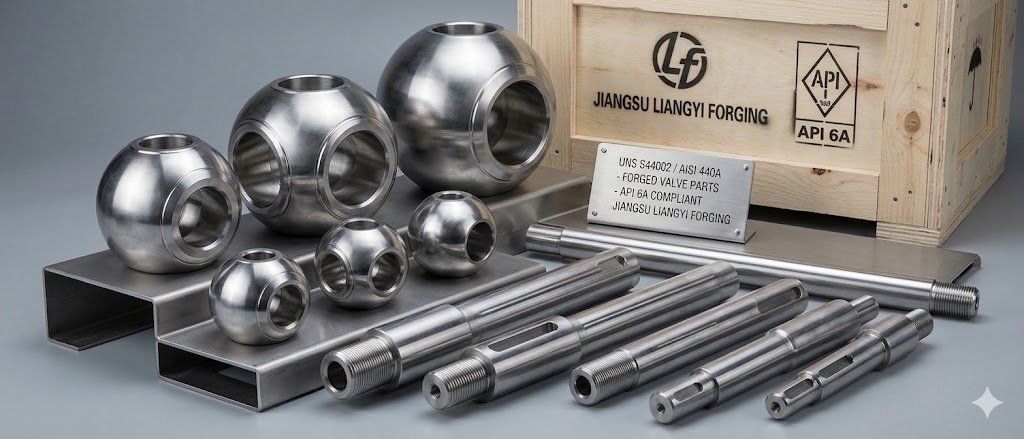
We supplied AISI 440A forged valve balls, valve bodies, valve stems, seat rings and bonnets for critical wellhead and pipeline projects. All products are manufactured to meet API 6A material specification requirements, with proven supply records in Saudi Arabia, UAE, Kuwait, and the USA. (API Monogram is the responsibility of the valve equipment manufacturer; we provide compliant forging materials and full EN 10204 3.1/3.2 documentation to support their certification.)
Technical requirements for this application: hardness 50–54 HRC (for maximum wear on seat contact surface), UT per ASTM A388 on 100% of pieces, surface finish Ra ≤ 0.4 μm on sealing surfaces, dimensional tolerance H7 on bore. Why 440A instead of 440C? Valve bodies over ∅200 mm showed a 28% quench-crack rejection rate in 440C from a previous supplier. 440A eliminated this entirely while maintaining API-required hardness with a 200°C temper.
Power Generation Industry (Asia and Europe)
Custom AISI 440A forged steam turbine blades, impellers, discs and seal rings for thermal and hydroelectric power plants, compliant with EN and ASME standards.
Key technical demands: fatigue life >10⁶ cycles at operating stress, dimensional stability under 450°C steam (within 0.05 mm per 1,000 hours), and Charpy impact ≥ 20 J at +20°C. AISI 440A’s low CTE (10.2 × 10⁻⁶/°C) and high hardness make it superior to 17-4PH for abrasive steam erosion applications at the blade leading edge, while maintaining better toughness than 440C at operating temperature. We apply sub-zero cryogenic treatment (−73°C) for these components to eliminate retained austenite and maximize dimensional stability.
Railway and Locomotive Industry (EU and Russia)
Precision SUS 440A forged transmission shafts and spindles for electric locomotive manufacturers, compliant with EN 10083, with 100% UT testing.
Railway transmission shafts operate under combined bending and torsional cyclic loads at rotation speeds up to 3,600 RPM, with shock loads during starting and braking. The specification requires minimum tensile strength 1,200 MPa with elongation ≥ 8% — a combination only achievable in 440A at tempering temperatures of 280–320°C (achieving approximately 50–52 HRC). EN/DIN 1.4109 was the specified equivalent; we supplied with EN 10204 3.2 third-party verification by Bureau Veritas.
Tool and Die Manufacturing (East Asia and Southeast Asia)
UNS S44002 forged cold forming dies, cutting knives, taps and scrapers for clients in Japan, South Korea and Southeast Asia. Tool service life extended by 30%+ versus standard tool steel.
Cold forming dies for copper and aluminum wire drawing are a demanding application: the die bore experiences high compressive contact stress per cycle. 440A at 54–56 HRC provides sufficient hardness for die life while maintaining enough toughness to survive the edge impact that D2 tool steel frequently fails at. Our clients who transitioned from D2 to 440A forgings reported meaningful die life improvements based on cycles-to-replacement data across their production lines — a result consistent with the metallurgical expectation that forged 440A’s fine, homogeneous carbide distribution outperforms D2 in cyclic-contact wear scenarios.
Petrochemical and Pump Industry (Southeast Asia and Australia)
AISI 440A forged pump casings, impellers, pump shafts, wear rings and housings for petrochemical and mining projects. Full material documentation to support customers’ AS/NZS standard requirements available upon request.
Slurry pump components handling abrasive mineral particles in pH 4–7 process water require a material that combines moderate acid resistance with very high surface hardness. 440A at 52–54 HRC outperforms 316L (hardness ~170 HV, ~87 HRB) by a factor of approximately 5× in abrasive wear resistance in slurry conditions with <50 ppm chloride content. Where chloride exceeds 100 ppm, we recommend duplex 2205 or 316L with hard-chrome overlay instead.
Precision Instrument and Aerospace Applications (USA and EU)
Grade 440A forged gage blocks, precision instrument shafts, gyroscope components and aerospace structural parts manufactured to AMS 5631/5632 material chemistry and property requirements, with complete heat treatment process records, furnace temperature uniformity data, and full material traceability documentation available for customer review.
Aerospace and precision instrument applications prioritize dimensional stability as much as mechanical performance. AISI 440A’s combination of high hardness (resisting surface deformation) and low CTE (minimizing thermal dimensional change) makes it a preferred choice for precision measuring equipment, gyroscope housings, and optical instrument mounts where ≤ 1 μm dimensional drift over the operating temperature range is required. We achieve this through mandatory sub-zero cryogenic treatment at −73°C to −196°C to convert retained austenite (<2% residual target) before final precision grinding.
Additional applications include: ball bearings, gage blocks, cutlery, measuring instruments, fuel nozzles, shear blades, gear shafts, surgical instruments, dental instruments, molds and dies, aircraft structural parts, and food processing equipment.
Which Standards Do Our AISI 440A Forgings Comply With?
North America (USA and Canada)
Materials manufactured to ASTM A276/A479, AMS 5631/5632, ASME material specifications. Full material test reports provided. Third-party inspection by SGS / Bureau Veritas / Lloyd’s available upon customer request and arrangement. NACE MR0175 material documentation available for sour service applications.
European Union
Materials manufactured to EN, DIN standard requirements. EN 10204 3.1/3.2 material test reports available. CE marking and PED (2014/68/EU) conformity assessment are the responsibility of the equipment manufacturer; we provide full material documentation to support their compliance process.
Middle East and Africa
Materials manufactured to API 6A material requirements. Anti-sulfur (NACE MR0175) material documentation available. Supply history: Saudi Arabia, UAE, Kuwait, Qatar, Oman.
East Asia (Japan, South Korea)
Compliant with JIS G4303 for SUS 440A. Strict JIS-grade inspection for precision machinery.
Southeast Asia and Oceania
Material documentation to support AS/NZS standard requirements. Shipping to Sydney, Melbourne, Singapore, Jakarta.
South America
Support ABNT/NBR (Brazil), NCh (Chile), IRAM (Argentina). DDP door-to-door available.
How Do We Ensure Quality of AISI 440A Forgings?
Full-Process Quality Control System
- Raw Material Inspection: OES spectral analysis, inclusion testing (ASTM E45), grain size inspection (ASTM E112)
- Forging Process Control: Pyrometer temperature monitoring, forging ratio verification, real-time data logging
- Heat Treatment Verification: Hardness testing (ASTM E18/E10), metallographic examination, mechanical testing (ASTM A370/E23)
- Finished Product Inspection: 100% dimensional check (CMM), surface quality (visual + Ra), comprehensive NDT
Core Testing Standards
- ASTM E18: Rockwell Hardness Testing (HRC/HRB)
- ASTM E10: Brinell Hardness Testing
- ASTM A370: Mechanical Testing (Tensile, Yield, Elongation)
- ASTM E23: Charpy V-Notch Impact Testing
- ASTM E45: Inclusion Content Determination
- ASTM E112: Average Grain Size Determination
- ASTM A262: Intergranular Corrosion Testing (where required)
- ASTM A967: Passivation Treatment Verification
- ASTM E837: Residual Stress Testing
- AMS 2315: Delta Ferrite Content Determination
- NDT: 100% UT (ASTM A388/EN 10228-3), optional MT (ASTM A275), PT (ASTM E165), RT
All products are supplied with EN 10204 3.1 material test reports including full traceability, heat analysis, mechanical results, heat treatment records, NDT results, and dimensional confirmation. EN 10204 3.2 documents with third-party witness inspection (SGS, Bureau Veritas, Lloyd’s, TUV) available upon customer request and at customer’s arrangement.
What Custom Forging Services Do We Offer for AISI 440A?
- Flexible MOQ: From 30 KGS prototypes to 30,000 KGS bulk production
- Lead Time: 15-25 days standard, 30-45 days custom, expedited service available
- Engineering Support: Free drawing review, process optimization, material selection, FEA simulation
- Trade Terms: EXW, FOB, CIF, CFR, DDP, DAP with door-to-door delivery
- Machining Service: Rough, semi-finish and finish machining on CNC centers
- Account Management: Dedicated project manager for each client
How to Weld and Machine AISI 440A Stainless Steel?
Welding Recommendations
- Pre-Heat: To 200–300°C. Per AZoM, preheating to 260°C and post-weld treating at 732–760°C for 6 hours followed by slow furnace cooling is recommended
- Filler Metal: Matching 440A filler or AWS 309/310 austenitic stainless steel filler
- PWHT: Temper immediately at 150–370°C. Do not cool below 150°C before PWHT
- Interpass Temperature: 200–300°C to prevent untempered martensite
- AISI 440A tends to air harden. For critical applications, forging is always preferred over welding
Machining Guidelines and Recommended Parameters
AISI 440A is generally described as “machinable with care,” but this description understates the practical complexity. The machinability behavior of 440A changes dramatically between its annealed and hardened conditions. The following parameters are drawn from our in-house CNC machining experience and discussions with our tooling suppliers:
- Annealed Condition: Machine at ≤95 HRB. Per AZoM, carbide or ceramic tooling with chip breakers recommended
- Tool Selection: Carbide inserts (C2/C3) or CBN tools for best results
- Cutting Parameters: Turning 40–60 m/min (carbide), feed 0.1–0.3 mm/rev, depth 1–3 mm
- Hardened Machining: CBN or ceramic inserts, 15–25 m/min, 0.1–0.5 mm depth of cut
- Grinding: Aluminum oxide or CBN wheels. Low forces to prevent grinding burn
- Surface Finish: Achievable Ra 0.8 μm or better
| Operation | Condition | Tool Material | Speed (m/min) | Feed (mm/rev or mm/tooth) | Depth of Cut (mm) | Coolant |
|---|---|---|---|---|---|---|
| Turning (roughing) | Annealed (~85 HRB) | Carbide C2/C3 (ISO P20–P30) | 55–75 | 0.25–0.40 | 2–5 | Soluble oil, flood |
| Turning (finishing) | Annealed (~85 HRB) | Carbide C3/Ceramic | 65–90 | 0.10–0.20 | 0.5–1.5 | Soluble oil, flood |
| Turning (roughing) | Hardened (50–56 HRC) | CBN (PCBN, low-binder) | 20–35 | 0.10–0.20 | 0.3–0.8 | Dry or MQL |
| Turning (finishing) | Hardened (50–56 HRC) | CBN (PCBN) | 15–25 | 0.05–0.10 | 0.1–0.3 | Dry |
| Face milling | Annealed | Carbide inserts (ISO P25) | 45–65 | 0.10–0.20 per tooth | 1–3 | Flood coolant |
| Drilling | Annealed | Solid carbide TiAlN-coated | 15–25 | 0.05–0.15 | Full diameter | Through-tool coolant preferred |
| Boring | Annealed | Carbide C2 with positive rake | 50–70 | 0.10–0.20 | 0.5–2 | Flood coolant |
| Cylindrical grinding | Hardened (52–56 HRC) | Cubic boron nitride (CBN) wheel | 25–35 m/s (wheel) | 0.002–0.005 per pass | ≤ 0.02 per pass | Flood (water-based) |
| Surface grinding | Hardened | Al₂O₃ or CBN wheel (46–60 grit) | 20–30 m/s (wheel) | 0.003–0.008 per pass | ≤ 0.02 per pass | Flood (water-based) |
| Tapping | Annealed | HSS-E (cobalt 8%), TiCN coated | 5–10 | Per thread pitch | — | Cutting oil (sulfurized) |
| EDM (wire/sinker) | Any | EDM wire / electrode | — | — | — | Dielectric fluid |
Three machining pitfalls we see most often with 440A:
- Grinding burn on hardened 440A: Excessive wheel pressure or insufficient coolant flow causes localized surface heating above 160°C, creating a white-layer (re-austenitized and re-quenched martensite) that is extremely brittle and has reduced corrosion resistance. Prevent by using sharp CBN wheels, limiting depth per pass to 0.02 mm, and verifying with nital etch inspection (ASTM F2269).
- Work hardening during annealed machining: 440A work-hardens less aggressively than 304/316 but still noticeably. Use positive-rake geometry inserts and maintain consistent feed — dwelling the tool with no feed creates a hardened layer that dramatically shortens tool life on the next pass.
- Thread quality on hardened 440A: Conventional tapping after hardening is generally not feasible. We recommend thread-rolling (for outside threads) or EDM (for blind bores) on hardened components. If threads must be cut before hardening, specify a tempering-stable thread tolerance that accounts for the approximately 0.05–0.08 mm dimensional change during heat treatment.
Surface Treatment and Post-Processing Options for AISI 440A Forgings
After forging and heat treatment, the surface condition of AISI 440A components is a critical final step that directly determines real-world corrosion resistance and wear life. Unlike austenitic grades where the as-machined surface usually suffices for most environments, 440A forgings frequently benefit from targeted post-processing because the martensitic surface — while very hard — contains microstructural features (carbide exposures, machining stress layers) that can initiate corrosion if untreated.
| Treatment | Process | Key Benefit | Limitation | Typical Application |
|---|---|---|---|---|
| Passivation | Nitric acid or citric acid bath per ASTM A967 | Removes free iron contamination; restores and strengthens Cr₂O₃ passive film; low cost | Does not increase hardness or change dimensions; not effective in strong chloride environments | Standard post-machining treatment for all 440A components; mandatory for food/pharma and medical applications |
| PVD TiN Coating | Physical vapor deposition, titanium nitride, 2–5 μm thick | Surface hardness up to 2,300 HV; reduced friction coefficient (0.4–0.5 vs. 0.6–0.8 uncoated); gold color improves aesthetics | Limited corrosion resistance improvement; coating above 500°C degrades; edge rounding needed before coating | Cutting blades, valve balls, forming dies requiring low friction |
| PVD TiAlN Coating | Titanium aluminum nitride, 2–5 μm, PVD process | Stable to 800°C (vs. TiN’s 500°C); higher hardness (~3,300 HV); excellent oxidation resistance | Slightly higher cost than TiN; grey-black color | High-temperature valve components, turbine wear surfaces, precision tooling |
| PVD CrN Coating | Chromium nitride, 2–8 μm | Best corrosion resistance among PVD coatings; hardness ~1,800 HV; good in marine and chemical environments | Lower hardness than TiAlN; limited to 700°C service temperature | Pump shafts, valve stems in mildly corrosive media, food processing equipment |
| Electroless Nickel (EN) | Autocatalytic Ni-P deposit, 10–50 μm per ASTM B733 | Uniform deposit on complex shapes; Ni-P at 10–12% P achieves ~1,000 HV after heat treatment; corrosion resistance improvement | Requires precise temperature control; adhesion on 440A requires thorough activation; adds dimensional thickness | Valve internals, hydraulic fittings, food processing parts needing corrosion + wear |
| Precision Polishing | Mechanical polishing to Ra ≤ 0.1 μm; electrolytic polishing (ASTM B912) to Ra ≤ 0.05 μm | Eliminates surface asperities that nucleate pitting corrosion; reduces friction in sliding contacts; improves cleanability | Cost-intensive; mechanical polishing introduces surface stress; electropolishing removes 10–30 μm of material | Sealing surfaces, surgical instruments, food/pharma contact surfaces, precision gage surfaces |
| Sub-Zero / Cryogenic Treatment | −73°C to −196°C (dry ice or liquid nitrogen), 8–24 hours | Converts retained austenite (<2% residual); improves dimensional stability; slight hardness increase (1–2 HRC); improved wear resistance | Not a corrosion treatment; must be performed before tempering or before final grind; adds 2–3 days lead time | Precision gage blocks, bearing rings, turbine seals, gyroscope components |
Our recommendation for standard industrial 440A components: Passivation per ASTM A967 (citric acid method preferred over nitric acid for environmental and safety reasons) is the minimum acceptable post-machining treatment. For components in API sweet service or mildly corrosive petroleum environments, add PVD CrN or electroless nickel on sealing/wear surfaces. For high-precision dimensional components such as turbine seals or gage blocks, cryogenic treatment before final grinding is mandatory in our production process.
Material Selection Guide: When to Choose AISI 440A vs. Key Alternatives
Material selection for high-performance forged components involves balancing four competing requirements: corrosion resistance, mechanical strength, wear resistance, and manufacturability. The following decision framework is based on our engineering team’s 25 years of consultation with global clients across oil and gas, power generation, aerospace, and industrial tooling:
| Requirement | AISI 440A | AISI 440C | 17-4PH (630) | AISI 316L | Duplex 2205 |
|---|---|---|---|---|---|
| Max hardness achievable | 56 HRC | 60 HRC | 44 HRC (H900) | ~87 HRB | ~32 HRC |
| Tensile strength (max) | 1790 MPa | 1970 MPa | 1310 MPa | 515 MPa | 620 MPa |
| Corrosion resistance | Moderate | Low | Good | Very Good | Excellent |
| Forgeability (complex shapes) | Excellent | Fair | Excellent | Very Good | Good |
| Wear resistance | Very Good | Excellent | Good | Poor | Fair |
| Cost index (relative) | 1.0 | 1.0–1.1 | 1.4–1.6 | 1.1–1.3 | 1.5–1.8 |
| Weldability | Fair | Very Poor | Good | Excellent | Good |
| Max useful section (forging) | >1,000 mm | ~400 mm | >1,000 mm | >1,000 mm | >1,000 mm |
| Magnetic | Yes | Yes | Yes (mostly) | No | Yes |
| NACE MR0175 sour service | Limited (check) | Not recommended | Yes (some cond.) | Yes | Yes |
Decision Guide: Which Grade for Your Application?
- Choose AISI 440A when: You need hardness 50–56 HRC + moderate corrosion resistance + complex forging geometry + cost-effective solution. Ideal: API valves, pump shafts, turbine seals, precision tooling, railway components.
- Choose AISI 440C when: You need the absolute maximum hardness (58–60 HRC) and the part geometry is simple (thin section, flat, small diameter <150 mm). Ideal: knife blades, gage blocks, ball bearings. Do not use 440C for complex large forgings — cracking risk is unacceptably high.
- Choose 17-4PH (630) when: You need high strength + good corrosion resistance + complex shape + weldability. Ideal: aerospace fasteners, hydraulic cylinders, offshore structural components. Premium cost justified by versatility.
- Choose AISI 316L when: The main requirement is corrosion resistance and there is no need of hardness >30 HRC. It is the best choice for chemical processing equipment, marine fittings, food industry tanks
- Choose Duplex 2205 when: You need superior corrosion resistance (especially chloride pitting) + high strength + NACE MR0175 compliance. Ideal: offshore subsea hardware, desalination equipment, highly corrosive chemical service.
Our engineering team provides free material selection consultation for customers unsure which grade suits their application. Send your operating conditions, environment, required hardness, and part geometry to sales@jnmtforgedparts.com and receive a written recommendation within 48 hours.
Frequently Asked Questions About AISI 440A Forgings
AISI 440A is a high-carbon martensitic stainless steel containing 0.60-0.75% carbon and 16-18% chromium. It provides moderate corrosion resistance, excellent strength, good forgeability, and can achieve hardness up to 56 HRC after quenching and tempering. It is equivalent to SUS 440A (JIS), UNS S44002 (UNS), X70CrMo15 / 1.4109 (DIN/EN), and 7Cr17 (GB).
The core difference is carbon content: 440A (0.60-0.75% C) has the best corrosion resistance, forgeability and toughness; 440B (0.75-0.95% C) has higher hardness (55-59 HRC) but lower toughness; 440C (0.95-1.20% C) has maximum hardness (58-60 HRC) and wear resistance but poorest forgeability. 440A is preferred for most forging applications.
Annealed: maximum 95 HRB. After quenching and tempering: 50-56 HRC, customizable by adjusting tempering temperature between 150°C and 370°C.
Yes. AISI 440A has excellent forgeability compared to 440B and 440C. It can be hot forged between 1050°C and 1150°C, with final forging above 850°C. It can form bars, rings, shafts, sleeves and custom parts. Slow cooling after forging is essential.
Our forged parts are made to comply with main global material standards: ASTM A276/A479 for the US market, AMS 5631/5632 for aerospace chemical and mechanical property rules, EN/DIN European standards, JIS G4303 and API 6Afor oil and gas service. We supply full EN 10204 3.1/3.2 material inspection certificates, and our production is fully covered under the ISO 9001:2015 quality management system.
Yes. We manufacture per your 2D/3D drawings with full engineering support. From 30 KGS prototypes to 30,000 KGS production pieces, with 120,000 tons annual capacity.
Standard products: 15-25 days. Custom complex forgings: 30-45 days. Expedited service available.
Three stages: (1) Annealing at 840-900°C; (2) Quenching at 1010-1065°C; (3) Tempering at 150-370°C for 50-56 HRC. Optional cryogenic treatment available. All recorded with ±5°C furnace uniformity.
Yes. AISI 440A is ferromagnetic in all conditions. Its martensitic crystal structure is inherently magnetic, unlike austenitic grades (304, 316).
Yes, with precautions: pre-heat to 200-300°C, use AWS 309/310 filler, apply immediate PWHT at 150-370°C. For critical applications, forging is preferred.
AISI 440A offers moderate corrosion resistance, the best among the 440 series (440A > 440B > 440C). It resists atmospheric corrosion, fresh water, mild chemicals and steam. Not suitable for strong acids or chloride-rich environments. Maximum corrosion resistance is achieved in the hardened/tempered condition with a polished surface.
Contact Us for Custom AISI 440A Forging Solutions
Jiangsu Liangyi Co., Limited is a top manufacturer of open die forgings and seamless rolled rings in China. We have more than 25 years of experience supplying premium AISI 440A forging parts to customers in more than 50 countries around the world. We can provide standard forged bars and rolled rings and custom complicated parts. We deliver cost-effective, high-quality solutions with short delivery cycles and comprehensive professional technical support.
Send your custom drawings, material requirements and quantity details to get a detailed quotation within 24 hours.
Inquiry Email: sales@jnmtforgedparts.com
Phone / WhatsApp: +86-135-8506-7993
Website: www.jnmtforgedparts.com
Factory: Chengchang Industry Park, Jiangyin City, Jiangsu Province, China 214400
Hours: Monday – Saturday, 8:00 AM – 6:00 PM (CST, GMT+8)