Why AISI 304LN Was Developed: The Engineering Story Behind the Grade
To specify 304LN correctly, an engineer first needs to understand why the grade exists at all. The answer lies in a chain of trade-offs that 304 and 304L could not resolve on their own. Standard AISI 304, introduced commercially in the 1920s as the workhorse 18-8 austenitic, has 0.08% maximum carbon. When a 304 weldment cools through the 450–850°C range — the so-called sensitization window — chromium combines with that carbon to precipitate Cr₂₃C₆ carbides at grain boundaries. The carbide-rich boundaries are surrounded by chromium-depleted zones (typically <12% Cr) that no longer form a passive film, and the heat-affected zone of the weld becomes vulnerable to intergranular corrosion (IGC) in service.
By the late 1940s the answer seemed obvious: lower the carbon. AISI 304L capped carbon at 0.03%, which kept it below the carbide solubility limit at room temperature and prevented sensitization. The downside surfaced quickly — 304L's room-temperature minimum yield strength dropped from 205 MPa (for 304) to 170 MPa, a 17% loss. For thin-gauge sheet that was acceptable, but for thick-section pressure vessel walls, wellhead bodies, and pump casings, the strength penalty translated directly into wall thickness, weight, and cost.
The breakthrough came from interstitial-strengthening research conducted by stainless-steel producers and national laboratories during the 1960s and 1970s. Nitrogen, like carbon, dissolves interstitially in austenite — but unlike carbon, nitrogen does not form chromium-depleting carbides at grain boundaries within the standard mill-anneal-and-quench condition. A controlled addition of 0.10–0.16% N delivered roughly 80–110 MPa of solid-solution strengthening, restoring the yield strength to 205 MPa and pushing tensile strength to 515 MPa minimum. Nitrogen also stabilized the austenite phase against deformation-induced martensite at sub-zero temperatures, dramatically improving cryogenic toughness. The grade was codified in the U.S. as UNS S30453, in Japan as SUS 304LN (JIS G 4303), and in Europe as 1.4311 / X2CrNiN18-10.
The Three-Way Trade-off That 304LN Solves
When practicing metallurgists evaluate which grade fits a given application, they balance three properties that historically pulled in different directions:
| Property Dimension | AISI 304 | AISI 304L | AISI 304LN |
|---|---|---|---|
| Post-weld IGC resistance | Poor (sensitization risk) | Excellent | Excellent |
| Room-temp yield strength | 205 MPa min | 170 MPa min | 205 MPa min |
| Cryogenic toughness (−196°C) | Acceptable | Good | Excellent |
| Magnetic permeability after cold work | Rises noticeably | Rises moderately | Stays <1.005 |
| Net engineering verdict | Strong but weld-restricted | Weldable but weak | Strong AND weldable AND tough |
Why Nitrogen Works Where Carbon Failed
The important metallurgical detail — and one we explain to first-time 304LN buyers regularly — is that nitrogen and carbon both solid-solution strengthen austenite by similar amounts per atomic percent. The difference is in their precipitation behavior. At sensitization temperatures, carbon partitions to grain boundaries and forms M₂₃C₆ carbides; nitrogen requires far longer times and higher concentrations to form Cr₂N nitrides, and the equilibrium phase diagram for Fe-Cr-Ni-N at 18-8 chemistry simply does not have a thermodynamic driving force for chromium nitride precipitation under normal service exposure. In practical terms: a 304LN forging that has been properly solution-annealed at 1040–1080°C and water-quenched will retain its corrosion resistance even after multi-pass welding, whereas a 304 forging in the same condition will require post-weld solution annealing — an enormous cost penalty for large fabrications.
Industries That Drove 304LN Adoption
- Nuclear power (1970s–1980s): Reactor coolant pump casings and pressurizer nozzles needed weldable, non-magnetic, high-strength stainless that could survive 60-year design lives without sensitization. 304LN was specified into ASME Section III Nuclear Code Case N-60 as one of the approved Class 1 austenitic forging grades.
- LNG and cryogenic process (1980s–present): The boom in liquefied natural gas trains demanded valve bodies, flanges, and pump parts with verified Charpy V-notch impact ≥ 41 J at −196°C. 304LN's nitrogen-stabilized austenite delivers it without the cost of 9% nickel steel.
- Subsea oil & gas (1990s–present): API 6A wellhead manufacturers adopted 304LN for sour-service-resistant trim parts qualified to NACE MR0175 / ISO 15156, where the 22% maximum hardness rule (HRC 22 max in solution-annealed condition) is naturally satisfied by 304LN.
- Pulp and paper digester equipment: 304LN replaced 304L for tube sheets and forged nozzles where the hot caustic/sulfide environment, combined with welding stress, caused premature 304L cracking.
Knowing this history matters in procurement: when a designer writes "304" on a drawing destined for welded pressure equipment, asking whether 304LN is more appropriate is one of the highest-leverage questions a buyer can ask. In our 25+ years supplying forgings, the cost premium of 304LN over 304L is typically 4–8% on raw material — a small fraction of the welded fabrication cost it can save.
Jiangsu Liangyi Co.,Limited is your trusted ISO 9001:2015 certified China manufacturer of high-performance AISI 304LN (UNS S30453) forged parts, producing custom stainless steel forgings to ASTM, API, ASME, NACE, EN, and JIS specifications, with 25+ years of experience supplying clients in 50+ countries worldwide.
- ISO 9001:2015 & API 6A Certified Manufacturer with 25+ Years Forging Experience
- Custom AISI 304LN Forgings from 30KG to 30,000KG, Compliant with ASTM/API/DIN/EN/JIS Standards
- 80,000㎡ Modern Factory in Jiangyin, Jiangsu, China, 120,000 Tons Annual Capacity
- Full-Process Quality Control, EN 10204 3.1/3.2 Mill Test Certificates Provided for All Orders
- Global Export to 50+ Countries, Serving Oil & Gas, Valve, Nuclear Power Industries
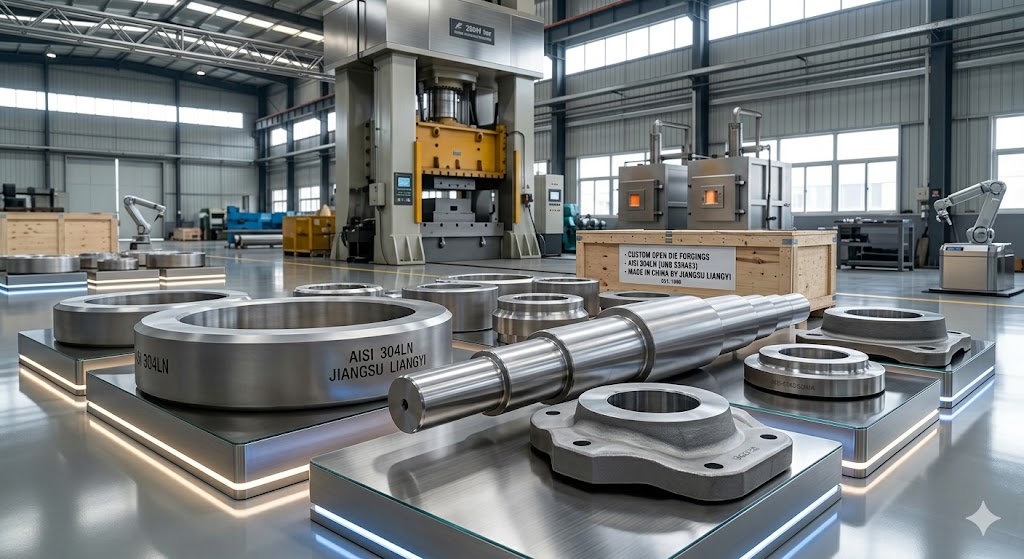
AISI 304LN (UNS S30453) Forged Parts Overview
Established in , Jiangsu Liangyi Co.,Limited is a professional ISO 9001:2015 certified manufacturer and supplier of AISI 304LN (also known as UNS S30453, Grade 304LN, SUS 304LN, TP 304LN) open die forgings and seamless rolled rings from our 80,000㎡ state-of-the-art factory in Jiangyin City, Jiangsu Province, China.
AISI 304LN is a low-carbon, high-nickel and nitrogen-alloyed austenitic stainless steel, an upgraded alternative to standard 304 stainless steel with significantly improved tensile strength, low-temperature toughness, and corrosion resistance. Thanks to its fully austenitic matrix, this material is the best choice for applications needing low magnetic permeability (µ < 1.005). With an annual manufacturing capacity of 120,000 tons, we supply custom AISI 304LN forged parts ranging from 30 KG to 30,000 KG to global clients across oil & gas, nuclear power, valve manufacturing, pump, and process industries worldwide.
Need custom AISI 304LN forged parts for your project? Send your CAD drawings for a free, no-obligation quote!
Get Free Quote NowCustom AISI 304LN Forged Product Forms
We manufacture a full range of custom UNS S30453 forged parts in various shapes and specifications strictly according to international standards and client CAD drawings. Each form below includes the typical size envelope we routinely produce, the forging route we use, and the machining or post-processing considerations our customers most frequently ask about.
AISI 304LN Forged Bars & Rods
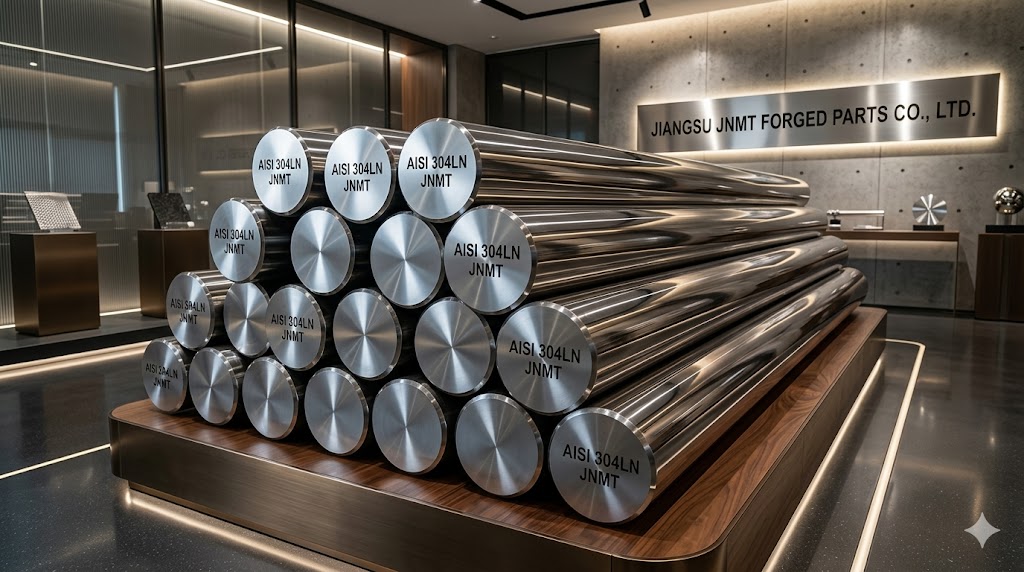
AISI 304LN forged round bars, square bars, flat bars, rectangular bars, step shafts, gear shafts, crank shafts, and custom rod profiles for industrial applications.
Typical envelope we produce: round bars Ø80 mm to Ø1,200 mm, length up to 8,000 mm; square and flat bars 100×100 mm to 600×800 mm cross-section. Forging route: upset-then-cog on a 4,000 T or 6,300 T hydraulic press from a continuously cast or remelted billet, finishing with a calibration pass to achieve straightness within 1.5 mm/m. Solution annealing: 1,050°C ± 10°C, soak 1 hour per 25 mm of section, water quench within 60 seconds of furnace exit. Machinability note: 304LN has 15–20% lower machinability rating than free-machining 303, so we recommend customers specify roughing stock allowance of 4–6 mm per side on diameters up to Ø300 mm and 8–10 mm per side above; cutting speed for carbide tooling should sit around 100–140 m/min with copious flood coolant to avoid work-hardening of the surface.
UNS S30453 Forged Rings & Flanges
UNS S30453 seamless rolled rings, gear rings, slewing bearing rings, contoured rolled rings, forged flanges, double studded adapter flanges, integral mud flanges, flanged outlets, studded crosses, and custom ring parts.
Typical envelope: outside diameter Ø300 mm to Ø5,000 mm, height 50 mm to 1,200 mm, wall thickness 30 mm to 600 mm, single-piece weight up to 12,000 KG. Process: billets are upset, pierced with a punch, then ring-rolled on our 1 m / 3 m / 5 m radial-axial mills with continuous infrared temperature monitoring (target finish-roll temperature 950–1,000°C). Why ring-rolled rather than cut from plate: seamless rolled rings have a fully circumferential grain flow that gives roughly 30–40% higher hoop fatigue strength than ring forgings cut from plate, which is why API 6A wellhead bodies, nuclear pump containment rings, and large-diameter flanges are specified as forged rings rather than fabricated. Inspection: 100% UT scanning per ASTM A388 with single back-wall echo plus straight-beam coverage, plus 100% PT on machined surfaces per ASTM E165.
Grade 304LN Forged Housings & Hollow Components
Grade 304LN forged hubs, shells, sleeves, bushes, casings, hollow bars, pump barrels, valve bodies, housings, and custom hollow forgings for pump and valve industries.
Process specifics: hollow parts below Ø600 mm bore are typically trepanned after solid forging, while larger bores (Ø600 mm to Ø2,200 mm) are pierced and mandrel-forged to produce a thick-walled hollow that is then bored and turned. The advantage of mandrel forging over weld-fabrication is the absence of HAZ — an important concern for sour-service and cryogenic housings where any sensitization or weld-deposit contamination could compromise corrosion resistance. Wall thickness range: 25 mm to 350 mm finished. Typical applications: centrifugal pump barrels for produced-water injection, multistage pump diffuser cartridges, ball-valve bodies for −46°C service, and nuclear-grade pump suction housings.
SUS 304LN Forged Discs, Plates & Blocks
SUS 304LN forged discs, disks, blocks, plates, tube sheets, baffle plates, and custom flat forgings for heat exchanger and pressure vessel applications.
Why forged rather than rolled plate: for tube sheets thicker than 150 mm and discs above Ø800 mm, forged plate gives a tighter through-thickness mechanical-property scatter (typically <5% variation between near-surface and mid-thickness coupons) than hot-rolled plate, which can show 10–15% scatter in heavy gauges. This matters for ASME Section VIII Division 2 and Division 3 designs that require certified through-thickness toughness. Typical envelope: diameter up to Ø3,500 mm, thickness 50 mm to 600 mm, single-piece weight to 18,000 KG. Drilling for tube sheets: our partner machine shops drill up to 3,000 holes Ø19–32 mm with positional tolerance ±0.15 mm per TEMA-RCB requirements.
TP 304LN Forged Pipe & Tubing Components
TP 304LN forged pipes, tubes, tubing shells, piping barrels, nozzles, channel flanges, and custom tubular forgings for oil & gas and chemical processing industries.
Process: heavy-wall seamless pipe sections are produced by piercing a forged billet on a vertical hydraulic press, then drawing or roll-elongating to length; very large nozzles (Ø500 mm to Ø1,200 mm with 80–250 mm wall) are forged as integral hollow bodies and machined to TEMA tolerance. Why this matters: NACE MR0175 sour service nozzles cannot have weld seams in the wetted bore, and ASME B31.3 high-pressure piping nozzles above NPS 16" Schedule 160 are difficult to source as seamless pipe — forged hollow nozzles solve both constraints simultaneously.
Custom Profiles & Specialty Forgings
Beyond the five standard forms above, we routinely produce custom-profile 304LN forgings to client drawings: stepped shafts with integral flanges, T-section forgings for boiler headers, Y-pieces for branch connections, hex-and-octagon bar stock for tooling, conical adapters for transition spools, and contoured ring forgings whose finished cross-section mimics the final part to minimize machining waste. For high-value parts where buy-to-fly ratio matters, we offer near-net-shape closed-die or contoured open-die routes that reduce machining stock removal by 30–60% versus conventional rectangular billet forging.
Metallurgy & Hot Forging Behavior of AISI 304LN
The forging response of 304LN differs in important ways from carbon-steel forgings — and even from standard 304/304L. The added nitrogen, low carbon, and fully austenitic structure all change how the material flows under the hammer, how it recrystallizes, and how it must be cooled. Engineers specifying 304LN forgings benefit from understanding these constraints because they directly affect achievable size, achievable grain size, and achievable lead time. The data below is drawn from our internal forging trials and production records, calibrated against open-literature flow-stress curves for AISI 304-family austenitics.
Forging Temperature Window
304LN has a narrower hot-working window than carbon steel. The upper limit is constrained by incipient melting and by δ-ferrite formation at very high temperatures; the lower limit is constrained by the rapid rise in flow stress and by the loss of dynamic recrystallization (DRX) below the solvus temperature. Our production windows:
| Stage | Temperature Range | Engineering Reason |
|---|---|---|
| Heating / soaking | 1,180–1,230°C | Dissolve carbides & nitrides, achieve uniform γ |
| Initial forging (start-of-stroke) | 1,150–1,200°C | Maximize DRX, minimize flow stress |
| Finish forging (last reduction) | 950–1,000°C | Refine grain via metadynamic recrystallization |
| Forging stop (re-heat trigger) | ≤ 920°C | Below this, re-heat to avoid surface cracking |
| Avoid range | 600–800°C | Sigma- and Cr₂N-precipitation risk if held |
Section sizes above 600 mm thickness require a multi-heat forging schedule because in-press cooling drops the surface temperature below the finish-forge limit before the geometry is achieved. Our 6,300 T press can deliver 120 mm of compression in a single stroke on a 1,000 mm-tall billet, but the practical limit before re-heating is roughly 180 mm of cumulative reduction at the 30–40 strokes-per-minute cadence we use for 304LN.
Flow Stress & Reduction Ratio
Compared to AISI 4140 or A350 LF2 carbon steels at the same temperature, 304LN flow stress is roughly 1.4–1.7× higher in the 1,100–1,200°C range. This means a forging that takes 8,000 kN per square meter of contact area in carbon steel will demand 11,000–14,000 kN/m² in 304LN. Our minimum specified forging reduction ratio is 3:1 per ASTM A788 — the ratio of original cross-section to final cross-section — and for high-integrity service (nuclear, sour service, cryogenic) we typically forge to 4:1 or 5:1 to ensure complete dendritic break-up and grain refinement.
Grain Size Control
Final grain size in 304LN forgings is governed primarily by finish-forge temperature, the cumulative strain in the last pass, and the post-forge cooling rate before solution annealing. We routinely deliver ASTM E112 grain size 5 or finer (≤ 65 µm mean intercept) in section thicknesses up to 250 mm. For nuclear-grade Class 1 forgings we can certify grain size 6 or finer (≤ 45 µm) on request, achieved by a controlled finish-forge below 980°C followed by a normalization-and-anneal cycle. Coarser grains (size 3–4) are sometimes deliberately produced for cryogenic toughness because larger grains reduce the volume fraction of high-angle boundaries that nucleate fracture, but this is application-dependent and must be discussed at the inquiry stage.
Solution Annealing & Quench
Every 304LN forging we ship is solution-annealed and water-quenched before mechanical testing and final inspection. Our standard cycle: heat at 100–150°C/h to 1,050°C ± 10°C, soak 1 hour per 25 mm of maximum section thickness (minimum 1 hour total), transfer to the quench tank within 90 seconds, and quench in agitated water until the surface temperature drops below 100°C. The 90-second transfer is important: if the part dwells in the 700–900°C range for more than approximately 5 minutes during transfer, chromium nitride and chromium carbide precipitation can begin, partially undoing the benefit of the soak. Our furnace-to-quench layout is designed so even our heaviest 18-tonne forgings transfer in under 60 seconds.
For very heavy sections (above 350 mm thickness) we use a higher soak temperature (1,065–1,080°C) and document hold time per ASME Section II Part A SA-965 or per the customer's specification. The end-quench results are verified with two coupons cut from the ¼-thickness location of a sacrificial forging from the same heat-treat batch: tensile per ASTM A370, intergranular corrosion per ASTM A262 Practice E, and grain size per ASTM E112.
AISI 304LN Forged Parts Industry Applications
Our Grade 304LN forged parts are engineered to meet the strict requirements of critical industrial applications, with verified project references across the following sectors worldwide. For each sector we list not just the part types but also the typical operating conditions and the specific reasons 304LN is preferred over alternative grades.
Oil & Gas Upstream & Downstream
Our AISI 304LN forged parts are widely used in onshore and offshore oil & gas operations globally. Typical service envelope: working pressure up to 15,000 psi (API 6A 15K rating), working temperature −46°C to +121°C, sour-service per NACE MR0175 / ISO 15156 with hardness controlled to HRC 22 maximum. Proven applications include:
- Christmas tree wellhead parts, spool bodies, casing heads, and tubing heads — selected over standard 304 because of post-weld sensitization risk in welded riser connections
- Downhole drilling tool mud motor splined drive shafts — 304LN's higher yield strength reduces shaft diameter and mud-passage restriction
- Electrical submersible pump (ESP) motor splined shafts — non-magnetic property prevents magnetic flux leakage that would heat the rotor
- Double studded adapter flanges, integral mud flanges, and studded crosses — produced to ASME B16.5 / API 6A flange dimensions and tolerances as applicable
- Casing hangers, tubing hangers, casing spools, and spacer spools — bore tolerance machined to ±0.05 mm for elastomeric seal performance
- Swept branch outlets and swept saddle steel fittings — forged from a single billet to eliminate the longitudinal weld that would otherwise be required for a fabricated swept tee
Why 304LN over nickel-based corrosion-resistant alloys (Alloy 625, Alloy 825): for mildly sour produced fluids (H₂S partial pressure below ~3.5 kPa) and chloride content below ~50,000 ppm, 304LN delivers the required corrosion and hardness performance at roughly 25–30% of the cost of nickel alloys. We routinely advise customers to qualify 304LN against their specific produced-fluid composition before defaulting to a nickel alloy.
Valve Manufacturing & Flow Control
We supply precision SUS 304LN forged parts for all main valve types, supporting important flow control applications for global valve manufacturers. Typical service envelope: ASME class 150 to 4500, temperature −196°C to +400°C (cryogenic to elevated), bidirectional sealing requirements, fire-safe per API 607.
- Ball valve bodies, bonnets, balls, stems, seat rings, and core parts — forged single-body construction deletes the gasket leak path of welded two-piece bodies
- Gate valve bodies, closures, and bespoke flat bar parts— including extended bonnet cryogenic gates for LNG service
- Check valve internals, discs, and back pressure valve parts
- Butterfly valve main shafts, spindles, and cryogenic high-performance butterfly valve (HPBV) shafts — diametral run-out controlled to 0.025 mm for elastomeric seat compatibility
- Cryogenic service valve parts for extreme low-temperature environments — Charpy V-notch ≥ 41 J at −196°C verified per supplementary test S1 of ASTM A370
Cryogenic insight: at −196°C, 304LN retains more than 130 J Charpy impact in our production lots — significantly above the 41 J ASTM minimum and comfortably above the 27 J floor that PED 2014/68/EU sets for low-temperature pressure parts. This is the single most common reason valve OEMs upgrade from 304L to 304LN.
Nuclear Power Generation
Our UNS S30453 forged parts meet strict nuclear-grade material standards. Typical service envelope: PWR primary loop pressure ~155 bar, primary coolant temperature ~315°C, 60-year design life, ASME Section III Class 1 / Class 2 / Class 3 as applicable, supplementary requirements per Code Case N-60 and ASME Section II SA-965. Critical applications:
- Nuclear reactor coolant pump casings, shells, and body blocks — forged single-piece bodies up to 18 tonnes finished weight
- Nuclear reactor coolant pump containment seal chambers — non-magnetic property important for instrumentation isolation
- Nuclear-grade pressure vessel nozzles and reactor parts — through-thickness mechanical property scatter limited to ±5%
- Low magnetic permeability parts for nuclear power equipment — verified µ < 1.005 after final cold operations
Documentation level for nuclear: nuclear-grade 304LN forgings ship with full traceability of melting heat, refining heat, forging heat number, heat-treat charge, NDT operator qualification, and inspector signatures on every test report. NDT is performed by inspectors qualified per ASNT SNT-TC-1A guidelines (in-house or third-party as required by the customer specification), and our quality system supports the documentation requirements typically requested by ASME Code-stamped vessel manufacturers and nuclear utility supply chains.
Pump & Turbomachinery
We manufacture high-performance AISI 304LN forged parts for centrifugal pumps, turbomachinery, and rotating equipment. Typical service envelope: shaft tip speed up to 220 m/s, suction pressure to 200 bar, slurry / produced-water / boiler-feed duty, API 610 / API 682 compliant.
- Centrifugal pump casings, covers, barrels, housings, and shells — barrel pumps for produced-water re-injection at 350+ bar discharge
- Pump impellers, shafts, wear rings, and case parts — closed-type shrouded impellers for high-cycle service
- Turbo centrifugal compressor impellers, including shrouded impellers — balanced to ISO 21940 G 0.4 grade
- Transition cones and other custom turbomachinery parts
Why forged impellers: for impellers above approximately 400 mm tip diameter or running above 7,500 rpm, the centrifugal stress field favors a forged blank with refined grain over a casting with as-cast porosity. We forge solid bar stock, then 5-axis machine the impeller profile and balance to API 610 acceptance.
Heat Exchanger, Pressure Vessel & Process Industry
Our Grade 304LN forged parts are the best choice material for chemical processing, power generation, and industrial process applications. Typical service envelope: design pressure 1–60 MPa, design temperature −60°C to +400°C, ASME Section VIII Division 1 / 2 / 3, PED 2014/68/EU, or AS/NZS 1200.
- Heat exchanger tube sheets, baffle plates, nozzles, and channel flanges — drilled tube sheets up to Ø3,500 mm
- Pressure vessel shells, reactor nozzles, and boiler parts — set-on and set-in nozzle forgings forged near-net-shape to reduce weld volume
- Venturi cone meter bodies and ultrasonic flow meter housings — bore profile machined to ISO 5167 dimensional tolerances
- Oil measurement valve spools and other process equipment parts
Cryogenic & LNG Service
The combination of nitrogen-stabilized austenite and low carbon makes 304LN an industry-default for cryogenic service down to −196°C — the boiling point of liquid nitrogen and a bounding temperature for most LNG and air-separation duty. Typical applications:
- LNG storage tank manhole and instrumentation nozzles
- Cryogenic ball, gate, and globe valve bodies and bonnets
- Air-separation cold-box piping flanges and nozzle forgings
- Liquid oxygen / liquid hydrogen storage and transfer hardware
For the lowest temperatures (−253°C liquid hydrogen, −269°C liquid helium) we recommend customers consider 304LN-Cu or 304N modifications and discuss the application individually — the standard 304LN composition is qualified to −196°C in our shop, with extended testing available on project basis.
Pulp & Paper, Food & Pharmaceutical
While less common than the heavy-industry sectors above, 304LN finds a niche in welded fabrications that combine corrosive exposure with structural loading: digester nozzles, evaporator headers, cellulose-process pump bodies, and large-diameter food-process tube sheets. The drivers are the same — IGC immunity post-weld, plus higher allowable design stress than 304L gives the designer thinner walls and lower weight.
AISI 304LN (UNS S30453) Material Specifications & Properties
All our AISI 304LN forgings are produced strictly based on international standards including ASTM, AISI, DIN, EN, and JIS, with complete Mill Test Certificates (MTC 3.1/3.2) provided for every order. The data below covers the full range of properties our customers regularly request — from baseline ASTM specification minimums through elevated- and low-temperature behavior, physical properties for thermal/mechanical design, and fatigue characteristics. Where ranges are given, the lower bound is the ASTM specification floor and the upper bound is what we typically achieve in production from our solution-annealed forgings.
Chemical Composition (ASTM A484 / A965 vs. our internal tightened limits)
The ASTM specification gives outer chemistry boundaries. Within those, we run a tighter internal aim chemistry to give our customers consistent forging response, repeatable mechanical properties, and full sour-service compatibility. Both columns are reported on every Mill Test Certificate.
| Element | ASTM A484 Range | Liangyi Internal Aim | Engineering Reason for Tightening |
|---|---|---|---|
| Carbon (C) | 0.030% max | 0.020% max | Margin against IGC after multi-pass welding |
| Manganese (Mn) | 2.00% max | 1.20–1.80% | Stabilize austenite, improve hot ductility |
| Phosphorus (P) | 0.045% max | 0.030% max | Limit hot-shortness during forging |
| Sulfur (S) | 0.030% max | 0.010% max | Improve forgeability & UT cleanliness |
| Silicon (Si) | 1.00% max (some refs 2.00%) | 0.30–0.75% | Avoid σ-phase risk on long anneals |
| Chromium (Cr) | 18.0–20.0% | 18.5–19.5% | Stable PREN, predictable corrosion behavior |
| Nickel (Ni) | 8.0–10.5% (some refs 8.0–12.0%) | 8.5–10.0% | Margin against deformation-induced martensite |
| Nitrogen (N) | 0.10–0.16% | 0.12–0.15% | Tight strength scatter run-to-run |
| Molybdenum (Mo) | 0.50% max (residual) | 0.30% max | Avoid unintentional drift toward 316L |
| Copper (Cu) | 0.75% max (residual) | 0.50% max | Limit galvanic effects in mixed-metal service |
| PREN (Cr + 3.3 Mo + 16 N) | ~20–22 typical | ~21–22 (with internal aim) | Predictable resistance to chloride pitting |
Mechanical Properties at Room Temperature (Solution Annealed, per ASTM A370)
| Property | ASTM Minimum | Liangyi Typical Range | Test Method |
|---|---|---|---|
| Ultimate Tensile Strength (Rₘ) | 515 MPa | 570–650 MPa | ASTM A370 / E8 |
| 0.2% Offset Yield Strength (Rₚ₀.₂) | 205 MPa | 260–330 MPa | ASTM A370 / E8 |
| Elongation A₅ | 40% | 50–65% | ASTM A370 / E8 |
| Reduction of Area | 50% (typical practice) | 65–80% | ASTM A370 |
| Hardness (Brinell) | ≤ 217 HBW | 150–185 HBW | ASTM E10 |
| Hardness (Rockwell C, sour service) | ≤ 22 HRC (NACE) | typically <18 HRC | ASTM E18 |
| Charpy V-notch (longitudinal, +20°C) | not specified by base spec | ≥ 200 J typical | ASTM A370 / E23 |
Elevated-Temperature Tensile Properties
For pressure-vessel design above 50°C, ASME Section II Part D allowable stresses are derived from elevated-temperature yield strength. The values below represent typical hot-tensile behavior of our solution-annealed 304LN forgings tested per ASTM E21. They are indicative — formal qualification at the design temperature should always be confirmed on heat-specific coupons for ASME Code applications.
| Test Temperature | UTS (MPa) | 0.2% Yield (MPa) | Elongation (%) |
|---|---|---|---|
| 20°C | 590 | 290 | 58 |
| 100°C | 540 | 235 | 55 |
| 200°C | 490 | 200 | 52 |
| 300°C | 460 | 175 | 50 |
| 400°C | 440 | 160 | 48 |
| 500°C | 420 | 150 | 46 |
| 550°C | 410 | 145 | 45 |
Service-temperature limit: we do not recommend continuous service of standard 304LN above 550°C because of σ-phase precipitation risk over long hold times. For sustained service in the 550–800°C range, consider 304H or higher-creep-resistant grades.
Cryogenic Tensile & Impact Properties
This is where 304LN clearly outperforms competing 18-8 grades. Our standard cryogenic test set includes both sub-zero tensile and Charpy V-notch impact at −196°C, with optional testing at −253°C for liquid-hydrogen service.
| Test Temperature | UTS (MPa) | 0.2% Yield (MPa) | Elongation (%) | CVN Impact (J, longitudinal) |
|---|---|---|---|---|
| +20°C | 590 | 290 | 58 | ≥ 200 |
| −40°C | 670 | 330 | 57 | ≥ 180 |
| −100°C | 820 | 400 | 55 | ≥ 160 |
| −196°C | 1,400–1,550 | 490–550 | 40–48 | ≥ 130 |
| −253°C (on request) | 1,650–1,800 | 540–600 | 30–38 | ≥ 80 |
The dramatic increase in tensile strength as temperature decreases is a hallmark of nitrogen-strengthened austenitics — the deformation mechanism shifts from dislocation glide to twin-induced plasticity (TWIP), which simultaneously raises strength and preserves work-hardening reserve. At −196°C the material work-hardens through the entire tensile test rather than necking abruptly, which is exactly what gives 304LN its outstanding Charpy energy at cryogenic temperatures.
Physical Properties (for thermal & structural design)
| Property | Value | Unit / Condition |
|---|---|---|
| Density (20°C) | 7.90 | g/cm³ |
| Modulus of elasticity (20°C) | 193 | GPa |
| Modulus of elasticity (400°C) | 165 | GPa |
| Mean coefficient of thermal expansion (20–100°C) | 16.0 × 10⁻⁶ | /K |
| Mean coefficient of thermal expansion (20–500°C) | 17.8 × 10⁻⁶ | /K |
| Thermal conductivity (20°C) | 15.0 | W/(m·K) |
| Thermal conductivity (500°C) | 21.5 | W/(m·K) |
| Specific heat capacity (20°C) | 500 | J/(kg·K) |
| Electrical resistivity (20°C) | 0.73 | µΩ·m |
| Magnetic permeability (solution annealed) | < 1.005 | relative, cold-side air |
| Melting range | 1,400–1,450 | °C (approximate) |
Fatigue & Cyclic Properties
For rotating-equipment shafts, valve stems, and high-cycle pressure vessel nozzles, cyclic-load capacity often governs design over static yield. The values below are typical for our solution-annealed 304LN forgings tested in rotating-bending or smooth-bar push-pull configurations:
- Fully reversed fatigue limit (R = −1, 10⁷ cycles, smooth bar): approximately 240–280 MPa
- Fatigue limit / UTS ratio: 0.40–0.45 (typical for austenitic stainless)
- Notch fatigue knockdown factor (Kf, Kt = 2.5): approximately 1.7–1.9
- Cyclic yield strength: approximately 320 MPa (modestly higher than monotonic yield due to cyclic hardening)
- Crack-growth threshold ΔKₜₕ (R = 0.1, lab air): approximately 6–7 MPa·√m
For ASME Section VIII Division 2 fatigue analysis, we can supply heat-specific Sₐ-vs-N data to support FEA of cyclic-loaded parts on request.
Key Material Advantages of AISI 304LN Stainless Steel
- Upgraded strength and toughness compared to standard 304 stainless steel — yield strength restored despite low-carbon chemistry
- Excellent low-temperature performance for cryogenic applications down to −196°C with retained CVN impact above 130 J
- Fully austenitic structure with low magnetic permeability (µ < 1.005), critical for nuclear and instrumentation use
- Superior corrosion resistance in mild to moderate corrosive environments — PREN ~21–22
- Low carbon content (0.03% max, often ≤ 0.020% in our production) eliminates intergranular corrosion after welding
- Hardness naturally below 22 HRC after solution annealing — automatically qualifies for NACE MR0175 sour service without extra processing
- TWIP-style work hardening at cryogenic temperatures provides exceptional impact energy reserves
- Predictable hot-forging response within a 1,000–1,200°C window enables tight grain-size control on heavy sections
AISI 304LN Corrosion Performance Database
304LN's corrosion resistance is essentially that of standard 304 — chromium and nickel content are within the same band — but the low-carbon chemistry eliminates one major failure mode (intergranular corrosion of weldments), and the nitrogen addition gives a small but measurable improvement in pitting resistance. The data below summarizes the corrosion behavior our customers most often ask about, drawn from published electrochemical data, our own customer-returned-sample analyses, and standard industry references.
General Corrosion in Common Process Media
| Medium | Concentration / Temperature | Corrosion Rate | Practical Verdict |
|---|---|---|---|
| Nitric acid (HNO₃) | 10%, boiling | < 0.1 | Excellent — passivating environment |
| Nitric acid (HNO₃) | 65%, boiling | 0.2–0.5 | Acceptable — monitor |
| Sulfuric acid (H₂SO₄) | 10%, 40°C | 1–3 | Marginal — consider 904L / Alloy 20 |
| Sulfuric acid (H₂SO₄) | 98%, 40°C | < 0.1 | Excellent — passivating |
| Hydrochloric acid (HCl) | any concentration, room temp | > 1.0 → severe | Not recommended — use Ni-Mo alloy / Ti |
| Phosphoric acid (H₃PO₄) | 50%, 60°C | 0.05–0.15 | Good |
| Sodium hydroxide (NaOH) | 50%, 80°C | 0.05–0.10 | Good (watch SCC at higher T) |
| Acetic acid | any concentration, ≤ 100°C | < 0.1 | Excellent |
| Sea water (quiescent) | 3.5% NaCl, ambient | uniform < 0.05; pitting risk | Acceptable for splash zone, not full immersion |
Pitting & Crevice Corrosion in Chlorides
304LN's Pitting Resistance Equivalent Number (PREN = Cr + 3.3 × Mo + 16 × N) sits at approximately 21–22, modestly higher than standard 304 (PREN ~19) thanks to the nitrogen contribution. In practical terms:
- Critical Pitting Temperature (CPT) in 1 M NaCl per ASTM G150: typically 12–18°C — sufficient for ambient chloride water but not for hot brines
- Critical Crevice Temperature (CCT): typically 0–5°C — tight crevices (gasketed flanges, threaded joints) in chloride service should be avoided or upgraded to a higher-PREN grade
- Chloride threshold for stress corrosion cracking (SCC): SCC risk emerges above ~50°C in aerated chloride solutions and rises sharply above 80°C; 304LN behaves similarly to standard 304 here
For chloride concentrations above ~50,000 ppm or service temperatures above 60°C in aerated chloride water, we consistently recommend customers consider 316L (PREN ~25), 904L (PREN ~35), or 22Cr / 25Cr duplex (PREN ~35–43) over 304LN.
Sour Service (H₂S) Behavior per NACE MR0175
304LN qualifies as a Material Class per NACE MR0175 / ISO 15156 Part 3 in the solution-annealed condition, with hardness controlled to 22 HRC maximum. Our typical production hardness sits well below this limit (15–18 HRC), giving comfortable margin. The grade is approved for use in sour environments within the temperature, H₂S partial pressure, chloride, and pH envelopes defined in MR0175 Table A.2 / A.3 (revised periodically — always confirm against the latest edition for your project).
Practical note from our experience: the most common 304LN sour-service failure we have investigated for customers is not general corrosion but stress corrosion cracking near welds where post-weld solution annealing was skipped on a thick-section component. The low-carbon chemistry of 304LN protects against IGC sensitization but does not protect against chloride-SCC if cold-work residual stresses are present. We strongly recommend full solution anneal after main welding for sour service.
Galvanic Compatibility
In mixed-metal assemblies, 304LN sits roughly mid-table on the galvanic series in seawater — anodic to titanium, alloy 625, and graphite, but cathodic to carbon steel, low-alloy steel, copper alloys, and aluminum. Specific guidance:
- Compatible: 304L, 304, 316L, 316, alloy 825, 254 SMO, super-duplex (small galvanic potential)
- Use with care: copper alloys and copper-nickel — risk of accelerated copper-side corrosion in seawater
- Avoid direct contact: carbon steel and low-alloy steel in immersed chloride service — the carbon steel will corrode preferentially; isolate with an electrically insulating gasket
AISI 304 vs 304L vs 304LN: Side-by-Side Comparison
Engineers and procurement teams often compare AISI 304, 304L, and 304LN to choose the optimal grade. The table below summarizes the key differences in chemistry, mechanical properties, and typical use cases:
| Property | AISI 304 (S30400) | AISI 304L (S30403) | AISI 304LN (S30453) |
|---|---|---|---|
| Carbon (C) Max | 0.08% | 0.030% | 0.030% |
| Nitrogen (N) Range | 0.10% Max (no requirement) | 0.10% Max (no requirement) | 0.10% – 0.16% (intentional) |
| Chromium (Cr) Range | 18.0 – 20.0% | 18.0 – 20.0% | 18.0 – 20.0% |
| Nickel (Ni) Range | 8.0 – 10.5% | 8.0 – 12.0% | 8.0 – 12.0% |
| Min. Tensile Strength | 515 MPa | 485 MPa | 515 MPa |
| Min. Yield Strength | 205 MPa | 170 MPa | 205 MPa |
| Min. Elongation | 40% | 40% | 40% |
| Weldability | Good (sensitization risk) | Excellent (no sensitization) | Excellent (no sensitization) |
| Cryogenic Service | Acceptable | Good | Excellent (down to −196°C) |
| Magnetic Permeability | Low (slightly increases with cold work) | Low | Very Low (µ < 1.005) |
| Typical Applications | General-purpose, food, dairy, kitchen | Welded vessels, sanitary piping | Wellhead, nuclear, cryogenic, valve |
| Relative Cost | $ (baseline) | $$ (slightly higher) | $$$ (premium) |
Summary: If your application requires both the weldability of 304L and the strength of standard 304 — plus low-temperature toughness and low magnetic permeability — AISI 304LN is the engineering choice. The intentional nitrogen addition (0.10–0.16%) restores the strength lost when carbon is reduced, making 304LN structurally equivalent to 304 while retaining the welding advantages of 304L.
304LN vs 316L vs Duplex 2205: A Practical Material Selection Guide
One of the most common procurement questions we receive is whether 304LN, 316L, or duplex 2205 is the right choice for a specific service. The answer almost always lives at the intersection of corrosion environment, strength target, temperature, and budget. This section gives a side-by-side technical and economic comparison, followed by a decision framework distilled from 25+ years of forging-supply experience.
Side-by-Side Comparison
| Attribute | 304LN (S30453) | 316L (S31603) | Duplex 2205 (S31803/S32205) |
|---|---|---|---|
| Microstructure | Fully austenitic | Fully austenitic | ~50/50 ferrite + austenite |
| Cr / Ni / Mo / N (typ.) | 19 / 9 / — / 0.13 | 17 / 11 / 2.2 / — | 22 / 5.5 / 3.0 / 0.16 |
| PREN (approx.) | 21–22 | 24–26 | 34–38 |
| Min. yield strength | 205 MPa | 170 MPa | 450 MPa |
| Min. tensile strength | 515 MPa | 485 MPa | 620 MPa |
| Charpy at −196°C (typ.) | ≥ 130 J | ≥ 100 J | not qualified below ~−50°C |
| Max. service temp (oxidizing) | ~550°C (long term) | ~600°C (long term) | ~280°C (long term — 475°C embrittlement) |
| Magnetic permeability | < 1.005 (non-magnetic) | < 1.005 (non-magnetic) | magnetic (ferritic phase) |
| Chloride SCC resistance | Moderate (similar to 304L) | Moderate-Good | Excellent |
| Sour service (NACE) | OK to ~3.5 kPa H₂S pp | OK to higher H₂S | Excellent to high H₂S |
| Weldability | Excellent (no sensitization) | Excellent (no sensitization) | Good but heat-input controlled |
| Forgeability | Easy | Easy | Narrower temperature window |
| Relative raw-material cost | 1.0× (baseline) | 1.3–1.5× | 1.4–1.7× (Mo + Ni driven) |
A Practical Decision Framework
The flowchart below summarizes how we typically guide customers when the application is borderline among the three grades. Each branch is derived from real procurement decisions we have helped make.
Step 1 — Define the corrosion driver
- If the dominant concern is post-weld IGC of welded fabrications in mild-to-moderate corrosive media → all three grades resist IGC; choose on strength & cost.
- If the dominant concern is chloride pitting or crevice attack at temperature > 50°C → 304LN is likely under-specified; lean 316L or duplex.
- If the dominant concern is chloride stress corrosion cracking at hot-water service > 60°C → strongly favor duplex 2205; austenitics are vulnerable.
- If the dominant concern is sour-service H₂S above ~3.5 kPa partial pressure → 304LN is at its NACE envelope limit; lean 316L or duplex.
Step 2 — Define the strength target
- Required design yield ≤ 205 MPa → 304LN is sufficient.
- Required design yield 205–400 MPa → 304LN typical production (260–330 MPa) covers most cases; 316L is 35 MPa lower at room temp.
- Required design yield > 400 MPa → duplex 2205 is the natural choice; austenitics will require either a heavier section or a stronger grade.
Step 3 — Define the temperature envelope
- Service temp below −50°C → austenitic only (304LN preferred); duplex is excluded due to ferrite-phase brittle transition.
- Service temp 200–550°C → 304LN or 316L; duplex is excluded due to 475°C embrittlement risk on long holds.
- Service temp 550–800°C continuous → consider 304H, 321H, 347H rather than 304LN; nitrogen contribution is partially lost above ~550°C.
Step 4 — Magnetic / instrumentation requirement
- Required µ < 1.005 (nuclear, sensors, MRI vicinity, rotating-machine measurement) → 304LN or 316L only; duplex is magnetic.
Step 5 — Cost & availability sanity check
- For low-/medium-criticality general industrial use, 304LN is the most economical of the three.
- For chloride or sour-service applications, the slightly higher 316L cost almost always pays back through avoided pitting/SCC failures.
- For high-strength + high-corrosion duty (subsea manifolds, FPSO process forgings, seawater pump bodies), duplex 2205 is the value choice despite higher initial cost.
Common Mistakes We Have Helped Customers Avoid
- Specifying 304LN for hot chloride service. A customer once asked for 304LN forged pump bodies for a 70°C chloride brine plant — we recommended 316L and the project switched specification before purchase order.
- Specifying 316L when 304LN would suffice. For a non-corrosive, welded, cryogenic LNG valve body, 304LN saved roughly 15% on raw material with no service-life trade-off.
- Specifying duplex 2205 below −50°C. A customer's spec called for duplex valve bodies for a −101°C ethane-cracker process. We flagged the ferrite-phase ductile-to-brittle transition and the project re-specified to 304LN.
For specific applications where the choice is unclear, our engineering team is happy to review your service conditions (temperature, pressure, fluid chemistry, cyclic loading) and recommend the most cost-effective material that meets the engineering requirement.
AISI 304LN Forgings Manufacturing Process & Parameters
This section walks through how we make a 304LN forging from raw steel to packaged finished part, with the actual process parameters we run on the shop floor. The level of detail here is intentional — we have found over many customer audits that procurement engineers want to know not just what we do but why at each step. Every parameter listed below is reflected in our internal Quality Plan and is auditable against our ISO 9001:2015 records.
Our core capability summary: 2,000 T to 6,300 T hydraulic forging presses, 1 m / 3 m / 5 m radial-axial seamless ring rolling mills, 12 m × 6 m × 4 m solution-annealing furnaces, chemical and mechanical testing capability (in-house and accredited partner laboratories), NDT inspectors qualified per ASNT SNT-TC-1A guidelines, and CNC machining capacity from Ø50 mm bar work to Ø3,500 mm vertical lathe work. Detailed equipment list is published separately.
Step 1: Raw Material & Melt Practice
All AISI 304LN steel used for our forgings is produced via a controlled melt route designed to deliver the tight chemistry, low residuals, and clean inclusion population that 304LN's nuclear, sour, and cryogenic applications demand. The process sequence:
- Electric Arc Furnace (EAF) melt from a charge of low-residual 304-family scrap, virgin nickel, ferrochrome (low-carbon), and ferromanganese. Melt temperature 1,580–1,620°C; tap temperature 1,600–1,640°C. Initial chemistry is set deliberately on the high-carbon side to allow downstream decarburization.
- Argon-Oxygen Decarburization (AOD) in a side-blown converter. Oxygen-argon mixtures with progressively higher argon fraction reduce carbon to below 0.020% without losing chromium to oxidation. Final argon-only stir homogenizes chemistry and floats out oxide inclusions.
- Vacuum Degassing (VD) in a tank degasser at < 1 mbar absolute pressure for 15–25 minutes. This step removes hydrogen (target < 2 ppm finished), removes residual nitrogen above the aim band so that we can deliberately re-add nitrogen on the next step, and floats out additional non-metallic inclusions.
- Nitrogen alloying by gas pickup or by addition of nitrogen-bearing ferroalloys (chromium nitride or manganese nitride) immediately before tapping, dialed to land in the 0.12–0.15% N internal aim band.
- Casting by either bottom-poured ingot (for very large forgings > 5 tonnes) or continuous-cast bloom (for smaller forgings up to 5 tonnes). Ingot mold or strand product is grade-stamped, weighed, and stored under cover.
Inclusion rating is verified to ASTM E45 Method A on representative coupons; we hold internal aims of A ≤ 1.5, B ≤ 1.5, C ≤ 0.5, D ≤ 1.5 thin/heavy. Hydrogen content is verified by hot-extraction on every heat.
Step 2: Hot Working — Cogging, Forging, Ring Rolling
Our forging practice complies with ASTM A788, with a minimum forging reduction ratio of 3:1 for all UNS S30453 forged parts. Heating, pressing, and finishing parameters:
| Parameter | Value | Why |
|---|---|---|
| Furnace heating rate | 100–150°C/h above 600°C | Avoid thermal cracking on heavy section |
| Soak temperature | 1,180–1,230°C | Full carbide / nitride dissolution |
| Soak time | ≥ 1 h per 25 mm of max section | Through-section temperature uniformity |
| Initial forging temperature | 1,150–1,200°C | Low flow stress, max DRX |
| Finish forging temperature | 950–1,000°C | Refine grain via metadynamic recrystallization |
| Re-heat trigger temperature | ≤ 920°C | Avoid surface cracking |
| Press capacity used | 2,000 T / 3,500 T / 4,000 T / 6,300 T | Matched to billet weight & section |
| Strain rate (typical) | 0.05–0.20 s⁻¹ | Stay in DRX-favorable regime |
| Minimum forging reduction ratio | 3:1 (4:1–5:1 for high-integrity) | Per ASTM A788; close dendritic structure |
| Cogging pass increment | ~10–15% bite | Penetrate strain to centerline |
| Ring-rolling finish temperature | 950–1,000°C (IR-monitored) | Consistent grain size around circumference |
| Post-forge cooling | still air on bench | Avoid supersaturation issues; anneal to follow |
Step 3: Solution Annealing & Quench
Solution annealing is the single most important heat-treatment for 304LN — it dissolves any residual M₂₃C₆ carbides, deletes prior cold-work texture, and establishes the fully austenitic microstructure that gives the grade its non-magnetic and IGC-resistant properties. Our standard cycle and tolerances:
- Heat-up rate: 100–150°C/h above 600°C, slower for sections > 300 mm to limit thermal stress.
- Soak temperature: 1,050°C ± 10°C standard; 1,065–1,080°C for sections > 350 mm.
- Soak time: 1 hour per 25 mm of maximum section, minimum 1 hour total. Verified by thermocouples placed in the load near the thickest cross-section, not just on the furnace wall.
- Furnace-to-quench transfer: < 90 seconds (we typically achieve < 60 s on parts up to 18 t). Dwell in the 700–900°C range during transfer must be minimized to prevent partial Cr-nitride / Cr-carbide precipitation.
- Quench medium: agitated water, tank volume sized for ≤ 30°C temperature rise during a single quench.
- Quench end-temperature: surface < 100°C before removal from tank.
- Verification: sacrificial coupons from same heat-treat lot tested per ASTM A370 (tensile), ASTM A262 Practice E (IGC by oxalic-acid etch + Strauss test), and ASTM E112 (grain size).
Step 4: Rough Machining & Final Heat Treatment Verification
After solution annealing, forgings are rough-machined to remove surface oxide, decarburized layer, and any minor surface defects. The rough-machined part is then re-inspected (UT, dimensional) before any optional stress-relief temper (rare for 304LN — we generally avoid it because of σ-phase risk; we recommend customers design to avoid the need for stress-relief on austenitic forgings). For nuclear-grade work, post-machining stabilization is sometimes specified at 850–900°C followed by air cool — only on specific customer request and with documented justification.
Step 5: Non-Destructive & Destructive Testing
Every batch of 304LN forgings is given the test suite below. Testing is documented heat-by-heat and lot-by-lot in the Mill Test Certificate:
- Visual examination per ASTM A961 / customer drawing — surface condition, marking, identification, weight verification.
- Dimensional verification per drawing — using calibrated micrometers, gauge blocks, CMM, or laser tracker as appropriate. First-piece dimensions are sample-marked and stored as audit reference.
- Chemical composition by optical emission spectrometry (OES) on chips taken from the forging itself, not just the heat-of-melt. This catches any chemistry drift between melt and finished part.
- Tensile test per ASTM A370 / E8 on coupons from the ¼-thickness location of a sacrificial forging or from prolongations of the production forging — UTS, 0.2% YS, elongation, reduction of area.
- Hardness by Brinell (ASTM E10) at multiple points on a documented hardness map; sour-service forgings additionally tested by Rockwell C (E18) at the surfaces specified by the inquiry.
- Charpy V-notch impact per ASTM A370 / E23 — three specimens at the test temperature (typically +20°C; supplementary tests at −46°C, −100°C, or −196°C as specified).
- Macrostructure examination per ASTM E381 — etched section reviewed for porosity, segregation, cracks, or unusual flow patterns.
- Microstructure / grain size per ASTM E112 — typically size 5 or finer for our standard production.
- Intergranular corrosion test per ASTM A262 Practice E (Strauss test) on welded coupons or sensitized samples — confirms post-weld IGC immunity.
- Ultrasonic Testing (UT) per ASTM A388 — straight-beam coverage of the full volume, plus angle-beam coverage of bore and OD circumference where geometry allows. Acceptance per ASME Section III, Section VIII Div 2, or customer-specified equivalent.
- Liquid Penetrant Testing (PT) per ASTM E165 / E1417 — 100% surface examination of all final-machined surfaces. Linear indications > 1.5 mm typically rejectable; sour-service has tighter limits.
- Magnetic permeability check on final-finished parts where µ < 1.005 is required — by ferritescope and supplementary calibrated air-cored solenoid measurement.
- Residual-stress measurement on selected forgings by hole-drilling strain-gauge method per ASTM E837 — applied where customer specs include residual-stress acceptance criteria.
Material Qualification Test Coupons (QTC) are needed for each heat number and heat-treat lot, with coupons taken from the ¼ T envelope location of the thickest section of the forging, or from a sacrificial forging from the same heat and heat-treat batch. This is consistent with ASME Section III NB-2222 and similar nuclear and pressure-vessel codes.
Step 6: Final Machining, Marking, Packaging
For finished parts, forgings are CNC-machined to client drawings on horizontal and vertical lathes (up to Ø3,500 mm swing), 5-axis machining centers, and gun-drill / deep-drill machines for tube-sheet work. Final dimension test is per drawing tolerance — typically ISO 2768-mK or customer-specified general tolerance, with critical features at ±0.05 mm or as noted.
Marking includes: heat number, drawing number, item number, manufacturer's mark, and material grade. Project-specific certification body stamps are applied where the project is being witnessed and stamped by an accredited body engaged by the customer (e.g., a Notified Body for PED-scope projects, an ASME Authorized Inspector for ASME Code-stamped vessels, an API-licensed manufacturer for parts being supplied to an API Monogram licensee). Marking method per customer specification — we routinely use low-stress steel die stamping, vibro-engraving, electro-etching, or laser marking depending on the substrate area's stress sensitivity.
Packaging: forgings are coated in VCI (volatile corrosion inhibitor) or rust-preventive oil, wrapped in waterproof film, and crated in seaworthy plywood / heat-treated wood crates compliant with ISPM-15 for international shipment.
12-Point Quality Control Checkpoints — From Steel to Shipment
While Step 5 above lists the testing on the finished forging, our actual quality system places twelve formal quality-hold points across the full production chain. Every customer order travels through these gates, and the corresponding records are bound into the final Mill Test Certificate package. The list below is essentially a condensed version of our Inspection & Test Plan (ITP) — the same document we exchange with customers for review and stamping during pre-production audits.
- QC-1 / Incoming raw material: verify scrap and ferroalloy chemistry against incoming MTC; reject heats that show out-of-aim residuals (P, S, Cu).
- QC-2 / Melt & refining hold: witness sampling at AOD and post-VD; chemistry must be inside internal aim before nitrogen addition is approved.
- QC-3 / Casting hold: ingot mold or bloom face must show clean meniscus; visible surface defects rejected.
- QC-4 / Pre-forging billet inspection: dimensional, surface, and identification check; UT scan on heavy ingots before first heat.
- QC-5 / Forging hot-pyrometry check: two independent pyrometer readings per heat; out-of-window readings trigger furnace-engineer escalation.
- QC-6 / In-process forging dimensional check: after main reductions, dimensions verified against process drawing; allowance for further finish machining confirmed.
- QC-7 / Post-forging surface inspection: after slow cool, surface examined for forge-cracks, laps, or scale issues; minor defects ground out and re-inspected.
- QC-8 / Heat-treatment loading audit: furnace charge map verified; load thermocouples placed; soak-time clock starts only when load thermocouples reach soak temperature.
- QC-9 / Quench audit: transfer time logged; quench-tank temperature pre-quench and post-quench logged; load weight versus quench-tank capacity verified inside design ratio.
- QC-10 / Mechanical & chemical lab hold: tensile, hardness, impact, IGC, OES results reviewed; release approval by Quality Manager before parts move to NDT.
- QC-11 / NDT hold (UT & PT): qualified NDT inspector (per ASNT SNT-TC-1A guidelines, in-house or third-party as the order requires) signs reports; any indication above acceptance limit triggers MRB (Material Review Board) review.
- QC-12 / Final dimensional & documentation hold: full dimensional CMM or layout report; marking verification; MTC compiled with melt cert, refining cert, NDT reports, dimensional report; customer release issued.
Customers are welcome to nominate any of QC-2 through QC-12 as a witness point or hold point in their order. Third-party inspectors (TÜV, BV, DNV, Lloyd's, SGS, Intertek, ABS, etc.) routinely attend and sign at QC-5, QC-8, QC-10, QC-11, and QC-12 on our nuclear, sour-service, and high-spec orders.
Common Forging Defects in 304LN & How We Prevent Them
Procurement engineers occasionally ask us what could go wrong with a 304LN forging and what they should look for during their incoming inspection. The honest answer is that the same set of issues that affect austenitic forgings in general can affect 304LN — and in our shop most of them are designed-out by process control rather than detected at the end. Below are the seven most common defect modes we see across the industry, the root cause, and the in-process control we use to prevent each one. This section may help your inspectors set up their own incoming criteria.
- Forging laps and folds (surface). Cause: metal flowing back over itself when the bite-per-pass is too aggressive or the corner radius on the die is too sharp. Prevention: tooling-geometry review on every new part number; standard cogging bites limited to ~10–15% per stroke; visual + dye-penetrant inspection on every forging at QC-7.
- Internal centerline porosity (heavy ingot legacy). Cause: as-cast ingot center retains some shrinkage/segregation; under-forged sections preserve it. Prevention: minimum 3:1 reduction ratio (4:1–5:1 for nuclear/sour); 100% UT scan of the finished volume per ASTM A388; reject indications > reference flat-bottom holes per applicable code.
- Coarse-grain bands. Cause: incomplete recrystallization in regions that received less strain in the last forging pass — typically near the neutral plane of an upset forging. Prevention: forging sequence designed so every position receives ≥ 30% effective strain in the last pass; grain-size verification on coupons from worst-case location.
- δ-ferrite stringers. Cause: chemistry slightly chromium-rich and nickel-lean, combined with high soak temperature. δ-ferrite is benign for most applications but unwelcome in nuclear and high-temperature service. Prevention: tight chemistry aim (Ni-equivalent above 12 typically); soak temperature capped at 1,230°C; ferritescope check on chosen samples.
- Quench cracking on heavy sections. Cause: too aggressive a quench on a section with sharp internal corners, restraining the surface from contracting freely. Prevention: design review on every new geometry; corner radius ≥ 0.1 × section thickness recommended on internal features; surface dry-blast before PT to ensure crack visibility if it occurs; PT 100%.
- Sensitization (Cr-carbide precipitation at grain boundaries). Cause: slow cooling through the 850–450°C range during quench, or post-anneal exposure to that range during welding without subsequent solution anneal. Prevention: quench transfer < 90 seconds; post-weld solution anneal recommended for thick fabrications; ASTM A262 Practice E test on every heat-treat lot for sour-service and nuclear.
- Magnetic spots from cold work or contamination. Cause: localized cold deformation (e.g., hammer marks, machining work-hardening) producing strain-induced martensite, or carbon-steel grinding-wheel transfer. Prevention: avoid striking finished surfaces with carbon-steel tools; use stainless-only grinding wheels; ferritescope scan on µ < 1.005 critical surfaces.
For every customer order, our Quality Plan identifies which of these defect modes is most relevant given the part geometry and service condition, and the corresponding inspection is scheduled into the ITP at the right point in the production flow.
Procurement & Sourcing Guide for AISI 304LN Forgings
This guide is written for engineers and procurement specialists buying 304LN forgings — particularly first-time buyers, or buyers transitioning from a 304L specification to 304LN. The seven steps below are extracted from the audit checklists used by our most rigorous customers (oil-major procurement, nuclear utility supply chain, top-tier valve OEM purchasing) and we believe they represent best practice across the industry.
Step 1 — Confirm the Material Designation Unambiguously
Write the material as "AISI 304LN, UNS S30453, per ASTM A484 / A965 grade F304LN", not just "304LN" or "304 with low N". Several near-name grades exist (304L, 304LN, 304N, 304HN) with different chemistry, and a misread on the purchase order can cost tens of thousands of dollars in re-work. If the application is sour-service, add: "in solution-annealed condition, NACE MR0175 / ISO 15156 compliant, 22 HRC max."
Step 2 — Specify the Right Standard for the End Use
Pick the parent ASTM (or equivalent EN / JIS) specification that matches the end product, and let it cascade chemistry, mechanical, NDT, and supplementary requirements:
- ASTM A965 / A965M Grade F304LN: general forged stainless flanges and forged piping parts.
- ASTM A182 / A182M F304LN: forged piping fittings and valves for high-temperature service.
- ASTM A479 UNS S30453: bars for boiler and pressure-vessel applications.
- ASME Section II SA-965 / SA-182 / SA-479: ASME Code-stamped pressure vessel work.
- API Spec 6A: wellhead and Christmas-tree forgings.
- EN 10222-5 X2CrNiN18-10 (1.4311): European pressure-equipment forgings.
Step 3 — Define Supplementary Requirements Explicitly
The base specification will not cover every project need. Common supplementary requirements that we regularly see (and which should be flagged in the inquiry, not after PO) include:
- Charpy V-notch impact at low temperature (specify the temperature and acceptance value)
- Intergranular corrosion test per ASTM A262 (specify Practice — A, B, C, or E)
- UT acceptance level (ASTM A388 + customer-specified flat-bottom-hole reference)
- PT acceptance criteria (ASME Section V Article 6 acceptance, or tighter)
- Magnetic permeability limit (e.g., µ < 1.005 measured per ASTM A342)
- Grain size requirement (ASTM E112 size number floor)
- EN 10204 3.1 vs 3.2 certification (3.2 means an independent inspector sign-off — typically required for nuclear and Class 1/2 pressure equipment)
- Hydrogen content limit (typically < 2 ppm for sour service)
- Forging reduction ratio floor (e.g., 4:1 minimum)
Step 4 — Vet the Supplier's Quality System & Capability
For a heavy-section 304LN forging supplier, the basic checklist a buyer should run is: (a) verify ISO 9001:2015 certification on a current certificate from an accredited registrar; (b) verify any end-use certification claims directly with the issuing body — for API 6A Monogram check the public API Composite List; for ASME Section III check the Certificate of Authorization; for PED Module H or H1 check the Notified Body decision (these are independently verifiable in minutes and any reluctance to supply current certificate copies is a red flag); (c) demonstrated capacity (press tonnage, ring-rolling diameter range, heat-treatment furnace size) matching the part; (d) chemistry, mechanical, and metallographic testing capability (in-house or via accredited partner laboratory, with the specific arrangement disclosed); (e) NDT inspectors qualified per ASNT SNT-TC-1A or equivalent (in-house or contracted, with qualification certificates available for review); and (f) a supply-chain track record of at least 3 years on similar parts. Jiangsu Liangyi is happy to provide our ISO 9001 certificate and references on request.
Step 5 — Conduct a First Article Inspection (FAI)
For a new part number, we strongly recommend a formal FAI on the first production unit before committing to the full order quantity. A standard FAI on a 304LN forging covers: full dimension test against drawing, full chemistry against specification, full mechanical against specification, NDT to acceptance level, photographic record, and traceability documentation review. We support customer-witnessed and third-party-witnessed FAIs.
Step 6 — Plan the Documentation Package Up-Front
Mill Test Certificates are not an afterthought. For nuclear, sour-service, and Code-stamped work, the MTC package can run 30–80 pages including melt cert, refining cert, forging cert, heat-treat charts, NDT reports, dimensional report, traceability log, certifying-body stamps, and material-of-construction tables. Specify in the PO who signs (customer-side QA representative, third-party inspector, or both), what language (English-only, English + customer-language), and the digital format (PDF/A archival quality is now standard).
Step 7 — Inspection on Receipt & In-Service Traceability
Even after delivery, plan for incoming inspection that mirrors the issued MTC: heat-number trace on the marking, dimensional spot-check, visual/NDT spot-check on critical features, hardness verification, and (for non-magnetic-required service) ferritescope spot-check. Maintain the MTC and PO traceability for the design life of the equipment — modern asset-integrity practice and many regulatory frameworks expect this.
Cost Drivers for AISI 304LN Forgings & How to Optimize
Procurement teams routinely ask us why two 304LN forging quotes can vary by 30–50% on apparently similar parts. The honest answer is that 304LN forging cost is driven by a small set of variables — most of them controllable by the buyer with the right specification choices. The breakdown below is approximate and reflects typical distributions we see in our own quoting:
- Raw material (~35–50% of cost): driven by spot prices of nickel and chromium on the LME, plus the alloy premium for nitrogen-controlled chemistry. This is the most volatile part — nickel can swing 30% in a single quarter.
- Forging operation (~15–25%): press-time, die-and-tooling, and the number of heats needed. A 4:1 reduction-ratio forging on a 6,300 T press takes more press-time per kilogram than a 3:1 forging.
- Heat treatment (~5–10%): furnace cycle time, gas/electricity cost, and quench-tank energy. Larger sections need longer soaks but at a sub-linear rate per kilogram.
- Testing & NDT (~5–15%): nuclear-grade and sour-service projects can require 20+ test reports per heat-treat lot; commercial-grade work may need 3–5.
- Machining (~10–25%): driven by stock-removal volume, surface-finish requirement, tolerance band, and feature complexity. Near-net-shape forging dramatically cuts this.
- Documentation & certification (~2–8%): 3.2 certification (third-party-witnessed) is more expensive than 3.1; multi-document orders that bundle Mill Test Certificate with separate certifying-body witnessing and customer-specific reporting layers fee on fee.
- Logistics & packaging (~3–8%): seaworthy crating, inland transport, and ocean freight; volatile with fuel pricing.
Six Practical Ways to Reduce 304LN Forging Cost
- Combine orders into single heats. Mill heats are typically 5–25 tonnes; small orders pay an alloy-charge premium. Pooling drawings into a quarterly purchase can cut raw-material cost 5–10%.
- Specify the standard (not premium) forging-reduction ratio when service permits. 3:1 satisfies ASTM A788 default; 5:1 is reserved for nuclear and the most demanding sour-service. Don't pay for reduction your application doesn't need.
- Use near-net-shape forging for high-machining-cost parts. A contoured open-die forging on an impeller or valve body can cut machining hours 30–60% with marginal forging-cost increase.
- Group testing scope realistically. Charpy at −196°C only when cryogenic; ASTM A262 only when post-weld IGC matters; magnetic check only when µ < 1.005 is specified. Each removed test saves 1–3% on a typical order.
- Allow EN 10204 type 3.1 instead of 3.2 where the application permits. 3.1 is fully traceable manufacturer's certification; 3.2 adds a third-party inspector at every test point. The cost delta is typically 3–8% of the order value.
- Plan lead time generously. Rush orders compete for press time and heat-treat capacity; standard lead time orders run on optimal furnace charge and quench-tank loadings, which is reflected in the quote.
We are happy to review a draft specification with you and identify which clauses are driving cost — sometimes a single line in a spec ("Charpy at −101°C minimum 50 J on each of three samples") drives 5–10% of the price for a service condition that may only require −46°C qualification. A 30-minute pre-PO discussion has saved customers significant money many times in our experience.
Real Project Case Studies
The three case studies below are drawn from our recent project records. Customer names and specific contractual details are omitted for confidentiality, but the technical scope, delivered specifications, and lessons learned are accurate to project. We share these because they illustrate the kind of problem-solving — not just supply — that 25 years of forging experience makes possible.
Case Study 1 — Subsea Wellhead Spool Bodies for a Middle-East Oil Major
Scope: 32 sets of forged spool bodies, integral mud flanges, and casing hangers for a 10K-rated wellhead system on an offshore platform. Material AISI 304LN per API 6A 21st edition, sour-service per NACE MR0175, working pressure 10,000 psi, design temperature −18°C to +121°C. Single-piece weights ranged from 380 KG to 2,850 KG.
Technical challenge: the customer's specification overlaid API 6A trim level "EE-NL" requirements (NACE-compliant low-temperature service) with a supplementary requirement of Charpy V-notch ≥ 60 J at −18°C on three transverse specimens — significantly tighter than API's nominal value. Initial trial heats showed inconsistent toughness when forging stop temperature drifted above 1,000°C.
Our solution: the chemistry aim was tightened (N to 0.13–0.15%, sulfur capped at 0.005%, finish-forge temperature lowered to 950–980°C with re-heat after every 100 mm of cumulative reduction). The result was a Charpy mean of 110 J at −18°C across all production lots — comfortably above the customer's 60 J floor.
Outcome: all 32 sets delivered on time; zero non-conformance reports issued; the customer extended the framework agreement for a follow-on platform project the following year.
Case Study 2 — Reactor Coolant Pump Containment Shell, European Nuclear Utility
Scope: single forged hollow shell, finished weight 14.2 tonnes, OD Ø1,650 mm, ID Ø1,180 mm, height 1,420 mm, material 304LN per ASME SA-965 F304LN with Code Case N-60 supplementary requirements, ASME Section III Class 1 compliance. Forging reduction ratio specified at 5:1 minimum.
Technical challenge: the magnetic permeability requirement was µ < 1.05 in the as-machined condition, plus a residual-stress acceptance of < 100 MPa principal stress on the bore surface. The combination is not technically demanding individually, but stacking them on a 14-tonne forging requires very careful heat-treatment design.
Our solution: a 17-tonne mother forging was produced from a 22-tonne ingot to support the 5:1 reduction; solution annealing was conducted with two-stage charging to avoid partial sensitization on the heaviest section; final bore was machined with low-stress climb-cut sequence to limit cold-work-induced ferrite. Bore residual stress measured at 38 MPa peak; permeability measured at µ = 1.003 across the full bore length.
Outcome: shell accepted on first FAI; full third-party inspection package signed off; project completed three weeks ahead of schedule.
Case Study 3 — Cryogenic LNG Ball-Valve Bodies for a US Gulf Coast Export Terminal
Scope: 240 forged ball-valve bodies in three sizes (NPS 6", 12", 24") in 304LN per ASTM A182 F304LN, design temperature −196°C, ASME B16.34 Class 600, fire-safe per API 607. Charpy V-notch acceptance ≥ 41 J at −196°C on three longitudinal and three transverse specimens per heat-treat lot.
Technical challenge: cumulative production over six months required consistent cryogenic toughness across 14 separate heat-treat lots. The customer's QA team wanted statistical demonstration that each lot would pass −196°C Charpy without retest.
Our solution: we ran a Six Sigma evaluation on the first three lots' Charpy distributions and identified the soak-temperature uniformity in our smallest furnace as the dominant variance source. The fix was simple — load only similar-section parts in any single charge — and the next 11 lots showed Cpk > 1.8 on the −196°C Charpy criterion, with mean values 130–155 J versus the 41 J floor.
Outcome: 240 valve bodies delivered without a single Charpy retest; the customer adopted our soak-uniformity practice as a recommended standard for their other suppliers.
Technical Glossary: AISI 304LN Forged Parts Terminology
For engineers and procurement teams new to stainless steel forging, the glossary below defines the key technical terms used throughout this guide. Definitions are written from a forging-shop perspective rather than as textbook abstractions, so each entry includes the practical relevance to specifying, producing, or inspecting a 304LN forging.
- AISI 304LN
- American Iron and Steel Institute designation for low-carbon (0.03% max), nitrogen-strengthened (0.10–0.16% N) austenitic stainless steel — the engineering response to two competing pressures on standard 304: post-weld sensitization (solved by lowering carbon) and the strength loss that came with 304L (solved by adding nitrogen). Equivalent to UNS S30453, EN 1.4311, JIS SUS 304LN.
- UNS S30453
- Unified Numbering System designation for AISI 304LN, established jointly by ASTM and SAE for unique alloy identification across international engineering standards. The "S" prefix denotes a stainless steel; the five-digit number is unique to this chemistry. Always cite UNS alongside AISI on purchase orders to remove naming ambiguity.
- Open Die Forging
- A metal forming process where heated metal billet is shaped between flat or simple-shaped dies through repeated pressing on a hydraulic press. Used to produce large custom forged parts above ~30 KG where closed-die tooling would be uneconomic. Provides excellent grain flow and the highest mechanical-property uniformity of any forging method.
- Seamless Rolled Ring
- A circumferentially continuous forged ring produced by piercing a forged billet and rolling between an external roll and an internal mandrel on a radial-axial mill. Has no welds or joints, giving fully circumferential grain flow and ~30–40% higher hoop fatigue strength than ring forgings cut from plate — the reason API 6A wellhead bodies and nuclear pump containment rings are specified as seamless rolled rings.
- Solution Annealing
- The defining heat treatment for austenitic stainless steel: heat to 1,040–1,080°C, soak ≥ 1 hour per 25 mm of section, transfer to quench within 90 seconds, water-quench until surface < 100°C. Dissolves any residual carbides and nitrides into solid solution, restoring corrosion resistance and ductility. Always required as the final heat treatment for 304LN forgings.
- Mill Test Certificate (MTC) 3.1 / 3.2
- Material test certification per EN 10204 standard. Type 3.1 is issued by the manufacturer's authorized in-house inspector independent of the production department; Type 3.2 requires additional independent third-party inspector verification (e.g., TÜV, BV, DNV, Lloyd's, SGS, Intertek). Type 3.2 is typically required for nuclear and ASME Section III Class 1/2 work.
- Forging Reduction Ratio
- The ratio of the original cross-sectional area of the billet to the final cross-sectional area of the forging — minimum 3:1 per ASTM A788, increased to 4:1 or 5:1 for nuclear-grade and high-integrity sour-service work. Higher reductions break up dendritic cast structure more thoroughly and produce tighter through-thickness mechanical-property scatter.
- Intergranular Corrosion (IGC)
- Localized attack at grain boundaries caused by chromium-depleted zones around Cr₂₃C₆ carbide precipitates that form when austenitic stainless steel is sensitized (held in the 450–850°C range). The principal historic failure mode of welded 304 fabrications. 304LN prevents IGC by limiting carbon to 0.03% maximum.
- Sensitization
- The microstructural change responsible for IGC — chromium carbide precipitation at grain boundaries during slow cooling or hold time in the 450–850°C range. Verified by ASTM A262 Practice E (Strauss test) on a copper-sulfate / sulfuric-acid bath followed by a bend test. 304LN's low carbon makes practical sensitization in the welding HAZ very unlikely.
- Pitting Resistance Equivalent Number (PREN)
- An empirical chemistry-based index of localized chloride pitting resistance: PREN = %Cr + 3.3 × %Mo + 16 × %N. 304LN sits at PREN ~21–22 (modestly above 304 thanks to nitrogen); 316L at ~25 (Mo contribution); 22Cr duplex at ~35. Used as a first-screening criterion when selecting between austenitic grades for chloride-bearing service.
- NACE MR0175 / ISO 15156
- Industry standard governing material selection for sour-service oil & gas equipment containing H₂S. Defines acceptable temperature, partial-pressure, chloride, pH, and hardness envelopes for each material class. 304LN qualifies as a Material Class in solution-annealed condition with hardness ≤ 22 HRC.
- Magnetic Permeability (µ)
- A measure of how easily a material supports formation of a magnetic field. Fully austenitic 304LN maintains relative µ < 1.005, making it effectively non-magnetic — critical for nuclear instrumentation, MRI vicinity components, and process measurement equipment. Cold work or strain-induced martensite can degrade this property.
- Cryogenic Service
- Operating environments below approximately −101°C; common qualification temperatures are −196°C (liquid nitrogen) and −253°C (liquid hydrogen). 304LN's nitrogen-stabilized austenite retains ductility and Charpy V-notch impact energy > 130 J at −196°C, making it the default forged grade for LNG, air-separation, and cold-box service.
- TWIP (Twinning-Induced Plasticity)
- A deformation mechanism active in nitrogen-strengthened austenitic stainless steels at low temperatures, where mechanical twins form rather than martensite, producing simultaneous strength increase and work-hardening reserve. The mechanism explains why 304LN's tensile strength rises from 590 MPa at 20°C to 1,400+ MPa at −196°C while elongation remains 40% or higher.
- Argon-Oxygen Decarburization (AOD)
- A secondary refining process where blown mixtures of oxygen and argon strip carbon from molten stainless steel without simultaneously oxidizing the chromium. The technology that made low-carbon stainless grades like 304L and 304LN economically viable in the 1970s and beyond.
- Vacuum Degassing (VD)
- A ladle-metallurgy step where molten steel is held under vacuum (< 1 mbar absolute) for 15–25 minutes to remove dissolved hydrogen (target < 2 ppm), allow controlled re-introduction of nitrogen, and float out non-metallic inclusions. Standard practice for forging-grade 304LN.
- Sigma (σ) Phase
- A hard, brittle iron-chromium intermetallic compound that can precipitate in austenitic stainless steels held in the 600–800°C range for extended times. Reduces toughness, impact energy, and corrosion resistance. The reason 304LN should not be used for continuous service above ~550°C.
- Delta (δ) Ferrite
- A small fraction of body-centered-cubic ferrite that can persist in austenitic stainless steels with marginally low nickel-equivalent chemistry, especially after high-temperature soaking. Generally benign, but unwelcome in nuclear and high-temperature service because it provides nucleation sites for σ-phase. Controlled at the chemistry-aim stage.
- Inspection & Test Plan (ITP)
- A document specifying every quality-control inspection point in the production sequence, with the test method, acceptance criterion, and responsible signatory at each point. Issued and stamped by the manufacturer's QA department and reviewed by the customer pre-production. Defines hold points where customer or third-party witness is required.
- First Article Inspection (FAI)
- A formal inspection on the first production unit of a new part number against the full drawing and specification, before committing to the full order quantity. Covers dimensional, chemical, mechanical, NDT, and traceability documentation. Standard practice for nuclear, aerospace, and high-spec oil & gas work.
- Material Review Board (MRB)
- A cross-functional review process triggered when a forging shows a non-conformance against drawing or specification. Determines whether the part can be reworked, re-tested, accepted on concession, or scrapped. Decisions are documented and form part of the Mill Test Certificate package on accept-on-concession cases.
- Charpy V-Notch Impact (CVN)
- A standard pendulum-impact test (per ASTM A370 / E23) on a 10×10×55 mm specimen with a 2 mm-deep V-notch. Energy absorbed during fracture, in joules, is the most widely used quick measure of steel toughness. 304LN's CVN is ≥ 200 J at room temperature and ≥ 130 J at −196°C in our typical production.
Frequently Asked Questions About AISI 304LN Forged Parts
AISI 304LN is a low-carbon (0.03% max), nitrogen-alloyed (0.10–0.16% N) austenitic stainless steel. The "L" indicates low carbon, and the "N" indicates a controlled nitrogen addition. Together these two compositional changes give 304LN three properties that rarely coexist in a single grade: weldability without sensitization (from low carbon), restored room-temperature strength of 515 MPa UTS / 205 MPa yield (from nitrogen solid-solution strengthening), and exceptional cryogenic toughness down to −196°C. Magnetic permeability stays below 1.005, making it effectively non-magnetic. The combination is why 304LN is the default specification for nuclear reactor coolant pump bodies, LNG cryogenic valves, sour-service wellhead bodies, and welded pump barrels.
The differences are: (1) carbon content — 304 allows up to 0.08%, 304LN caps at 0.03% to prevent post-weld intergranular corrosion; (2) nitrogen content — 304LN deliberately includes 0.10–0.16% N to restore the strength lost when carbon is reduced; (3) cryogenic toughness — 304LN's nitrogen-stabilized austenite retains over 130 J Charpy V-notch impact energy at −196°C, well above what standard 304 typically delivers; (4) magnetic permeability — 304LN's microstructure resists deformation-induced martensite formation under cold work, keeping µ stable below 1.005. From a procurement viewpoint, 304LN raw material costs roughly 4–8% more than 304L but typically saves significant cost in welded fabrications by eliminating the need for post-weld solution annealing.
UNS S30453 is the Unified Numbering System designation for AISI 304LN, established jointly by ASTM and SAE. The same material is also known as Grade 304LN, SUS 304LN (Japanese JIS G 4303), TP 304LN (tubing per ASTM A312), and 1.4311 / X2CrNiN18-10 (European EN 10088 / EN 10222). All five designations refer to the same low-carbon nitrogen-alloyed austenitic stainless steel with chromium 18–20%, nickel 8–10.5% (some references 8–12%), and nitrogen 0.10–0.16%. When writing a purchase specification, we recommend stating both the AISI designation and the UNS number to delete ambiguity, e.g., "AISI 304LN, UNS S30453, per ASTM A965 grade F304LN."
AISI 304LN forged parts serve six main industrial sectors: (1) oil & gas wellhead and Christmas tree equipment per API 6A — spool bodies, casing heads, mud flanges, hangers; (2) valve manufacturing — ball, gate, check, butterfly valve bodies and trim, especially cryogenic and sour-service grades; (3) nuclear power generation — reactor coolant pump shells, pressurizer nozzles, instrumentation flanges per ASME Section III Class 1/2/3; (4) centrifugal pumps and turbomachinery — barrels, casings, impellers, shafts; (5) heat exchangers and pressure vessels — tube sheets, channel flanges, set-on/set-in nozzles per ASME Section VIII; (6) cryogenic and LNG service — storage tank flanges, cold-box piping, transfer-line components down to −196°C.
Yes. As a professional China forging manufacturer with over 25 years of experience, we produce custom AISI 304LN (UNS S30453) forged parts strictly according to your CAD drawings, technical specifications, and international standards including ASTM A788 / A484 / A965 / A182, API 6A, ASME Section II/III/VIII, NACE MR0175, EN 10204, EN 10222-5, JIS G 4303, and DIN. We support custom shapes from 30 KG to 30,000 KG including bars, rings, housings, discs, plates, hollows, and finished CNC-machined parts. Standard quotation turnaround is 24 hours from receipt of drawing and technical specification.
We implement a 12-point quality system from raw-material acceptance to final shipment. The end-of-line tests on every order include: chemical composition by OES on chips from the actual forging; mechanical property testing per ASTM A370 (tensile, yield, elongation, reduction of area, hardness); Charpy V-notch impact at customer-specified temperature; macrostructure per ASTM E381; grain size per ASTM E112; intergranular corrosion per ASTM A262 Practice E (sour-service / nuclear); 100% ultrasonic testing per ASTM A388; 100% liquid penetrant per ASTM E165; magnetic permeability check on µ-critical orders; and dimensional verification against drawing. Each order ships with a complete EN 10204 type 3.1 (manufacturer's certified) or 3.2 (third-party endorsed) Mill Test Certificate package.
Standard lead time is 30–45 days from purchase-order confirmation, depending on size, quantity, machining requirement, and testing scope. Indicative breakdown: 5–8 days for raw material and melt scheduling; 3–7 days for forging and ring rolling (longer for multi-heat heavy sections); 5–10 days for solution annealing and post-anneal cleaning; 5–10 days for testing and NDT; 5–10 days for machining and finishing; 2–3 days for final inspection, marking, packaging, and documentation. Sample / first-article forgings can typically be delivered in 25 days. We also offer expedited production for urgent projects when arranged before order placement.
Yes — 304LN is one of the industry-default grades for cryogenic service down to −196°C. The fully austenitic structure is stabilized by the 0.10–0.16% nitrogen addition, which prevents the formation of brittle deformation-induced martensite at sub-zero temperatures. Our typical production lots deliver Charpy V-notch ≥ 130 J at −196°C, well above the 41 J floor that most cryogenic specifications require and the 27 J floor that PED 2014/68/EU sets for low-temperature pressure parts. For service down to −253°C (liquid hydrogen), 304LN is qualifiable with extended testing; for −269°C (liquid helium) we recommend customers discuss the application individually because nickel-content adjustments may be required.
Jiangsu Liangyi Co.,Limited is located at Chengchang Industry Park, Jiangyin City, Jiangsu Province, China (postal code 214400). Our 80,000 m² facility includes 2,000 T to 6,300 T hydraulic forging presses, 1 m / 3 m / 5 m radial-axial seamless ring rolling mills, 12 m × 6 m × 4 m solution-annealing furnaces with computer-controlled charge profiling, chemical and mechanical testing capability (in-house and accredited partner laboratories), NDT inspectors qualified per ASNT SNT-TC-1A guidelines, and CNC machining capacity from Ø50 mm bar work to Ø3,500 mm vertical lathe work. Total annual production capacity is approximately 120,000 tonnes of forged parts. We have shipped to 50+ countries since founding in 1997.
Jiangsu Liangyi is an ISO 9001:2015 certified manufacturer. Our forgings are produced in accordance with internationally recognized specifications including ASTM A788, A484, A965, A182, A479, ASME Section II / III / VIII (as the customer's purchase specification dictates), API 6A, NACE MR0175 / ISO 15156, EN 10204, EN 10222-5, JIS G 4303, and DIN — applied as appropriate to each order's end use. Where a project requires Code stamping, API Monogram licensing, or PED Notified Body involvement, those services are arranged through the customer-nominated certifying body. We routinely accept third-party inspection by TÜV, BV, DNV, Lloyd's Register, ABS, SGS, and Intertek when nominated by the customer.
Yes — 304LN qualifies as a Material Class per NACE MR0175 / ISO 15156 Part 3 in the solution-annealed condition with hardness controlled to 22 HRC maximum. Our typical production hardness sits 15–18 HRC, comfortably below the limit. The grade is approved for use in sour environments within the temperature, H₂S partial pressure, chloride, and pH envelopes defined in MR0175 Tables A.2 and A.3 (revised periodically — always confirm against the latest edition for your project). For service above approximately 3.5 kPa H₂S partial pressure or above ~50,000 ppm chloride at elevated temperature, we typically recommend customers consider 316L, 22Cr duplex (2205), or super-duplex grades instead.
For continuous service in oxidizing environments, we recommend an upper temperature of approximately 550°C. Above that temperature, σ-phase precipitation can occur on long holds, embrittling the grain boundaries. Short-term excursions to 700–800°C are generally tolerable for incident-loading scenarios, but they are not a basis for design. For sustained service in the 550–800°C range, we recommend higher-creep-resistant austenitic grades such as 304H, 321H, or 347H. ASME Section II Part D allowable design stresses for 304LN are tabulated up to 425°C in most editions; above that temperature, the material is not Code-allowable for primary stress design.
304LN and 316L overlap in many applications but optimize for different priorities: 304LN gives higher minimum yield strength (205 MPa vs 170 MPa for 316L), exceptional cryogenic toughness, and approximately 25–30% lower raw-material cost; 316L gives substantially better chloride pitting resistance (PREN ~25 vs ~21) thanks to its 2.0–3.0% molybdenum addition, plus modestly better SCC behavior in hot chloride environments. Pick 304LN for strength-driven, weldable, cryogenic, or non-aggressive corrosive service. Pick 316L for chloride-exposure, mildly acidic process media, or food / pharmaceutical service. For full side-by-side decision criteria, see the "304LN vs 316L vs Duplex 2205" section above.
Our minimum specified forging reduction ratio is 3:1 — the ratio of original cross-sectional area of the billet to the final cross-sectional area of the forging — which is the floor set by ASTM A788. For high-integrity service such as nuclear-grade Class 1, sour service per NACE MR0175, or critical cryogenic LNG service, we routinely forge to 4:1 or 5:1 to ensure complete dendritic break-up, uniform grain refinement, and through-thickness mechanical-property consistency. Higher reduction ratios cost slightly more in press time but produce noticeably tighter property scatter — important for code-compliant pressure equipment.
For our standard production, we routinely deliver ASTM E112 grain size 5 or finer (mean intercept ≤ 65 µm) up to 250 mm section thickness. For nuclear-grade Class 1 work and high-integrity sour-service forgings, we can certify grain size 6 or finer (≤ 45 µm) on request, achieved by a controlled finish-forge below 980°C followed by a normalization-and-anneal cycle. Coarser grain (size 3–4) is occasionally requested for specific cryogenic toughness profiles where reduced grain-boundary area improves CVN energy reserve — application-dependent and reviewed at the inquiry stage.
Yes — type 3.2 certification is available on request. Type 3.2 means the Mill Test Certificate is issued by us as the manufacturer and counter-signed by an independent inspector authorized either by official regulation (e.g., a PED Notified Body) or appointed by the customer (TÜV, BV, DNV, Lloyd's, SGS, Intertek, etc.). The third-party inspector witnesses key hold points — chemistry sampling, mechanical testing, NDT, dimensional inspection — and signs the corresponding test reports. The third-party inspector is normally engaged directly by the customer; we provide all necessary access, samples, and documentation. Type 3.1 certification (manufacturer's certificate without third-party witness) is our standard delivery and is more cost-effective for non-critical applications.
Yes — we offer rough-machining, semi-finish, and full-finish CNC machining in-house and through our vetted partner workshops. Capability includes horizontal and vertical lathes up to Ø3,500 mm swing, 5-axis machining centers, gun-drill and deep-drill machines for tube-sheet work, and CMM inspection up to 4 m × 2 m × 1.5 m measuring volume. Tolerances achievable: general ISO 2768-mK, critical features ±0.05 mm or per drawing, surface finish to Ra 0.8 µm on mating faces. Recommended cutting parameters for 304LN: carbide tooling at 100–140 m/min, feed 0.15–0.25 mm/rev, copious flood coolant — avoid dry machining as 304LN work-hardens aggressively.
Our standard internal aim for hydrogen content is < 2 ppm in the finished forging, achieved through vacuum degassing (VD) of the liquid steel before casting. For sour-service applications per NACE MR0175 and for nuclear-grade Class 1 work, we routinely meet customer specifications of < 1.5 ppm and report the actual measured value (by hot-extraction analysis) on the Mill Test Certificate. Hydrogen control matters because dissolved hydrogen can cause stress-induced cracking during cooling of heavy sections and can compromise long-term ductility in service.
Our standard envelope is 30 KG to 30,000 KG (30 tonnes) finished weight. The 6,300 T hydraulic press accommodates billets up to approximately 35 tonnes; the largest seamless rolled rings we routinely produce are Ø5,000 mm OD with up to 12 tonnes finished weight. Discs and plates up to Ø3,500 mm × 600 mm thickness are within capacity. For specifically large or unusual geometries we are happy to review the part with our forging engineering team and confirm achievability before quoting — sometimes a near-net-shape approach saves both cost and capacity headroom.
For welding 304LN to itself or to 304L / 316L, we recommend ER308LN or ER308L filler metal for GTAW / GMAW, and E308L-15 or -16 covered electrodes for SMAW. Heat input should be controlled to 1.5 kJ/mm or less for thin sections, up to 2.5 kJ/mm for heavy sections, with maximum interpass temperature 150°C. Backing gas (argon) is recommended on the root pass to prevent oxidation and chromium loss. Post-weld heat treatment is generally not required for 304LN because the low carbon prevents sensitization, but for very heavy welded fabrications or when residual-stress relief matters, a full solution anneal at 1,050°C followed by rapid water quench is the only acceptable PWHT — partial stress-relief at intermediate temperatures (450–800°C) must be avoided because it risks σ-phase or carbide precipitation.
Three quick checks: (1) hardness — solution-annealed 304LN typically falls 150–185 HBW (15–22 HRC); a hardness reading much above 25 HRC suggests cold work or skipped solution anneal; (2) magnetic permeability — a quality solution-annealed 304LN should be effectively non-magnetic (a small handheld magnet should not stick); persistent magnetic attraction indicates either an off-spec composition or strain-induced martensite from cold work; (3) ASTM A262 Practice E (Strauss test) on a coupon — corroded grain boundaries after the test indicate sensitization, meaning either the carbon was too high or the post-anneal cooling was too slow. Any of these three quick checks taking less than a day can flag a non-conforming lot before it enters fabrication.
For first-time orders we typically work on 30% T/T deposit with order confirmation and 70% balance against B/L copy or against pre-shipment inspection sign-off. For established customers we routinely accept 100% irrevocable Letter of Credit at sight, or open-account terms after several successful orders. Currencies accepted: USD, EUR, CNY. Shipping: FOB any major Chinese port (Shanghai, Ningbo, Qingdao) is standard; CIF and CFR are available on request; for urgent orders we arrange air freight from Shanghai Pudong on a per-shipment basis. Packaging is seaworthy plywood / heat-treated wood crates compliant with ISPM-15, with VCI rust-prevention on machined surfaces.
Request a Quote for Custom AISI 304LN Forged Parts
As a professional Chinese manufacturer of AISI 304LN, UNS S30453, Grade 304LN, SUS 304LN, and TP 304LN forged parts, we are committed to providing high-quality custom forgings to meet your specific project requirements. Welcome to send your custom CAD drawing, material requirement and quantity for a detailed quotation within 24 hours!
Inquiry Email: sales@jnmtforgedparts.com
Phone/WhatsApp: +86-13585067993
Product Page: https://www.jnmtforgedparts.com/aisi-304ln-forged-parts.html
Official Website: https://www.jnmtforgedparts.com
Factory Address: Chengchang Industry Park, Jiangyin City, Jiangsu Province, China