815M17 (EN353) Forging Parts | China Professional Open Die Forging Manufacturer
Quick Answer: What Is 815M17 (EN353) Steel?
815M17 (EN353) is a 1.25% nickel-chromium case hardening steel defined in British Standard BS 970 and European Standard EN 10084. After carburizing and quenching, it achieves a surface hardness up to 62 HRC while maintaining excellent core toughness, with a standard core tensile strength of 770 N/mm². It is the industry-preferred material for heavy-load forged gear shafts, pinion shafts, and transmission components used in sugar mills, cement plants, mining, and renewable energy sectors worldwide.
| Property / Fact | Value |
|---|---|
| Material Name | 815M17 (BS 970) / EN353 (EN 10084) |
| Steel Type | Nickel-Chromium Case Hardening Steel |
| Carbon Content (C) | 0.14 – 0.20% |
| Nickel Content (Ni) | 1.20 – 1.70% |
| Chromium Content (Cr) | 0.80 – 1.20% |
| Max Surface Hardness | Up to 62 HRC (after carburizing + quenching) |
| Standard Core Tensile Strength | 770 N/mm² |
| Applicable Standards | BS 970, EN 10084 |
| Custom Weight Range (per piece) | 30 KGS – 30,000 KGS |
| Typical Heat Treatment | Carburizing (870–900°C) → Quenching → Tempering (150–200°C) |
| Lead Time | 15–30 days (small batch); 30–45 days (large batch) |
| Certifications | ISO 9001:2015 (certified) |
| Manufacturer | Jiangsu Liangyi Co.,Limited, Jiangyin, China |
| Export Markets | 50+ countries globally |
815M17 (EN353) Forging Parts — Manufacturer Overview and Custom Capabilities
Why 815M17 (EN353) Is Specified for Large Open Die Forgings
Among all case hardening steels available in the market, 815M17 (EN353) occupies a uniquely practical position for heavy industrial forgings. Its 1.20–1.70% nickel combined with 0.80–1.20% chromium provides a hardenability window that is wide enough for sections up to approximately 100mm ruling section under standard oil-quench conditions — the size range that covers the vast majority of industrial gear shafts, pinion shafts, and transmission components specified worldwide. Unlike higher-nickel grades such as EN36 (655M13), the alloy addition in 815M17 is carefully balanced: enough Ni-Cr to guarantee through-hardening in the relevant section sizes, but not so much that material cost becomes prohibitive or that retained austenite becomes problematic after case-hardening.
From our 29 years of manufacturing experience at Jiangsu Liangyi Co.,Limited, we have observed that procurement engineers frequently select 815M17 (EN353) when three conditions converge simultaneously: the component requires a carburized case hardness of 58–62 HRC for wear life, the core must sustain bending fatigue without fracture under cyclic loading, and total project cost is a design constraint. No other commonly available case hardening grade satisfies all three requirements as consistently as 815M17. This is why it has remained a backbone material in sugar mill, cement, and mining drivetrain engineering for decades, long after many alternative grades were trialled and found either over-specified or insufficient.
Designated as 815M17 under British Standard BS 970 and as a compliant grade under European Standard EN 10084 (where it is widely referred to as EN353), this steel's name encodes its composition: the "815" denotes the approximate nickel and chromium percentages, and "M17" indicates a nominal carbon content of 0.17%. In our Jiangyin factory, every heat of 815M17 we pour is spectrometrically verified against BS 970 / EN 10084 limits before any forging begins — there are no exceptions.
Jiangsu Liangyi: Our 815M17 (EN353) Manufacturing Capabilities at a Glance
Established in 1997, Jiangsu Liangyi Co.,Limited operates an ISO 9001:2015 certified, 80,000 sqm production facility in Jiangyin, Jiangsu Province, China, with a total annual manufacturing capacity exceeding 120,000 metric tons. Our entire production chain for 815M17 (EN353) forgings — from electric arc furnace melting, open die forging, heat treatment, machining, and final inspection — is performed in-house under one roof. This vertical integration is not merely a marketing claim: it means we control every variable affecting your forging's final mechanical properties, and we can issue traceability documentation that links every finished component directly back to a specific steel heat number and ingot position.
Our open die forging presses range from 1,000 to 8,000 metric tons pressing force, and our ring rolling mills can produce seamless rolled rings from 300mm to 5,000mm in outer diameter. For 815M17 (EN353) specifically, we routinely produce single forgings up to 30,000KGS — a capability that few manufacturers outside of Europe can offer at competitive lead times. Our full equipment list is available for review upon request.
Complete Product Range: 815M17 (EN353) Forged Parts We Manufacture
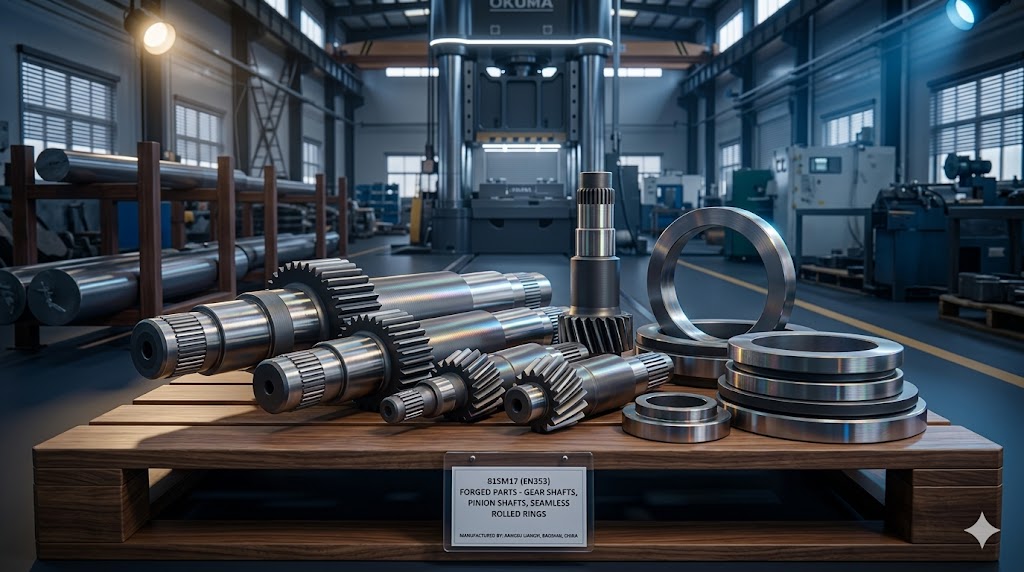
We produce custom open die forged steel products in virtually any cross-section and geometry, with individual piece weight from 30KGS to 30,000KGS. The following product forms are routinely available in 815M17 (EN353):
- Forged bars and billets: Round bars, square bars, flat bars, rectangular bars, and hexagonal forged rods — supplied either rough-forged or with preliminary machining allowance for customer finish machining
- Seamless rolled rings: Gear rings, slewing bearing rings, flange rings, and custom profile-rolled rings from 300mm to 5,000mm OD; ring rolling preserves continuous grain flow around the circumference for superior fatigue resistance vs. machined blanks from solid bar
- Hollow forgings and sleeves: Forged hubs, hollow shafts, housings, shells, sleeves, bushes, and cases — including pierced hollow bars to minimize material waste on large-bore components
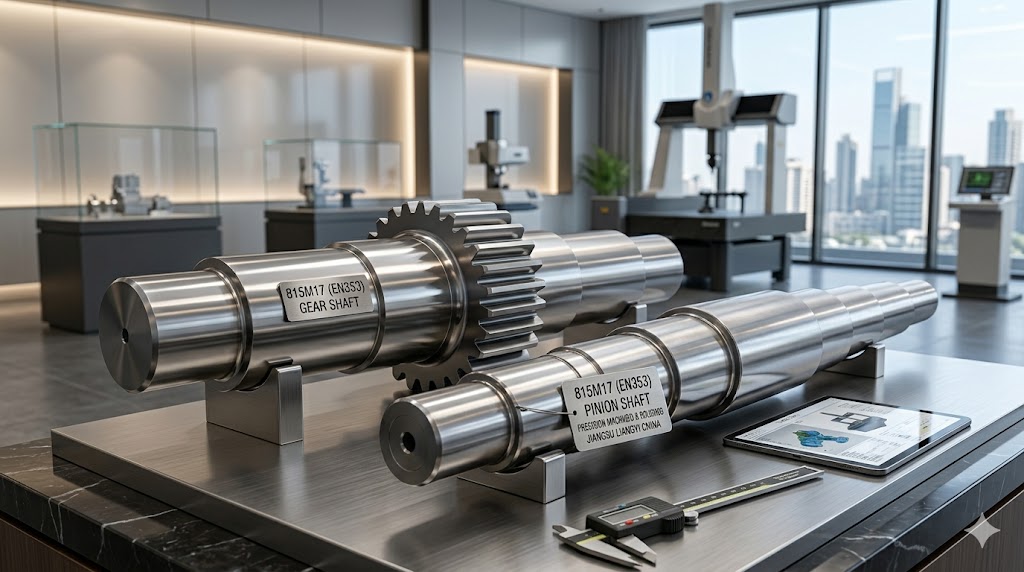
- Shafts and rotational components: Gear shafts, stepped pinion shafts, spindles, crankshafts, turbine shafts, eccentric shafts, and gear wheels — the most common application for 815M17 in heavy industry, where the combined demands of surface wear resistance and core toughness are most critical
- Discs, blocks, and plates: Forged discs, rectangular blocks, thick plates, flanges, and pressure vessel casings — produced with controlled forge ratios to achieve uniform cross-sectional properties
- Fully machined and finished components: Custom 815M17 (EN353) forgings machined to final drawing dimensions according to your engineering specifications, including keyways, bores, threaded features, and gear tooth profiles (post-carburizing grinding available)
Every product form listed above can be produced with either EN 10204 3.1 or 3.2 inspection certificates, and any combination of heat treatment condition — from as-forged, to normalized, annealed, or fully carburized and case-hardened — depending on your project requirement and whether you intend to perform final heat treatment in-house.
815M17 (EN353) Chemical Composition, Melting Standards and Material Specifications
What Each Alloying Element Does in 815M17 (EN353)
Understanding why 815M17 (EN353) is composed the way it is helps engineers make better material selection decisions and communicate more precisely with their suppliers. Here is what each element contributes in this grade:
- Carbon (C): 0.14–0.20% — The low base carbon keeps the core of the forging tough and weldable before carburizing. The carburizing process later raises the surface carbon to 0.7–0.9%, creating the hard martensitic case. The narrow 0.06% carbon band also limits hardness variability across a production lot — critical for predictable gear tooth performance.
- Nickel (Ni): 1.20–1.70% — Nickel is the primary toughness element in this grade. It lowers the ductile-to-brittle transition temperature of the steel, which is particularly important for gear shafts operating in cold-climate installations such as wind turbines or mining equipment in Canada or Russia. Unlike higher-nickel grades (EN36 at 3.0–3.75% Ni), 815M17 uses Ni economically while still achieving adequate case depth uniformity.
- Chromium (Cr): 0.80–1.20% — Chromium contributes most of the hardenability in this grade, allowing the carburized case to through-harden in oil quench without the high distortion risk associated with water quenching. Cr also forms stable chromium carbides during carburizing that slow carbon diffusion at the case-core interface, giving a more gradual hardness gradient — a feature that reduces risk of spalling under contact stress.
- Molybdenum (Mo): 0.10–0.20% — The small Mo addition provides three important benefits: it suppresses temper embrittlement during post-case-hardening tempering, it slightly increases the hardenability of the core for larger ruling sections, and it refines austenite grain size during heating — producing finer martensite after quenching and thus better fatigue resistance in the case.
- Manganese (Mn): 0.60–0.90% — Manganese acts as a deoxidiser during steelmaking and adds secondary hardenability support to chromium. It also improves hot workability during forging. The controlled upper limit of 0.90% prevents excessive segregation in large ingots, which would create banding visible in macrographic examination.
- Silicon (Si): 0.10–0.40% — Silicon strengthens the ferrite matrix and helps resist high-temperature oxidation of the steel surface during carburizing furnace cycles. Excessive Si would reduce surface quality in the case; the 0.40% maximum prevents this.
- Phosphorus (P) and Sulfur (S): Max 0.035% each — These residual elements are strictly controlled because: P promotes grain boundary embrittlement under impact loading, and S forms manganese sulfide inclusions that reduce transverse ductility — a concern in large cross-section forgings where anisotropy is critical.
Our Melting and Refining Process for 815M17 (EN353) Forgings
All 815M17 (EN353) forging material we use is produced with international standard compliant melting processes, and every heat comes with a complete mill test certificate (MTC) before forging begins. We select the melting route based on the final component's criticality and size:
- EAF + LF + VD route (Electric Arc Furnace + Ladle Furnace refining + Vacuum Degassing): Our standard route for 815M17 forgings above 5 tons. The vacuum degassing step reduces dissolved hydrogen to below 2.0 ppm and total oxygen below 15 ppm, eliminating the flaking risk that undegas'd steel poses in large cross-section forgings. This is a non-negotiable step for any gear shaft over approximately 500mm diameter.
- EAF + LF + ESR route (Electro-Slag Remelting): Specified for 815M17 components requiring the highest inclusion cleanliness — for example, wind turbine gearbox ring gears or critical oil and gas drivetrain components. ESR removes macro-inclusions almost completely and delivers isotropic mechanical properties regardless of sampling direction. We quote this route separately as it increases cost and lead time.
- AOD + Induction furnace route: Available for smaller heats where very tight sulfur and phosphorus control is required (e.g., S ≤ 0.010%, P ≤ 0.015%) without the full cost of ESR.
Regardless of melting route, every heat of 815M17 we produce is spectrometrically analysed by OES (Optical Emission Spectrometry) immediately after tapping — not just from a ladle sample, but verified again after casting from the top, middle, and bottom zones of each ingot for large heats. This three-point sampling catches any end-to-end segregation that ladle-only sampling would miss.
Chemical Composition Table: 815M17 (EN353) per BS 970 / EN 10084
The following chemical composition of 815M17 (EN353) is as specified in BS 970 and EN 10084. All heats we produce are verified to comply with these limits before forging proceeds:
| Element | Symbol | Content Range | Primary Function in Steel |
|---|---|---|---|
| Carbon | C | 0.14 – 0.20% | Provides base hardness; low level keeps core tough before carburizing |
| Silicon | Si | 0.10 – 0.40% | Deoxidiser; strengthens ferrite; limited to protect carburized case quality |
| Manganese | Mn | 0.60 – 0.90% | Secondary hardenability; deoxidiser; improves hot workability |
| Phosphorus | P | Max 0.035% | Residual — controlled to prevent grain boundary embrittlement |
| Sulfur | S | Max 0.035% | Residual — controlled to minimize MnS inclusions and anisotropy |
| Chromium | Cr | 0.80 – 1.20% | Primary hardenability element; promotes uniform case depth; controls carbon diffusion gradient |
| Molybdenum | Mo | 0.10 – 0.20% | Suppresses temper embrittlement; refines austenite grain; adds hardenability |
| Nickel | Ni | 1.20 – 1.70% | Primary toughness element; lowers DBTT; improves impact resistance in core |
Heat Treatment of 815M17 (EN353) Forged Parts: Processes, Mechanisms and Our In-House Capabilities
Why Heat Treatment Sequence Matters for 815M17 (EN353) Forgings
Many engineers treat heat treatment as a simple checklist — carburize, quench, temper — but in large open die forgings, the sequence and control precision of each step directly determines whether the finished component reaches its specified mechanical properties. At Jiangsu Liangyi, we operate 10 dedicated heat treatment furnaces with computer-controlled atmosphere and temperature management. The open die forging process itself refines austenite grain size and distributes microstructure more uniformly than casting, which gives the subsequent heat treatment a better starting point — this is one reason why forged 815M17 components generally demonstrate superior fatigue resistance compared to cast alternatives at the same nominal chemical composition — a well-established principle in forging metallurgy.
Here is our complete standard heat treatment menu for 815M17 (EN353), with the metallurgical rationale for each step:
Preliminary Heat Treatment (Pre-Delivery or Pre-Machining Condition)
- Normalizing — 850–900°C, air cooling: After forging, 815M17 billets are normalized to homogenise the as-forged microstructure. The 850–900°C range is above the Ac3 transformation temperature (~820°C for this grade), converting the structure fully to austenite before cooling in still air produces a fine, uniform ferrite-pearlite structure. Normalizing relieves residual thermal stresses from uneven cooling during forging and establishes a consistent baseline hardness for subsequent machining. We measure hardness at both ends of each bar after normalizing — target is typically 180–220 HB for 815M17 in this condition.
- Isothermal annealing — 850–900°C, hold 2h, controlled cooling to 650°C, then furnace cool: Specified when very low hardness (≤180 HB) is required for heavy rough-machining before heat treatment. The controlled cooling to 650°C transforms the austenite to pearlite at a specific undercooling, producing a more uniform carbide distribution than conventional full annealing. This process takes approximately 12–18 hours per cycle in our furnaces but delivers significantly more machinable stock — cutting tool life in our machining shop doubles compared to normalized stock for the same grade.
- Subcritical annealing — 650–700°C, slow furnace cool: Used when only stress relief is needed without microstructural transformation. Suitable for partially machined components that will undergo further machining before final heat treatment, where distortion from residual stresses is the primary concern.
Case Hardening Heat Treatment (Final Condition)
- Gas carburizing — 870–900°C, controlled carbon potential (Cp): This is the defining heat treatment step for 815M17 (EN353). The component is heated in an atmosphere of enriched natural gas or methanol-nitrogen mixture with a carbon potential of 0.75–0.90% maintained by automatic gas analysis. Carbon diffuses into the austenite surface at a rate determined by temperature and time. For a 0.8mm effective case depth (the most commonly specified for industrial gear shafts), our process requires approximately 8–10 hours at 890°C. For heavier case depths of 1.5–2.5mm required on large mining crusher shafts, the cycle extends to 20–35 hours. The key quality parameter is case depth uniformity — we aim for ±0.1mm variation across the gear tooth profile.
- Core-hardening quench — 840–870°C, oil or polymer quench: After carburizing, the component is re-austenitised at 840–870°C (above the core Ac3 but below the optimal case temperature) to refine core grain size before quenching. Oil quenching is standard; polymer quench solution is available for components where reduced distortion is critical. The oil temperature is maintained at 60–80°C during quenching to balance quench rate against distortion — too cold causes excessive distortion on long shafts, too hot reduces core hardness. This dual-quench approach (separate core-hardening from case-hardening) produces finer and tougher core microstructure than a single direct quench from carburizing temperature.
- Case-hardening quench — 800–830°C, oil or polymer quench: The lower austenitising temperature for the case quench (800–830°C vs 840–870°C for core) is deliberately selected to be above the case Ac1 (~720°C) but not so high that excessive austenite grain growth occurs in the high-carbon case layer. This minimises retained austenite — a critical consideration for gear applications where retained austenite above ~15% can cause dimensional instability and surface pitting over time.
- Low-temperature tempering — 150–200°C, air cooling: The final step converts some martensite to tempered martensite, reducing the risk of quench cracking without significantly reducing hardness. At 150–200°C, the carburized case retains hardness of 58–62 HRC while the core tempering is sufficient to relieve quench stresses. Components destined for high-impact loading (e.g., mining crusher eccentric shafts) are sometimes tempered at the upper end of 180–200°C to sacrifice 1–2 HRC in exchange for marginally better impact toughness in the case layer.
Achievable Case Depth and Surface Hardness — Our Production Data
Based on our production records for 815M17 (EN353) forgings, the following effective case depths and surface hardness values are routinely achieved under our standard gas carburizing process:
| Carburizing Time at 890°C | Effective Case Depth (CHD 550HV) | Surface Carbon | Typical Surface Hardness | Typical Application |
|---|---|---|---|---|
| 6–8 hours | 0.5 – 0.7 mm | 0.75 – 0.85% | 60 – 62 HRC | Small pinion shafts, spindles up to 80mm diameter |
| 8–12 hours | 0.7 – 1.0 mm | 0.78 – 0.88% | 59 – 62 HRC | Standard industrial gear shafts 80–200mm diameter |
| 14–20 hours | 1.0 – 1.5 mm | 0.78 – 0.90% | 58 – 61 HRC | Cement kiln pinion shafts, sugar mill shafts 200–400mm |
| 20–35 hours | 1.5 – 2.5 mm | 0.75 – 0.85% | 57 – 61 HRC | Large mining gyratory crusher shafts over 400mm diameter |
Note: Effective case depth is defined as depth to 550 HV (approximately 52 HRC) as per ISO 2639. Actual case depth achieved depends on the specific cross-section geometry, furnace loading density, and your technical specification — our engineering team will calculate and confirm the required cycle for your component before production.
Mechanical Properties of 815M17 (EN353) — Data, Interpretation and What They Mean for Your Application
Understanding Why Mechanical Properties Vary with Section Size
The mechanical property tables for 815M17 (EN353) list values against "ruling section" or diameter — a concept that confuses many engineers encountering it for the first time. The reason properties decline as section size increases is hardenability: when a large forging is quenched, the surface cools faster than the centre. If the steel's hardenability is insufficient to allow martensite to form all the way to the centre of the section at the achieved cooling rate, the centre remains as softer bainite or pearlite. 815M17 (EN353) with its 1.25% Ni-Cr composition achieves full martensite formation (via oil quench) in sections up to approximately 70–100mm — this is its "effective ruling section." Sections larger than 100mm will exhibit progressively lower core properties than the table values shown below, because the centre is not fully martensitic.
This is a critical design consideration: if your gear shaft core diameter exceeds 100mm and you require full core mechanical properties, discuss with our engineering team whether 815M17 remains the appropriate grade or whether a higher-hardenability alternative (such as 18CrNiMo7-6 or EN36/655M13 for sections to 150mm) would be more appropriate. For components where only the surface case properties matter and the core simply needs adequate strength, 815M17 performs well in sections considerably larger than 100mm.
Core Mechanical Properties After Case-Hardening (BS 970 Specified Minimum Values)
| Ruling Section (Diameter) | Tensile Strength (MPa) | Min Yield Strength (MPa) | Min Elongation A5 | Min Reduction of Area | Hardness (HB) | Typical Charpy Impact (J, 20°C) |
|---|---|---|---|---|---|---|
| 11mm and below | 1225 – 1520 | 980 | 8% | 30% | 361 – 432 | ≥ 40 |
| 11 – 25mm | 1030 – 1325 | 785 | 9% | 32.5% | 311 – 384 | ≥ 55 |
| 25 – 40mm | 930 – 1230 | 735 | 9% | 32.5% | 278 – 363 | ≥ 65 |
| 40 – 100mm | 785 – 1080 | 590 | 10% | 35% | 234 – 327 | ≥ 75 |
Interpretation note: The Charpy impact values listed above are indicative figures from our production experience — BS 970 does not mandate impact testing for 815M17 in all conditions, but we include it as standard in EN 10204 3.1 certificates upon customer request. The larger ruling sections show higher elongation and reduction of area because the slightly softer bainitic core is inherently tougher than fully martensitic structure. This means that for shock-loaded applications (e.g., crusher shafts), a 60–80mm ruling section core may actually be more damage-tolerant than a smaller, fully martensitic core at the same tensile strength level.
Carburized Case Hardness — Surface Properties After Full Case-Hardening
| Depth from Surface | Typical Hardness (HV) | Approx. HRC Equivalent | Notes |
|---|---|---|---|
| Surface (0 mm) | 700 – 780 HV | 60 – 62 HRC | Martensitic case with ≤15% retained austenite |
| 0.1 mm depth | 680 – 750 HV | 59 – 61 HRC | Peak hardness zone — highest wear resistance |
| 0.3 mm depth | 620 – 700 HV | 56 – 60 HRC | Still fully within effective case depth |
| Effective case depth (CHD 550HV) | 550 HV | ~52 HRC | Defined boundary per ISO 2639; typical 0.7–1.5mm for industrial gear shafts |
| Core (center) | 230 – 330 HV | ~22 – 34 HRC | Tough martensitic/bainitic core; exact value depends on ruling section |
The hardness gradient from surface to core in a properly carburized 815M17 forging is not a sharp step but a gradual transition — this is metallurgically important because an abrupt hardness discontinuity would create a stress concentration under contact loading and lead to subsurface fatigue cracking. The Cr-Mo combination in 815M17 produces a particularly smooth gradient compared to plain carbon case hardening steels, which is one reason it has such a good service record in gear applications with high Hertzian contact stress.
815M17 (EN353) vs Other Case Hardening Steels — How to Choose the Right Grade for Your Forging
Material selection for case hardening forgings is not a commodity decision. The wrong grade can mean either over-specification and unnecessary cost, or under-specification and premature component failure. Based on our experience manufacturing custom forgings across these grades for clients in 50+ countries, here is our engineering team's honest comparison:
| Parameter | 815M17 (EN353) | 655M13 (EN36) | 835M30 (EN39B) | 18CrNiMo7-6 |
|---|---|---|---|---|
| C Content | 0.14–0.20% | 0.10–0.16% | 0.26–0.34% | 0.15–0.21% |
| Ni Content | 1.20–1.70% | 3.00–3.75% | 4.00–4.50% | 1.40–1.70% |
| Cr Content | 0.80–1.20% | 0.70–1.00% | 1.00–1.40% | 1.50–1.80% |
| Mo Content | 0.10–0.20% | None | None | 0.25–0.35% |
| Max Ruling Section (full core props) | ~100mm | ~150mm | ~200mm | ~130mm |
| Core Tensile Strength (40–100mm RS) | 785–1080 MPa | 850–1160 MPa | 1000–1310 MPa | 785–1080 MPa |
| Surface Hardness After Carburizing | Up to 62 HRC | Up to 62 HRC | Up to 63 HRC | Up to 62 HRC |
| Retained Austenite Risk | Low–Moderate | Moderate–High (high Ni) | High (very high Ni) | Low–Moderate |
| DBTT (Ductile-Brittle Transition) | ~-40°C | ~-60°C | ~-70°C | ~-50°C |
| Machinability (annealed) | Good | Good | Moderate | Good |
| Relative Alloy Cost | Economical (baseline) | +30–50% | +60–90% | +25–40% |
| Standard | BS 970 / EN 10084 | BS 970 | BS 970 | EN 10084 / DIN 17210 |
When to choose each grade — our engineering team's guidance:
- Choose 815M17 (EN353) when: ruling section is ≤100mm, cost is a constraint, operating temperature stays above -40°C, retained austenite must be minimised, and you need a grade with decades of proven track record in sugar, cement, and general industrial drivetrain applications. This is the right choice for perhaps 70% of industrial gear shaft and pinion shaft applications.
- Choose 655M13 (EN36) when: ruling section is 100–150mm, impact loading in very cold environments (below -40°C) is a concern, or the design specification explicitly calls for it. The higher Ni content improves cold toughness but requires more careful retained austenite management during case hardening. Cost is approximately 30–50% higher than 815M17.
- Choose 835M30 (EN39B) when: the core must sustain maximum stress — for example, heavily loaded gyratory crusher main shafts or marine propeller shafts where core tensile strength above 1000 MPa is a design requirement. The very high Ni content introduces significant retained austenite management complexity and high material cost. Rarely specified where 815M17 or 655M13 can serve the purpose.
- Choose 18CrNiMo7-6 when: the component is a wind turbine gearbox ring gear or high-precision automotive/aerospace gearbox component where the DIN/EN 10084 designation is explicitly required by the customer specification, and where the higher Cr+Mo combination provides better tempering resistance at slightly elevated operating temperatures (up to ~160°C) compared to 815M17.
Contact our engineers for free material selection advice — we frequently help procurement teams navigate these trade-offs and have substituted grades in both directions (up and down) for clients where the original specification was either over- or under-stated.
Quality Control and Inspection for 815M17 (EN353) Forgings — Our Process and Equipment
Why Quality Control in Forging Is More Complex Than in Bar Stock
When a customer purchases 815M17 bar stock from a steel mill, they receive a material with homogeneous properties that has been tested by the mill on standardised specimens from a standardised position. When they purchase a custom open die forging from Jiangsu Liangyi, they receive a component whose mechanical properties depend not only on the steel chemistry but also on the forging reduction ratio, the forging temperature history, the actual ruling section of their specific geometry, and the heat treatment cycle applied to their specific part dimensions. This is a fundamentally more complex product, and it requires a fundamentally more rigorous quality control system to verify.
Our quality control system for 815M17 (EN353) forgings is built around three principles: upstream verification (control every input before it enters the process), in-process control (monitor and record every critical parameter during production), and downstream verification (test the actual component, not just representative coupons). The following describes how we implement these principles:
Testing and Inspection Programme for Every 815M17 (EN353) Forging Order
Every 815M17 (EN353) forging we deliver passes through the following mandatory inspection steps, performed on our dedicated quality inspection equipment:
- Incoming heat chemical composition verification — OES analysis: Before any forging begins, the steel ingot or bloom is verified by our in-house Optical Emission Spectrometer (OES). We analyse C, Si, Mn, P, S, Cr, Mo, Ni, Cu, Al, V, Ti, Nb simultaneously. If any element falls outside BS 970 / EN 10084 limits, the heat is rejected — no exceptions.
- Hydrogen and oxygen content check (for forgings ≥2 tons): We verify dissolved hydrogen ≤2.0 ppm and total oxygen ≤15 ppm from the vacuum degassing certificate before forging large pieces. Hydrogen-induced flaking is the most insidious forging defect because it may not appear until machining uncovers the interior — our upstream control eliminates this risk.
- Forging process records: Forging temperature (start and finish), press tonnage, forge reduction ratio, and sequence of passes are all recorded per ISO 9001 production traveller for each forging. Minimum forge ratio of 3:1 from ingot to finished forging is our internal standard for 815M17 shafts — this ensures the as-cast dendritic structure is fully broken down and replaced with uniform wrought structure.
- Post-forging ultrasonic testing (UT) — ASTM A388 / EN 10228-3: All 815M17 forgings ≥300mm diameter or ≥1,000KGS weight are 100% ultrasonically tested after rough machining and before heat treatment. We use a 2.25MHz straight-beam contact probe in water coupling to detect internal flaws (inclusions, hydrogen flakes, core porosity, shrinkage) down to a reflector equivalent diameter of 3mm. Any indication exceeding class C per EN 10228-3 results in rejection.
- HB hardness testing — 2 tests per bar/forging, one on each end: After normalizing or annealing, every forging is Brinell-tested at both ends using a 3000kgf load, 10mm ball. The two-end measurement catches any end-to-end hardness gradient that could indicate incomplete heat treatment or localised microstructural variation.
- Macrographic examination — 2 cross-sections per bar: A transverse section from each end of the forging is etched and examined at 1× magnification per ISO 4969. We look for pipe, segregation, porosity, and laps. Photographs are retained in our quality records for each production lot.
- Austenitic grain size test — ASTM E112: One bar per production lot is tested for prior austenite grain size after carburizing. Coarse grain (ASTM grain size No. 1–4) causes reduced impact toughness and increased distortion during quenching — our target is ASTM No. 6–8 for 815M17 carburized at 880–900°C.
- Tensile testing — per EN ISO 6892-1: One full set of tensile test specimens (round specimens per ISO 6892-1 Figure 5) is machined from a heat treatment coupon attached to the main forging body and tested after final heat treatment. We record tensile strength, yield strength (0.2% proof stress), elongation A5, and reduction of area Z.
- Charpy impact testing — per EN ISO 148-1: Longitudinal V-notch Charpy specimens tested at the temperature specified by the customer (typically +20°C, -20°C, or -40°C for cold-service applications). Three specimens are tested per condition; the average is reported on the certificate.
- NDT — UT, MT, PT as per customer specification: UT (volumetric), MT (surface and near-surface), and PT (surface) are all available in-house. Acceptance criteria are per your specified standard — commonly EN 10228, ASTM A388, or project-specific client standards. We include NDT reports in the EN 10204 3.1 package.
EN 10204 3.1 vs 3.2 Inspection Certificates — What They Mean and Which You Need
This is a topic where confusion is common, and where choosing the wrong option can cause costly delays at customs or during customer audits. Here is a practical explanation:
- EN 10204 2.2 (Test Report): The manufacturer's declaration that the material meets the specification, with non-specific (heat-based) test results. This is sometimes called a "mill certificate." It is not traceable to your specific components. Acceptable for non-critical commodity forgings.
- EN 10204 3.1 (Inspection Certificate, validated by the manufacturer's own QA): The manufacturer's QA department — independent from the production department — reviews and signs off test results taken from your specific production lot. All test specimens are taken from material bearing the same heat number as your forgings. This is what we provide as standard for all 815M17 (EN353) forgings. It is sufficient for the vast majority of industrial applications including ISO 9001 supply chains.
- EN 10204 3.2 (Inspection Certificate, counter-signed by an independent third party): As above, but additionally counter-signed by an authorised independent inspection body (Bureau Veritas, SGS, TÜV, Lloyd's Register, etc.) or by the customer's own representative present at our factory. Required for ASME pressure vessel components, nuclear applications, and some project-specific client quality plans. Available upon request with advance notice — please note that scheduling the third-party inspector will add approximately 3–5 working days to lead time.
Certificate content for all 815M17 (EN353) deliveries includes: customer PO details, drawing number and revision, heat number, full ladle analysis, melting method, forging history, heat treatment records (time/temperature charts), all mechanical test results, NDT reports, and dimensional compliance statement.
Industry Applications of 815M17 (EN353) Forging Parts — Real-World Technical Scenarios
Our 815M17 (EN353) forging parts are in service across heavy industries in more than 50 countries. The following application descriptions are drawn from our actual production experience — the component types, sizes, and technical requirements described are representative of orders we have fulfilled for clients worldwide:
- Sugar Industry — Mill Gear Shaft and Pinion Shaft Forgings
- Sugar mill transmissions are among the most demanding gear shaft applications for 815M17 (EN353). A 1,000 TPD (tonnes per day) crushing capacity requires pinion shafts typically in the 250–400mm journal diameter range, with overall forging lengths of 1,500–3,500mm. The combination of high sustained torque, shock loading from cane feeding irregularities, and high ambient humidity make a material with good core toughness and corrosion-resistant carburized surface essential. We supply 815M17 forged gear shafts to sugar mills in India, Thailand, Brazil, Colombia, and South Africa. Typical weight per piece: 800KGS to 8,000KGS. Our standard carburized case depth for sugar mill pinion shafts is 1.0–1.5mm effective case depth (CHD 550HV).
- Cement Industry — Rotary Kiln and Ball Mill Pinion Shaft Forgings
- Cement rotary kiln pinion shafts represent one of the most weight-intensive 815M17 forging applications we produce — single pieces regularly exceed 10,000KGS on a 5,000 TPD kiln drivetrain. The kiln operates continuously 24/7, typically for 3–5 years between planned overhauls, meaning the pinion shaft must sustain billions of load cycles over its design life. We produce these shafts to customer-specified gear quality standards, with the carburized case ground to Ra ≤ 0.8µm on gear tooth flanks after heat treatment where specified. The ruling section for the gear portion is typically 120–160mm, which is at the upper edge of 815M17's hardenability — we verify core hardness on a sacrificial test ring machined from the same forging to confirm properties before delivery.
- Mining Industry — Crusher Shafts and Mill Pinions
- In mining applications, 815M17 is specified for eccentric shafts in cone and gyratory crushers, where the eccentric motion creates high bending stresses combined with impact from rock feed irregularities. For a 60-inch gyratory crusher, the eccentric shaft forging is typically 800–1,200mm in maximum cross-section and weighs 5,000–15,000KGS. At this ruling section, the core of an 815M17 forging is not fully martensitic — but the core toughness of the bainite/upper-bainite structure that forms is actually better suited to impact loading than high-hardness martensite would be. This is a case where partial hardenability is a design advantage rather than a limitation. We supply these forgings with UT per ASTM A388 Class 3 acceptance criteria and 100% magnetic particle inspection of all accessible surfaces.
- Renewable Energy — Wind Turbine Gearbox Components
- 1.5–3.0 MW wind turbine main shaft gearbox pinion shafts are manufactured in 815M17 (EN353) where the cold-climate toughness requirement is not extreme (operating temperature above -30°C) and cost sensitivity is high. For offshore or arctic installations requiring lower ductile-to-brittle transition temperature, we recommend upgrading to 18CrNiMo7-6 or 655M13 (EN36) — this is the kind of honest application guidance we provide before quotation, not after problems arise. Typical 2MW wind turbine planet shaft: 400–600mm ruling section, 2,500–5,000KGS, ESR melt quality, EN 10204 3.2 certificate required by wind turbine OEM standards.
- Oil and Gas Industry — Drilling and Wellhead Equipment
- 815M17 (EN353) forgings for oil and gas wellhead and drilling equipment are produced to our most stringent process controls, with full EN 10204 3.1 material certificates and complete heat treatment traceability. Typical components include gate valve bodies, flanges, casing hangers, and mud pump shafts where the combination of high mechanical strength and low-temperature toughness is required. If your project specification references a specific petroleum industry standard (such as API or NACE requirements), please advise at inquiry stage so we can confirm capability and documentation accordingly.
- Heavy Machinery — Industrial Compressor and Press Crankshafts
- Reciprocating gas compressor crankshafts in 815M17 operate under complex combined loading — torsion from the drive motor, bending from connecting rod forces, and axial load from thrust collars. Case hardening of the crankpin journals is essential to resist fretting fatigue where the connecting rod big-end bearing oscillates. For large pipeline compressor crankshafts in the 5,000–20,000KGS range, we apply a selective case hardening process where only the crankpin and main bearing journal surfaces are carburized — the crankweb material remains in the tougher normalized-and-tempered condition to handle bending stress without risk of brittle fracture.
- Transportation and Marine — Locomotive and Ship Drivetrain Forgings
- Locomotive traction motor pinion shafts in 815M17 are a niche but important application. The rail environment demands extremely consistent material properties — a failed pinion shaft on a locomotive in service is a safety event. Our marine propeller shaft applications using 815M17 are typically for smaller vessels (under 5,000 DWT) where the combination of 62 HRC case hardness on the stern tube bearing journals and adequate core toughness for shock loading from wave action is required. For larger vessels, 835M30 (EN39B) or higher-alloy grades are typically specified.
How We Manufacture Your Custom 815M17 (EN353) Forging — Step by Step
Understanding our production process helps you plan your procurement timeline and know what questions to ask at each stage. The following describes our complete production sequence for a typical large 815M17 (EN353) gear shaft forging:
- Inquiry Review and Technical Evaluation (Day 1–2)
When we receive your inquiry — ideally with a 2D engineering drawing (PDF or DXF) plus the material specification, heat treatment condition required, applicable standard, and order quantity — our engineering team performs three evaluations before we quote: (a) forging feasibility — can we produce this geometry within our press and ring rolling equipment limits? (b) material grade validation — is 815M17 the correct grade for your ruling section and application? (c) heat treatment feasibility — can the required case depth be achieved for your geometry? If any of these flags an issue, we contact you proactively with an alternative proposal before confirming quotation. This technical pre-screening has saved our clients from costly tooling orders only to discover the material cannot meet the specification at the required ruling section.
- Order Confirmation and Production Planning (Day 3–7)
After contract signing, our production planning team schedules the order against available ingot heat, press time, and heat treatment furnace capacity. For 815M17 forgings above 5,000KGS, we typically source the ingot heat specifically for your order from our qualified steel mill partners — this takes 7–14 days from order confirmation. Smaller forgings can often be produced from existing ingot inventory in 3–5 days lead time to first forging operation. We issue a production traveller document that tracks every step from ingot to final inspection, and this traveller number is referenced on your EN 10204 certificate.
- Steel Melting, Refining, and Incoming Inspection (Day 7–20, depends on ingot weight)
The 815M17 steel is melted by EAF + LF + VD (or ESR for special orders) as described in our specifications section. Upon ingot delivery to our factory, we verify the mill analysis certificate against BS 970 / EN 10084 composition limits and perform our own OES re-check before accepting the ingot into production. Ingots are heated to forging temperature in our pusher-type gas furnaces — 815M17 is heated to 1150–1250°C for forging, with a minimum soaking time calculated based on ingot cross-section (typically 1 hour per 100mm of minimum dimension) to ensure uniform temperature throughout.
- Open Die Forging and Initial Shape Making (Day 15–30)
The heated ingot is placed under our open die press (1,000T to 8,000T capacity) and worked through a series of drawing-out, upsetting, and bending passes to achieve the required shape. For 815M17 gear shafts, we target a minimum forge ratio of 3:1 from ingot cross-section to final forging cross-section — this is the threshold at which the as-cast dendritic structure is fully replaced by wrought fibrous grain flow. Higher forge ratios of 5:1 or more are used for critical components. The finish forging temperature is maintained above 900°C to prevent forging into the two-phase region, which would create surface seams. Post-forging, the forging is slow-cooled in the forge shop to prevent thermal cracking, then transferred to our heat treatment shop.
- Preliminary Heat Treatment and Rough Machining (Day 25–40)
Normalizing or isothermal annealing is applied (as described in our heat treatment section) to relieve forging stresses and establish a uniform, machinable starting microstructure. The forging is then rough-machined to leave 3–5mm machining allowance on all surfaces before final heat treatment. This stock removal also allows the UT inspection to be performed on a surface that is free of forging scale, significantly improving flaw detection sensitivity.
- Non-Destructive Testing — UT, MT (Day 40–45)
Every 815M17 forging above our UT threshold is 100% volumetrically inspected by straight-beam ultrasonic testing per EN 10228-3 or ASTM A388. Our UT technicians are qualified and experienced in straight-beam and angle-beam ultrasonic inspection methods. Magnetic particle inspection is performed on all accessible surfaces per EN 10228-1. Any discontinuity exceeding acceptance criteria requires engineering review before the forging proceeds — we never conceal or "ignore" a relevant indication.
- Final Case Hardening Heat Treatment (Day 45–65)
The rough-machined forging enters our gas carburizing furnace at 870–900°C for the required cycle duration. Our furnaces are equipped with continuous atmosphere monitoring — CO, CO₂, CH₄, and O₂ are analysed every 5 minutes and the atmosphere composition is automatically adjusted to maintain carbon potential within ±0.05% of the target. After carburizing, the dual quench cycle (core-hardening then case-hardening) is applied as described in our heat treatment section, followed by low-temperature tempering at 150–200°C.
- Finish Machining and Final Dimensional Inspection (Day 60–75)
After case hardening, the forging is finish-machined to final drawing dimensions. For gear tooth surfaces, this typically means hard turning or grinding after heat treatment — our CNC turning centres can accommodate shafts up to 5,000mm between centres and 1,200mm swing diameter. Final dimensional inspection is performed on our CMM (Coordinate Measuring Machine) with inspection report issued per your drawing tolerances. Surface roughness is measured on all critical bearing and sealing surfaces.
- Final NDT, Mechanical Testing, and Certificate Preparation (Day 70–80)
Completed forgings are given final surface MT or PT inspection, hardness verification on carburized surfaces (portable Leeb hardness tester or Rockwell), and any additional customer-specified tests. The EN 10204 3.1 certificate is compiled by our QA department, cross-referencing the heat number, production traveller, all test results, and the applicable standard requirements. The complete certificate package is reviewed by our Quality Manager before issue — not by the production department.
- Packing, Shipping, and After-Sales Technical Support
815M17 forgings are surface-treated with rust preventive oil before export packaging. Rough-machined or finish-machined surfaces are protected with corrosion inhibitor film. Export packing is in wooden case or steel frame as required by destination port regulations. We arrange CIF, FOB, or Ex-Works shipment per your preference. After delivery, our engineering team is available for long-term technical support on the component — if you experience an in-service issue and need assistance diagnosing whether it is material-related, we will support your root cause analysis at no additional charge.
Typical Total Lead Time: 30–45 days for single pieces up to 5,000KGS with standard heat treatment; 45–75 days for pieces above 5,000KGS or with ESR melt quality; 75–90 days for very large pieces above 20,000KGS or requiring EN 10204 3.2 certificates with third-party witness. Expedited production is possible in some cases — discuss your deadline with our team.
Frequently Asked Questions About 815M17 (EN353) Forging Parts
Yes, 815M17 and EN353 are the same steel chemistry, but they come from two different national designation systems. 815M17 is the British Standard BS 970 designation — in the BS 970 system, the first three digits encode the approximate alloy composition (815 ≈ 1% Ni + Cr combined), M denotes case hardening quality, and 17 indicates the nominal carbon percentage (0.17%). EN353 is the older British/European trade name for the same steel, which remains in widespread commercial use even after BS 970 was technically superseded by EN 10084 as the European standard. In EN 10084, the equivalent grade is not specifically called EN353 by code, but EN353 steel meeting EN 10084 composition limits is accepted by most European buyers. When ordering from us, you may specify either 815M17 or EN353 — we will verify that the heat chemistry meets both designations' composition limits.
815M17 (EN353) is a 1.25% nickel-chromium case hardening steel specified in British Standard BS 970 and European Standard EN 10084. Its nominal composition is: C 0.14–0.20%, Ni 1.20–1.70%, Cr 0.80–1.20%, Mo 0.10–0.20%, Mn 0.60–0.90%. After carburizing at 870–900°C and subsequent oil quenching, the carburized case achieves surface hardness of 58–62 HRC while the core retains tensile strength of 785–1080 MPa (varying with ruling section) and Charpy impact energy ≥40J at 20°C. The combination of wear-resistant carburized surface and tough core makes it the industry standard for heavy-duty gear shafts, pinion shafts, and transmission components across sugar, cement, mining, and energy industries worldwide.
Effective case depth (defined as depth to 550 HV per ISO 2639) in 815M17 (EN353) is a function of carburizing temperature, time, and the carbon potential of the furnace atmosphere. In our standard gas carburizing process at 880–900°C with carbon potential 0.80–0.85%, we routinely achieve:
- 0.5–0.7mm effective case depth in 6–8 hours (suitable for small pinion shafts ≤80mm OD)
- 0.7–1.0mm in 8–12 hours (standard industrial gear shafts 80–200mm OD)
- 1.0–1.5mm in 14–20 hours (cement kiln and sugar mill large shafts)
- 1.5–2.5mm in 20–35 hours (mining crusher eccentric shafts, large slow-speed gears)
Case depth is verified on metallographic cross-sections cut from a test coupon attached to the main forging. We measure actual hardness traverse from surface to core using a Vickers micro-hardness tester per ISO 6507-1, and report both the measured effective case depth and the hardness gradient curve on your inspection certificate. Specifying too-deep a case for a small section can increase the risk of retained austenite and network carbides — our engineers will advise the optimal case depth specification for your component geometry.
We manufacture custom 815M17 (EN353) forging parts with a single piece weight range from 30KGS to 30,000KGS. Standard lead times depend on piece weight and heat treatment complexity:
- 30–500KGS single pieces, normalised or annealed condition: 15–25 days
- 500–5,000KGS, normalised or annealed: 25–40 days
- 5,000–30,000KGS, normalised or annealed: 40–60 days
- Any weight with full case hardening (carburize + quench + temper): add 15–25 days
- Any weight requiring ESR melt quality: add 14–21 days for ingot sourcing
- EN 10204 3.2 with third-party witness inspection: add 3–5 working days to schedule the inspector
Expedited service is possible for some orders — contact us with your required delivery date and we will assess feasibility. We will never commit to a lead time we cannot reliably meet, because we understand that late delivery of a large gear shaft can halt an entire mill or plant.
We are ISO 9001:2015 certified and provide the following inspection documentation as standard or on request:
- EN 10204 3.1 Inspection Certificate (standard): All test results signed off by our independent QA department, traceable to the specific heat number of your order. Includes full ladle analysis, mechanical test results (tensile, yield, elongation, reduction of area, hardness), Charpy impact results, heat treatment records, NDT reports, and dimensional compliance statement.
- EN 10204 3.2 Inspection Certificate (on request): As above, additionally counter-signed by Bureau Veritas, SGS, TÜV, or your preferred third-party body. Please advise at order stage.
- Raw Material Mill Test Certificate: Original certificate from the steel mill for the specific ingot heat, issued by the steel manufacturer.
- NDT Reports: Ultrasonic testing report (per EN 10228-3 or ASTM A388), magnetic particle inspection report, and/or penetrant testing report as applicable.
- Heat Treatment Records: Time-temperature charts from our furnace data loggers, showing the complete thermal cycle for your specific production lot.
815M17 (EN353) is the dominant case hardening steel in heavy industrial drivetrain applications where the component ruling section is up to approximately 100mm and where cost-performance balance is critical. From our production experience, the following industries account for the majority of our 815M17 forging output:
- Sugar industry (approx. 25% of our 815M17 volume): Mill gear shafts and pinion shafts for 500–3,000 TPD crushing systems. India, Brazil, and Thailand are our largest sugar industry markets.
- Cement industry (approx. 20%): Pinion shafts for rotary kilns, ball mills, and vertical roller mills. 3,000–10,000 TPD plants require the largest single forgings we produce — up to 25,000KGS per piece.
- Mining and minerals processing (approx. 20%): Crusher shafts, mill pinions, and slewing bearing rings for mining excavators and conveyor systems.
- Oil and gas (approx. 15%): Mud pump pinion shafts, wellhead components, and drilling rig transmission shafts.
- Renewable energy and general machinery (approx. 20%): Wind turbine gearbox components, compressor crankshafts, and custom engineered machinery shafts.
The grade is preferred because it occupies the intersection of three procurement requirements: well-established global specification (BS 970 / EN 10084), proven supply chain with competitive availability, and best-in-class surface/core property balance for sections under 100mm at economical alloy cost.
We offer the complete range of heat treatment options for 815M17 (EN353) from our 10 dedicated furnaces in Jiangyin. The options depend on your required delivery condition:
- As-forged (no heat treatment): For customers performing their own heat treatment in-house. We will supply the forging in as-forged condition with forging temperature records.
- Normalised (850–900°C, air cool): Standard delivery condition for forgings that will be machined before case hardening. Produces a fine ferrite-pearlite structure, 180–220 HB, easily machinable.
- Isothermal annealed (850–900°C, controlled cool to 650°C, furnace cool): Lower hardness than normalised (150–190 HB), better for heavy rough-machining. Adds approximately 1–2 days to lead time.
- Normalised + tempered or Q+T (through-hardened): For applications where 815M17 is used in the through-hardened condition rather than carburized — uncommon but possible. Core tensile strength 850–1000 MPa achievable in smaller sections.
- Carburized + oil quenched + low tempered (case hardened): The primary final heat treatment for gear shaft applications. Case depth 0.5–2.5mm, surface 58–62 HRC, core as per mechanical properties table. This is the most common delivery condition we supply for industrial gear applications.
- Selective carburizing (masked areas): For components where only specific surfaces should be carburized — for example, gear tooth flanks but not keyway or spline areas. We apply copper paint masking to areas that should remain soft before the carburizing cycle.
815M17 (EN353) in the normalised or isothermal annealed condition (180–220 HB) machines very well — it is one of the more machinable low-alloy case hardening steels in its class. Our machining shop uses the following guideline parameters as a starting point for rough turning 815M17 in normalised condition:
- Rough turning (carbide insert, CNMG 120408, ISO P20): Cutting speed Vc = 180–220 m/min, feed f = 0.3–0.5 mm/rev, depth of cut ap = 3–6 mm, coolant wet. Tool life approximately 30–45 minutes per cutting edge.
- Finish turning (carbide insert, VNMG 160404, ISO P10): Vc = 220–280 m/min, f = 0.1–0.2 mm/rev, ap = 0.5–1.5 mm, achieving Ra ≤ 1.6 µm.
- Drilling (solid carbide, TiAlN coated): Vc = 80–100 m/min, feed per revolution 0.15–0.25 mm, through coolant preferred for deep holes.
- After case hardening (HRC 58–62): Hard turning with CBN insert for journal surfaces is possible if surface hardness is uniform. Grinding (cylindrical or surface) remains the preferred method for final finishing of carburized surfaces to Ra ≤ 0.4 µm for bearing and sealing surfaces.
Note: The Mo content (0.10–0.20%) in 815M17 slightly increases tool wear compared to non-Mo grades at the same hardness level — factor approximately 10–15% shorter tool life compared to plain 805M17 (EN352, without Mo).
To get an accurate quotation and avoid delays, please provide the following information when you contact us:
- Engineering drawing: 2D DXF or PDF drawing with all dimensions, tolerances, and surface finish requirements. If you don't have a drawing yet, a sketch with key dimensions (overall length, max and min diameters, bore dimensions if applicable) is sufficient for a preliminary budget estimate.
- Material specification: 815M17, EN353, or BS 970 815M17 — and the applicable standard (BS 970, EN 10084, or your own company standard). Confirm whether chemical composition only is required, or whether specific mechanical property test results are required (and at which test positions).
- Heat treatment condition required: Normalised, annealed, through-hardened, or case hardened (with required case depth and surface hardness, if applicable).
- Certificate requirement: EN 10204 3.1 (standard) or 3.2 (third-party witness).
- NDT requirements: Required NDT methods (UT, MT, PT), applicable standard, and acceptance class.
- Quantity and delivery requirement: Number of pieces, and your required delivery date (CIF port of destination, FOB China, or Ex-Works our factory).
Send your enquiry to sales@jnmtforgedparts.com or via WhatsApp at +86-13585067993. Our engineering team responds within 24 working hours for standard enquiries. For complex multi-item enquiries or urgent projects, WhatsApp is faster.
This is the most important material selection question for case hardening forgings, and the honest answer is nuanced. From our 29 years of manufacturing experience across all these grades:
- Stay with 815M17 (EN353) when: Your maximum ruling section is ≤100mm; operating temperature is above -30°C; you need to minimise retained austenite in the carburized case; cost is a significant factor; or your existing design specification and plant maintenance team has experience with this grade. Approximately 70% of the gear shafts and pinion shafts we supply to heavy industry are in 815M17 — it is not the "budget option" but the correctly specified option for most applications.
- Upgrade to 655M13 (EN36) when: Ruling section is 100–150mm and you need full core mechanical properties throughout; the component operates below -30°C (cold climate wind turbines, Arctic mining); or your specification explicitly requires EN36. Budget for 30–50% higher material cost.
- Upgrade to 18CrNiMo7-6 when: The application is a wind turbine gearbox, high-precision industrial gearbox, or any application where the DIN/ISO specification is required by the OEM; or you need higher tempering resistance at slightly elevated operating temperatures (up to ~160°C continuously). Cost premium is approximately 25–40% over 815M17.
- Upgrade to 835M30 (EN39B) only when: Core strength above 1000 MPa is a confirmed design requirement that cannot be met by lower alloy grades at the available ruling section. This is rarely truly necessary and is often a conservative carry-over from an older specification that was originally written for a different application. We frequently help clients re-examine whether EN39B is genuinely necessary or whether 815M17 or EN36 would satisfy the actual design load — this analysis is free of charge and can save significant material cost.