Why Choose Jiangsu Liangyi for 2.4669 (NiCr15Fe7TiAl) Forgings
✓ 25+ Years Nickel Alloy Forging ExpertiseEstablished in 1997 in Jiangyin City, Jiangsu Province — China's most concentrated hub for high-performance alloy metallurgy — Jiangsu Liangyi Co.,Limited has spent over a quarter century developing proprietary forging schedules, heat treatment protocols, and inspection procedures specifically tailored to precipitation-hardenable nickel superalloys including 2.4669 (NiCr15Fe7TiAl). Our 80,000㎡ production facility houses 11 hydraulic open-die presses (ranging from 1,000 to 8,000 tonnes), 6 ring-rolling machines, 12 precision heat treatment furnaces with independent PLC atmosphere control, and a fully equipped in-house metallurgical laboratory — all under one roof in Jiangyin.
Unlike trading companies or material distributors who subcontract forging work, every kilogram of 2.4669 produced under the Jiangsu Liangyi name is melted, forged, heat treated, machined, and inspected by our own engineers and technicians. This end-to-end control is what allows us to provide binding guarantees on grain size, mechanical properties, and full EN 10204 3.1 documentation for each individual forging — not just lot-level certificates.
Key Differentiator: All 2.4669 billets are sourced exclusively from VIM (Vacuum Induction Melting) + ESR (Electroslag Remelting) dual-melt certified material suppliers. This ensures elimination of the sulphur segregation and non-metallic inclusion problems common in air-melted stock, resulting in superior fatigue life and impact toughness — verified in our incoming metallographic analysis reports.
Our 2.4669 Manufacturing Capacity at a Glance
| Capability | Specification |
|---|---|
| Single Piece Weight Range | 30 KG — 30,000 KG |
| Forged Bar Diameter | Ø50 mm — Ø1,200 mm |
| Seamless Rolled Ring OD | Ø300 mm — Ø6,000 mm |
| Rolled Ring Height | 50 mm — 1,500 mm |
| Disc / Plate Diameter | Up to Ø2,500 mm |
| Max Press Capacity | 8,000 tonnes (open die) |
| Heat Treatment Furnace Range | 400°C — 1,250°C ± 5°C |
| Annual 2.4669 Output | ~2,500 tonnes/year |
| Grain Size Achievable (ASTM) | ASTM 4 — ASTM 8 (per application) |
| NDT Methods In-House | UT (immersion & contact), MT, PT, RT |
| Standard Lead Time | 15 — 30 days (custom forgings) |
| Emergency Lead Time | 7 — 14 days (on request, confirm in advance) |
2.4669 (NiCr15Fe7TiAl) Metallurgy — Why This Alloy Performs Where Others Fail
Most product pages list chemical compositions and mechanical properties without explaining the underlying metallurgical reasons for those properties. We believe that a buyer making a critical material selection decision deserves a deeper understanding. What follows is our engineering team's distillation of 25 years of working with 2.4669 in demanding industrial applications.
The Face-Centred Cubic Matrix and Precipitation Hardening Mechanism
The base structure of 2.4669 is a face-centred cubic (FCC) gamma (γ) matrix, predominantly nickel with chromium and iron in solid solution. This matrix alone would provide only modest strength — similar to a standard austenitic stainless steel. The remarkable mechanical properties of 2.4669 arise from the controlled precipitation of coherent secondary phases within this matrix during aging heat treatment:
- Gamma-prime (γ', Ni₃(Ti,Al)) precipitates: Coherent, ordered L1₂-structure particles, typically 10–50 nm diameter, which form during aging at 620–720°C. Their coherency with the γ matrix creates lattice strain fields that impede dislocation movement — the fundamental mechanism of precipitation hardening. The titanium-to-aluminium ratio in 2.4669 is deliberately calibrated to produce a γ' composition that is thermally stable to approximately 700°C, beyond which the precipitates begin to coarsen and lose their strengthening effect.
- Gamma-double-prime (γ'', Ni₃Nb) precipitates: Body-centred tetragonal (BCT) D0₂₂-structure discs, approximately 5–20 nm diameter, forming preferentially on {001} planes of the γ matrix. These metastable precipitates provide exceptionally strong short-range order hardening. In 2.4669, the niobium content (0.7–1.2 wt%) is lower than in standard Inconel® 718 (5.0–5.5 wt%), which deliberately limits the γ'' volume fraction and shifts the dominant strengthening toward the thermally stable γ' phase — improving long-term elevated temperature performance above 650°C.
Engineering Insight — 2.4669 vs Inconel® 718 at High Temperature: Standard Inconel® 718 derives approximately 70% of its precipitation hardening from γ''. Above 650°C, γ'' begins the irreversible transformation to orthorhombic delta (δ, Ni₃Nb) phase, which has zero coherency with the γ matrix and therefore provides no strengthening — accelerating stress relaxation and creep. In contrast, 2.4669's lower Nb content and higher Ti/Al ratio result in a γ'-dominant microstructure that retains meaningful strength and creep resistance up to ~700°C in long-term service. This is why EN 10302 — the creep-resisting alloys standard — explicitly lists 2.4669, while standard Inconel® 718 is not included.
The Role of Chromium — Oxidation and Hot Corrosion Resistance
The 14–17 wt% chromium in 2.4669 serves a dual function. First, it forms a continuous, self-healing Cr₂O₃ (chromia) scale on the alloy surface at elevated temperatures, providing excellent resistance to oxidation up to ~900°C in dry air conditions. Second, chromium enhances resistance to Type II hot corrosion — the sulphate-induced corrosion attack that occurs at 650–750°C in gas turbine hot sections where fuel sulphur contaminants react with sodium chloride from inlet air. Both mechanisms are critical for gas turbine and industrial furnace applications where 2.4669 components are routinely specified.
Iron Content — The Cost-Performance Balance
The deliberate inclusion of 5–9 wt% iron in 2.4669 is not a compromise — it is an engineering decision. Iron partially substitutes for nickel in the γ matrix, reducing raw material cost without significantly degrading corrosion resistance or mechanical properties at the intended service temperatures. However, it does limit the alloy's maximum usable temperature relative to cobalt-containing superalloys such as Waspaloy or René 41. Buyers requiring continuous service above 750°C should discuss alternative alloys with our engineering team.
Grain Size Control — The Hidden Quality Factor
In forgings for rotating applications (turbine discs, impellers, compressor wheels), grain size is not merely a quality indicator — it directly governs fatigue initiation resistance and crack growth rate. Our forging process for 2.4669 uses a controlled multi-stage deformation schedule to achieve ASTM 5 to ASTM 8 grain size uniformly through the cross-section, including the centre of heavy sections. Each metallographic report includes grain size measurements at surface, mid-radius, and centre positions, with documented forging reduction ratios for each heat.
Full Range of 2.4669 (NiCr15Fe7TiAl) Forged Products
We make a full range of custom 2.4669 (NiCr15Fe7TiAl) forged partsin six main product families, with single piece weights ranging from 30 KG to 30,000 KG. All of the products are made exactly to your drawings and technical specifications, and you have complete control over the size, tolerances, surface finish, and testing scope.
Forged Bars, Rods & Shafts
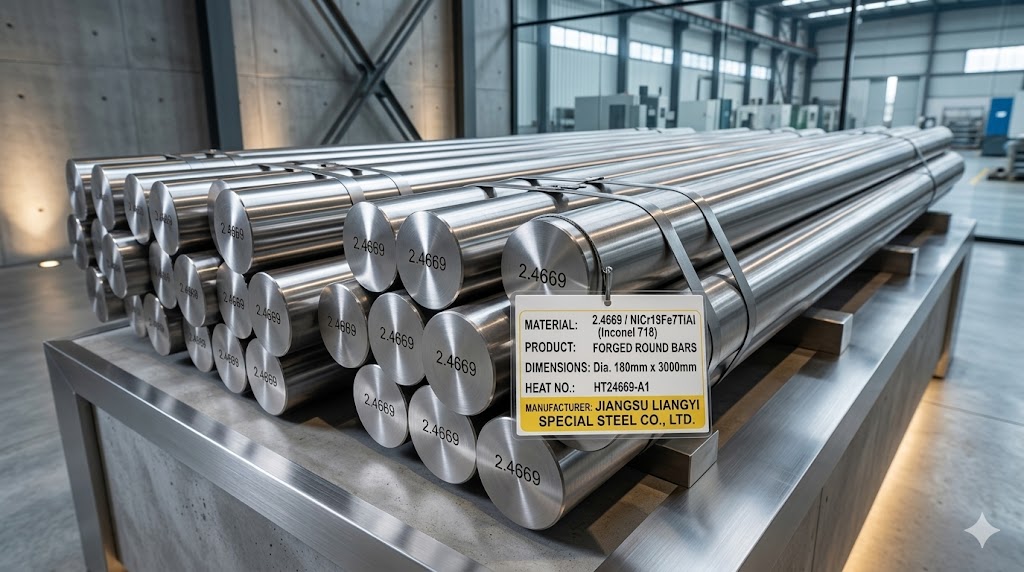
Round bars (Ø50–Ø1,200 mm), square bars, flat bars, rectangular bars, step shafts, and custom profile rods. Used for high-temperature bolting, valve stems, turbine blade blanks, fasteners, and structural components.
Key tolerances: Diameter ±1.5 mm (rough), ±0.5 mm (turned), straightness ≤1 mm/m.
Seamless Rolled Rings
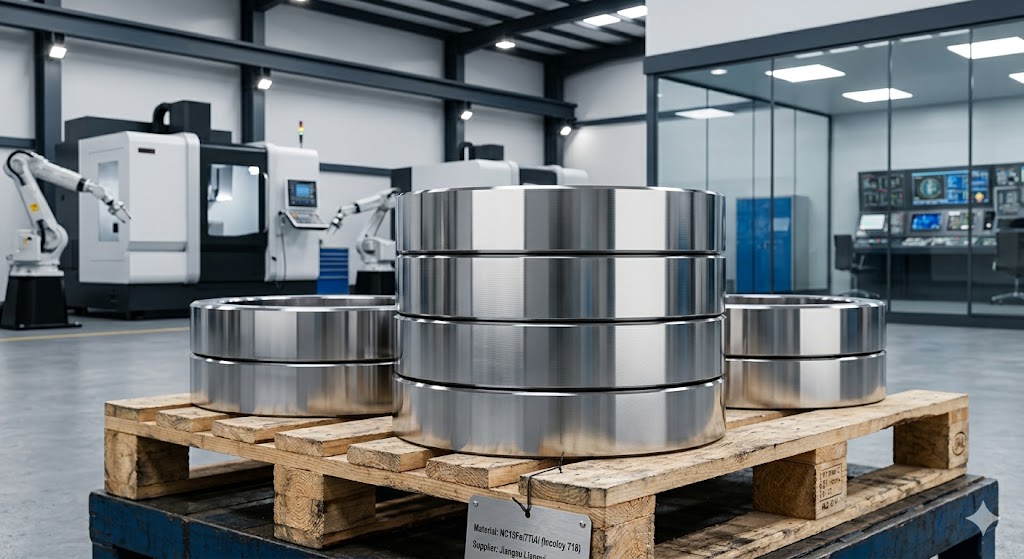
Rolled rings with OD from Ø300 mm to Ø6,000 mm, heights 50–1,500 mm. Rectangular, square, or custom profiled cross-sections. Used for gas turbine casings, seal rings, labyrinth rings, gear ring blanks, flange blanks, and bearing rings.
Key tolerances: OD ±5 mm (rough), roundness ≤3 mm; profiled rings machined to ±0.5 mm.
Forged Discs, Plates & Blanks
Forged discs and plates up to Ø2,500 mm diameter and 600 mm thickness. Used as turbine disc blanks, impeller blanks, compressor wheel blanks, and pressure vessel end caps. Full centre bore capability by drilling or punching.
Key tolerances: Diameter ±4 mm (rough), flatness ≤2 mm/m.
Housings, Sleeves & Hollow Bars
Forged hubs, pump housings, valve bonnets, sleeves, hollow bars, and seamless pipe/tube blanks. Used in high-temperature/high-pressure pump systems, high-pressure valve bodies, chemical reactor vessels, and deep-sea wellhead equipment.
Key tolerances: Wall thickness ±3 mm (rough), concentricity ≤3 mm.
Custom Valve Components
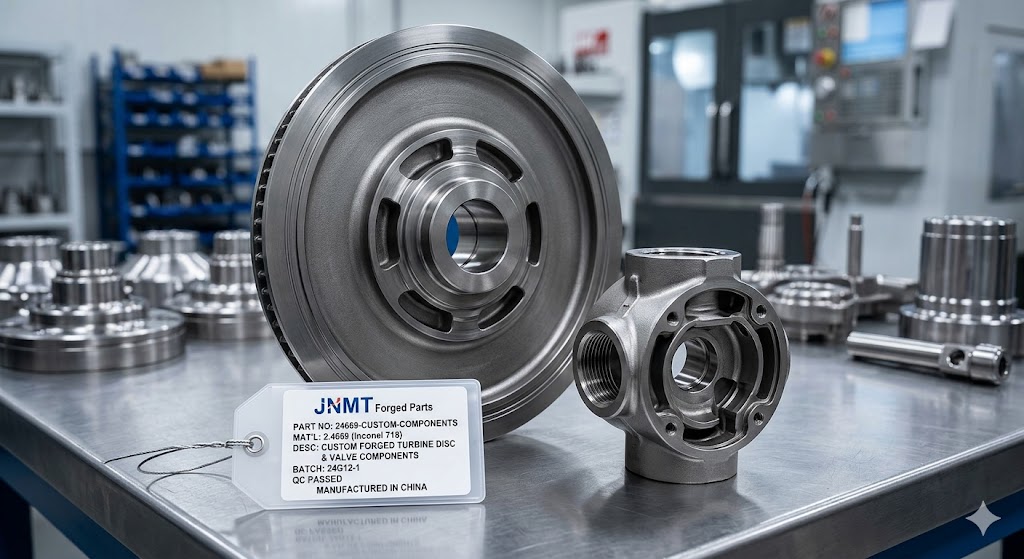
Forged valve bodies, bonnets, gates, discs, balls, seats, wedges, and guide bushings. Fully machined to your drawing for API 6A gate valves, ANSI 2500# ball valves, cryogenic butterfly valves, and main steam isolation valves for power generation applications.
Pressure ratings: Up to ANSI Class 2500 / PN 420 as standard; higher on request.
Turbine, Compressor & Pump Parts
Custom turbine disc forgings, impeller blanks, compressor stage discs, pump shaft blanks, pump casing halves, wear rings, and labyrinth seal strips. Full compatibility with aeroderivative and industrial gas turbine OEM dimensional standards.
Grain size: ASTM 5–8 for fatigue-critical rotating parts; coarser grades available for static components.
Our Proprietary 8-Stage Forging Process for 2.4669 (NiCr15Fe7TiAl)
The forging of 2.4669 presents challenges that do not exist with common carbon or stainless steels: a narrow hot-working temperature window, high flow stress, sensitivity to strain rate, and the need to forge below the gamma-prime solvus to avoid grain growth. Our 8-stage proprietary process, refined over 25+ years, specifically addresses these challenges.
- Stage 1 — Raw Material Verification: Before any processing, all 2.4669 raw stock (VIM+ESR certified billets or forged blooms from qualified melt suppliers) must pass a 100% incoming inspection. This includes PMI (portable XRF analysis), a hardness survey, a macro-etch examination, and ultrasonic testing according to EN 10228-3. Only materials that have full heat certificates and meet the chemistry requirements of EN 10302 are released for processing.
- Stage 2 — Billet Conditioning: Billet surface is ground or turned to remove any surface seams, laps, or inclusions that could propagate into the finished forging. Section dimensions are confirmed against the forging plan before heating.
- Stage 3 — Controlled Furnace Heating: Billets are charged into PLC-controlled gas-fired furnaces and brought to the initial forging temperature of 1,080–1,150°C using a programmed ramp rate of ≤100°C/hour for sections over 200 mm diameter. Soak time is minimum 2 hours per 100 mm of diameter to achieve thorough thermal homogenisation. Atmosphere is controlled to minimise surface oxidation.
- Stage 4 — First Forging Pass (Breakdown): The primary breakdown forging pass applies a total true strain of ≥0.5 to break up the as-cast or as-rolled dendritic microstructure and close internal porosity. This pass is performed at 1,100–1,150°C to take advantage of maximum workability. The strain rate is controlled to ≤2 s⁻¹ to prevent adiabatic shear banding in this strain-rate-sensitive alloy.
- Stage 5 — Intermediate Reheating Cycles: For heavy-section forgings, multiple reheating cycles are applied at 1,050–1,100°C between successive forging passes. This controlled thermal processing keeps the material temperature consistently above the γ' solvus temperature (approximately 990°C), avoiding deformation within the ductility trough and effectively eliminating the risk of surface cracking. The quantity of reheating cycles is defined in the customized forging schedule and fully recorded in official manufacturing records for complete traceability and quality control.
- Stage 6 — Final Shaping & Precision Forging: Final shape forging passes are performed at 1,000–1,050°C to refine grain size to ASTM 5–8. For rolled rings, the ring rolling operation begins at this temperature, with precise control of radial and axial roll forces to ensure dimensional accuracy and uniform grain flow throughout the ring cross-section.
- Stage 7 — Two-Stage Precipitation Heat Treatment: Following forging, all 2.4669 components undergo the mandatory two-stage aging cycle: (i) Solution Annealing: 980–1,010°C for 1 hour per 25 mm cross-section thickness, followed by rapid air cool or water quench to dissolve coarse precipitates and restore a supersaturated matrix; (ii) Double Aging: First age at 718–725°C / 8 hours, controlled furnace cool at 55±10°C/hour to 618–622°C, second age 8 hours, then air cool to room temperature. This produces the optimal γ' + γ'' precipitate distribution for the specified mechanical condition (+P980 or +P1170).
- Stage 8 — Full Inspection, Testing & Certification: Completed forgings undergo the full inspection scope (see Quality Assurance section): UT, MT/PT, dimensional survey, mechanical testing (tensile, hardness, Charpy impact), chemical analysis confirmation, and metallographic examination. All test data is compiled into the EN 10204 3.1 inspection certificate before release.
Production Standards & Compliance for 2.4669 Forgings
Understanding which standard applies to your application — and why — is as important as the standard itself. Here is a precise breakdown of the standards framework governing 2.4669 (NiCr15Fe7TiAl) forging production:
EN 10302:2008 — The Primary Material Standard
Nickel and cobalt alloys, as well as creep-resistant steels, must meet the EN 10302 standard in Europe. It clearly states that 2.4669 (NiCr15Fe7TiAl) is a designated alloy with specific limits on its chemical composition, heat treatment needs, and minimum mechanical properties at high temperatures. This is the main standard that our material certifications for 2.4669 use. It is also the right standard to use for gas turbine, power generation, and high-temperature pressure equipment.
EN 10269:1999 — Elevated and Low-Temperature Fastener Properties
EN 10269 covers steels and nickel alloys with specified elevated and/or low-temperature mechanical properties specifically for fasteners — bolts, studs, nuts, and similar threaded components. When 2.4669 bars or billets are supplied specifically for fastener machining, EN 10269 applies and requires additional low-temperature Charpy impact testing at -196°C in addition to the standard elevated-temperature tensile properties. We supply EN 10269-compliant 2.4669 bar stock with full cryogenic test documentation for nuclear, LNG, and cryogenic valve applications.
EN 10228 — NDT of Steel Forgings
Our ultrasonic testing of 2.4669 forgings is conducted per EN 10228-3 (ultrasonic testing of alloy and stainless steel forgings). For heavy-section components >300 mm diameter, we apply quality class 4 as standard, with class 5 or 6 available on request for aerospace and nuclear applications. Surface NDT (MT or PT) is performed per EN 10228-1 (magnetic particle) or EN 10228-4 (penetrant testing) as appropriate for the geometry.
Compatible North American and International Standards
- ASTM B637: Standard specification for precipitation-hardening nickel alloy bars, forgings, and forging stock — functionally equivalent to 2.4669 for UNS N07718 and similar alloys. Our forgings can be supplied with dual EN 10302 + ASTM B637 certification where required.
- AMS 5663 / AMS 5664: Aerospace Material Specifications for Inconel® 718-type alloys in precipitation-hardened condition. The AMS 5663/5664 heat treatment conditions are technically compatible with EN 10302 double-aging cycles and can be referenced for comparison in customer technical reviews.
- API 6A / API 17D (material requirements): For wellhead and Christmas tree valve components, our 2.4669 forgings are manufactured to meet the material chemical composition, mechanical property, and heat treatment requirements referenced in API 6A and API 17D. API-licensed end product certification is the responsibility of the valve/equipment manufacturer. NACE MR0175/ISO 15156-3 material hardness requirements are met in selected heat treatment conditions.
- ISO 9001:2015: Our quality management system certification covers all phases of 2.4669 production from raw material receipt to final shipment.
Chemical Composition of 2.4669 (NiCr15Fe7TiAl) — Full Element-by-Element Analysis
The table below lists the complete composition ranges per EN 10302:2008. Every heat of 2.4669 we process is independently verified by our in-house spectrometric analysis (OES) and reported in the heat analysis section of the EN 10204 3.1 certificate. We do not ship material based solely on the supplier's mill certificate without independent chemical verification.
| Element | Symbol | Min (%) | Max (%) | Metallurgical Role |
|---|---|---|---|---|
| Nickel | Ni | 65.9 | 77.7 | FCC matrix base; corrosion resistance; ductility |
| Chromium | Cr | 14.0 | 17.0 | Oxidation & hot corrosion resistance via Cr₂O₃ scale; solid solution strengthening |
| Iron | Fe | 5.0 | 9.0 | Partial Ni substitute; cost optimisation; austenite stabiliser |
| Titanium | Ti | 2.3 | 2.8 | Primary γ' (Ni₃Ti) former; thermal stability above 650°C; grain boundary strengthening |
| Niobium | Nb | 0.7 | 1.2 | γ'' (Ni₃Nb) former; short-range hardening; reduces delta phase risk vs Inconel® 718 |
| Aluminium | Al | 0.4 | 1.0 | Co-former of γ' Ni₃(Ti,Al); oxidation resistance; deoxidiser during melting |
| Manganese | Mn | 0 | 1.0 | Deoxidiser; sulphur scavenger (MnS formation preferred over FeS); max controlled |
| Cobalt | Co | 0 | 1.0 | Residual; solid solution strengthener at high temperature; controlled as impurity |
| Silicon | Si | 0 | 0.5 | Deoxidiser; oxidation resistance; controlled to prevent sigma phase formation |
| Copper | Cu | 0 | 0.5 | Residual; minimal effect below 0.5%; controlled for nuclear and sour service compliance |
| Carbon | C | 0 | 0.080 | Grain boundary carbides (M₂₃C₆, MC); controlled: too high → sensitisation; too low → grain growth |
| Phosphorus | P | 0 | 0.020 | Harmful grain boundary segregant; strictly limited for hot ductility and toughness |
| Sulfur | S | 0 | 0.015 | Harmful grain boundary and hot-shortness element; strictly limited; reduced by ESR refining |
Note on Ti + Al content: The sum of titanium and aluminium (Ti + Al) is the key predictor of γ' volume fraction and therefore age-hardening response. In 2.4669, Ti+Al typically falls between 2.7 and 3.8 wt%, producing a γ' volume fraction of approximately 10–15% after full precipitation heat treatment. Heats at the lower end of the Ti+Al range are best suited for the +P980 condition; heats at the upper end, combined with optimised double-aging, are required for reliable +P1170 properties. Our engineering team selects heats accordingly for your strength requirement.
Mechanical Properties of 2.4669 (NiCr15Fe7TiAl) Forged Products
The mechanical properties of 2.4669 forgings depend on section size, forging reduction ratio, heat treatment condition, and the specific test position within the forging (longitudinal vs transverse vs short-transverse orientation). The values below represent minimum guaranteed values per EN 10302 for round bar forgings. We provide actual test values — not just "passed/failed" statements — in our EN 10204 3.1 certificates.
Room Temperature Mechanical Properties — 2.4669 Forged Round Bars (EN 10302)
| Mechanical Property | Symbol | Condition +P980 | Condition +P1170 | Test Standard |
|---|---|---|---|---|
| Tensile Strength | Rm (MPa) | ≥ 980 | ≥ 1,170 | EN ISO 6892-1 |
| 0.2% Proof Strength | Rp0.2 (MPa) | ≥ 630 | ≥ 790 | EN ISO 6892-1 |
| Elongation after fracture | A (%) | ≥ 12 | ≥ 10 | EN ISO 6892-1 |
| Reduction of area | Z (%) | ≥ 20 | ≥ 18 | EN ISO 6892-1 |
| Brinell hardness | HBW | 280 – 360 | 320 – 400 | EN ISO 6506-1 |
| Charpy V-notch impact (longitudinal) | KV (J) at +20°C | ≥ 22 | ≥ 18 | EN ISO 148-1 |
| Charpy V-notch impact (longitudinal) | KV (J) at -196°C | ≥ 20 | ≥ 15 | EN ISO 148-1 |
Elevated Temperature Tensile Properties — 2.4669 (Typical Values, Longitudinal)
The following elevated-temperature data represents typical values for optimally aged 2.4669 bar forgings in the +P980 condition. These values are provided for engineering reference — actual certified values are measured and reported per customer request on a batch-by-batch basis.
| Test Temperature | Tensile Strength Rm (MPa) | 0.2% Proof Strength Rp0.2 (MPa) | Elongation A (%) |
|---|---|---|---|
| 20°C (Room Temperature) | ≥ 980 (typically 1,050–1,130) | ≥ 630 (typically 720–820) | ≥ 12 (typically 15–22) |
| 300°C | typically 920–990 | typically 680–760 | typically 14–20 |
| 400°C | typically 880–960 | typically 650–730 | typically 14–19 |
| 500°C | typically 840–920 | typically 620–710 | typically 13–18 |
| 600°C | typically 780–870 | typically 590–680 | typically 12–17 |
| 650°C | typically 730–820 | typically 560–640 | typically 12–16 |
| 700°C | typically 620–700 | typically 480–580 | typically 12–18 |
Physical Properties of 2.4669 (NiCr15Fe7TiAl)
| Property | Value | Condition |
|---|---|---|
| Density | 8.19 g/cm³ | Room temperature |
| Melting Range | 1,260 – 1,330°C | Solidus to liquidus |
| Thermal Conductivity | ~11.2 W/(m·K) | At 20°C |
| Thermal Conductivity | ~17.8 W/(m·K) | At 600°C |
| Coefficient of Thermal Expansion | ~13.0 × 10⁻⁶ /°C | 20–300°C |
| Coefficient of Thermal Expansion | ~14.2 × 10⁻⁶ /°C | 20–600°C |
| Modulus of Elasticity | ~200 GPa | At 20°C |
| Modulus of Elasticity | ~170 GPa | At 600°C |
| Electrical Resistivity | ~122 μΩ·cm | Room temperature |
| Magnetic Permeability | < 1.01 | Non-magnetic in annealed and aged states |
2.4669 vs Competing Alloys — Engineering Selection Guide
Selecting the correct alloy for a demanding application requires understanding not just the data sheet values, but the real-world trade-offs between competing options. Our engineering team regularly assists global buyers with alloy selection — here is our honest assessment of 2.4669 against the most common alternatives.
| Property / Factor | 2.4669 (NiCr15Fe7TiAl) | Inconel® 718 (2.4668) | Waspaloy® (2.4654) | Nimonic® 80A (2.4952) |
|---|---|---|---|---|
| EN Standard | EN 10302, EN 10269 | EN 10302 (2.4668) | EN 10302 (2.4654) | EN 10302 (2.4952) |
| Primary Strengthening | γ'-dominant (stable) | γ''-dominant (metastable) | γ'-dominant (stable) | γ' (stable) |
| Max Continuous Service Temp. | ~700°C | ~650°C (γ'' instability) | ~760°C | ~815°C (low strength) |
| Room Temp. Tensile Strength | 980–1,170 MPa (aged) | 1,100–1,350 MPa (aged) | 1,080–1,280 MPa (aged) | 800–1,000 MPa (aged) |
| Cryogenic Toughness (-196°C) | Excellent (≥20 J KV) | Excellent | Good | Good |
| Hot Corrosion Resistance | Good (14–17% Cr) | Moderate (17–21% Cr, lower Ti) | Good (19–21% Cr) | Good (18–21% Cr) |
| Forgeability | Good (wide temp. window) | Moderate (narrow window) | Difficult (narrow window, high flow stress) | Good |
| Weldability | Good (low Nb, low strain-age cracking risk) | Moderate (controlled conditions) | Difficult (high γ' → strain-age cracking risk) | Moderate |
| Relative Material Cost | Moderate (lower Co, lower Nb vs 718) | Moderate-High | High (>20% Co content) | Moderate |
| EN 10302 Creep Class | Yes (explicit listing) | Yes (explicit listing) | Yes (explicit listing) | Yes (explicit listing) |
| NACE MR0175 Sour Service | Yes (selected conditions) | Yes (selected conditions) | Limited | Limited |
| Best Application Fit | Gas turbines ≤700°C, nuclear, cryogenic, oil & gas valves | Aerospace, high-strength structural ≤650°C | Aeroengine hot section >700°C | Industrial turbines, moderate temperature |
Our recommendation: 2.4669 is the preferred choice when you need precipitation-hardening strength exceeding 980 MPa, combined with EN 10302 creep-resistance certification, good cryogenic toughness, and weldability — at a cost point below cobalt-bearing alternatives. If your service temperature consistently exceeds 720°C, contact our engineering team to discuss Waspaloy® (2.4654) or Nimonic® 90 (2.4632) alternatives, both of which we also produce.
Corrosion Resistance of 2.4669 (NiCr15Fe7TiAl) — Environment-by-Environment Guide
The corrosion performance of 2.4669 is markedly superior to austenitic stainless steels and carbon steels in most aggressive industrial environments, but there are environments where it is not the optimum choice. Our engineering team provides the following guidance based on documented service experience.
| Environment | Resistance Rating | Notes & Limitations |
|---|---|---|
| Oxidising acids (dilute HNO₃) | ★★★★☆ Excellent | Passive film stable; superior to 316L SS in moderate concentrations |
| Reducing acids (dilute H₂SO₄) | ★★★☆☆ Good | Adequate at low concentrations; not recommended for concentrated H₂SO₄ |
| Sour gas (H₂S + CO₂ + Cl⁻) | ★★★★☆ Very Good | NACE MR0175 / ISO 15156-3 compliant in +P980 condition; HRC ≤33 required; suitable for downhole and wellhead applications |
| Seawater / brine | ★★★★☆ Very Good | Pitting resistance superior to 316L SS due to Ni+Cr content; suitable for offshore and subsea components to 3,000 m depth |
| Chloride stress corrosion cracking | ★★★★☆ Excellent | Highly resistant due to >40% Ni content; far superior to austenitic SS; suitable for high-chloride environments where 316L SS would fail |
| High-temperature oxidation (dry air) | ★★★★☆ Very Good | Stable Cr₂O₃ scale to ~900°C; protective to ~700°C in long-term service; scale becomes locally spalling above 800°C under thermal cycling |
| Hot corrosion (Type I, 850–950°C) | ★★★☆☆ Good | Chromia scale provides moderate protection; superior to low-Cr alloys; inferior to higher-Cr MCrAlY coated systems |
| Hot corrosion (Type II, 650–750°C) | ★★★★☆ Very Good | 14–17% Cr is highly effective at resisting sulphate-induced Type II attack at gas turbine temperatures |
| Caustic / NaOH (concentrated) | ★★★☆☆ Moderate | Resistant to dilute caustic; concentrated NaOH at elevated temperature can cause stress corrosion in sensitised conditions |
| Hydrofluoric acid (HF) | ★★☆☆☆ Limited | Not recommended for HF service; Hastelloy® C-276 (2.4819) is preferred for HF environments |
| Cryogenic fluids (LN₂, LNG, LH₂, LO₂) | ★★★★★ Excellent | FCC structure retains full ductility and toughness at -196°C; impact certified per EN 10269 material requirements for cryogenic fastener and valve applications; no ductile-to-brittle transition |
| Nuclear reactor coolant water (PWR) | ★★★★☆ Very Good | Resistance to stress corrosion cracking superior to sensitised austenitic SS in high-temperature water; widely used by licensed nuclear equipment manufacturers for coolant pump and valve components |
Machining, Welding & Fabrication Guidance for 2.4669 Forgings
2.4669 (NiCr15Fe7TiAl) is significantly more challenging to machine than carbon steel or standard austenitic stainless steel. Buyers who will machine our forgings need to understand these characteristics to achieve the best surface finish, dimensional accuracy, and tool life. Our engineering team is available to provide application-specific machining advice.
Machining Characteristics
Work hardening: 2.4669 work hardens rapidly during cutting — more so than austenitic stainless steels. This is caused by dislocation accumulation in the FCC matrix and the interaction with coherent precipitates. The key mitigation strategies are: (i) maintaining a consistent cutting depth greater than the work-hardened layer from the previous pass; (ii) avoiding rubbing or dwell — always keep the tool advancing; (iii) using cutting fluids liberally to manage heat.
Recommended cutting parameters for turning (aged condition):
- Cutting speed: 15–30 m/min (significantly lower than for 316L SS at 50–80 m/min)
- Feed rate: 0.1–0.25 mm/rev
- Depth of cut: 1.5–4.0 mm (roughing), 0.2–0.8 mm (finishing)
- Tooling: Uncoated or TiAlN-coated submicron cemented carbide (ISO K20–K30); CBN inserts for finishing of fully hardened components
- Cutting fluid: High-pressure (70+ bar) flood coolant (soluble oil); essential for tool life and surface integrity
Grinding: 2.4669 can be surface and cylindrical ground to tight tolerances. Use vitrified aluminium oxide wheels (36–80 grit for roughing, 80–120 for finishing) with soft-to-medium grade. Keep grinding forces low and use abundant coolant to prevent thermal damage to the precipitate microstructure. Grinding burns will locally overage the material and produce tensile residual stresses — always perform Barkhausen noise testing or nital etch inspection after critical grinding operations on fatigue-sensitive components.
Welding of 2.4669 Forgings
2.4669 can be welded using Gas Tungsten Arc Welding (GTAW/TIG), Gas Metal Arc Welding (GMAW/MIG), or Electron Beam Welding (EBW), with the following important considerations:
- Pre-heat: Not required for 2.4669 — in fact, pre-heating above 150°C can promote hydrogen embrittlement in the presence of dissolved hydrogen from welding consumables. Keep interpass temperature ≤150°C.
- Filler metal selection: ERNiCrMo-3 (Alloy 625 filler, over-matching for corrosion resistance) or ERNiFeCr-2 (Alloy 718 filler, matching composition) are the standard choices. Consult AWS A5.14 or EN ISO 18274 for filler classification.
- Post-Weld Heat Treatment (PWHT): Post-weld aging at 718–725°C / 8 hours + 618–622°C / 8 hours (the standard double-aging cycle) is strongly recommended to restore γ' + γ'' precipitation in the weld heat-affected zone, which is depleted during welding. Without PWHT, the HAZ will have significantly lower strength than the parent material.
- Strain-age cracking risk: The risk of strain-age cracking during PWHT is lower in 2.4669 than in higher-γ' alloys (Waspaloy, René 41) because the γ' precipitation kinetics are relatively slow below 750°C. However, for thick section welds (>50 mm), use a slow ramp rate to the aging temperature (≤50°C/hour) to minimise thermal stress during heating.
Surface Treatment
2.4669 components used in high-temperature oxidation environments can benefit from:
- Aluminide diffusion coatings: Pack cementation or chemical vapour deposition aluminide coatings extend oxidation resistance above 900°C for 2.4669 turbine components by converting the surface to a NiAl intermetallic layer that forms a slow-growing Al₂O₃ scale.
- Shot peening: Controlled shot peening of fatigue-critical surfaces (turbine disc bores, fillet radii) introduces compressive residual stresses that significantly extend high-cycle fatigue life. Shot peening of fatigue-critical surfaces can be specified; the peening operation is performed by qualified subcontractors to customer-specified standards.
- Electropolishing: For pharmaceutical, food processing, or nuclear applications requiring ultra-smooth surfaces with minimum crevice corrosion risk, electropolishing can be arranged through qualified subcontractors to ASTM B912 or equivalent.
Quality Assurance & Inspection — What "Full Traceability" Actually Means
Many suppliers claim "full traceability" as a marketing phrase. For Jiangsu Liangyi, it is an engineering commitment that means a specific, documented chain from raw material source to finished part stamp — a chain that any third-party auditor can verify at any point in the supply chain. Here is exactly what our quality system delivers for every 2.4669 forging order.
Our In-House Testing Equipment
- Chemical Analysis: In-house Optical Emission Spectrometer (OES) — simultaneous multi-element analysis covering all EN 10302-required elements including Ni, Cr, Ti, Nb, Al, Fe, C, S, P
- Ultrasonic Testing: Digital phased-array and conventional UT flaw detectors, immersion tank system (for bars and rings) and contact probes; calibrated per EN 10228-3 to quality class 4 standard
- Mechanical Testing: Universal tensile testing machine (600 kN capacity); pendulum impact tester (Charpy 300 J capacity); all instruments calibrated per EN ISO standards and traceable to national standards
- Hardness Testing: Brinell hardness tester (EN ISO 6506-1); Rockwell hardness tester (EN ISO 6508-1); portable Leeb hardness tester for large forgings
- Metallography: Research-grade optical microscope with image analysis system for grain size measurement per ASTM E112 / EN ISO 643; scanning electron microscopy (SEM) available through accredited third-party laboratory
- Dimensional Measurement: Portable coordinate measuring arm (±25 μm accuracy); calibrated inside micrometers; digital height gauges; all instruments calibrated and traceable
EN 10204 3.1 Certificate — Section-by-Section Contents
Our EN 10204 3.1 inspection certificates are generated by our certified QC inspectors and contain the following documented data sections, in the order they appear in the certificate:
- Purchase Order number, item number, drawing number, revision, and technical specification reference (full traceability to customer purchase order)
- Material designation: 2.4669 / NiCr15Fe7TiAl, EN 10302:2008 / EN 10269:1999 as applicable
- Heat number, melt source and cast analysis with all elements per standard
- Product analysis (check analysis on the forging itself by OES), confirming heat analysis within standard limits
- Melting method and manufacturing route summary
- Forging reduction ratio and forging temperature range used
- Complete heat treatment records: solution anneal (temperature × time × quench method), aging cycle (720°C × 8h, cool rate, 620°C × 8h, cool method), furnace chart reference numbers
- Full metallographic examination results: grain size (ASTM number at surface, mid-radius, centre), phase identification, microstructural condition
- Individual tensile test results: specimen ID, gauge length, Rm, Rp0.2, A%, Z%, test temperature
- Individual Charpy impact test results: specimen IDs, test temperatures (room temperature and -196°C), individual KV values and average
- Brinell hardness survey results (minimum 3 readings per forging)
- NDT results: UT (sensitivity level, scanning pattern, indication report), MT or PT (coverage, acceptance criteria, result), RT where applicable
- Complete dimensional inspection report with all critical dimensions as-measured vs drawing tolerance
- Marking description: forging number, heat number, test number, standard, and material designation as stamped on the part
- Declaration of conformity and authorised signatory
Marking & Physical Identification
Every 2.4669 forging is permanently marked by low-stress dot-peen stamping (to avoid stress concentration) on a designated marking area per client drawing. The minimum marking content includes: unique forging number, heat number, test number, material designation (2.4669 / NiCr15Fe7TiAl), applicable standard reference, and Jiangsu Liangyi's manufacturer identification code. Forgings are not released for shipping unless marking has been verified against the certificate by QC inspection.
Industry Applications & Global Project Case Studies
2.4669 (NiCr15Fe7TiAl) forgings are specified in some of the world's most demanding industrial applications. The combination of high strength, creep resistance, cryogenic toughness, and EN 10302 certification makes this alloy the preferred material for engineers working on gas turbines, high-temperature pump and valve systems, subsea oil and gas equipment, and cryogenic processing plants. We have supplied 2.4669 forged components to clients in Germany, France, the United Kingdom, the United States, Canada, Saudi Arabia, the UAE, Australia, South Korea, Japan, and over 50 countries globally.
Aero & Industrial Gas Turbine Components (European & North American Markets)
The gas turbine hot section represents one of the most metallurgically demanding environments on earth: rotating at 3,000–15,000 RPM, exposed to combustion gas temperatures of 1,200–1,600°C (in the gas path — cooled component metal temperatures are 700–900°C), and subject to 20,000+ start-stop thermal cycles over a 25-year service life.
Our 2.4669 forgings are used in industrial gas turbine (not aeroengine) hot section components operating at metal temperatures of 600–720°C, including: turbine disc forgings (the most safety-critical rotating component, requiring ASTM 5–8 grain size, full UT per EN 10228-3 class 4–6, and 100% individual mechanical test certification); labyrinth seal rings (precision rolled, OD tolerance ±0.5 mm); compressor stage discs; turbine spacer rings; and structural casing ring forgings.
Project Reference: We have supplied over 5,000 sets of EN 10302-certified 2.4669 turbine disc and seal ring forgings to a leading European turbine OEM over a 12-year period, with consistently high acceptance rates on incoming inspection. Grain size ASTM 6–8 in all cases; all mechanical test certificates retained in our quality system for full retrospective traceability.
High-Temperature, High-Pressure Pump & Valve Components
Critical fluid-handling systems in power generation, chemical processing, and heavy industry demand components that combine high tensile strength, fatigue resistance, and corrosion resistance at sustained elevated temperatures. 2.4669 (NiCr15Fe7TiAl) is specified in these environments because its FCC structure remains ductile under thermal cycling, its chromia scale resists hot water and steam corrosion, and its precipitation-hardened strength allows reduced section thickness and component weight versus austenitic stainless alternatives.
Our 2.4669 forgings for this category include: pump impeller forgings (OD up to Ø1,200 mm), pump casing ring forgings, high-pressure valve body forgings, seal chamber forgings, and nozzle forgings. All are produced under enhanced quality plans including 100% immersion UT, full heat treatment records with furnace charts, and EN 10204 3.1 documentation. Third-party witness inspection by client-appointed inspection bodies (Bureau Veritas, Lloyd's Register, SGS, TÜV Rheinland and others) is fully supported and routinely facilitated at our facility.
Application Note: For applications requiring specific statutory certifications (ASME Boiler and Pressure Vessel Code, PED, or nuclear quality classifications), the applicable certification is held by the equipment manufacturer / end-product licence holder. Our forgings are supplied as materials compliant with EN 10302 / EN 10269 and can be incorporated into such certified scopes upon the equipment manufacturer's review.
Oil & Gas Wellhead, Subsea & Downhole Components
The upstream oil and gas industry presents 2.4669 with its most chemically aggressive challenge: NACE sour service environments combining H₂S (up to several hundred ppm partial pressure), CO₂ (up to 100+ bar partial pressure), chloride brines (up to 180,000 ppm Cl⁻), elemental sulphur at high temperatures, and methanol injection for hydrate inhibition. Standard carbon steel and even duplex stainless steel fail by hydrogen embrittlement or sulphide stress cracking in these conditions. 2.4669 in the +P980 condition meets NACE MR0175 / ISO 15156-3 requirements for corrosion-resistant alloy (CRA) service in sour wells.
Our 2.4669 oil and gas forgings include: wellhead Christmas tree body forgings (ANSI Class 2500 / 5,000 psi WP); tubing hanger forgings; casing head flanges; subsea connector forgings (designed for 3,000 metre water depth, 400+ bar wellbore pressure); downhole packer mandrel forgings; and sour service gate valve body forgings, with material properties meeting API 6A referenced material requirements.
Project Reference: A major Middle East integrated oil company selected our 2.4669 forged wellhead components for a sour gas field development where H₂S partial pressure exceeded 0.3 MPa and chloride levels reached 120,000 ppm. Material qualification testing including NACE TM0177 Method A slow strain rate testing and ASTM G48-B pitting corrosion testing was performed at the client's appointed accredited corrosion testing laboratory, confirming full compliance with NACE MR0175 / ISO 15156-3 requirements. The supplied components have performed reliably in service without material-related issues.
High-Performance Industrial Valves — Power Plant & Petrochemical
Industrial valves used in supercritical steam cycles (600°C, 300+ bar), LNG liquefaction trains (-162°C), and high-pressure hydrogen service represent three of the most demanding valve applications in the process industries. 2.4669 is increasingly specified for valve bodies and trim in these services because conventional materials (F316 stainless steel, F22 alloy steel) lack either the temperature capability, the cryogenic toughness, or the hydrogen embrittlement resistance required.
Our 2.4669 valve forgings include: forged valve bodies for main steam control valves at ultra-supercritical power plants; cryogenic gate valve bodies for LNG liquefaction trains (certified to -196°C Charpy impact per EN 10269); ball valve bodies and seats for high-pressure hydrogen service (700 bar) in hydrogen compression and storage equipment; and throttle valve bodies for CO₂ injection wells in CCS (carbon capture and storage) projects.
Project Reference: We supply over 10,000 sets of 2.4669 valve body and trim forgings annually to a global valve OEM serving the power generation and petrochemical sectors. Components are certified per EN 10302 with EN 10204 3.1 documentation and have achieved <0.1% field rejection rate over a 7-year supply relationship.
Cryogenic & LNG Applications — Proven Toughness at -196°C
2.4669 (NiCr15Fe7TiAl) holds a unique position among precipitation-hardenable alloys: unlike ferritic or martensitic steels which undergo a ductile-to-brittle transition at low temperatures, the FCC crystal structure of 2.4669 retains full ductility and toughness down to -196°C (liquid nitrogen temperature) and below. This makes it a premier material choice for cryogenic valves, LNG liquefaction train components, cold-box heat exchanger tube sheets, and cryogenic pump impellers where high strength must coexist with certified low-temperature toughness.
Our standard quality plan for cryogenic-application forgings includes mandatory Charpy V-notch impact testing at -196°C per EN ISO 148-1, with minimum guaranteed impact energy of 20 J per EN 10269. We routinely exceed this minimum — verified impact energies at -196°C typically range from 45 to 80 J for optimally processed 2.4669 bar forgings in the +P980 condition.
Application Reference: We supply 2.4669 forged valve body blanks, impeller blanks, and cryogenic pump casing ring forgings for LNG liquefaction and regasification equipment manufacturers, with full EN 10269 cryogenic certification at -196°C. Dimensional tolerances of ±0.5 mm on rough forgings and ±0.1 mm on semi-finished bores are routinely achieved for precision cryogenic components.
Additional applications include: heat exchanger tube sheet forgings (combined corrosion resistance + machinability for thousands of tube holes); pressure vessel shell forgings and nozzle forgings (EN 13445-3 / ASME Section VIII); marine propeller shaft and sealing ring forgings (seawater corrosion resistance + fatigue strength); chemical reactor agitator shaft forgings (NACE corrosion resistance + mechanical sealing compatibility); and mining slurry pump shaft and impeller forgings (wear resistance + corrosion resistance in acidic tailings).
How to Specify & Order 2.4669 (NiCr15Fe7TiAl) Forgings — Procurement Guide
Getting the specification right before enquiry is the single most important factor in receiving an accurate quotation and avoiding production delays. Here is a practical guide from our sales engineers on the information we need — and why each piece matters.
Essential Information for a Complete Enquiry
- Material specification: State "2.4669 (NiCr15Fe7TiAl) per EN 10302:2008" for elevated-temperature applications; "per EN 10269:1999" for fastener/cryogenic applications. If you need dual-standard compliance (e.g., EN 10302 + ASTM B637), state both.
- Heat treatment condition: Specify "+P980" (lower strength, better ductility and toughness, preferred for cryogenic and complex geometry) or "+P1170" (higher strength, suitable for compact structural sections). If unsure, ask our engineering team — selecting the wrong condition is a common mistake that cannot be corrected after forging.
- Applicable standards and inspection class: State the NDT standard (e.g., EN 10228-3 quality class 4) and certificate type (EN 10204 3.1 or 3.2 with third-party involvement). If third-party witness inspection is required, name the inspection body and contact in your PO.
- Drawings with full dimensions and tolerances: Provide 2D engineering drawings (DXF/DWG/PDF) and optionally 3D STEP models. Include surface finish requirements (Ra values) on all critical surfaces. State the machining allowance required if we supply rough forgings for your subsequent machining.
- Quantity and delivery requirements: State quantity per order, any phased delivery schedule, and your required dock date. For project-critical deliveries, inform us as early as possible — lead time can be compressed to 7–14 days in genuine emergencies with advance notice and coordination.
- Special requirements: Any NACE compliance requirements (state specific well environment parameters); any nuclear classification (ASME Level A/B/C/D, RCC-M, KTA); any witness inspection hold points; any customer-specific material qualification requirements (such as first-article inspection or material qualification test programmes).
Our Quotation and Order Process Timeline
- Hour 0 — Enquiry received: Enquiries sent to sales@jnmtforgedparts.com or via WhatsApp (+86-13585067993) are assigned to a dedicated sales engineer within 2 hours during working hours.
- Hours 4–24 — Technical review: Our engineering team reviews your drawings, confirms our manufacturing capability, checks raw material stock or lead time for billet procurement, and prepares a formal technical proposal.
- Within 24 hours — Quotation issued: You will get a formal written quotation including unit price, total price, lead time, applicable standards, certificate type, and commercial terms (Incoterms, payment terms, packing specification).
- PO receipt → Production start: Upon receipt of signed purchase order and confirmation of technical specification, a dedicated Inspection Test Plan (ITP) and production schedule are issued within 48 hours. Production begins immediately upon raw material availability.
- Days 5–25 — Production and testing: Progressive milestones are available including forging completion, heat treatment completion, and NDT/mechanical test results, shared proactively via email without waiting for you to ask.
- Days 15–30 — Shipment: Completed, inspected, certified, and marked forgings are shipped by air freight (for urgent orders), sea freight (LCL or FCL), or express courier depending on weight and delivery urgency.
Frequently Asked Questions — 2.4669 (NiCr15Fe7TiAl) Forgings
2.4669 (NiCr15Fe7TiAl) achieves its exceptional strength through a dual precipitation hardening mechanism: coherent gamma-prime (γ', Ni₃(Ti,Al)) and gamma-double-prime (γ'', Ni₃Nb) precipitates within the face-centred cubic nickel matrix. Unlike solid-solution alloys such as Alloy 625, 2.4669 can be aged to tensile strengths exceeding 1,170 MPa while retaining outstanding cryogenic toughness to -196°C. Its higher Ti/Al ratio relative to Inconel® 718 also produces a γ'-dominant microstructure more thermally stable above 650°C, making it the preferred choice under EN 10302 for creep-critical applications.
2.4669 requires a two-stage precipitation heat treatment. Stage 1 — Solution Annealing: 980–1,010°C for 1 hour per 25 mm section thickness, followed by rapid air cool or water quench. Stage 2 — Double Aging: First at 718–725°C / 8 hours, furnace cool at ~55°C/hour to 618–622°C, hold 8 hours, then air cool to room temperature. This produces the optimal γ' + γ'' precipitate distribution for +P980 or +P1170 properties. We provide complete heat treatment records with furnace chart printouts for every batch.
2.4669 and Inconel® 718 (2.4668) are closely related but not identical or interchangeable without engineering review. The key difference is niobium content: 2.4669 has 0.7–1.2% Nb (low) vs 718's 5.0–5.5% Nb (high). This means 2.4669 produces more thermally stable γ' versus the metastable γ'' dominant in 718. For service above 650°C, 2.4669 is generally the superior choice due to reduced delta-phase formation risk. For maximum room-temperature strength below 650°C (aerospace structural), standard Inconel® 718 may be preferred. Always discuss service temperature and loading with our engineering team before substituting one for the other.
Both conditions use the same double-aging heat treatment cycle but target different minimum strength levels by selecting heats with appropriate Ti+Al content. +P980 (Rm ≥ 980 MPa, Rp0.2 ≥ 630 MPa): better ductility and toughness, preferred for complex-geometry forgings, cryogenic applications, and thick sections. +P1170 (Rm ≥ 1,170 MPa, Rp0.2 ≥ 790 MPa): higher strength for structural applications where weight reduction is critical. +P1170 typically shows slightly lower elongation and impact energy. For NACE sour service, +P980 condition is usually preferred as it typically produces lower hardness (HRC ≤33) meeting MR0175 requirements.
Yes. 2.4669 in the +P980 precipitation-hardened condition is listed in NACE MR0175 / ISO 15156-3 as an acceptable corrosion-resistant alloy (CRA) for sour service in oil and gas production, subject to hardness ≤HRC 33 (≤Brinell 313 HBW). We control the heat treatment precisely to achieve this hardness range and provide hardness certification on each forging. For subsea and high-H₂S applications, NACE TM0177 corrosion testing can be arranged through accredited third-party corrosion testing laboratories as part of the material qualification programme, if required by your project specification.
Our standard NDT scope for 2.4669 forgings includes: Ultrasonic Testing (UT) per EN 10228-3, quality class 4 (contact or immersion method depending on geometry); Magnetic Particle Testing (MT) per EN 10228-1 for surface and near-surface indications on magnetic-permeable geometries; Liquid Penetrant Testing (PT) per EN 10228-4 for non-magnetic components or complex surface geometries. Higher UT quality classes (5 or 6) for aerospace/nuclear applications, and Radiographic Testing (RT) for specific internal geometry requirements, are available at additional cost. All NDT results are documented with individual indication reports in the EN 10204 3.1 certificate.
Yes, 2.4669 is weldable by TIG, MIG, or electron beam welding. No pre-heat is required. Keep interpass temperature ≤150°C. Recommended fillers: ERNiCrMo-3 (Alloy 625, over-matching for corrosion) or ERNiFeCr-2 (Alloy 718, composition-matching). Post-weld aging at 720°C/8h + 620°C/8h is strongly recommended to restore precipitation hardening in the HAZ. Strain-age cracking risk is lower than in higher-γ' alloys (Waspaloy, René 41) due to slower γ' precipitation kinetics, but thick section welds (>50 mm) should use a slow ramp rate to aging temperature (≤50°C/hour) to minimise residual stress during heating.
Standard lead time is 15–30 days for custom 2.4669 forgings. Emergency lead time of 7–14 days is available with advance coordination for urgent project needs. A detailed technical quotation is provided within 24 hours of receiving your drawings and specifications. Minimum order quantity (MOQ) is flexible: we accommodate prototype single-piece orders as well as production runs of hundreds of pieces. For blanket purchase agreements or framework contracts covering 12+ months of demand, we offer priority scheduling, fixed pricing, and consignment stock arrangements. Send your enquiry to sales@jnmtforgedparts.com.
Custom 2.4669 (NiCr15Fe7TiAl) Forging Solutions — Request Your Quote
Jiangsu Liangyi is your trusted China manufacturing partner for custom 2.4669 (NiCr15Fe7TiAl) forging parts, backed by 25+ years of nickel superalloy metallurgical expertise, ISO 9001:2015 certified production, and a proven track record of supplying gas turbine, oil & gas, industrial valve, and cryogenic applications for global clients in 50+ countries.
Send us your drawings, specifications, required standards, heat treatment condition, and project timeline — and our engineering team will return a complete technical and commercial proposal within 24 hours. Whether you need a single prototype ring or a framework contract for thousands of valve bodies, we have the process control, quality system, and capacity to deliver.
Permanent Product Page: https://www.jnmtforgedparts.com/24669-nicr15fe7tial-forging-parts.html
📧 Technical & Sales Enquiries: sales@jnmtforgedparts.com
📞 Phone / WhatsApp (24h for urgent enquiries): +86-13585067993
🌐 Official Website: https://www.jnmtforgedparts.com
📍 Factory: Chengchang Industry Park, Jiangyin City, Jiangsu Province, China 214400
🕐 Working Hours: Monday – Friday 08:00–17:30 CST (UTC+8)