1.8070 | 21CrMoV5-11 Forged Parts — Manufacturer & Supplier, China
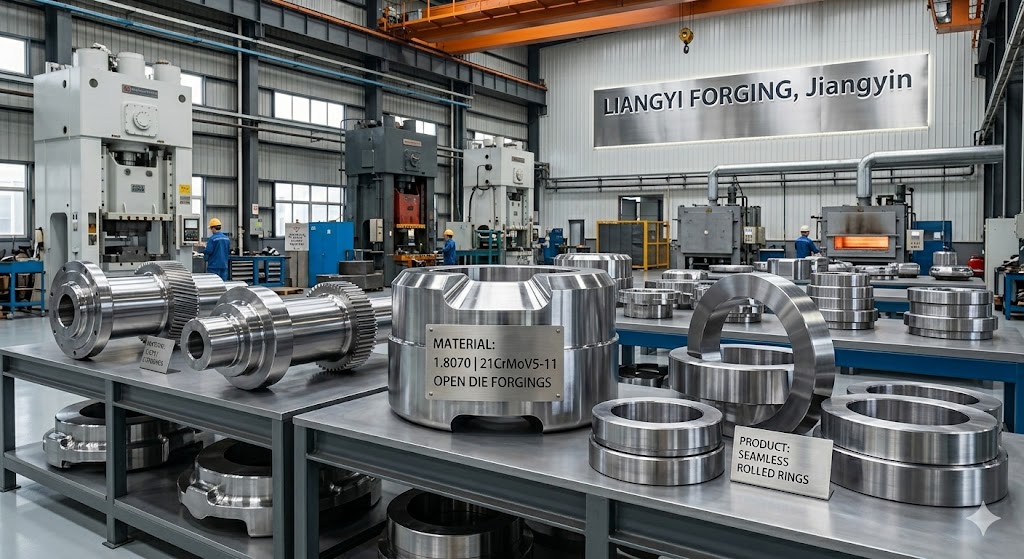
1.8070 / 21CrMoV5-11 Steel — Grade Overview
1.8070 is the EN material number for 21CrMoV5-11, a chromium-molybdenum-vanadium pearlitic heat-resistant alloy steel standardized under EN 10269 for fasteners and pressure-bearing components in elevated-temperature service. The designation encodes the nominal composition: 21 = 0.21% C, Cr = ~1.3%, Mo = ~1.1%, V = ~0.3%, with the suffix 5-11 representing the scaled Cr and Mo coefficients.
The vanadium addition (0.25–0.35%) distinguishes 21CrMoV5-11 from plain Cr-Mo grades. During tempering, vanadium forms fine V₄C₃ carbide precipitates that pin austenite grain boundaries, suppress coarsening at elevated service temperatures and raise the long-term creep rupture strength relative to grades without vanadium. In service, the grade holds a minimum yield strength of 400 MPa at 400°C and is rated for continuous use up to 500°C.
Jiangsu Liangyi Co., Limited, based in Jiangyin, Jiangsu, China, has manufactured 1.8070 / 21CrMoV5-11 open die forgings, seamless rolled rings and precision machined components since 1997. The facility is ISO 9001:2015 certified and ships to customers in more than 50 countries.
21CrMoV5-11 vs Conventional Cr-Mo Grades — Engineering Differences
- Creep resistance at 450–500°C: The V₄C₃ dispersion gives 21CrMoV5-11 a 10,000-hour creep rupture strength of ~180–220 MPa at 500°C — measurably higher than 1.7225 (42CrMo4) or 1.7380 (10CrMo9-10) at the same temperature.
- Through-hardening in large sections: The Cr-Mo-V combination hardens uniformly in sections up to ~500 mm equivalent diameter, keeping surface-to-core property variation within EN 10269 tolerances for large turbine shafts and heavy flanges.
- Oxidation resistance above 400°C: Chromium content of 1.2–1.5% forms a stable oxide film that slows surface scaling in steam and oxidizing process gases, extending component service intervals.
- Machinability after Q+T: At 230–280 HB, the grade produces consistent chip formation in turning and milling, relevant when machining complex profiles such as turbine blade roots and precision-threaded fasteners.
- Weldability: 21CrMoV5-11 is weldable with preheat (150–250°C depending on section size) and post-weld heat treatment at 650–700°C. Matching filler metals are available; consult a qualified WPS for each joint configuration.
1.8070 / 21CrMoV5-11 — International Grade Cross-Reference
The table and cards below cross-reference 1.8070 against the major standards bodies, including the 1.8070 ASTM equivalent and DIN, JIS and GB counterparts. "Equivalent" indicates compositional similarity only — verify chemical and mechanical requirements against your project's inspection test plan (ITP) before substituting grades on certified work.
| Standard | Grade | C % | Cr % | Mo % | V % | Rp0.2 min (MPa) | Max Temp (°C) |
|---|---|---|---|---|---|---|---|
| EN 10269 | 1.8070 / 21CrMoV5-11 | 0.17–0.25 | 1.20–1.50 | 1.00–1.20 | 0.25–0.35 | 540 | 500 |
| DIN | 21CrMoV511 | 0.17–0.25 | 1.20–1.50 | 1.00–1.20 | 0.25–0.35 | 540 | 500 |
| ASTM | A193 B7 (approx.) | 0.37–0.49 | 0.75–1.20 | 0.15–0.25 | — | 725 (≤63 mm) | 427 |
| ASTM | A182 F22 (approx.) | 0.05–0.15 | 2.00–2.50 | 0.87–1.13 | — | 310 | 650 |
| GB | 20Cr1Mo1VNbTiB (approx.) | 0.17–0.25 | 0.90–1.30 | 0.90–1.20 | 0.22–0.38 | ≥490 | 510 |
Composition ranges are for reference only. Confirm against current standard editions and project ITPs before grade substitution.
1.8070 / 21CrMoV5-11 Chemical Composition (EN 10269)
All Liangyi 1.8070 heats are analyzed at both ladle stage (heat analysis) and product stage (check analysis). The internal aim composition is narrower than the EN 10269 smelted analysis limits to improve batch-to-batch consistency, particularly for repeat orders:
| Element | EN 10269 Smelted Analysis | Liangyi Aim Range | Function |
|---|---|---|---|
| Carbon (C) | 0.17 – 0.25 | 0.19 – 0.23 | Primary strengthener; tighter range reduces HAZ hardness scatter in weldments |
| Silicon (Si) | 0.30 – 0.60 | 0.35 – 0.50 | Deoxidizer; minor contribution to oxidation resistance |
| Manganese (Mn) | 0.30 – 0.60 | 0.35 – 0.50 | Hardenability; held at lower end to reduce temper embrittlement sensitivity |
| Chromium (Cr) | 1.20 – 1.50 | 1.30 – 1.45 | Hardenability, oxidation resistance, carbide stability |
| Nickel (Ni) | 0.60 max | 0.40 max | Toughness; limited to reduce temper embrittlement risk |
| Molybdenum (Mo) | 1.00 – 1.20 | 1.05 – 1.15 | Creep resistance; M₂C carbides suppress temper embrittlement |
| Vanadium (V) | 0.25 – 0.35 | 0.28 – 0.32 | V₄C₃ precipitates pin grain boundaries; raises Rp0.2 and creep rupture strength at elevated temperature |
| Phosphorus (P) | 0.035 max | 0.020 max | Tramp impurity; reduced via LF refining to protect toughness |
| Sulphur (S) | 0.035 max | 0.015 max | Controls MnS inclusion count; tight limit improves UT acceptance rate on large sections |
1.8070 / 21CrMoV5-11 Mechanical Properties (Q+T Condition)
Values below apply to forgings in the quenched and tempered (Q+T) condition, with specimens taken from the mid-section or ¼T position per EN 10269. Key figures: 1.8070 tensile strength 690–830 MPa, yield strength Rp0.2 min 540 MPa, 21CrMoV5-11 hardness 230–280 HB. The "Liangyi typical" column reflects production results from batch MTCs over the past three years:
| Property | Temperature | EN 10269 Minimum | Liangyi Typical | Test Standard |
|---|---|---|---|---|
| Yield Strength Rp0.2 | +20°C | 540 MPa | 570 – 620 MPa | EN 10002-1 |
| Tensile Strength Rm | +20°C | 690 – 830 MPa | 710 – 780 MPa | EN 10002-1 |
| Elongation A5 | +20°C | Min 18% | 19 – 22% | EN 10002-1 |
| Reduction of Area Z | +20°C | Min 25% | 55 – 65% | EN 10002-1 |
| Brinell Hardness | +20°C | 230 – 280 HB | 235 – 270 HB | ISO 6506-1 |
| Impact Energy KV | +20°C | Min 54 J | 85 – 130 J | EN 10045-1 |
| Yield Strength Rp0.2 | 400°C | Min 400 MPa | 420 – 450 MPa | EN 10002-5 |
Yield Strength vs. Temperature — 20°C to 500°C
The table below shows the Rp0.2 profile across the full service range, based on EN 10269 requirements and Liangyi production data. This is the primary comparison point when evaluating 21CrMoV5-11 against lower-alloy alternatives such as 1.7225 (42CrMo4) or 1.7380 (10CrMo9-10):
| Temperature | Rp0.2 (MPa) | Rm (MPa) | Retention vs. RT |
|---|---|---|---|
| +20°C | 540 | 690 | 100% (baseline) |
| +100°C | 510 | 660 | ~94% |
| +200°C | 480 | 640 | ~89% |
| +300°C | 450 | 620 | ~83% |
| +400°C | 400 (EN 10269 min) | — | ~74% |
| +450°C | ~360 | — | ~67% |
| +500°C (rated maximum) | ~300 | — | ~56% |
Values above 400°C are indicative. Request certified elevated-temperature test data for your specific section size and heat treatment condition.
Creep and Stress Rupture Data — 1.8070 Creep Strength
For long-term elevated-temperature applications — steam turbine bolting and high-pressure valve bodies in particular — 1.8070 creep strength often governs the design rather than short-term yield strength. The values below are from published literature and Liangyi production records:
| Temperature | Rupture Strength at 10,000 h | Rupture Strength at 100,000 h | 1% Creep Limit at 10,000 h |
|---|---|---|---|
| 450°C | ~320 MPa | ~240 MPa | ~230 MPa |
| 500°C | ~180 – 220 MPa | ~140 – 165 MPa | ~140 MPa |
| 550°C | ~95 – 120 MPa | ~65 – 85 MPa | — |
Request project-specific certified creep test data where design codes require direct material evidence.
Heat Treatment Parameters — 1.8070 / 21CrMoV5-11
Meeting EN 10269 mechanical requirements for 1.8070 depends on controlling all three treatment stages within defined temperature windows. Liangyi operates dedicated vertical quench towers and computer-controlled furnaces. Furnaces are calibrated quarterly with temperature uniformity surveys to ±5°C. Load thermocouples on each batch verify actual component temperatures rather than chamber air temperatures — relevant for sections above 200 mm where thermal lag is material:
Temperature: 960 – 1000°C
Hold: 1 h per 25 mm, min 2 h
Cool: Air to below 300°C
Purpose: Eliminate as-forged banding; homogenize austenite grain size before quench
Temperature: 950 – 980°C
Hold: 1 h per 25 mm, min 1.5 h
Atmosphere: Controlled or protective
Purpose: Full carbide dissolution; uniform austenitization for maximum hardenability
Medium: Oil (≤200 mm sections); water-polymer for larger sections
Transfer: ≤30 s from furnace to quench
Bath: 40–80°C (oil) / 20–40°C (water-polymer)
Purpose: Develop martensitic or bainitic microstructure
Temperature: 650 – 720°C
Hold: 1 h per 25 mm, min 2 h
Cool: Air or furnace
Purpose: Stress relief; V₄C₃ and M₂C carbide precipitation; achieve 230–280 HB
Temperature: 580 – 620°C (below original temper)
Hold: 2 – 4 h
Cool: Furnace to ≤200°C
Purpose: Relieve machining stresses without degrading Q+T properties
J-factor [(Si+Mn)×(P+Sn)×10⁴] <80; X-factor [(10P+5Sb+4Sn+As)/100] <12
Controlled cooling through 300–550°C range
Purpose: Avoid Irwin-Rees-Stuart embrittlement common in Cr-Mo steels
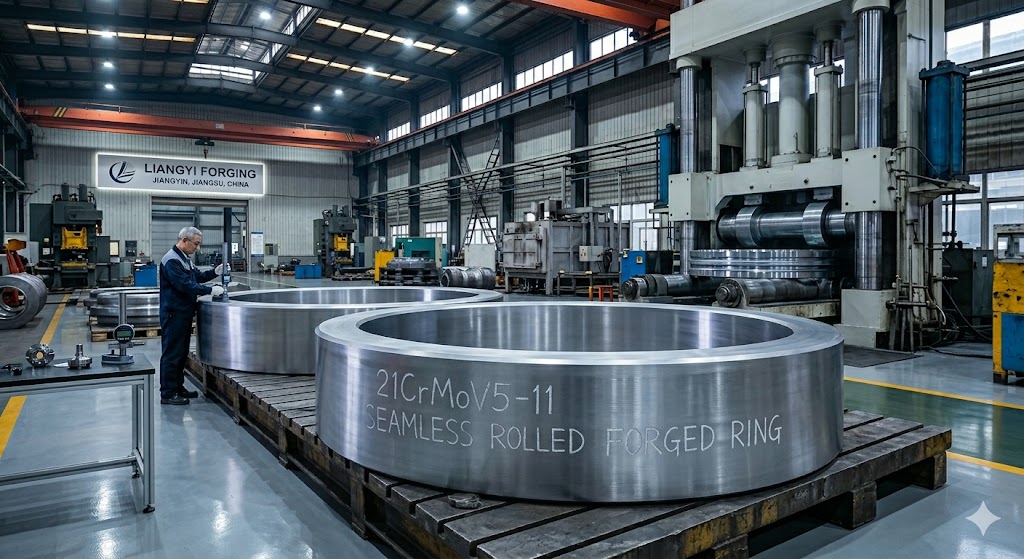
Product Range — Dimensions and Delivery Conditions
All 1.8070 / 21CrMoV5-11 forgings are manufactured to customer drawings or specifications. No pre-forged stock is held. Minimum order weight is 30 kg per piece; single-piece prototypes are accepted. The table below gives size capability by product category:
| Product Type | Typical Forms | Max OD / Width | Max Length / Height | Max Weight | Delivery Condition |
|---|---|---|---|---|---|
| Forged Round Bars | Solid cylinders, step shafts, spindles | Ø2,000 mm | 8,000 mm | 30 t | Q+T / Normalized / As-forged |
| Flat / Rectangular Bars | Flat bars, blade blanks, key stock | 1,500 mm wide | 6,000 mm | 20 t | Q+T / Normalized |
| Seamless Rolled Rings | Flanges, gear rings, turbine discs, valve seats | OD 6,000 mm | Height 1,200 mm | 30 t | Q+T |
| Discs & Blocks | Impellers, tube sheets, end covers | Ø3,000 mm | 800 mm thick | 30 t | Q+T / Normalized |
| Hollow Forgings | Pipes, sleeves, housings, cylinders | OD 3,000 mm | 5,000 mm | 25 t | Q+T |
| Machined Components | Turbine blades, rotor shafts, bolts, valve bodies | Per drawing | Per drawing | 30 t | Finished machined, Q+T |
Each forging is stamped with heat number, material grade, heat treatment condition and inspection mark before dispatch.
1.8070 Forged Round Bars, Step Shafts and Rotor Shaft Blanks
The most frequently ordered form is the 1.8070 forged round bar — solid cylinders and step shafts machined from open die forgings. Diameters run from 80 mm up to Ø2,000 mm, lengths to 8,000 mm, and individual piece weight to 30 t. Typical end uses include 21CrMoV5-11 rotor shaft forgings for steam turbine and compressor applications, valve spindles, pump shafts and heavy-duty fastener blanks. All supplied Q+T with Brinell hardness survey per piece.
21CrMoV5-11 Turbine Blade Blanks — Flat and Rectangular Bars
Flat and rectangular bar forgings in 1.8070 are used primarily as turbine blade blanks for industrial gas turbines, where the aerofoil profile is subsequently milled from the forged blank. Cross-sections from 60 × 30 mm to 1,500 × 200 mm; lengths to 6,000 mm. Dimensional straightness ≤ 1 mm/m after Q+T heat treatment. The same form is also used for compressor blisk blanks and heavy key stock.
1.8070 Seamless Rolled Rings — Flanges, Turbine Discs and Gear Rings
1.8070 seamless rolled rings cover the widest application range: pressure vessel flanges, turbine discs, gear rings, valve seats and bearing rings. OD up to 6,000 mm, height up to 1,200 mm, wall thickness from 30 mm upward. Profile options include rectangular cross-section, contoured (T-section, L-section) and near-net-shape rings to reduce machining stock. Supplied Q+T; 100% UT per EN 10228-3 standard.
1.8070 Forged Discs, Blocks and Hollow Forgings
1.8070 forged discs up to Ø3,000 mm are used for turbine impellers, tube sheets and pressure vessel end covers. 21CrMoV5-11 hollow forgings — shells, sleeves, heavy-wall cylinders and forged pipe sections with OD up to 3,000 mm — are used in boiler, heat exchanger and reactor pressure boundary applications. Both forms are supplied Q+T with full-face UT and dimensional inspection report.
21CrMoV5-11 Turbine Bolts, Studs and Fastener Forgings
EN 10269 was written specifically for grades like 1.8070 used in bolted joints at elevated temperature. 21CrMoV5-11 turbine bolt and stud blanks — round bar sections from Ø20 mm to Ø200 mm — are among the highest-volume items we produce. Tolerances match ISO 965-1 and ASME B1.1 thread engagement requirements. Charpy impact at test temperature and hardness per EN 10269 are included in every MTC.
Applications and Project References
The following references are from shipped orders. Client names are withheld; technical and geographic details are factual:
Power Generation — Steam Turbines and Boiler Components
EN 10269 specifically designates 1.8070 for fasteners and pressure-bearing parts in elevated-temperature service. 21CrMoV5-11 turbine bolts, studs and nuts — used on main steam valves, high-pressure cylinder joints and turbine casing flanges — are the single highest-volume application for this grade globally. Beyond turbine bolting, Liangyi's power generation supply record includes:
- Forged turbine blade blanks (flat rectangular bars, 120 × 60 mm to 300 × 120 mm cross-section, 500–2,000 mm length) for industrial gas turbine manufacturers in Germany and Italy — toleranced to ±0.05 mm, surface finish Ra ≤ 1.6 µm after precision milling
- High-pressure cylinder flange rings (OD 1,200 mm × ID 800 mm × H 300 mm) for a 660 MW ultra-supercritical coal-fired project in Indonesia — TÜV EN 10204 3.2 certificate, 100% UT per ASTM A388
- 21CrMoV5-11 rotor shaft forging: blanks (Ø620 mm × 4,200 mm, 9.2 t) for nuclear island auxiliary turbines on a Chinese EPR project — RCC-M M2111 standard, full heat traceability, 100% PAMI marking
- Double-end stud and heavy hex nut blanks for main steam stop valves at three Southeast Asian thermal power plants — service temperature 500°C, no in-service failures reported after more than 8 years in service
Petrochemical — Reactors, Heat Exchangers, Pressure Vessel Flanges and Boilers
With appropriate heat treatment, 21CrMoV5-11 meets NACE MR0175 hardness limits and supports ASME-qualified weld procedures. 1.8070 pressure vessel flange forgings, reactor shells and heat exchanger components are routinely supplied for process equipment in the 400–500°C design temperature range:
- Reactor shell forgings (OD 2,400 mm × wall 180 mm × L 3,800 mm) for a 1.8 Mtpa coal-to-olefins project in Shaanxi Province — ASME BPVC Section VIII Div.2, PWHT applied, full-volume UT and RT, U-stamp documentation support
- Heat exchanger tube sheet forgings (Ø1,600 mm × 260 mm thick, two pieces, 6.8 t total) for a crude desulfurization unit in Saudi Arabia — DNV-GL 3.2 certificate, Saudi Aramco SAES-A-007 compliant
- Forged nozzle and pipe nipple forgings for petrochemical projects in Malaysia (Pengerang Integrated Complex) and eastern Indonesia — NACE MR0175 / ISO 15156 compliant, hardness ≤ 22 HRC, per HIC batch qualification
Steel and Metallurgy — Continuous Casting Rolls and Rolling Mill Components
1.8070 continuous casting roll forgings operate under cyclic thermal shock — alternating between molten steel contact and water quench — which demands a material with stable temper hardness over many thermal cycles. 21CrMoV511 is selected for this application because its V₄C₃ dispersion resists softening at the roll surface temperatures involved:
- 840+ forged caster roll bodies (Ø250–450 mm) supplied to four Chinese steelmakers (Baotou, Handan, Liuzhou) and one Turkish steelmaker over seven years — measured service life 40–55% longer than 42CrMo4 rolls on the same casters
- Dummy bar heads and tail-end guides for square and slab billet casters — selective induction hardening to achieve surface 40–45 HRC with Q+T core at 270–300 HB
- Backup roll shaft blanks for hot strip mills — OD 1,050 mm × 4,800 mm, 19 t, UT per EN 10228-3 class S4/E4
Oil and Gas — Wellheads, Valves and Turbomachinery
1.8070 / 21CrMoV5-11 is widely used as forging stock for wellhead and valve body components where the downstream manufacturer holds the applicable product license. Liangyi supplies the raw forgings; the licensed equipment manufacturer is responsible for final product qualification and marking. Supply examples:
- Forged round bar and block blanks for wellhead connector and spool body machining, supplied to downstream manufacturers in Europe and the Middle East — test package: Charpy at −46°C (min 40 J average), full hardness survey per piece, dimensional inspection report, EN 10204 3.1 MTC
- Blisk blanks for centrifugal compressor impellers — 1.8070 flat bars 240 × 80 mm to 420 × 110 mm, supplied to European turbomachinery OEMs, pre-machining dynamic balance within 0.5 g·mm
- Gate valve body and bonnet forging blanks for high-pressure valve manufacturers — NACE MR0175 / ISO 15156 compliant heat treatment, hardness ≤ 22 HRC, 100% MPI and UT, EN 10204 3.2 by Bureau Veritas on request
Manufacturing Sequence
Stage 1 — Steel Melting and Refining
Raw steel is sourced from qualified Chinese steelmakers using EAF primary melt. Every heat is refined in a ladle furnace (LF) for deoxidation and desulfurization, then vacuum degassed (VD) to reduce dissolved hydrogen below 1.5 ppm and oxygen below 15 ppm. For orders specifying low inclusion ratings per ASTM E45 Method D (max A/B/C/D = 1.5), electroslag remelted (ESR) material is available.
Ladle chemistry targets a J-factor [(Si+Mn)×(P+Sn)×10⁴] below 80 and X-factor [(10P+5Sb+4Sn+As)/100] below 12 — both below the thresholds associated with temper embrittlement in Cr-Mo-V steels.
Stage 2 — Forging and Ring Rolling
The forging floor has three hydraulic open-die presses (2,000T, 4,000T and 6,300T) and two electro-hydraulic hammers (1T and 5T). Ring rolling is done on radial-axial mills capable of OD 200 mm to 6,000 mm.
Billets are heated to 1,150–1,200°C and forged to a minimum reduction ratio of 4:1 longitudinally and 2.5:1 transversely. This biaxial reduction breaks down dendritic segregation, closes residual porosity and refines austenite grain size to ASTM 5–8, producing uniform microstructure through large cross-sections.
Stage 3 — Heat Treatment
Furnaces are calibrated quarterly with temperature uniformity surveys to ±5°C. Load thermocouples attached to each batch record actual component temperatures — not chamber air temperature. For sections above 200 mm, this distinction affects temper response in practice.
Stage 4 — Machining (Where Required)
In-house CNC turning center: max swing Ø3,200 mm, max component length 8,000 mm, max weight 30 t. Dimensional tolerance: IT6 on critical fit surfaces, IT7–IT8 general. Surface finish: Ra 0.8–3.2 µm by function. Thread cutting covers ACME, Buttress and API thread forms.
Stage 5 — Inspection and Documentation
Every batch is released only after completing the full inspection sequence below:
- Chemical analysis: OES heat analysis + product check analysis; combustion analysis for C and S
- Mechanical testing: Room-temperature tensile (Rp0.2, Rm, A%, Z); Charpy KV at 20°C (lower temperatures on request); Brinell hardness, min 3 points per face
- High-temperature tensile (on request): Rp0.2 at 300°C, 350°C, 400°C per EN 10002-5
- NDT: 100% UT per ASTM A388 or EN 10228-3 (customer-specified acceptance class); MPI per ASTM E709; PT per ASTM E165 for non-magnetic sections; RT where specified
- Dimensional: Full CMM report to drawing; 3D scan available for complex profiles
- Metallographic: Grain size per ASTM E112; inclusion rating per ASTM E45; microstructure confirm (tempered martensite/bainite, decarburization layer ≤0.5 mm)
- Intergranular corrosion (on request): ASTM A262 Practice E for nuclear and critical petrochemical applications
- PAMI: 100% XRF positive material identification, documented per piece
Standard certificate: EN 10204 3.1 MTC. On request: EN 10204 3.2 countersigned by DNV-GL, Bureau Veritas, Lloyd's Register, ABS, RINA or TÜV. Test records are retained for 10 years.
Packaging, Marking and Shipping
- Rust prevention: Machined surfaces and threads are coated with VCI-based rust preventive oil immediately after final inspection. Bare forgings for sea freight over 20 days receive shot-blast Sa 2.5 plus anti-rust paint coat
- Inner wrap: VCI polyethylene film sealed with moisture-indicator desiccant bags
- Outer case: ISPM 15-compliant heat-treated wooden cases for air and sea freight; steel-framed wooden skids for pieces above 500 kg
- Marking: Order number, heat number, grade (1.8070 / 21CrMoV5-11), gross/net/tare weight, dimensions, destination port and customer PO number — on each piece and each case
- Documents: Commercial invoice, packing list, certificate of origin, bill of lading, EN 10204 3.1/3.2 MTC, NDT and dimensional reports — emailed or couriered before vessel departure
- Incoterms: FOB Tianjin / Shanghai / Ningbo or CIF destination port. DDU/DDP available for Europe, Middle East and Southeast Asia
Grade Selection — 1.8070 vs Related Alloy Steel Grades
The table below compares 21CrMoV5-11 with the most common alternatives for elevated-temperature applications. All grades listed are available from Liangyi. Use this as a starting point; confirm selection with your design engineer against the applicable code:
| Grade | EN No. | Max Service Temp. | Rp0.2 at RT min | Difference from 1.8070 | Typical Selection Reason |
|---|---|---|---|---|---|
| 21CrMoV5-11 | 1.8070 | 500°C | 540 MPa | — | — |
| 42CrMo4 | 1.7225 | ~400°C | 650 MPa (Q+T) | Higher RT strength; no V; lower creep resistance above 400°C | Structural forgings at ambient to moderate temperature; no creep design requirement |
| 34CrNiMo6 | 1.6582 | ~300°C | 900 MPa (Q+T) | Higher RT strength and toughness; not suited for elevated-temperature creep service | Heavy rotating shafts and high-load structural forgings at ambient temperatures |
| 10CrMo9-10 | 1.7380 | ~550°C | 280 MPa | Better oxidation resistance above 500°C; lower RT and elevated-temperature strength | Boiler and pressure vessel plate/piping at 510–560°C where strength demand is lower |
| X20CrMoV11-1 | 1.4922 | ~600°C | 550 MPa | Higher long-term creep above 540°C; martensitic stainless; significantly higher cost | Ultra-supercritical steam above 550°C where 1.8070 is outside its temperature rating |
See the full materials list and products page for other grades and forms available from Liangyi.
Frequently Asked Questions — 1.8070 / 21CrMoV5-11
What is 1.8070 steel equivalent to in ASTM, DIN, JIS and GB standards?
1.8070 is the EN numeric designation for 21CrMoV5-11. The DIN equivalent is 21CrMoV511. Closest ASTM grades are A193 B7 (bolting) and A182 F22 (flanges), though neither contains vanadium and alloy compositions differ. Nearest JIS grade is SCMnCrMoV (approx.); nearest GB grade is 20Cr1Mo1VNbTiB. Verify composition and mechanical requirements before substituting on certified projects.
What are the heat treatment parameters for 1.8070 / 21CrMoV5-11?
Standard sequence: (1) Normalize at 960–1000°C, air cool — optional for large sections. (2) Austenitize at 950–980°C, hold 1 h per 25 mm, minimum 1.5 h. (3) Oil quench for sections ≤200 mm; water-polymer for larger. (4) Temper at 650–720°C, hold 1 h per 25 mm minimum 2 h, air or furnace cool to 230–280 HB. Post-machining stress relief at 580–620°C for 2–4 h is recommended for heavily machined components.
What is the creep rupture strength of 21CrMoV5-11 at 500°C?
At 500°C: 10,000-hour creep rupture strength approximately 180–220 MPa; 100,000-hour approximately 140–165 MPa. The 1% creep limit at 500°C / 10,000 h is approximately 140 MPa. Vanadium carbide dispersion gives this grade higher creep rupture strength than plain Cr-Mo grades at the same temperature. Project-specific certified creep test data is available on request.
What is 1.8070 steel?
1.8070 is the EN material number for 21CrMoV5-11, a Cr-Mo-V pearlitic heat-resistant alloy steel covered by EN 10269. The same material is also designated 21CrMoV511 or 21CrMoV5.11. It is rated for continuous service up to 500°C with a minimum yield strength of 400 MPa at 400°C.
What certificates does Jiangsu Liangyi provide for 1.8070 forgings?
EN 10204 3.1 MTC is standard for all orders. EN 10204 3.2 with countersignature by DNV-GL, Bureau Veritas, Lloyd's Register, ABS, RINA or TÜV is available on request. PED 2014/68/EU documentation is available for pressure equipment. RCC-M M2111 traceability documentation is available for nuclear applications. The facility holds ISO 9001:2015 certification.
What is the maximum ring size for 1.8070 seamless rolled rings?
Seamless rolled rings in 1.8070 / 21CrMoV5-11 are produced up to 6,000 mm OD, 1,200 mm height and 30 t per piece. Minimum OD is approximately 300 mm. All rings are supplied Q+T with EN 10204 3.1 or 3.2 certification.
What is the lead time for 1.8070 / 21CrMoV5-11 forgings?
Standard lead time from raw material through forging, heat treatment, inspection and documentation is 25–35 working days for most sizes. Forgings above 15 t or complex machined components typically require 40–50 days. Send drawings and quantity to sales@jnmtforgedparts.com for a confirmed schedule.
Supply Capability and Order Process
Jiangsu Liangyi has supplied 1.8070 / 21CrMoV5-11 forgings since 1997, shipping to customers in more than 50 countries. As a 21CrMoV5-11 forging supplier with in-house melting qualification, forging, heat treatment, machining and inspection, every order goes through the same traceable workflow — drawing review, material heat qualification, forging route plan, heat treatment batch record and inspection lot documentation.
- Drawing formats accepted: 2D DXF, DWG, PDF; 3D STEP and IGES. We can also work from a material specification alone if dimensions are flexible
- Order size: Single-piece prototypes through repeat annual batches of 100–500 pieces (fastener and blade blank programs)
- Raw material inventory: Standard grade billets held in stock; raw material is not on the critical path for orders under 10 t
- Communication: Export sales and technical team corresponds in English. No agents or intermediaries for drawing reviews, hold points or shipment coordination
- Documentation: Full commercial and technical document set prepared before vessel booking — no amendments needed at destination
Request a Quotation for 1.8070 / 21CrMoV5-11 Forgings
To receive an accurate 1.8070 forging price or 21CrMoV5-11 forging quote, send drawings or specifications with material grade, applicable standard, quantity, certificate requirements and target delivery date. Enquiries receive a technical response within one working day.
📧 Email: sales@jnmtforgedparts.com
📞 Phone / WhatsApp: +86-13585067993
🌐 Website: www.jnmtforgedparts.com
📍 Address: Chengchang Industry Park, Jiangyin, Jiangsu, China 214400