17CrNi6-6 (1.5918) Case Hardening Steel Forging Parts
Product Code: 17CrNi6-6-15918 | Standard: EN 10084 | Manufacturer: Jiangsu Liangyi | Lead Time: 15-30 Working Days
About 17CrNi6-6 (1.5918) Forging Material
Jiangsu Liangyi is a professional China-based manufacturer of open die forging parts and seamless rolled steel forged rings made from 17CrNi6-6 (also known as 1.5918, 17CrNi66, 17CrNi6.6) case hardening (carburizing) alloy steel. Established in 1997, we have over 25 years of direct production experience in custom alloy steel forging for mission-critical industrial components, serving more than 2,000 engineering clients across Europe, North America, Australia, Southeast Asia, the Middle East, and 50+ countries worldwide.
What Makes 17CrNi6-6 Metallurgically Unique
17CrNi6-6 (material number 1.5918 under EN standard) is a Chromium-Nickel case hardening alloy steel engineered around a carefully balanced dual-element strengthening system. The nominal composition — approximately 1.40–1.70% Chromium and 1.40–1.70% Nickel — is not arbitrary. These two elements work synergistically in ways that most single-element alloying systems cannot replicate:
- Chromium's role: Chromium forms fine, stable carbide networks during carburizing, significantly increasing surface wear resistance and case depth uniformity. It also enhances hardenability — the ability to achieve full martensitic transformation to a deeper cross-section — which is critical for large-diameter forgings where oil quenching alone may not reach the core adequately.
- Nickel's role: Nickel does not form carbides, but instead dissolves into the iron matrix (austenite and subsequent martensite), dramatically improving core toughness and low-temperature impact resistance without reducing ductility. This is the property that prevents brittle fracture in heavy-load, shock-loaded components like crusher shafts and wind turbine gear shafts.
- The Cr-Ni synergy: When both elements are present in balanced proportions (as in 17CrNi6-6), the steel achieves a combination that neither can produce alone: a hard, wear-resistant carburized case (58–64HRC) over a tough, impact-resistant core (30–45HRC). This dual-zone microstructure is precisely what makes 17CrNi6-6 the specification of choice in demanding power transmission applications across European and global heavy industry.
Why Open Die Forging is the Preferred Process for 17CrNi6-6 Components
The intrinsic material properties of 17CrNi6-6 are only fully realised when the steel is processed by open die forging rather than casting, rolling, or machining from bar stock. After 25+ years of processing this grade, our engineering team has observed consistently that:
- Forging closes internal porosity and voids inherent in the original ingot or continuous casting billet, producing a sound, defect-free grain structure throughout the cross-section — essential for components subjected to reverse bending fatigue (e.g., rotating gear shafts).
- Directional grain flow follows the component geometry in open die forging, aligning the material's fibre structure along the principal stress axes. For a stepped gear shaft, this means maximum tensile and fatigue strength exactly where it is needed. Cast or bar-machined equivalents cannot achieve this fibre orientation.
- Forging refines grain size (typical ASTM grain size 5–8 in finished forgings vs 2–4 in cast equivalents), which directly improves fatigue crack initiation resistance — a primary failure mode in high-cycle rotating components.
- Alloy segregation is broken down by the thermomechanical working, producing a more chemically homogeneous structure that responds more uniformly to subsequent carburizing and quenching, giving tighter control over case depth and hardness distribution across large cross-sections.
We provide a complete one-stop custom solution for 17CrNi6-6 (1.5918) forgings: from raw steel ingot selection, open die forging and seamless ring rolling, through precision heat treatment with computer-controlled atmosphere carburizing, to CNC precision machining and full-process third-party quality inspection. Every forging we produce is backed by complete mill documentation traceable to the original melt.
17CrNi6-6 (1.5918) Global Equivalent Steel Grades & Grade Selection Guide
One of the most frequent technical questions we receive from procurement and engineering teams is: "What is the exact equivalent of 17CrNi6-6 in our national standard?" The answer requires careful interpretation, because true chemical equivalents — grades with identical composition ranges — are rare across different standard systems. Below is a verified cross-reference of officially recognised equivalent grades, followed by practical guidance for procurement teams working with mixed-standard specifications:
| Standard System | Equivalent Grade | Country/Region | Notes |
|---|---|---|---|
| European Standard (EN 10084) | 17CrNi6-6 / 1.5918 | European Union | Primary reference standard; material number 1.5918 is the authoritative designation |
| German Standard (DIN 17210) | 17CrNi6-6 | Germany | Direct predecessor of the EN grade; composition requirements are essentially identical |
| French Standard (AFNOR NF A35-551) | 16NC6 | France | Slight difference in grade designation format; composition closely aligned with EN 10084 |
| Italian Standard (UNI 7846) | 17CrNi6-6 | Italy | Adopts same designation as EN; used in Italian heavy industrial and railway sectors |
| ASTM/SAE (USA) – Approximate Only | SAE 8617 / SAE 8620 (approximate) | USA | Not a direct equivalent. SAE 8617/8620 have lower Cr and Ni content (0.40–0.70% Cr, 0.40–0.70% Ni vs 1.40–1.70% each for 17CrNi6-6); core toughness and deep hardenability are significantly lower. Always verify with your engineering team before substituting. |
| Chinese Standard (GB/T) | 17CrNiMo6 (closest, not identical) | China | Chinese standard 17CrNiMo6 adds molybdenum, giving higher core strength but different heat treatment response. For EN 10084 compliance, we produce to the EN standard from certified European-equivalent ingot material. |
Procurement Team Note: Why Grade Substitution Requires Engineering Sign-Off
In our experience working with global purchasing teams over 25+ years, incorrect grade substitution in case hardening steels is one of the most common sources of premature component failure in service. The higher Chromium-Nickel balance in 17CrNi6-6 versus superficially similar grades (like 20MnCr5 or SAE 8620) gives it measurably better deep hardenability — typically an ideal critical diameter (DI) of 80–130mm versus 40–60mm for 20MnCr5. This means that on forged components with large cross-sections (≥100mm effective diameter), only 17CrNi6-6 and grades with comparable alloy content can reliably achieve the required core mechanical properties after oil quenching. We recommend that any proposed grade substitution be formally reviewed by your design or materials engineering team, and we are happy to provide a technical comparison upon request.
17CrNi6-6 vs Alternative Case Hardening Grades: Which Is Right for Your Component?
Engineers frequently ask us to compare 17CrNi6-6 (1.5918) against other common case hardening grades — particularly 18CrNiMo7-6, 20MnCr5 and 16MnCr5 — when deciding on material specification for a new component or replacement project. Based on 25+ years of forging and heat treating all of these grades, our metallurgical team's structured comparison is as follows:
| Property / Factor | 17CrNi6-6 (1.5918) | 18CrNiMo7-6 (1.6587) | 20MnCr5 (1.7147) | 16MnCr5 (1.7131) |
|---|---|---|---|---|
| Core Toughness (Impact) | Excellent (high Ni effect) | Very Good | Moderate | Limited |
| Deep Hardenability | Very Good (DI ~80–130mm) | Excellent (DI ~130–180mm) | Moderate (DI ~40–70mm) | Limited (DI ~25–45mm) |
| Surface Hardness After Carburizing | 58–64 HRC | 58–64 HRC | 58–63 HRC | 57–62 HRC |
| Fatigue Strength | Excellent | Excellent | Good | Good |
| Machinability (Pre Heat-Treat) | Good | Moderate | Good | Excellent |
| Relative Material Cost | Medium | Medium–High (Mo content) | Lower | Lowest |
| Optimal Section Size | Up to ~150mm core diameter | Up to ~250mm core diameter | Up to ~80mm core diameter | Up to ~40mm core diameter |
| Typical Applications | Wind gearbox shafts, crusher shafts, cement mill pinions, railway transmission shafts | Large planetary gear sets, heavy-duty gearboxes for steel mills, large offshore equipment | Automotive gears, light–medium industrial gearbox components | Automotive camshafts, light transmission components, fasteners |
Our recommendation: 17CrNi6-6 occupies the optimal cost-performance position for forged components in the 50–150mm core section range that must combine high surface hardness with genuine core toughness under impact loading. If your component exceeds 150mm critical section diameter under heavy shock loading (e.g., large offshore gearwheels), we recommend considering 18CrNiMo7-6. If your application is lower-stress with tight budget constraints, 20MnCr5 may be technically adequate. Our application engineering team will review your drawing and loading conditions and recommend the most appropriate grade free of charge before you commit to an order.
Custom 17CrNi6-6 (1.5918) Forged Products & Machining Range
We offer fully customized 17CrNi6-6 forging solutions across the complete range of open die forged shapes and seamless rolled ring geometries. Every product type listed below is supported by in-house tooling, from forging dies and press configurations to ring rolling mandrels and CNC machining fixtures — meaning no outsourcing and full traceability throughout the production chain.
Main Forged Product Shapes & Engineering Notes
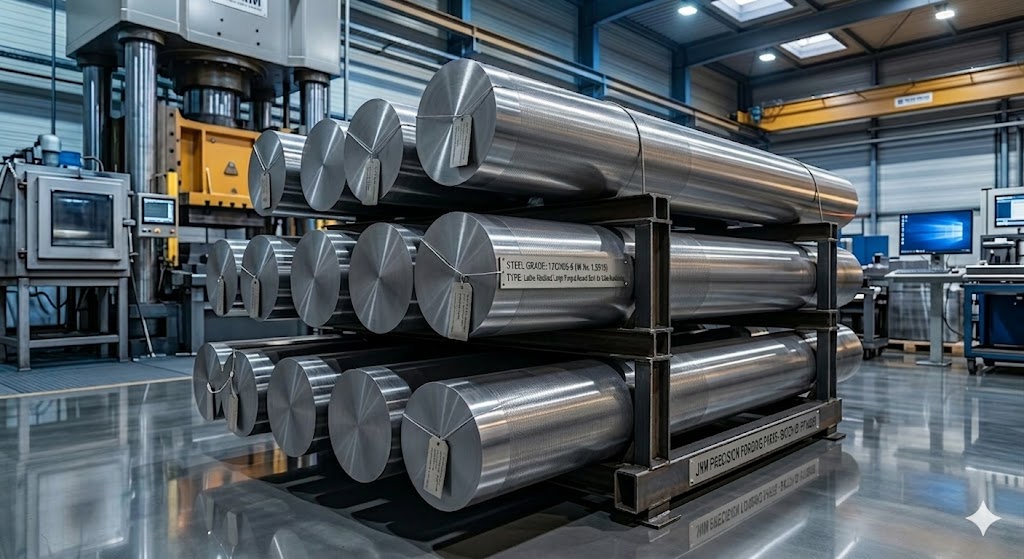
- Forged Bars & Round Bars: 17CrNi6-6 forged round bars, square bars, flat bars, rectangular bars and step rods. Standard machining allowance: 5–15mm per side depending on diameter. Widely used as feedstock for gear blanks, shaft production and structural heavy machinery parts. We recommend specifying forged bar over rolled bar for diameters above 150mm, where the additional forging reduction ratio provides meaningful grain refinement and mechanical property improvements. Available in as-forged (AF), normalised (N), soft-annealed (A) or quenched+tempered (QT) condition.
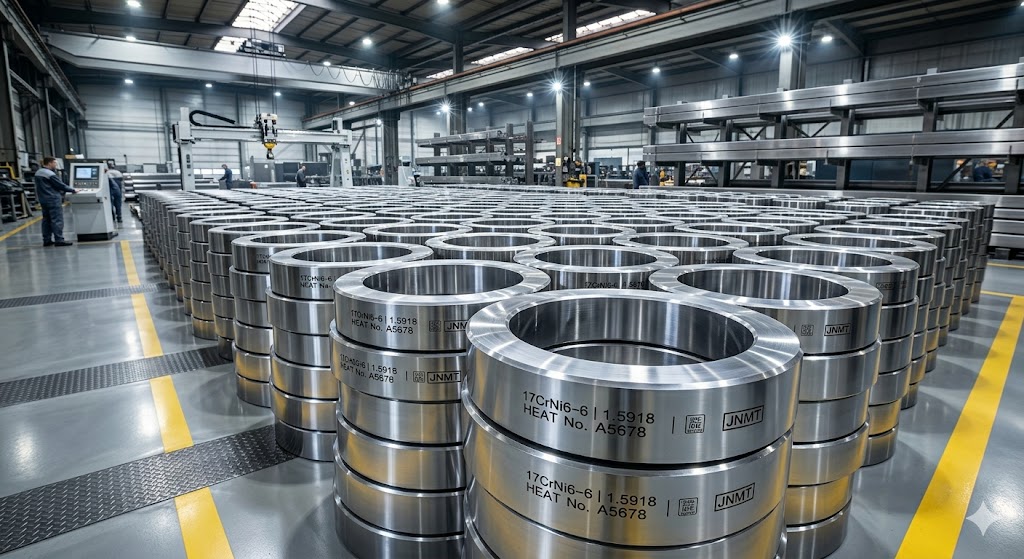
- Seamless Rolled Rings: 1.5918 seamless rolled forged rings up to 5,000mm outer diameter, including gear rings, bearing outer races, flanges, rotary kiln riding rings, slewing bearing rings and pressure vessel flanges. The seamless ring rolling process provides circumferential fibre orientation — the optimal grain flow direction for hoop stress resistance in rotating ring parts. We can supply rectangular, T-section, L-section and custom profiled rings to reduce downstream machining stock and cost.
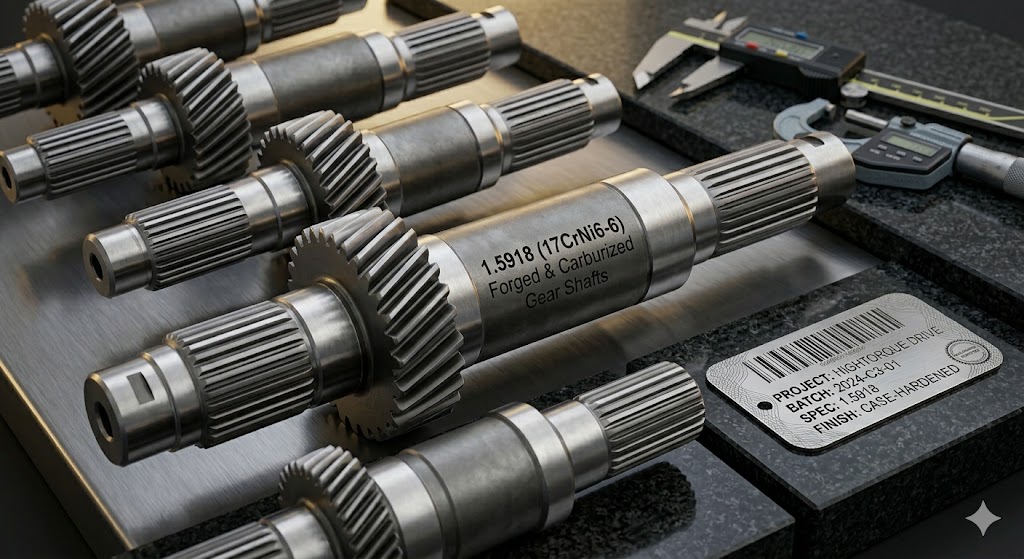
- Forged Shafts & Gear Parts: Custom 17CrNi6-6 forged gear shafts, pinion shafts, spindles, main shafts, stepped shafts, spline shafts, gear wheels and integrated pinion-shaft assemblies. For shafts with D/L ratio below 1:10, we typically recommend dedicated forging mandrel tooling to keep straightness within 1mm/m. All shafts are ultrasonically tested to EN 10228-3 before machining, guaranteeing internal soundness prior to machining investment.
- Hollow Parts & Housings: 1.5918 forged hubs, housings, sleeves, bushes, hollow bars, thick-wall cylinders and barrel forgings for hydraulic systems, oil & gas wellhead equipment and cement mill parts. Hollow forging — either by piercing or mandrel forging — deletes the centre zone of the original ingot, which is typically the last area to solidify and the most prone to compositional segregation. This makes hollow forged components structurally superior to solid bar with bored centre for most tubular applications.
- Discs, Plates & Blocks: 17CrNi6-6 forged discs, disks, blocks, plates and custom near-net-shape blanks. For disc forgings, our standard practice is to forge to a forging ratio of at least 4:1 from ingot to guarantee complete closure of any central porosity. Typical applications include heavy machinery structural parts, wear-resistant liners, valve bodies and pressure vessel end caps.
- Custom Special-Shaped Parts: Non-standard forgings produced according to client 2D drawings or 3D CAD models, including eccentric shapes, flanged shafts, forged brackets and complicate section profiles. We offer free DFM (Design for Manufacturability) review for custom shapes prior to tooling investment, to identify opportunities to reduce material waste and machining cost without compromising structural integrity.
Detailed Production & Machining Range
| Product Type | Max Production Range | Customization Support |
|---|---|---|
| Forged Bars/Rods | Max Diameter 1200mm, Max Length 12000mm | Custom size, heat treatment, rough/finish machining |
| Seamless Rolled Rings | Max Outer Diameter 5000mm, Max Height 800mm | Custom diameter, wall thickness, section shape |
| Forged Shafts | Max Length 12000mm, Max Weight 30000kg | Step shaft, spline shaft, gear shaft, custom profile |
| Discs/Plates/Blocks | Max Diameter 2500mm, Max Thickness 800mm | Custom thickness, size, machining tolerance |
| Custom Special-Shaped Parts | Single Piece Weight 30kg - 30000kg | Fully customized based on client drawings |
One-Stop Machining Service – From Forging to Finished Component
We provide full-process CNC machining services so clients receive finished, assembly-ready 17CrNi6-6 components without secondary supplier involvement. Our machining facility operates 50+ CNC turning centres, vertical and horizontal machining centres, gear hobbing machines, spline milling machines, deep-hole drilling equipment and surface grinding machines:
- Rough machining: Removal of forging scale and surface defects; leaves 2–5mm finish allowance per surface for post-heat-treatment machining. Conducted before heat treatment to avoid distortion risk on finish dimensions.
- Semi-finish machining: Achieves IT8–IT9 dimensional tolerance; components can be delivered in this condition for clients who perform final machining in-house.
- Finish CNC machining: Achieves IT6 dimensional tolerance (equivalent to h6/H7 shaft/hole fits); surface roughness Ra 0.8–1.6μm standard, Ra 0.4μm achievable on journal surfaces. All finish machining is performed after complete heat treatment, including carburizing, to eliminate heat treatment distortion from finished dimensions.
- Gear hobbing & gear grinding: For gear shafts and pinion shafts, we provide gear hobbing to DIN quality 7–9 and gear grinding to DIN quality 5–6 as required.
- Deep hole drilling: For hollow shafts and hydraulic cylinder components; L/D ratio up to 30:1 achievable with gun drilling.
- Spline milling & keyway machining: Involute splines and straight keyways produced to DIN 5480 / ISO 4156 specification.
Carburized Layer Depth Selection Guide for 17CrNi6-6 Components
One of the most application-specific decisions in specifying a 17CrNi6-6 forging is the required carburized (case) depth. Selecting too shallow a case risks accelerated wear and case crushing under high contact stress; selecting too deep a case increases brittleness and the risk of surface spalling. Based on our practical experience across thousands of carburized 17CrNi6-6 components, we recommend the following case depth selection guidelines:
| Application Type | Recommended CHD (mm) | Rationale |
|---|---|---|
| Wind turbine gearbox planet gears (module 6–10) | 0.8 – 1.2 | Balances contact fatigue resistance with tooth root bending strength; excessive case depth on small module teeth reduces toughness at root fillet |
| Cement mill pinion shafts (module 20–40, heavy abrasion) | 2.5 – 4.0 | High contact stress and abrasive operating environment require deep case; two-step carburizing process used to achieve uniform depth on large tooth profiles |
| Crusher eccentric shafts (impact + wear combined) | 1.5 – 2.5 | Must balance surface wear resistance with core toughness for impact absorption; case too deep reduces effective core section and impact resistance |
| Railway locomotive transmission shafts | 1.0 – 1.8 | High bending fatigue cycle count (>10⁸ cycles); case must support compressive residual stress at surface without reducing fatigue limit at case/core transition |
| Sugar mill roller shafts (continuous heavy load) | 2.0 – 3.5 | Continuous contact loading in wet, corrosive environment; deeper case compensates for gradual corrosive-wear depth loss during service life |
| Hydraulic cylinder barrels & piston rods | 0.5 – 1.0 | Primarily requires surface hardness for seal wear resistance; deep case not necessary and may complicate honing operations post-heat treatment |
These are engineering guidelines. We strongly recommend discussing your specific loading conditions, contact stress calculations and required service life with our technical team before finalising the heat treatment specification. We will provide a written heat treatment recommendation as part of our technical quotation at no additional charge.
Industry Applications & Proven Project Cases
17CrNi6-6 (1.5918) forgings are the material of choice in any application that simultaneously demands high surface hardness, deep hardenability across large cross-sections, and genuine core toughness under dynamic or impact loading. Below we detail the specific technical requirements for each key industry sector, explain why 17CrNi6-6 is specified over alternatives, and share representative project cases from our production history to illustrate real-world performance data.
Wind Energy Industry – Turbine Gearbox Components
Modern wind turbine gearboxes — typically 3-stage helical/planetary configurations for 1.5–6MW turbines — subject gears and shafts to some of the most demanding fatigue loading conditions in industrial machinery. Variable wind loads produce complex, constantly reversing bending and contact stress cycles, with peak torque spikes (e.g., during emergency stops or grid faults) that can reach 3–5× rated torque. 17CrNi6-6 is specified for this application because its Nickel content ensures adequate core impact resistance during these peak transient events, while the Chromium-enhanced carburized case provides the contact fatigue resistance required for ISO 6336-compliant gear design at surface pressures above 1,500 MPa. The alternative grade 18CrNiMo7-6 is used for the largest planet gear configurations (above 600mm pitch diameter), but 17CrNi6-6 remains the dominant specification for intermediate and high-speed shaft gears up to ~400mm pitch diameter across European turbine designs.
Cement & Building Materials Industry – Mill and Kiln Drive Components
Cement mill and rotary kiln drive systems represent one of the most severe combined-loading environments in heavy industry: continuous operation at 85–95% rated load, ambient temperatures of 50–80°C at the kiln shell, high dust and abrasive contamination, and tooth contact stresses on open gear drives that typically reach 800–1,200 MPa on large module (module 20–45) gearing. 17CrNi6-6 is selected for cement mill pinion shafts and kiln drive gears because its case depth can be tailored (2.5–4.0mm CHD) to provide the wear allowance needed for 8–12-year service intervals between overhauls, and because its core toughness accommodates the cyclic thermal loading from kiln thermal expansion during start-stop cycles. A key manufacturing challenge specific to this application: pinion shafts for large kilns (Φ4.5–6.2m kiln diameter) have module 30–45 teeth with case depths that must be uniform across a tooth height of 50–90mm. Our two-stage atmosphere carburizing process and precision quench fixturing achieve case depth uniformity within ±0.3mm across the full tooth profile on pinion shafts up to 5,000kg forging weight.
Mining & Heavy Construction Machinery Industry
Mining applications expose 17CrNi6-6 forgings to what is arguably the most demanding combination of operating conditions in any industry: extreme impact loading (jaw crushers and gyratory crushers generate single-blow energies of 50–500kJ), severe abrasive wear from high-hardness ores (granite, quartzite, iron ore: 600–900 HV), and vibration spectra that accelerate fatigue crack propagation in any steel with insufficient core toughness. The Nickel content in 17CrNi6-6 is the critical factor for this application: it reduces the ductile-to-brittle transition temperature (DBTT) significantly below the DBTT of Nickel-free grades like 20MnCr5, making 17CrNi6-6 components safe from brittle fracture even at ambient temperatures of -20°C to -30°C in cold-climate mining operations. For mining applications in Australia, Canada and Scandinavia, we routinely specify supplementary Charpy impact testing at -20°C (minimum 27J) on heat-treated coupons from the forging batch, in addition to the standard EN 10084 tests.
Railway & Locomotive Industry
Railway traction transmission systems impose very high cycle fatigue requirements — locomotive transmission shafts and gear sets must be designed for >10⁸ load cycles over a 30-year service life. The critical failure mode is surface contact fatigue (pitting) on gear flanks and bending fatigue at shaft fillets and spline roots, both of which are directly governed by the quality and uniformity of the carburized case. 17CrNi6-6 is specified in European railway design standards (in conjunction with UIC loading codes) specifically because its dual hardening process (two-step quenching) produces a finer martensite in the case layer and a more refined ferrite-pearlite structure in the core than single-quench grades — measurably improving the case-core transition zone fatigue strength. All 17CrNi6-6 railway components we produce are subjected to additional magnetic particle inspection (MPI) at the fillet radii, key stress concentration points, after final machining to provide the highest level of defect assurance for safety-critical components.
Sugar Manufacturing Industry – Cane Press Drive Components
Large sugar cane presses operate under continuous heavy loads (crushing forces of 2,000–8,000kN per roller set) in extremely challenging environmental conditions: 85–95% relative humidity, 40–50°C ambient temperature, and direct contact with sugar cane juice — a mildly acidic, corrosive fluid that attacks low-alloy surfaces. The combination of Nickel (corrosion resistance improvement) and Chromium (carbide formation, improved wear resistance) in 17CrNi6-6 makes it significantly more resistant to the combined wear-corrosion degradation mechanism than lower-alloy grades like 20MnCr5. We recommend that minimum CHD of 2.5-3.5mm be specified for sugar mill gear shafts to provide a wear reserve sufficient for the typical 2 year inter-campaign service interval between overhauls.
Other Core Application Industries
In addition to the above primary sectors, our 17CrNi6-6 (1.5918) forging parts are widely used in:
- Hydro turbine equipment: Hydro turbine main shafts and generator shafts for hydropower stations; forging weight typically 5,000–20,000kg; requires comprehensive UT inspection to EN 10228-4 Level 3
- Industrial gearboxes & reducers: Gear wheels, pinion shafts and ring gears for multi-stage heavy-duty transmission; helical and bevel-helical designs for steel mill drives, paper mill drives, and general industrial applications
- Gas compressor and pump systems: High-strength crankshafts, connecting rods and crosshead components for reciprocating compressors; fatigue life is the primary design criterion
- Oil & gas drilling: Drilling tool gear shafts, mud pump gear shafts, rotary table components and subsea equipment housings; sour service versions require additional sulphur content control (S ≤0.015%) and hydrogen-induced cracking resistance verification
- Marine and shipbuilding: Ship gearwheels, propulsion system intermediate shafts and deck machinery drive components; Lloyd's Register, DNV-GL and Bureau Veritas witness inspection available on request
- Metallurgical equipment: Cold mill mandrel drum shafts, decoiler and coiler drum shafts for steel processing lines; high torque and reversing load conditions
- Flue gas desulfurization (FGD) systems: Rotary atomizer shafts for wet FGD spray drying systems in power plant environmental equipment
- Hydraulic equipment: Hard chrome-platable forged piston rods and cylinder barrels; the 17CrNi6-6 substrate provides superior fatigue resistance as the base metal under chromium plating compared to standard structural steels
- Heavy vehicle and off-highway equipment: Ring gears, sun gears, planet gears and differential housings for heavy-duty truck axles, concrete mixer drives and construction machinery final drives
Need custom 17CrNi6-6 forgings for your industrial project? Send us your drawings for a free quote!
Get Free Quote NowProduction Standards & Full-Process Quality Control
Compliance Standards
Our 17CrNi6-6 (1.5918) forged parts are made according to international standards and industry specifications, which includes:
- EN 10084:2008 – Case hardening steels. Technical delivery conditions (primary material standard; defines composition, heat treatment conditions, mechanical property requirements and inspection documentation)
- EN 10263-3:2001 – Steel rod, bars and wire for cold heading and cold extrusion. Technical delivery conditions for case hardening steels (for bar form supply)
- EN 10228-1/3/4 – Non-destructive testing of steel forgings. Part 1: Magnetic particle inspection; Part 3: Ultrasonic testing of ferritic or martensitic steel forgings (Class 1–4); Part 4: Penetrant inspection
- EN 10204:2004 – Inspection documents for metallic products (Type 3.1: inspection certificate issued by manufacturer; Type 3.2: inspection certificate issued by manufacturer and independent inspector)
- PED 2014/68/EU – European Pressure Equipment Directive. We manufacture products to the technical requirements of PED for clients supplying the EU market. Clients requiring formal PED compliance certification with Notified Body involvement should specify this at the enquiry stage.
- ISO 6336 – Calculation of load capacity of spur and helical gears (referenced for gear blank material property verification on wind and industrial gearbox components)
- AMS 2750E – Heat treatment furnace pyrometry standard (referenced for aerospace-adjacent sectors; available by arrangement).
For requirements beyond the above standards — including client-specific Quality Plans (QAP), Inspection & Test Plans (ITP), welding procedure qualifications (WPS/WPQR) for weldable forging supply, or fatigue test certification — we can accommodate and document these within our project quality management framework. Contact our technical team at the enquiry stage to discuss your specific documentation requirements.
Raw Material Quality Control
We strictly control the quality of raw materials from the source to ensure the final performance of forgings:
- All raw materials are sourced from top domestic and international steel mills, with complete original material certification
- All supplied materials are fully killed steel, with optional secondary refining processes including vacuum degassing, argon stirring, vacuum arc remelting, electroslag remelting and controlled cooling, to ensure optimal material purity and uniformity
- Incoming material inspection: 100% chemical composition testing and hardness testing before entering the production workshop
- We guarantee that the material is commercially sound, free from internal and external defects (including seams, laminations, cold shuts, incipient melting, and excessive non-metallic inclusions) that may affect forging, machining and heat treatment
Full-Process Production Quality Control
We implement strict quality control throughout the entire production process, from forging to final delivery, to ensure the reliability and consistency of every 1.5918 forging part we deliver:
- Forging process control: strictly control forging ratio (min 3:1 for critical components), heating temperature, final forging temperature and cooling method, to ensure uniform and fine grain structure
- Heat treatment process control: fully computer-controlled heat treatment furnace, precise control of heating temperature, holding time and cooling rate, to ensure stable mechanical properties
- Machining process control: CNC machining equipment, full-process dimensional inspection, to ensure compliance with drawing tolerance requirements
- Strictly control remnant as-case dendritic pattern and alloy segregation, which are prohibited in critical stress areas to avoid reduced mechanical properties and machinability issues
- The product surface is free of high-temperature scale, cracks and other defects, with controlled surface roughness to meet subsequent processing needs
Final Inspection & Certification
Our workshop is equipped with advanced inspection equipment, and all finished products must pass strict inspection before delivery:
- Chemical composition analysis (direct-reading spectrometer)
- Mechanical property testing (tensile strength, yield strength, elongation, impact energy, hardness testing)
- Non-destructive testing: ultrasonic testing (UT), magnetic particle testing (MT), penetrant testing (PT), compliant with EN 10228 standard
- Metallographic testing: grain size, microstructure, non-metallic inclusions rating
- Full dimensional inspection (3D coordinate measuring machine, vernier caliper, micrometer, etc.)
- We can provide complete Mill Test Certificate (MTC) EN 10204 3.1 / 3.2 as required
Chemical Composition of 17CrNi6-6 (1.5918) Steel – Element-by-Element Analysis
The chemical composition of 17CrNi6-6 (1.5918) under EN 10084 is not simply a set of numbers — each element range is engineered to contribute a specific metallurgical function. Understanding what each element does helps engineers and procurement teams appreciate why this grade performs as it does, and why substituting a lower-alloy grade is often a false economy in high-performance applications:
| Chemical Element | Content Range (Weight %) | Metallurgical Function in 17CrNi6-6 |
|---|---|---|
| Carbon (C) | 0.14 – 0.20 | The base carbon provides adequate core strength after quenching and tempering while remaining low enough to maintain core toughness and weldability (where required). The carburizing process raises the surface carbon to 0.7–0.85% to generate the hard martensite case. |
| Silicon (Si) | Max 0.40 | |
| Manganese (Mn) | 0.50 – 0.90 | Manganese enhances hardenability (increases DI) and acts as a deoxidiser during steelmaking. The controlled upper limit avoids excessive retained austenite formation in the carburized case, which would reduce surface hardness. |
| Nickel (Ni) | 1.40 – 1.70 | The defining element of this grade. Nickel dissolves entirely in the matrix (does not form carbides), significantly lowering the ductile-to-brittle transition temperature, increasing core impact toughness, and improving fatigue crack propagation resistance. The 1.40–1.70% range is the minimum required to deliver reliable toughness on large-section forgings (≥100mm diameter) while remaining cost-effective versus higher-Nickel grades. |
| Chromium (Cr) | 1.40 – 1.70 | Chromium greatly increases hardenability, so that complete martensitic transformation to ≥100mm cross-section diameter is achieved after oil quenching. It also forms stable chromium carbides during carburizing which improve surface wear resistance and case depth uniformity. Chromium also improves tempering resistance and enables the carburized case to retain its hardness at high service temperatures up to ~200°C. |
| Phosphorus (P) | Max 0.025 | Controlled at low levels to prevent grain boundary embrittlement (temper brittleness), which would reduce impact toughness in the carburized case. Our steel sourcing targets P ≤0.015% on critical components. |
| Sulfur (S) | Max 0.035 | Kept low to minimise manganese sulphide (MnS) inclusions, which act as stress concentration sites for fatigue crack initiation. For the most demanding applications (wind gearbox, railway safety-critical parts), we specify supplementary inclusion rating to SEP 1571 or EN 10247 to verify low inclusion content in the forging batch. |
| Copper (Cu) | Max 0.30 | Residual element from scrap steelmaking; controlled below 0.30% to avoid hot shortness during forging at high temperatures and to prevent surface cracking during the carburizing process. |
Our raw material commitment: We source 17CrNi6-6 ingot and billet exclusively from certified mills that provide heat-by-heat chemical certificates, and we re-verify composition by in-house optical emission spectrometry (OES) on every incoming heat. For clients requiring tighter composition control than the EN 10084 standard ranges, we offer supplementary composition windows (e.g., Ni 1.50–1.65%, Cr 1.50–1.65%, P ≤0.015%, S ≤0.015%) by special agreement at the enquiry stage.
Heat Treatment Process for 17CrNi6-6 Forged Components – Technical Deep Dive
The heat treatment of 17CrNi6-6 (1.5918) is more complex than most other case hardening grades, specifically because the grade is designed for large-section, high-performance components where a simple single-cycle carburize-and-quench is insufficient to achieve the required combination of case properties and core properties simultaneously. The standard EN 10084-compliant process for 17CrNi6-6 involves a multi-stage sequence, each step of which has a specific metallurgical purpose:
- Soft Annealing (650–700°C, Furnace Cooling): The forged component is heated to 650–700°C and slow-cooled in the furnace. At this sub-critical temperature, the martensite or bainite structures formed during forging cooling are transformed to a soft, globular carbide + ferrite microstructure (spheroidite). This dramatically reduces hardness to typically 170–220 HB, enabling efficient CNC rough machining before carburizing. Skipping this step results in excessive tool wear and potential dimensional error in the pre-carburizing machining phase. We perform soft annealing in sealed bell furnaces with controlled atmosphere (N₂ or endothermic gas) to prevent surface decarburisation on critical dimensions.
- Austenitisation (870°C, 30–35 Minutes per 25mm Section): The component is heated to 870°C — above the Ac3 transformation temperature for 17CrNi6-6 — to fully dissolve the carbides into austenite and produce a homogeneous, single-phase structure.The holding time is based on the section thickness of the part (approximately 1 minute/mm section). Failure to maintain adequate holding time leads to inhomogeneous austenite, which results in patchy hardness after quenching.
- Carburizing (880–980°C, Controlled Atmosphere): The austenitised component is transferred to the carburizing furnace and exposed to an enriched carbon atmosphere (endothermic gas + natural gas or propane enrichment) at 880–980°C. Carbon diffuses from the atmosphere into the steel surface. We use a two-stage carburizing process for components requiring deep cases (CHD >1.5mm): a high-carbon boost stage at 950–980°C to maximise carbon flux into the surface, followed by a lower-temperature diffuse stage at 880–920°C to homogenise the carbon concentration gradient and achieve the specified surface carbon (typically 0.75–0.85%). Carbon potential is monitored continuously by oxygen probe and periodically verified by gravimetric foil analysis. Case depth is controlled to ±0.1mm of specified CHD by time-temperature modelling validated against production data.
- First Hardening / Primary Quench (830–870°C, Oil Quench): This is the step that distinguishes the 17CrNi6-6 two-step quench process from simpler single-quench grades. After carburizing, the component is re-heated to 830–870°C (below the carburizing temperature, but above Ac3 for the core composition) and quenched in agitated oil. The purpose of this first quench is to optimise the core structure: at this temperature, the Cr-Ni stabilised core austenite transforms fully to martensite on quenching, producing a refined core microstructure with maximum toughness. The lower temperature also reduces quenching distortion compared to a direct quench from carburizing temperature.
- Second Hardening / Final Quench (780–820°C, Oil Quench): The component is re-heated to 780–820°C (below Ac3 for the carburized case composition but within the two-phase austenite + carbide range) and quenched again. The purpose of this second quench is to optimise the case structure: the lower austenitising temperature produces a fine-grained case martensite with maximum hardness and contact fatigue resistance, while also dissolving retained austenite that may have formed after the first quench. The two-stage quench process is what allows 17CrNi6-6 to simultaneously achieve surface hardness of 58–64HRC AND core impact toughness values that single-quench grades cannot match. We perform all quenching in purpose-built oil quench tanks with agitation pumps and temperature control (oil maintained at 50–80°C) to ensure consistent quench severity across the component section.
- Low Temperature Tempering (150–200°C, 1–2 Hours Minimum): Immediately after the final quench, components are transferred to the tempering furnace. At 150–200°C, the fresh martensite undergoes stress relief: residual stresses from the quench are reduced, improving toughness and fatigue resistance, without measurably reducing surface hardness (HRC drop typically ≤1 HRC at 200°C). We hold components at tempering temperature for a minimum of 1 hour per 25mm of section thickness, and always complete tempering within 4 hours of final quench to prevent quench crack formation. For components with complex cross-sections or heavy sections (>200mm), we use 200°C tempering for extended periods (4–8 hours) to guarantee complete through-section stress relief.
All heat treatment cycles are performed in fully computer-controlled furnaces with data-logged temperature profiles (Type K thermocouple control, ±3°C accuracy) and continuous atmosphere monitoring. Full heat treatment records are archived and provided in the inspection dossier accompanying each component shipment. For clients with specific heat treatment requirements (e.g., modified carburizing cycle to achieve non-standard case depths, or post-grinding stress relief requirements), we are happy to develop and validate a custom heat treatment procedure (HTP) documented to your QA system requirements.
Mechanical Properties of 17CrNi6-6 (1.5918) Steel – Data and Engineering Context
The mechanical properties listed below are the EN 10084 standard requirements for 17CrNi6-6 material after the standard quenching and tempering (QT) condition, tested on a 16mm diameter reference sample cut from the heat treatment coupon. These represent the minimum guaranteed properties for the base material; the carburized case of the finished forging will typically exhibit significantly higher tensile strength at the surface (estimated 1,800–2,200 MPa) due to the elevated surface carbon and martensite hardness. Understanding the difference between "material properties" (tested on QT reference coupon) and "component properties" (actual through-section hardness and fatigue strength of the finished forged component) is important for accurate design calculations:
| Mechanical Property | Standard Value | Unit | Engineering Note |
|---|---|---|---|
| Tensile Strength (Rm) | 1080 – 1320 | MPa | The wide range reflects the effect of section size and quench severity. For large-section forgings (≥80mm), expect Rm at the core to be in the 1,080–1,200 MPa range; for small sections, 1,200–1,320 MPa is achievable. |
| Yield Strength (Rp0.2) | Min 830 | MPa | Minimum yield-to-tensile ratio (Rp0.2/Rm) for 17CrNi6-6 is typically 0.75–0.82, indicating a material with adequate plastic deformation reserve before fracture — important for shock-loaded components. |
| Elongation After Fracture (A) | Min 8 | % | For components where ductility is critical (e.g., shafts that must deform rather than fracture under overload), the EN minimum of 8% A is conservative. Our production material typically achieves 10–14% A on the reference coupon. |
| Reduction of Area (Z) | Min 40 | % | High Z value (>40%) confirms genuine core toughness — a material characteristic directly linked to the Nickel content in 17CrNi6-6. |
| Notched Impact Energy (KV, 20°C) | Min 25 | J | EN minimum. Our production typically achieves 40–65J on reference coupons at 20°C. For cold-climate applications (mining in Canada, Scandinavia, high-altitude sites), we offer supplementary testing at -20°C and -40°C by agreement. |
| Core Hardness (After Q+T) | 30 – 45 | HRC | Core hardness is measured at the centre of the finished forging section. The 30–45 HRC range corresponds to the tough martensite + some bainite microstructure that gives 17CrNi6-6 its combination of strength and impact resistance at the core. |
| Surface Hardness (After Carburizing & Quenching) | 58 – 64 | HRC | Measured at the component surface. The typical microstructure at this hardness level is fine lath martensite with ≤20% retained austenite (RA). RA content above 20% reduces wear resistance and fatigue life; our two-step quench process is specifically designed to minimise RA in the case layer. |
| Bending Fatigue Limit (σ-1, estimated) | ~620 – 720 | MPa | Not an EN standard parameter; estimated from empirical correlation Rm × 0.43–0.50. The compressive residual stress introduced by carburizing and quenching increases the effective fatigue limit at the surface by 15–25% above this estimate. |
Important note on large-section forging properties: The EN 10084 standard test sample diameter is 16mm — far smaller than most industrial forgings. For components with effective section diameters above 100mm, the achievable mechanical properties at the core will be lower than the 16mm sample values, due to the mass effect (slower quench cooling rate at the core of a large cross-section). We provide Jominy end-quench hardenability data for our 17CrNi6-6 heat batches on request, which allows your design engineer to predict actual core properties at any section size using standard DIN 50190 or SAE J406 calculation methods. For critical large-section components (shafts >200mm diameter), we recommend agreeing on mandatory core hardness and tensile test coupons cut from the production forging itself, rather than relying solely on the standard reference coupon values.
Our Production Capabilities & Why Global Industrial Clients Choose Us
Jiangsu Liangyi's production infrastructure for 17CrNi6-6 (1.5918) forgings has been built over 25+ years of continuous capital investment, process optimisation, and client feedback-driven improvement. The following describes our actual production capabilities in specific, verifiable terms — not marketing generalities:
- Forging Equipment: 8 sets of 1–8 tonne electro-hydraulic counterblow hammers (for smaller components, forging rates up to 120 blows/minute ensuring fine, uniform grain refinement); 4,000 tonne and 6,000 tonne hydraulic free forging presses (for large shafts and discs up to 30,000kg); 2 sets of fully CNC-controlled radial-axial ring rolling mills with maximum ring OD 5,000mm (for seamless rolled rings). All forging operations are supported by two 50-tonne and one 100-tonne overhead cranes, allowing safe and precise manipulation of large, heavy-section forgings.
- Heat Treatment: 10+ sets of full-automatic sealed box carburizing furnaces with online carbon potential control (±0.02% C accuracy) and maximum load capacity of 8,000kg per charge; 4 dedicated multi-zone pit furnaces for large shaft carburizing and annealing; 2 sets of controlled-atmosphere bell furnaces for soft annealing and normalising; computer-controlled oil quench tanks (agitated, temperature-controlled to 50–80°C) with quench severity monitoring; tempering furnaces with 150–300°C operating range. Furnace temperature uniformity is verified by regular calibration surveys.
- CNC Machining: 50+ sets of CNC machining centres and lathes, including large-bore CNC turning centres with maximum swing diameter 3,000mm and turning length 12,000mm; vertical machining centres with table sizes up to 4,000×2,000mm; CNC gear hobbing machines (max module 60); CNC spline milling; deep hole drilling (max depth 3,000mm, min bore diameter 30mm); surface grinding (max grinding length 6,000mm). All machined components are 100% dimensionally verified by CMM (Coordinate Measuring Machine) with 3D scanning capability on complex profiles.
- Quality Laboratory: Our in-house quality laboratory is equipped with optical emission spectrometer (OES) for chemical composition analysis (all elements simultaneous, 60-second result), universal tensile testing machine (max 600kN capacity), Charpy impact testing machine (-40°C to +100°C temperature range), Rockwell/Brinell/Vickers hardness testers, optical metallurgical microscope (up to 1000× magnification), 3D coordinate measuring machine (CMM) with touch probe and laser scanner, and magnetic particle inspection (MPI) and dye penetrant inspection (DPI) equipment. Ultrasonic inspection (UT) is performed by qualified UT technicians with documented training and certification records.
- Annual Capacity & Lead Time: Annual production capacity of 120,000 tonnes of forgings. Standard lead time for 17CrNi6-6 forgings: 15–30 working days from confirmed order and approved drawings. For repeat orders with pre-approved specifications, lead time can be reduced to 10–15 working days. Expedited production is available for urgent projects (minimum 7 working days for standard-size components).
- Certifications & Approvals: ISO 9001:2015 Quality Management System certified. Our products for EU pressure equipment applications are manufactured to the technical requirements of PED 2014/68/EU — clients requiring formal PED compliance documentation (including Notified Body involvement) should discuss this at the enquiry stage. Third-party witness inspection services available with all major inspection agencies including SGS, TÜV, Bureau Veritas, Intertek, Lloyd's Register, DNV, ABS.
- Global Shipping & Logistics: We have logistics partnerships with the major international freight forwarders at Shanghai, Ningbo and Tianjin ports, and can offer competitive freight rates and reliable transit times to all major global destinations. – Typical transit times: Europe 20-28 days (sea freight), USA East Coast 25-32 days, Australia/NZ 18-22 days, SE Asia 5-12 days For over size or overweight forgings (>6,000kg single piece) we can arrange specialist heavy lift & project cargo shipping.
- Competitive Cost Transparency: Our integrated production chain — from steel ingot procurement through forging, heat treatment and machining — eliminates all subcontracting margins and intermediate handling costs. We offer detailed cost breakdowns on request and are open to volume-based pricing agreements for repeat supply programs. Our cost structure is typically 25–40% below comparable European forging suppliers for equivalent quality and specification compliance.
Our Trade Terms & Customer Service
We provide a full range of services for global clients, to make your procurement process simple and worry-free:
- Trade Terms: Support EXW, FOB Shanghai, CIF, CFR, DDP, DAP and other mainstream international trade terms
- Payment Terms: T/T (30% deposit, 70% before delivery), irrevocable L/C at sight, and other negotiable payment methods
- Delivery Time: Standard lead time 15-30 working days, expedited production available for urgent orders
- Packaging: Standard seaworthy wooden cases/pallets, or customized packaging according to your requirements
- Export Documents: Provide full set of export documents, including commercial invoice, packing list, bill of lading, Mill Test Certificate (MTC), certificate of origin, etc.
- After-Sales Service: Full after-sales tracking service, if there is any quality problem with the product, we will give a formal response within 24 hours and provide a professional solution.
- Language Support: English, Chinese, Spanish, German language support for communication and technical documents.
Get Custom Quote for Your 17CrNi6-6 (1.5918) Forging Project
Send us your 2D/3D drawings and technical requirements, our professional engineering team will provide you with a detailed quotation and technical solution within 24 hours.
Frequently Asked Questions (FAQ)
17CrNi6-6 (designated as 1.5918 in EN standard) is a high-performance case hardening (carburizing) alloy steel. It has excellent surface hardness (58-64HRC) after carburizing and quenching, paired with superior core toughness, high fatigue resistance and strong impact load bearing capacity, so that it is the best choice material for heavy-duty industrial components that require high wear resistance and long lifetime under extreme working conditions.
The global equivalent grades of 17CrNi6-6 (1.5918) include: DIN 17CrNi6-6 (Germany), AFNOR 16NC6 (France), UNI 17CrNi6-6 (Italy). It is a premium European-standard case hardening steel with excellent comprehensive mechanical properties.
17CrNi6-6 (1.5918) forgings are commonly used for wind turbine gearboxes, cement mill rotary kilns, mining crusher equipment, railway locomotives, sugar mill machinery, oil & gas drilling equipment, industrial gearboxes & reducers, hydraulic systems, marine shipbuilding, metallurgical equipment and other heavy industrial fields.
Our 17CrNi6-6 (1.5918) forged parts are manufactured in strict accordance with EN 10084:2008 (Case hardening steels. Technical delivery conditions) and EN 10263-3:2001 standards. For clients supplying the EU pressure equipment market, we can manufacture products to the technical requirements of PED 2014/68/EU — please specify this at the enquiry stage so we can advise on the appropriate documentation and Notified Body process for your application category.
The standard heat treatment process for 17CrNi6-6 includes: soft annealing, austenitisation at 870℃, carburizing at 880-980℃ (customizable carburized layer depth), first hardening at 830-870℃, second hardening at 780-820℃, and low-temperature tempering at 150-200℃. All parameters can be fully customized based on your component performance requirements.
We produce custom forgings 17CrNi6-6 (1.5918) with individual forging weight from 30kg to 30,000kg. Forged bars: max diameter 1200 mm, max length 12000 mm; seamless rolled rings: max outer diameter 5000 mm; forged shafts: max length 12000 mm. We provide full customization of dimensions and shapes as per your 2D/3D drawings.
Quality control is carried out at every stage of manufacturing for all 17CrNi6-6 forgings, which include incoming raw materials inspection, chemical composition tests (spectrometer analysis), mechanical property tests (tensile, impact, hardness), ultrasonic non-destructive testing (UT) per EN 10228, magnetic particle testing (MT), penetrant testing (PT), metallographic tests, and final dimension test. We provide complete Mill Test Certificate (MTC) EN 10204 3.1 / 3.2 as required.
Yes. We provide a complete one-stop service from raw steel melting, open die forging, heat treatment, rough machining to finish CNC machining. We can deliver finished 17CrNi6-6 components ready for assembly, fully machined according to your drawings with tolerance up to IT6 level.
For custom 17CrNi6-6 forging orders ,normal lead time is 15-30 working days. The real lead time depends on the product drawings, order quantity and technical requirements. We also can speed up production for urgent orders.
We support all mainstream international trade terms, including EXW, FOB Shanghai, CIF, CFR, DDP and DAP. We also accept flexible payment methods such as T/T and irrevocable L/C at sight, to meet the needs of global clients.
Both are Chromium-Nickel case hardening steels, but 18CrNiMo7-6 (1.6587) has added molybdenum (~0.25-0.35% Mo) which greatly improves the deep hardenability and core strength, and is the preferred grade for very large gear forgings above ~150mm effective section diameter (e.g. large planetary gear sets and steel mill drives). For components up to ~150mm section 17CrNi6-6 is the optimum choice where its better machinability (no Mo) and lower material cost are a significant practical advantage without loss of performance. Our engineering team can review the cross section size and load conditions for your specific component and provide a formal grade recommendation at no charge.
Yes. We perform Jominy end-quench hardenability testing (per EN ISO 642) on representative samples from each 17CrNi6-6 heat batch upon client request. The Jominy curve data allows your design engineer to predict actual core hardness and tensile properties at any given cross-section diameter using standard DIN 50190 or SAE J406 hardenability calculation methods. This is particularly important for large-section forgings (shaft diameters above 100mm) where the standard EN 10084 16mm reference coupon properties may not accurately represent the actual core properties of your component. We include Jominy data in the Material Test Certificate (MTC) when requested at the order stage.
Our standard minimum forging ratio for 17CrNi6-6 components is 3:1 (ingot cross-sectional area to finished forging cross-sectional area) for general applications, and 4:1 for components in safety-critical applications (wind turbines, railway, pressure equipment). The forging ratio is critical because it determines the degree of hot working applied to the original ingot structure. Below a ratio of 3:1, internal porosity, dendritic segregation and non-metallic inclusion stringers from the original ingot may not be fully closed and broken down — leading to reduced impact toughness, fatigue limit, and UT acceptance quality. Above 4:1, the grain refinement and microstructural homogenisation are effectively complete for most cross-section sizes. We document the forging ratio for each component as part of the production record and disclose it in the inspection dossier on request.
Yes, we regularly accommodate third-party witness inspection at our facility. We have established working relationships with all major inspection agencies including SGS, TÜV Rheinland, Bureau Veritas, Intertek, Lloyd's Register, DNV, ABS and RINA. We provide our production schedule and inspection readiness notification at least 5 working days in advance so TPI inspectors can be scheduled. The inspection scope (witness points, hold points, document review) is agreed in the Inspection & Test Plan (ITP) at the order stage. We can also provide remote video inspection options for clients who cannot arrange in-person inspector travel. All inspection records, including TPI sign-off sheets, are included in the final documentation package shipped with the products.
Based on our technical involvement with clients over the last 25+ years, the four most common specification errors are: (1) Under-specification of case depth: Choosing CHD based on tooth module only, without accounting for the magnitude of contact stress, leading to case crushing under heavy load conditions; (2) Non-specification of retained austenite limits: Not restricting retained austenite (RA) content in the carburized case, permitting high RA (>25%) that degrades wear resistance and leads to dimensional instability in service; (3) Substitution of lower-alloyed grades without engineering sign-off – 20MnCr5 substituted for 17CrNi6-6 for components with section sizes above 80mm, resulting in inadequate core toughness after quenching (4) Inadequate stock for post-heat treatment machining – inadequate grinding/finishing stock not allocated for compensation of heat treatment distortion on carburised components.
We provide a free pre-order technical review service to help identify and resolve these issues before they become production problems.