1.7335 (13CrMo4-5) Forged Parts | China Professional Forging Manufacturer
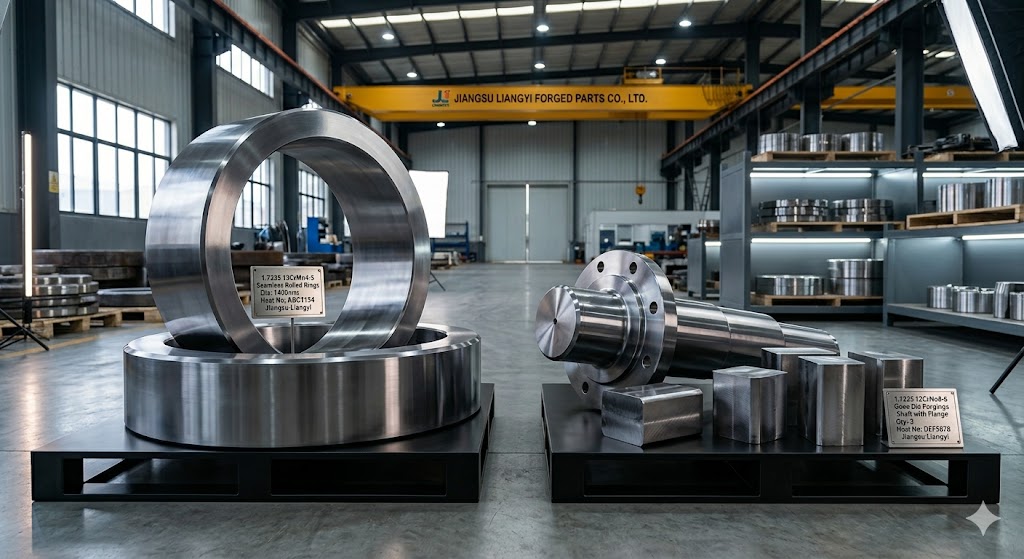
Jiangsu Liangyi Co.,Limited is a professional manufacturer based in China, holding ISO 9001:2015 certification. We make premium1.7335 (13CrMo4-5, 13CrMo45, 13CrMo4.5) open die forging parts and seamless rolled steel forged rings. Equipped with advanced melting and forging machines, we follow strict quality control standards and fully meet European EN and American ASTM standards. We provide custom 13CrMo4-5 forged parts for all industrial buyers across power generation, petrochemical, oil & gas, nuclear power, valve manufacturing and other fields, exporting our products to more than 50 countries around the world.
1.7335 (13CrMo4-5) Alloy Steel — In-Depth Material Overview
EN 1.7335 (also known as 13CrMo4-5 and often written as 13CrMo45 or 13CrMo4.5) is a low-alloy chromium‑molybdenum heat-resistant steel suitable for long-term use at high temperatures. Ordinary carbon steel loses its ability to resist creep above 350°C, while 1.7335 contains 0.7–1.15% chromium and 0.4–0.6% molybdenum.These added elements form stable carbide particles along grain boundaries, which block internal metal sliding that causes creep. So that the steel can keep its structural strength steady up to 500°C under continuous load.
Why the Cr-Mo Combination Matters for High-Temperature Forging
Chromium in this concentration range serves a dual role: it contributes to oxidation resistance by forming a thin chromium oxide surface layer, and it stabilizes the ferritic matrix, keeping the steel in a favorable microstructural condition during long-term thermal cycling. Molybdenum complements this by increasing the recrystallization temperature of the steel — meaning that even after repeated thermal cycles, the grain structure remains refined and uniform rather than coarsening. This synergy is precisely why 1.7335 is the preferred choice over plain carbon steel or lower-alloy grades for boilers and pressure vessels that must operate for 200,000+ hours without creep failure.
Weldability: The Engineering Advantage of 1.7335 Over Higher Cr-Mo Grades
One of the most commercially important properties of 13CrMo4-5 is its genuinely excellent weldability — a characteristic that higher Cr-Mo grades like 10CrMo9-10 (1.7380) or 12CrMo9-10 do not share to the same degree. With a carbon equivalent (CE) value typically in the range of 0.55–0.65 for forged sections, 1.7335 can be welded with standard low-hydrogen electrodes and requires only moderate pre-heat (typically 150–200°C for section thicknesses above 25mm). Post-weld heat treatment (PWHT) at 690–710°C is standard practice for stress relief, and the steel consistently produces high-quality, crack-free welds in qualified procedures. This combination — high-temperature strength plus field-weldability — makes 1.7335 uniquely practical for installation in large-scale plant construction where welding is unavoidable.
Standard Delivery Condition and What It Means for Your Application
All our 1.7335 forged parts are supplied in the normalized and tempered (N+T) condition as standard. Normalizing at 910–940°C refines the forging-induced coarse grain matrix, removes forging stresses and produces a consistent ferritic-pearlitic microstructure throughout the section. Tempering at 650–720°C then improves the balance between yield strength, tensile strength and toughness — achieving the property levels required by EN 10222-2 and related standards. The result is a forging that has stable, predictable properties immediately upon receipt, without the need for the buyer to perform additional heat treatment before installation.
International Equivalent Grades for Cross-Reference
For procurement engineers who source goods from supply chains with mixed standards, these grade matches offer easy practical reference. ASTM A182 Grade F11 Class 2 is the closest American match for forged flanges and fittings, with nearly the same chromium (1.0–1.5%) and molybdenum (0.44–0.65%) content.ASTM A387 Grade 11 applies to pressure vessel plates made with the same equivalent material composition.
The British standard BS 1503 621-490 and the older German designation 13CrMo44 (DIN 17175) are also directly equivalent. When substituting 1.7335 for A182 F11 material in a mixed European-American project, always verify that the specific heat and mechanical test data meet both EN and ASTM minimum requirements — our MTC format includes both sets of values on request.
Available 13CrMo4-5 Forged Product Forms: Dimensions, Tolerances & Selection Guide
We manufacture the complete range of 1.7335 (13CrMo4-5) forging products across all standard and custom shapes, from single prototype forgings to mass production runs of thousands of pieces. Every product is manufactured from in-house melted ingots with full traceability, guaranteeing that the material properties of the finished forging are directly traceable to the original heat analysis. Below is a detailed guide to each product form, including dimensional capability, typical tolerances and the specific engineering considerations that determine the right form for your application.
Open Die Forged Bars, Rods & Custom Shafts
Our 1.7335 open die forged bars are produced by repeated hot compression between flat dies, achieving a minimum forging ratio of 4:1 to guarantee thorough closure of internal porosity and significant grain refinement throughout the entire cross-section. Available forms include round bars (diameter range: 80mm–1,200mm), square bars, rectangular flat bars and hexagonal bars. Shaft-type forgings include simple stepped shafts, eccentric shafts, turbine rotor blanks, gear shaft preforms and spindles, with lengths up to 12,000mm.
Dimensional tolerances for forged bars are held to EN 10243-1 (open die forgings) as standard, with tighter tolerances available for pre-machined surfaces. Surface condition is supplied as forged (black surface) with decarburization layer removed on machined surfaces. For shaft forgings, we routinely achieve straightness within 2mm per meter of length on bars above 300mm diameter after heat treatment — a specification that significantly reduces downstream machining waste for our customers.
Seamless Rolled Rings — Flanges, Swivel Rings & Custom Profiles
Seamless ring rolling is one of our main specializations, with 1.7335 rolled rings available from 200mm to 6,000mm outer diameter, wall thicknesses from 30mm to 800mm, and ring heights from 50mm to 2,500mm. The ring rolling process provides a continuous, unbroken grain flow that follows the circumference of the ring — a significant mechanical advantage over rings machined from plate or forged disc, where grain flow cuts across the important hoop stress direction.
Common ring products include weld-neck flanges, slip-on flanges, blind flanges, swivel flanges (for rotating offshore applications), valve seat rings, gear ring blanks, bearing ring blanks, slewing ring blanks and custom profiled rings. We can roll near-net-shape profiles (rectangular, trapezoidal, T-section, L-section) that reduce machining time and material waste by up to 35% compared to starting from a flat ring blank. All rings are 100% ultrasonically tested per EN 10228-3 before dispatch.
Hollow Forgings, Thick-Walled Cylinders & Pressure Vessel Shells
For hollow forgings — including pressure vessel shells, reactor body sections, thick-walled cylinders, tubing barrels and sleeve forgings — we use a combination of open die forging with a mandrel-assisted punching and elongation process. This technique ensures that the forging ratio is kept across the full wall thickness, not just the outer surface, which is critical for large-diameter, thick-walled parts where center porosity and segregation are the primary quality risks.
Our hollow forging capability covers outer diameters from 300mm to 3,000mm, wall thicknesses from 50mm to 600mm, and lengths up to 8,000mm. Typical applications include reactor pressure vessel body sections, high-pressure column shells for distillation towers, cylinder liners for large reciprocating compressors and hydraulic cylinder body blanks. UT acceptance class for hollow forgings is standard EN 10228-3 Class 3 (which requires rejection of echoes above 50% of the reference reflector from any Ø2mm FBH), with Class 4 available for important pressure applications where higher cleanliness is specified by the customer.
Forged Discs, Plates, Tube Sheets & Blind Flanges
1.7335 forged discs and tube sheets are essential parts in heat exchanger and pressure vessel construction. The main engineering requirement for tube sheets is that the material must retain sufficient strength at the tube-to-tubesheet joint even after the thermal cycling of welding and PWHT operations — 1.7335's combination of weldability and high-temperature strength makes it particularly well-suited. We produce forged discs from 300mm to 4,500mm diameter and tube sheets from 200mm to 3,500mm diameter, with bore and face machining available.
All forged discs and tube sheets are produced with a minimum forging reduction ratio of 3:1 measured from ingot to finished forging, with the additional requirement that the forging direction is documented and included in the MTC. This is important for tube sheets, where the through-thickness properties (Z-direction) must meet specific requirements to resist lamellar tearing during the tube-expanding and welding process.
Custom Special-Shaped & Near-Net Forgings
Beyond standard shapes, our engineering team works directly with customers to design optimized forging preforms for complex geometries. Common special-shaped 1.7335 forgings include: impeller blanks for high-temperature centrifugal pumps, valve body blanks (globe, gate, check, ball valve), transition cone sections for pressure vessel nozzles, BOP (blowout preventer) body blocks, tee-shaped forgings and elbow preforms. For complex shapes, we provide a DFM (Design for Manufacturability) review at quotation stage, suggesting parting line placement, draft angle requirements and material allocation that minimizes finishing machining while ensuring full sound metal in all important areas.
Get a Free Custom Quote for Your 1.7335 Forging Project
Send us your drawings and specifications, our engineering team will provide you with a detailed competitive quote within 24 hours.
1.7335 Forging Parts: Industry Applications, Design Considerations & Project Experience
Understanding why 1.7335 (13CrMo4-5) is specified in a given application — rather than simply listing end-use industries — is what distinguishes a genuine engineering partner from a commodity supplier. Below, we explain the specific design requirements that drive 1.7335 selection in each main industry, alongside real production experience from our 25+ years of global supply.
Power Generation & Utility Boiler Industry: Creep Life Management
In thermal power generation, the design life target for a supercritical boiler pressure part is typically 200,000 to 300,000 hours of continuous operation. Over this period, even small amounts of creep deformation accumulate and can lead to failure if the material is not correctly specified. 1.7335 (13CrMo4-5) is the standard material for boiler headers, steam drum nozzle necks, tube-to-header weld connections and superheater outlet collector forgings operating in the 400–500°C range — below the optimal range for higher-alloy grades like P91, but well above where plain carbon steel is reliable.
Our supply experience in this sector includes tube sheet forgings up to 2,800mm diameter for shell-and-tube heat exchangers, drum nozzle forgings for 600MW and 1000MW supercritical boiler projects, and custom channel flanges for feedwater heater assemblies. A main engineering point we communicate to our customers: for boiler forgings above 100mm section thickness, the normalizing and tempering temperatures must be carefully controlled to ensure the center of the section reaches full transformation temperature — a quality control step we verify using embedded thermocouples in our furnaces and document in the heat treatment record delivered with every MTC.
Petrochemical & Pressure Vessel Industry: High-Pressure Hydrogen Service
One of the most demanding applications for 1.7335 forgings is in high-pressure hydrogen service — hydrocracking reactors, hydrotreating vessels and catalytic reformer equipment where the combination of high temperature, high hydrogen partial pressure and cyclic loading creates conditions for hydrogen embrittlement, temper embrittlement and stress corrosion cracking. The Nelson Curves (API 941) define the safe operating limits for Cr-Mo steels in hydrogen service, and 1.7335 — with its 0.7–1.15% Cr — sits in the appropriate zone for hydrogen partial pressures up to approximately 70 bar at 500°C when in the normalized and tempered condition.
Our petrochemical forging experience includes reactor shell ring sections, transition cone forgings connecting cylindrical shells to ellipsoidal heads, large nozzle forgings (DN300–DN600) for reactor inlet/outlet connections, and heat exchanger channel head forgings. For hydrogen service applications, we offer additional testing on request: step cooling tests for temper embrittlement screening, absorbed hydrogen measurement, and J-factor (J = Si+Mn × P+Sn ×10,000) calculation to verify resistance to temper embrittlement — supporting our customers' compliance with API 934-A requirements.
Industrial Valve Manufacturing: Dimensional Precision & Pressure Rating
Valve body forgings in 1.7335 must meet two demanding requirements simultaneously: tight dimensional precision in the bore areas and nozzle openings (typically ±0.5mm for CNC-finish machined components) and excellent structural integrity in the thin-wall regions between the flow passage and the outer pressure boundary. The challenge is that the forging process inherently creates variable grain flow patterns around complex internal passages — for valve bodies with multiple intersecting bores, the die design must ensure that the primary grain flow remains aligned with the principal stress direction in service.
We supply valve forging blanks to valve manufacturers across Europe, North America and the Middle East, in pressure ratings from ANSI Class 150 through Class 4500. Product range covers gate valve bodies (sizes DN15–DN600), globe valve bodies, check valve bodies, ball valve body halves, valve bonnet forgings and valve yoke arms. For ASME VIII pressure-containing valve forgings, we provide the full material traceability documentation including A182 F11 grade cross-reference alongside the EN 1.7335 mill certificate on request. Valve forgings are among our highest-volume product categories and a core part of our regular production schedule.
Nuclear Power Industry: Secondary Loop Applications & Documentation Support
1.7335 forged parts for nuclear plant secondary loop systems — including heat exchanger tube sheets, feedwater heater shells, and secondary piping flanges — are non-nuclear-safety class in most plant designs, but are still subject to improved quality documentation requirements from the equipment manufacturer. These requirements typically include full material heat traceability, documented and witnessed heat treatment, and third-party inspected MTCs (EN 10204 Type 3.2).
We supply 1.7335 forgings to equipment manufacturers who hold the relevant nuclear supply qualifications for their specific projects, providing them with EN 10204 3.2 certified forgings with full chemistry traceability, complete heat treatment records, and third-party witnessed UT and MPI inspection. Our ISO 9001:2015 quality management system — with its documented process control, non-conformance tracking, and full heat-number traceability — provides the quality evidence framework that equipment manufacturers need when auditing material suppliers for nuclear-related projects. We welcome customer quality audits and can provide our quality system documentation upon request.
Oil & Gas Industry: Subsea & High-Pressure Well Service
Blowout preventer (BOP) bodies represent one of the most demanding forging applications in the oil and gas sector: they must withstand working pressures up to 138 MPa (20,000 PSI) for deepwater applications, survive impact loading from rapidly closing rams, and function reliably at temperatures ranging from -29°C (subsea ambient in cold water) to +121°C (produced fluid temperature). The 1.7335 material in BOP applications is specified to API 6A requirements, with material property requirements that often exceed the standard EN values — particularly in terms of Charpy impact toughness at low temperature (-60°C for certain subsea applications).
Our BOP forging experience covers wellhead housing forgings, BOP ram block forgings, annular BOP body forgings and high-pressure valve block forgings, supplied to oil and gas equipment manufacturers across the Middle East, North America and Southeast Asia. For subsea applications with low-temperature impact requirements, we select ingot heats with the lowest possible phosphorus and sulphur content (P ≤ 0.010%, S ≤ 0.003%) and apply a specialized quench and temper heat treatment optimized for toughness rather than the standard normalize and temper cycle.
Pump & Rotating Machinery: Fatigue Performance & Dimensional Stability
For rotating parts — impellers, pump shafts, bearing housings and compressor disc blanks — the engineering requirements shift from static high-temperature strength to fatigue life, dynamic balance tolerances and dimensional stability after final machining. 1.7335 forgings for rotating applications are produced to tighter hardness uniformity requirements (max variation 20 HB across any cross-section) and are given additional magnetic particle inspection to detect any surface cracks or laps that could serve as fatigue crack initiation sites. For large pump casings, we perform rough machining at our facility, followed by a stress-relief heat treatment at 620–650°C before the final precision machining — eliminating the dimensional creep that occurs when internal stresses are released during heavy material removal.
Production Standards, Melting Technology & Why In-House Steel Making Matters
All our 1.7335 (13CrMo4-5) forged steel products are manufactured based on the applicable international standards shown below. However, meeting a standard is a minimum threshold, not a quality target. What distinguishes our 1.7335 forgings from many market alternatives is our in-house steel making capability — we melt our own ingots from certified scrap and alloying materials, rather than purchasing commercial billets of unknown or variable internal quality. This vertical integration is the foundation of our quality guarantee and the reason we can provide full traceability from liquid steel to finished forging.
Applicable International Standards
- EN 10028-2: 2009 — Flat products made of steels for pressure purposes. Defines chemical composition, mechanical properties and testing requirements for 13CrMo4-5 in plate form. Our forging MTCs include property values cross-referenced to this standard when plate-equivalent products are requested.
- EN 10222-2: 2000 — Steel forgings for pressure purposes, ferritic and martensitic steels with specified elevated temperature properties. This is the primary standard governing our forged bars, rings, discs and hollow forgings in 1.7335. It specifies the normalized + tempered delivery condition and the minimum elevated-temperature yield strength values.
- EN 10216-2: 2014 — Seamless steel tubes for pressure purposes, non-alloy and alloy steel tubes with specified elevated temperature properties. Referenced when our hollow forgings and thick-walled tubular products are supplied as tube-equivalent stock.
- EN 10253-2: 2007 — Butt-welding pipe fittings, non-alloy and ferritic alloy steels with specific inspection requirements. Governs material requirements for 1.7335 forged elbow preforms, tee-forgings and transition cone forgings used in pressure piping systems.
- EN 10273: 2007 — Hot rolled weldable steel bars for pressure purposes with specified elevated temperature properties. Referenced for forged bar supply where customers are manufacturing pressure parts by machining from bar stock.
Additional standards our material can be cross-referenced to on request: ASME SA-182 F11 (pressure vessel and piping flanges and fittings), API 6A material requirements (wellhead and Christmas tree equipment), API 16A material requirements (drill-through equipment including BOPs), NACE MR0175/ISO 15156 sour service material requirements, and EN 13480 (industrial piping). For products being incorporated into assemblies that need PED 2014/68/EU compliance or CE marking, we can provide the material traceability documentation and EN 10204 3.1/3.2 certificates required by the equipment assembler who holds legal responsibility for CE marking. For projects with RCC-M or ASME NQA-1 documentation requirements, please contact us at inquiry stage to confirm what additional traceability or witness inspection arrangements are required.
Our In-House Melting Technology: The Difference Between Raw Material and Real Quality
Many forging suppliers purchase commercial billets or bar stock and forge from purchased material — meaning they have no visibility into how the steel was made, what the ingot structure looked like, or how the chemistry was controlled during melting. We operate our own complete steelmaking facility, and for 1.7335, every ingot starts with our controlled melting process:
- 60-tonne Electric Arc Furnace (EAF), 40 MVA power — Primary melting with controlled atmosphere, eliminating bulk impurities and establishing base composition. Our EAF operation monitors melt chemistry continuously with optical emission spectrometry, allowing real-time composition adjustment before tapping.
- 2 × Ladle Furnace (LF) — Secondary metallurgical treatment for precise alloy trimming, desulfurization (achieving S ≤ 0.003% routinely, well below the EN maximum of 0.010%) and temperature homogenization. The LF stage is where we achieve our tighter-than-standard chemistry control ranges — particularly important for the Cr:Mo ratio that determines high-temperature creep performance.
- 2 × VD/VOD Tank Degassing — Vacuum degassing to get hydrogen levels below 1.5 ppm and oxygen levels below 15 ppm. For large forgings where hydrogen-induced cracking is a risk during cooling after forging, this ultra-low dissolved gas content is essential — it eliminates the need for a slow-cooling or hydrogen bake-out treatment that would otherwise add 48+ hours to the production cycle.
- Bottom Pouring Pits — Controlled bottom pouring produces ingots with lower oxide inclusions (no top-pouring splashing and re-oxidation) and better ingot surface quality, resulting in less surface defect conditioning required before forging and a higher yield of clean metal.
- ESR Plant (max 32-tonne ingot weight) — Electroslag Remelting for the most critical applications where inclusion content must be minimized to the absolute lowest level achievable. ESR-remelted 1.7335 ingots show inclusion ratings consistently at A0-B0 level (per ASTM E45 Chart I) — well beyond the capability of conventional cast ingots. ESR material is specified for nuclear applications, subsea BOP forgings and other safety-important parts where no compromise on cleanliness is acceptable.
For more details about our production facilities, please visit our Equipment page. For our full range of available alloy steel grades, please visit our Materials page.
13CrMo4-5 (1.7335) Chemical Composition: Element-by-Element Engineering Analysis
The chemical composition of 1.7335 is not an arbitrary set of numbers — each element plays a specific, quantified role in getting the material's characteristic combination of weldability, high-temperature strength and toughness. Knowing these roles helps procurement engineers evaluate MTCs and identify out-of-specification or borderline heats before they become field problems. Following are our standard EN-range values alongside our tighter production control targets, with an explanation of why each element matters.
| Element | EN Standard Range | Our Production Target | Engineering Role & Risk of Deviation |
|---|---|---|---|
| Carbon (C) | 0.08 – 0.18% | 0.10 – 0.15% | Carbon at the lower end improves weldability and toughness; at the upper end, it increases strength but raises the risk of cold cracking during welding and reduces ductility. We target the middle-lower range to optimize the weldability/strength balance. |
| Silicon (Si) | Max 0.35% | Max 0.30% | Silicon deoxidizes the steel during melting and contributes to oxidation resistance. Excess Si increases the J-factor for temper embrittlement susceptibility — a key concern for hydrogen service applications. Our tighter control (≤0.30%) reduces this risk. |
| Manganese (Mn) | 0.40 – 1.00% | 0.60 – 0.80% | Manganese improves hardenability and combines with sulfur to form MnS, preventing the formation of brittle FeS films at grain boundaries. Our narrow target range controls the J-factor contribution of Mn (since high Mn raises the X-bar parameter for temper embrittlement) while maintaining adequate hardenability for thick sections. |
| Phosphorus (P) | Max 0.025% | Max 0.015% | Phosphorus is the most damaging element for temper embrittlement, segregating to prior austenite grain boundaries during slow cooling through 375–565°C. Even small increases in P raise the transition temperature (DBTT) dramatically. Our target of ≤0.015% places our 1.7335 heats well within the low-P zone recommended by API 934-A for hydrogen service. |
| Sulfur (S) | Max 0.010% | Max 0.005% | Sulfur forms MnS inclusions that act as stress concentrators and reduce through-thickness (Z-direction) ductility. Our LF desulfurization achieves S ≤ 0.005% routinely, significantly improving resistance to lamellar tearing in tube sheets and improving the cleanliness of weld heat-affected zones. |
| Chromium (Cr) | 0.70 – 1.15% | 0.85 – 1.05% | Chromium is the primary contributor to oxidation resistance and high-temperature strength through carbide stabilization. Below 0.70%, the creep resistance drops markedly. Above 1.15%, weldability begins to deteriorate. Our target range keeps Cr in the zone of maximum benefit for the normalized and tempered condition, balancing oxidation resistance with CE (carbon equivalent) control. |
| Molybdenum (Mo) | 0.40 – 0.60% | 0.45 – 0.55% | Molybdenum is the main element for creep resistance, acting through solid solution strengthening of the ferrite matrix and stabilization of carbides at service temperatures. Mo also significantly reduces temper brittleness susceptibility. Our tight Mo target guarantees consistent creep rupture properties across production heats — critical for parts with 200,000-hour design life targets. |
| Nitrogen (N) | Max 0.012% | Max 0.010% | Excess nitrogen causes strain age embrittlement and can form brittle nitride precipitates during long-term high-temperature service. Our VOD degassing process routinely achieves N ≤ 0.008%, well within the control target. |
| Copper (Cu) | Max 0.30% | Max 0.20% | Copper in this grade is a residual element from scrap. While small amounts are tolerable, high Cu content can cause hot shortness during forging (cracking on the forging surface) and contributes to the X-bar temper embrittlement parameter. Our scrap choice and chemistry monitoring keep Cu comfortably below 0.20%. |
Carbon Equivalent (CE) Note: For weldability assessment, engineers should calculate the Pcm (Process Composition for cold cracking) or the IIW CE value from the actual MTC values, not assumed midpoint values. Our 1.7335 production heats typically get CE (IIW) in the range of 0.52–0.62 for sections up to 300mm, confirming the material's position as genuinely weldable with standard low-hydrogen procedures and appropriate pre-heat.
Mechanical Properties of 1.7335 Forged Steel: Understanding the Numbers
Mechanical property tables for 1.7335 are published in EN 10222-2 and widely reproduced — but the numbers themselves only have meaning when understood in the context of how they were obtained and what they imply for your application. The values below represent minimum requirements for the normalized and tempered condition. Our actual production results consistently exceed these minima, and we provide the actual measured values — not simply "≥ standard" statements — on every MTC. This distinction matters when customers perform fitness-for-service calculations that require the actual lower-bound properties of the specific heat delivered, rather than a standard minimum assumption.
Room Temperature Mechanical Properties (Normalized + Tempered, EN 10222-2)
| Nominal Thickness (e) | Yield Strength (ReH) Min | Tensile Strength (Rm) | Total Elongation (A5) Min |
|---|---|---|---|
| ≤ 16 mm | 300 MPa | 450 - 600 MPa | 19% |
| > 16 mm | 290 MPa | 450 - 600 MPa | 19% |
Elevated Temperature Yield Strength (Rp0.2 Min)
| Test Temperature | Rp0.2 (e ≤ 16 mm) | Rp0.2 (e > 16 mm) |
|---|---|---|
| 50°C | 294 MPa | 285 MPa |
| 100°C | 285 MPa | 275 MPa |
| 150°C | 269 MPa | 260 MPa |
| 200°C | 252 MPa | 243 MPa |
| 250°C | 234 MPa | 226 MPa |
| 300°C | 216 MPa | 209 MPa |
| 350°C | 200 MPa | 194 MPa |
| 400°C | 186 MPa | 180 MPa |
| 450°C | 175 MPa | 169 MPa |
| 500°C | 164 MPa | 159 MPa |
Design Note on Elevated-Temperature Properties: The values in the table above are minimum Rp0.2 values for the normalized and tempered condition per EN 10222-2. Designers should note that these values are derived from short-time tensile tests at temperature, not from long-term creep tests. For design of parts with design life above 100,000 hours, creep rupture strength values (Rm/100,000h and Rp1%/100,000h from EN 10302 or equivalent) should be used rather than the short-time proof strength, as they represent the actual limiting failure mode for long-term elevated-temperature service. Contact our technical team for creep rupture data applicable to specific operating temperatures and design life requirements.
Heat Treatment of 1.7335 Forgings: Process Stages and Engineering Rationale
Heat treatment is the step that transforms a raw forging — with its uneven deformation-induced microstructure and residual thermal stresses — into a consistent, predictable engineering material. For 1.7335 (13CrMo4-5), the heat treatment sequence is not merely a quality assurance step; it is where the final mechanical properties are fundamentally established. Understanding the physical basis of each treatment helps engineers evaluate whether a supplier's process is genuinely optimized or simply the minimum required to pass a specification test.
Softening Annealing (600–700°C): When Pre-Machining Requires Softer Material
Softening annealing is an optional first step, applied when customers require a pre-machined condition for complex shapes where large material removal is planned. Heating to 600–700°C partially spheroidizes the pearlite phase, reducing hardness from the as-forged 220–260 HB range to approximately 160–185 HB, significantly improving machinability and reducing tool wear. Cooling rate through this range must be slow (furnace cool at max 20°C/hour through 400°C) to avoid re-introducing residual stresses. This treatment is not part of the standard normalized + tempered sequence — it is an additional cycle applied to specific orders only.
Normalizing (910–940°C): Grain Refinement and Microstructural Homogenization
The normalizing treatment is the most important first step of the standard N+T cycle. Heating above the Ac3 transformation temperature (approximately 870°C for 1.7335) fully austenitizes the steel, dissolving all prior carbide precipitates and eliminating the coarse forged grain matrix. The target temperature of 910–940°C is selected to be high enough to guarantee complete austenitization even in the centre of large-section forgings, while avoiding excessive grain coarsening that occurs above 960°C in this grade. Holding time is calculated at 2 hours per 100mm of maximum section thickness (minimum 4 hours), with temperature verified by three independent thermocouples placed to bracket the actual cold-section zone of the furnace charge.
After normalizing, forgings are withdrawn from the furnace and cooled in calm (still) air. This is not simply "air cooling" — for thick sections (above 200mm), we use controlled cooling booths with monitored airflow to ensure that the cooling rate through the 800–500°C range is kept within 1.5–3.0°C/second. Too-slow cooling produces coarse pearlite with insufficient strength; too-fast cooling risks martensite formation in thick sections that could cause cracking during subsequent tempering loading.
Tempering (650–720°C): Optimizing the Strength-Toughness Balance
The tempering treatment following normalizing reduces the brittleness of the as-normalized matrix by allowing controlled carbide precipitation and recovery of the dislocation substructure. For 1.7335, the tempering temperature selection within 650–720°C critically affects the final property balance: lower tempering temperatures (650–670°C) produce higher strength at some cost in toughness, while higher tempering temperatures (700–720°C) optimize toughness and ductility at the cost of yield strength. For impact-critical applications requiring high Charpy energy (≥50J at 0°C), we use the higher end of the tempering range. For API 6A oil and gas forgings requiring high yield strength (≥515 MPa), the lower end is appropriate. The specific tempering temperature is agreed with the customer at the order confirmation stage and documented in the heat treatment record on the MTC.
Stress Relief Annealing (660–710°C): Post-Weld and Post-Machining Treatment
Stress relief annealing (PWHT) is performed after welding when customers purchase 1.7335 forgings that will be welded into fabricated assemblies. At 660–710°C, residual stresses from welding are reduced to below 20% of the yield strength without significantly altering the base material microstructure or properties. We can perform PWHT in our furnaces before dispatch, providing a stress-relieved, ready-to-use forging. For customers performing PWHT in their own facilities, we provide the recommended thermal cycle parameters including maximum heating rate (≤100°C/hour for sections above 50mm), soak time (typically 1 hour per 25mm of weld throat, minimum 2 hours) and maximum cooling rate (≤100°C/hour through 400°C).
Hardening and Tempering (Q+T): For High-Strength Pressure Applications
The quench and temper (Q+T) cycle is an alternative to N+T for applications requiring significantly higher yield strength — for example, API 6A forgings where 75K (515 MPa YS) or 110K (758 MPa YS) material grades are needed. For Q+T, 1.7335 is austenitized at 890–930°C, then rapidly quenched (water cooling for sections ≤150mm; oil cooling or forced air for larger sections) to produce a predominantly martensitic microstructure, then tempered at 650–700°C. The Q+T cycle produces significantly higher strength than N+T for equivalent section thickness, but needs more careful process control to avoid quench cracking in complex shapes — particularly at section changes, holes and undercuts.
Quality Inspection System: What We Test, How We Test It, and Why It Matters
Quality inspection in forging is not a single test at the end of the production process — it is a cascade of interconnected controls from liquid steel to finished part. At each stage, a specific defect type is being targeted by the most appropriate detection method. Below, we describe our full inspection system for 1.7335 forgings, with an explanation of what each test detects and why it is necessary for the product types we manufacture.
In-Process Chemistry Control: OES and Vacuum Spectrometry
Chemistry verification begins in the ladle, not after casting. During melting, we take multiple ladle samples at 10-minute intervals during the LF treatment, analyzing each by optical emission spectrometry (OES) with a 60-second turnaround time. This allows real-time adjustment of alloy additions before the heat is tapped. After casting, a product analysis sample is taken from the actual ingot and analyzed by vacuum spectrometry for trace elements including tin (Sn), arsenic (As), antimony (Sb) and lead (Pb) — elements not specified in EN standards but relevant to temper embrittlement susceptibility. Both ladle and product analyses appear on the MTC.
Ultrasonic Testing (UT): Volumetric Integrity of the Forging
Ultrasonic testing per EN 10228-3 is performed on 100% of our 1.7335 forgings after final heat treatment and before any machining beyond the initial surface preparation. The UT examination uses contact straight-beam (compression wave) scanning at 2 MHz or 4 MHz to detect internal planar defects (cracks, cold shuts, segregation bands), volumetric defects (porosity clusters, inclusions) and laminations. Inspection class is standard EN 10228-3 Class 3 (which requires rejection of echoes above 50% of the reference reflector from any Ø2mm flat-bottomed hole) with Class 4 available for more demanding applications where customers specify a higher cleanliness requirement. For ring forgings above 1,500mm diameter, we perform UT from multiple directions — including axial, radial and circumferential scanning — to ensure no significant defect orientation is missed by single-direction scanning.
Magnetic Particle Inspection (MPI): Surface and Near-Surface Crack Detection
MPI per EN 10228-1 is applied to all 1.7335 forgings after heat treatment and after any rough machining that exposes new surfaces. MPI detects surface-breaking and near-surface (≤2mm depth) linear defects — primarily hot tears, forging laps, grinding burns and quench cracks — that are not reliably detected by UT due to their thin planar geometry. We use the wet fluorescent technique (WFMT) with UV-A (365 nm) illumination, which provides significantly better sensitivity than the dry powder or wet visible methods commonly used by less specialized suppliers. Fluorescent MPI can detect cracks as narrow as 1 μm at the surface — a capability that is particularly important for valve body forgings where any surface crack is an absolute rejection criterion.
Mechanical Property Testing: Tension, Hardness and Impact
Mechanical testing is performed on test coupons machined from sacrificial material attached to each forging heat lot (for bars and rings) or from a prolongation of each individual forging (for large one-piece pressure vessel parts). This ensures that test results reflect the actual thermal and mechanical history of the forging being supplied, not just the heat of steel.
- Tensile Testing (ASTM E8/E8M or EN ISO 6892-1): Room-temperature testing for ultimate tensile strength (UTS), 0.2% proof strength (Rp0.2), elongation (A%) and reduction of area (Z%). Test specimens are machined parallel to the main forging direction. For section thicknesses above 200mm, we test at both surface and ¼-thickness locations to demonstrate property uniformity through the section.
- Charpy Impact Testing (EN ISO 148-1): Standard testing at 0°C on three V-notch specimens per test location, reporting individual and average absorbed energy values. For low-temperature applications, we routinely test at -20°C and -40°C, with -60°C testing available for subsea and arctic applications.
- Brinell Hardness (ASTM E10 / EN ISO 6506-1): Surface hardness mapping at a minimum of 5 evenly distributed locations per forging. For 1.7335 in N+T condition, acceptable hardness range is typically 135–190 HBW for standard pressure applications. Hardness variation within a single forging of more than 30 HBW triggers re-inspection of the heat treatment record.
- Elevated-Temperature Tensile Testing (EN 10002-5): Performed at customer request for boiler and pressure vessel applications, typically at 200°C, 300°C, 400°C and 500°C, providing actual Rp0.2 values at service temperature for design verification.
EN 10204 3.1/3.2 Mill Test Certificate: What Is Actually Included
Our standard MTC for every 1.7335 forging delivery is a Type 3.1 certificate (prepared and signed by our authorized Inspector, independent from the manufacturing department) covering: heat number, ingot number, forging serial number, order reference; full product analysis (not just ladle analysis) including 20+ elements; actual measured mechanical test results (not "conforms to standard" statements); heat treatment cycle records with actual furnace temperatures, holding times and cooling rates from embedded thermocouples; UT and MPI inspection results with acceptance class reference; dimensional inspection report with actual measured values; and material designation to EN 10222-2 (or dual-certified to ASTM A182 F11 where required). Type 3.2 co-inspection by a customer-nominated third-party inspector (Bureau Veritas, Lloyd's, SGS, TÜV, DNV etc.) is available for all orders above 5 tonnes.
Why Source 1.7335 Forgings from Jiangsu Liangyi: A Supplier Evaluation Guide
We encourage our customers to evaluate forging suppliers rigorously — not to accept generic claims of "best quality and price" without verification. Below, we provide specific, verifiable differentiators that distinguish our 1.7335 forging capability from the typical market alternatives. These are the questions we recommend asking any forging supplier before placing an order.
Do You Melt Your Own Steel?
We do. Our 60-tonne EAF + LF + VOD melting line produces every ingot we forge from certified raw materials. This means full chemistry traceability, real-time composition control, and no dependence on purchased billet quality. Most small and mid-size forging shops purchase commercial billets — meaning they cannot guarantee the ingot-level properties that large pressure vessel and critical industrial customers require.
What Is Your Maximum Forging Size?
Our 6,300-tonne hydraulic press handles single forgings up to 30,000 kg. Our 5-metre ring rolling mill produces seamless rings up to 6,000mm outer diameter. These are not standard capabilities — they place us among the small number of independent forging manufacturers worldwide that can supply the largest pressure vessel shells, reactor nozzle forgings and large-bore flanges without multi-piece welded construction.
Can You Provide Third-Party Inspected Certificates?
Yes. We routinely support EN 10204 3.2 co-inspection by Bureau Veritas, Lloyd's Register, SGS, TÜV Rheinland, DNV and other third-party inspection bodies. Our manufacturing schedule accommodates inspector witness points at key stages: heat treatment, UT inspection and final dimensional check. We provide advance notice of inspection readiness dates and maintain inspection history records for all major orders.
What Are Your Actual Lead Times (Not Best-Case Estimates)?
For standard forged bars and rings in 1.7335 below 3,000 kg per piece: 18–22 working days from PO confirmation to ready-for-dispatch. For custom complex shapes requiring special dies or multi-step machining (3,000–15,000 kg): 28–38 working days. For very large forgings (above 15,000 kg) needing ESR remelting: 45–60 working days. These are realistic production schedules, not optimistic estimates. We provide weekly production progress reports for orders with inspection at critical stages.
How Do You Handle Non-Conformances?
Every non-conformance that reaches finished inspection generates a documented Corrective Action Report, sent to the customer within 5 working days of detection. We do not simply rework and re-ship non-conforming product without customer notification. Our internal non-conformance tracking system logs every rejection by product type, defect category and root cause — data we use to drive ongoing process improvements and that we can share with key accounts during quality audits.
What After-Sales Technical Support Do You Provide?
Our technical team includes metallurgical engineers available to support customers with: welding procedure parameter recommendations specific to the delivered heat of 1.7335; fitness-for-service calculations using actual MTC properties; advice on PWHT temperature selection for assembled components; and root cause analysis if field issues arise from forging-related causes. This metallurgical engineering support is provided at no charge as part of our commitment to long-term customer relationships, not as a paid consultancy service.
Our 1.7335 Custom Forging Production Process: Step-by-Step
Step 1: Drawing Review, DFM Analysis & Order Confirmation
Our engineering team performs a full Design for Manufacturability (DFM) review of your drawings within 2 working days. This includes: checking that the specified forging dimensions allow adequate material for ultrasonic test coupons and machining allowances; identifying any features (re-entrant angles, abrupt section changes, deep blind holes) that require die design modifications for sound forging; confirming that the specified inspection class is achievable for the given geometry; and reviewing the material specification for any special requirements (low-temperature impact, hydrogen service, nuclear). A detailed technical clarification document is issued with the quotation where deviations or alternatives are recommended.
Step 2: In-House Steel Melting (EAF → LF → VD/VOD → Casting)
Heat melting begins only after the ingot weight, chemistry aim and delivery condition are confirmed in the production order. The EAF primary melt is adjusted to achieve a base composition within 0.02% of the aim carbon and manganese targets. LF treatment adds the alloying elements — ferrochrome, ferromolybdenum — in controlled additions monitored by OES sampling every 10 minutes. VOD degassing holds the melt under vacuum (typically ≤0.5 mbar) for minimum 25 minutes for large heats, reducing dissolved hydrogen to below 1.5 ppm. Ingots are then bottom-poured under controlled conditions, with the gating system designed to minimize turbulence and oxide entrainment. Ingots are slow-cooled in pits to prevent hydrogen cracking before stripping.
Step 3: Ingot Preparation, Heating & Open Die Forging / Ring Rolling
Stripped ingots are inspected visually and by surface magnetic particle inspection before cropping. Top and bottom discards (typically 10–15% total for 1.7335 quality requirements) are removed to eliminate the segregation-rich zones. The trimmed ingot is heated to the forging temperature (1,150–1,230°C for 1.7335) in our programmed gas furnaces, with a minimum soak time of 1 hour per 100mm of maximum cross-section to ensure full and consistent heating. Open die forging on our 2,000T–6,300T hydraulic presses uses multiple-pass compression sequences calculated to achieve forging ratio ≥ 4:1 for important sections. For ring rolling, the roughed ring is transferred to our 1M–5M ring rolling mill with the mandrel diameter, roll pass geometry and feed rate programmed for the specific ring dimensions.
Step 4: Heat Treatment — Controlled Atmosphere Furnaces with Thermocouple Monitoring
All 1.7335 forgings are heat treated in our 10 sealed-atmosphere furnaces (maximum working temperature 1,100°C). Our furnaces are maintained with calibrated thermocouples (calibration records available on request) and temperature uniformity is verified periodically across the furnace working zone. Each furnace load is equipped with 3–6 embedded or contact thermocouples positioned in the coldest locations of the load — not simply at the furnace atmosphere. All thermocouple data is recorded digitally at 1-minute intervals throughout the cycle, producing a temperature-time chart that becomes part of the permanent MTC package. No forging is released for inspection until the heat treatment record has been reviewed and signed by our Chief Inspector.
Step 5: Non-Destructive Testing, Mechanical Testing & Dimensional Inspection
After heat treatment and initial surface preparation, every forging enters the NDT queue: 100% UT scanning per EN 10228-3, then 100% fluorescent MPI per EN 10228-1. Mechanical test specimens are simultaneously prepared from the test prolongation or representative test piece and sent to our accredited testing laboratory. Dimension test follows machining, using our calibrated coordinate measuring machines (CMM) for complex geometries and conventional hard gauging (digital micrometers, bore gauges, height gauges) for standard features. All dimensional data is recorded and included in the shipment documentation.
Step 6: MTC Preparation, Marking, Packaging & Global Dispatch
Every forging has the following information permanently stamped or etched on it: heat number, our forge serial number, material designation (1.7335/13CrMo4-5), delivery condition (N+T), size, and inspector's stamp.Our authorized 3.1 Inspector issues the MTC, signs it, verifies it against the order specification checklist, and dispatches it with the shipment. We handle all export documentation, including the commercial invoice, packing list, country of origin certificate, and material safety data sheet. We can also arrange for FCL/LCL sea freight or airfreight to Europe, the Middle East, North America, Southeast Asia, and Australia through our trusted logistics partners. Wooden crates or steel frames with VCI corrosion protection film are the standard sea freight packaging method.
Get Your Free Custom Quote Today
As a professional China-based forging manufacturer with 25+ years of experience, we are ready to support your 1.7335 (13CrMo4-5) forging project with high-quality products, competitive price and fast delivery. Send us your drawings and requirements now!
Frequently Asked Questions (FAQ) About 1.7335 (13CrMo4-5) Forgings
EN 1.7335 (also written as 13CrMo4-5, 13CrMo45 or 13CrMo4.5) is a low-alloy chromium-molybdenum heat-resistant steel standardized by European material number system. The fundamental difference from plain carbon steel is its ability to maintain useful strength and creep resistance at elevated temperatures: plain carbon steel begins to soften significantly above 300°C and loses meaningful creep strength above 350°C, whereas 1.7335 retains adequate proof strength (approximately 160 MPa Rp0.2) even at 500°C — a capability entirely attributable to the Cr-Mo alloying. The 0.7–1.15% chromium forms stable complex carbides (Cr23C6, Cr7C3) at grain boundaries that physically prevent dislocation movement under sustained high-temperature load, while the 0.4–0.6% molybdenum both strengthens the ferrite matrix by solid solution and further stabilizes these carbides against dissolution and coarsening during extended high-temperature service. In practical terms, this means that a 1.7335 pressure vessel operating at 480°C can safely sustain design stress levels that would cause a carbon steel vessel to fail by creep within months.
The primary applications of 1.7335 (13CrMo4-5) forged parts reflect the material's core strengths — elevated temperature service, pressure containment, and weldability. In the power generation sector, 1.7335 is used for boiler headers, steam drum nozzle necks, tube sheets, channel flanges and superheater outlet collector forgings in thermal power plants operating below 520°C. In petrochemical processing, it is the standard material for hydrocracking and hydrotreating reactor shells, high-pressure heat exchanger channel heads, and nozzle forgings on pressure vessels rated above 40 bar at temperatures above 350°C. The oil and gas industry uses 1.7335 for wellhead housing forgings, BOP part forgings, valve body blanks in ANSI Class 600–2500 pressure ratings, and pump casing forgings for high-temperature process service. Nuclear power secondary loop systems use 1.7335 for heat exchanger forgings, steam generator part forgings and feedwater heater pressure parts. Valve manufacturers across Europe, North America and the Middle East use 1.7335 forged bar and ring material as the starting stock for gate, globe, check and ball valve bodies in pressure-temperature ratings covered by ASME B16.34.
Our 1.7335 (13CrMo4-5) forgings are manufactured based on the EN European standard family: EN 10222-2 (forgings for pressure purposes), EN 10028-2 (flat products for pressure purposes), EN 10216-2 (seamless steel tubes — referenced for tubular products), EN 10253-2 (butt-welding pipe fittings) and EN 10273 (hot-rolled bars for pressure purposes). For customers requiring American standard cross-reference, we produce material meeting the chemical composition and mechanical property requirements of ASTM A182 Grade F11 Class 2, and can provide ASME B31.3 compatible material traceability documentation for process piping applications. For oil and gas customers, we manufacture forgings to meet the material property requirements of API 6A (wellhead equipment) and API 16A (drill-through equipment/BOPs). For European markets, we supply the EN 10204 3.1/3.2 material certificates required by the equipment assembler to support their PED 2014/68/EU compliance process — CE marking is the legal responsibility of the equipment manufacturer, not the material supplier. For projects with special documentation requirements such as RCC-M, DNV-OS or EN 13480, please contact us at inquiry stage to confirm the applicable requirements.
Yes, 13CrMo4-5 (1.7335) is classified as genuinely weldable — not merely "can be welded with care" as is the case for higher-alloy Cr-Mo grades. With a typical carbon equivalent (IIW formula) of 0.55–0.65 for standard section sizes, 1.7335 requires low-hydrogen electrodes (E8018-B2L for AWS or equivalent), pre-heat of 150–200°C for sections above 25mm, and inter-pass temperature maintained below 300°C. Post-weld heat treatment (PWHT/stress relief) at 690–720°C for minimum 1 hour per 25mm of weld throat is standard practice for pressure-containing welds and is required by EN 13480, ASME VIII Div.1 (UCS-56 tables) and similar codes for the section thicknesses typically involved. After correct PWHT, the weld heat-affected zone in 1.7335 recovers to near-base-metal toughness values, making it suitable for long-term high-temperature service without concern about HAZ degradation. We provide welding parameter guidance specific to the delivered heat of material upon request, including the actual carbon equivalent calculated from the MTC chemistry.
Our standard delivery condition for 1.7335 forgings is normalized + tempered (N+T): normalizing at 910–940°C (furnace soak time calculated at 2 hours per 100mm minimum section thickness) followed by controlled still-air cooling, then tempering at 650–720°C for equivalent soak time followed by still-air cooling. The tempering temperature within this range is selected based on the application — 650–670°C for high-strength requirements (API 6A, high-pressure valve applications), 700–720°C for maximum toughness (impact-critical applications, low-temperature service). Customization options include: softening annealing at 600–700°C before delivery for customers performing heavy machining; stress relief annealing at 660–710°C post-welding; full quench and temper (Q+T) cycle for customers needing API 6A 75K or higher strength grades; and triple normalizing for applications needing the finest achievable grain size (ASTM grain size ≥7). All heat treatment cycles are fully documented with furnace thermocouple records and issued with the MTC. Changes from the standard cycle require written agreement at the order confirmation stage and may affect pricing and lead time.
13CrMo4-5 (EN 1.7335) has well-established equivalents across major international material standards, though procurement engineers should always verify specific property requirements against the applicable standard revision before substituting: ASTM/ASME: A182 F11 Class 2 (forged flanges and fittings), A387 Grade 11 (pressure vessel plates), A234 Grade WP11 (welded pipe fittings), A335 Grade P11 (seamless pipe) — all with nominally 1.0–1.5% Cr and 0.44–0.65% Mo. DIN (historical German): 13CrMo44 (DIN 17175, DIN 17204), Werkstoff-Nr. 1.7335. British Standard: BS 1503 Grade 621-490. ISO: ISO 9328-2 Grade 13CrMo4-5. JIS (Japanese): STBA22 for tube form. The practical caution when cross-referencing: ASTM A182 F11 Class 1 (min YS 230 MPa) does NOT meet the minimum yield requirements of EN 10222-2 for the normalized condition — only Class 2 (min YS 275 MPa) is a valid equivalent. Always specify F11 Class 2 when dual-standard supply is required.
Our production capability for 1.7335 (13CrMo4-5) forgings covers the following ranges: Seamless rolled rings: 200mm to 6,000mm outer diameter, wall thickness 30–800mm, height 50–2,500mm. Open die forged bars: 80mm to 1,200mm diameter (round), lengths up to 12,000mm; rectangular bars up to 1,200mm × 800mm section. Forged discs and tube sheets: 300mm to 4,500mm diameter, 50mm to 1,000mm thickness. Hollow forgings and cylinders: 300mm to 3,000mm outer diameter, wall thickness 50–600mm, length up to 8,000mm. Custom special-shaped forgings: up to 30,000 kg per piece. Minimum order weight per piece: 30 kg. For forgings above 10,000 kg requiring ESR ingot quality (nuclear, subsea), lead time extends by approximately 3 weeks for ESR remelting. We recommend sending your drawings for a feasibility review before committing to a timeline for very large or unusually shaped forgings.
Yes. We provide one-stop machined forging supply covering: rough machining (removing forging scale and excess material to leave 5–15mm stock on all surfaces), semi-finish machining (leaving 0.5–2mm stock for final customer grinding or lapping), and full finish machining to drawing tolerances (typically IT7–IT8 for bores, IT8–IT9 for outside diameters, and flatness within 0.1mm/300mm for sealing faces). Our CNC machining capability includes vertical and horizontal turning centers (max turning diameter 4,000mm), boring mills (max table 3,000mm × 3,000mm), CNC milling and drilling centers, and deep-hole drilling for blind bores up to 3,000mm depth. For valve body forgings and flange forgings where sealing surface finish is critical, we achieve Ra ≤ 1.6 μm on standard spiral-serrated flange faces and Ra ≤ 0.8 μm on raised face sealing surfaces. All finish-machined parts undergo a final 100% dimension test on our CMMs (calibration certificates available on request), with full measurement report included in the shipping documents.
Realistic delivery times for 1.7335 (13CrMo4-5) forgings depend on the product type, size and inspection requirements. For standard forged bars (≤300mm diameter) and seamless rolled rings (≤1,500mm OD) below 3,000 kg from existing inventory ingots: 18–22 working days from purchase order to ready-for-dispatch. For custom rings (1,500–4,000mm OD) and forged bars (300–800mm diameter) needing specific heat melting: 28–35 working days. For large complex forgings (above 5,000 kg per piece) with CNC finish machining: 40–55 working days. For ESR-quality ingots (nuclear, subsea applications): add 18–22 working days for ESR remelting. For orders needing third-party inspection at multiple witness points (3.2 MTC): add 5–10 working days to accommodate inspector scheduling. Expedited production is possible for straightforward geometries in standard sizes — contact us with your drawings and required delivery date for a confirmed production schedule. We provide bi-weekly production progress updates for all orders above 5 tonnes.
Our standard documentation package for every 1.7335 (13CrMo4-5) forging shipment includes: (1) EN 10204 Type 3.1 Mill Test Certificate — prepared and signed by our authorized Inspector, independent from production, covering: full product analysis (20+ elements including trace elements Sn, As, Sb, Pb on request); actual measured mechanical test results (UTS, YS, elongation, reduction of area, Charpy impact at specified temperature — actual values, not simply "conforms to standard"); ingot and forging traceability data (heat number, ingot number, forging serial number, ingot weight, forging ratio, top/bottom crop percentages); (2) Heat Treatment Record — digitally recorded temperature-time curves from furnace thermocouples, with hold temperatures, soak times and cooling rates documented; (3) Non-Destructive Testing Reports — UT scanning record showing coverage area, equipment calibration reference, probe details and accept/reject criteria; MPI report with magnetic field strength verification and defect map; (4) Dimension Test Report — actual measured values for all specified dimensions with tolerance callouts; (5) Hardness Test Record — Brinell readings at minimum 5 surface locations; (6) Packing List with marking verification — confirming that all stamps match the MTC data. EN 10204 Type 3.2 (co-signed by customer's nominated third-party inspector) is available for all orders. Additional documents available on request: NACE compliance declaration, PED Declaration of Conformity, REACH statement, conflict minerals declaration, and CO2 emissions data for LCA purposes.