17-4PH Stainless Steel Forgings (UNS S17400 / AISI 630) — Manufacturer & Supplier | Jiangsu Liangyi
⚡ 17-4PH (UNS S17400) Quick Reference
- Type: Martensitic Precipitation Hardening Stainless Steel
- Names: UNS S17400 | AISI 630 | SUS 630 | Grade 630 | EN 1.4542
- Tensile Strength Range: 795 MPa (H1150M) — ≥1310 MPa (H900)
- Standards: ASTM A564 (bars) / ASTM A705 (forgings) / API 6A 105K (sour service)
- Sour Service according to: NACE MR0175 / ISO 15156 (H1150D condition)
- Main Alloy: 17% Cr + 4% Ni + 4% Cu + Nb/Ta
- Lead Time: 30–60 days | Free quote within 24 hours
17-4PH stainless steel, also known as UNS S17400, AISI 630, SUS 630, Grade 630, or EN 1.4542, is a martensitic precipitation hardening stainless steel that contains about 17% chromium (Cr), 4% nickel (Ni), and 4% copper (Cu). It has tensile strengths ranging from 795 MPa (H1150M) to over 1310 MPa (H900) by strictly age-hardening heat treatment, it also has great corrosion resistance which makes it the best choice of forging material for oil & gas, power generation, marine, and aerospace industries. Jiangsu Liangyi can supply all standard heat treatment products as per ASTM A564 / A705 and is also API 6A 105K sour service certified.
17-4PH (UNS S17400/AISI 630) Forgings — Manufacturer Introduction
Jiangsu Liangyi is a professional custom 17-4PH forging manufacturer, specializing in producing stainless steel forgings, open die forgings, and seamless rolled forged rings in this alloy (UNS S17400 / AISI 630 / SUS 630 / EN 1.4542). All products meet the strict production standards of ASTM A564/A705.
As a leading Chinese forging manufacturer, we can supply a full range of 17-4PH forged components at any standard heat treatment conditions: H900, H925, H1025, H1075, H1100, H1150, H1150M, and H1150D.
17-4PH forged components are the best material choice for high-demand industrial fields. Through air-melted, ESR (Electroslag Remelting), and VAR (Vacuum Arc Remelting) melting processes, all our refined materials achieve perfect cleanliness, fewer inclusions, and no alloy segregation — making our forgings suitable for oil & gas, power generation, chemical, marine, and other critical industries.
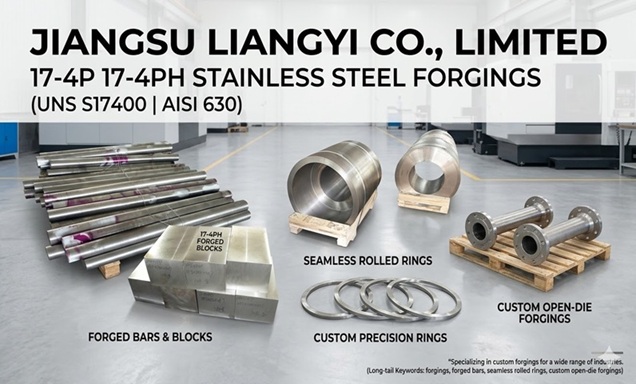
17-4PH Forged Steel Product Range
We offer a full range of custom forgings in this grade with different shapes and specifications as per all global clients' needs. Following is our full forging products catalog for specifications and dimensions.
- 17-4PH forged bars: Forged round, square, flat, rectangular and hollow bars — including high-quality API 6A 105K bars for oilfield sour service.
- Seamless rolled rings (UNS S17400 / AISI 630): Seamless rolled forged rings in any size including exact sizes for rotating equipment.
- Forged housings & sleeves: Forged hubs, housing shells, sleeves, bushes and bushing cases that will not be worn out easily.
- Forged discs, blocks & plates: Forged steel discs, blocks, and plates as per clients' thickness requirement for heavy machinery and other industrial use.
- Forged pipes & tubes: Forged steel pipes, tubes, piping shells, casings and barrels for pressure equipment and downhole use.
- Custom open die forgings: Shafts, spindles, valve bodies, turbine impellers, flanges as per clients' drawings.
17-4PH Seamless Rolled Forged Rings (UNS S17400 / SUS 630)
Seamless rolled rings in 17-4PH (UNS S17400) are essential for rotating machinery, turbines, and structural applications. Unlike welded rings, seamless rolled rings maintain full grain continuity around the circumference — critical for components under cyclic stress or high-speed rotation.
Ring Dimension Capabilities
| Parameter | Standard Range | Maximum Capability |
|---|---|---|
| Outer Diameter (OD) | ⌀100mm – ⌀3000mm | ⌀6000mm (on request) |
| Wall Thickness | 20mm – 500mm | 600mm (confirmed per drawing) |
| Height / Width | 20mm – 1200mm | 1500mm (on request) |
| Unit Weight | 5 kg – 5,000 kg | 15,000 kg (per project) |
| Heat Treatment | H900 – H1150D (all conditions) | Custom H1150M for large-section rings |
| Standards | ASTM A564 / ASTM A705 / EN 10250-4 | API 6A, ASME, DIN on request |
| NDE | 100% UT (ASTM A388) + MPE (ASTM A275) | EN 10228-3 / EN 10228-4 on request |
| Certificate | EN 10204-3.1 | EN 10204-3.2 (TPI-witnessed) on request |
Key Applications for 17-4PH Forged Rings
- Gas & steam turbines: Guide rings, labyrinth seal rings, rotor end rings, blisk rings — H1150M condition for maximum toughness in large-section rotating components.
- Nuclear power:Reactor coolant pump housing, pump housing ring, pump bowl ring - var precision, H1150M, all 3.2TPI certified.
- Oil & gas wellhead: Wellhead ring flanges, adapter flange rings, BOP spool rings — H1150D, API 6A 105K and NACE MR0175 compliant.
- Marine propulsion: Shaft coupling rings, propeller hub rings — H1075 or H1100 for seawater corrosion resistance.
- Valve industry: Valve seat rings and pressure-retaining ring bodies — H900 or H925 for maximum hardness and wear resistance.
UNS S17400 Custom Forged Bar Stock — Dimensions & Specifications
Our UNS S17400 (17-4PH / AISI 630 / SUS 630) forged bar stock is produced to ASTM A564/A705 in all standard and custom dimensions. Bars are produced by open die forging from ESR or VAR refined billets, heat treated to the specified condition, and fully NDE-inspected before shipment.
| Bar Type | Diameter / Cross-Section | Length | Weight per Piece | Standard |
|---|---|---|---|---|
| Round bars (forged) | ⌀20mm – ⌀1500mm | 100mm – 8000mm | 1 kg – 12,000 kg | ASTM A564 / AMS 5643 |
| Square bars | 20×20mm – 500×500mm | 100mm – 6000mm | 1 kg – 8,000 kg | ASTM A564 |
| Flat bars (rectangular) | Thickness 20–500mm, Width 50–2000mm | 100mm – 6000mm | 1 kg – 10,000 kg | ASTM A564 |
| Hollow bars | OD ⌀80–600mm, ID ⌀30–400mm | 100mm – 3000mm | 5 kg – 3,000 kg | ASTM A564 |
| API 6A sour service bars (H1150D) | ⌀25mm – ⌀500mm | 100mm – 6000mm | 1 kg – 5,000 kg | API 6A 105K / NACE MR0175 |
Melting route options: Air-melted (AM) for general engineering; ESR for oil & gas, valve, and marine applications; VAR for nuclear, aerospace, and critical API 6A sour service applications. Surface conditions: Black (as-forged), rough-turned (±2–5mm), or precision-turned to drawing (±0.1–0.5mm). All bars supplied with EN 10204-3.1 certificates including full chemical, mechanical, and heat treatment records per heat number.
17-4PH Forgings — Industry Applications
Our 17-4PH forged products can work well in the strict industrial environments. Below are delivered products that showcase our capabilities as a specialized forging manufacturer.
Oil & Gas Industry — 17-4PH Forgings
The oil and gas industry has strict requirements for forging material selection, particularly in harsh downhole and subsea environments. Our 17-4PH forgings and API 6A 105K bars are the top choice:
- Downhole drilling equipment: Mud motor splined drive shafts and ESP motor splined shafts.
- Wellhead equipment: Christmas trees, wellhead spool bodies, locknuts and frac heads rated to 15,000 psi+.
- Subsea components: X-tree high-pressure elbows, subsea manifolds, BOP RAM bodies and annular BOP components.
- Forged flanges: Double-studded adapter flanges, integral mud flanges and studded crosses (AISI 630 / UNS S17400).
- Wellhead Equipment:main parts such as casing heads, tubing heads, casing hangers, tubing hangers, and spacers.
Case 1 — Saudi Arabia Oilfield Sour Service Project: We supplied 500+ pieces of API 6A 105K forged bars in UNS S17400 (H1150D condition) to a big Saudi Arabian oilfield company. The products were used in wellhead equipment with H2S content ≥15% and 15,000 psi. They were API 6A certified, NACE MR0175 tested. All finished work very well with no failures after two years of use. Our production time was only 45 days.
Power Generation Industry — 17-4PH Turbine Impeller Forgings
Gas & steam turbines and nuclear power plants need forgings that can withstand high-temperatures and stay stable for a long time. Our turbine forgings in this alloy (H1150M condition) are widely used:
- Gas/steam turbine parts: Turbine blades, disks, impellers, blisks, guide rings, seal rings, labyrinth rings and rotor end rings.
- Nuclear power equipment: Casing shells, chamber impellers, pump rotors, and reactor coolant pump rotor impellers.
- Thermal power plant: Boiler forgings, pressure vessel forgings, nozzles, channel flanges and heater components.
- Power plant pumps: Forged impellers, pump casings, wear rings and shafts in high-quality 17-4PH stainless steel.
Valve Industry — 17-4PH Fluid Control Component Forgings
Forgings for valves and fluid systems need to be very hard, seal well and resist corrosion. We make all kinds of valve parts in this grade:
- Valve parts: Precision forged balls, bonnets, bodies, stems, closures, seat rings, cores and discs.
- Valve types: There are different sizes of ball valves, gate valves, check valves, back-pressure valves to meet each client's need.
- Cryogenic valves: Specifically those butterfly valve shafts,are essential in getting high-performance flow seal cryogenic use.
- Waterjet equipment: Hydro-cylinders, accumulators and intensifier pump sealing heads for high-pressure systems.
Marine & Heavy Machinery — 17-4PH Forgings
Marine and heavy machinery need forgings that can withstand saltwater corrosion and have long lifetime:
- Marine products: Propeller shafts, rudder shafts, ship valve components for harsh marine service.
- Compressors: Gas compressor rotors, turbine centrifugal compressor impellers and crown impellers.
- Hydraulic equipment: Pistons, plungers and piston rods of hydraulic cylinders for construction machinery.
- General engineering: Load-bearing parts, homogenizer pistons, venturi cone meter bodies, frac pump fluid end parts.
Case 4 — About Singapore Marine Propulsion Project: We made forged propeller shafts in 17-4PH (⌀350 mm × 6000 mm, H1075 condition, tensile strength >1000 MPa) and seamless rolled rings (SUS 630) for a Singapore shipyard.These parts were 100% UT and MPE tested and have been operating reliably in a saltwater marine environment with no failures.
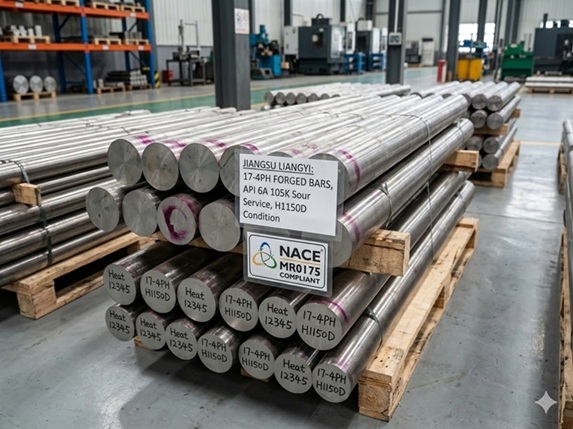
Project Case Studies — Technical Challenges & Verified Outcomes
The following four cases document projects where standard approaches were insufficient. Each case describes the specific engineering challenge, the solution applied, and the verified outcome. Client names are withheld per NDA; all specifications and test data are from delivery documentation.
The wellhead environment contained H₂S ≥15% partial pressure — far above the typical threshold. Simultaneous compliance required:
- NACE MR0175/ISO 15156-3: hardness ≤33 HRC on every piece
- API 6A 105K Class L: Charpy ≥27 J at −46°C on every heat
- Minimum yield ≥725 MPa
- Zero sulfide inclusions — SSC initiation risk
Three previous suppliers had failed QC on Charpy or hardness. Standard ESR material could not guarantee inclusion cleanliness at this H₂S level.
- VAR remelting to eliminate dissolved gases and sulfide inclusions at ingot stage
- Tightened H1150D control: 621°C ±8°C (vs. standard ±14°C) × 4h + air quench to ≤32°C, repeated twice — thermocouple records in MTC
- 100% Rockwell hardness on each bar — all verified ≤33 HRC before release
- Charpy at −46°C, 3 specimens per heat, ASTM A370, SGS witnessed
- 100% UT (ASTM A388) + MPE (ASTM A275) before dimensional release
All 500+ pieces passed first-time. Zero rejects.
- Charpy at −46°C: 44–53 J average (required ≥27 J)
- Hardness: 24–31 HRC across all pieces (required ≤33 HRC)
- Yield strength: 738–765 MPa (required ≥725 MPa)
- Delivered 3 days ahead of schedule
— Procurement Manager, Saudi Arabian oilfield operator (written feedback, 2024)
An 850 kg, ⌀1200mm turbine impeller presents three simultaneous challenges:
- Section effect: Standard H1150M means the 850 kg core reaches peak temperature 40–60 min after the surface — core toughness drops significantly if not controlled
- German DIN traceability: EN 10204-3.2, DIN EN 10250-4, and physical specimens from 1/4T depth required
- Impact target: >80 J at room temperature from 1/4T position — above ASTM A705 minimum of 75 J
- VAR ingot, ≥5:1 reduction ratio to break down cast structure through full section
- Extended solution anneal: 1038°C ±10°C / 3.5h (vs. standard 0.5h/inch) for full through-section solutionizing
- Slow equalization cool: 2°C/min from 1038°C to 204°C under furnace — prevents transformation stress gradients
- Stage 1 aging: 760°C ±10°C / 2h, air quench to ≤32°C
- Stage 2 aging: 621°C ±10°C / 4h, air quench to ≤32°C
- Specimens from surface AND 1/4T AND 1/2T — Bureau Veritas witnessed
All positions met or exceeded the 80 J target.
- Surface Charpy: 93 J
- 1/4T Charpy: 87 J
- 1/2T core Charpy: 82 J
- Tensile at 1/4T: 831 MPa (required ≥795 MPa)
- EN 10204-3.2 + BV witness sign-off issued
- Dimensional: all within ±1.0mm of drawing
— Chief Metallurgist, German power plant EPC contractor (project review report, 2023)
A chemical company in America needed valve parts for service with a mix of sulfuric acid and chlorine gas:
- Hardness >40 HRC for wear resistance — requires H900, limiting achievable toughness
- Corrosion: Simultaneous H₂SO₄ (30–40%) and Cl₂ gas — pitting initiates from any inclusion
- Dimensional: Valve balls required sphericity ±0.05mm
- Delivery: 300+ sets in 8 weeks
- ESR remelting to minimize inclusions (key pitting initiation sites in acid environments)
- H900 aging at 482°C ±8°C: >40 HRC verified on every piece by Rockwell testing before shipment
- Near-net-shape forging dies for ball forgings — minimized machining stock and surface work-hardening risk
- 100% MPE (ASTM A275) on all surfaces after heat treatment
- Staggered batch production in 5 batches to meet 8-week schedule without compromising heat treatment integrity
All 300 sets passed first-time. Delivered on schedule.
- Hardness: 40–42 HRC across all pieces
- Zero MPE rejections on final inspection
- Ball sphericity: all within ±0.04mm
- Chemical analysis confirmed Cr 16.8%, Ni 4.1%, Cu 3.7% per ASTM A564 limits
— Valve Engineering Manager, U.S. chemical plant (reorder inquiry, 2024)
Challenges rarely encountered for shorter forgings of 6000mm drive shafts:
- Length uniformity: If the thermal gradient during the aging process is not controlled, it may cause a hardness change of ±3 HRC. Customer requires that the HRC variation for a length of 6000mm be ≤±2.
- Straightness: Required ≤0.5mm/m after heat treatment
- Saltwater corrosion: Continuous seawater immersion — SCC initiation risk on any surface defect
- H1075 condition selected — ≥1000 MPa tensile with ≥27 J Charpy at −29°C; better toughness for marine shock loads than H900
- Extended aging soak time: 579°C / 5h (vs. 4h minimum) to ensure full precipitation through ⌀350mm core
- Symmetrical furnace loading: Shaft horizontal on ceramic support pins at 1000mm intervals — prevents thermal bowing
- Post-heat-treatment precision straightening: Hydraulic press to ≤0.3mm/m final straightness
- NDE after straightening: 100% UT (ASTM A388) + 100% MPE (ASTM A275) — mandatory because straightening can open sub-surface defects
First submission — passed all inspection criteria.
- Hardness: 32–34 HRC at 12 check points (variation ±1 HRC)
- Straightness: 0.22mm/m (required ≤0.5mm/m)
- UT result: No indications exceeding Class C1 per ASTM A388
- Tensile: 1028 MPa (required ≥1000 MPa)
- Charpy at −29°C: 31 J (required ≥27 J)
— Naval Architect & Materials Engineer, Singapore shipyard (3-year service review, 2025)
17-4PH (UNS S17400) Chemical Composition — Per ASTM A564
The chemical composition is a key factor in how well the alloy performs. All our forgings comply with ASTM A564/A564M (Standard Specification for Hot-Rolled and Cold-Finished Age-Hardening Stainless Steel Bars and Shapes). See Table 1 below:
| Chemical Element | Content (Max / Range) % | Chemical Element | Content (Max / Range) % |
|---|---|---|---|
| Carbon (C) | 0.07% max | Molybdenum (Mo) | — |
| Chromium (Cr) | 15.00–17.50% | Phosphorus (P) | 0.040% max |
| Manganese (Mn) | 1.00% max | Niobium + Tantalum (Nb+Ta) | 0.15–0.45% |
| Nickel (Ni) | 3.00–5.00% | Sulfur (S) | 0.030% max |
| Silicon (Si) | 1.00% max | Copper (Cu) | 3.00–5.00% |
| Iron (Fe) | Balance | — | — |
For power-plant turbine impeller forgings, we offer a modified composition per ASTM A705 Type 630: Cr 15.0–17.5%, Ni 3.0–5.0%, Cu 3.0–5.0%, Nb+Ta 0.15–0.45%, which further improves high-temperature performance.
Note on naming: This alloy is also designated EN 1.4542 (European standard) and SUS 630 (Japanese JIS standard). All these names — 17-4PH, UNS S17400, AISI 630, EN 1.4542, SUS 630 — refer to the same precipitation hardening stainless steel with identical chemical composition and mechanical properties.
17-4PH Forging Process and Heat Treatment
Correct heat treatment and forging processes are the main reasons we can supply stable, high-quality forgings in this grade. We follow advanced forging and heat treatment technology to ensure the excellent, consistent performance of every batch.
Key Forging Temperatures for 17-4PH
- For thickness <19 mm (0.75 in): minimum 15 minutes holding time at forging temperature.
- For thickness ≥19 mm (0.75 in): 30 minutes basic hold + 1 hour per additional inch of thickness.
- Minimum forging temperature: 1010°C (1850°F) — reheat immediately if temperature drops below this threshold.
- Solution annealing: 1024–1052°C (1875–1925°F), quench to ≤32°C (90°F) by air, oil, or water-polymer quenching.
- For large/complex forgings: equalize at 1038–1149°C (1900–2100°F), slow-cool to black state, then air-cool to ≤32°C (90°F).
Standard Precipitation Hardening Conditions — 17-4PH Mechanical Properties (ASTM A564)
All conditions below are per ASTM A564/A564M:
| Condition | Aging Temp. °F (°C) | Tensile (Rm) MPa | Yield 0.2% (Rp0.2) MPa | Elongation % | RA % | Hardness HB / HRC | Impact KV (21°C) J |
|---|---|---|---|---|---|---|---|
| H900 | 900°F (482°C) | ≥1310 | ≥1170 | ≥10 | ≥40 | ≥388 / ≥40 | — |
| H925 | 925°F (496°C) | ≥1170 | ≥1070 | ≥10 | ≥44 | ≥375 / ≥38 | ≥6.8 |
| H1025 | 1025°F (552°C) | ≥1070 | ≥1000 | ≥12 | ≥45 | ≥331 / ≥35 | ≥20 |
| H1075 | 1075°F (579°C) | ≥1000 | ≥860 | ≥13 | ≥45 | ≥311 / ≥32 | ≥27 |
| H1100 | 1100°F (593°C) | ≥965 | ≥795 | ≥14 | ≥45 | ≥302 / ≥31 | ≥34 |
| H1150 | 1150°F (621°C) | ≥930 | ≥725 | ≥16 | ≥50 | ≥277 / ≥28 | ≥41 |
| H1150M | 1400°F + 1150°F | ≥795 | ≥520 | ≥18 | ≥55 | ≥255 / ≥24 | ≥75 |
| H1150D | 1150°F × 2 cycles | ≥860 | ≥725 | ≥16 | ≥50 | ≥255 / ≥24 | ≥41 |
Custom H1150M Heat Treatment — 17-4PH Turbine Impeller Forgings
For turbine impeller forgings with special performance requirements, we offer a custom H1150M heat treatment protocol, as follows:
- Solution annealing: Hold at 1038°C ±14°C (1900°F ±25°F) for 0.5 hours per inch of forging thickness.
- Stage 1 aging: Hold at 760°C±14°C (1400°F±25°F) for at least 2 hours, then air quenched to ≤32°C (90°F).
- Stage 2 aging: Hold at 621°C ±14°C (1150°F ±25°F) for at least 4 hours, then air quench to ≤32°C (90°F).
- Slow furnace cooling: Cool at ≤56°C/h (≤100°F/h) to 204°C (400°F), then gradually to ≤32°C (90°F) to eliminate thermal stress.
17-4PH Heat Treatment Conditions: Application Selection Guide
Selecting the correct heat treatment condition is critical. Using the wrong condition could cause a failure too soon or not meet industry standards. The table below maps each aging condition to its real-world application, rationale, and key limitations.
| Condition | Aging Temp. | Tensile (MPa) | Hardness (HRC) | Charpy (J) | Primary Application | Key Advantage | Not Suitable For |
|---|---|---|---|---|---|---|---|
| H900 | 482°C | ≥1310 | ≥40 — above NACE limit | — | Valve balls/stems, waterjet intensifier heads, high-pressure pump pistons | Maximum hardness & wear resistance | ❌ H₂S sour service ❌ Impact-critical applications |
| H925 | 496°C | ≥1170 | ≥38 | ≥6.8 | Aerospace fasteners, precision tooling, medical instruments | High strength, marginal toughness improvement over H900 | ❌ Not NACE MR0175 compliant ❌ Cryogenic service |
| H1025 | 552°C | ≥1070 | ≥35 | ≥20 | Chemical pump impellers, marine shafts (non-sour), compressor rotors | Good strength-toughness balance | ❌ Still above 33 HRC NACE limit — not for H₂S environments |
| H1075 | 579°C | ≥1000 | ≥32 | ≥27 | Nuclear reactor pump components, marine propeller shafts (Class L), subsea non-sour structural parts | First condition meeting ≥27 J impact; acceptable for limited cold-temperature service | Not API 6A 105K sour service approved — verify hardness per lot |
| H1100 | 593°C | ≥965 | ≥31 | ≥34 | Power generation turbine housings, thermal power station pressure parts, compressor casings | Good elevated-temperature stability to 316°C | Lower strength limits use in extreme-pressure applications |
| H1150 | 621°C | ≥930 | ≥28 | ≥41 | Gas turbine seal rings, labyrinth rings, guide rings, large forged flanges | High impact ≥41 J; good weldability | Single-aging only — NACE MR0175 requires double-aging (H1150D) for sour service |
| H1150M | 760°C (2h) + 621°C (4h) | ≥795 | ≥24 | ≥75 — maximum toughness | Turbine impellers (gas/steam), nuclear coolant pump rotors, heavy rotating equipment | Highest impact toughness — ideal for large-section forgings requiring uniform through-section properties | Lowest strength — not for high-pressure valve applications requiring ≥1000 MPa yield |
| H1150D | 621°C × 2 cycles | ≥860 | ≤33 HRC — NACE compliant | ≥41 J at −29°C (Class P) ≥27 J at −46°C (Class L) |
API 6A 105K wellhead forgings, sour service bars, BOP components, X-tree parts — all H₂S environments | Only condition fully compliant with NACE MR0175/ISO 15156 + API 6A 105K simultaneously | Lower tensile (≥860 MPa) — not for applications requiring ≥1000 MPa yield |
17-4PH API 6A 105K Sour Service Forgings
Forgings to API Specification 6A 105K sour standard must meet the highest technical requirements for heat treatment and mechanical properties. As an API-certified manufacturer, we strictly follow API 6A 105K when producing sour service components according to NACE MR0175 / ISO 15156.
Heat Treatment — H1150D Method A (API 6A 105K Sour Service)
- Solution anneal: Heat to 1026–1050°C (1875–1925°F), hold ≥1 hour, then quench with air/nitrogen to ≤32°C (90°F).
- 1st age hardening: Heat to 621°C ±14°C (1150°F ±25°F), hold ≥4 hours, then quench to ≤32°C (90°F).
- 2nd age hardening: Repeat aging at 621°C ±14°C (1150°F ±25°F) for ≥4 hours, quench to ≤32°C (90°F). (H1150D = double-aging, per API 6A Method A.)
Charpy V-Notch Impact Requirements — API 6A 105K (ASTM A370)
| Temperature Class | Test Temperature | Min Average Impact Value | Min Individual Value |
|---|---|---|---|
| L | −50°F (−46°C) | 27 J (20 ft-lbf) | 18 J (13 ft-lbf) |
| P | −20°F (−29°C) | 41 J (30 ft-lbf) | 27 J (20 ft-lbf) |
Acceptance: Each individual specimen must be ≥2/3 of the specified average value. For batches with only 2 specimens, each specimen must individually meet or exceed the minimum average specified in API 6A 105K.
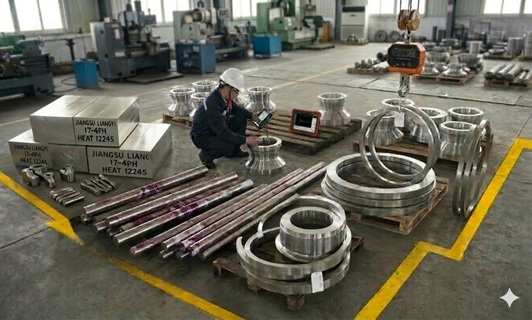
17-4PH Forgings — Quality Control & NDE Inspection
We follow ASTM, API and ASME international standards for 100% quality control and full non-destructive examination (NDE) . No flaws allowed in 17-4PH forgings like porosity, internal bursts, flakes, laps, seams or cracks.
- Visual Inspection (VT): Check for laps, cold shuts, and all other surface flaws on 100% full-surface according to AWS standards.
- Ultrasonic Testing (UT): Based on ASTM A388/388M. all forged parts must pass 100% UT after heat treatment and before machining
- Magnetic Particle Examination (MPE): All products were checked for cracks on the surface and just below the surface according to ASTM A275/275M.
- Mechanical Testing: 100% batch testing for tension test (ASTM E8), hardness (HB/HRC), and Charpy V-notch impact test
- Chemical Analysis: All materials tested per ASTM A751; certified chemical report is issued per heat/serial number.
Certification & Full Traceability
We provide the official EN 10204-3.1 material certificates for all 17-4PH forgings, which will show the source of the raw materials and the manufacturing method. Each certificate includes:
- Complete order information: PO number, client part number, and full UNS S17400/AISI 630 material specification.
- Production traceability: a unique serial number, a production lot number, and raw material vendor details.
- Test reports:Reports of the chemical composition inspection and mechanical performance(hardness, tensile, yield, elongation) inspection.
- Records of the inspections:complete records of non-destructive inspections, size inspections and heat treatment processes.
- Identification of stamping:Each forging and sample is printed with a serial number, heat number and material grade.
of 17-4PH vs Other Stainless Steel Grades — Forging Material Comparison
When choosing forging material for demanding industrial applications, it is important to understand the comparison between 17-4PH (UNS S17400) and other stainless steels. Also see our full stainless steel forging materials guide.
| Property | 17-4PH H900 (S17400) | 316L SS (S31603) | 17-7PH CH900 (S17700) | 15-5PH H900 (S15500) |
|---|---|---|---|---|
| Steel Type | Martensitic PH | Austenitic | Semi-Austenitic PH | Martensitic PH |
| Tensile Strength | ≥1310 MPa | ~515 MPa | ≥1380 MPa | ≥1310 MPa |
| Yield Strength (0.2%) | ≥1170 MPa | ~205 MPa | ≥1170 MPa | ≥1170 MPa |
| Hardness (HRC) | ≥40 | ~90 HRB | ≥41 | ≥38 |
| Corrosion Resistance | Good | Excellent | Good | Good |
| Magnetic | Yes | No | Yes | Yes |
| NACE MR0175 Sour Service | ✓ Yes (H1150D) | Limited | ✗ No | ✓ Yes |
| Weldability | Good | Excellent | Moderate | Good |
| EN Designation | 1.4542 | 1.4404 | 1.4568 | — |
| Best Applications | Oil & Gas, Marine, Valves | Food, Pharma, Chemical | Aerospace, Springs | Oil & Gas, Aerospace |
17-4PH vs 15-5PH Forgings — Detailed Comparison
The choice between 17-4PH (UNS S17400) and 15-5PH (UNS S15500) is one of the most common specification decisions in oil & gas and aerospace procurement. Both are martensitic precipitation hardening stainless steels with similar peak strength, but meaningful differences exist in microstructure, melting practice, and application suitability.
Chemistry and microstructure: 17-4PH contains approximately 17% chromium and 4% nickel; 15-5PH contains 15% chromium and 5% nickel. The higher nickel content in 15-5PH produces a more consistently martensitic microstructure with fewer delta-ferrite stringers than air-melted 17-4PH, giving 15-5PH better transverse toughness from air-melted stock. However, when 17-4PH is ESR or VAR refined — our standard for critical applications — this advantage largely disappears. ESR/VAR 17-4PH achieves transverse Charpy values comparable to air-melted 15-5PH.
Sour service compliance: Both grades are listed in NACE MR0175/ISO 15156-3. Both require H1150D (double-aging) and a maximum hardness of 33 HRC. For API 6A 105K applications, 17-4PH H1150D is more widely specified due to its longer field service history and broader global availability from API-certified manufacturers. 15-5PH H1150D is used in equivalent applications but is specified more frequently in aerospace than in oil & gas.
Forgeability and availability: 17-4PH has a slightly wider forging temperature window and responds consistently in large open die forgings. For forgings >⌀300mm or >500 kg, 17-4PH is the more practical choice — wider supplier capability and larger billet availability at shorter lead times than 15-5PH. 15-5PH typically commands a 10–20% price premium due to lower production volume.
Our recommendation: For most oil & gas wellhead, valve, and marine applications — specify 17-4PH H1150D (ESR or VAR refined). Specify 15-5PH only when the mil specification or AMS standard explicitly requires your application.
SUS 630 Forgings — JIS Standard (Japanese Specification)
SUS 630 is the Japanese JIS designation for the same alloy known internationally as 17-4PH, UNS S17400, AISI 630, and EN 1.4542. The composition, heat treatment conditions, and mechanical properties are identical across all designations. Japanese buyers and engineering firms typically specify SUS 630 with reference to JIS G 4303 (stainless steel bars) or ASTM A564/A705 for forgings.
| Standard System | Name | Standard Document | Region |
|---|---|---|---|
| UNS (ASTM/SAE) | S17400 | ASTM A564 / ASTM A705 | North America |
| AISI | Type 630 | ASTM A564 | North America |
| JIS (Japanese) | SUS 630 | JIS G 4303 / JIS G 4318 | Japan |
| EN (European) | 1.4542 / X5CrNiCuNb17-4-4 | EN 10088-3 / EN 10250-4 | Europe |
| Chinese GB | 05Cr17Ni4Cu4Nb | GB/T 3280 | China |
We supply SUS 630 forgings to Japanese buyers with EN 10204-3.1 certificates referencing both the JIS name and the equivalent ASTM A564 condition. For Japanese projects requiring JIS G 0404 marking or Japanese third-party inspection, we can arrange this through approved Japanese inspection agencies. Our SUS 630 forged products are regularly supplied to Japanese power generation EPC contractors, shipbuilding companies and valve manufacturers. Japanese-language technical document and material certificates are available on request.
Technical FAQ — Oil & Gas and Power Generation Engineering Questions
The questions below are compiled from engineering inquiries and procurement RFQs received from oil & gas operators, EPC contractors, and power plant procurement teams. We answer them directly with technical specifics — not marketing language.
Three simultaneous requirements must all be met:
- Heat treatment: H1150D (double-aging) only — the single condition permitted by NACE MR0175/ISO 15156-3. H900 through H1100 are prohibited because hardness exceeds 33 HRC.
- Hardness verification: Each forging must read ≤33 HRC (≤310 HB) after H1150D aging. We verify on every piece — not batch sampling.
- Melting quality: ESR or VAR remelting specified for sour service forgings to minimize sulfide inclusions (key SSC initiation sites). Air-melted material is for non-sour applications only.
Certificate issued: EN 10204-3.1 with NACE MR0175 / ISO 15156 compliance statement and full hardness records.
API Specification 6A defines two temperature classes:
- Class L (Arctic): Test temperature −46°C (−50°F), minimum average ≥27 J, minimum individual specimen ≥18 J.
- Class P (Standard): Test temperature −29°C (−20°F), minimum average ≥41 J, minimum individual specimen ≥27 J.
Test procedure: ASTM A370, standard 10×10mm Charpy V-notch specimens. Minimum 3 specimens per test. One retest permitted per API 6A Section 5.3. We test at our certified in-house laboratory with full Charpy records in the MTC.
Achieved in practice: Our H1150D forgings consistently reach 45–52 J at −29°C in routine production testing.
The normal lead time for H1150D acid forgings is as below:
- Small batch (<20 pcs, standard sizes): 25–35 days after the drawing is approved
- Medium batch (20–100 pcs): 35–45 days
- Large batch or complex shapes: 45–60 days
Urgent orders:By prioritizing heating scheduling, the standard bar size is accelerated to 20-28 days.Rush surcharge applies. Contact us with your deadline — we will confirm feasibility within 4 hours.
Note: API 6A documentation (mill cert + Charpy records + dimensional report) adds 2–3 days to release. Plan accordingly.
For large rotating turbine impellers, standard H1150 (≥41 J) is insufficient for heavy sections. We recommend:
- Condition: H1150M (custom double-aging) — 760°C/2h + 621°C/4h, with slow furnace cool
- Expected Charpy: ≥75 J at room temperature (ASTM A705 requirement); VAR-refined material typically achieves 80–95 J
- Section uniformity: For impellers >⌀600mm, Charpy specimens taken from surface AND 1/4T depth — both must meet the requirement
- Standard: ASTM A705 Type 630, Condition H1150M
German power projects (DIN EN 10250-4) typically require EN 10228-3 UT acceptance criteria — we issue UKAS-accredited 3rd party UT reports on request.
Large-section 17-4PH has inherent hardenability challenges. Our process controls:
- Melt route: VAR (Vacuum Arc Remelting) for homogeneous grain structure and minimal macro-segregation
- Forging reduction: Minimum 4:1 reduction ratio from ingot — ensures thorough grain refinement through the full section
- Slow furnace cool after H1150M: ≤56°C/h from 204°C to ambient — eliminates thermal stress gradients causing property variation
- Mechanical testing: Specimens from 1/4T, 1/2T positions — not just surface material. All positions reported in MTC.
- ESR: Removes non-metallic inclusions via molten slag — adequate for most oil & gas API 6A, valve, and marine applications. Specify ESR for 90% of projects.
- VAR: Removes dissolved gases + volatile impurities under vacuum. Specify VAR for: nuclear reactor components, high-cycle fatigue turbine impellers >800 kg, aerospace, or when AMS 5622 is invoked.
Cost delta: VAR adds approximately 15–25% to ingot cost. In most API 6A 105K sour service applications, ESR is fully sufficient and represents better value.
API 6A Class L requires ≥27 J average at −46°C. At −60°C (beyond Class L scope), behavior must be individually qualified:
- H1150D typically maintains 20–30 J at −60°C in our production experience (VAR material)
- If ≥27 J at −60°C is mandatory, consider H1150M condition which shows better ductile-to-brittle transition behavior
- We can arrange supplemental Charpy testing at your project-specified temperature as part of first article qualification — before committing to the order
Yes — we fully support TPI witness testing. Practical details:
- Approved agencies: Bureau Veritas, SGS, Lloyds Register, TÜV, Intertek, DNV, and others — all accepted
- Witness points: Chemical analysis, mechanical testing (tensile, Charpy, hardness), NDE (UT, MPE), dimensional inspection
- Certificate: EN 10204-3.2 (TPI-witnessed) available; add 5–7 business days for TPI scheduling vs. standard 3.1
- Remote inspection: Live video inspection available if TPI travel is not feasible
Why Choose Jiangsu Liangyi as Your 17-4PH Forgings Manufacturer
We are one of China's top 17-4PH forging manufacturers and global suppliers, our main strengths are:
- International Standard Certification: All our products are as per ISO/ASTM/API/ASME standards.Also, all API 6A 105K acid forgings meet the NACE MR0175 and ISO 15156 standards.
- Customized Forging Solutions: All open die forgings and seamless rolled rings are made according to customer drawings and technical manuals.
- Advanced ESR/VAR Melting Processes: Our ESR and VAR double-refining melting processes ensure high material purity, minimal inclusions, and no alloy segregation.
- Complete Heat Treatment: We have professional equipment for all conditions H900–H1150D and custom precipitation hardening heat treatment protocols.
- Global Logistics: We can provide Door-to-Door international delivery service for over 50 countries. Our professional logistics team ensures the on-time delivery worldwide.
- EN 10204-3.1 Certified: Full material certificates with complete traceability — raw material to finished forging — for every order.
- Flexible Capacity: Small batches to large volume production with competitive pricing and 30–60 day lead time.
Technical Glossary — 17-4PH Stainless Steel Forging Terms
- Precipitation Hardening (PH)
- A heat treatment process that strengthens alloys by forming fine precipitates (copper-rich phases in 17-4PH) within the metal matrix during controlled aging at moderate temperatures (482–760°C). This dramatically increases yield strength and hardness compared to the solution-annealed condition.
- ESR — Electroslag Remelting
- We will do a secondary metallurgical refining process so the alloy is remelted through a molten slag layer, thus removing non-metallic inclusions and improving the cleanliness, homogeneity, and mechanical properties of 17-4PH (UNS S17400) billets.
- VAR — Vacuum Arc Remelting
- A remelting process performed under vacuum, eliminating dissolved gases and volatile trace elements from the melt. VAR-refined 17-4PH has the highest purity and is widely used for critical aerospace, nuclear, and high-reliability oil & gas industries.
- NACE MR0175 / ISO 15156
- An international standard (published by NACE International / AMPP) specifying material requirements for metallic equipment in oil and gas environments containing hydrogen sulfide (H2S) — called "sour service." 17-4PH in H1150D condition qualifies under this standard for acceptable use.
- API 6A 105K
- API Specification 6A governs equipment used in wellhead and Christmas tree applications. The "105K" material class specifies that the minimum yield strength must be 105,000 psi (725 MPa). This, along with sour service requirements, makes up the most stringent oilfield forging specification for 17-4PH.
- Open Die Forging
- A forging process where the workpiece is shaped by flat or simple-contour dies that do not enclose the material completely, makes the production of large, custom-shaped billets, bars, discs, and rings in 17-4PH stainless steel possible.
- EN 10204-3.1 Material Certificate
- The manufacturer's authorized inspectors will issue a material test certificate according to European standard (Type 3.1), which states the actual chemical composition and mechanical test results for each specific heat/lot of forging material supplied. Required by most global industrial buyers.
- Charpy V-Notch (CVN) Impact Test
- A standardized test per ASTM A370 measures the energy absorbed by a notched specimen during fracture at a specified temperature. For API 6A 105K 17-4PH sour service forgings: minimum 27 J at −46°C (Class L) or 41 J at −29°C (Class P).
- UNS — Unified Numbering System
- A standardized alloy name system used in North America (ASTM/SAE). UNS S17400 is the official designation for 17-4PH precipitation hardening stainless steel — equivalent to AISI 630, EN 1.4542, and SUS 630.
Frequently Asked Questions — 17-4PH Stainless Steel Forgings
What is 17-4PH stainless steel (UNS S17400)?
17-4PH (UNS S17400 / AISI 630 / EN 1.4542) is a martensitic precipitation hardening stainless steel which contains about 17% chromium, 4% nickel and 4% copper. It gets tensile strengths up to ≥1310 MPa (H900 condition) through age-hardening heat treatment, combined with good corrosion resistance and moderate toughness — widely used in oil & gas, aerospace, marine, power generation and valve parts.
What is the difference between 17-4PH H900 and H1150D heat treatment conditions?
H900 (aged at 482°C/900°F) has maximum strength: tensile strength ≥1310 MPa and hardness ≥40 HRC, making it ideal to make valve parts and pump parts which require high hardness. H1150D (double aging at 621°C/1150°F × 2 cycles) offers lower strength (≥860 MPa) but much higher toughness (≥41 J impact at 21°C) and meets NACE MR0175 requirements — the correct condition for API 6A 105K sour oilfield equipment exposed to H2S.
What is API 6A 105K 17-4PH sour service forging?
API 6A 105K 17-4PH sour service forgings are stainless steel forgings which meet API Specification 6A used for wellhead and Christmas tree equipment with 105,000 psi (725 MPa) minimum yield strength, produced via H1150D double-aging heat treatment and compliant with NACE MR0175/ISO 15156 for H2S environments. Required Charpy V-notch impact: ≥27 J at −46°C (Class L) or ≥41 J at −29°C (Class P) per ASTM A370.
What industries use 17-4PH stainless steel forgings?
17-4PH stainless steel forgings are mainly used in: (1) Oil & Gas — downhole drilling tools for oil and gas, wellhead equipment, subsea X-tree parts and blowout preventer parts; (2) Power Generation — turbine impellers, pump casings, nuclear coolant pump rotors; (3) Valve production — valve balls, valve stems, valve covers and valve seat rings; (4) Marine & Offshore — propeller shafts, rudder shafts, marine valves; (5) Chemical Processing — control of corrosion-resistant fluids; (6) Aerospace and defense — high strength-to-weight ratio applications.
What is the chemical composition of 17-4PH (UNS S17400)?
As per ASTM A564, the chemical composition of 17-4PH (UNS S17400) is as follows: Chromium (Cr) 15.00–17.50%, Nickel (Ni) 3.00–5.00%, Copper (Cu) 3.00–5.00%, Niobium+Tantalum (Nb+Ta) 0.15–0.45%, Carbon (C) max 0.07%, Manganese (Mn) max 1.00%, Silicon (Si) max 1.00%, Phosphorus (P) max 0.040%, Sulfur (S) max 0.030%, Iron (Fe) balance.
Is 17-4PH stainless steel magnetic?
Yes. 17-4PH (UNS S17400) is ferromagnetic under solution annealing (condition A) and all aging conditions (H900-H1150D) due to its martensitic microstructure. This distinguishes it from non-magnetic austenitic stainless steel (such as 316L (UNS S31603)). When applied near magnetic sensitive instruments or in environments sensitive to electromagnetic compatibility, it is important to consider their magnetism.
What is the difference between ESR and VAR refined 17-4PH?
ESR (Electroslag Remelting) refines 17-4PH by passing it through a molten slag layer which can significantly reduce non-metallic inclusions and improve the cleanliness — suitable for most industrial and oilfield uses. VAR (Vacuum Arc Remelting) is a higher-purity process performed under vacuum, eliminating dissolved gases and volatile impurities to get good homogeneity. VAR-refined 17-4PH is specified for critical aerospace, nuclear power, and highest-performance oil & gas uses where maximum fatigue life and reliability are required.
What NDE inspections does Jiangsu Liangyi perform on 17-4PH forgings?
Jiangsu Liangyi performs 100% inspection including: Visual Inspection (VT) for surface defects; Ultrasonic Testing (UT per ASTM A388) for internal flaws; Magnetic Particle Examination (MPE per ASTM A275) for surface/near-surface cracks; Mechanical Testing (tension per ASTM E8, hardness HB/HRC, Charpy V-notch impact); and Chemical Analysis (per ASTM A751). All products are supplied with EN10204-3.1 material test certificates and a full set of traceable records.
What is the lead time of custom 17-4PH forgings from Jiangsu Liangyi?
Normal lead time of custom 17-4PH forgings is 30–60 days depending on client's drawing, quantity and heat treatment condition required. For API 6A 105K acid forgings (H1150D), lead time is within 45 days. Rush orders are available per client requirements. Free quotes are provided within 24 hours after inquiry.
What certifications does Jiangsu Liangyi provide for 17-4PH forgings?
Jiangsu Liangyi is an API 6A certified manufacturer for 105K sour forgings and operates under the ISO 9001 quality management system. All 17-4PH forgings are shipped with EN 10204-3.1 material certifications. Products comply with ASTM A564/A705, API 6A, ASME codes, and NACE MR0175/ISO 15156 for sour service materials. Full chemical, mechanical, and NDE test reports are provided for each order.
17-4PH Forgings Inquiry — Contact Jiangsu Liangyi
If you have any questions about 17-4PH forgings, UNS S17400 / AISI 630 forged parts, API 6A 105K bars or other custom forged parts for oil & gas, power generation, marine or valve industries — our team is ready to help you with professional technical solutions and full after-sales support.
Jiangsu Liangyi is a leading manufacturer of 17-4PH (UNS S17400 / AISI 630) forged stainless steel parts, API 6A 105K bars, turbine impeller forgings and valve forgings. We offer competitive prices, good lead times and fully custom solutions for oil & gas, power generation, nuclear power, marine, valve and heavy equipment to our customers in over 50 countries.
Get Free Quote — Reply in 24h