15CrNi6 (1.5919) Forging Parts | Custom China Forging Manufacturer
About 15CrNi6 (1.5919) Case Hardening Forged Steel
Established in 1997, Jiangsu Liangyi is an ISO 9001:2015 certified professional manufacturer of 15CrNi6 (1.5919) open die forging parts and seamless rolled forged rings in China. With over 25 years of industry experience, we provide one-stop custom solutions from steel melting, forging, heat treatment to precision machining, strictly complying with EN, DIN, ASTM and other international standards for global clients.
15CrNi6, also known as 1.5919 alloy steel under EN standard, is a premium case hardening steel widely used in the heavy engineering industry. It is specially engineered for medium to large heavily loaded components that require high surface hardness, excellent core toughness, superior wear resistance and outstanding impact resistance. This material is the best choice material for manufacturing gears, shafts, pinions, transmission parts and other important components that need to withstand variable loads and long-term continuous operation in harsh working conditions.
The Metallurgy of 15CrNi6 — Why Each Alloying Element Matters
Unlike general-purpose structural steels, 15CrNi6 (1.5919) is a precision-balanced alloy where each element plays a specific, engineered role in achieving the combination of surface hardness, core toughness, and hardenability that heavy-duty forgings demand. Understanding the function of each element helps engineers make better material selection decisions and specify correct processing routes.
Chromium is the primary carbide-forming element in 15CrNi6. Cr promotes the formation of stable Cr7C3 and Cr23C6 carbides in the case layer during the carburizing process, and significantly improves the surface hardness and wear resistance after quenching. Chromium also improves oxidation resistance and hardenability, allowing the steel to achieve full martensitic transformation at greater section depths. In the core, Cr contributes to solid-solution strengthening of the tempered martensite matrix.
Nickel is the toughening element in 15CrNi6 and is the main differentiator from simpler case hardening steels like 20MnCr5. Ni does not form carbides; instead, it dissolves completely into the ferrite/martensite matrix, lowering the ductile-to-brittle transition temperature by approximately 10°C per 1% Ni addition. This makes 15CrNi6 forgings suitable for applications down to −40°C — important for wind turbines in cold climates and offshore oil & gas equipment. Ni also synergizes with Cr to produce a more uniform hardenability across large cross-sections, reducing the "soft core" risk in heavy forgings above 200mm diameter.
The low core carbon content of 15CrNi6 (0.14–0.19%) is intentional: it makes sure the core remains ductile and tough after quenching, with a core hardness of 30–42 HRC in the quenched-and-tempered condition. This low base carbon means the steel cannot be surface-hardened by induction alone — it relies on carburizing to raise the case carbon to 0.75–0.85%, where the case can reach 58–62 HRC. The narrow carbon band (0.05% range) requires precise steelmaking control, which is why vacuum degassing or ESR is recommended for high-specification forgings.
Manganese in 15CrNi6 serves a dual purpose: it acts as a deoxidizer during steelmaking (combining preferentially with sulfur to form MnS rather than the more brittle FeS grain boundary films), and it provides a moderate hardenability contribution. The relatively low Mn ceiling of 0.60% is a deliberate design choice — higher Mn would increase retained austenite after carburizing and raise the risk of temper brittleness in the Cr-Ni system, which can occur if Mn exceeds 0.60% and slow cooling passes through the 400–600°C embrittlement range.
Silicon is controlled to a maximum of 0.40% in 15CrNi6. At this level, Si contributes to deoxidation and slight solid-solution strengthening. Importantly, Si retards the diffusion of carbon in austenite, which must be accounted for when designing carburizing cycles — higher Si content slightly slows carburizing kinetics and requires longer cycle times to reach the specified case depth. Very high Si (>0.50%) would form internal oxidation layers during gas carburizing, so the 0.40% ceiling protects carburizing quality.
Such tight limits for P and S are important for the impact toughness performance of 15CrNi6 in important applications. Phosphorus segregates to grain boundaries during solidification and severely reduces impact toughness, especially at low temperatures, which is a major concern for wind turbine components. Sulfur forms MnS inclusions that reduce transverse ductility and act as fatigue crack initiation sites. For the highest-specification 15CrNi6 forgings, we can achieve P ≤ 0.015% and S ≤ 0.010% through EAF+LF+VD or ESR processing routes.
Why the Balanced Cr-Ni Design (Both at 1.40–1.70%) Is the Engineering "Sweet Spot"
An important but often misunderstood aspect of 15CrNi6 is that Chromium and Nickel are intentionally specified at identical concentration ranges. This is not coincidental — it is a well-established metallurgical strategy. Chromium alone improves hardenability and wear resistance, but can embrittle the steel if not balanced by a toughening element. Nickel alone improves toughness but reduces hardenability and raises cost without the wear resistance needed for case hardening. Together at equal levels, Cr provides the hard, wear-resistant carburized case while Ni makes sure the core (uncarburized zone) retains high impact energy even at sub-zero temperatures — a balance that neither element can achieve independently. This dual-alloying philosophy makes 15CrNi6 the standard specification for wind turbine gearbox ring gears operating in Arctic-proximity installations where −40°C impact testing is mandatory.
Custom 15CrNi6 (1.5919) Forging Products & Shapes
We can customize a full range of 15CrNi6 (1.5919) forged components according to your official drawings and specific technical requirements, covering the following main product shapes, all produced with our advanced forging equipment:
- Forged bars: 15CrNi6 round bars, square bars, flat bars, rectangular bars and rods — max diameter 1200 mm, max length 12,000 mm
- Forged rings: 1.5919 seamless rolled rings, riding rings, gear rims and bearing races — max OD 5,000 mm
- Shafts & transmission parts: 15CrNi6 gear shafts, pinion shafts, spindles, gear wheels, crankshafts and coupling parts
- Hollow parts: 1.5919 housings, shells, sleeves, bushes, hollow bars, pipes, tubes and casings — produced by punching and mandrel elongation for superior grain flow
- Custom special shapes: 15CrNi6 discs, blocks, flanged shapes, eccentric sections, and other non-standard forged parts per customer drawings
Why Choose Jiangsu Liangyi for Your 15CrNi6 Forging Needs
Full One-Stop Service
From steel melting, forging, heat treatment to precision machining, we handle the entire production process in-house, guaranteeing strict quality control and short lead time.
Large Production Capacity
80,000 ㎡ production base with 120,000 tons annual capacity, capable of producing 15CrNi6 forgings from 30 KGS to 30,000 KGS single piece weight.
Strict Quality Assurance
Equipped with full set of nondestructive testing, chemical composition and mechanical property testing equipment, providing complete MTC 3.1/3.2 for every batch.
Customized Material Solutions
Flexible melting processes including EAF, ESR, VIM, etc., can meet different technical requirements for all kinds of industrial applications.
Rich Industry Experience
Over 25 years of forging experience, serving global clients from wind power, mining, oil & gas, cement industries, with mature project cases.
International Standard Compliance
All 15CrNi6 forged parts strictly comply with EN, DIN, ASTM, ISO international standards, meeting the requirements of global industrial clients.
15CrNi6 (1.5919) vs Competing Case Hardening Steels — Engineering Comparison
Choosing the right case hardening steel for a heavy forging project requires an accurate understanding of how different grades perform in actual application conditions. Below is an original engineering comparison based on our 25+ years of production experience and material testing data for forgings supplied to global clients:
| Property / Criteria | 15CrNi6 (1.5919) | 16NiCr4 (1.5752) | 18CrNiMo7-6 (1.6587) | 20CrNiMo (1.6523) |
|---|---|---|---|---|
| Core Carbon (%) | 0.14–0.19 | 0.14–0.19 | 0.15–0.21 | 0.17–0.23 |
| Nickel Content (%) | 1.40–1.70 | 0.70–1.00 | 1.40–1.70 | 0.25–0.65 (max) |
| Chromium Content (%) | 1.40–1.70 | 0.60–1.00 | 1.50–1.80 | 0.40–0.70 |
| Molybdenum (%) | None | None | 0.25–0.35 | 0.08–0.15 |
| Hardenability — Large Section | Excellent | Moderate | Excellent | Moderate |
| Low-Temperature Toughness (−40°C) | Very High | High | Very High | Moderate |
| Surface Hardness after Carburizing | 58–62 HRC | 58–62 HRC | 58–63 HRC | 57–61 HRC |
| Core Tensile Strength (QT, >150mm) | ≥1050 MPa | ≥900 MPa | ≥1150 MPa | ≥980 MPa |
| Temper Brittleness Risk | Low (if Mn <0.60%) | Low | Very Low (Mo suppresses) | Low |
| Best-Fit Application | Large gear forgings, wind turbine shafts, mining shafts | Medium gears, shafts below 150mm | Wind ring gears, highest-spec gear forgings | General gears, moderate loads |
| Relative Material Cost | Medium-High | Medium | High | Medium |
From this comparison, 15CrNi6 occupies the important "high hardenability + high toughness + no Mo" design space. For projects where 18CrNiMo7-6 exceeds the budget but 20CrNiMo or 16NiCr4 cannot deliver the hardenability or low-temperature toughness required in large cross-sections, 15CrNi6 is frequently the technically correct and commercially optimal choice. Please contact us for a specific material substitution analysis for your project.
15CrNi6 (1.5919) Forged Product Gallery
Below are our typical 15CrNi6 forging products. We can customize all shapes and specifications according to your official drawings:
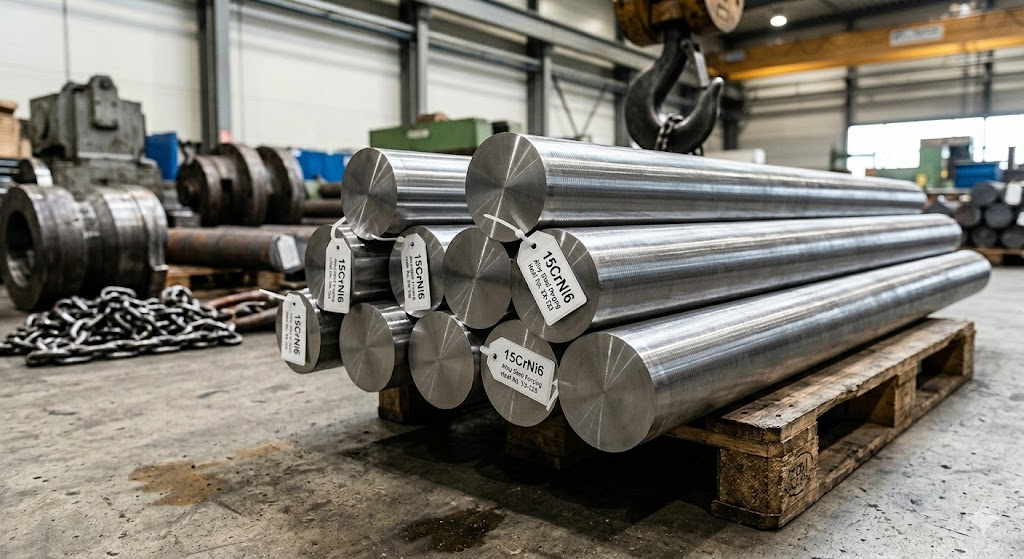
15CrNi6 Forged Round Bars
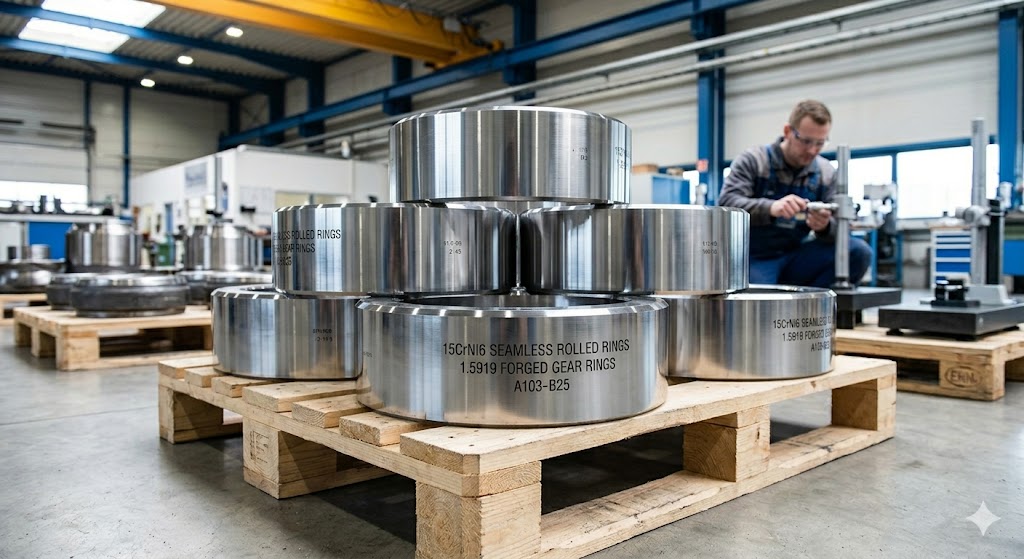
15CrNi6 Seamless Rolled Rings
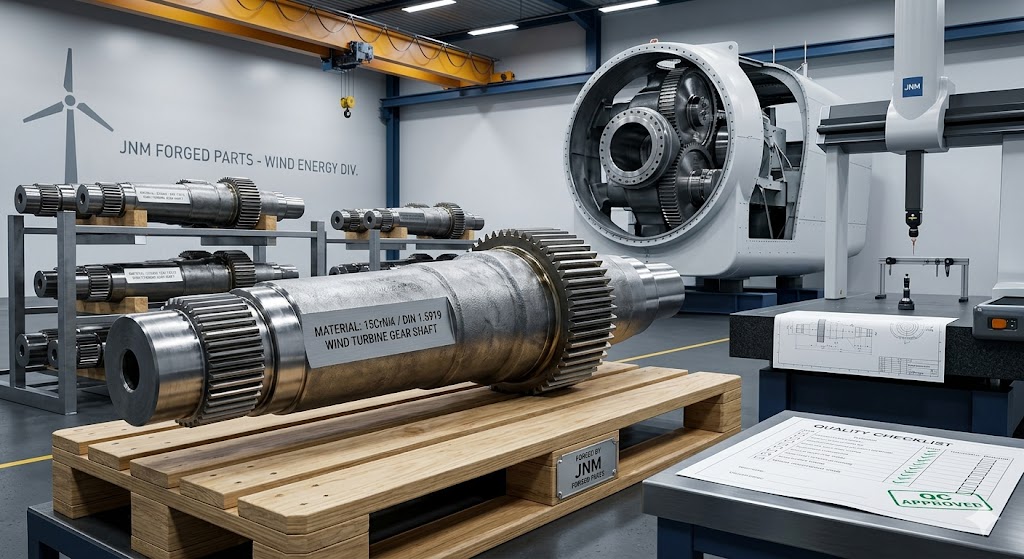
15CrNi6 Forged Gear Shafts
Main Applications & Global Industry Cases of 15CrNi6 Forging Parts
Benefiting from its excellent full mechanical properties, 15CrNi6 (1.5919) forged parts are widely used in all kinds of heavy industry fields worldwide. Below are our mature application cases and customized solutions for global clients from more than 50 countries:
Wind Power Industry 15CrNi6 Forgings
We produce high-precision 15CrNi6 forged gear shafts, pinion shafts and ring gears for 1.5MW–6MW wind turbine gearboxes. Our products adopt advanced refining and heat treatment processes, with excellent impact resistance and fatigue strength under long-term variable load conditions, supporting the demanding design life requirements of modern wind turbine gearboxes (typically 20+ years as specified by turbine OEMs), widely supplied to wind power projects in Europe, North America and Asia. For offshore wind turbine applications where ambient temperature can reach −30°C to −40°C, we specify EAF+LF+VD or EAF+ESR melting routes and mandate Charpy V-notch impact testing at the service temperature as part of the acceptance criteria — a process specification not always offered by general forging suppliers.
Cement & Building Materials Industry 1.5919 Forged Parts
We supply 15CrNi6 case hardened pinion shafts for large cement mill rotary kilns, as well as riding gear rings for granulators, dryers and coolers. These 1.5919 forged parts have high surface hardness and core toughness, effectively resisting wear and impact during continuous high-load operation of cement production equipment. The balanced Cr-Ni alloy design provides the combination of case wear resistance and core impact toughness that cement plant pinion shafts require — reducing unplanned downtime and extending maintenance intervals for cement plants across Europe, Asia and the Middle East.
Mining & Heavy Machinery Industry 15CrNi6 Forged Components
Our 1.5919 forged eccentric shafts for gyratory crushers, slewing bearing races for mining excavators, and main shafts for mine hoist systems are widely used in Australian, South American and African mining operations. Manufactured with strict forging process control, these components can withstand heavy shock loads and abrasive working conditions, significantly extending the service life of mining equipment. For slewing ring applications, we produce 15CrNi6 seamless rolled rings in diameters from 800mm to 4,500mm, with ring rolling ratio controlled at minimum 3:1 to guarantee circumferentially aligned grain flow that maximizes hoop stress fatigue resistance.
Oil & Gas Industry 15CrNi6 Forging Parts
We provide custom 15CrNi6 forged gear shafts, pinion shafts and riser joints for onshore and offshore oil and gas drilling rigs, mud pumps and subsea production equipment. The material has excellent ductility and fatigue resistance that meet the stringent requirements of the oil and gas industry, so that they can work reliably in high-pressure and complex downhole environments for Middle East and Southeast Asian oilfield projects. For sour service (H₂S-containing) environments, we can advise on hardness limits (typically ≤22 HRC for core sections per NACE MR0175) and select melting processes that minimize sulphur segregation.
General Industrial & Transportation Equipment Forgings
15CrNi6 (1.5919) forged parts are also widely used in sugar mills, steel mills, hydro power equipment, railway locomotives, heavy trucks and engineering machinery. Our core products include transmission shafts for locomotives, crane wheels, hydro turbine shafts, gearbox gears and pinions for speed reducers, crankshafts for gas compressors and mechanical presses, and other custom forged parts for heavy-duty equipment.
15CrNi6 Open Die Forging Process — Step-by-Step Technical Controls
The forging process for 15CrNi6 (1.5919) is not a generic hot-working operation — it requires precise temperature control, reduction ratio management, and post-forge cooling procedures to develop the microstructural refinement and grain flow that justify the use of a forging over machined bar or casting. Below is our production process sequence and the engineering rationale behind each step:
Ingot / Billet Heating — Charge Temperature & Soaking
15CrNi6 ingots or continuous cast billets are charged into a gas-fired or electric furnace and heated to 1200–1240°C (well above the austenite homogenization temperature of approximately 1100°C for this grade). A minimum soaking time of 1 hour per 100mm of cross-section diameter is applied to ensure thorough temperature equalization throughout the section and full dissolution of any alloy carbide clusters from the as-cast microstructure. Charging directly into a furnace above 800°C (without gradual pre-heating) risks thermal shock cracking in large ingots — our standard is to pre-heat at 600–700°C before final temperature ramp-up for ingots above 800mm diameter.
Initial Forging — Breaking Down the As-Cast Structure
The first forging pass is applied at 1150–1200°C with heavy reductions (30–40% per pass) to break down the dendritic solidification structure, close internal shrinkage cavities, and begin grain refinement. For 15CrNi6, the chromium and nickel contents slightly reduce thermal conductivity compared to plain carbon steels, so temperature gradients across large section forgings are monitored more carefully at this stage. Forging must not continue below 900°C without reheating — working 15CrNi6 in the Cr-Ni carbide precipitation range (700–900°C) risks intergranular cracking.
Forging Ratio Control — Minimum 4:1 for Critical Parts
We apply a minimum forging ratio (cross-sectional area reduction) of 4:1 for standard 15CrNi6 forgings, and 5:1 to 8:1 for important gear shaft and ring gear applications. The forging ratio is the single most important parameter in establishing the mechanical property advantage of a forging over bar stock: at 4:1 reduction, ASTM grain size reaches 5–7; at 6:1 reduction, grain size reaches 7–9, and aligned fibrous grain flow (Widmanstätten matrix deleted) is consistently achieved. Our in-house metallographic analysis verifies grain size per ASTM E112 for every certified heat.
Finish Forging — Temperature & Dimensional Control
Finish forging of 15CrNi6 is performed in the range of 950–1050°C to ensure a consistent, fine-grained microstructure in the finished forging. The finish forging temperature should not drop below 900°C — lower temperatures in this Cr-Ni alloy system can produce a duplex (mixed fine + coarse grain) matrix that degrades fatigue performance. Dimensional tolerances at the forged stage include machining allowance per the customer's drawing, typically 5–25mm per surface depending on forging size and complexity.
Post-Forge Cooling — Controlled Air or Slow Cooling
After forging, 15CrNi6 parts are cooled under controlled conditions. For small to medium forgings (below 300mm section), air cooling in still air is standard. For large forgings (above 300mm), controlled slow cooling in a pit furnace (cooling rate 20–40°C/hour) prevents hydrogen flaking (a risk in heavy Ni-bearing alloy steel sections where dissolved hydrogen cannot diffuse out fast enough during rapid cooling) and avoids quench crack initiation from high thermal gradients. This step is particularly critical for sections above 500mm — a technical requirement frequently overlooked by less experienced forging suppliers.
Soft Annealing or Normalizing — Pre-Machining Condition
Prior to rough machining, 15CrNi6 forgings are typically delivered in either the annealed condition (≤210 HBW, EN standard) or normalized condition. Annealing at 650–680°C (subcritical) or 800–850°C (full anneal) produces a spheroidized carbide microstructure that maximizes machinability. Normalizing at 880–920°C followed by air cooling produces a pearlite-bainite microstructure with 170–230 HBW — slightly harder but useful when the customer's rough machining tolerances are generous and the heat treatment cycle to Q+T or carburizing follows in-house.
Why Forging is Superior to Machined Bar or Casting for 15CrNi6 Critical Components
When a 15CrNi6 component is machined from hot-rolled bar, the grain flow runs longitudinally along the bar axis regardless of the part geometry. In a gear tooth, this means the highest-stress section (the tooth root in bending fatigue) has grain boundaries crossing perpendicular to the stress — reducing fatigue strength compared to a forged equivalent (metallurgical literature typically reports 20–35% improvement in fatigue strength and 30–50% improvement in impact toughness for forgings versus machined bar in equivalent alloy steels). Open die forging custom-shapes the grain flow to follow the geometry of the finished part. In forged rings, the circumferential grain flow created by ring rolling provides significantly improved hoop stress resistance versus a disc-machined ring. In gear shaft forgings, our controlled grain flow extends from flange face to bearing journal, creating a continuous "fiber" that fatigue cracks must cross rather than follow — the primary mechanism behind the superior service life of forged components in wind turbine gearboxes and mining equipment.
Melting Process Options for 15CrNi6 (1.5919) Forged Materials
We can provide flexible melting process solutions for 15CrNi6 (1.5919) forged materials according to your technical requirements and application scenarios, all processes are strictly controlled to ensure material internal quality and stability, with complete Mill Test Certificate (MTC) available for every batch:
- EAF: Electric Arc Furnace — standard route for non-critical structural forgings
- EAF+LF+VD: Electric Arc Furnace + Ladle Refining + Vacuum Degassing — recommended for wind turbine and mining gear forgings (hydrogen ≤2 ppm, O ≤20 ppm)
- EAF+ESR: Electric Arc Furnace + Electro Slag Remelting — superior inclusion cleanliness for oil & gas and high-fatigue applications
- EAF+PESR: Electric Arc Furnace + Protective Atmosphere ESR — for steels requiring minimal oxidation loss during remelting
- VIM+PESR: Vacuum Induction Melting + Protective ESR — highest purity route for maximum-specification 15CrNi6 forgings
Chemical Composition of 15CrNi6 (1.5919) Steel
The chemical composition of 15CrNi6 (1.5919) steel strictly meets EN international standards, with the main element content range as follows. Heat analysis (ladle chemistry) and product analysis (from the forged piece) are both reported in our EN 10204 3.1 MTC for every batch:
| Element | Symbol | Content Range (Heat Analysis) | Role in 15CrNi6 |
|---|---|---|---|
| Carbon | C | 0.14 – 0.19% | Low core carbon for toughness; surface carbon enriched to 0.75–0.85% by carburizing |
| Silicon | Si | Max 0.40% | Deoxidation; limited to avoid internal oxidation during gas carburizing |
| Manganese | Mn | 0.40 – 0.60% | Deoxidation, hardenability; restricted to <0.60% to prevent temper brittleness in Cr-Ni system |
| Nickel | Ni | 1.40 – 1.70% | Core toughness, low-temperature impact resistance, synergistic hardenability with Cr |
| Chromium | Cr | 1.40 – 1.70% | Hardenability, case wear resistance via carbide formation, oxidation resistance |
| Phosphorus | P | Max 0.025% | Impurity; strict limit to protect grain boundary toughness especially at low temperature |
| Sulfur | S | Max 0.035% | Impurity; forms MnS inclusions — controlled to minimize fatigue crack initiation sites |
Mechanical Properties of 15CrNi6 (1.5919) Forging Material
The mechanical properties of 15CrNi6 (1.5919) forged parts can be fully customized through professional heat treatment according to your requirements. Properties are size-dependent — larger cross-sections achieve lower core hardness due to reduced quench cooling rates. The values below represent minimum guaranteed properties for forgings in the effective diameter range 100–160mm under standard heat treatment conditions:
| Heat Treatment Condition | Performance Index | Standard Value (≤160mm dia.) |
|---|---|---|
| Quenched & Tempered (+QT) | Tensile Strength (Rm) | ≥1050 MPa |
| Quenched & Tempered (+QT) | Yield Strength (Re/Rp0.2) | ≥945 MPa |
| Quenched & Tempered (+QT) | Elongation (A) | ≥10% |
| Quenched & Tempered (+QT) | Reduction of Area (Z) | ≥50% |
| Quenched & Tempered (+QT) | Impact Energy (KV₂, +20°C) | ≥60 J |
| Quenched & Tempered (+QT) | Core Hardness | 30–42 HRC (application-dependent) |
| After Carburizing + Quench + Temper | Surface Hardness (Case) | 58–62 HRC |
| After Carburizing + Quench + Temper | Retained Austenite (surface) | ≤25% (targeted <20%) |
| Annealed (+A) | Hardness (for machining) | ≤210 HBW |
Heat Treatment Specifications for 15CrNi6 (1.5919) Forgings — Full Technical Guide
Heat treatment is the defining step that transforms 15CrNi6 forged steel from a machinable blank into a high-performance component. The choice of heat treatment route must align with the application's functional requirements — surface hardness, core toughness, dimensional stability, and service temperature. Below we document all standard heat treatment routes we offer for 15CrNi6 forgings, with specific parameters derived from our production experience:
Gas Carburizing + Quench + Low Temper (Standard Case Hardening)
- Carburizing temperature: 900–930°C in atmosphere-controlled furnace
- Carbon potential: 0.75–0.90% C (controlled by dew point or lambda sensor)
- Boost phase: 0.95–1.05% C for first 60–70% of cycle time
- Diffuse phase: 0.75–0.80% C for remaining cycle (prevents surface carbide network)
- Case Hardening Depth (CHD at 550 HV): 0.6–2.8 mm per drawing spec
- Quench: oil at 60–80°C (direct quench from carburizing temperature) or single reheat quench from 820–840°C
- Temper: 150–200°C × 2–4 hours (low temper to relieve quench stress, preserve surface hardness)
- Surface hardness: 58–62 HRC; Core hardness: 30–42 HRC
- Retained austenite target: ≤20% (controlled by diffuse-phase carbon potential)
Quench & Temper (+QT) — Through-Hardening Route
- Austenitizing temperature: 820–870°C × 1 hour per 25mm section
- Quench medium: oil (preferred for heavy sections to reduce distortion) or polymer solution
- Tempering temperature: 550–650°C × 2 hours minimum per 25mm section
- Temper must not be performed in the 250–450°C range to avoid temper embrittlement in the Ni-Cr system
- Typical result: Rm ≥1050 MPa, Re ≥945 MPa, KV₂ ≥60 J at +20°C
- Used when uniform through-properties (not carburized case) are required
Normalizing (+N) — Grain Refinement & Pre-Machining
- Normalizing temperature: 880–920°C × 1 hour per 25mm section
- Cooling: still air (natural air cooling)
- Result: Uniform pearlite-bainite microstructure, ASTM grain size 5–8
- Typical hardness: 170–230 HBW (depending on section size)
- Used as pre-machining condition or as intermediate step before QT or carburizing
- Does not achieve final mechanical properties — always followed by QT or carburizing for service
Annealing (+A) — Soft Delivery Condition for Machining
- Full anneal: 800–850°C × hold, slow furnace cool at ≤30°C/hour through 650°C → air cool below 300°C
- Subcritical anneal: 650–680°C × 4–8 hours → furnace cool to <400°C → air cool (preferred for minimal distortion)
- Result: Spheroidized carbide microstructure, ≤210 HBW per EN 10084
- Maximizes machinability — recommended when extensive rough machining is required before final heat treatment
- Note: Annealed condition does not represent final service properties — customer must specify and perform final heat treatment
Carburizing Case Depth Engineering Guide for 15CrNi6 Gear Forgings
One of the most common technical questions from gear designers working with 15CrNi6 (1.5919) forgings is how to specify the correct Case Hardening Depth (CHD). Over-specifying CHD results in excessive carburizing time, higher cost, and greater distortion risk. Under-specifying results in premature pitting fatigue at the case-core interface. Based on our production experience with gear forgings supplied to wind turbine, cement mill, and mining equipment OEMs across 50+ countries, we provide the following guidance as a starting reference:
These values are guidelines based on ISO 6336-5 and AGMA 2101 recommendations for carburized and case-hardened steel gears. We recommend that you confirm CHD with your gear design engineer for your specific application and share the final tooth geometry drawing with us – we will verify the specified CHD against our carburizing furnace capability and confirm any constraints with you before production starts.
Non-Destructive Testing (NDT) & Quality Inspection Capabilities
Every batch of 15CrNi6 (1.5919) forging parts is given a rigorous quality inspection program before shipment. Our in-house NDT capabilities are calibrated and operated by qualified personnel, and all critical inspection results are documented in the EN 10204 3.1 MTC issued with each delivery:
Ultrasonic Testing (UT) — EN 10228-3 / ASTM A388
Straight-beam and angle-beam UT is performed on all 15CrNi6 forgings above 50mm section to detect internal discontinuities including shrinkage, laminations, flakes, and large inclusions. Acceptance criteria are specified per the applicable standard (EN 10228-3 Class 3 or 4, or customer-specified zone mapping). For large forgings above 1000mm, immersion UT is available through our certified third-party partners. UT is performed after rough machining (not on forged surface) to eliminate surface wave interference and maximize sensitivity.
Magnetic Particle Testing (MT) — EN 10228-1
Wet fluorescent magnetic particle testing is applied to all 15CrNi6 forgings requiring surface and near-surface discontinuity detection. MT is particularly effective for detecting forging laps, seams, and quench cracks that form at or near the surface during heat treatment. We perform MT after final heat treatment and before any coating or protective treatment, in the soft-delivery condition for annealed parts, and after Q+T for hardened parts. Acceptance is per EN 10228-1 Class 2 or 3, or customer specification.
Chemical Composition Analysis — Optical Emission Spectrometry (OES)
Heat analysis is provided by the steel mill's ladle sample report. Product analysis is performed on a test coupon cut from the actual forged piece using our in-house OES spectrometer, verifying all 7 specified elements (C, Si, Mn, Ni, Cr, P, S) and typically also reporting Mo, V, Al, Cu, Sn, As, Pb as tramp elements to confirm no harmful residual element concentrations. Both heat analysis and product analysis are reported side-by-side in the MTC.
Mechanical Property Testing — Tensile, Impact & Hardness
Mechanical property tests are performed on test samples taken from a forged test coupon (or integral prolongation) heat-treated together with the production batch. Tensile testing per ISO 6892-1 reports Rm, Rp0.2, A%, Z%. Charpy V-notch impact testing per ISO 148-1 reports KV₂ at the specified test temperature (typically +20°C, 0°C, or −40°C). Brinell hardness (HBW) is measured on the delivery forging body per ISO 6506. For carburized parts, Rockwell HRC is measured on the case surface and Vickers HV profile (case depth traverse) is performed per ISO 3327/EN ISO 2639.
Dimension Test
All forged dimensions are inspected against the customer's drawing using calibrated measuring instruments including calipers, micrometers, height gauges, and CMM (coordinate measuring machine) for complex geometries. Straightness of long forgings (shafts, bars above 1000mm) is checked by V-block rolling to verify run-out within the specified tolerance. All important dimensions are documented in a dimension test report issued with each shipment.
Metallographic Examination (Upon Request)
Metallographic examination reports can be provided on highest specification orders including grain size (ASTM E112), microstructure rating (inclusion rating per ASTM E45 or ISO 4967), decarburization depth measurement and carburized case microstructure assessment (retained austenite estimation, carbide network rating). These reports are prepared by qualified metallurgists and are especially valuable to wind turbine OEM and oil & gas qualification projects where first-article inspection calls for full material characterization.
15CrNi6 (1.5919) Machinability & Manufacturing Considerations
Understanding the machinability characteristics of 15CrNi6 helps buyers and engineers plan their rough and finish machining operations more effectively, especially when receiving forgings in annealed or normalized condition for in-house machining before heat treatment.
Machinability in Annealed Condition (≤210 HBW)
In the annealed condition, 15CrNi6 has a machinability rating of approximately 60–70% relative to free-cutting 1212 steel (AISI/SAE baseline). The spheroidized carbide matrix obtained by full annealing produces good chip formation and reasonable tool life. Typical turning parameters for annealed 15CrNi6 forgings: cutting speed 80–120 m/min with coated carbide (TiCN/TiAlN) inserts, feed 0.2–0.35 mm/rev, depth of cut 2–6 mm. The high nickel content produces a somewhat "gummy" chip compared to plain Cr-Mo steels — ensure adequate chip-breaking geometry to avoid built-up edge at lower cutting speeds. Use soluble oil or semi-synthetic coolant at 5–8% concentration.
Machinability After Quench & Temper (30–42 HRC core)
Semi-finish machining of 15CrNi6 in the Q+T condition (Rm 1050–1200 MPa) typically uses coated carbide or cermet inserts at reduced cutting speeds of 50–80 m/min, lower feed (0.1–0.2 mm/rev), and reduced depth of cut (0.5–2 mm). The work-hardened surface layer from quenching may cause initial tool chatter — take an initial light cut of 0.3–0.5 mm to remove this hardened skin before applying full cutting parameters. CBN inserts are preferred for high-accuracy bearing journal finish grinding operations.
Distortion Management During Heat Treatment
Dimensional distortion during quenching is a primary manufacturing concern for 15CrNi6 gear forgings. Main factors that minimize distortion: (1) Symmetrical part geometry — avoid unsupported long thin sections. (2) Controlled oil quench temperature (60–80°C) — warmer oil reduces thermal shock. (3) Vertical quench orientation for shafts — prevents gravity sag during transformation. (4) Press quenching for ring gears and thin-walled rings to constrain out-of-round distortion. For large ring forgings above 800mm OD, we apply controlled quench immersion sequencing and bath agitation management to minimize out-of-round distortion — actual achievable tolerances depend on ring geometry and wall thickness ratio, and are confirmed with the customer at the order review stage.
Packaging, Marking & Full Traceability
Packaging & Loading
All finished 15CrNi6 (1.5919) forged parts are bundled and loaded according to the standard practices specified in the purchase contract, fully suitable for international sea and air transportation, to guarantee the safety and integrity of products during long-distance transportation. All shipping notices will include the customer's purchase order number for easy tracking and management.
Product Identification & Traceability
To guarantee full traceability of every batch of products, we will make clear and permanent identification marks on all finished 15CrNi6 forged parts, including:
- Customer's Name and Purchase Order Number
- Supplier's Name
- Steel Grade and Specification
- Size and Length of Forged Products
- Product Weight
- Heat Number and Original Mill Information
- Custom Color Code (painted on one end of the product as required)
For forged bars with a diameter of 3 inches or larger, rough machined rounds and semi-finished products, the heat number will be die stamped on one end only. For special-shaped 15CrNi6 forged parts, the forging heat code will be forged or stamped in a location that will not be obliterated by subsequent machining, and we can confirm the marking position according to your engineering drawings.
Frequently Asked Questions About 15CrNi6 (1.5919) Forging Parts
15CrNi6 (1.5919) is a premium case hardening alloy steel, mainly used for manufacturing medium and large heavily loaded components that require high surface hardness and excellent core toughness. It is widely used for gears, pinions, gear shafts, crankshafts, transmission parts in wind turbine gearboxes, mining machinery, cement equipment, oil & gas drilling rigs, locomotives and other heavy-duty equipment. The balanced Cr-Ni alloy design makes it particularly suitable for applications requiring good low-temperature impact toughness down to −40°C.
15CrNi6 (EN 1.5919) has similar properties to 16NiCr4 (1.5752), 20CrNiMo (1.6523), and AISI 4320 steel, but features a higher and more balanced Cr-Ni content (both 1.40–1.70%) that delivers superior hardenability in large cross-sections and better low-temperature toughness versus these alternatives. It is not a direct interchangeable substitute — engineering review of section size, hardenability requirement, and impact test temperature is essential before substitution. We provide professional material substitution analysis for your project upon request.
The standard route for 15CrNi6 gear forgings is gas carburizing at 900–930°C to the specified case depth (CHD 0.6–2.8mm depending on module), followed by oil quench at 60–80°C, then low-temperature tempering at 150–200°C to achieve 58–62 HRC surface hardness. For through-hardened (non-carburized) applications, quench & temper at 820–870°C austenitizing → oil quench → 550–650°C temper achieves Rm ≥1050 MPa with KV₂ ≥60 J. Normalizing and annealing are pre-machining conditions only — not final service heat treatments. We provide full heat treatment support and can perform all processes in-house.
We can produce 15CrNi6 forged parts with single piece weight ranging from 30 KGS to 30,000 KGS. For forged bars, we support maximum diameter up to 1,200 mm and maximum length up to 12,000 mm. For seamless rolled rings, we can manufacture maximum outer diameter up to 5,000 mm. For gear shafts and custom shapes, size capability depends on geometry — please submit your drawing for confirmation. All sizes and shapes can be fully customized according to your official drawings.
Yes. Every batch of 15CrNi6 forged parts includes a complete EN 10204 3.1 MTC signed by our QC department, covering: heat and product chemical composition analysis (all 7 elements + tramp elements), tensile test results (Rm, Rp0.2, A%, Z%), Charpy impact test results at specified temperature, hardness test results, heat treatment records (temperatures, times, quench medium), and NDT results (UT and/or MT). EN 10204 3.2 third-party inspection certificate (with witness by a notified body or customer-designated inspector) is also available upon advance arrangement.
The standard lead time for custom 15CrNi6 forging parts is 15–30 working days, and the actual lead time depends on product drawings, section weight, heat treatment route (carburizing cycles for heavy sections can take 40–80 hours alone), and order quantity. For large ring forgings above 2,000 mm OD or forgings above 5,000 KGS , the lead time may be 35–45 working days. For urgent orders, we also can speed up production and priority scheduling to strictly meet your project deadline — please specify your required delivery date when inquiring.
The balanced Cr-Ni design (both 1.40–1.70%) is a deliberate metallurgical engineering decision. Chromium forms carbides in the carburized case layer, providing surface hardness and wear resistance. Nickel dissolves in the matrix and lowers the ductile-to-brittle transition temperature of the core, providing low-temperature toughness. Together, they synergize to produce hardenability in large cross-sections that neither element can provide alone. The balanced ratio also prevents the Ni-Cr interaction that can promote "temper embrittlement" if Mn simultaneously exceeds 0.60% — which is why 15CrNi6 also specifies a strict Mn ceiling of 0.60%.
Standard NDT for 15CrNi6 forgings includes Ultrasonic Testing (UT) per EN 10228-3 Class 3 (or ASTM A388) and Magnetic Particle Testing (MT) per EN 10228-1 Class 2. For critical applications such as wind turbine ring gears or oil & gas gear shafts, we apply Class 4 UT and Class 3 MT, and can arrange third-party witness inspection. Hardness testing is performed per ISO 6506 (Brinell) on delivery condition and ISO 6508 (Rockwell HRC) on case-hardened surfaces. Charpy impact testing is performed per ISO 148-1 at customer-specified temperature. All results are documented in the 3.1 or 3.2 MTC.
Open die forging with a minimum 4:1 reduction ratio breaks the as-cast dendritic microstructure, closes internal shrinkage porosity, refines grain size to ASTM 5–8 (from ASTM 1–3 as-cast), and aligns grain flow parallel to the stress direction in the finished component. Metallurgical literature reports that this directional fiber structure typically improves fatigue strength by 20–35% and impact toughness by 30–50% versus machined bar in equivalent alloy steel grades, while eliminating the shrinkage porosity and segregation risks of casting. For ring forgings, ring rolling further aligns grain flow circumferentially, maximizing resistance to hoop stress fatigue — the critical failure mode in large gear rings under cyclic loading.
Case Hardening Depth (CHD at 550 HV) should be selected based on gear module: module 3–5 → CHD 0.5–0.9 mm; module 5–10 → CHD 0.9–1.5 mm; module 10–16 → CHD 1.5–2.2 mm; module 16–25 → CHD 2.0–2.8 mm; module >25 → CHD 2.5–3.5 mm. Surface carbon content should be controlled at 0.75–0.85% to limit retained austenite to ≤25% at the surface. For critical applications, also specify total case depth (at 0.35% C) and the hardness profile at specific distances from the surface. We recommend sharing your full gear geometry drawing with us for a specific process confirmation before production.
Yes. 15CrNi6's Nickel content (1.40–1.70%) is specifically engineered to provide low-temperature toughness. In the Q+T condition, 15CrNi6 forgings produced by EAF+LF+VD or ESR melting consistently achieve KV₂ ≥40 J at −40°C (impact test per ISO 148-1, 10×10mm specimen, quench and temper condition). This makes 15CrNi6 one of the few case hardening steels without additional Mo or V additions that is suitable for −40°C service — a main reason it is specified for wind turbine gearboxes deployed in Arctic-adjacent regions. If your specification requires −40°C impact testing, please request it explicitly in your purchase order so we can include it in the MTC program.
15CrNi6 has excellent hardenability for a case hardening steel with no Mo addition. At the Jominy end-quench distance of J=15mm (25mm dia bar equivalent), typical hardness is 38–44 HRC; at J=25mm, 32–40 HRC. In practical terms, the 15CrNi6 steel core (quench & temper) achieves minimum Rm ≥1050 MPa in forgings up to approximately 250–300mm equivalent diameter in oil quench. For larger sections (300–500mm), Rm of 950–1050 MPa is achievable; above 500mm, consult us for specific section performance data. The higher Ni and Cr combination (versus 20MnCr5 or 16MnCr5) is what enables 15CrNi6 to keep adequate core properties in heavy mining and wind turbine gear shaft cross-sections.
Inquire About Custom 15CrNi6 (1.5919) Forging Parts
Welcome to contact us for your detailed inquiry about custom 15CrNi6 (1.5919) forging parts. As a professional China forging manufacturer with over 25 years of experience, we will provide you with high-quality products, competitive prices and full-process technical support. Please send us your drawings, material requirements, heat treatment specification, NDT requirements and quantity to get a quick and detailed quote.
📧 Inquiry Email: sales@jnmtforgedparts.com
📞 Phone/WhatsApp: +86-13585067993
🌐 Official Website: https://www.jnmtforgedparts.com
📍 Factory Address: Chengchang Industry Park, Jiangyin City, Jiangsu Province, China