Forged Bars & Rods
- • Round bars (up to 2,000 mm Ø)
- • Square & rectangular bars
- • Flat bars & step bars
- • Solid rods & billets
- • Custom profile bars
China Manufacturer of 1.4901 (X10CrWMoVNb9-2) Open Die Forgings & Seamless Rolled Rings
Jiangyin, Jiangsu Province — ISO 9001:2015 Certified | Supplying Global Customers Since 1997
Material Type
9% Cr tempered martensitic steel; 9Cr-2W-Mo-V-Nb-N-B alloy
Max Service Temp.
650°C (vs 600°C P91, ~625°C P92)
Creep vs P91 at 600°C
~33% higher 100,000h rupture strength
ASTM Equivalent
SA-182 F92 / SA-335 P92 / SA-213 T92
Standards
EN 10222-5, EN 10216-2, EN 10028-2
Tensile (Room Temp)
620–850 MPa; Rp0.2 ≥ 440 MPa (+NT)
Max Forging Size
30 t piece; rings to 6 m OD; shafts to 15 m
Certification
ISO 9001:2015 · EN 10204 3.1 std · 3.2 on request
Jiangsu Liangyi is a China 1.4901 (X10CrWMoVNb9-2) forging manufacturer with over 25 years of experience producing high-performance open die forging parts and seamless rolled rings. Located in Chengchang Industry Park, Jiangyin City, Jiangsu Province, we deliver precision-engineered components that meet demanding international standards.
Our X10CrWMoVNb9-2 forging products include valve bodies, bonnets, stems, seat rings, forged pipes, seamless tubes, turbine components and custom shapes for high-temperature and high-pressure applications in power generation, oil & gas, petrochemical and industrial processing industries.
As an ISO 9001:2015 certified manufacturer, we supply EN 10204 Type 3.1 mill test certificates as standard. EN 10204 Type 3.2 certificates — countersigned by a customer-nominated third-party inspector — are available upon request.
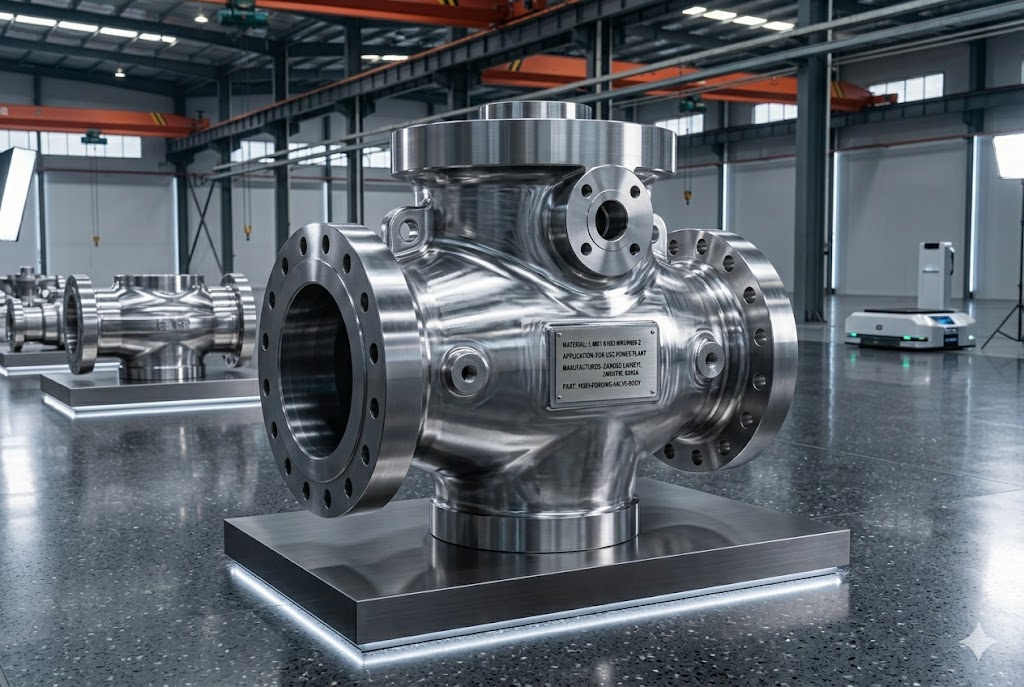
We produce a comprehensive range of 1.4901 forged parts from 30 kg to 30,000 kg single-piece weight, up to 6 meters in diameter and 15 meters in length.
EN 1.4901 (X10CrWMoVNb9-2) is a tempered martensitic heat-resistant steel engineered for supercritical and ultra-supercritical power generation. Compared to P91, its defining innovation is the replacement of half the molybdenum with tungsten. Tungsten's larger atomic radius creates stronger solid solution strengthening, and W-bearing carbides coarsen far more slowly during high-temperature service — preserving creep strength over 100,000-hour design lifetimes.
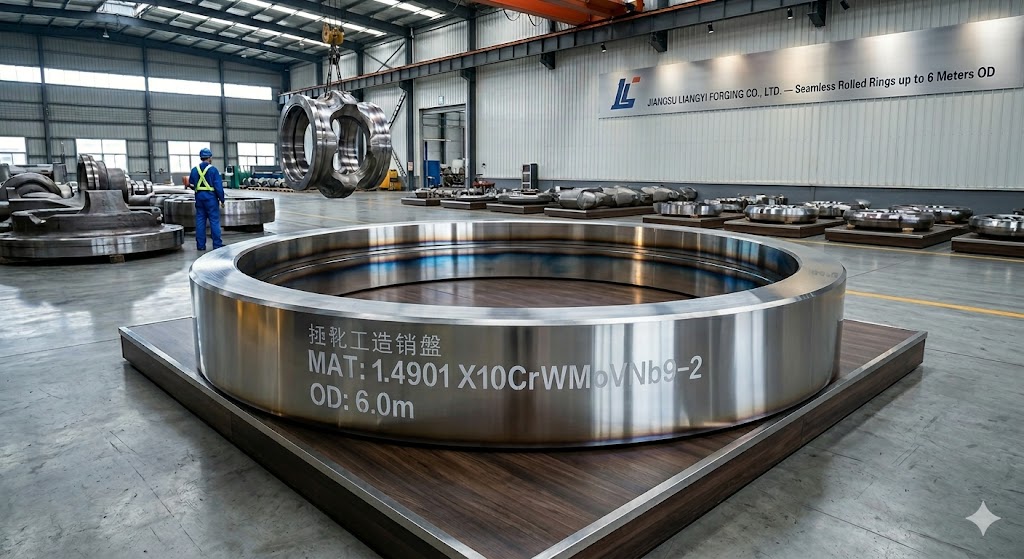
Values in weight percent (wt%). Indicative ranges — always verify against the applicable standard edition for design and procurement.
| Element | Min | Max | Role in Alloy |
|---|---|---|---|
| Carbon (C) | 0.07 | 0.13 | Carbide forming, strength; controlled to balance strength and weldability |
| Chromium (Cr) | 8.50 | 9.50 | Oxidation/corrosion resistance, M23C6 carbide former, hardenability |
| Tungsten (W) ★ | 1.50 | 2.00 | ★ Key differentiator vs P91: solid solution strengthening + slow-coarsening carbides → superior creep life |
| Molybdenum (Mo) | 0.30 | 0.60 | Solid solution strengthening; reduced vs P91 to balance with W |
| Vanadium (V) | 0.15 | 0.25 | Fine MX carbonitride precipitation strengthening |
| Niobium (Nb) | 0.04 | 0.09 | MX carbonitride strengthening; grain refinement during normalizing |
| Nitrogen (N) | 0.030 | 0.070 | MX nitride formation (VN, NbN), strengthens matrix |
| Boron (B) | 0.0010 | 0.0060 | Hardenability in heavy sections; grain boundary strengthening |
| Manganese (Mn) | 0.30 | 0.60 | Deoxidizer, sulfide shape control |
| Silicon (Si) | — | 0.50 | Deoxidizer; kept low to avoid delta-ferrite |
| Nickel (Ni) | — | 0.40 | Improves toughness; limited to maintain Ms temperature |
| Phosphorus (P) | — | 0.020 | Controlled impurity — grain boundary embrittlement risk |
| Sulfur (S) | — | 0.010 | Controlled impurity — hot shortness risk |
| Aluminum (Al) | — | 0.020 | Kept very low — Al ties up N, reducing MX strengthening |
Minimum values at room temperature. Test direction: longitudinal unless noted. Indicative — verify against applicable standard for design.
| Property | Symbol | Min / Range | Notes |
|---|---|---|---|
| Tensile Strength | Rm | 620–850 MPa | Upper limit prevents excessive hardness / brittleness |
| 0.2% Proof Strength | Rp0.2 | ≥ 440 MPa | Yield criterion for pressure design calculations |
| Elongation (Longitudinal) | A₅ | ≥ 19% | Superior to P91 minimum (18%) |
| Elongation (Transverse) | A₅ | ≥ 17% | Measured perpendicular to forging direction |
| Reduction of Area | Z | ≥ 40% | Ductility indicator for large forgings |
| Charpy Impact (Longitudinal, +20°C) | KV | ≥ 40 J | Average of 3 specimens; individual min 28 J |
| Charpy Impact (Transverse, +20°C) | KV | ≥ 27 J | Especially relevant for ring-rolled products |
| Brinell Hardness | HBW | 185–265 | Per EN 10003-1; routine production check |
Indicative representative values for 1.4901 (+NT condition). Used for pressure component design per EN 13480 and ASME Section II-D. Verify against specific code tables for design calculations.
| Temperature (°C) | Rp0.2 (MPa) | Rm (MPa) | Strength Retention vs RT |
|---|---|---|---|
| 20 (RT) | ≥440 | 620–850 | 100% |
| 400 | ≈430 | ≈620 | ~98% |
| 450 | ≈410 | ≈600 | ~93% |
| 500 | ≈380 | ≈570 | ~86% |
| 550 | ≈340 | ≈510 | ~77% |
| 600 | ≈290 | ≈440 | ~66% |
| 625 ★ | ≈260 | ≈390 | ~59% |
| 650 | ≈225 | ≈340 | ~51% |
★ 625°C is a typical operating condition for advanced USC main steam systems.
Indicative minimum average creep rupture strength values. For design, use allowable stress tables from ASME Section II-D or EN 13480-2 Annex B.
| Temperature (°C) | 1.4901 — σ₁₀₀,₀₀₀h (MPa) | P91 — σ₁₀₀,₀₀₀h (MPa) | 1.4901 Advantage |
|---|---|---|---|
| 550°C | ≈140 | ≈120 | +17% |
| 575°C | ≈115 | ≈90 | +28% |
| 600°C ★ | ≈95 | ≈72 | +32% |
| 625°C | ≈72 | ≈49 | +47% |
| 650°C | ≈52 | ≈30 | +73% |
Essential constants for thermal stress analysis, piping flexibility calculations and heat transfer design. Values are indicative.
| Property | 20°C | 400°C | 500°C | 600°C | Unit |
|---|---|---|---|---|---|
| Density (ρ) | 7.70 | 7.63 | 7.58 | 7.52 | g/cm³ |
| Elastic Modulus (E) | 220 | 195 | 180 | 165 | GPa |
| Thermal Conductivity (λ) | 28.0 | 29.5 | 30.5 | 31.5 | W/(m·K) |
| Mean Thermal Expansion (α, 20°C to T) | — | 11.0 | 11.3 | 11.8 | ×10⁻⁶/K |
| Specific Heat Capacity (cp) | 480 | 540 | 570 | 620 | J/(kg·K) |
Ac1 ≈ 800–820°C | Ms ≈ 390–420°C — critical for heat treatment and PWHT window design.
| Parameter | 1.4901 (X10CrWMoVNb9-2) | P91 (X10CrMoVNb9-1) | P92 (ASME F92/T92) |
|---|---|---|---|
| EN Steel Number | 1.4901 | 1.4903 | — |
| W Content | 1.50–2.00% | None | 1.50–2.00% |
| Max Service Temp. | 650°C | 600°C | ~625°C |
| σ₁₀₀,₀₀₀h at 600°C | ≈95 MPa | ≈72 MPa | ≈98 MPa |
| Min Elongation | 19% | 18% | 19% |
| Weldability | Good | Moderate | Good |
| Typical Application | Large forgings, valves, rotors, USC plant | SC plant piping, headers, valves | USC boiler tubes, piping, small forgings |
Compositionally equivalent or closely matched designations across major standards. Always confirm applicability to your specific design code before substituting grades.
| Standard | Standard Number | Grade Designation | Form | Equivalence |
|---|---|---|---|---|
| EN (European) | EN 10222-5 / EN 10216-2 / EN 10028-2 | 1.4901 / X10CrWMoVNb9-2 | Forgings, tubes, plate | Reference grade |
| ASME (USA) | SA-182 / SA-335 / SA-213 / SA-336 | F92 / P92 / T92 | Forgings, pipe, tubes | Near-identical composition |
| ASTM (USA) | A182 / A335 / A213 / A336 | F92 / P92 / T92 | Forgings, pipe, tubes | Near-identical to EN 1.4901 |
| GB/T (China) | GB/T 5310 / GB/T 28900 | 10Cr9W2MoVNbBN | Boiler tubes, pipe | Compositionally equivalent |
| JIS (Japan) | JIS G4107 / G3462 | SFVQ2B / STBA29 | Forgings, boiler tubes | Approximate equivalent |
| DIN / BS EN | DIN 17175 / BS EN 10222-5 | X10CrWMoVNb9-2 / 1.4901 | Tubes, forgings | Same as EN designation |
The microstructure — and therefore the creep performance — of 1.4901 forgings is entirely determined by the quality of heat treatment. At Jiangsu Liangyi, all heat treatment is performed in calibrated, atmosphere-controlled furnaces with thermocouple-verified temperature uniformity of ±10°C across the load.
| Temperature | 1,050 – 1,080°C |
| Soak Time | ≥1 min/mm thickness (min 30 min) |
| Cooling Method | Air cooling or forced air |
| Cool-down to | <100°C before tempering |
This temperature fully dissolves M23C6 carbides and MX carbonitrides into the austenite matrix, enabling uniform re-precipitation on tempering. Below 1,000°C leaves undissolved carbides; above 1,100°C causes grain coarsening that reduces toughness.
| Temperature | 730 – 790°C |
| Soak Time | ≥2 min/mm thickness (min 60 min) |
| Heating Rate | ≤100°C/h above 400°C |
| Cooling Method | Air cooling |
| Ac1 Limit | Must stay ≥30°C below Ac1 (~800–820°C) |
Exceeding Ac1 during tempering creates fresh untempered martensite zones — severely reducing toughness. The 730–790°C window produces the optimal balance of M23C6 carbide precipitation, MX carbonitride reprecipitation, and tempered martensite softening.
Welding 1.4901 requires careful control of preheat, interpass temperature and mandatory post-weld heat treatment (PWHT). The primary challenges are controlling martensite formation on cooling, preventing hydrogen-induced cold cracking in the HAZ, and ensuring PWHT fully restores HAZ toughness.
| Minimum Preheat | 200°C (250°C for thickness >50mm) |
| Maximum Interpass | 300°C |
| Preheat Soak | ≥15 min after reaching temp across full thickness |
| Why Upper Limit? | Interpass >300°C risks partial austenitization in weld metal, creating untempered martensite on cooling |
| Process | EN ISO Classification |
|---|---|
| SMAW / MMA | E CrMo91 B — H4/H5 low-hydrogen class required |
| TIG / GTAW | W CrMo91 (EN ISO 21952-A) — preferred for root passes |
| MIG / GMAW | G CrMo91 (EN ISO 21952-A) |
| SAW | S CrMo91 + flux (EN ISO 26304-A) |
PWHT is mandatory for all pressure-bearing welds in 1.4901. Without PWHT, the HAZ remains untempered martensitic with Charpy values typically below 10 J.
745 – 775°C
Must stay ≥30°C below Ac1 (~800°C). Local overheating above Ac1 creates fresh untempered martensite.
1h / 25mm
Minimum 1 hour regardless of thickness. For sections >100mm: minimum 4 hours. Measured from all thermocouples reaching minimum temperature.
≤80°C/h up / ≤100°C/h down
Above 400°C. Below 300°C, free air cooling is acceptable.
⚠ Temper Embrittlement Warning (350–550°C)
Do not allow slow cooling or prolonged hold in the 350–550°C range. This promotes phosphorus segregation to grain boundaries causing temper embrittlement. Control cooling rate through this range at ≥100°C/h for heavy sections.
Steam-side oxidation directly affects both safety and plant efficiency. Scale exfoliation — where thick oxide layers detach and become entrained particles — can severely erode turbine blades, valve seats and steam separators. 1.4901 shows measurably better oxidation resistance than P91 above 580°C due to tungsten stabilizing the protective Cr₂O₃-rich inner oxide layer.
| Condition | 1.4901 | P91 |
|---|---|---|
| Oxidation onset (steam) | ~580°C | ~560°C |
| Scale growth rate at 600°C | Lower (~15% less) | Higher |
| Scale adherence | More adherent | More layered |
| Exfoliation tendency (>580°C) | Lower | Higher risk |
| Max service temp. in steam | 650°C | 600°C |
Jiangsu Liangyi regularly supplies 1.4901 X10CrWMoVNb9-2 forged components to customers worldwide across the following industries. The capability ranges below reflect our standard production experience.
1.4901 is the industry standard for main steam systems in 600°C-class ultra-supercritical power plants operating at steam temperatures of 600–640°C and pressures of 25–30 MPa. At these conditions, P91 is insufficient — the wall thickness required would make pipework and valves economically unviable. 1.4901 enables wall thickness reductions of 20–30% compared to P91 designs, with corresponding weight and cost savings.
Typical Products We Supply
Typical Size Ranges
Applicable standards: EN 13709, ASME B16.34, API 600, API 602, DIN EN ISO 15761, EN 13445.
Valve bodies and bonnets are the largest single product category in our 1.4901 portfolio. The material's excellent forgeability and machinability make it ideal for the complex internal geometries required in main steam, bypass and emergency stop valves. We maintain dedicated tooling for standard valve body configurations across common pressure ratings.
Valve Forging Capabilities
Design Standards
1.4901 is increasingly specified for pressure vessel nozzles, headers, tube sheets and pressure-containing flanges in USC boilers. Large diameter seamless rings are well-suited to boiler drum manway flanges and nozzle forgings — the circumferential grain flow from ring rolling provides superior pressure containment properties compared to cut-from-plate alternatives.
In oil and gas, 1.4901 is used where chromium-molybdenum steels have reached their temperature limits and more expensive nickel-base alloys are cost-prohibitive. Hydrogen reformer components, transfer line exchangers and high-temperature process valves are typical applications.
Our 80,000 m² Jiangyin facility is a fully integrated manufacturing center — from primary steelmaking through final inspection, every process step is performed under our ISO 9001:2015 quality system, ensuring complete material traceability from heat number to finished component.
EN 10204 Type 3.2 certificates are available upon request. The customer nominates their preferred inspection body (such as DNV-GL, Bureau Veritas, Lloyd's Register, ABS, RINA or TÜV), who witnesses testing and countersigns the certificate. We have full facilities to accommodate third-party witness inspections.
Since 1997 we have specialized in high-temperature 9Cr alloy forgings. Our engineering team has direct production experience with the unique challenges of 1.4901 — delta-ferrite control, heat treatment window management, and heavy-section hydrogen diffusion — built through decades of production cycles.
From liquid steel to finished machined component — all under one roof and one ISO 9001:2015 quality system. No sub-contracted melting or heat treatment where control gaps introduce risk. Complete traceability from heat number to shipped piece.
With presses up to 6,300T, ring rolling to 6m diameter, and shafts to 15m in length, we cover the size range that most suppliers cannot. If your 1.4901 forging exceeds 5 tons, contact us for a feasibility review.
Our technical team reviews customer drawings before quotation to identify manufacturability issues, recommend forging reduction ratios for creep-critical applications, and confirm that the heat treatment will achieve specified properties at the actual section thickness ordered.
Located approximately 120 km from Shanghai Yangshan Port with direct Yangtze River port access, we offer efficient loading of heavy forgings with competitive freight rates to Rotterdam, Houston, Dubai, Singapore and other major ports worldwide.
As a direct manufacturer with our own steelmaking, we remove multiple intermediary margins. Our pricing is competitive while maintaining quality standards required for critical power generation and pressure equipment applications.
What is 1.4901 steel (X10CrWMoVNb9-2)?
1.4901 is the EN steel number for X10CrWMoVNb9-2 — a 9% chromium tempered martensitic heat-resistant steel standardized under EN 10216-2, EN 10222-5 and EN 10028-2. Its defining feature is the addition of 1.5–2.0 wt% tungsten, which improves creep strength above 575°C by producing thermally stable M23C6 and MX precipitates that resist coarsening during long-term service. Maximum continuous service temperature is 650°C.
What is the ASTM/ASME equivalent of EN 1.4901?
The closest equivalent is ASME Grade F92 (SA-182 F92 forgings), P92 (SA-335 P92 pipe) and T92 (SA-213 T92 tubes). Both EN 1.4901 and ASME Grade 92 contain approximately 9% Cr and 1.5–2.0% W with comparable Mo, V, Nb, N and B levels. Minor composition differences exist; always confirm with your engineering team before treating as direct equivalents in design calculations.
What is the difference between 1.4901 and P91?
1.4901 contains 1.5–2.0% tungsten while P91 contains no tungsten, and 1.4901 has lower molybdenum (0.3–0.6% vs 0.85–1.05%). The tungsten addition provides approximately 33% higher creep rupture strength at 600°C (100,000h basis) and extends maximum continuous service temperature from 600°C (P91) to 650°C (1.4901). 1.4901 also offers marginally better weldability due to its lower carbon equivalent.
What PWHT is required for 1.4901 welds?
PWHT is mandatory for all 1.4901 pressure welds. Required parameters: temperature 745–775°C (must remain ≥30°C below Ac1 ~800°C); minimum soak 1 hour per 25mm weld thickness; heating rate ≤80°C/h above 400°C; cooling rate ≤100°C/h above 300°C. PWHT restores HAZ Charpy toughness from typically below 10 J (as-welded) to the required minimum of 40 J.
What certificates do you provide?
All 1.4901 forgings are supplied with EN 10204 Type 3.1 Mill Test Certificates as standard, documenting chemical analysis, mechanical test results, heat treatment records and NDT results. Jiangsu Liangyi holds ISO 9001:2015 certification. For EN 10204 Type 3.2 certificates, the customer nominates their preferred independent third-party inspector (such as DNV-GL, Bureau Veritas, Lloyd's Register, ABS, RINA or TÜV), who witnesses key tests and countersigns the certificate. We have full facilities to support third-party witness inspection.
What heat treatment do you apply to 1.4901 forgings?
Condition +NT per EN 10222-5: Normalize at 1,050–1,080°C (soak ≥1 min/mm, minimum 30 min), air cool to below 100°C. Temper at 730–790°C (soak ≥2 min/mm, minimum 60 min), air cool. Tempering must remain at least 30°C below Ac1 (~800–820°C) to prevent partial re-austenitization. For large forgings, a post-forging dehydrogenation anneal at 650–680°C for ≥4 hours is applied before cooling to prevent hydrogen cracking.
What is the maximum size of 1.4901 forgings you can produce?
Open die forgings up to 30,000 kg single-piece weight; seamless rolled rings up to 6,000 mm outer diameter; shafts and bars up to 2,000 mm diameter and 15,000 mm length. For components at the upper end of these ranges, contact us with your drawings for a technical feasibility review before ordering.
What is the typical lead time?
Standard lead time is 4–8 weeks from order confirmation and drawing approval. Factors extending lead time: ESR requirement (+1–2 weeks), single-piece weight above 10 t (+1–2 weeks), third-party witness inspection scheduling (+1 week). Expedited production is available for critical projects — contact us with your deadline for an assessment.
What machining tolerances can you achieve?
Standard CNC machining: OD/ID tolerances ±0.05 mm; flatness 0.05 mm per 300 mm; surface finish Ra 1.6 µm (Ra 0.8 µm on seating and sealing surfaces). We supply components in as-forged, rough-machined, semi-finished or fully finished condition per customer drawings. CMM inspection report available on request.
Chengchang Industry Park
Jiangyin City, Jiangsu Province, 214400
People's Republic of China
Google Maps Embed
Chengchang Industry Park, Jiangyin, Jiangsu
(Replace with actual Google Maps iframe)
Send us your drawings, material specifications (EN 10222-5 / ASME SA-182 F92), size and quantity — we will respond with a competitive quotation and technical review within 24 hours.
Chengchang Industry Park, Jiangyin, Jiangsu, China