1.4606 (X5NiCrTiMoVB25-15-2) Forging Parts | Jiangsu Liangyi – China Manufacturer
Jiangsu Liangyi is ISO 9001:2015 certified manufacturer of custom 1.4606 (X5NiCrTiMoVB25-15-2) open die forgings and seamless rolled rings, located in Jiangyin, Jiangsu Province, China. Founded in 1997 with over 25 years of experience, the company produces 1.4606 forged parts with weight range from 30 kg to 30,000 kg. We have exported products to more than 50 countries across Europe, North America, Asia, and the Middle East. All products are supplied with EN10204 3.1/3.2 mill test certificates and meet EN 10088-3:2005.
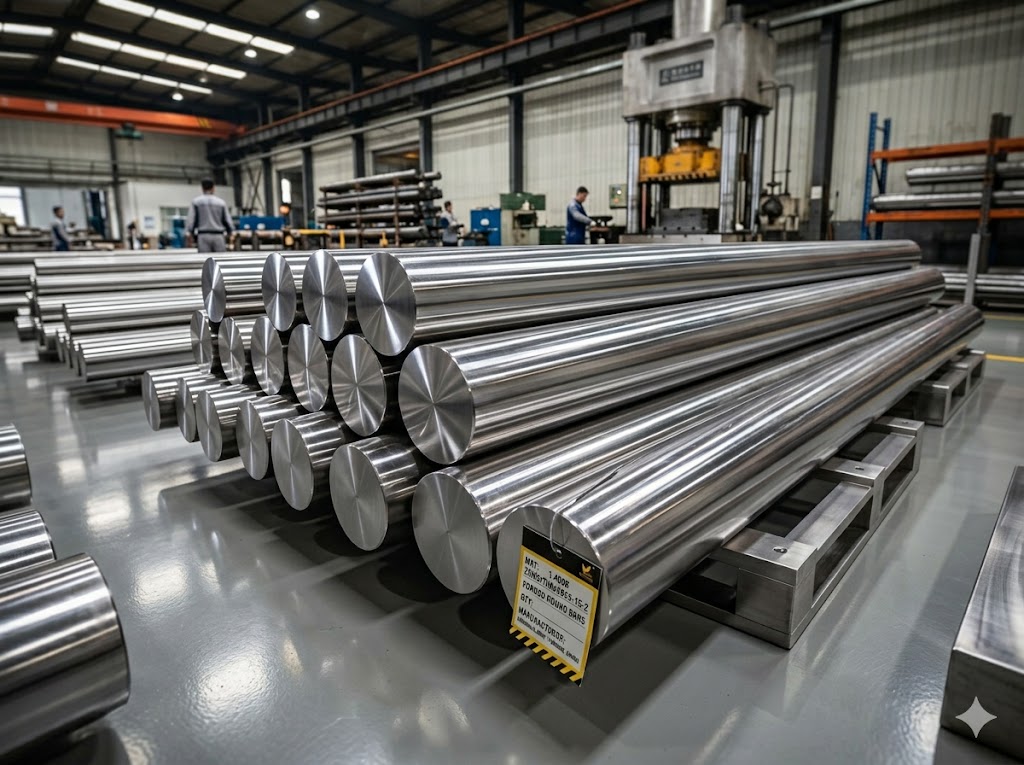
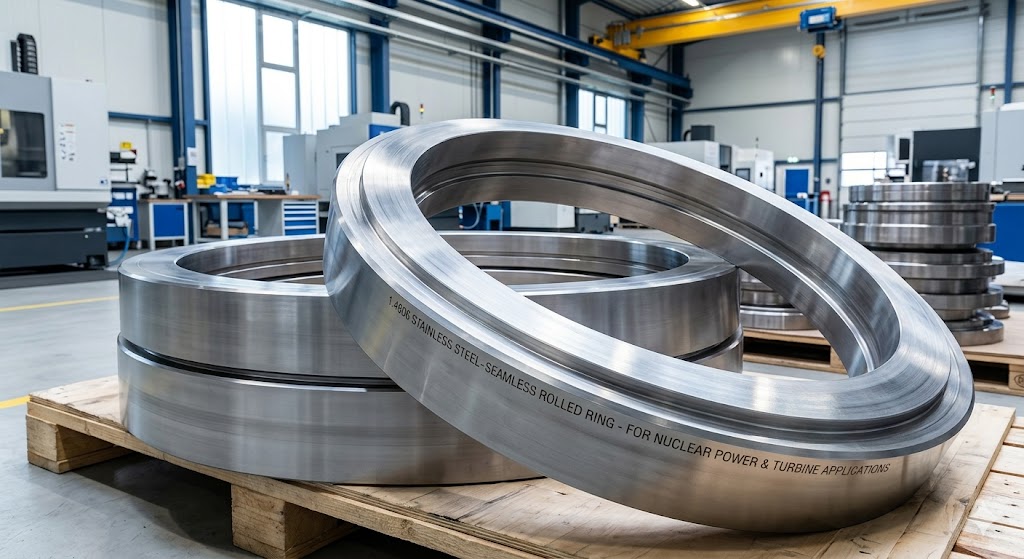
Our modern factory has 2,000T–6,300T hydraulic presses and 1–5 m seamless rolling machines, enables us to deliver precision-engineered 1.4606 stainless steel forgings that meet the most stringent international standards, including EN 10088-3:2005 and EN 10088-1:2005. All products are supplied with full EN10204 3.1/3.2 mill test certificates for full traceability and quality assurance.
Comprehensive Range of 1.4606 Forged Products
With advanced forging equipment, we produce a full range of 1.4606 age-hardened alloy forgings in different shapes, sizes and designs to match your specific project needs. Whether you need standard ready-made parts or custom products, we have the professional knowledge and production capacity to supply them.
- Forged Bars & Rods: Provide round bars (up to 2,000 mm diameter), square bars, flat bars, rectangular bars, and step shafts up to 15 m in length
- Seamless Rolled Rings: Provide custom forged rings up to 6 m in diameter and 30 tons in weight for important rotating and pressure applications
- Hollow Forged Components: Provide hubs, housings, shells, sleeves, bushes, cases, and heavy-wall hollow bars up to 3,000 mm outer diameter
- Discs & Plates: Provide forged discs, disks, blocks, plates, and blanks for turbine and valve applications
- Pipes & Tubes: Provide seamless forged pipes, tubes, tubings, shells, and casings for high-pressure and high-temperature environments
- Custom Forged Parts: Provide valve bodies, bonnets, stems, seats, impellers, turbine blades, fasteners, and other custom parts according to your drawings
1.4606 (X5NiCrTiMoVB25-15-2) Material Properties & Advantages
1.4606 is an iron-based nickel-chromium austenitic stainless alloy that keeps excellent mechanical properties across a very wide temperature range, from cryogenic temperatures up to 704 °C (1,300 °F). This age-hardenable alloy combines high strength, great corrosion resistance, and non-magnetic characteristics, making it ideal for the most demanding industrial uses.
Key Advantages of 1.4606 Stainless Steel
- Exceptional High-Temperature Strength: It keeps excellent mechanical properties up to 704 °C (1,300 °F), so that it is the best choice material for turbine and valve parts.
- Superior Corrosion Resistance: Resists oxidation, sulfidation, and general corrosion in harsh industrial environments including H₂S and chloride-rich media
- Age-Hardenable: It can be precipitation hardened to get tensile strengths of 880–1,150 MPa without sacrificing ductility
- Non-Magnetic Properties: It is fully austenitic with near-zero magnetic permeability, so that it is the best choice material for traction motors and electromagnetic equipment
- Excellent Cryogenic Toughness: Keeps good ductility and impact toughness at sub-zero temperatures for LNG and cryogenic applications
- Good Fabricability: It can be forged, machined, and welded using standard techniques with proper procedure qualification
Chemical Composition of 1.4606 Steel (per EN 10088-3:2005)
| Element | Content (%) | Element | Content (%) |
|---|---|---|---|
| Carbon (C) | Max 0.08 | Nickel (Ni) | 24.0 – 27.0 |
| Silicon (Si) | Max 1.0 | Chromium (Cr) | 13.0 – 16.0 |
| Manganese (Mn) | 1.0 – 2.0 | Molybdenum (Mo) | 1.0 – 1.5 |
| Phosphorus (P) | Max 0.025 | Titanium (Ti) | 1.9 – 2.3 |
| Sulfur (S) | Max 0.015 | Aluminum (Al) | Max 0.35 |
| Boron (B) | 0.001 – 0.01 | Iron (Fe) | Balance |
| Vanadium (V) | 0.10 – 0.50 | – | – |
Mechanical Properties of 1.4606 Forgings
| Property | Condition +AT (Annealed) | Condition +P880 (Precipitation Hardened) |
|---|---|---|
| Tensile Strength (Rm, MPa) | ≥ 700 | 880 – 1,150 |
| 0.2% Proof Strength (Rp0.2, MPa) | ≥ 250 | ≥ 550 |
| Elongation at Fracture (A, %) | ≥ 35 | ≥ 20 |
| Impact Energy (KV, J) at +20 °C (Longitudinal) | – | ≥ 40 |
| Brinell Hardness (HB) | ≤ 212 | – |
Physical Properties of 1.4606 at Room Temperature
The physical constants below apply to solution‑annealed 1.4606 bar and forged products within the temperature range most commonly used by design engineers. Values change in a predictable way with temperature; contact us for data under high‑temperature operating conditions.
| Property | Value | Unit |
|---|---|---|
| Density | 7.92 | g/cm³ |
| Elastic Modulus (Young's Modulus) | 200 | GPa |
| Thermal Conductivity (20 °C) | 12.0 | W/(m·K) |
| Thermal Conductivity (700 °C) | 21.5 | W/(m·K) |
| Mean Coefficient of Thermal Expansion (20–100 °C) | 16.0 | ×10⁻⁶ /K |
| Mean Coefficient of Thermal Expansion (20–600 °C) | 17.5 | ×10⁻⁶ /K |
| Specific Heat Capacity (20 °C) | 480 | J/(kg·K) |
| Electrical Resistivity (20 °C) | 0.91 | µΩ·m |
| Magnetic Permeability (µr) | < 1.02 | – |
| Melting Range | 1,320 – 1,370 | °C |
Heat Treatment Parameters for 1.4606 Forgings
Heat treatment is the most important factor affecting the final mechanical properties of 1.4606. EN 10088-3 recognizes two valid heat treatment conditions: solution annealing (+AT) and precipitation hardening (+P880). Both need strict control of time and temperature — a deviation of just ±10 °C from the aging temperature range will clearly reduce yield strength.
| Treatment Stage | Temperature (°C) | Hold Time | Cooling Medium | Resulting Condition |
|---|---|---|---|---|
| Solution Annealing | 980 – 1,050 | 1 h per 25 mm of section, min. 30 min | Water quench or rapid air cool | +AT (soft, fully austenitic) |
| Precipitation Aging | 715 – 730 (target 720) | 16 h | Air cool to room temperature | +P880 (age-hardened) |
| Stress Relief (post-machining, optional) | 650 – 680 | 2 – 4 h | Furnace cool to ≤ 300 °C, then air | Dimensional stability retained |
Practical notes from our heat treatment workshop: For sections thicker than 200 mm, we attach load thermocouples directly to the forging surface, in addition to using furnace air sensors. This removes the risk of temperature delay common in heavy sections, and this process is recorded in the MPP provided to each customer. The furnace temperature is kept consistent within ±8 °C across the working area, and calibration records are available upon request.
1.4606 Forging Process Parameters
1.4606 is much more difficult to process than standard austenitic stainless steels like 304 or 316. Its strengthening from gamma‑prime (γ') and eta‑phase (η) needs narrower temperature ranges and higher press pressure for each cross‑section area. The parameters below show Jiangsu Liangyi’s proven production methods, which have been verified across thousands of production batches since 1997.
| Parameter | Recommended Range | Notes |
|---|---|---|
| Ingot Heating Temperature | 1,150 – 1,180 °C | Soak until thermal equilibrium through full cross-section |
| Start (Initial) Forging Temperature | 1,100 – 1,150 °C | Do not begin deformation above 1,180 °C — risk of incipient melting at grain boundaries |
| Finish (Final) Forging Temperature | ≥ 950 °C | Return to furnace if temperature drops below 950 °C before target reduction is reached |
| Minimum Forging Reduction Ratio | ≥ 4:1 (total) | Required for grain refinement and homogeneous mechanical properties through section |
| Cooling after Forging | Air cool or controlled furnace cool | Rapid water quench used only when immediate solution anneal follows; avoid quench cracking in heavy sections |
| Re-heat Cycles | As required (typically 2–4 per part) | Each re-heat logged by forging pyrometers and documented in the forging record |
Corrosion Resistance of 1.4606
Many engineers underestimate how well 1.4606 resists corrosion, because they use the same standards they apply to common 300‑series alloys.With 24–27% nickel plus added chromium and molybdenum, this alloy resists corrosion better than 316L in most industrial environments. It also remains weldable and non‑magnetic — a combination no cheaper, lower‑grade alloy can match.
| Corrosion Type / Environment | Performance Rating | Relevant Notes |
|---|---|---|
| General Oxidation (up to 704 °C) | Excellent | Continuous service; protective Cr₂O₃ scale stable to design limit |
| Aqueous Chloride (moderate concentration) | Good | Pitting Resistance Equivalent Number (PREN) ≈ 23–25; superior to 316L (PREN ≈ 24) at elevated temperature |
| H₂S / Sour Service (NACE MR0175) | Good | Used in downhole valve components; consult hardness limits per NACE MR0175-2021 |
| Intergranular Corrosion | Excellent | Ti and B stabilisation suppresses chromium carbide precipitation at grain boundaries; IGC risk negligible in qualified heat treatment |
| Stress Corrosion Cracking (SCC) | Good | High Ni content provides inherent SCC resistance; age-hardened (+P880) condition remains below NACE hardness threshold |
| Crevice Corrosion (seawater) | Moderate | Acceptable for intermittent seawater exposure; not recommended for long-term stagnant seawater immersion without coating |
| Sulphidation (H₂S at elevated temperature) | Good | Resists sulphidation attack at temperatures up to 600 °C in refinery service |
Weldability & Joining of 1.4606
1.4606 can be welded using standard fusion welding methods. The main risk is over-aging in the heat-affected zone (HAZ) during multi-pass welding, which lowers the local yield strength. The guidance below follows current industry practices for structural and pressure-retaining welds on 1.4606 forgings. For code-compliant work, procedure qualification according to EN ISO 15614-1 or ASME IX is needed.
- Recommended Welding Processes: GTAW (TIG) is preferred for root passes and thin sections; GMAW and SAW are acceptable for fill and cap passes on heavy sections with qualified procedures
- Filler Metal: AWS A5.14 ERNiCrMo-3 (Inconel® 625 type) is the industry-standard consumable for dissimilar and similar 1.4606 joints — it avoids matching filler cracking risks while maintaining joint toughness
- Preheat: It is generally not needed at room temperature for sections ≤ 50 mm; preheat to 100–150 °C for sections > 50 mm or when ambient temperature is below 5 °C
- Interpass Temperature: The maximum is 150 °C — which is important for maintaining austenite stability and avoiding sensitisation in the HAZ
- Post-Weld Heat Treatment (PWHT): Full re-solution anneal + re-age is the only treatment that fully restores +P880 mechanical properties across the weld zone; stress-relief alone at 650 °C is acceptable for annealed (+AT) fabrications where maximum strength is not needed.
- Distortion Control: The alloy's thermal expansion coefficient (16 × 10⁻⁶ /K) is higher than carbon steel — clamping fixtures and back-step welding sequences are advisable for precision parts.
1.4606 vs. Alternative High-Alloy Forgings — Head-to-Head Comparison
Design engineers often compare 1.4606 with three competing alloys: A-286 (UNS S66286), Incoloy® 909 (UNS N19909), and 17-4PH (1.4542). The table below clearly distinguishes these materials to make grade selection easier — the best choice depends on which combination of properties is essential for your application.
| Property / Criterion | 1.4606 (X5NiCrTiMoVB25-15-2) | A-286 (UNS S66286) | Incoloy® 909 (UNS N19909) | 17-4PH (1.4542) |
|---|---|---|---|---|
| Max Service Temperature | 704 °C | 704 °C | 650 °C | 316 °C |
| Tensile Strength (age-hardened, MPa) | 880 – 1,150 | 900 – 1,100 | 1,000 – 1,300 | 930 – 1,310 |
| 0.2% Proof Strength (age-hardened, MPa) | ≥ 550 | ≥ 590 | ≥ 827 | ≥ 725 |
| Non-Magnetic | Yes (µr < 1.02) | Yes | No (Fe-Co-Ni, magnetic) | No (semi-magnetic) |
| Corrosion Resistance (aqueous) | Good–Excellent | Good | Moderate | Good (pH-dependent) |
| Weldability | Good | Good | Moderate | Good |
| Low Thermal Expansion (controlled) | Standard (16 ×10⁻⁶ /K) | Standard | Very low (7.7 ×10⁻⁶ /K) | Standard |
| EN Standard | EN 10088-3 | ASTM A638 / AMS 5737 | AMS 5884 | EN 10088-3 |
| Nuclear Code Recognition | RCC-M, ASME III | ASME III | Limited | Limited |
| Typical Cost Index (relative) | 1.0 (baseline) | 1.0 – 1.1 | 1.5 – 2.0 | 0.7 – 0.9 |
| Best-Fit Application | Nuclear / Oil & Gas / Non-magnetic rotating | Turbine fasteners / aerospace | Jet engine rings (low expansion) | Valves / general high-strength |
Selection guidance: Choose 1.4606 when your application needs non‑magnetic properties, aqueous corrosion resistance, and operation above 400 °C all at the same time — no other competing grade in this table meets all three requirements together. If matching thermal expansion with titanium or composites is the main requirement, Incoloy® 909 may be a better choice, even though it is magnetic.
Non-Destructive Testing (NDT) Standards for 1.4606 Forgings
We agree on the NDT scope and acceptance standards with each client during the quotation stage, and these are fixed in the Inspection and Test Plan (ITP). Below are our standard basic services. Project-specific inspection needs — such as third-party witnessed inspections, extra NDT methods, or stricter acceptance levels — can be arranged with client-nominated inspection agencies when placing an order.
| NDT Method | Applicable Standard | Scope | Acceptance Level (Default) |
|---|---|---|---|
| Ultrasonic Testing (UT) | EN 10228-3 / ASTM A388 | 100% volumetric scan of all forgings > 300 mm diameter or > 500 kg | Quality Class 3 (EN 10228-3); tighter classes available on request |
| Liquid Penetrant Testing (PT) | EN ISO 3452-1 / ASTM E165 | 100% accessible surface area after final machining | Linear indications: none permitted; rounded: Level 2 |
| Magnetic Particle Testing (MT) | EN ISO 9934-1 | Not applicable — 1.4606 is non-magnetic; PT is used instead | N/A |
| Hardness Testing | EN ISO 6506-1 (Brinell) | Each forging, minimum 3 readings per piece on representative face | +AT: ≤ 212 HB; +P880: 260–360 HB |
| Positive Material Identification (PMI) | XRF / OES | 100% of forgings when required by client or project specification | Chemical composition within EN 10088-3 limits |
| Dimensional Inspection | Customer drawing + EN ISO 1101 | 100% of forgings; CMM used for complex geometries | Per drawing tolerances; dimensional report included in MTC |
Standard Size Range — 1.4606 Forged Product Forms
The table below shows our standard manufacturing range. We have also produced parts beyond these ranges for specific projects — please contact our engineering team with your exact requirements.
| Product Form | Minimum Size | Maximum Size | Weight Range | Typical Tolerance |
|---|---|---|---|---|
| Round Bar / Shaft | Ø 50 mm | Ø 2,000 mm × L 15,000 mm | 30 – 15,000 kg | EN 10243-1 Class D or per drawing |
| Seamless Rolled Ring | OD 200 mm × H 50 mm | OD 6,000 mm × H 2,000 mm | 5 – 30,000 kg | EN 10243-2 or per drawing |
| Disc / Plate / Block | Ø 100 mm × T 20 mm | Ø 2,500 mm × T 800 mm | 10 – 20,000 kg | ±5 mm on OD; ±3 mm on thickness |
| Hollow Bar / Sleeve / Casing | OD 150 mm × ID 50 mm | OD 3,000 mm × wall 500 mm | 30 – 25,000 kg | Per drawing; wall thickness ±5% |
| Pipe / Tube (seamless forged) | OD 76 mm × WT 10 mm | OD 1,500 mm × WT 300 mm | 20 – 8,000 kg | ASTM A999 or EN 10216-5 equivalent |
| Custom Near-Net-Shape Parts | As per customer drawing — 3D model or 2D DXF accepted | 30 – 30,000 kg | Per drawing / agreed machining stock | |
Industrial Applications & Success Cases of 1.4606 Forged Parts
1.4606 (X5NiCrTiMoVB25-15-2) forgings are used in main applications across many industries that need high strength, corrosion resistance, temperature stability, and non‑magnetic properties. Below are our main application areas and proven success cases from our global customers.
Nuclear Power Industry
- Nuclear reactor coolant pump rotors and impellers
- Coolant pump casings, shells, and containment seal chambers
- Pressure vessel reactor nozzles and penetrations
- Control rod drive mechanisms and parts
- Steam generator internals and tube sheets
Production Experience: We supplied 1.4606 forged pump casings for nuclear power plant projects in Asia. The parts were produced according to the customer's quality plans and inspected by third-party agencies appointed by the client.
Oil & Gas Industry
- High-pressure valve balls, bonnets, bodies, stems, and seat rings
- Oil measurement valve spools and ultrasonic flow meter bodies
- Double studded adapter flanges and wellhead components
- Subsea equipment components and Christmas tree parts
- Refinery process equipment and heat exchanger components
Production Experience: We delivered over 5,000 pieces of 1.4606 valve seats for oil and gas projects in the Middle East, they are produced based on customer drawings and project‑specific inspection and test plans.
Power Generation
- Gas and steam turbine disks, impellers, and blisks
- Turbine blades, guide rings, and shroud rings
- MSV/GV/CV/CRV valve seats, cores, and spindles
- Steam turbine control and reheat valve discs
- Generator components and retaining rings
Production Experience: We produced 1.4606 turbine discs for thermal power plant projects throughout Europe and Asia.
Petrochemical Industry
- Venturi cone meter bodies and flow measurement parts
- Boiler and heat exchanger tube sheets and baffles
- Pressure vessel parts and reactor internals
- Process piping and high-temperature fittings
- Cracking furnace components and catalyst tubes
Production Experience: We supplied custom 1.4606 heat exchanger tube sheets for a petrochemical complex in Europe. All parts meet customer’s material specifications and third-party inspection requirements.
Railway & Transportation
- Railway locomotive traction motor non-magnetic retaining rings
- High-speed train suspension and braking components
- Marine propulsion system parts and shaft components
- Aerospace engine components and structural parts
- Heavy-duty truck and construction equipment parts
Production Experience: We produced 1.4606 non‑magnetic retaining rings for railway traction motors, which have been used in multiple countries.
General Engineering
- Centrifugal compressor impellers and shrouds
- Labyrinth shaft seals and packing seal diaphragms
- Electromagnetic stirring rolls for continuous casting machines
- High-strength fasteners, studs, and bolts for critical applications
- Tooling and die components for high-temperature processes
Production Experience: We supplied 1.4606 electromagnetic stirring rolls for steel mills in Asia and Europe.
Advanced Manufacturing & Quality Control Processes
We use strict manufacturing and quality control methods to make sure that every 1.4606 forged part meets or exceeds international standards and clients' needs.We have a full range of control processes from melting the raw materials to the final inspection and packaging, thanks to our fully integrated production facility.
Advanced Melting Processes
To get the excellent material purity needed for important 1.4606 applications, we offer two advanced melting routes:
- Triple Melt (VIM + ESR + VAR): Vacuum Induction Melting → Electroslag Remelting → Vacuum Arc Remelting — the highest purity process is used for nuclear and aerospace-grade components
- Double Melt (VIM + VAR): Vacuum Induction Melting → Vacuum Arc Remelting — that is used for high-quality standard industrial applications needing superior cleanliness
Comprehensive Quality Control Process
Step 1
Raw Material Inspection & Certification
Step 2
Precision Forging Process
Step 3
Heat Treatment & Hardening
Step 4
Non-Destructive Testing (NDT)
Step 5
Mechanical Property Testing
Step 6
Microstructure & Chemical Analysis
Step 7
Dimensional Inspection
Step 8
Final Documentation & Packaging
Microstructure & Grain Size Requirements
All our 1.4606 forged products are given full microstructure testing according to EN ISO 643. We make sure:
- Consistent microstructure that is entirely free from extensive segregation and inhomogeneity
- Mean grain size is 2–6 for sheets and plates
- Grain size is 5 or coarser for bars and shafts
- Testing is performed for each melt, thickness, and heat treatment lot
- Detailed microstructure reports are provided with every shipment
Manufacturing Qualification Process
Before commencing full production, we submit a detailed Manufacturing Process Plan (MPP) to our clients' Material and Process Engineering departments for approval. The MPP includes:
- Complete ingot specifications (supplier, manufacturing process, dimensions, chemical tests)
- Detailed forging process parameters and temperature controls
- Complete heat treatment process with time-temperature profiles
- Full part testing procedures and acceptance criteria
- First article inspection requirements and documentation
Why Choose Jiangsu Liangyi as Your 1.4606 Forging Partner in China?
Jiangsu Liangyi is a Chinese company that makes 1.4606 forgings. We have a lot of experience and can give our customers technical suggestion, consistent quality, and reliable delivery. Here are the main reasons why businesses in Europe, North America, and Asia choose us to be their forging partner:
- 25+ Years of Specialized Experience: Established in 1997, we have extensive expertise in manufacturing high-quality 1.4606 and other high-alloy forged parts for the most extreme industries around the world.
- Advanced Manufacturing Equipment: We have 2,000T–6,300T hydraulic presses, 1–5 m seamless rolling machines, and state-of-the-art heat treatment facilities with full traceability
- Complete In-House Capabilities: We provide a full range of service from steel melting and forging, heat treatment, machining, to testing — zero sub-contracting of core processes
- Rigorous Quality Assurance: ISO 9001:2015 certified with full quality control systems, providing complete EN10204 3.1/3.2 mill test certificates
- Global Delivery Network: Export products to over 50 countries with reliable shipping and on-time delivery guarantees
- Custom Engineering Solutions: Experienced engineering team work directly with your drawings and specifications to produce custom parts with weight range from 30 kg to 30,000 kg
- Competitive Pricing: Provide cost-effective manufacturing solutions without compromising quality, backed by competitive lead times
- Fast Turnaround Times: We have efficient production processes that allow us to meet tight deadlines and urgent orders
Frequently Asked Questions (FAQ) About 1.4606 Forgings
1.4606 (X5NiCrTiMoVB25-15-2) is mainly used in high‑temperature, high‑strength applications in nuclear power, oil and gas, power generation, and petrochemical industries. Typical parts include valve parts, turbine discs, nuclear pump casings, non‑magnetic retaining rings for traction motors, and heat exchanger tube sheets.
1.4606 keeps excellent mechanical properties and corrosion resistance up to 704 °C (1,300 °F), so that it is the best choice material for most high-temperature industrial applications such as steam turbine valves and gas turbine parts.
No. 1.4606 is a fully austenitic, non‑magnetic stainless alloy with near‑zero magnetic permeability. This makes it especially suitable for applications that demand non‑magnetic performance, such as railway traction motors, electromagnetic stirring equipment, and MRI‑compatible industrial parts.
In the annealed condition (+AT): tensile strength ≥ 700 MPa, 0.2% proof strength ≥ 250 MPa, elongation ≥ 35%, Brinell hardness ≤ 212 HB. In the precipitation-hardened condition (+P880): tensile strength 880–1,150 MPa, 0.2% proof strength ≥ 550 MPa, elongation ≥ 20%, impact energy ≥ 40 J at +20 °C (longitudinal).
Yes. We specialize in custom 1.4606 forgings based on clients' drawings and specifications. Our engineering team submits a Manufacturing Process Plan (MPP) for client approval before production. We handle weights from 30 kg to 30,000 kg and will respond to inquiries within 24 hours.
All 1.4606 forgings are supplied with complete EN10204 3.1 mill test certificates as standard. EN10204 3.2 certificates with third-party inspection (TPI) are available upon request. The factory holds ISO 9001:2015 certification.
1.4606 (EN grade) and A-286 (UNS S66286, ASTM grade) are similar heat-treatable austenitic stainless steels. They share almost the same makeup of nickel, chromium, titanium and molybdenum. There are only small differences in chemical composition between the EN 10088-3 and ASTM A638/ASTM A453 standards. Jiangsu Liangyi can provide materials meeting either standard, along with the corresponding mill test reports.
We offer two melting routes: (1) Triple Melt – VIM + ESR + VAR for nuclear-grade and aerospace-grade cleanliness; (2) Double Melt – VIM + VAR for high-quality standard industrial applications. Both routes guarantee ultra-low inclusion content and tight chemical composition control.
Solution annealing at 980–1,050 °C (held for 1 hour per 25 mm of thickness, then water quenched or rapidly air cooled) results in the annealed +AT condition. Precipitation hardening at 715–730 °C for 16 hours , followed by air cooling, produces the +P880 hardened condition. An optional stress-relief treatment after machining at 650–680 °C for 2–4 hours helps maintain dimensional stability. Furnace temperature is controlled within ±8 °C, and calibration records are available upon request.
Main physical properties of 1.4606 at 20 °C:Density 7.92 g/cm³, modulus of elasticity 200 GPa, thermal conductivity 12.0 W/(m·K), which increases to 21.5 W/(m·K) at 700 °C, average thermal expansion coefficient 16.0 × 10⁻⁶/K (20–100 °C).Magnetic permeability is less than 1.02, making it practically non-magnetic under working temperatures.Melting temperature range: 1320–1370 °C.
Yes. 1.4606 can be welded using GTAW, GMAW and SAW methods, following welding procedures qualified to EN ISO 15614-1 or ASME IX. The standard filler metal is AWS A5.14 ERNiCrMo-3 (Inconel® 625 type). The interpass temperature should be kept at 150 °C or lower.To fully restore the +P880 mechanical properties, the finished weldment requires a full re-solution anneal and re-aging treatment.Stress relief alone at 650 °C is only acceptable for annealed (+AT) parts where yield strength is not an important requirement.
1.4606 vs A-286:They are nearly the same chemically, both have a maximum operating temperature of 704 °C, and both are non‑magnetic. The only real difference is the standard they follow — EN 10088-3 for 1.4606 and ASTM A638/AMS 5737 for A-286. Jiangsu Liangyi can supply either grade.1.4606 vs 17-4PH: 17-4PH is lower in cost and stronger at room temperature, but it can only be used up to 316 °C, is semi‑magnetic, and is not approved for nuclear codes such as RCC-M or ASME Section III.1.4606 is the better choice when you need non‑magnetic properties, corrosion resistance, and high‑temperature strength all at the same time.
Standard NDT scope:100% ultrasonic testing (UT)to EN 10228-3 for forgings over 300 mm in diameter or weighing more than 500 kg;100% liquid penetrant testing (PT) to EN ISO 3452-1 on all machined surfaces;Brinell hardness testing(at least 3 measurements per part);and PMI checking by XRF or OES if required.
Magnetic particle testing (MT) cannot be used because 1.4606 is non‑magnetic.Extra or stricter inspection requirements can be arranged with third‑party inspectors chosen by the customer.
Typical lead time for standard 1.4606 forgings is 8–14 weeks after order confirmation. The actual lead time depends on clients' drawings, weight, heat treatment, and inspection requirements. We can handle urgent orders based on current production capacity. Contact our sales team with your drawing and specifications for a project-specific delivery schedule.
1.4606 (X5NiCrTiMoVB25-15-2) forgings meet EN 10088-3:2005 for semi-finished products and long products, and EN 10088-1:2005 for the classification of stainless steels. Comparable standards include ASTM A638 Grade 660 (A-286) and AMS 5737 for aerospace applications.
Contact Us for a 1.4606 Forging Quotation
Jiangsu Liangyi is your trusted China-based partner for high-quality 1.4606 (X5NiCrTiMoVB25-15-2) forged parts. We provide competitive prices, great quality products, and excellent customer service based on your specific requirements.
Please send us your custom drawings, material specifications, and quantity requirements for a detailed quotation. Our experienced sales team will respond within 24 hours.
sales@jnmtforgedparts.com
+86-135-8506-7993
www.jnmtforgedparts.com
Chengchang Industry Park, Jiangyin City, Jiangsu Province, China